Energy and EfficiencyS ThompsonMr S Thompson
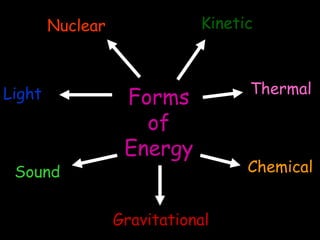
KineticNuclearThermalForms of EnergyLightChemicalSoundGravitational
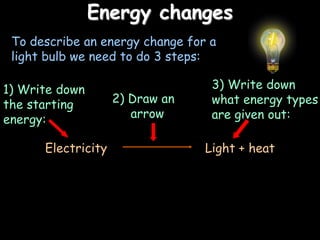
Energy changes3) Write down what energy types are given out:1) Write down the starting energy:2) Draw an     arrowElectricity 			Light + heatTo describe an energy change for a light bulb we need to do 3 steps:
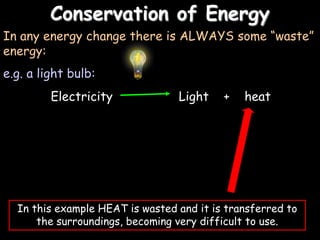
Conservation of EnergyElectricity			Light    +    heatIn this example HEAT is wasted and it is transferred to the surroundings, becoming very difficult to use.In any energy change there is ALWAYS some “waste” energy:e.g. a light bulb:
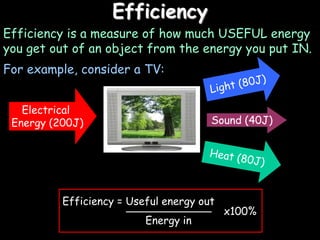
EfficiencyEfficiency = Useful energy out		      Energy inx100%Efficiency is a measure of how much USEFUL energy you get out of an object from the energy you put IN.Light (80J)For example, consider a TV:Electrical Energy (200J)Sound (40J)Heat (80J)
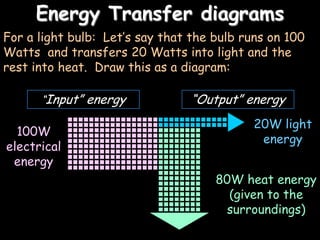
Energy Transfer diagramsFor a light bulb:  Let’s say that the bulb runs on 100 Watts  and transfers 20 Watts into light and the rest into heat.  Draw this as a diagram:“Input” energy“Output” energy20W light energy100W electrical energy80W heat energy (given to the surroundings)
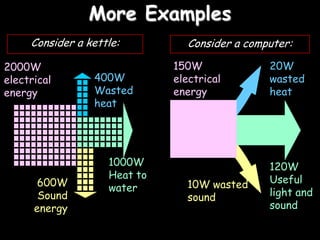
More ExamplesConsider a kettle:Consider a computer:2000W electrical energy150W electrical energy20W wasted heat400W Wasted heat1000W Heat to water120W Useful light and sound600W Sound energy10W wasted sound

P1a: Energy and Efficiency SJT

  • 1.
    Energy and EfficiencySThompsonMr S Thompson
  • 2.
  • 3.
    Energy changes3) Writedown what energy types are given out:1) Write down the starting energy:2) Draw an arrowElectricity Light + heatTo describe an energy change for a light bulb we need to do 3 steps:
  • 4.
    Conservation of EnergyElectricity Light + heatIn this example HEAT is wasted and it is transferred to the surroundings, becoming very difficult to use.In any energy change there is ALWAYS some “waste” energy:e.g. a light bulb:
  • 5.
    EfficiencyEfficiency = Usefulenergy out Energy inx100%Efficiency is a measure of how much USEFUL energy you get out of an object from the energy you put IN.Light (80J)For example, consider a TV:Electrical Energy (200J)Sound (40J)Heat (80J)
  • 6.
    Energy Transfer diagramsFora light bulb: Let’s say that the bulb runs on 100 Watts and transfers 20 Watts into light and the rest into heat. Draw this as a diagram:“Input” energy“Output” energy20W light energy100W electrical energy80W heat energy (given to the surroundings)
  • 7.
    More ExamplesConsider akettle:Consider a computer:2000W electrical energy150W electrical energy20W wasted heat400W Wasted heat1000W Heat to water120W Useful light and sound600W Sound energy10W wasted sound