Transport of O2 and CO2 in
Blood and Tissue Fluids
Gas transport
• It is the process of carrying gases from the alveoli to the
systemic tissues and vice versa.
• The cause of the movement of gases is always a partial
pressure difference from first point to the next.
Thus,the transport of O2 and CO2 by the blood depends on both
diffusion and flow of blood.
O2 transport
• O2 diffuses from the alveoli
Pulmonary capillary blood
Higher PO2 in the capillary blood
than tissues
Surrounding cells
• Oxygen is metabolized in the cells
to form CO2.
CO2 transport
• CO2 diffuses from the cells
Tissue capillaries
After blood flows to lungs
• CO2 diffuses out of blood
Alveoli
Diffusion of Oxygen from the alveoli to the
pulmonary capillary blood
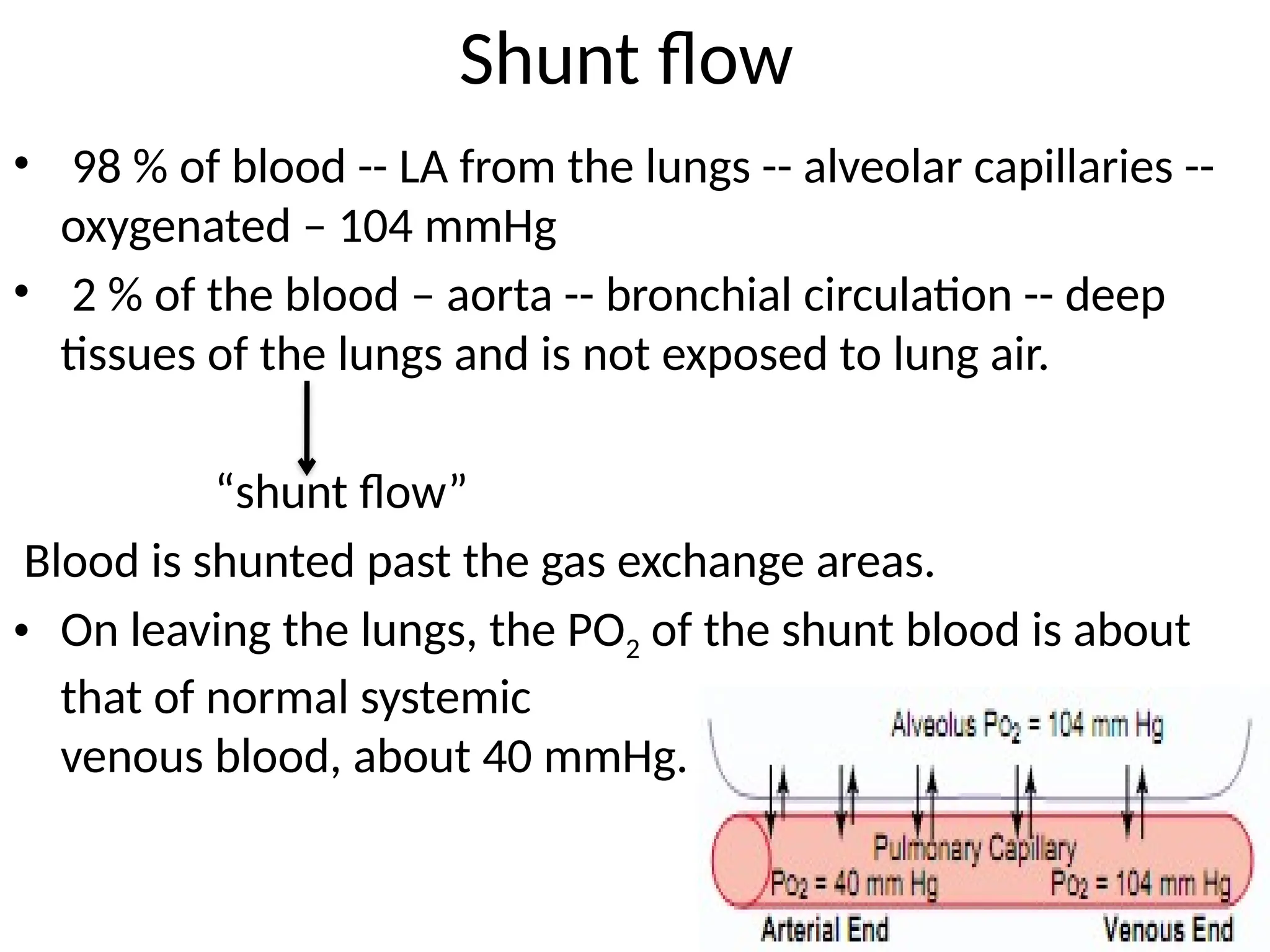
• PO2 in the alveolus averages 104
mmHg.
• PO2 of the venous blood entering the
pulmonary capillary at its arterial end
averages only 40 mmHg.
• Initial pressure difference that causes
O2 to diffuse into the pulmonary
capillary is 104-40, or 64mmHg.
• Blood PO2 rises almost to that
of the alveolar air by the time it
reaches the venous end,104mmHg.
Shunt flow
• 98 % of blood -- LA from the lungs -- alveolar capillaries --
oxygenated – 104 mmHg
• 2 % of the blood – aorta -- bronchial circulation -- deep
tissues of the lungs and is not exposed to lung air.
“shunt flow”
Blood is shunted past the gas exchange areas.
• On leaving the lungs, the PO2 of the shunt blood is about
that of normal systemic
venous blood, about 40 mmHg.
Shunt flow
Shunt blood + oxygenated blood
Venous admixture of blood
• Causes the PO2 of blood entering the left heart and
pumped into the aorta to fall about 95 mmHg.
Diffusion of oxygen from the peripheral capillaries into the tissue fluid
• PO2 of arterial blood in peripheral capillaries is 95mmHg.
• PO2 in the interstitial fluid is 40mmHg.
• Initial pressure difference causes O2 to diffuse rapidly from
the capillary blood into the tissues.
• PO2 of blood leaving the capillaries and entering the
systemic veins is also about 40 mmHg
Diffusion of oxygen from the tissue fluid to the tissue cells
• O2 is always being used by the cells.
• The normal intracellular PO2 ranges from as low as 5mmHg
to as high as 40mmHg,averaging 23mmHg
Diffusion of CO2 from the peripheral tissue cells
into the capillaries
• Intracellular PCO2 46mmHg ; interstitial PCO2 45 mmHg
only 1 mmHg pressure difference.
• PCO2 of the arterial blood entering the tissues 40 mmHg;
PCO2 of the venous blood leaving the tissues 45mmHg.
• Tissue capillary blood comes almost exactly to equilibrium
with the interstitial PCO2 of 45mmHg.
Diffusion of CO2 from the pulmonary capillaries
into the alveoli
• PCO2 of the blood entering the pulmonary capillaries
at the arterial end 45mmHg;
• PCO2 of the alveolar air 40mmHg
• Only a 5mmHg pressure difference causes CO2
diffusion out of the pulmonary capillaries into the
alveoli.
• PCO2 of the pulmonary capillary blood falls to almost
exactly equal the alveolar PCO2 of 40mmHg.
Transport of oxygen
• 97% in combination with hemoglobin in the red
blood cells  Oxyhemoglobin
• 3 % in dissolved state in water of the plasma and
blood cells.
Oxygen-Hemoglobin Dissociation Curve
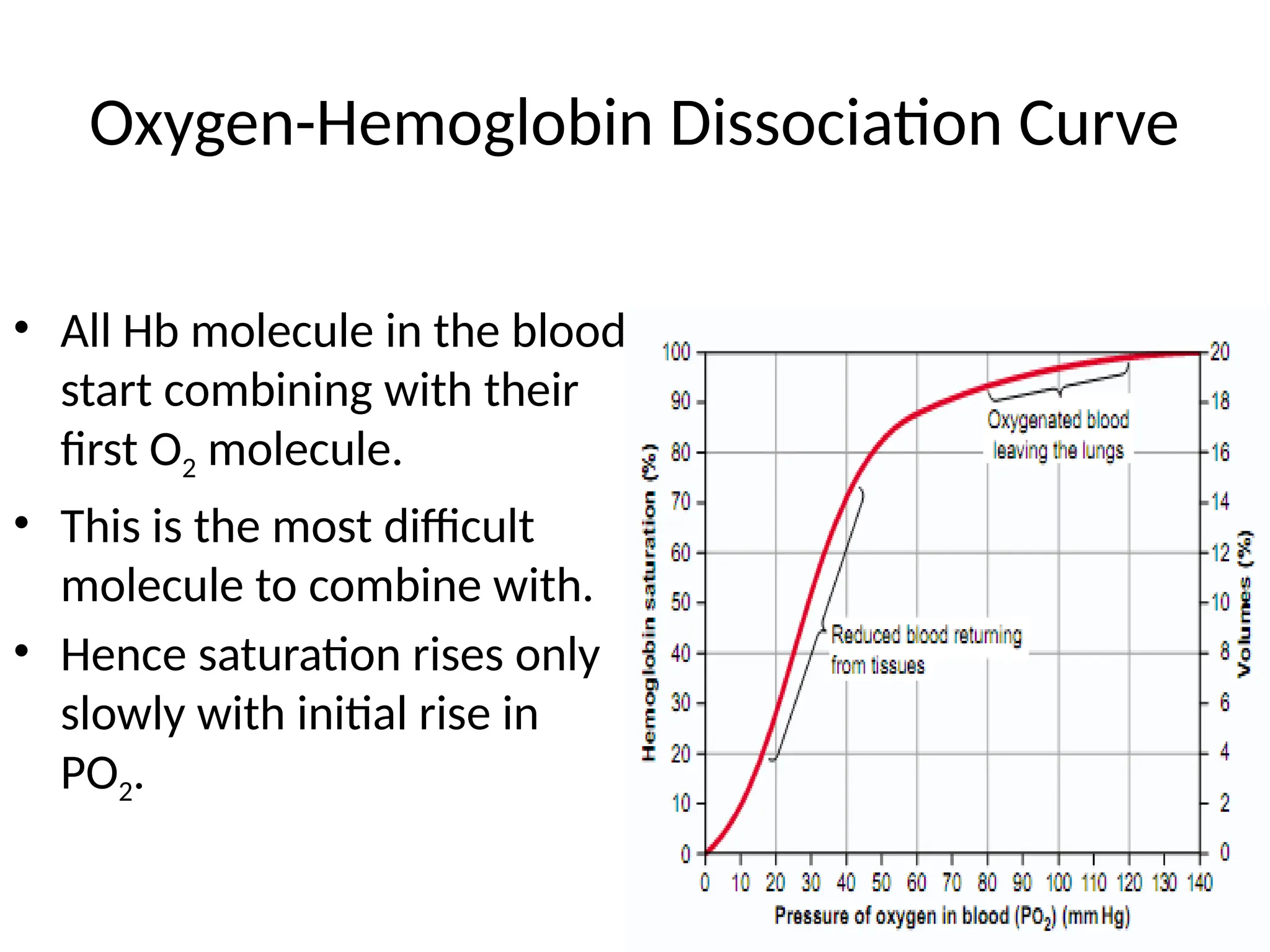
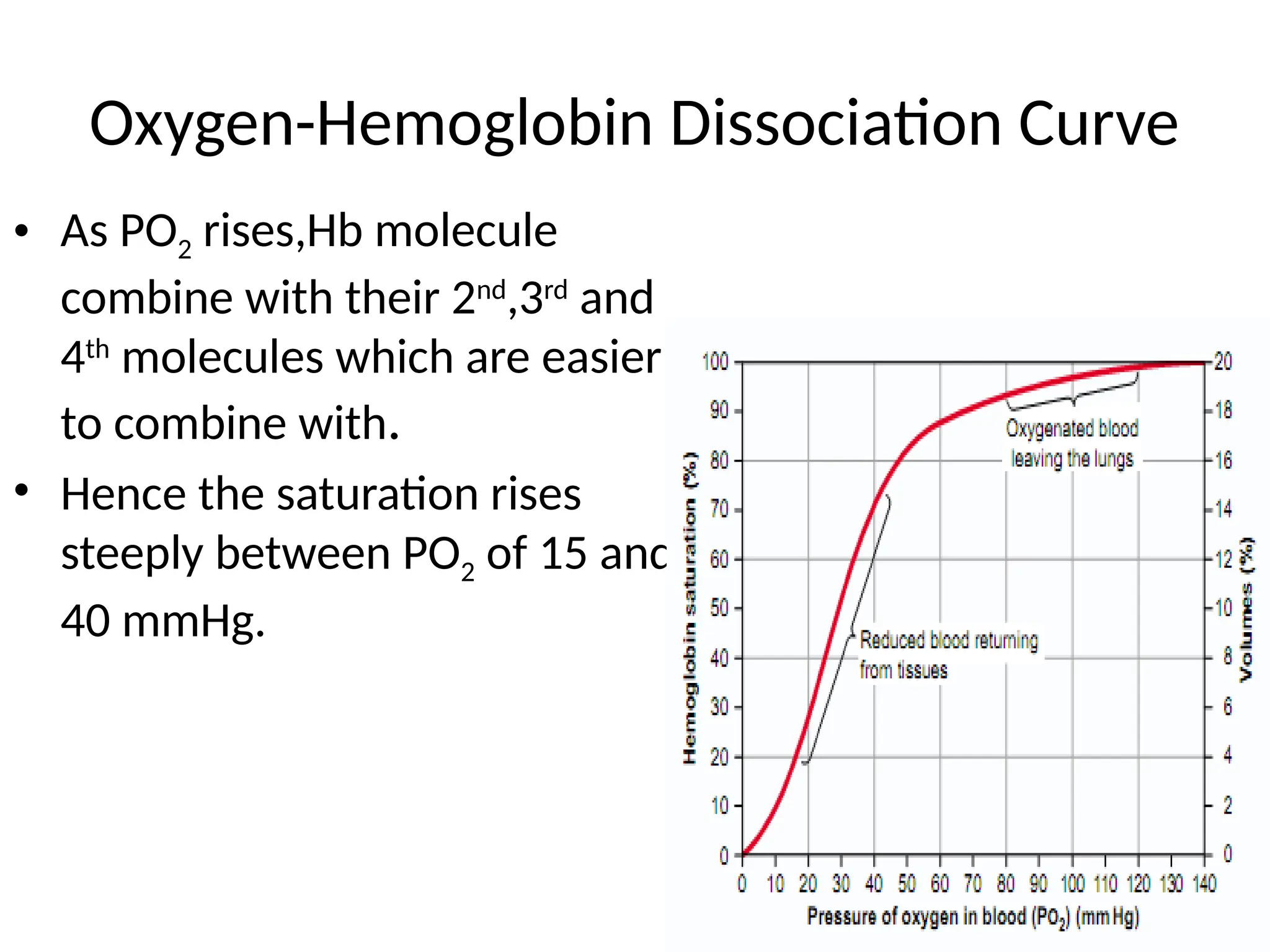
• There is a progressive increase in the percentage of Hb
bound with O2 as blood PO2 increases, which is called
percent saturation of Hb.
Oxygen-Hemoglobin Dissociation Curve
• In PO2 of about 95 mmHg,
saturation of systemic
arterial blood averages 97%
• In PO2 of about 40mmHg,
the saturation of Hb
averages 75%.
• Sigmoid Shape Curve
Molecular basis of the Sigmoid Shape
• Each molecule of Hb can combine with upto 4 molecules of
O2.
• Combination with the first molecule alters the
conformation of the Hb molecule in such a way as to
facilitate combination with the next O2 molecule.
Oxygen-Hemoglobin Dissociation Curve
• All Hb molecule in the blood
start combining with their
first O2 molecule.
• This is the most difficult
molecule to combine with.
• Hence saturation rises only
slowly with initial rise in
PO2.
Oxygen-Hemoglobin Dissociation Curve
• As PO2 rises,Hb molecule
combine with their 2nd
,3rd
and
4th
molecules which are easier
to combine with.
• Hence the saturation rises
steeply between PO2 of 15 and
40 mmHg.
Oxygen-Hemoglobin Dissociation Curve
• When PO2 rises still further,O2
finds most of the Hb molecules
carrying 4 molecules of O2
each.
• No scope for O2 combining
with Hb.
• Hence the curve is flat beyond
60 mmHg PO2.
Maximum amount of O2 that can combine with Hb
• The blood of normal person contains about 15 grams of Hb
in each 100 ml of blood.
• Each gram of Hb can bind with a maximum of 1.34 ml of O2
• 1.39 ml when Hb is chemically pure, but impurities such as
methemoglobin reduce this.
• Therefore, 15 X 1.34 = 20.1
• The 15 grams of Hb in 100 ml of blood can combine with a
total of about 20 ml of O2 if the Hb is 100 % saturated.
Factors that shift the O2-Hb dissociation curve
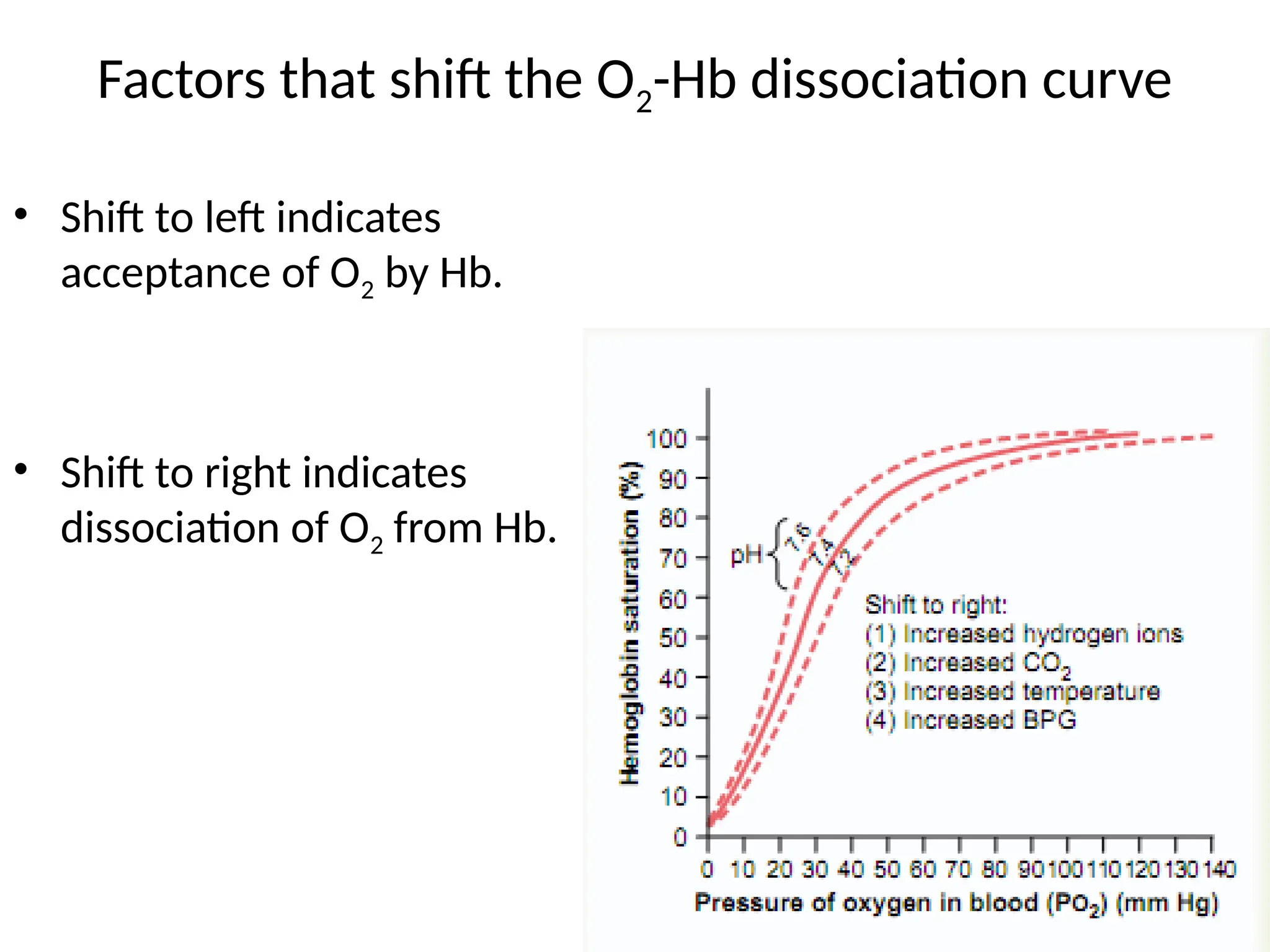
• Shift to left indicates
acceptance of O2 by Hb.
• Shift to right indicates
dissociation of O2 from Hb.
The Bohr effect
• There is increased delivery of O2 to the tissues when CO2
and H+
ions shift the O2-Hb dissociation curve.
• As blood passes through the tissues,CO2 diffuses from the
tissue cells into the blood.
• This increases the blood PCO2 which in turn raises the blood
H2CO3 acid and H+
ion concentration.
Shift the O2-Hb dissociation curve to the right
Transport of CO2 in the blood
• In dissolved state: 7%
• In combination with hemoglobin and plasma
proteins- carbaminohemoglobin : 23 %
• In the form of bicarbonate ion: 70%
Transport of CO2 in the blood
• Carbonic anhydrase
5000 fold
• Bicarbonate-chloride
carrier protein in the
red cell membrane.
• Chloride shift.
The Haldane Effect
• When oxygen binds with hemoglobin,CO2 is released to
increase CO2 transport.
• The combination of O2 with Hb in the lungs causes Hb to
become a stronger acid.
1. Highly acidic Hb has less tendency to combine with CO2 to
form carbaminohemoglobin, thus displacing much of the
CO2 that is present in the carbamino form from the blood.
2. Increased acidity of the Hb causes it to release as excess
of H+
ion and these bind with HCO3
-
ion to form carbonic
acid CO2 and H2O
Thankyou

Transport of O2 and CO2 in blood and tissue fluids laptop.pptx

  • 1.
    Transport of O2and CO2 in Blood and Tissue Fluids
  • 2.
    Gas transport • Itis the process of carrying gases from the alveoli to the systemic tissues and vice versa. • The cause of the movement of gases is always a partial pressure difference from first point to the next.
  • 3.
    Thus,the transport ofO2 and CO2 by the blood depends on both diffusion and flow of blood. O2 transport • O2 diffuses from the alveoli Pulmonary capillary blood Higher PO2 in the capillary blood than tissues Surrounding cells • Oxygen is metabolized in the cells to form CO2. CO2 transport • CO2 diffuses from the cells Tissue capillaries After blood flows to lungs • CO2 diffuses out of blood Alveoli
  • 4.
    Diffusion of Oxygenfrom the alveoli to the pulmonary capillary blood • PO2 in the alveolus averages 104 mmHg. • PO2 of the venous blood entering the pulmonary capillary at its arterial end averages only 40 mmHg. • Initial pressure difference that causes O2 to diffuse into the pulmonary capillary is 104-40, or 64mmHg. • Blood PO2 rises almost to that of the alveolar air by the time it reaches the venous end,104mmHg.
  • 5.
    Shunt flow • 98% of blood -- LA from the lungs -- alveolar capillaries -- oxygenated – 104 mmHg • 2 % of the blood – aorta -- bronchial circulation -- deep tissues of the lungs and is not exposed to lung air. “shunt flow” Blood is shunted past the gas exchange areas. • On leaving the lungs, the PO2 of the shunt blood is about that of normal systemic venous blood, about 40 mmHg.
  • 6.
    Shunt flow Shunt blood+ oxygenated blood Venous admixture of blood • Causes the PO2 of blood entering the left heart and pumped into the aorta to fall about 95 mmHg.
  • 7.
    Diffusion of oxygenfrom the peripheral capillaries into the tissue fluid • PO2 of arterial blood in peripheral capillaries is 95mmHg. • PO2 in the interstitial fluid is 40mmHg. • Initial pressure difference causes O2 to diffuse rapidly from the capillary blood into the tissues. • PO2 of blood leaving the capillaries and entering the systemic veins is also about 40 mmHg
  • 8.
    Diffusion of oxygenfrom the tissue fluid to the tissue cells • O2 is always being used by the cells. • The normal intracellular PO2 ranges from as low as 5mmHg to as high as 40mmHg,averaging 23mmHg
  • 9.
    Diffusion of CO2from the peripheral tissue cells into the capillaries • Intracellular PCO2 46mmHg ; interstitial PCO2 45 mmHg only 1 mmHg pressure difference. • PCO2 of the arterial blood entering the tissues 40 mmHg; PCO2 of the venous blood leaving the tissues 45mmHg. • Tissue capillary blood comes almost exactly to equilibrium with the interstitial PCO2 of 45mmHg.
  • 10.
    Diffusion of CO2from the pulmonary capillaries into the alveoli • PCO2 of the blood entering the pulmonary capillaries at the arterial end 45mmHg; • PCO2 of the alveolar air 40mmHg • Only a 5mmHg pressure difference causes CO2 diffusion out of the pulmonary capillaries into the alveoli. • PCO2 of the pulmonary capillary blood falls to almost exactly equal the alveolar PCO2 of 40mmHg.
  • 11.
    Transport of oxygen •97% in combination with hemoglobin in the red blood cells  Oxyhemoglobin • 3 % in dissolved state in water of the plasma and blood cells.
  • 12.
    Oxygen-Hemoglobin Dissociation Curve •There is a progressive increase in the percentage of Hb bound with O2 as blood PO2 increases, which is called percent saturation of Hb.
  • 13.
    Oxygen-Hemoglobin Dissociation Curve •In PO2 of about 95 mmHg, saturation of systemic arterial blood averages 97% • In PO2 of about 40mmHg, the saturation of Hb averages 75%. • Sigmoid Shape Curve
  • 14.
    Molecular basis ofthe Sigmoid Shape • Each molecule of Hb can combine with upto 4 molecules of O2. • Combination with the first molecule alters the conformation of the Hb molecule in such a way as to facilitate combination with the next O2 molecule.
  • 15.
    Oxygen-Hemoglobin Dissociation Curve •All Hb molecule in the blood start combining with their first O2 molecule. • This is the most difficult molecule to combine with. • Hence saturation rises only slowly with initial rise in PO2.
  • 16.
    Oxygen-Hemoglobin Dissociation Curve •As PO2 rises,Hb molecule combine with their 2nd ,3rd and 4th molecules which are easier to combine with. • Hence the saturation rises steeply between PO2 of 15 and 40 mmHg.
  • 17.
    Oxygen-Hemoglobin Dissociation Curve •When PO2 rises still further,O2 finds most of the Hb molecules carrying 4 molecules of O2 each. • No scope for O2 combining with Hb. • Hence the curve is flat beyond 60 mmHg PO2.
  • 18.
    Maximum amount ofO2 that can combine with Hb • The blood of normal person contains about 15 grams of Hb in each 100 ml of blood. • Each gram of Hb can bind with a maximum of 1.34 ml of O2 • 1.39 ml when Hb is chemically pure, but impurities such as methemoglobin reduce this. • Therefore, 15 X 1.34 = 20.1 • The 15 grams of Hb in 100 ml of blood can combine with a total of about 20 ml of O2 if the Hb is 100 % saturated.
  • 19.
    Factors that shiftthe O2-Hb dissociation curve • Shift to left indicates acceptance of O2 by Hb. • Shift to right indicates dissociation of O2 from Hb.
  • 20.
    The Bohr effect •There is increased delivery of O2 to the tissues when CO2 and H+ ions shift the O2-Hb dissociation curve. • As blood passes through the tissues,CO2 diffuses from the tissue cells into the blood. • This increases the blood PCO2 which in turn raises the blood H2CO3 acid and H+ ion concentration. Shift the O2-Hb dissociation curve to the right
  • 21.
    Transport of CO2in the blood • In dissolved state: 7% • In combination with hemoglobin and plasma proteins- carbaminohemoglobin : 23 % • In the form of bicarbonate ion: 70%
  • 22.
    Transport of CO2in the blood • Carbonic anhydrase 5000 fold • Bicarbonate-chloride carrier protein in the red cell membrane. • Chloride shift.
  • 23.
    The Haldane Effect •When oxygen binds with hemoglobin,CO2 is released to increase CO2 transport. • The combination of O2 with Hb in the lungs causes Hb to become a stronger acid. 1. Highly acidic Hb has less tendency to combine with CO2 to form carbaminohemoglobin, thus displacing much of the CO2 that is present in the carbamino form from the blood. 2. Increased acidity of the Hb causes it to release as excess of H+ ion and these bind with HCO3 - ion to form carbonic acid CO2 and H2O
  • 24.

Editor's Notes

  • #3 Pp of o2 in the alveoli is greater than the pp in the pulmonary capillary blood.in the other tissues of the body, a higher pp in the capillary blood than in the tissues causes 02 to diffuse into the surrounding cells.
  • #4 40 mmHg because a large amount of O2 was remeoved from this blood as it passed through the peripheral tissues
  • #5 About 98 % of blood that enters the LA from the lungs has just passed through the alveolar capillaries and become oxygenated up to a PO2 of about 104 mmHg Another 2 % of the blood has passed from the aorta through the bronchial circulation, which supplies mainly the deep tissues of the lungs and is not exposed to lung air. This blood flow is called “shunt flow” meaning that the blood is shunted past the gas exchange areas. On leaving the lungs, the PO2 of the shunt blood is about that of normal systemic venous blood, about 40 mmHg. About 98 % of blood that enters the LA from the lungs has just passed through the alveolar capillaries and become oxygenated up to a PO2 of about 104 mmHg Another 2 % of the blood has passed from the aorta through the bronchial circulation, which supplies mainly the deep tissues of the lungs and is not exposed to lung air. This blood flow is called “shunt flow” meaning that the blood is shunted past the gas exchange areas. On leaving the lungs, the PO2 of the shunt blood is about that of normal systemic venous blood, about 40 mmHg.
  • #6 When this shunt blood combines in the pulmonary veins with the oxygenated blood from the alveolar capillaries, this so-called venous admixture of blood causes the PO2 of blood entering the left heart and pumped into the aorta to fall about 95 mmHg.
  • #7 So rapidly that the capillary PO2 falls almost to equal the 40 mmHg pressure in the intersitium.therefore the PO2 of the blood laeving the tissue capillaries and entering the sytemic veins is also about 40 mmHg.