
DIVYA SHREE NANDINI
B.SC (HONS.) MATHEMATICS
SHRI RAMSWAROOP MEMORIAL UNIVERSITY
A LITTLE BIT ABOUT MYSELF
Hi my name is Divya Shree
Nandini.
Today I hope will be useful for
both you and me.
Don’t afraid to ask me about
something you’re unsure of.
You’ll have the opportunity to ask
me questions at the end of the
presentation.
 Enjoy the ride! (she sai  -
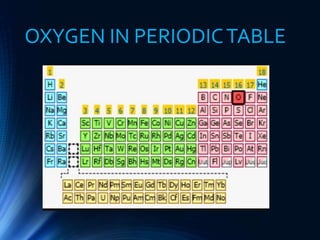
OXYGEN IN PERIODICTABLE
OXYGEN
 Oxygen is a chemical element
with symbol O and atomic
number 8. It is a member of the
Chalcogen group on the
periodic table and is a highly
reactive nonmetal and
oxidizing agent that readily
forms oxides with most
elements as well as other
compounds. By mass, Oxygen
is the third most abundant
element in the universe, after
Hydrogen and Helium.
 Discovery-CarlWilhelm
Scheele
 Named by-Antoine Lavoisier Spectral lines of oxygen
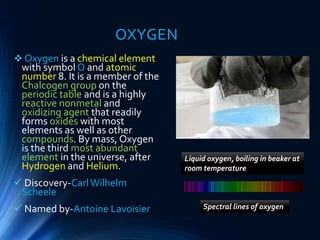
Liquid oxygen, boiling in beaker at
room temperature
APPLICATIONS
MEDICAL- Uptake of O2 from
the air is the essential purpose of
respiration, so Oxygen
supplementation is used in
medicine.Treatment not only
increases Oxygen levels in the
patient’s blood, but has the
secondary effect of decreasing
resistance to blood flow in many
types of diseased lungs, easing
work load on the heart. Oxygen
therapy is used to treat
emphysema, pneumonia, some
heart disorders ( congestive heart
failure), some disorders that cause
increased pulmonary artery
pressure, and any disease that
impairs the body’s ability to take
up and use gaseous oxygen.
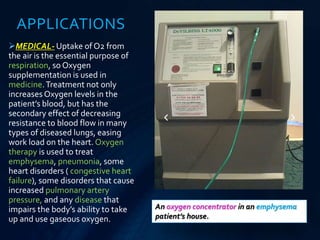
An oxygen concentrator in an emphysema
patient’s house.
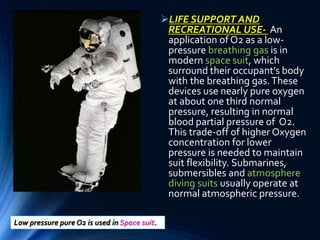
LIFE SUPPORT AND
RECREATIONAL USE- An
application of O2 as a low-
pressure breathing gas is in
modern space suit, which
surround their occupant’s body
with the breathing gas.These
devices use nearly pure oxygen
at about one third normal
pressure, resulting in normal
blood partial pressure of O2.
This trade-off of higher Oxygen
concentration for lower
pressure is needed to maintain
suit flexibility. Submarines,
submersibles and atmosphere
diving suits usually operate at
normal atmospheric pressure.
Low pressure pure O2 is used in Space suit.
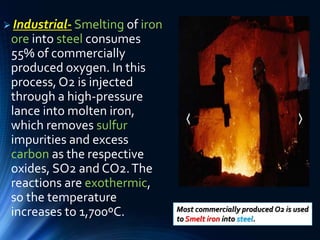
 Industrial- Smelting of iron
ore into steel consumes
55% of commercially
produced oxygen. In this
process,O2 is injected
through a high-pressure
lance into molten iron,
which removes sulfur
impurities and excess
carbon as the respective
oxides, SO2 and CO2.The
reactions are exothermic,
so the temperature
increases to 1,700ºC. Most commercially produced O2 is used
to Smelt iron into steel.
COMPOUNDS
The oxidation state of
oxygen is -2 in almost all
known compounds of
oxygen.The oxidation state
-1 is found in a few
compounds such as
peroxides. Compounds
containing oxygen in other
oxidation states are very
uncommon: -1/2 (super
oxides), -1/3 (ozonides), 0
(elemental, hypofluorous
acid), +1/2 (dioxygenyl), +1
(dioxygen difluoride), and
+2 (oxygen difluoride).
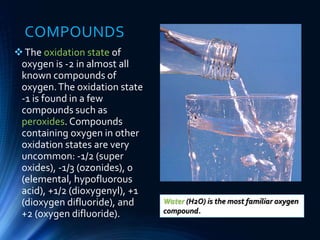
Water (H2O) is the most familiar oxygen
compound.
OXIDES AND OTHER INORGANIC COMPOUNDS
Water (H2O) is an oxide
of hydrogen and the most
familiar oxygen
compound. Hydrogen
atoms are covalently
bonded to oxygen in a
water molecule but also
have an additional
attraction (about 23.3
kJ.mol⁻¹ per hydrogen
atom) to an adjacent
oxygen atom in a
separate molecule.
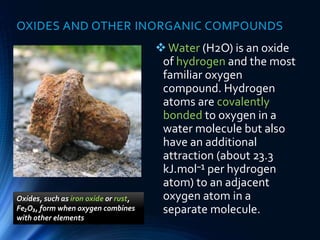
Oxides, such as iron oxide or rust,
Fe₂O₃, form when oxygen combines
with other elements
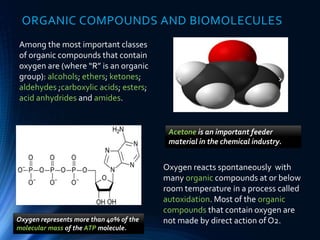
ORGANIC COMPOUNDS AND BIOMOLECULES
Among the most important classes
of organic compounds that contain
oxygen are (where “R” is an organic
group): alcohols; ethers; ketones;
aldehydes ;carboxylic acids; esters;
acid anhydrides and amides.
Oxygen reacts spontaneously with
many organic compounds at or below
room temperature in a process called
autoxidation. Most of the organic
compounds that contain oxygen are
not made by direct action of O2.Oxygen represents more than 40% of the
molecular mass of the ATP molecule.
Acetone is an important feeder
material in the chemical industry.
BASIC PROPERTIES OF OXYGEN
 Atomic Number: 8
 Atomic Mass: 16
 AtomicWeight: 15.9994
 Melting Point: -219 degrees C
 Boiling Point: -183 degrees C
 Group, Period: group 16 (chalcogens), period 2
 Block: p-block
 Electron Configuration: [He] 2s² 2p⁴
Phase: Gas
Electron per shell: 2,6
 Heavier than air, three isotopes, Highly paramagnetic, electronegative,
highly oxidized, Releasing heat.
Oxygen is a chemical element.
 Oxygen is a member of the chalcogen group.
 Oxygen is classified as a nonmetal or gas.
 Oxygen is colorless.
 Oxygen is a tasteless gas.
 Oxygen also acts as a ligand for transition metals.
 Freshwater contains about 6.04 milliliters (mL) of oxygen
per liter.
 Oxygen has vital biological role.
 6 CO₂ + 6H₂O + photons C₆H₁₂O₆ + 6O₂
 C₆H₁₂O₆ + 6O₂ 6 CO₂ + 6H₂O + 2880 kJ. mol⁻¹
FACTS ABOUT OXYGEN
 Dry air is 21 perfect oxygen, 78 percent nitrogen and 1 percent
other gases.
 Oxygen does not burn - honestly! It does, however, support the
combustion of other substances.Think about it – if oxygen itself
actually burnt, striking a match would be enough to burn all of the
oxygen in our planet’s atmosphere.
The Northern (and Southern) Lights:The green and dark – red
colors in the aurora borealis (and australis) are caused by oxygen
atoms.
 Oxygen is made in stars which have a mass of five or more Earth
suns when they burn helium and carbon or just carbon in nuclear
fusion reactions. Oxygen is part of the ‘ash’ formed by these
nuclear files.
 Oxygen is the third most abundant element in the universe.
Oxygen is about two times more soluble in water than nitrogen is.
 Almost two – thirds of the weight of living things comes from
oxygen, mainly because living things contain a lot of water and
88.9 percent of water’s weight comes from oxygen.
 Oxygen (O2) is unstable in our planet’s atmosphere and must be
constantly replenished by photosynthesis in green plants.Without
life, our atmosphere would contain almost no O2.
 If we discover any other planets with atmospheres rich in oxygen,
we will know that life is almost certainly present on these planets;
significant quantities of O2 will only exist on planets when it is
released by living things.
 Just five elements make up over 90 percent of the weight in the
Earth’s crust. Almost half of the weight of the crust comes from
oxygen. (Silicon, aluminum, iron and calcium are the other four
main elements in the crust.)
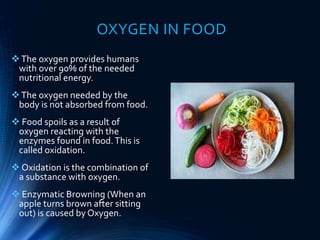
OXYGEN IN FOOD
The oxygen provides humans
with over 90% of the needed
nutritional energy.
The oxygen needed by the
body is not absorbed from food.
 Food spoils as a result of
oxygen reacting with the
enzymes found in food.This is
called oxidation.
 Oxidation is the combination of
a substance with oxygen.
 Enzymatic Browning (When an
apple turns brown after sitting
out) is caused by Oxygen.
THANKYOU
Hit me up on
GOOGLE & FACEBOOK- NANDINI
SRIVASTAVA
INSTAGRAM- DIVYASHREENANDINI
TWITTER- NANDINI_SRI21
devendrasrivastava36@gmail.com
www.twitter.com/nandini_sri21
www.instagram.com/divyashreenandini
www.facebook.com/nandinisrivastava21
www.linkedin.com/in/nandini-srivastava-
3b770b13b

Oxygen

  • 1.
    DIVYA SHREE NANDINI B.SC(HONS.) MATHEMATICS SHRI RAMSWAROOP MEMORIAL UNIVERSITY
  • 2.
    A LITTLE BITABOUT MYSELF Hi my name is Divya Shree Nandini. Today I hope will be useful for both you and me. Don’t afraid to ask me about something you’re unsure of. You’ll have the opportunity to ask me questions at the end of the presentation.  Enjoy the ride! (she sai  -
  • 3.
  • 4.
    OXYGEN  Oxygen isa chemical element with symbol O and atomic number 8. It is a member of the Chalcogen group on the periodic table and is a highly reactive nonmetal and oxidizing agent that readily forms oxides with most elements as well as other compounds. By mass, Oxygen is the third most abundant element in the universe, after Hydrogen and Helium.  Discovery-CarlWilhelm Scheele  Named by-Antoine Lavoisier Spectral lines of oxygen Liquid oxygen, boiling in beaker at room temperature
  • 5.
    APPLICATIONS MEDICAL- Uptake ofO2 from the air is the essential purpose of respiration, so Oxygen supplementation is used in medicine.Treatment not only increases Oxygen levels in the patient’s blood, but has the secondary effect of decreasing resistance to blood flow in many types of diseased lungs, easing work load on the heart. Oxygen therapy is used to treat emphysema, pneumonia, some heart disorders ( congestive heart failure), some disorders that cause increased pulmonary artery pressure, and any disease that impairs the body’s ability to take up and use gaseous oxygen. An oxygen concentrator in an emphysema patient’s house.
  • 6.
    LIFE SUPPORT AND RECREATIONALUSE- An application of O2 as a low- pressure breathing gas is in modern space suit, which surround their occupant’s body with the breathing gas.These devices use nearly pure oxygen at about one third normal pressure, resulting in normal blood partial pressure of O2. This trade-off of higher Oxygen concentration for lower pressure is needed to maintain suit flexibility. Submarines, submersibles and atmosphere diving suits usually operate at normal atmospheric pressure. Low pressure pure O2 is used in Space suit.
  • 7.
     Industrial- Smeltingof iron ore into steel consumes 55% of commercially produced oxygen. In this process,O2 is injected through a high-pressure lance into molten iron, which removes sulfur impurities and excess carbon as the respective oxides, SO2 and CO2.The reactions are exothermic, so the temperature increases to 1,700ºC. Most commercially produced O2 is used to Smelt iron into steel.
  • 8.
    COMPOUNDS The oxidation stateof oxygen is -2 in almost all known compounds of oxygen.The oxidation state -1 is found in a few compounds such as peroxides. Compounds containing oxygen in other oxidation states are very uncommon: -1/2 (super oxides), -1/3 (ozonides), 0 (elemental, hypofluorous acid), +1/2 (dioxygenyl), +1 (dioxygen difluoride), and +2 (oxygen difluoride). Water (H2O) is the most familiar oxygen compound.
  • 9.
    OXIDES AND OTHERINORGANIC COMPOUNDS Water (H2O) is an oxide of hydrogen and the most familiar oxygen compound. Hydrogen atoms are covalently bonded to oxygen in a water molecule but also have an additional attraction (about 23.3 kJ.mol⁻¹ per hydrogen atom) to an adjacent oxygen atom in a separate molecule. Oxides, such as iron oxide or rust, Fe₂O₃, form when oxygen combines with other elements
  • 10.
    ORGANIC COMPOUNDS ANDBIOMOLECULES Among the most important classes of organic compounds that contain oxygen are (where “R” is an organic group): alcohols; ethers; ketones; aldehydes ;carboxylic acids; esters; acid anhydrides and amides. Oxygen reacts spontaneously with many organic compounds at or below room temperature in a process called autoxidation. Most of the organic compounds that contain oxygen are not made by direct action of O2.Oxygen represents more than 40% of the molecular mass of the ATP molecule. Acetone is an important feeder material in the chemical industry.
  • 11.
    BASIC PROPERTIES OFOXYGEN  Atomic Number: 8  Atomic Mass: 16  AtomicWeight: 15.9994  Melting Point: -219 degrees C  Boiling Point: -183 degrees C  Group, Period: group 16 (chalcogens), period 2  Block: p-block  Electron Configuration: [He] 2s² 2p⁴ Phase: Gas Electron per shell: 2,6  Heavier than air, three isotopes, Highly paramagnetic, electronegative, highly oxidized, Releasing heat.
  • 12.
    Oxygen is achemical element.  Oxygen is a member of the chalcogen group.  Oxygen is classified as a nonmetal or gas.  Oxygen is colorless.  Oxygen is a tasteless gas.  Oxygen also acts as a ligand for transition metals.  Freshwater contains about 6.04 milliliters (mL) of oxygen per liter.  Oxygen has vital biological role.  6 CO₂ + 6H₂O + photons C₆H₁₂O₆ + 6O₂  C₆H₁₂O₆ + 6O₂ 6 CO₂ + 6H₂O + 2880 kJ. mol⁻¹
  • 13.
    FACTS ABOUT OXYGEN Dry air is 21 perfect oxygen, 78 percent nitrogen and 1 percent other gases.  Oxygen does not burn - honestly! It does, however, support the combustion of other substances.Think about it – if oxygen itself actually burnt, striking a match would be enough to burn all of the oxygen in our planet’s atmosphere. The Northern (and Southern) Lights:The green and dark – red colors in the aurora borealis (and australis) are caused by oxygen atoms.  Oxygen is made in stars which have a mass of five or more Earth suns when they burn helium and carbon or just carbon in nuclear fusion reactions. Oxygen is part of the ‘ash’ formed by these nuclear files.  Oxygen is the third most abundant element in the universe.
  • 14.
    Oxygen is abouttwo times more soluble in water than nitrogen is.  Almost two – thirds of the weight of living things comes from oxygen, mainly because living things contain a lot of water and 88.9 percent of water’s weight comes from oxygen.  Oxygen (O2) is unstable in our planet’s atmosphere and must be constantly replenished by photosynthesis in green plants.Without life, our atmosphere would contain almost no O2.  If we discover any other planets with atmospheres rich in oxygen, we will know that life is almost certainly present on these planets; significant quantities of O2 will only exist on planets when it is released by living things.  Just five elements make up over 90 percent of the weight in the Earth’s crust. Almost half of the weight of the crust comes from oxygen. (Silicon, aluminum, iron and calcium are the other four main elements in the crust.)
  • 15.
    OXYGEN IN FOOD Theoxygen provides humans with over 90% of the needed nutritional energy. The oxygen needed by the body is not absorbed from food.  Food spoils as a result of oxygen reacting with the enzymes found in food.This is called oxidation.  Oxidation is the combination of a substance with oxygen.  Enzymatic Browning (When an apple turns brown after sitting out) is caused by Oxygen.
  • 16.
    THANKYOU Hit me upon GOOGLE & FACEBOOK- NANDINI SRIVASTAVA INSTAGRAM- DIVYASHREENANDINI TWITTER- NANDINI_SRI21 devendrasrivastava36@gmail.com www.twitter.com/nandini_sri21 www.instagram.com/divyashreenandini www.facebook.com/nandinisrivastava21 www.linkedin.com/in/nandini-srivastava- 3b770b13b