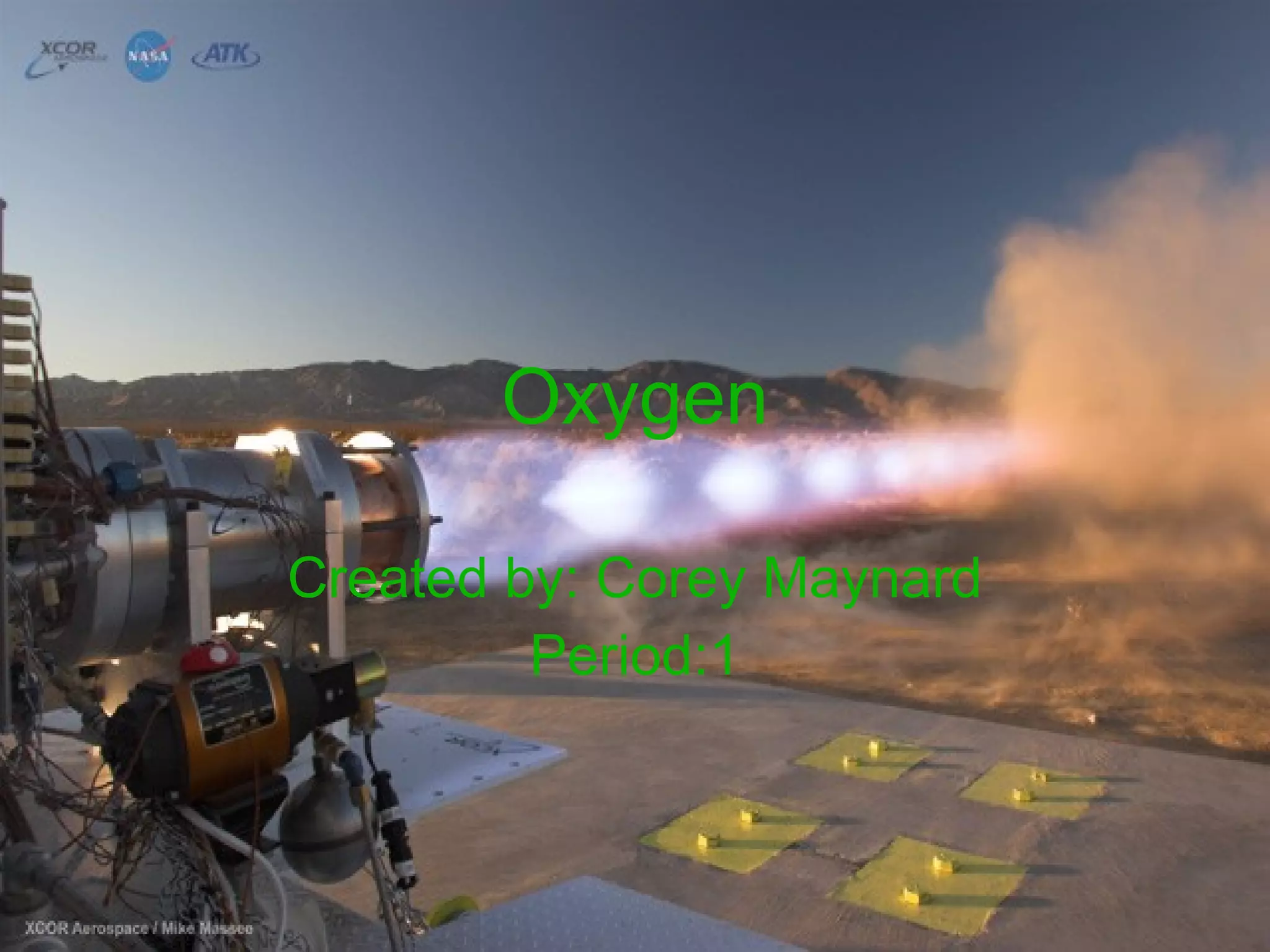
Oxygen Created by: Corey Maynard Period:1
General Information Symbol: O Atomic Number: 8 Atomic mass: 16 Group Name: Chalcogen Group Number:16
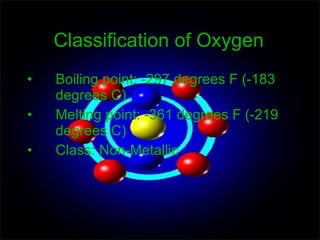
Classification of Oxygen Boiling point: -297 degrees F (-183 degrees C) Melting point: -361 degrees F (-219 degrees C) Class: Non-Metallic
Historical Information Discovered in: 1774 Discovered by: Joseph Priestley and Carl Scheele Discovered at: England and Sweden Word Origin: From the Greek words “oxy genes” meaning “acid” (sharp) and “forming” (acid former)
Additional Information. Oxygen is found in over 45% of earths crust Color: None Natural isotopes: 16O, 17O, and 18O Hazards: Pollution
Elements Oxygen is in. Gold (Au2O3) Berkelium (BKO3) Platinum (PtO2) Plutonium (PuO2) Curium (CmO2)
Uses and Availabilities Breathing (animals need it in air or water) Oxidation (burns) 21% of the atmosphere Most elements  Plants and animal respiration Nearly all combustion No hardness or elasticity
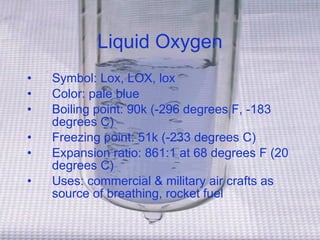
Liquid Oxygen Symbol: Lox, LOX, lox Color: pale blue Boiling point: 90k (-296 degrees F, -183 degrees C) Freezing point: 51k (-233 degrees C) Expansion ratio: 861:1 at 68 degrees F (20 degrees C) Uses: commercial & military air crafts as source of breathing, rocket fuel
Resources http://www.google.com/firefox?client=firefox-a&rls=org.mozilla : http://en.wikipedia.org/wiki/Liquid_oxygenn-US : http://www-safety.deas.harvard.edu/services/oxygen.html http://images.search.yahoo.com/search/images?p=oxygen&toggle=1&cop=mss&ei=UTF-8&fr=yfp-t-701 http://www.answers.com/topic/oxygen

Oxygen Project

  • 1.
    Oxygen Created by:Corey Maynard Period:1
  • 2.
    General Information Symbol:O Atomic Number: 8 Atomic mass: 16 Group Name: Chalcogen Group Number:16
  • 3.
    Classification of OxygenBoiling point: -297 degrees F (-183 degrees C) Melting point: -361 degrees F (-219 degrees C) Class: Non-Metallic
  • 4.
    Historical Information Discoveredin: 1774 Discovered by: Joseph Priestley and Carl Scheele Discovered at: England and Sweden Word Origin: From the Greek words “oxy genes” meaning “acid” (sharp) and “forming” (acid former)
  • 5.
    Additional Information. Oxygenis found in over 45% of earths crust Color: None Natural isotopes: 16O, 17O, and 18O Hazards: Pollution
  • 6.
    Elements Oxygen isin. Gold (Au2O3) Berkelium (BKO3) Platinum (PtO2) Plutonium (PuO2) Curium (CmO2)
  • 7.
    Uses and AvailabilitiesBreathing (animals need it in air or water) Oxidation (burns) 21% of the atmosphere Most elements Plants and animal respiration Nearly all combustion No hardness or elasticity
  • 8.
    Liquid Oxygen Symbol:Lox, LOX, lox Color: pale blue Boiling point: 90k (-296 degrees F, -183 degrees C) Freezing point: 51k (-233 degrees C) Expansion ratio: 861:1 at 68 degrees F (20 degrees C) Uses: commercial & military air crafts as source of breathing, rocket fuel
  • 9.
    Resources http://www.google.com/firefox?client=firefox-a&rls=org.mozilla :http://en.wikipedia.org/wiki/Liquid_oxygenn-US : http://www-safety.deas.harvard.edu/services/oxygen.html http://images.search.yahoo.com/search/images?p=oxygen&toggle=1&cop=mss&ei=UTF-8&fr=yfp-t-701 http://www.answers.com/topic/oxygen