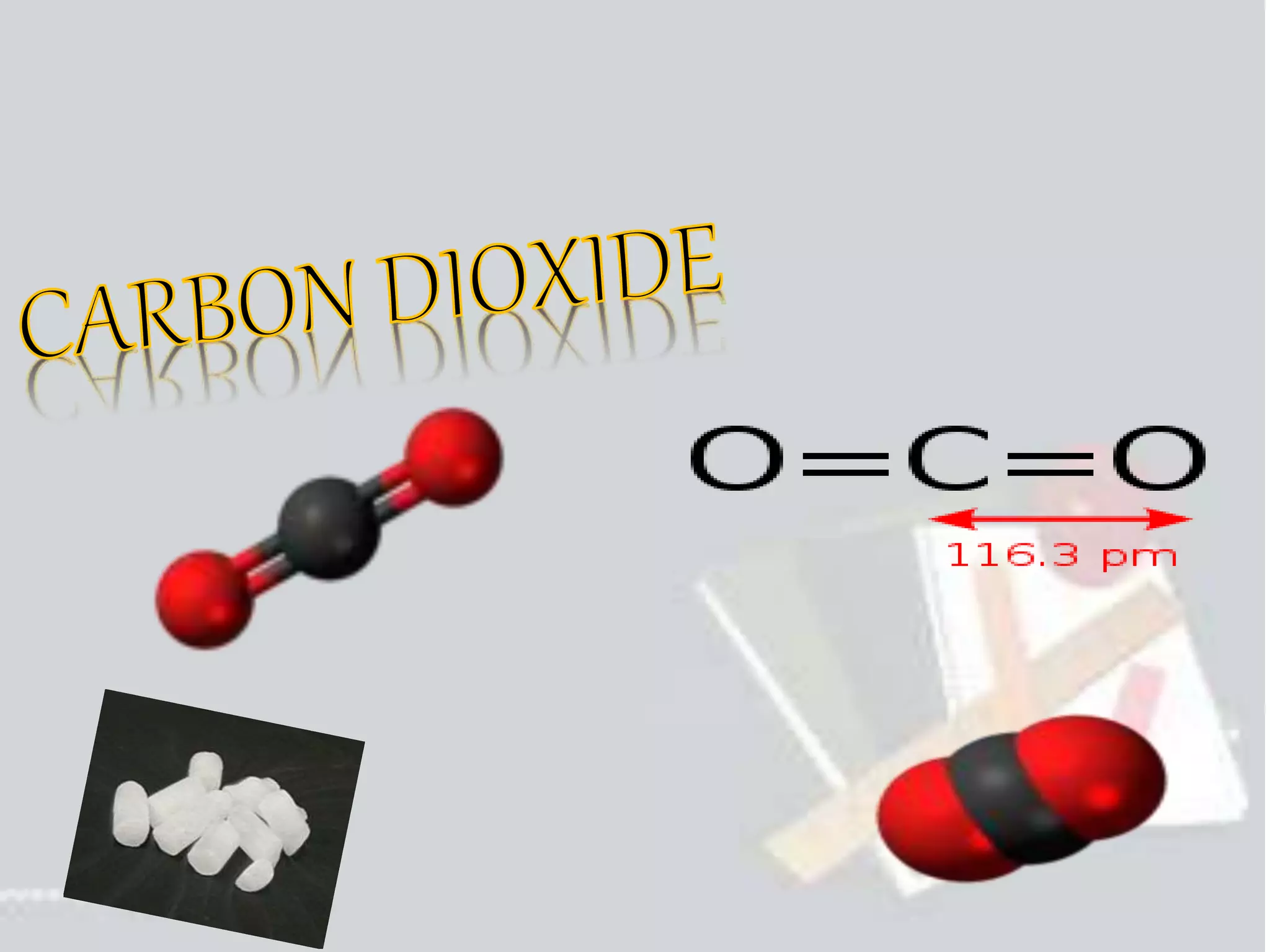
- is a colorless, odorless gas vital
to life on Earth. This naturally occurring chemical
compound is composed of a carbon atom
covalently double bonded to two oxygen atoms.
-is a trace gas comprising 0.039% of the
atmosphere.
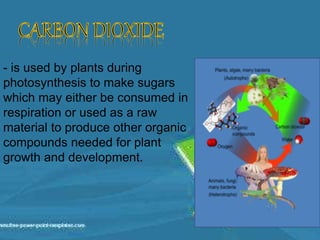
- is used by plants during
photosynthesis to make sugars
which may either be consumed in
respiration or used as a raw
material to produce other organic
compounds needed for plant
growth and development.
- Generated as a by product of the
combustion of fossil fuels or the burning of
vegetable matter, among other chemical
processes.
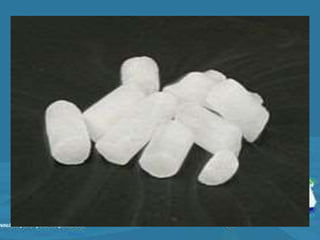
Carbon dioxide has no liquid state at
pressures below 5.1 atm. At 1 atm., the gas
deposits directly to a solid a temperatures
below -78 ˚C and the solid sublimes directly to
gas above - 78˚C. In its solid state, carbon
dioxide is commonly called “dry ice.”
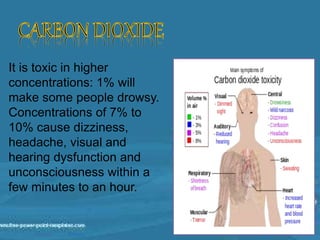
It is toxic in higher
concentrations: 1% will
make some people drowsy.
Concentrations of 7% to
10% cause dizziness,
headache, visual and
hearing dysfunction and
unconsciousness within a
few minutes to an hour.
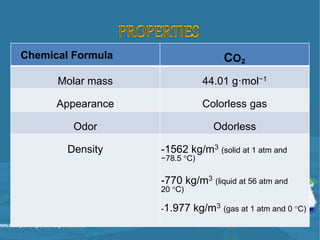
Chemical Formula CO₂
Molar mass 44.01 g·mol−1
Appearance Colorless gas
Odor Odorless
Density -1562 kg/m3 (solid at 1 atm and
−78.5 °C)
-770 kg/m3 (liquid at 56 atm and
20 °C)
-1.977 kg/m3 (gas at 1 atm and 0 °C)
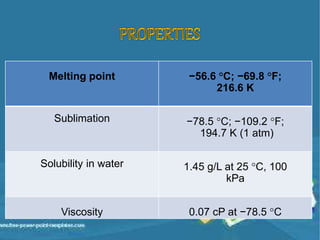
Melting point −56.6 °C; −69.8 °F;
216.6 K
Sublimation −78.5 °C; −109.2 °F;
194.7 K (1 atm)
Solubility in water 1.45 g/L at 25 °C, 100
kPa
Viscosity 0.07 cP at −78.5 °C
USES OF
CARBON DIOXIDE
Food
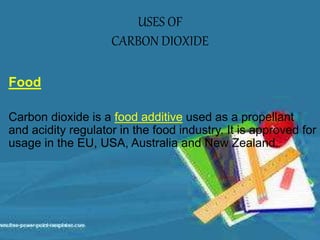
Carbon dioxide is a food additive used as a propellant
and acidity regulator in the food industry. It is approved for
usage in the EU, USA, Australia and New Zealand.
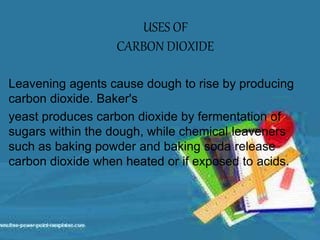
Leavening agents cause dough to rise by producing
carbon dioxide. Baker's
yeast produces carbon dioxide by fermentation of
sugars within the dough, while chemical leaveners
such as baking powder and baking soda release
carbon dioxide when heated or if exposed to acids.
USES OF
CARBON DIOXIDE
USES OF
CARBON DIOXIDE
Beverages
Carbon dioxide is used to produce carbonated soft
drinks and soda water. Traditionally, the carbonation in beer
and sparkling wine came about through natural fermentation,
but many manufacturers carbonate these drinks with carbon
dioxide recovered from the fermentation process. In the case
of bottled and kegged beer, the most common method used is
carbonation with recycled carbon dioxide.
Wine making
Carbon dioxide in the form of dry ice is often used in
the wine making process to cool down bunches of grapes quickly
after picking to help prevent spontaneous fermentation by
wild yeast. The main advantage of using dry ice over regular
water ice is that it cools the grapes without adding any additional
water that may decrease the sugar concentration in the grape
and therefore also decrease the alcohol concentration in the
finished wine.
USES OF
CARBON DIOXIDE
Carbon dioxide is sometimes used to top up
wine bottles or other storage vessels such as
barrels to prevent oxidation, though it has the
problem that it can dissolve into the wine, making
a previously still wine slightly fizzy. For this
reason, other gases such as nitrogen
or argon are preferred for this process by
professional wine makers.
Welding & Metal Fabrication
Carbon dioxide is most often mixed
with argon as a shielding gas used
to prevent atmospheric contamination
of molten metal in electric arc
welding processes.
USES OF
CARBON DIOXIDE
Carbon dioxide extinguishes flames, and some fire
extinguishers, especially those designed for electrical fires,
contain liquid carbon dioxide under pressure. Carbon dioxide
extinguishers work well on small flammable liquid and
electrical fires, but not on ordinary combustible fires,
because although it excludes oxygen, it does not cool the
burning substances significantly and when the carbon
dioxide disperses they are free to catch fire upon exposure to
atmospheric oxygen.
USES OF
CARBON DIOXIDE
Fire extinguisher
Supercritical CO2 as solvent
Liquid carbon dioxide is a good solvent for
many lipophilic organic compounds and is used to remove
caffeine from coffee. Carbon dioxide has attracted attention
in the pharmaceutical and other chemical processing
industries as a less toxic alternative to more traditional
solvents such as oraganochlorides.
USES OF
CARBON DIOXIDE
Agricultural and biological applications
Plants require carbon dioxide to
conduct photosynthesis. The atmospheres of greenhouses
may (if of large size, must) be enriched with additional CO2 to
sustain and increase the rate of plant growth.
In medicine, up to 5% carbon dioxide (130 times
atmospheric concentration) is added to oxygen for stimulation of
breathing after apnea and to stabilize the O2/CO2 balance in blood.
It has been proposed that carbon dioxide from power
generation be bubbled into ponds to grow algae that could then be
converted into biodiesel fuel.
USES OF
CARBON DIOXIDE
USES OF
CARBON DIOXIDE
Oil recovery
Carbon dioxide is used in enhanced oil recovery where it is
injected into or adjacent to producing oil wells, usually under
supercritical conditions, when it becomes miscible with the oil. It
acts as both a pressurizing agent and, when dissolved into the
underground crude oil, significantly reduces its viscosity, and
changing surface chemistry enabling the oil to flow more rapidly
through the reservoir to the removal well
USES OF
CARBON DIOXIDE
Refrigerant
Liquid and solid carbon dioxide are
important refrigerants, especially in the food industry,
where they are employed during the transportation
and storage of ice cream and other frozen foods.
Solid carbon dioxide is called "dry ice" and is used for
small shipments where refrigeration equipment is not
practical.
USES OF
CARBON DIOXIDE
Liquid carbon dioxide was used as a refrigerant
prior to the discovery of R-12 and may enjoy a
renaissance due to the fact that R134a contributes
to climate change. Its physical properties are highly
favorable for cooling, refrigeration, and heating
purposes, having a high volumetric cooling capacity.
USES OF
CARBON DIOXIDE
Coal bed methane recovery
In enhanced coal bed methane recovery, carbon
dioxide would be pumped into the coal seam to
displace methane, as opposed to current methods
which primarily rely on the removal of water (to reduce
pressure) to make the coal seam release its trapped
methane.
USES OF
CARBON DIOXIDE
OTHER USES
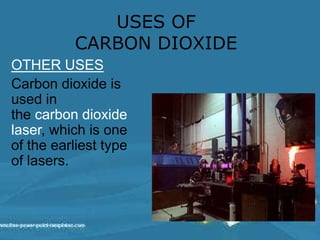
Carbon dioxide is
used in
the carbon dioxide
laser, which is one
of the earliest type
of lasers.
- Carbon dioxide can be used as a means of controlling
the pH of swimming pools, by continuously adding
gas to the water, thus keeping the pH from rising.
- It is also used in the maintaining reef aquaria, where it
is commonly used in calcium reactors to temporarily
lower the pH of water being passed over calcium
carbonate in order to allow the calcium carbonate to
dissolve into the water more freely where it is used by
some corals to build their skeleton.
Source:
http://www.praxair.com/gases/buy-liquid-or-compressed-
carbon-dioxide-gas#!tab=applications
http://wikepedia.org.
Carbon dioxide

Carbon dioxide

  • 2.
    - is acolorless, odorless gas vital to life on Earth. This naturally occurring chemical compound is composed of a carbon atom covalently double bonded to two oxygen atoms.
  • 3.
    -is a tracegas comprising 0.039% of the atmosphere.
  • 4.
    - is usedby plants during photosynthesis to make sugars which may either be consumed in respiration or used as a raw material to produce other organic compounds needed for plant growth and development.
  • 5.
    - Generated asa by product of the combustion of fossil fuels or the burning of vegetable matter, among other chemical processes.
  • 6.
    Carbon dioxide hasno liquid state at pressures below 5.1 atm. At 1 atm., the gas deposits directly to a solid a temperatures below -78 ˚C and the solid sublimes directly to gas above - 78˚C. In its solid state, carbon dioxide is commonly called “dry ice.”
  • 7.
    It is toxicin higher concentrations: 1% will make some people drowsy. Concentrations of 7% to 10% cause dizziness, headache, visual and hearing dysfunction and unconsciousness within a few minutes to an hour.
  • 9.
    Chemical Formula CO₂ Molarmass 44.01 g·mol−1 Appearance Colorless gas Odor Odorless Density -1562 kg/m3 (solid at 1 atm and −78.5 °C) -770 kg/m3 (liquid at 56 atm and 20 °C) -1.977 kg/m3 (gas at 1 atm and 0 °C)
  • 10.
    Melting point −56.6°C; −69.8 °F; 216.6 K Sublimation −78.5 °C; −109.2 °F; 194.7 K (1 atm) Solubility in water 1.45 g/L at 25 °C, 100 kPa Viscosity 0.07 cP at −78.5 °C
  • 12.
    USES OF CARBON DIOXIDE Food Carbondioxide is a food additive used as a propellant and acidity regulator in the food industry. It is approved for usage in the EU, USA, Australia and New Zealand.
  • 13.
    Leavening agents causedough to rise by producing carbon dioxide. Baker's yeast produces carbon dioxide by fermentation of sugars within the dough, while chemical leaveners such as baking powder and baking soda release carbon dioxide when heated or if exposed to acids. USES OF CARBON DIOXIDE
  • 14.
    USES OF CARBON DIOXIDE Beverages Carbondioxide is used to produce carbonated soft drinks and soda water. Traditionally, the carbonation in beer and sparkling wine came about through natural fermentation, but many manufacturers carbonate these drinks with carbon dioxide recovered from the fermentation process. In the case of bottled and kegged beer, the most common method used is carbonation with recycled carbon dioxide.
  • 15.
    Wine making Carbon dioxidein the form of dry ice is often used in the wine making process to cool down bunches of grapes quickly after picking to help prevent spontaneous fermentation by wild yeast. The main advantage of using dry ice over regular water ice is that it cools the grapes without adding any additional water that may decrease the sugar concentration in the grape and therefore also decrease the alcohol concentration in the finished wine. USES OF CARBON DIOXIDE
  • 16.
    Carbon dioxide issometimes used to top up wine bottles or other storage vessels such as barrels to prevent oxidation, though it has the problem that it can dissolve into the wine, making a previously still wine slightly fizzy. For this reason, other gases such as nitrogen or argon are preferred for this process by professional wine makers.
  • 17.
    Welding & MetalFabrication Carbon dioxide is most often mixed with argon as a shielding gas used to prevent atmospheric contamination of molten metal in electric arc welding processes. USES OF CARBON DIOXIDE
  • 18.
    Carbon dioxide extinguishesflames, and some fire extinguishers, especially those designed for electrical fires, contain liquid carbon dioxide under pressure. Carbon dioxide extinguishers work well on small flammable liquid and electrical fires, but not on ordinary combustible fires, because although it excludes oxygen, it does not cool the burning substances significantly and when the carbon dioxide disperses they are free to catch fire upon exposure to atmospheric oxygen. USES OF CARBON DIOXIDE Fire extinguisher
  • 19.
    Supercritical CO2 assolvent Liquid carbon dioxide is a good solvent for many lipophilic organic compounds and is used to remove caffeine from coffee. Carbon dioxide has attracted attention in the pharmaceutical and other chemical processing industries as a less toxic alternative to more traditional solvents such as oraganochlorides. USES OF CARBON DIOXIDE
  • 20.
    Agricultural and biologicalapplications Plants require carbon dioxide to conduct photosynthesis. The atmospheres of greenhouses may (if of large size, must) be enriched with additional CO2 to sustain and increase the rate of plant growth. In medicine, up to 5% carbon dioxide (130 times atmospheric concentration) is added to oxygen for stimulation of breathing after apnea and to stabilize the O2/CO2 balance in blood. It has been proposed that carbon dioxide from power generation be bubbled into ponds to grow algae that could then be converted into biodiesel fuel. USES OF CARBON DIOXIDE
  • 21.
    USES OF CARBON DIOXIDE Oilrecovery Carbon dioxide is used in enhanced oil recovery where it is injected into or adjacent to producing oil wells, usually under supercritical conditions, when it becomes miscible with the oil. It acts as both a pressurizing agent and, when dissolved into the underground crude oil, significantly reduces its viscosity, and changing surface chemistry enabling the oil to flow more rapidly through the reservoir to the removal well
  • 22.
    USES OF CARBON DIOXIDE Refrigerant Liquidand solid carbon dioxide are important refrigerants, especially in the food industry, where they are employed during the transportation and storage of ice cream and other frozen foods. Solid carbon dioxide is called "dry ice" and is used for small shipments where refrigeration equipment is not practical.
  • 23.
    USES OF CARBON DIOXIDE Liquidcarbon dioxide was used as a refrigerant prior to the discovery of R-12 and may enjoy a renaissance due to the fact that R134a contributes to climate change. Its physical properties are highly favorable for cooling, refrigeration, and heating purposes, having a high volumetric cooling capacity.
  • 24.
    USES OF CARBON DIOXIDE Coalbed methane recovery In enhanced coal bed methane recovery, carbon dioxide would be pumped into the coal seam to displace methane, as opposed to current methods which primarily rely on the removal of water (to reduce pressure) to make the coal seam release its trapped methane.
  • 25.
    USES OF CARBON DIOXIDE OTHERUSES Carbon dioxide is used in the carbon dioxide laser, which is one of the earliest type of lasers.
  • 26.
    - Carbon dioxidecan be used as a means of controlling the pH of swimming pools, by continuously adding gas to the water, thus keeping the pH from rising. - It is also used in the maintaining reef aquaria, where it is commonly used in calcium reactors to temporarily lower the pH of water being passed over calcium carbonate in order to allow the calcium carbonate to dissolve into the water more freely where it is used by some corals to build their skeleton.
  • 27.