Acids, bases and salts
Identification
• Acids – sour taste
• Bases – soapy taste
• Salts – combination of acids and bases
• Acids and bases are differentiated by
indicators
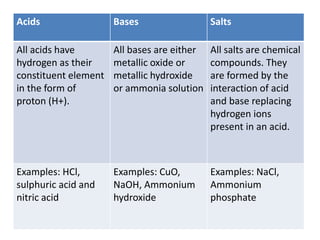
Acids Bases Salts
All acids have
hydrogen as their
constituent element
in the form of
proton (H+).
All bases are either
metallic oxide or
metallic hydroxide
or ammonia solution
All salts are chemical
compounds. They
are formed by the
interaction of acid
and base replacing
hydrogen ions
present in an acid.
Examples: HCl,
sulphuric acid and
nitric acid
Examples: CuO,
NaOH, Ammonium
hydroxide
Examples: NaCl,
Ammonium
phosphate
Acids
• Compounds which contain one or more
hydrogen atoms and when dissolved in water,
produce hydronium ions (H3O+) the only
positively charged ions.
Classification of acids
• Depending on their sources
– Organic acids – ex: oxalic acid
– Inorganic acids – ex: nitric acid
• Depending on their basicity
– Monobasic acid
– Dibasic acids
– Tribasic acids
Organic acids
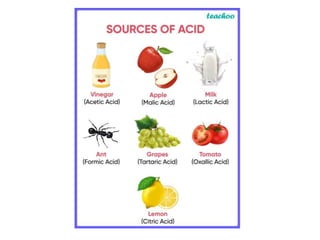
• Obtained from plants
• It contains C atom along with
H atom
• They are weak acids
• Do not ionise completely in
solution
• It contains ions as well as
molecules
• Examples:
– Oxalic acid
– Acetic acid
– Formic acid
Inorganic acids
• Obtained from minerals
• It does not contain C atom except
carbonic acid
• They are storng acids
• They ionise completely in solution
producing a high concentration of
hydronium ions.
• It contains ions only except carbonic
acid.
• Tow types of inorganic acids
– Oxy-acids contain oxygen along with
hydrogen and some other elements
– Hydracids – contains hydrogen and a
non-metallic element. It does not
contain oxygen.
• Examples:
– Hydrochloric acid
– Sulphuric acid
– Nitric acid
Depending on their basicity
• The basicity of an acid is defined as the
number of hydronium ions that can be
produced by the ionization of one molecule of
that acid in aqueous solution
– Monobasic acid
– Dibasic acids
– Tribasic acids
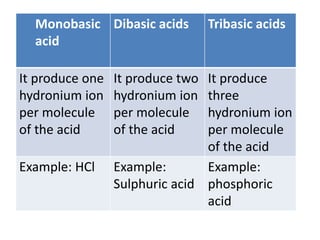
Monobasic
acid
Dibasic acids Tribasic acids
It produce one
hydronium ion
per molecule
of the acid
It produce two
hydronium ion
per molecule
of the acid
It produce
three
hydronium ion
per molecule
of the acid
Example: HCl Example:
Sulphuric acid
Example:
phosphoric
acid
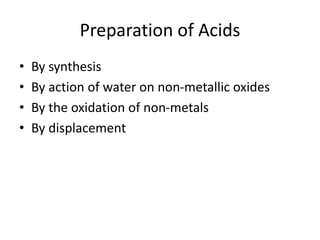
Preparation of Acids
• By synthesis
• By action of water on non-metallic oxides
• By the oxidation of non-metals
• By displacement
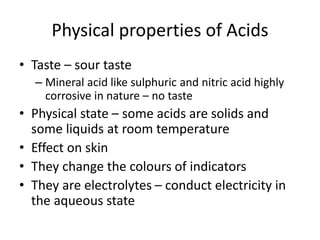
Physical properties of Acids
• Taste – sour taste
– Mineral acid like sulphuric and nitric acid highly
corrosive in nature – no taste
• Physical state – some acids are solids and
some liquids at room temperature
• Effect on skin
• They change the colours of indicators
• They are electrolytes – conduct electricity in
the aqueous state
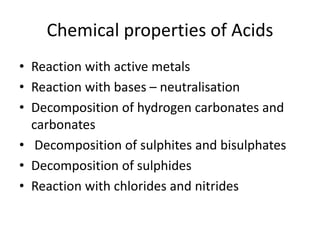
Chemical properties of Acids
• Reaction with active metals
• Reaction with bases – neutralisation
• Decomposition of hydrogen carbonates and
carbonates
• Decomposition of sulphites and bisulphates
• Decomposition of sulphides
• Reaction with chlorides and nitrides

Acids, bases and salts.pptx

  • 1.
  • 2.
    Identification • Acids –sour taste • Bases – soapy taste • Salts – combination of acids and bases • Acids and bases are differentiated by indicators
  • 3.
    Acids Bases Salts Allacids have hydrogen as their constituent element in the form of proton (H+). All bases are either metallic oxide or metallic hydroxide or ammonia solution All salts are chemical compounds. They are formed by the interaction of acid and base replacing hydrogen ions present in an acid. Examples: HCl, sulphuric acid and nitric acid Examples: CuO, NaOH, Ammonium hydroxide Examples: NaCl, Ammonium phosphate
  • 5.
    Acids • Compounds whichcontain one or more hydrogen atoms and when dissolved in water, produce hydronium ions (H3O+) the only positively charged ions.
  • 6.
    Classification of acids •Depending on their sources – Organic acids – ex: oxalic acid – Inorganic acids – ex: nitric acid • Depending on their basicity – Monobasic acid – Dibasic acids – Tribasic acids
  • 7.
    Organic acids • Obtainedfrom plants • It contains C atom along with H atom • They are weak acids • Do not ionise completely in solution • It contains ions as well as molecules • Examples: – Oxalic acid – Acetic acid – Formic acid Inorganic acids • Obtained from minerals • It does not contain C atom except carbonic acid • They are storng acids • They ionise completely in solution producing a high concentration of hydronium ions. • It contains ions only except carbonic acid. • Tow types of inorganic acids – Oxy-acids contain oxygen along with hydrogen and some other elements – Hydracids – contains hydrogen and a non-metallic element. It does not contain oxygen. • Examples: – Hydrochloric acid – Sulphuric acid – Nitric acid
  • 8.
    Depending on theirbasicity • The basicity of an acid is defined as the number of hydronium ions that can be produced by the ionization of one molecule of that acid in aqueous solution – Monobasic acid – Dibasic acids – Tribasic acids
  • 9.
    Monobasic acid Dibasic acids Tribasicacids It produce one hydronium ion per molecule of the acid It produce two hydronium ion per molecule of the acid It produce three hydronium ion per molecule of the acid Example: HCl Example: Sulphuric acid Example: phosphoric acid
  • 10.
    Preparation of Acids •By synthesis • By action of water on non-metallic oxides • By the oxidation of non-metals • By displacement
  • 11.
    Physical properties ofAcids • Taste – sour taste – Mineral acid like sulphuric and nitric acid highly corrosive in nature – no taste • Physical state – some acids are solids and some liquids at room temperature • Effect on skin • They change the colours of indicators • They are electrolytes – conduct electricity in the aqueous state
  • 12.
    Chemical properties ofAcids • Reaction with active metals • Reaction with bases – neutralisation • Decomposition of hydrogen carbonates and carbonates • Decomposition of sulphites and bisulphates • Decomposition of sulphides • Reaction with chlorides and nitrides