

Abhay Bhargav, CEO, we45
Quick Intro…
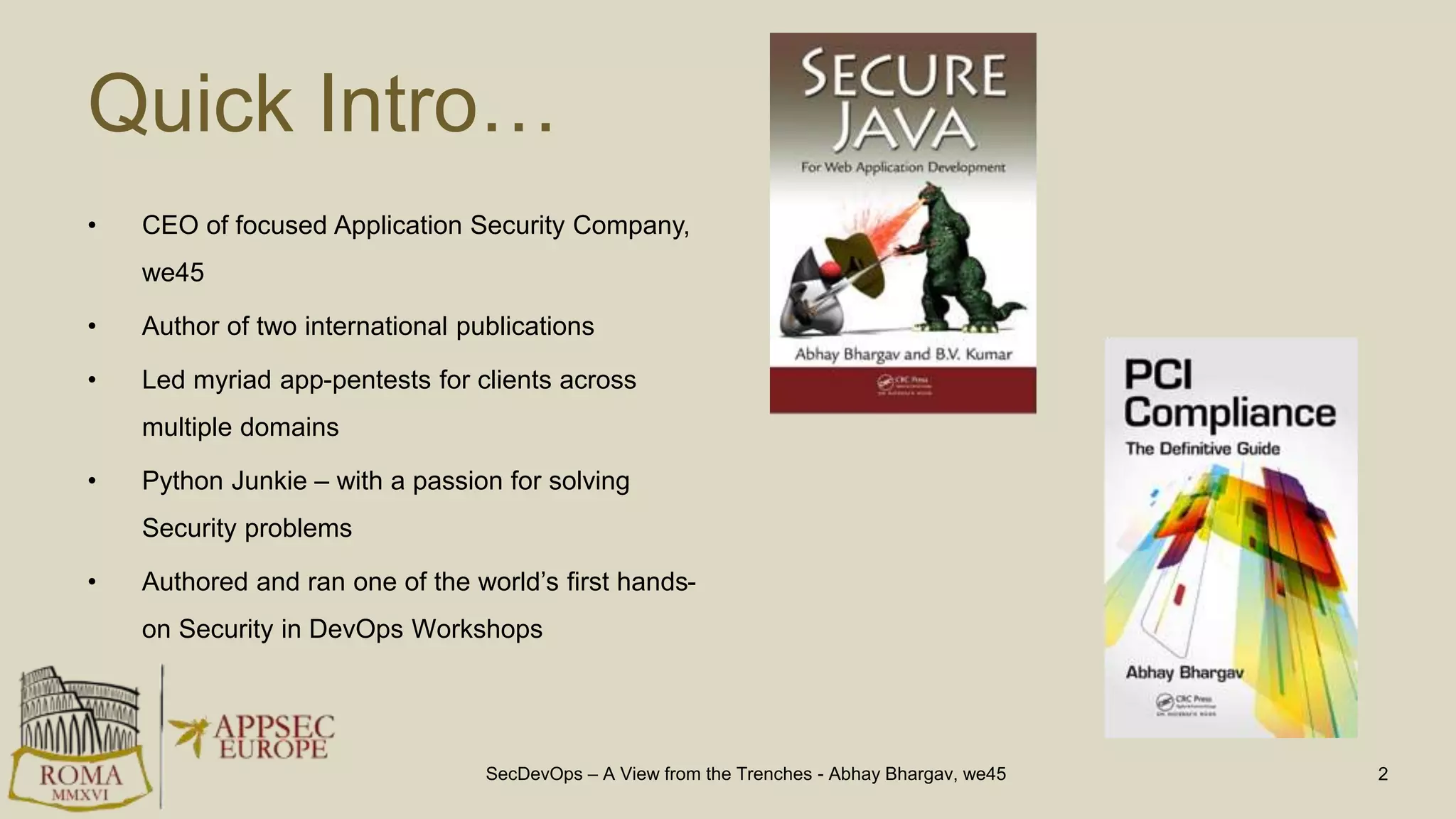
• CEO of focused Application Security Company,
we45
• Author of two international publications
• Led myriad app-pentests for clients across
multiple domains
• Python Junkie – with a passion for solving
Security problems
• Authored and ran one of the world’s first hands-
on Security in DevOps Workshops
SecDevOps – A View from the Trenches - Abhay Bhargav, we45 2
Agenda
• A Case for Security in DevOps (SecDevOps)
• Story 1 – Confessions of a Vulnerability Scanner Junkie
• Story 2 – The Anorexic Threat Model
• Story 3 – Rapid Deployment == Vulnerabilities at Scale
3
Let’s test security just before we go live.
4
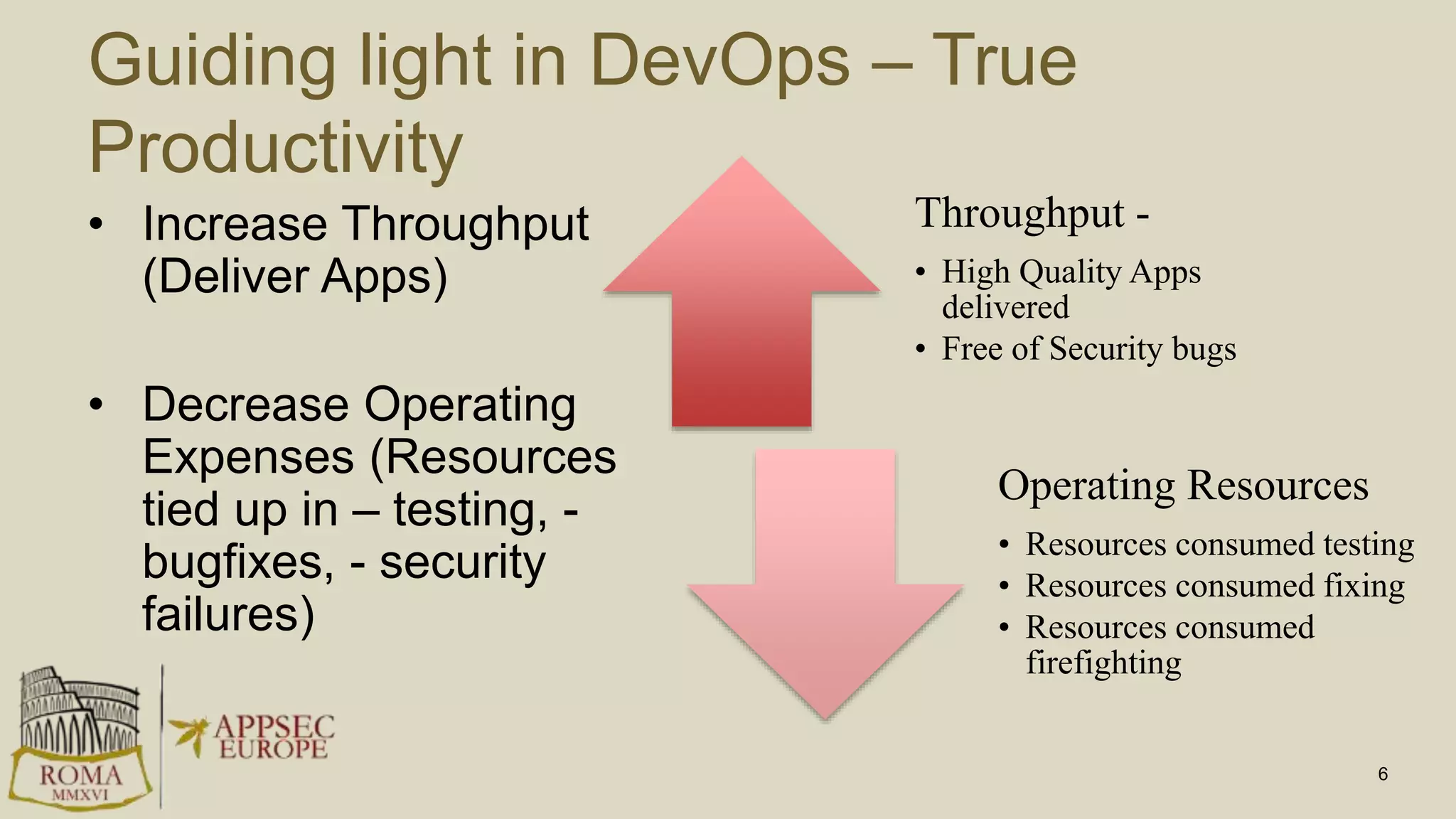
Guiding light in DevOps – True
Productivity
• Increase Throughput
(Deliver Apps)
• Decrease Operating
Expenses (Resources
tied up in – testing, -
bugfixes, - security
failures)
6
Throughput -
• High Quality Apps
delivered
• Free of Security bugs
Operating Resources
• Resources consumed testing
• Resources consumed fixing
• Resources consumed
firefighting
Speed and Scale
• Amazon deploys every 11.6
seconds
• Etsy deploys 25 times a day
• Your apps are probably
deployed on similar lines
9
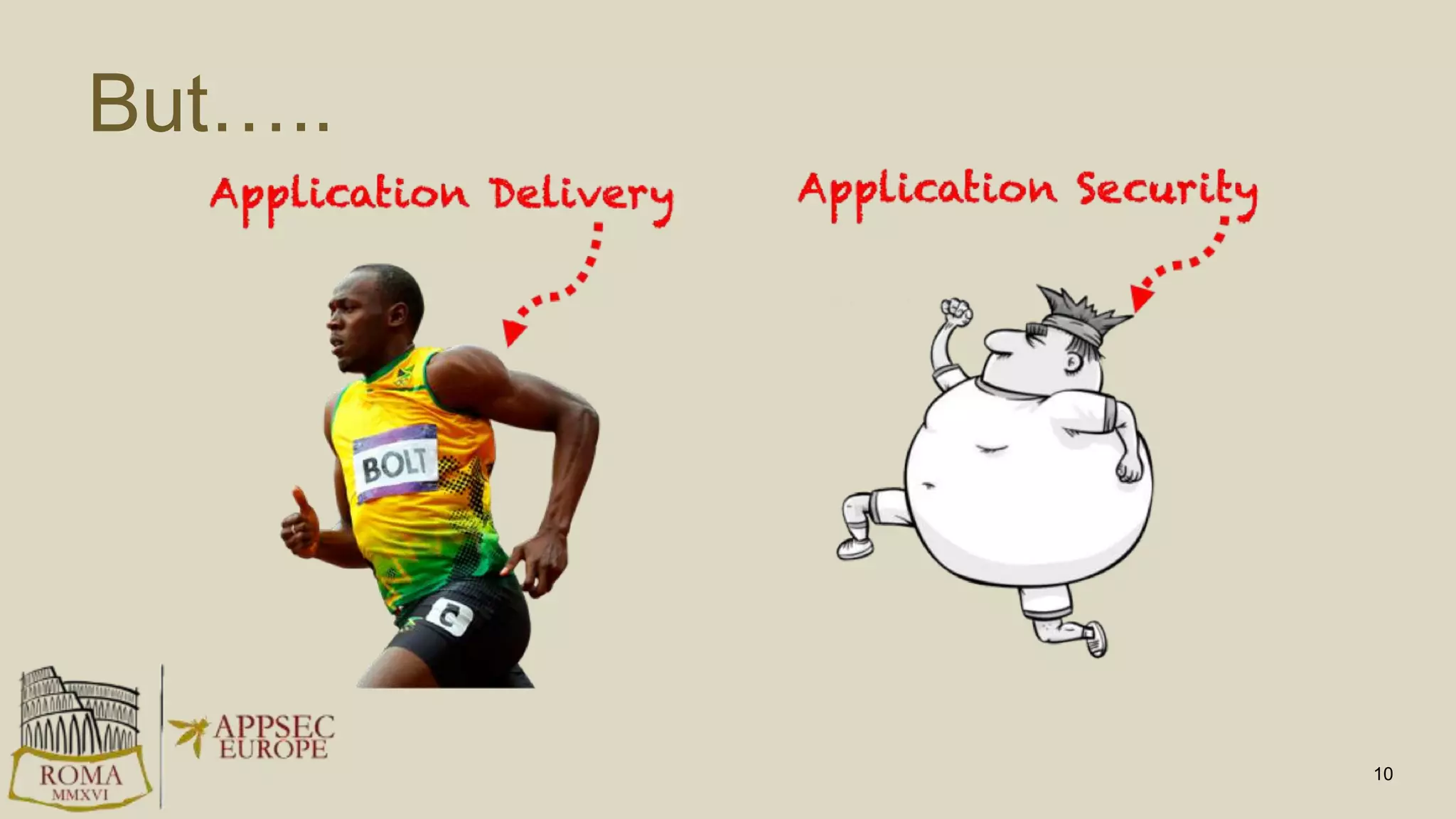
But…..
10
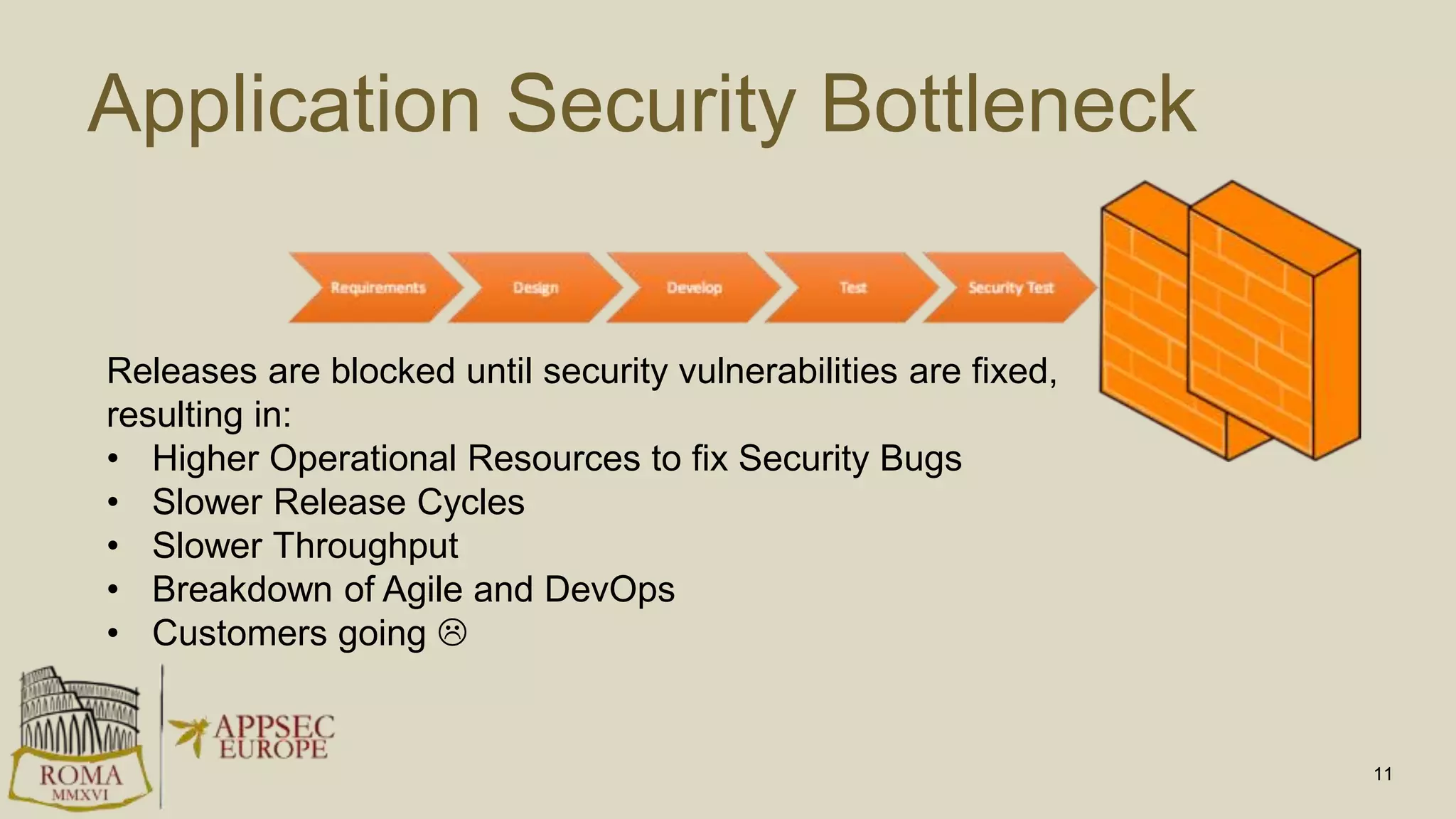
Application Security Bottleneck
11
Releases are blocked until security vulnerabilities are fixed,
resulting in:
• Higher Operational Resources to fix Security Bugs
• Slower Release Cycles
• Slower Throughput
• Breakdown of Agile and DevOps
• Customers going 
Story 1 – The Application Vulnerability
Scanner Junkie
• Working with a Fintech Client
• 5 deploys a day
• Mature DevOps Processes
• Working with SAST and DAST in DevOps
• Seems Perfect, Right?
12
Problem Statement
• Their Customer Pentests constantly came up with
Critical and High Severity Issues
• They seemed to be missing several vulnerabilities –
every release
• No unified perspective on Vulnerabilities
• No validation on False positives
13
Our Diagnosis
• ZAP with Jenkins was giving them minimal coverage
• Authentication – AJAX Driven was hard to automate with
standard headless ZAP
• Web Services Test Quality– very poor
• No “Second Opinion”
• All possibly leading to one conclusion……
14
15
16
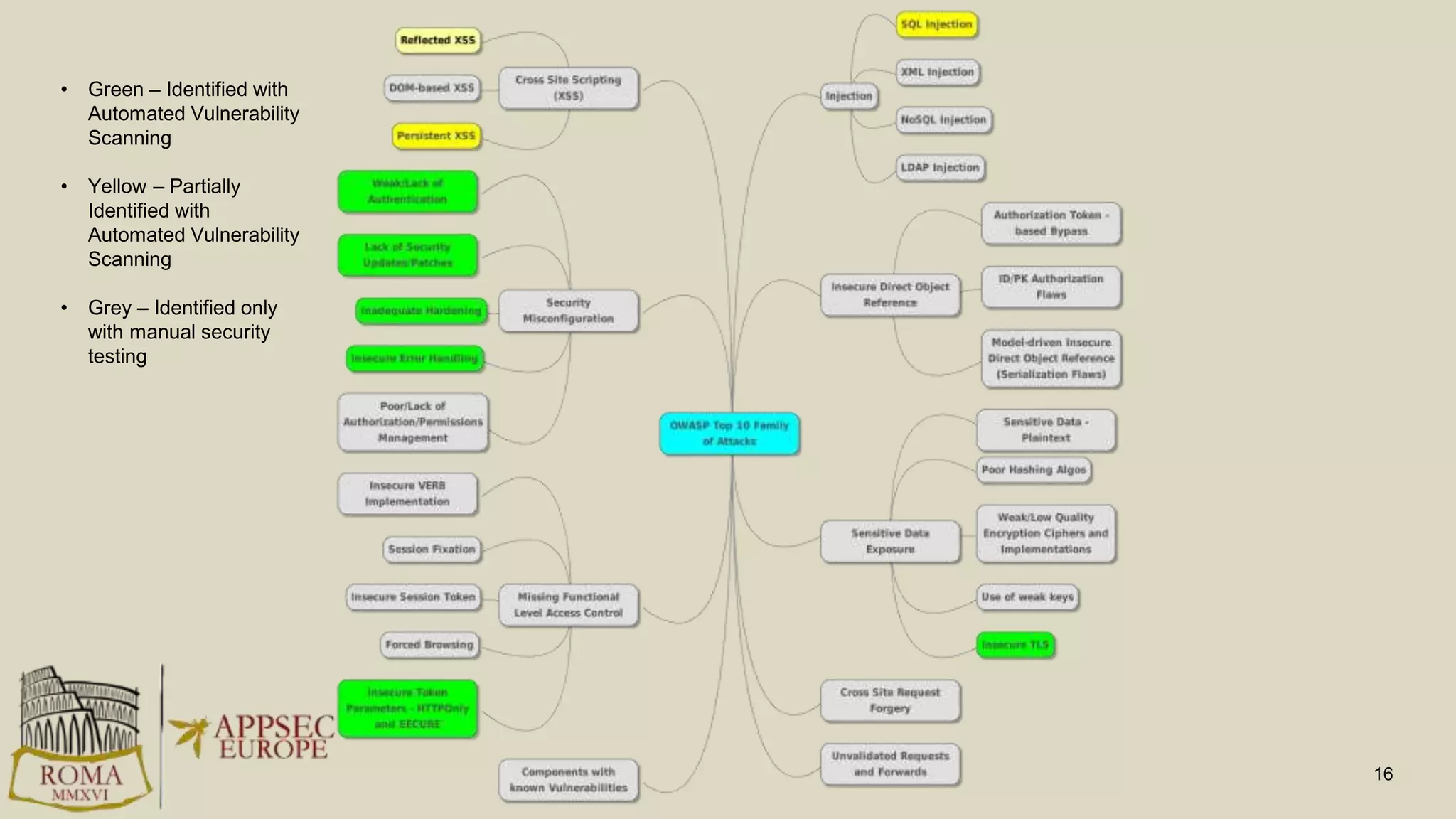
• Green – Identified with
Automated Vulnerability
Scanning
• Yellow – Partially
Identified with
Automated Vulnerability
Scanning
• Grey – Identified only
with manual security
testing
Our Solution - Coverage
• L1 Coverage:
– Leverage ZAP API – Test better with Authentication + Multi-Browser
Headless
– Second Opinion with the w3af REST API
– Integrate Nessus and Nikto for Low-Level Findings
• L2 Coverage:
– Customized Selenium Scripts for specific threat models
– PyRESTTest Test Scripts for specific Web-Services driven Threat
Models
17
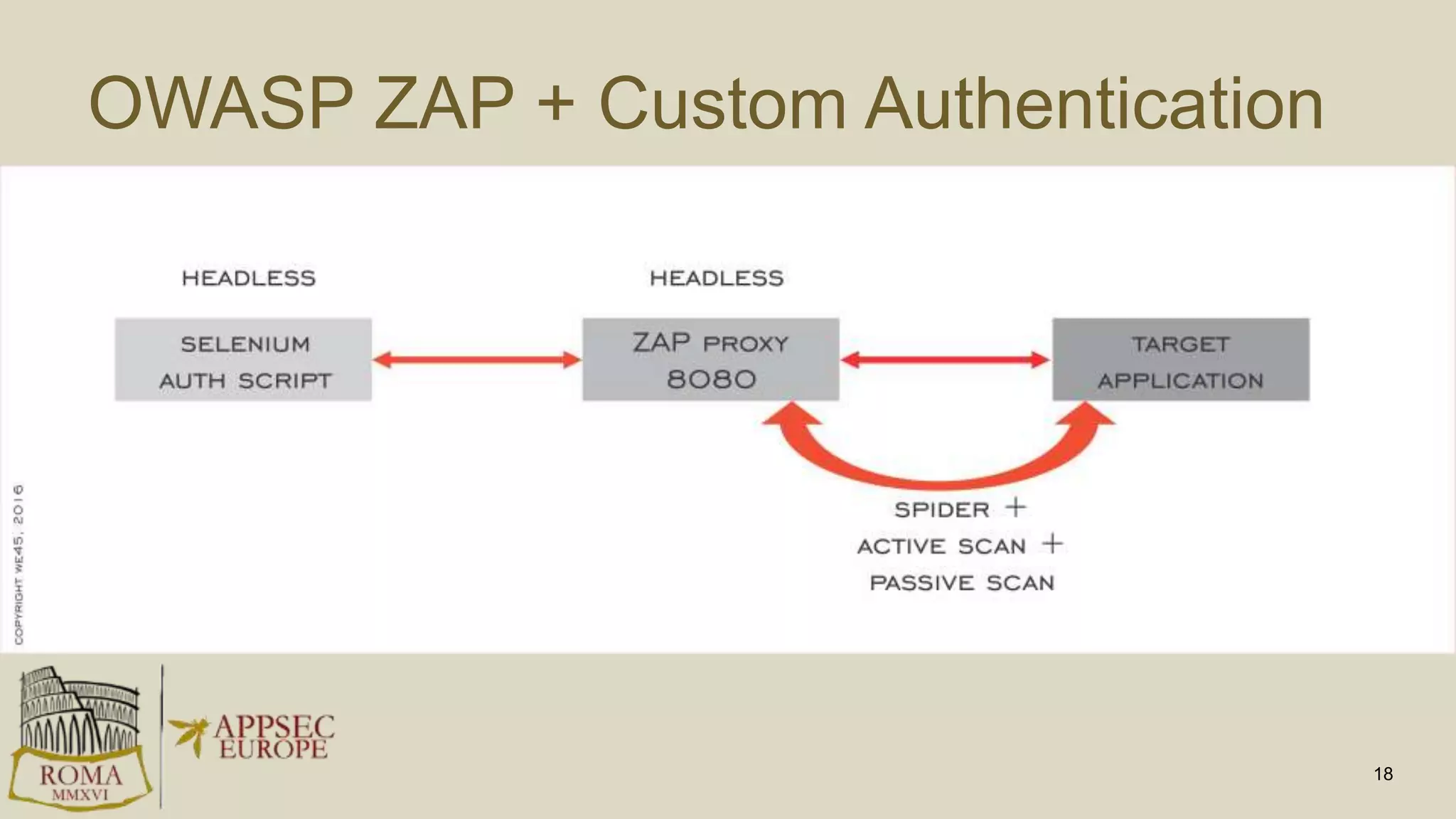
OWASP ZAP + Custom Authentication
18
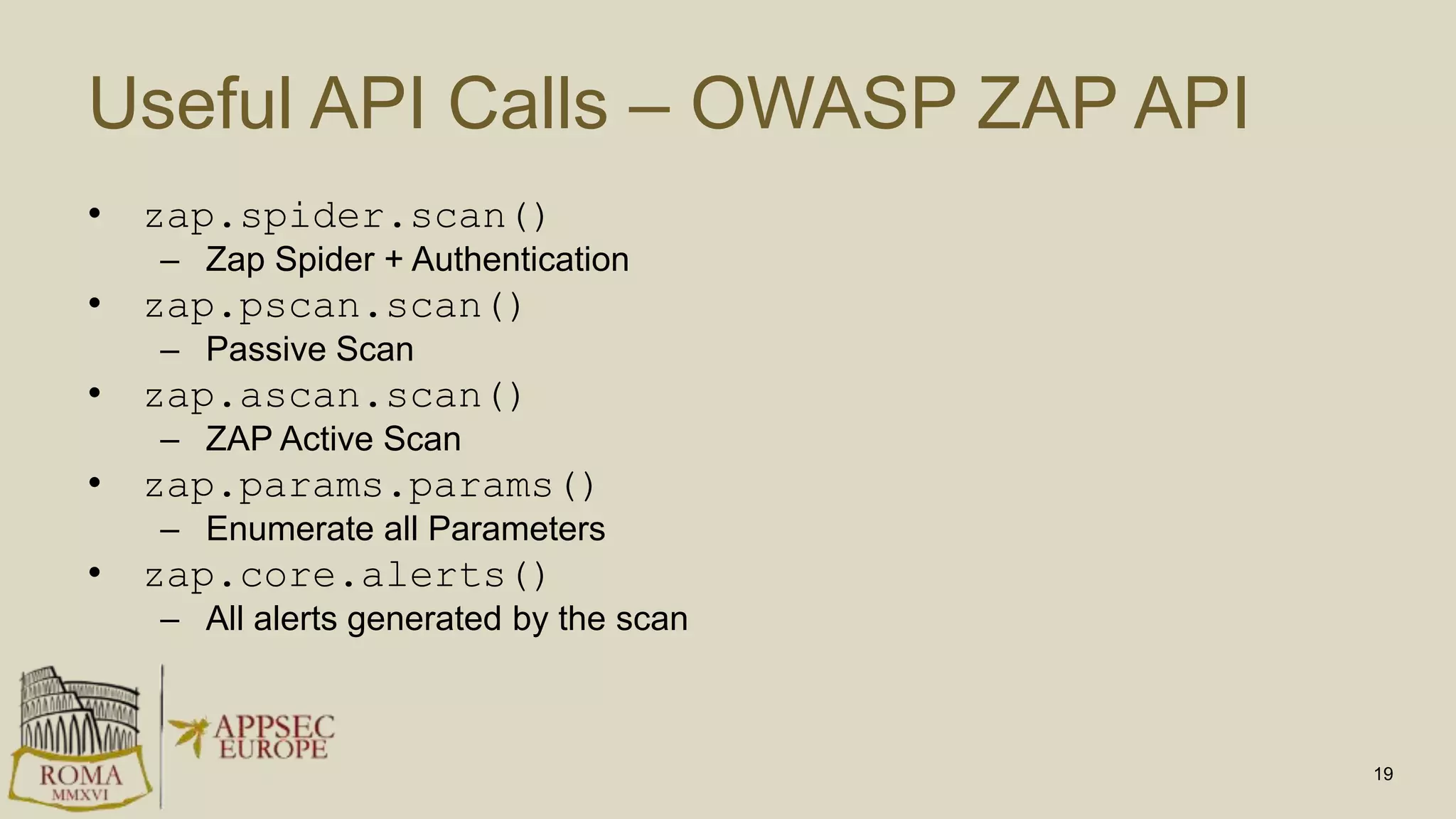
Useful API Calls – OWASP ZAP API
• zap.spider.scan()
– Zap Spider + Authentication
• zap.pscan.scan()
– Passive Scan
• zap.ascan.scan()
– ZAP Active Scan
• zap.params.params()
– Enumerate all Parameters
• zap.core.alerts()
– All alerts generated by the scan
19
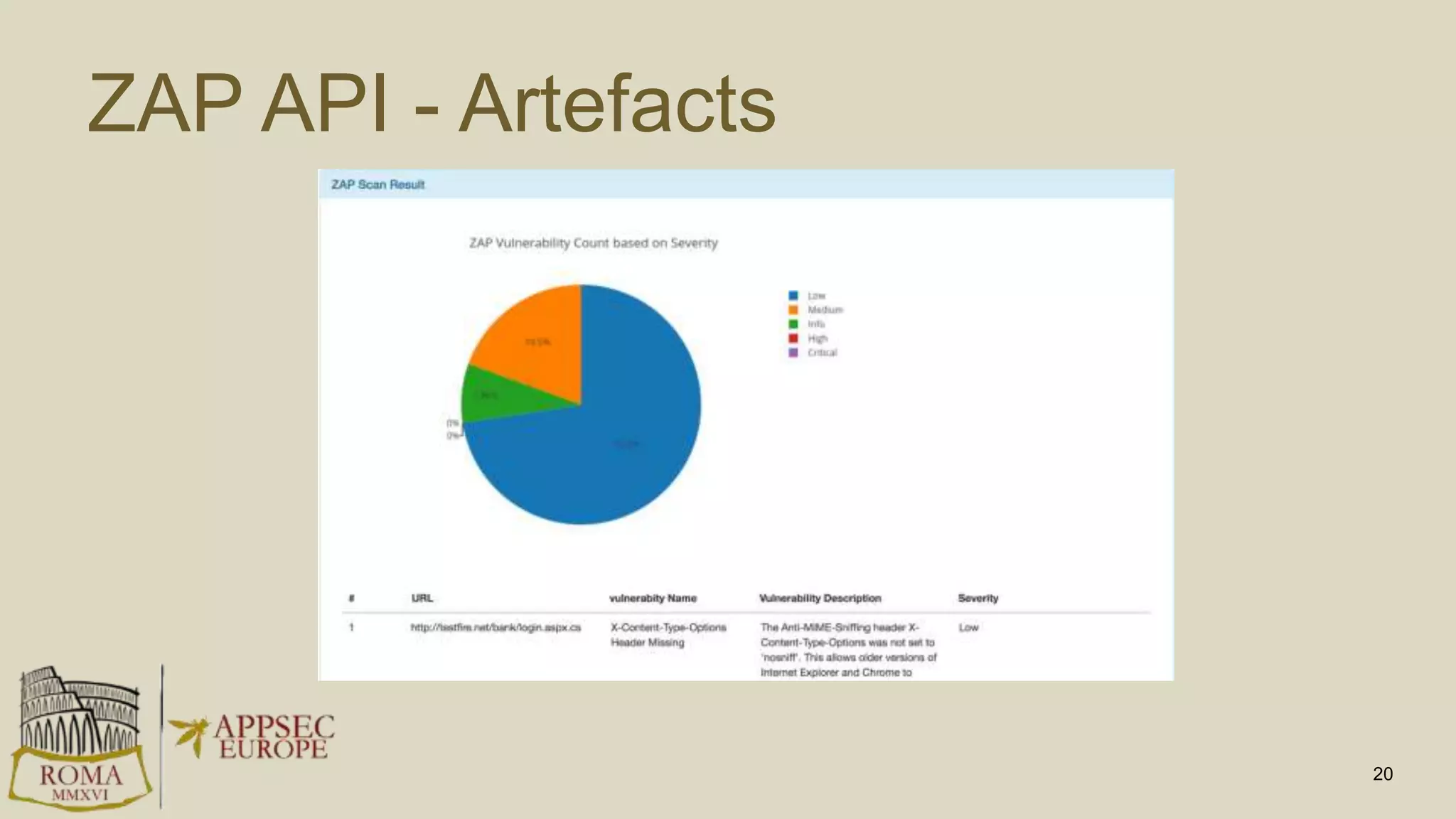
ZAP API - Artefacts
20
w3af API
• w3af’s API is very detailed and easy to use
• HTTP REST API – Detailed views and datasets
• Configurable Scan Profiles
21
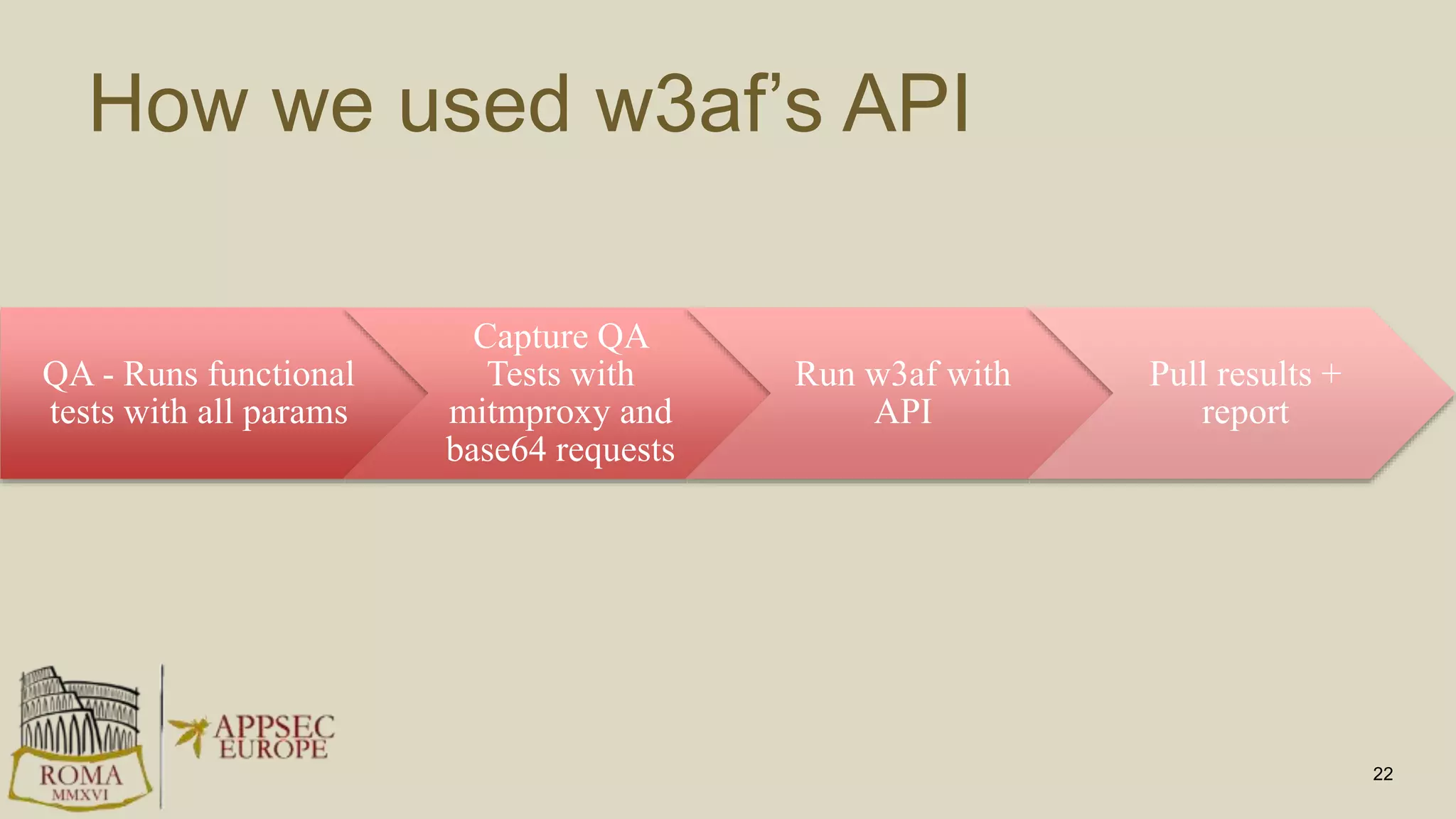
How we used w3af’s API
22
QA - Runs functional
tests with all params
Capture QA
Tests with
mitmproxy and
base64 requests
Run w3af with
API
Pull results +
report
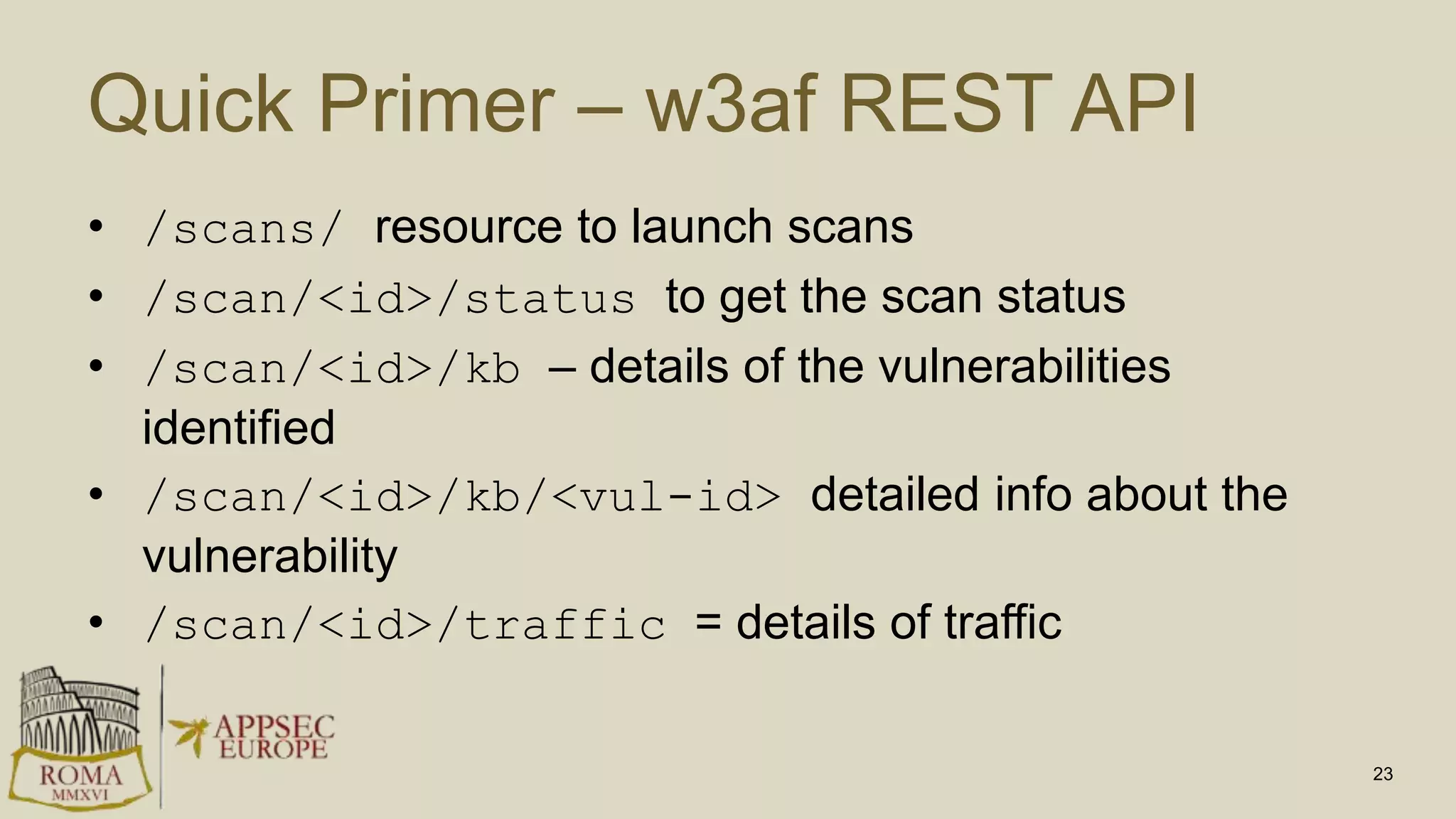
Quick Primer – w3af REST API
• /scans/ resource to launch scans
• /scan/<id>/status to get the scan status
• /scan/<id>/kb – details of the vulnerabilities
identified
• /scan/<id>/kb/<vul-id> detailed info about the
vulnerability
• /scan/<id>/traffic = details of traffic
23
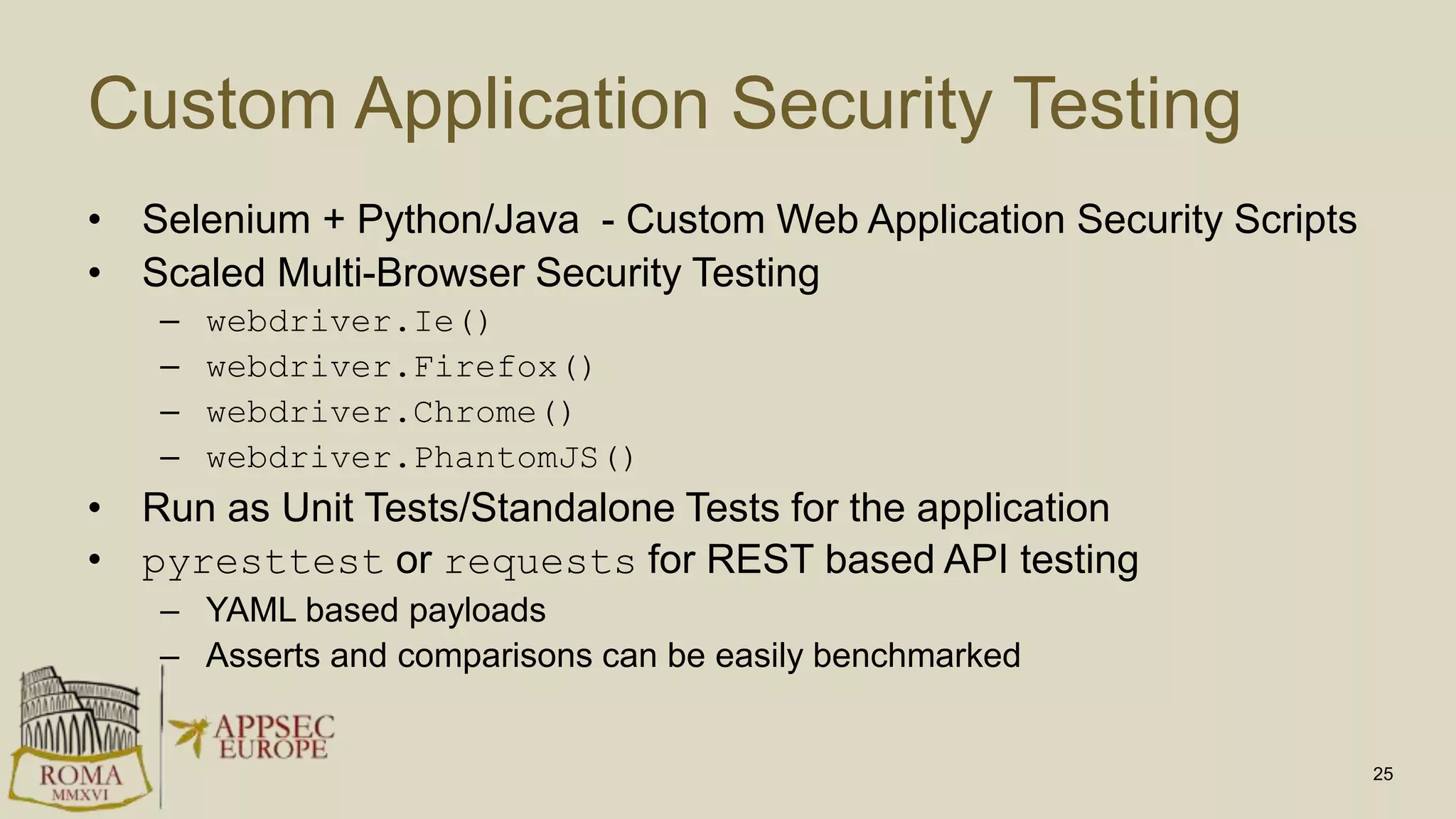
Custom Application Security Testing
• Selenium + Python/Java - Custom Web Application Security Scripts
• Scaled Multi-Browser Security Testing
– webdriver.Ie()
– webdriver.Firefox()
– webdriver.Chrome()
– webdriver.PhantomJS()
• Run as Unit Tests/Standalone Tests for the application
• pyresttest or requests for REST based API testing
– YAML based payloads
– Asserts and comparisons can be easily benchmarked
25
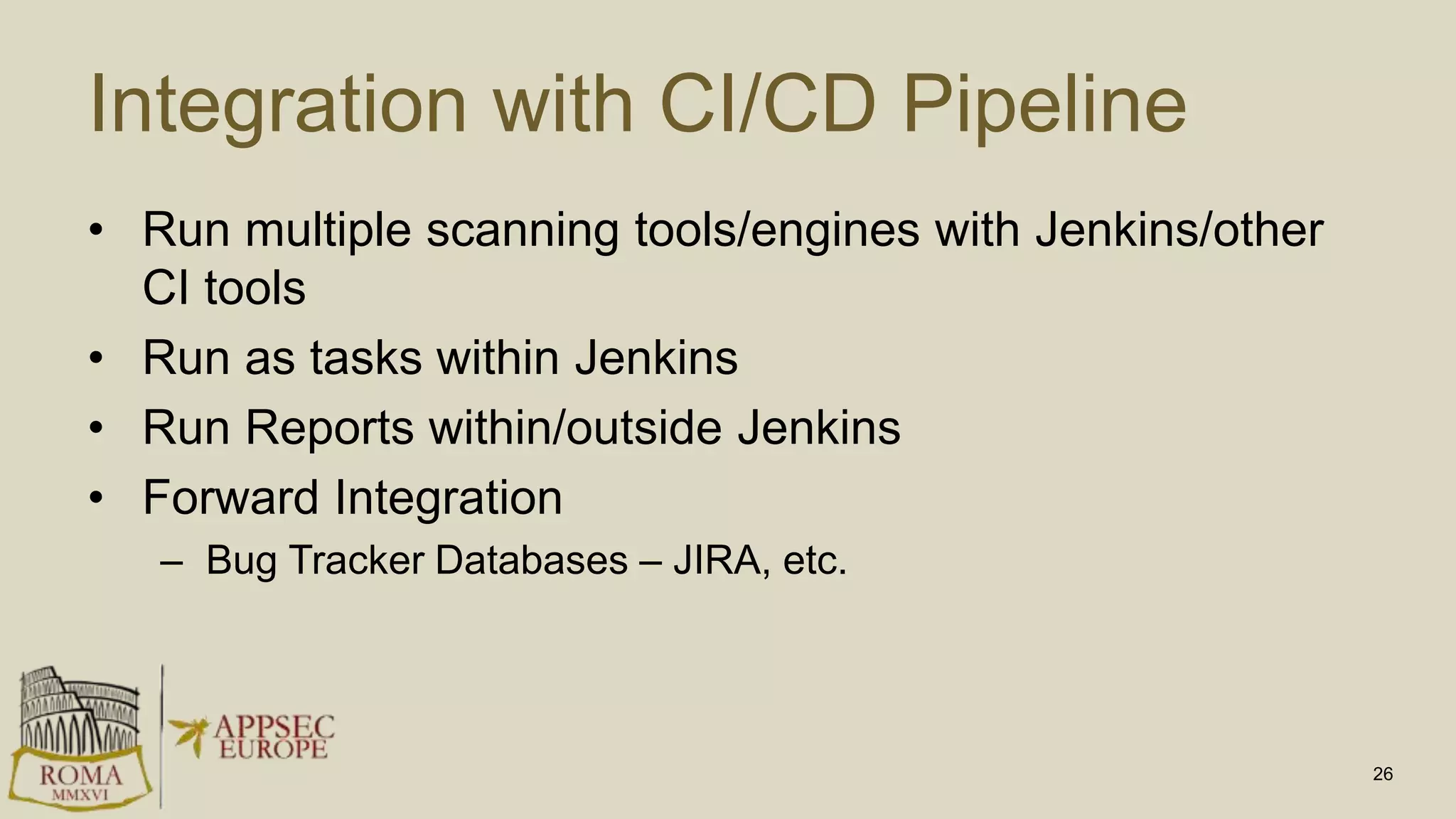
Integration with CI/CD Pipeline
• Run multiple scanning tools/engines with Jenkins/other
CI tools
• Run as tasks within Jenkins
• Run Reports within/outside Jenkins
• Forward Integration
– Bug Tracker Databases – JIRA, etc.
26
Story 2 – The Anorexic Threat Model
• Threat Modeling is dead, Long live the Threat Model!
• Problems of Threat Modeling in a DevOps World
• Practical Approaches to Threat Modeling with Agile and
DevOps
28
29
Everything wrong with Threat Models
Today
• Assumption of frozen requirements – Very Waterfall!
• Threat Models are not dynamic enough – Out of date
with application delivery
• Current Threat Modeling is not collaborative – Bunch of
Security folks at the beginning of a project
30
Requirements – Threat Modeling in a
DevOps World
• Just like deployment – Threat Models must be broken
down into smaller and more regular chunks
• Think of a SCRUM user story and integrate it into the
sprint as an “Abuser Story”
• Engage collaboratively with Agile Team-members
31
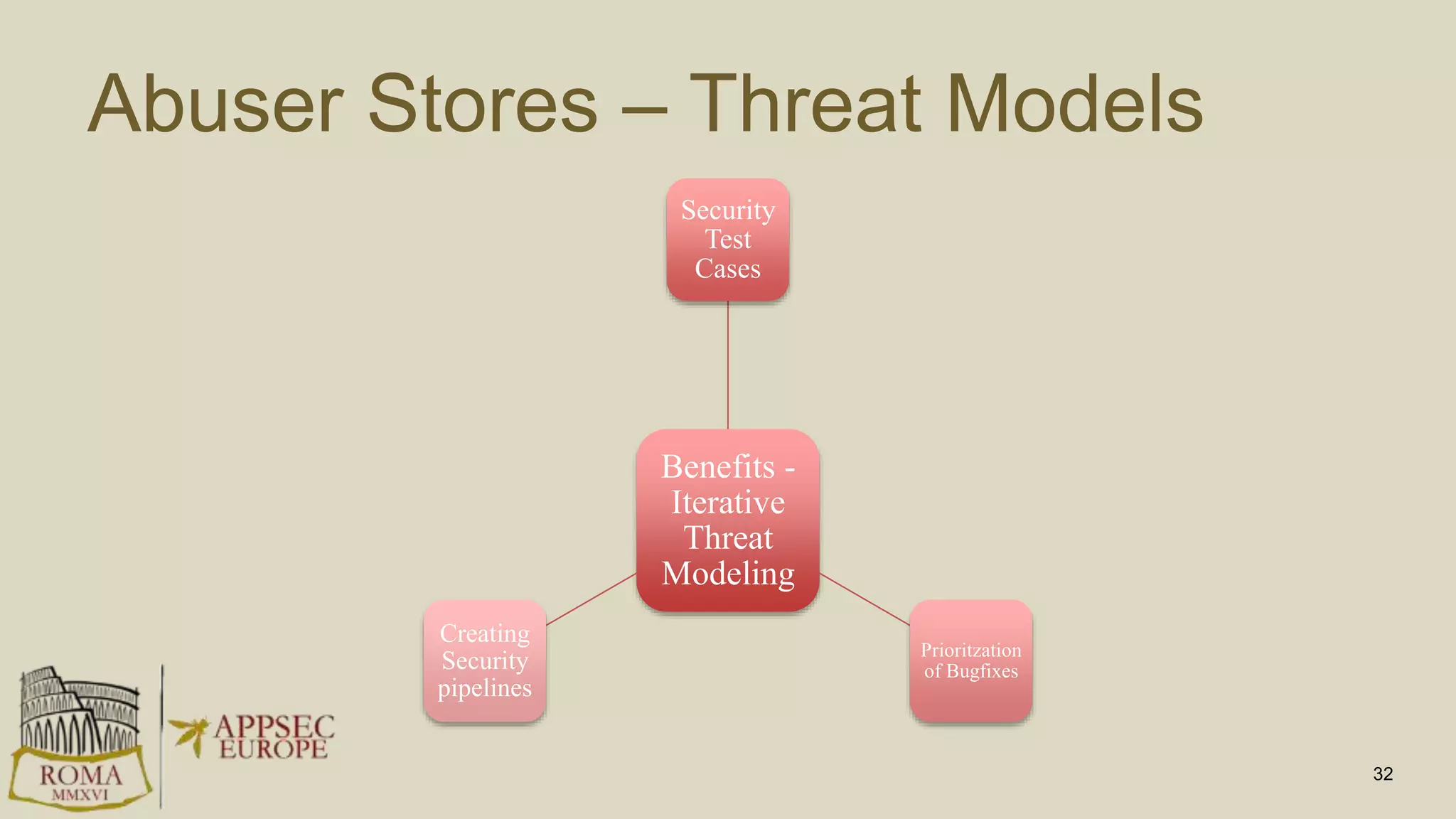
Abuser Stores – Threat Models
32
Benefits -
Iterative
Threat
Modeling
Security
Test
Cases
Prioritzation
of Bugfixes
Creating
Security
pipelines
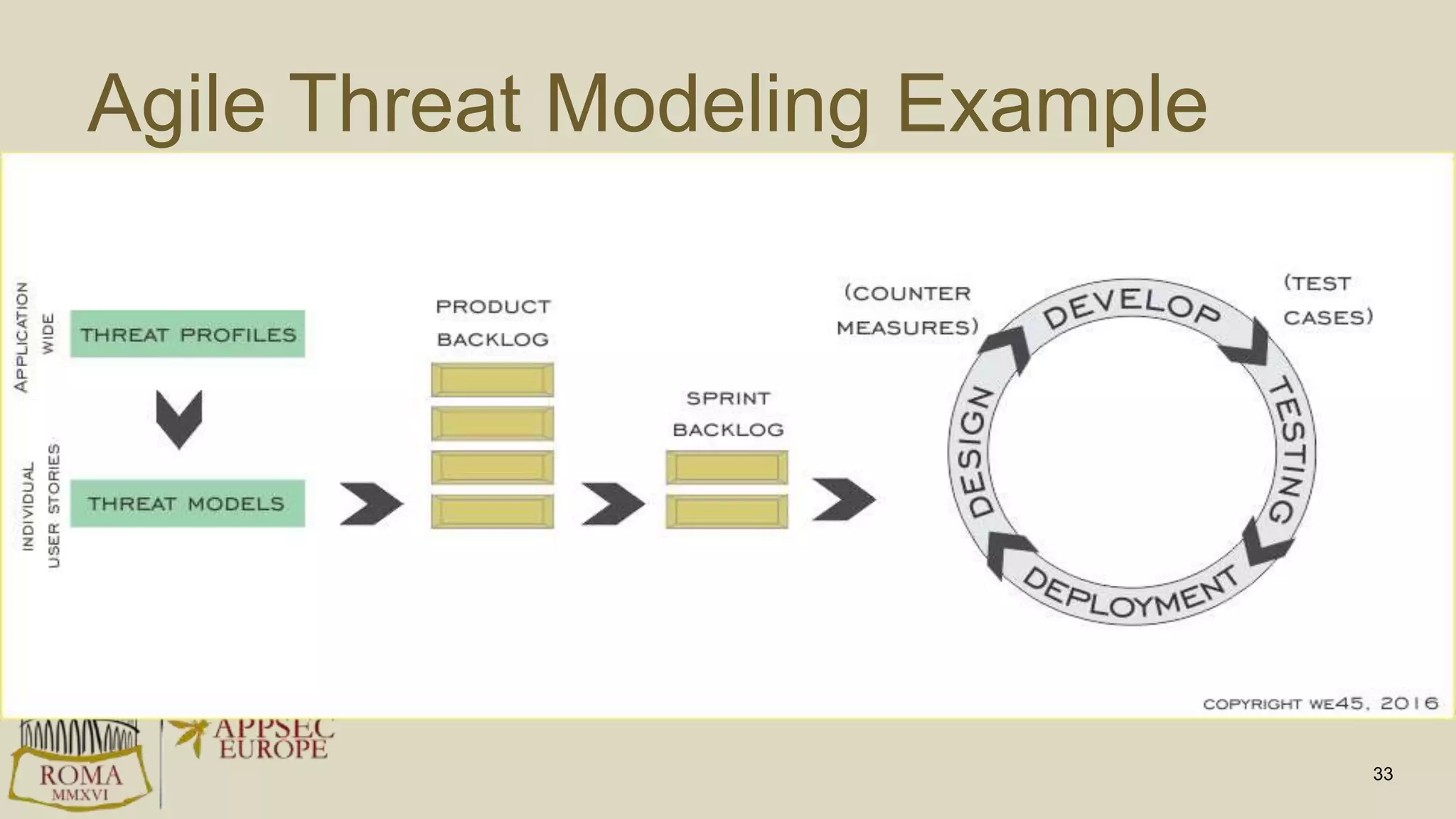
Agile Threat Modeling Example
33
Story 3 – Rapid Deployments ==
Vulnerabilities at Scale
• Docker, Infrastructure as Code is great, but…..
• Security Failures in IaC
• Practical Steps:
– Security Testing IaC Deployments
– Other practices
34
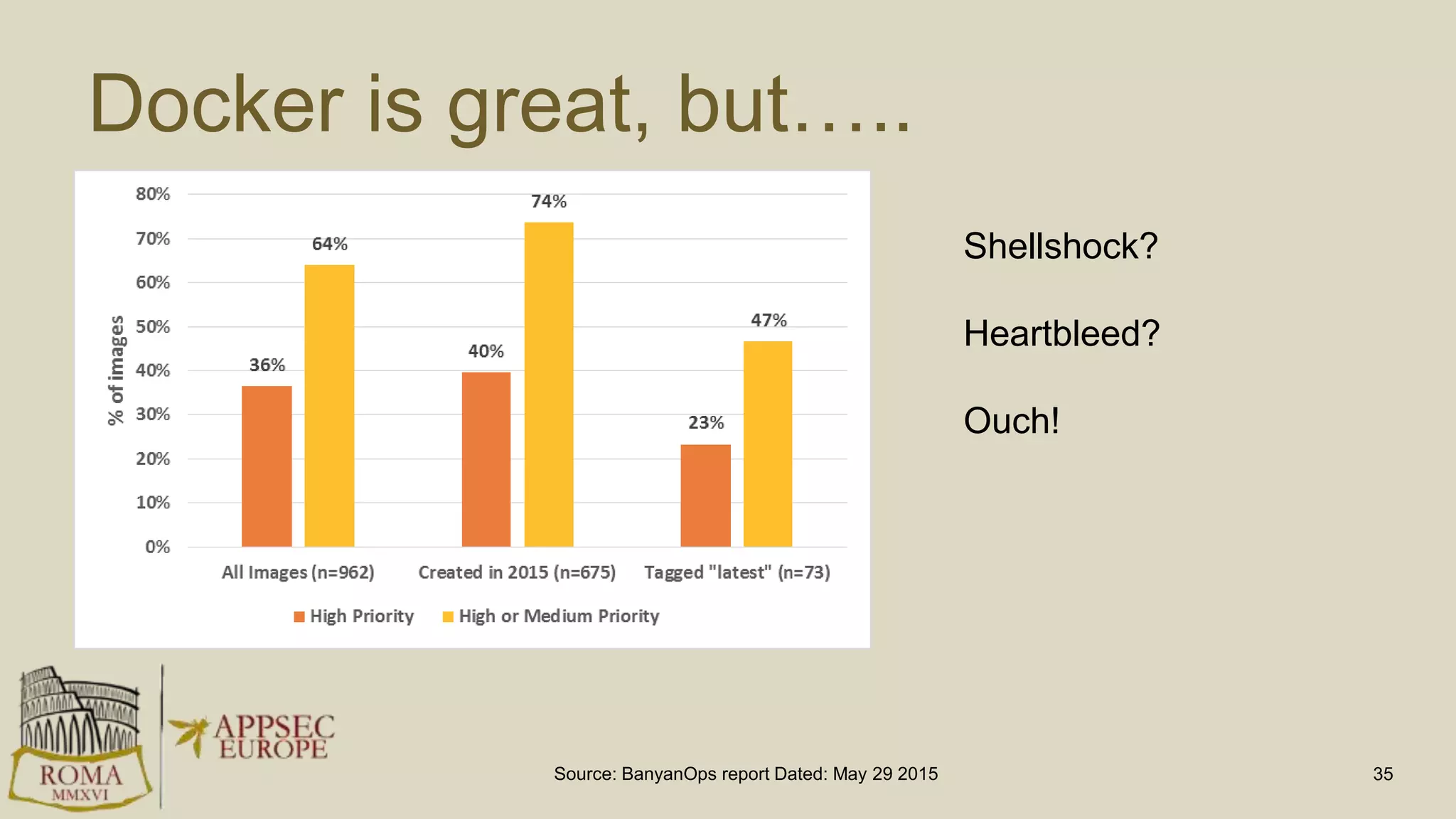
Docker is great, but…..
Source: BanyanOps report Dated: May 29 2015 35
Shellshock?
Heartbleed?
Ouch!
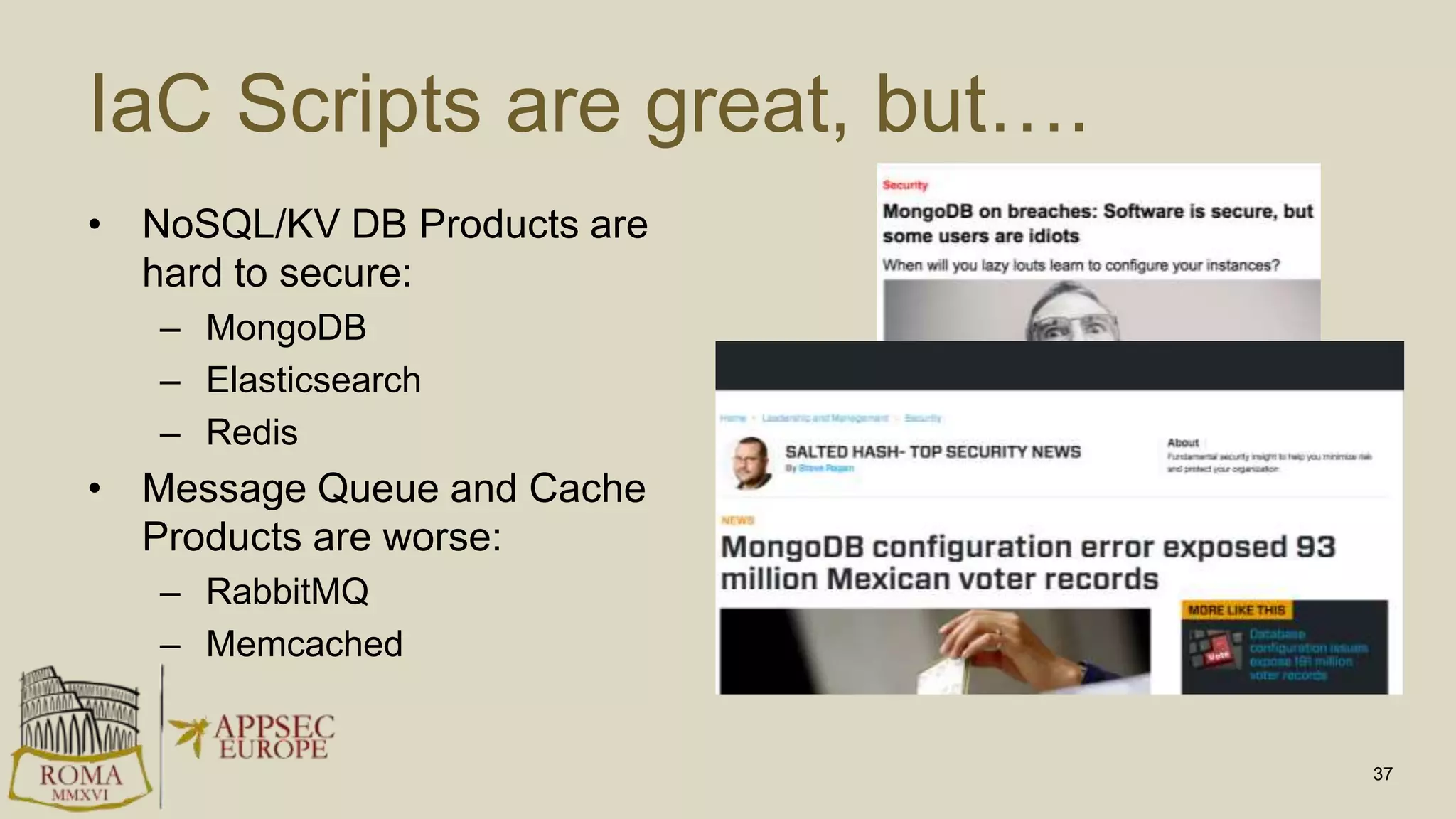
IaC Scripts are great, but….
• NoSQL/KV DB Products are
hard to secure:
– MongoDB
– Elasticsearch
– Redis
• Message Queue and Cache
Products are worse:
– RabbitMQ
– Memcached
37
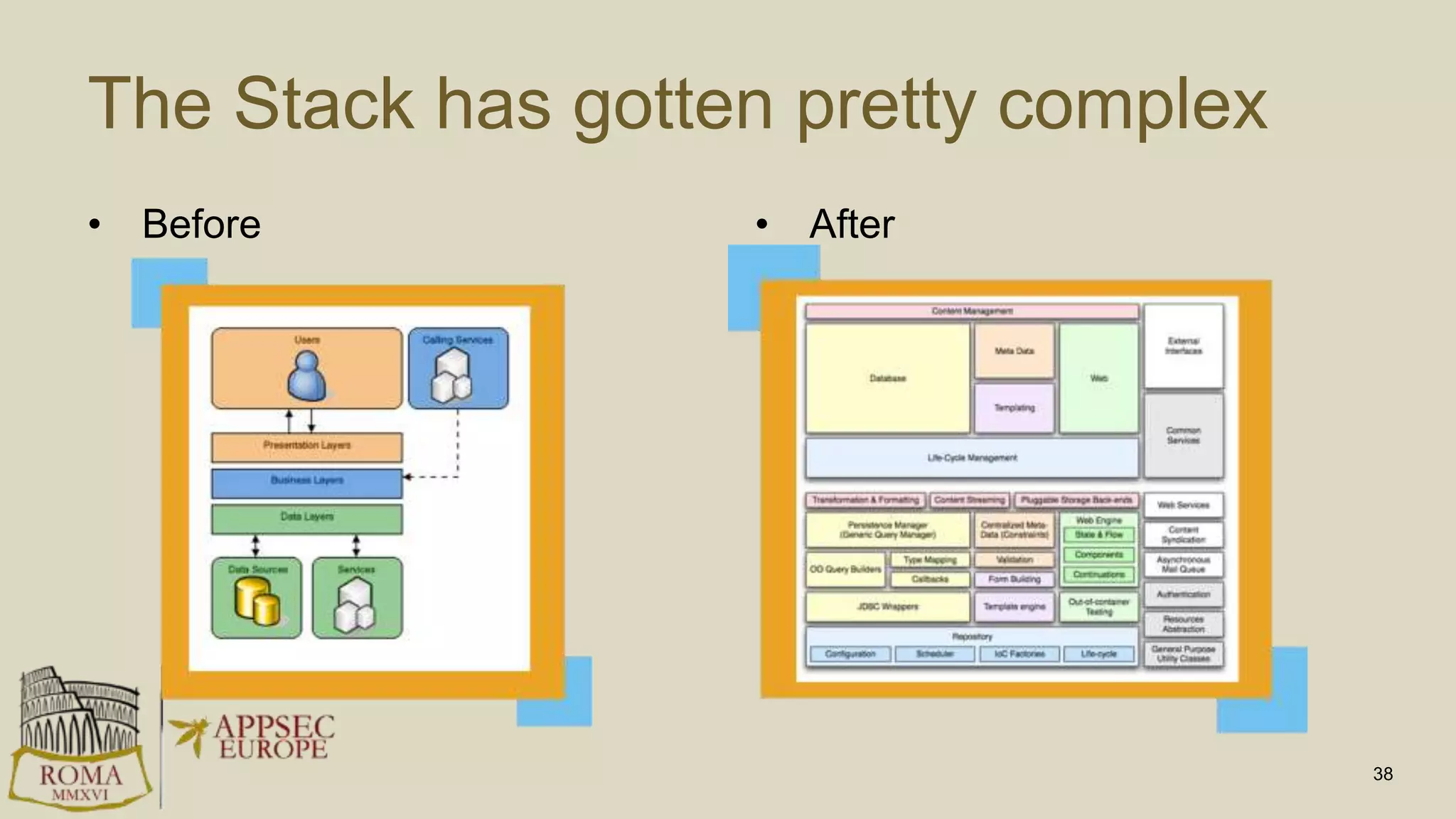
The Stack has gotten pretty complex
• Before • After
38
Lack of Documentation
• Security in Configs are hard to
locate
• In-house Security
documentation - nearly non-
existent
• “Security Hardening
Documents” - mostly for Audit
purposes
39
How do we solve this?
• Higher awareness:
– Hardening Framework for IaC => https://github.com/dev-sec
• Validation
– Integrating Security Scanners with IaC Deployments +
Specialized Scripts
• Nmap + NSE Scripts for Specific deployments
• Lynis
• Integration with Vulnerability Feeds
• Code Review?
40
Conclusion
• DevOps and Security can play well together
• We just need to fit the pieces
• And keep it fitted as continuously as possible
42
Thank You!
• Email: abhay@we45.com
• Twitter: @abhaybhargav
• LinkedIn:
www.linkedin.com/in/abhaybhargav
43

OWASP AppSec EU - SecDevOps, a view from the trenches - Abhay Bhargav

  • 1.
  • 2.
    Quick Intro… • CEOof focused Application Security Company, we45 • Author of two international publications • Led myriad app-pentests for clients across multiple domains • Python Junkie – with a passion for solving Security problems • Authored and ran one of the world’s first hands- on Security in DevOps Workshops SecDevOps – A View from the Trenches - Abhay Bhargav, we45 2
  • 3.
    Agenda • A Casefor Security in DevOps (SecDevOps) • Story 1 – Confessions of a Vulnerability Scanner Junkie • Story 2 – The Anorexic Threat Model • Story 3 – Rapid Deployment == Vulnerabilities at Scale 3
  • 4.
    Let’s test securityjust before we go live. 4
  • 5.
    Guiding light inDevOps – True Productivity • Increase Throughput (Deliver Apps) • Decrease Operating Expenses (Resources tied up in – testing, - bugfixes, - security failures) 6 Throughput - • High Quality Apps delivered • Free of Security bugs Operating Resources • Resources consumed testing • Resources consumed fixing • Resources consumed firefighting
  • 6.
    Speed and Scale •Amazon deploys every 11.6 seconds • Etsy deploys 25 times a day • Your apps are probably deployed on similar lines 9
  • 7.
  • 8.
    Application Security Bottleneck 11 Releasesare blocked until security vulnerabilities are fixed, resulting in: • Higher Operational Resources to fix Security Bugs • Slower Release Cycles • Slower Throughput • Breakdown of Agile and DevOps • Customers going 
  • 9.
    Story 1 –The Application Vulnerability Scanner Junkie • Working with a Fintech Client • 5 deploys a day • Mature DevOps Processes • Working with SAST and DAST in DevOps • Seems Perfect, Right? 12
  • 10.
    Problem Statement • TheirCustomer Pentests constantly came up with Critical and High Severity Issues • They seemed to be missing several vulnerabilities – every release • No unified perspective on Vulnerabilities • No validation on False positives 13
  • 11.
    Our Diagnosis • ZAPwith Jenkins was giving them minimal coverage • Authentication – AJAX Driven was hard to automate with standard headless ZAP • Web Services Test Quality– very poor • No “Second Opinion” • All possibly leading to one conclusion…… 14
  • 12.
  • 13.
    16 • Green –Identified with Automated Vulnerability Scanning • Yellow – Partially Identified with Automated Vulnerability Scanning • Grey – Identified only with manual security testing
  • 14.
    Our Solution -Coverage • L1 Coverage: – Leverage ZAP API – Test better with Authentication + Multi-Browser Headless – Second Opinion with the w3af REST API – Integrate Nessus and Nikto for Low-Level Findings • L2 Coverage: – Customized Selenium Scripts for specific threat models – PyRESTTest Test Scripts for specific Web-Services driven Threat Models 17
  • 15.
    OWASP ZAP +Custom Authentication 18
  • 16.
    Useful API Calls– OWASP ZAP API • zap.spider.scan() – Zap Spider + Authentication • zap.pscan.scan() – Passive Scan • zap.ascan.scan() – ZAP Active Scan • zap.params.params() – Enumerate all Parameters • zap.core.alerts() – All alerts generated by the scan 19
  • 17.
    ZAP API -Artefacts 20
  • 18.
    w3af API • w3af’sAPI is very detailed and easy to use • HTTP REST API – Detailed views and datasets • Configurable Scan Profiles 21
  • 19.
    How we usedw3af’s API 22 QA - Runs functional tests with all params Capture QA Tests with mitmproxy and base64 requests Run w3af with API Pull results + report
  • 20.
    Quick Primer –w3af REST API • /scans/ resource to launch scans • /scan/<id>/status to get the scan status • /scan/<id>/kb – details of the vulnerabilities identified • /scan/<id>/kb/<vul-id> detailed info about the vulnerability • /scan/<id>/traffic = details of traffic 23
  • 21.
    Custom Application SecurityTesting • Selenium + Python/Java - Custom Web Application Security Scripts • Scaled Multi-Browser Security Testing – webdriver.Ie() – webdriver.Firefox() – webdriver.Chrome() – webdriver.PhantomJS() • Run as Unit Tests/Standalone Tests for the application • pyresttest or requests for REST based API testing – YAML based payloads – Asserts and comparisons can be easily benchmarked 25
  • 22.
    Integration with CI/CDPipeline • Run multiple scanning tools/engines with Jenkins/other CI tools • Run as tasks within Jenkins • Run Reports within/outside Jenkins • Forward Integration – Bug Tracker Databases – JIRA, etc. 26
  • 23.
    Story 2 –The Anorexic Threat Model • Threat Modeling is dead, Long live the Threat Model! • Problems of Threat Modeling in a DevOps World • Practical Approaches to Threat Modeling with Agile and DevOps 28
  • 24.
  • 25.
    Everything wrong withThreat Models Today • Assumption of frozen requirements – Very Waterfall! • Threat Models are not dynamic enough – Out of date with application delivery • Current Threat Modeling is not collaborative – Bunch of Security folks at the beginning of a project 30
  • 26.
    Requirements – ThreatModeling in a DevOps World • Just like deployment – Threat Models must be broken down into smaller and more regular chunks • Think of a SCRUM user story and integrate it into the sprint as an “Abuser Story” • Engage collaboratively with Agile Team-members 31
  • 27.
    Abuser Stores –Threat Models 32 Benefits - Iterative Threat Modeling Security Test Cases Prioritzation of Bugfixes Creating Security pipelines
  • 28.
  • 29.
    Story 3 –Rapid Deployments == Vulnerabilities at Scale • Docker, Infrastructure as Code is great, but….. • Security Failures in IaC • Practical Steps: – Security Testing IaC Deployments – Other practices 34
  • 30.
    Docker is great,but….. Source: BanyanOps report Dated: May 29 2015 35 Shellshock? Heartbleed? Ouch!
  • 31.
    IaC Scripts aregreat, but…. • NoSQL/KV DB Products are hard to secure: – MongoDB – Elasticsearch – Redis • Message Queue and Cache Products are worse: – RabbitMQ – Memcached 37
  • 32.
    The Stack hasgotten pretty complex • Before • After 38
  • 33.
    Lack of Documentation •Security in Configs are hard to locate • In-house Security documentation - nearly non- existent • “Security Hardening Documents” - mostly for Audit purposes 39
  • 34.
    How do wesolve this? • Higher awareness: – Hardening Framework for IaC => https://github.com/dev-sec • Validation – Integrating Security Scanners with IaC Deployments + Specialized Scripts • Nmap + NSE Scripts for Specific deployments • Lynis • Integration with Vulnerability Feeds • Code Review? 40
  • 35.
    Conclusion • DevOps andSecurity can play well together • We just need to fit the pieces • And keep it fitted as continuously as possible 42
  • 36.
    Thank You! • Email:abhay@we45.com • Twitter: @abhaybhargav • LinkedIn: www.linkedin.com/in/abhaybhargav 43

Editor's Notes

  • #3 Afternoon ladies and gentlemen, I can imagine how you’re all feeling for this session before lunch. I think the OWASP’s motto for this session was “catch em when they’re hungry”
  • #4 Towards the end of the slide – “I think there has been one line that has ruined application security for all of us. Forever.
  • #5 I realized that this works, because while we claim to have embraced Agile Development and DevOps, we treat security in a very waterfall way. We cant seem to process it unless its in sequence.
  • #10 Of course, this has happened. Application Delivery just got really quick. It doesn’t matter if your Amazon or whatever, you are delivering apps this way.
  • #11 So Application security is like this now….