SecDevOps Risk Workflow
v0.6
InfoSecWeek, Oct 2016
@DinisCruz
Me
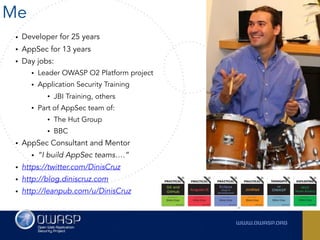
• Developer for 25 years
• AppSec for 13 years
• Day jobs:
• Leader OWASP O2 Platform project
• Application Security Training
• JBI Training, others
• Part of AppSec team of:
• The Hut Group
• BBC
• AppSec Consultant and Mentor
• “I build AppSec teams….”
• https://twitter.com/DinisCruz
• http://blog.diniscruz.com
• http://leanpub.com/u/DinisCruz
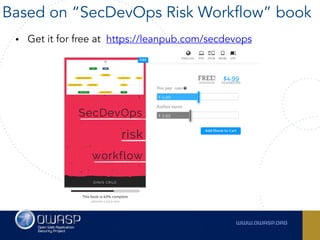
• Get it for free at https://leanpub.com/secdevops
Based on “SecDevOps Risk Workflow” book
APPSEC, INFOSEC, POLLUTION
• (unit) Test - For me a test is anything that can be executed
with one of these Unit Test Frameworks: https://
en.wikipedia.org/wiki/List_of_unit_testing_frameworks
• RISK - Abuse the concept, found RISK to be best one for the
wide range of issues covered by AppSec, while being
understood by all players
• 100% Code Coverage - not the summit, but base-camp (i.e.
not the destination). And 100% code is not enough, we really
need 500% or more Code Coverage)
• AppSec ~= Non Functional requirements - AppSec is about
understanding and controlling app’s unintended behaviours
Disclaimers
• InfoSec is about:
– Networks, Firewalls, Server security, Anti-virus, IDS, Logging, NOC,
Policies, end-user security, mobile devices, AD/Ldap management,
user provisioning, DevOps, ….
• AppSec is about:
– code, apps, CI, secure coding standards, threat models,
frameworks, code dependencies, QA, testing, fuzzing, dev
environments, DevOps, ….
• If your ‘InfoSec’ team/person cannot code (and would not be
hired by the Dev team), then that is NOT AppSec.
• Both are equally important, but InfoSec is much more mature,
has bigger budgets and is understood by the business
AppSec vs InfoSec
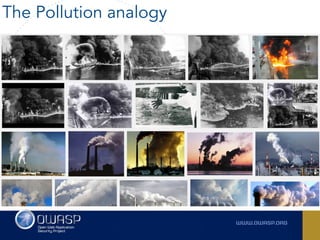
The Pollution analogy
• The developers are the ones who pays the
debt
• Pollution is a much better analogy
• The key is to make the business accept the
risk (i.e the debt)
– make sure it is your boss who gets fired (all the way to
the board)
• Which is done using the JIRA RISK Workflows
Technical Debt is a bad analogy
RISK WORKFLOW
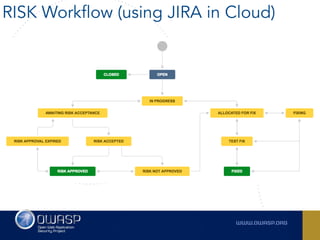
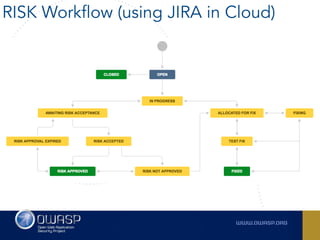
RISK Workflow (using JIRA in Cloud)
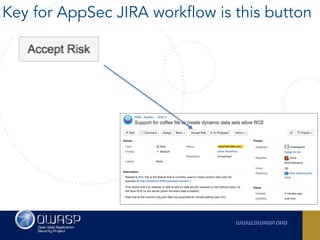
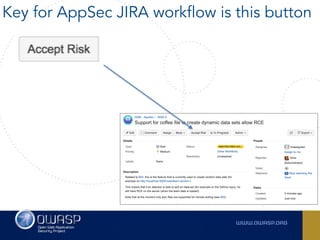
Key for AppSec JIRA workflow is this button
CSO POINT VIEW
• Create an environment and workflow where Security (InfoSec and
AppSec) is an enabler.
• Allow the business to ship faster with quality, security and assurance
• InfoSec protects the organisation and operations
• AppSec protects the code created, used and bought
• Developers code in environments where it is very hard to create
security vulnerabilities
• Applications run in environments where security exploits are
contained and visible
• Align business risk appetite with reality (using proposed Risk
Workflow to allocate responsibility at the correct level)
What type of security organisation to create
• Give security teams a mandate to focus on Quality, Testing and
Engineering
• Create a network of Security Champions
• Become the ‘Department of Yes’
• Measure code pollution using Risk Workflow
• Understand that developers are key players and need to be
trusted
• Testing and Quality are core business requirements (and what
gives you speed)
• Create an central AppSec team (usually there is only an InfoSec
team)
How to embed security into the culture
• Security policies are the foundation of decisions
• They underpin the reason behind actions and risk accepted
• But, if not based on reality, most policies will NOT be
– read
– followed
– enforced
• For policies to work they need to be customised to its
target (for example Secure coding standards for App XYZ)
• They also need to be delivered in the target’s environment
(for example IDE)
What about security policies?
• If you don’t
– have an AppSec team
– do Threat Models
– do weekly code reviews and security assessments
– have embedded security automation automation in your SDL pipeline
– have secure coding standards, bug-bounties, dependency management
– …. and many other other AppSec activities
• Where is security going to come from?
• without them … there will be massive security vulnerabilities in code and
apps used
• and your security model is based on the ‘skill level and business model’
of your attackers
Security magic pixie dust
DEVOPS AND SECDEVOPS
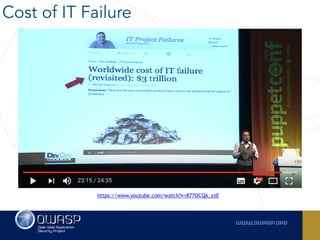
Cost of IT Failure
https://www.youtube.com/watch?v=877OCQA_xzE
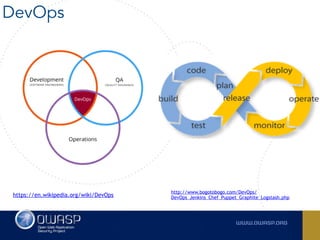
DevOps
https://en.wikipedia.org/wiki/DevOps
http://www.bogotobogo.com/DevOps/
DevOps_Jenkins_Chef_Puppet_Graphite_Logstash.php
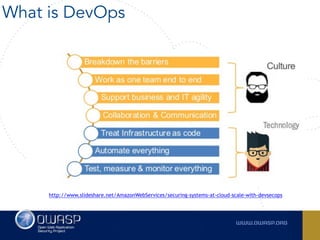
What is DevOps
http://www.slideshare.net/AmazonWebServices/securing-systems-at-cloud-scale-with-devsecops
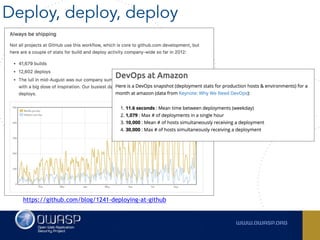
Deploy, deploy, deploy
https://github.com/blog/1241-deploying-at-github
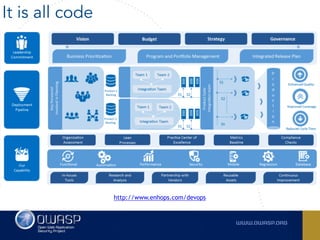
It is all code
http://www.enhops.com/devops
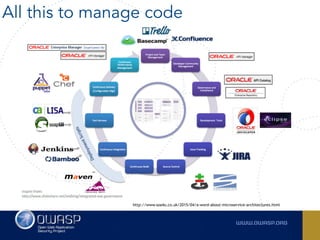
All this to manage code
http://www.soa4u.co.uk/2015/04/a-word-about-microservice-architectures.html
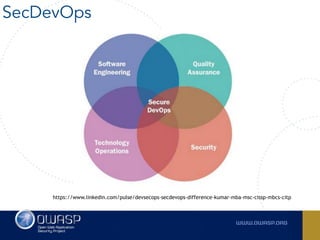
SecDevOps
https://www.linkedin.com/pulse/devsecops-secdevops-difference-kumar-mba-msc-cissp-mbcs-citp
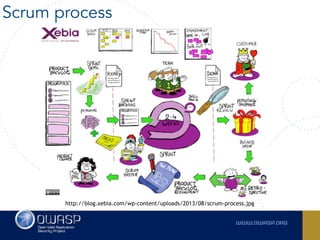
Scrum process
http://blog.xebia.com/wp-content/uploads/2013/08/scrum-process.jpg
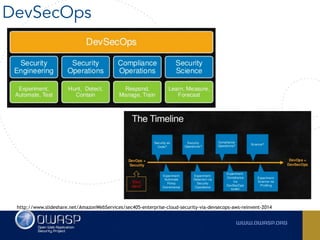
DevSecOps
http://www.slideshare.net/AmazonWebServices/sec405-enterprise-cloud-security-via-devsecops-aws-reinvent-2014
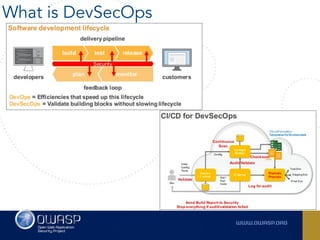
What is DevSecOps
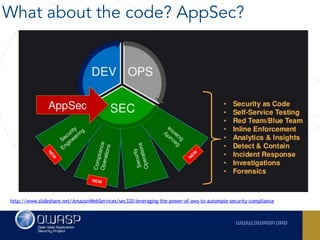
What about the code? AppSec?
http://www.slideshare.net/AmazonWebServices/sec320-leveraging-the-power-of-aws-to-automate-security-compliance
• Fixing and Securing the DevOps pipeline is not
enough
– In fact that is actually the ‘easy’ part
• We also need to fix the developers workflow and
secure the code they create
– Threat Models
– Security knowledge in the IDE
– Security Champions
– Risk Workflows that reward visibility and non-functional
requirements
Since everything is code, code is root cause
• Interesting debate at the moment in the industry
• For me Sec-DevOps is about adding security to
DevOps
• Dev-SecOps is about adding development
practices to Security operations
• I like the idea that SecDevOps when done right
– becomes just DevOps, which when the Ops are done
right,
– should become just Dev
SecDevOps or DevSecOps
SECURITY CHAMPIONS
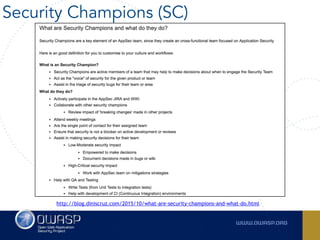
Security Champions (SC)
http://blog.diniscruz.com/2015/10/what-are-security-champions-and-what-do.html
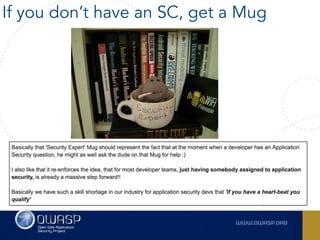
If you don’t have an SC, get a Mug
JIRA WORKFLOW
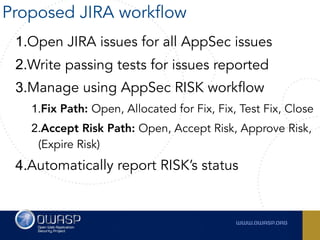
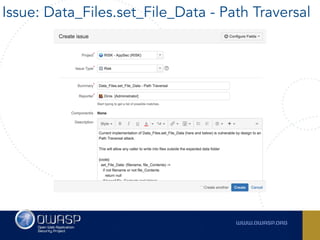
1.Open JIRA issues for all AppSec issues
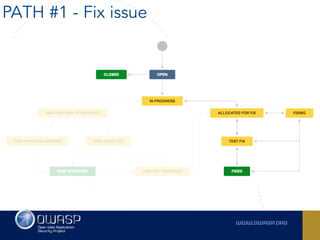
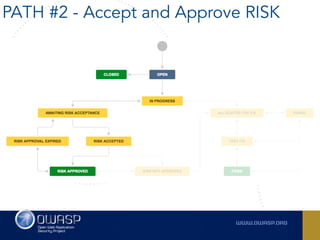
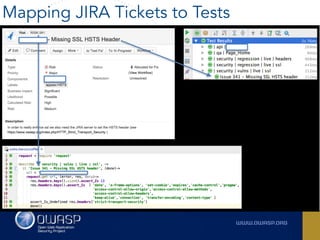
2.Write passing tests for issues reported
3.Manage using AppSec RISK workflow
1.Fix Path: Open, Allocated for Fix, Fix, Test Fix, Close
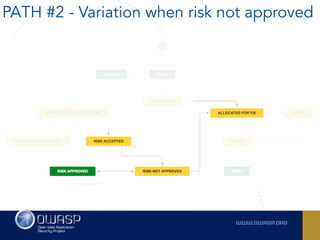
2.Accept Risk Path: Open, Accept Risk, Approve Risk,
(Expire Risk)
4.Automatically report RISK’s status
Proposed JIRA workflow
RISK Workflow (using JIRA in Cloud)
PATH #1 - Fix issue
PATH #2 - Accept and Approve RISK
PATH #2 - Variation when risk not approved
‘FIX’ PATH
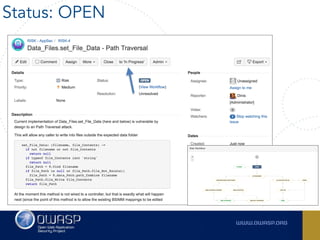
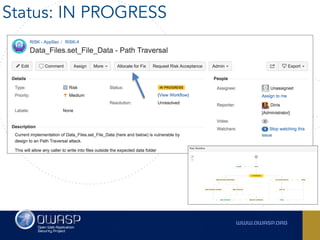
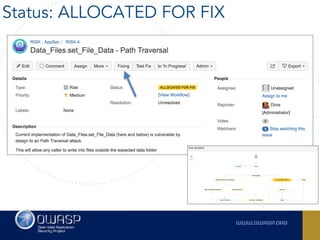
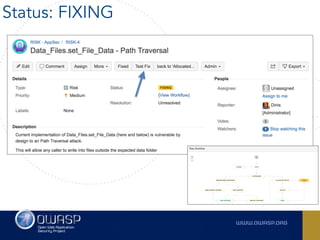
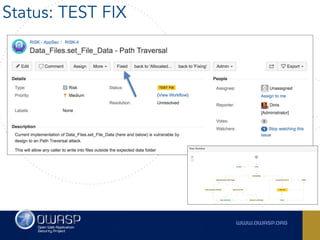
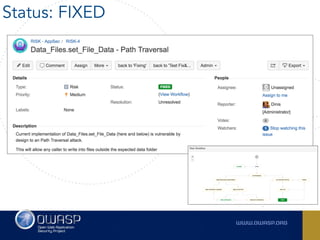
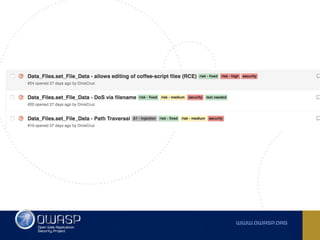
Issue: Data_Files.set_File_Data - Path Traversal
Status: OPEN
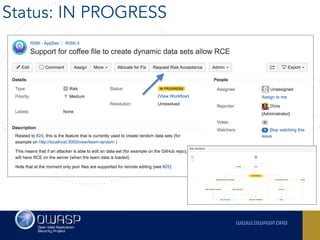
Status: IN PROGRESS
Status: ALLOCATED FOR FIX
Status: FIXING
Status: TEST FIX
Status: FIXED
PATH ‘RISK ACCEPT/APPROVE’
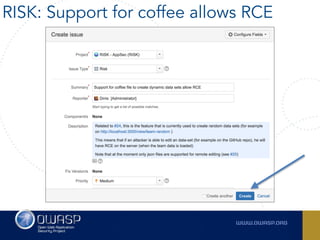
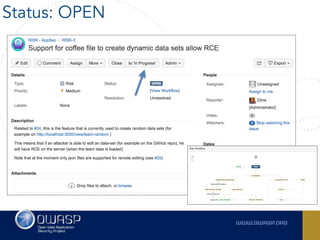
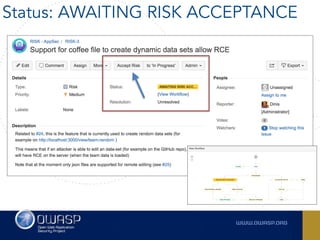
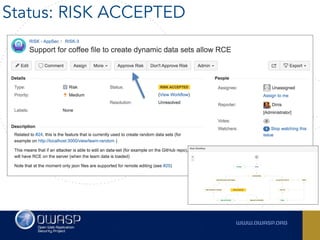
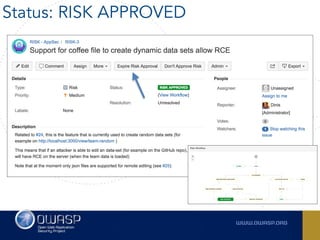
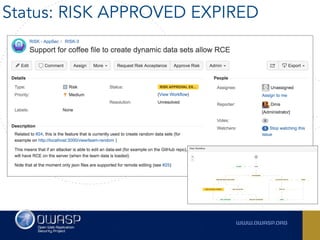
RISK: Support for coffee allows RCE
Status: OPEN
Status: IN PROGRESS
Status: AWAITING RISK ACCEPTANCE
Status: RISK ACCEPTED
Status: RISK APPROVED
Status: RISK APPROVED EXPIRED
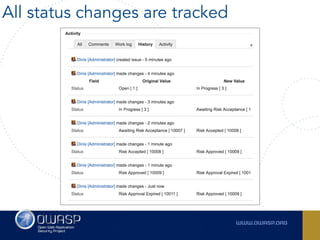
All status changes are tracked
KEY CONCEPTS FOR
JIRA RISK WORKFLOW
Key for AppSec JIRA workflow is this button
• This is a separate JIRA repo from the one used by devs
– I like to call that project ‘RISK’
– This avoids project ‘issue creation’ politics and ‘safe harbour for:
• known issues
• ’shadow of a vulnerability’ issues
• ‘this could be an problem…’ issues
• ‘app is still in development’ issues
– When deciding to fix an issue:
• that is the moment to create an issue in the target project JIRA (or
whatever bug tracking system they used)
– When issue is fixed (and closed on target project JIRA):
• AppSec confirms fix and closes RISK
Separate JIRA project
• Key is to understand that issues need to be
moving on one of two paths:
– Fix
– Risk Accepted (and approved)
• Risks (i.e. issues) are never in ‘Backlog’
• If an issue is stuck in ‘allocated for fix’, then
it will be moved into the ‘Awaiting Risk
Acceptance’ stage
Always moving until fix or acceptance
• If you don’t have 350+ issues on your JIRA RISK
Project, you are not playing (and don’t have
enough visibility into what is really going on)
• Allow team A to see what team B had (and scale
due due to issue description reuse)
• Problem is not teams with 50 issues, prob is team
with 5 issues
• This is perfect for Gamification and to provide
visibility into who to reward (and promote)
You need volume
• All issues identified in Threat Models are
added to the JIRA RISK project
• Create Threat models by
– layer
– feature
– bug
• … that is a topic for another talk
Threat model
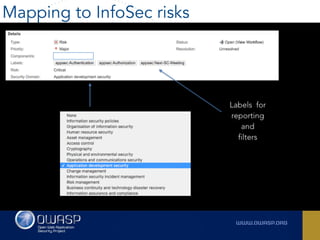
Mapping to InfoSec risks
Mapping JIRA Tickets to Tests
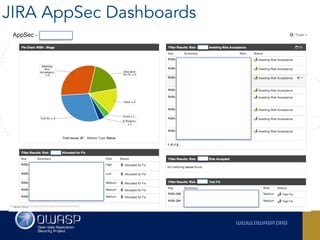
JIRA AppSec Dashboards
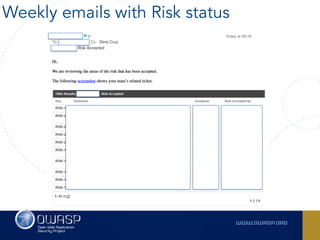
Weekly emails with Risk status
• Components (one per team or project)
• Labels (to add metadata to issues, for OWASP Top 10)
• Links
– connect with internal/external issues and
– external resources
• Auto emails
• Copy and paste of images into description
• Markdown
• Security restrictions (use with care)
• Security lock certain actions
• Extra workflow actions for example when moving state)
• Create APPSEC JIRA project for AppSec related tasks (like ‘Create Threat
Model for app XYZ’)
Other powerful JIRA features
GITHUB RISK WORKFLOW
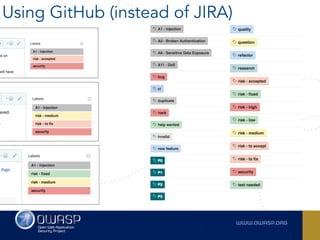
Using GitHub (instead of JIRA)
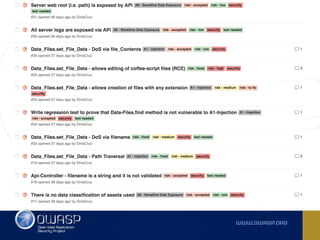
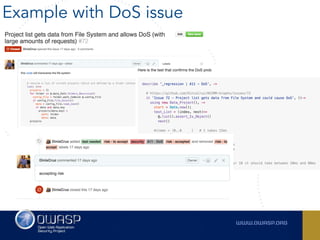
Example with DoS issue
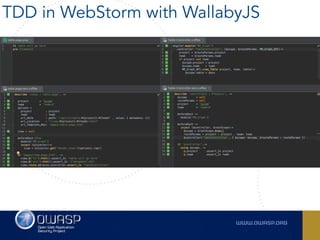
TDD
• For TDD to be productive you need
– Real time unit test execution (when hands lift)
– Real time code coverage
• TDD focus needs to be on
– making developers more productive
– preventing developers from switching context
• If 99% code coverage doesn’t happen ‘by
default’ TDD workflow is not working
TDD
TDD in WebStorm with WallabyJS
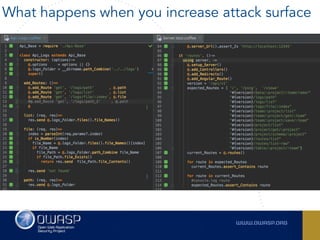
What happens when you increase attack surface
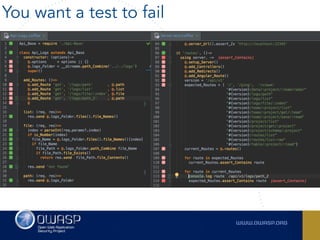
You want a test to fail
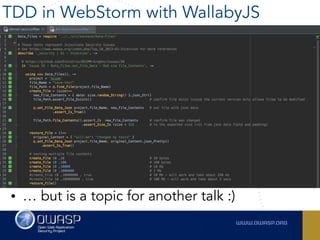
TDD in WebStorm with WallabyJS
• … but is a topic for another talk :)
OWASP
• Best AppSec conferences of the year
• 100s of chapters around the world
• 100s of research projects on AppSec
• All released under OpenSource and Creative
Common licenses
• Best concentration of AppSec talent in the
world
• Please join, collaborate, participate
Epicentre of Application Security
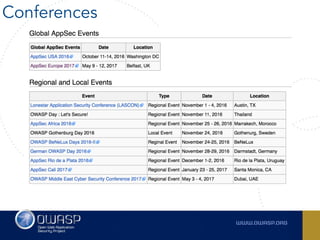
Conferences
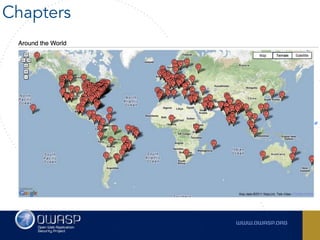
Chapters
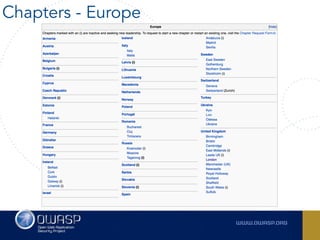
Chapters - Europe
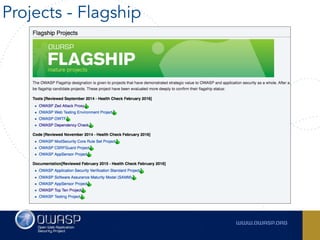
Projects - Flagship
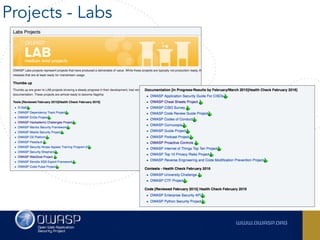
Projects - Labs
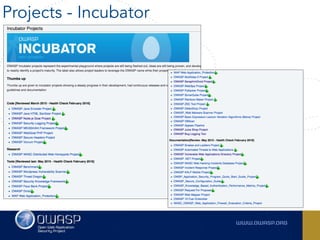
Projects - Incubator
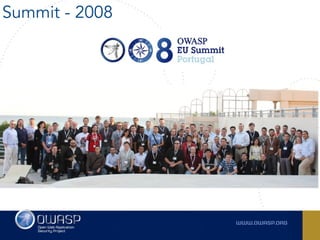
Summit - 2008
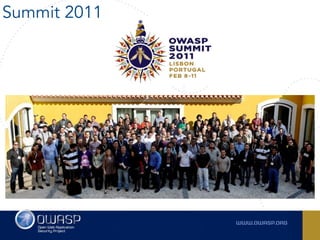
Summit 2011
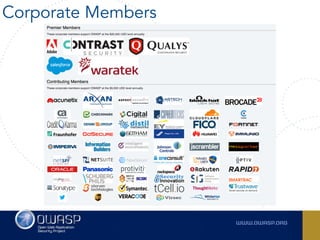
Corporate Members
Thanks, any questions
@diniscruz
dinis.cruz@owasp.org

SecDevOps Risk Workflow - v0.6

  • 1.
  • 2.
    Me • Developer for25 years • AppSec for 13 years • Day jobs: • Leader OWASP O2 Platform project • Application Security Training • JBI Training, others • Part of AppSec team of: • The Hut Group • BBC • AppSec Consultant and Mentor • “I build AppSec teams….” • https://twitter.com/DinisCruz • http://blog.diniscruz.com • http://leanpub.com/u/DinisCruz
  • 3.
    • Get itfor free at https://leanpub.com/secdevops Based on “SecDevOps Risk Workflow” book
  • 4.
  • 5.
    • (unit) Test- For me a test is anything that can be executed with one of these Unit Test Frameworks: https:// en.wikipedia.org/wiki/List_of_unit_testing_frameworks • RISK - Abuse the concept, found RISK to be best one for the wide range of issues covered by AppSec, while being understood by all players • 100% Code Coverage - not the summit, but base-camp (i.e. not the destination). And 100% code is not enough, we really need 500% or more Code Coverage) • AppSec ~= Non Functional requirements - AppSec is about understanding and controlling app’s unintended behaviours Disclaimers
  • 6.
    • InfoSec isabout: – Networks, Firewalls, Server security, Anti-virus, IDS, Logging, NOC, Policies, end-user security, mobile devices, AD/Ldap management, user provisioning, DevOps, …. • AppSec is about: – code, apps, CI, secure coding standards, threat models, frameworks, code dependencies, QA, testing, fuzzing, dev environments, DevOps, …. • If your ‘InfoSec’ team/person cannot code (and would not be hired by the Dev team), then that is NOT AppSec. • Both are equally important, but InfoSec is much more mature, has bigger budgets and is understood by the business AppSec vs InfoSec
  • 7.
  • 8.
    • The developersare the ones who pays the debt • Pollution is a much better analogy • The key is to make the business accept the risk (i.e the debt) – make sure it is your boss who gets fired (all the way to the board) • Which is done using the JIRA RISK Workflows Technical Debt is a bad analogy
  • 9.
  • 10.
    RISK Workflow (usingJIRA in Cloud)
  • 11.
    Key for AppSecJIRA workflow is this button
  • 12.
  • 13.
    • Create anenvironment and workflow where Security (InfoSec and AppSec) is an enabler. • Allow the business to ship faster with quality, security and assurance • InfoSec protects the organisation and operations • AppSec protects the code created, used and bought • Developers code in environments where it is very hard to create security vulnerabilities • Applications run in environments where security exploits are contained and visible • Align business risk appetite with reality (using proposed Risk Workflow to allocate responsibility at the correct level) What type of security organisation to create
  • 14.
    • Give securityteams a mandate to focus on Quality, Testing and Engineering • Create a network of Security Champions • Become the ‘Department of Yes’ • Measure code pollution using Risk Workflow • Understand that developers are key players and need to be trusted • Testing and Quality are core business requirements (and what gives you speed) • Create an central AppSec team (usually there is only an InfoSec team) How to embed security into the culture
  • 15.
    • Security policiesare the foundation of decisions • They underpin the reason behind actions and risk accepted • But, if not based on reality, most policies will NOT be – read – followed – enforced • For policies to work they need to be customised to its target (for example Secure coding standards for App XYZ) • They also need to be delivered in the target’s environment (for example IDE) What about security policies?
  • 16.
    • If youdon’t – have an AppSec team – do Threat Models – do weekly code reviews and security assessments – have embedded security automation automation in your SDL pipeline – have secure coding standards, bug-bounties, dependency management – …. and many other other AppSec activities • Where is security going to come from? • without them … there will be massive security vulnerabilities in code and apps used • and your security model is based on the ‘skill level and business model’ of your attackers Security magic pixie dust
  • 17.
  • 18.
    Cost of ITFailure https://www.youtube.com/watch?v=877OCQA_xzE
  • 19.
  • 20.
  • 21.
  • 22.
    It is allcode http://www.enhops.com/devops
  • 23.
    All this tomanage code http://www.soa4u.co.uk/2015/04/a-word-about-microservice-architectures.html
  • 24.
  • 25.
  • 26.
  • 27.
  • 28.
    What about thecode? AppSec? http://www.slideshare.net/AmazonWebServices/sec320-leveraging-the-power-of-aws-to-automate-security-compliance
  • 29.
    • Fixing andSecuring the DevOps pipeline is not enough – In fact that is actually the ‘easy’ part • We also need to fix the developers workflow and secure the code they create – Threat Models – Security knowledge in the IDE – Security Champions – Risk Workflows that reward visibility and non-functional requirements Since everything is code, code is root cause
  • 30.
    • Interesting debateat the moment in the industry • For me Sec-DevOps is about adding security to DevOps • Dev-SecOps is about adding development practices to Security operations • I like the idea that SecDevOps when done right – becomes just DevOps, which when the Ops are done right, – should become just Dev SecDevOps or DevSecOps
  • 31.
  • 32.
  • 33.
    If you don’thave an SC, get a Mug
  • 34.
  • 35.
    1.Open JIRA issuesfor all AppSec issues 2.Write passing tests for issues reported 3.Manage using AppSec RISK workflow 1.Fix Path: Open, Allocated for Fix, Fix, Test Fix, Close 2.Accept Risk Path: Open, Accept Risk, Approve Risk, (Expire Risk) 4.Automatically report RISK’s status Proposed JIRA workflow
  • 36.
    RISK Workflow (usingJIRA in Cloud)
  • 37.
    PATH #1 -Fix issue
  • 38.
    PATH #2 -Accept and Approve RISK
  • 39.
    PATH #2 -Variation when risk not approved
  • 40.
  • 41.
  • 42.
  • 43.
  • 44.
  • 45.
  • 46.
  • 47.
  • 48.
  • 49.
    RISK: Support forcoffee allows RCE
  • 50.
  • 51.
  • 52.
  • 53.
  • 54.
  • 55.
  • 56.
    All status changesare tracked
  • 57.
    KEY CONCEPTS FOR JIRARISK WORKFLOW
  • 58.
    Key for AppSecJIRA workflow is this button
  • 59.
    • This isa separate JIRA repo from the one used by devs – I like to call that project ‘RISK’ – This avoids project ‘issue creation’ politics and ‘safe harbour for: • known issues • ’shadow of a vulnerability’ issues • ‘this could be an problem…’ issues • ‘app is still in development’ issues – When deciding to fix an issue: • that is the moment to create an issue in the target project JIRA (or whatever bug tracking system they used) – When issue is fixed (and closed on target project JIRA): • AppSec confirms fix and closes RISK Separate JIRA project
  • 60.
    • Key isto understand that issues need to be moving on one of two paths: – Fix – Risk Accepted (and approved) • Risks (i.e. issues) are never in ‘Backlog’ • If an issue is stuck in ‘allocated for fix’, then it will be moved into the ‘Awaiting Risk Acceptance’ stage Always moving until fix or acceptance
  • 61.
    • If youdon’t have 350+ issues on your JIRA RISK Project, you are not playing (and don’t have enough visibility into what is really going on) • Allow team A to see what team B had (and scale due due to issue description reuse) • Problem is not teams with 50 issues, prob is team with 5 issues • This is perfect for Gamification and to provide visibility into who to reward (and promote) You need volume
  • 62.
    • All issuesidentified in Threat Models are added to the JIRA RISK project • Create Threat models by – layer – feature – bug • … that is a topic for another talk Threat model
  • 63.
  • 64.
  • 65.
  • 66.
    Weekly emails withRisk status
  • 67.
    • Components (oneper team or project) • Labels (to add metadata to issues, for OWASP Top 10) • Links – connect with internal/external issues and – external resources • Auto emails • Copy and paste of images into description • Markdown • Security restrictions (use with care) • Security lock certain actions • Extra workflow actions for example when moving state) • Create APPSEC JIRA project for AppSec related tasks (like ‘Create Threat Model for app XYZ’) Other powerful JIRA features
  • 68.
  • 69.
  • 72.
  • 73.
  • 74.
    • For TDDto be productive you need – Real time unit test execution (when hands lift) – Real time code coverage • TDD focus needs to be on – making developers more productive – preventing developers from switching context • If 99% code coverage doesn’t happen ‘by default’ TDD workflow is not working TDD
  • 75.
    TDD in WebStormwith WallabyJS
  • 76.
    What happens whenyou increase attack surface
  • 77.
    You want atest to fail
  • 78.
    TDD in WebStormwith WallabyJS • … but is a topic for another talk :)
  • 79.
  • 80.
    • Best AppSecconferences of the year • 100s of chapters around the world • 100s of research projects on AppSec • All released under OpenSource and Creative Common licenses • Best concentration of AppSec talent in the world • Please join, collaborate, participate Epicentre of Application Security
  • 81.
  • 82.
  • 83.
  • 84.
  • 85.
  • 86.
  • 87.
  • 88.
  • 89.
  • 90.