Automating Security Tests for
Continuous Integration
Stephen de Vries
@stephendv
www.continuumsecurity.net
About Continuum Security
• Founded 2012
• Services: Security Testing, BDD-Security jump start
• Products: Securing the SDLC
– Open Source
• BDD-Security Testing Framework
• OWASP ZAP integration with JUnit
• Nessus Java client API
– Commercial
• IriusRisk Risk Management for Application Security: www.iriusrisk.com
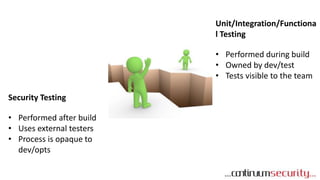
Security Testing
• Performed after build
• Uses external testers
• Process is opaque to
dev/opts
Unit/Integration/Functiona
l Testing
• Performed during build
• Owned by dev/test
• Tests visible to the team
Design Build
Unit
Tests
Integration
Tests
Acceptance
Tests
Deploy
Development Pre-prod Production
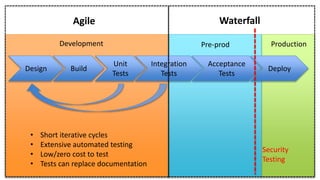
Agile
• Short iterative cycles
• Extensive automated testing
• Low/zero cost to test
• Tests can replace documentation
Security
Testing
Waterfall
Design Build
Unit
Tests
Integration
Tests
Acceptance
Tests
Deploy
Development Pre-prod Production
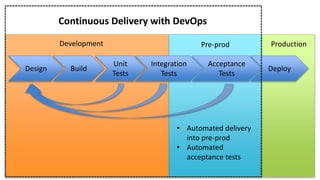
Continuous Delivery with DevOps
• Automated delivery
into pre-prod
• Automated
acceptance tests
Design Build
Unit
Tests
Integration
Tests
Acceptance
Tests
Deploy
Development Pre-prod Production
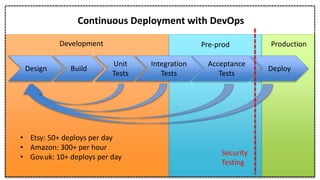
Continuous Deployment with DevOps
Security
Testing
• Etsy: 50+ deploys per day
• Amazon: 300+ per hour
• Gov.uk: 10+ deploys per day
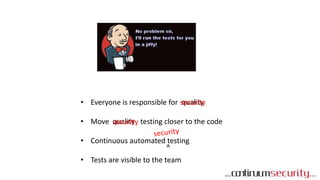
• Everyone is responsible for
• Move testing closer to the code
• Continuous automated testing
• Tests are visible to the team
quality
quality
security
security
^
Design Build
Integration TestsUnit
Tests
Acceptance
Tests
Deploy
Development Pre-prod Production
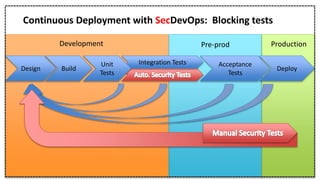
Continuous Deployment with SecDevOps: Blocking tests
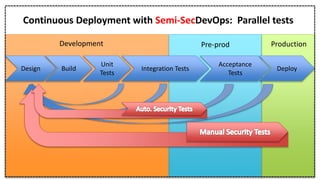
Design Build Integration Tests
Unit
Tests
Acceptance
Tests
Deploy
Development Pre-prod Production
Continuous Deployment with Semi-SecDevOps: Parallel tests
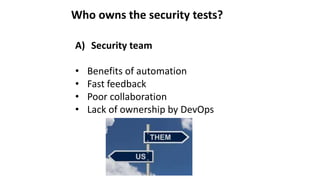
Who owns the security tests?
A) Security team
• Benefits of automation
• Fast feedback
• Poor collaboration
• Lack of ownership by DevOps
Who owns the security tests?
B) DevOps team with oversight by Security
• Better collaboration
• More sense of ownership of security
• Good stepping stone to…
Who owns the security tests?
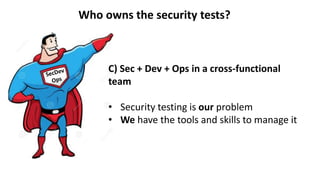
C) Sec + Dev + Ops in a cross-functional
team
• Security testing is our problem
• We have the tools and skills to manage it
Automated Security Tests should:
• return either a pass or fail result
• execute quickly (similar to acceptance tests)
• test infrastructure and application tiers
• test functional security features, e.g. Login, Password Reset
• capture manual testing processes and automate them,
i.e. security regression tests
• be checked into version control along with the code
• be understandable by the whole team
BDD-Security Testing Framework
https://github.com/continuumsecurity/bdd-security
BDD-Security = JBehave +
OWASP ZAP +
Nessus +
Internal security tools +
Pre-written baseline security specifications
Selenium +
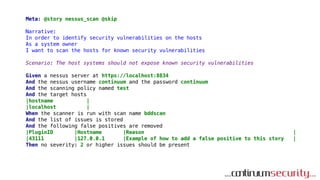
Infrastructure Security Testing
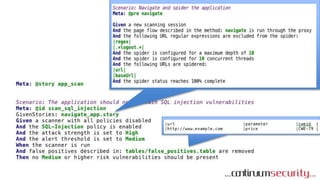
Application Security Testing
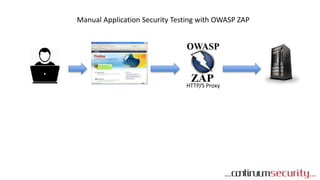
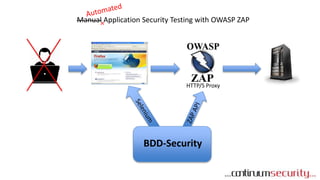
HTTP/S Proxy
Manual Application Security Testing with OWASP ZAP
HTTP/S Proxy
Manual Application Security Testing with OWASP ZAP
^
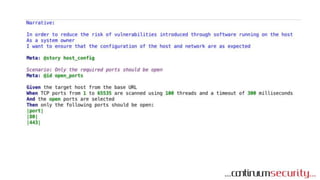
BDD-Security
Functional Security Tests
Integrating with Jenkins
• Configuration
• Test run
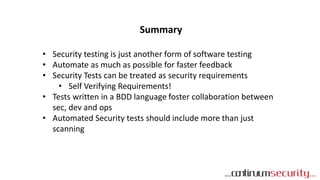
Summary
• Security testing is just another form of software testing
• Automate as much as possible for faster feedback
• Security Tests can be treated as security requirements
• Self Verifying Requirements!
• Tests written in a BDD language foster collaboration between
sec, dev and ops
• Automated Security tests should include more than just
scanning
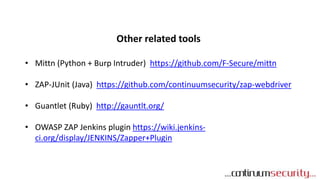
Other related tools
• Mittn (Python + Burp Intruder) https://github.com/F-Secure/mittn
• ZAP-JUnit (Java) https://github.com/continuumsecurity/zap-webdriver
• Guantlet (Ruby) http://gauntlt.org/
• OWASP ZAP Jenkins plugin https://wiki.jenkins-
ci.org/display/JENKINS/Zapper+Plugin
Thank you
www.continuumsecurity.net
@stephendv

Automating security tests for Continuous Integration

Editor's Notes

  • #2 Story: There is a gap between sec testing and every other type of software testing Sec is still stuck in waterfall model History of testing and sec testing Benefits of agile, fast feedback, low cost tests = run them more often TDD and BDD: Tests as communication mechanism DevOps is Agile for the rest of the organisation Don’t need to look far to find answers to integrating security into dev: quality Sec testing is subset Security testing > automated scanning Security testing > Penetration Testing BDD-Sec intro: objectives. Default set of security tests + allows building more specific tests
  • #4 There is a considerable gap between how we use security testing and how we use almost every other type of software test.
  • #5 The first great leap forward for software testing was Agile But even though we had this benefit of fast feedback, it was constrained to the dev environment.
  • #6 …there’s a manual step before deploying into production.
  • #7 All security testing, automated scans and manual penetration testing.
  • #8 And looking at how testing has evolved over time two things stand out: we’re doing more automation, and we’re doing that automated testing closer to the code. Our unit and integration tests are a key part to making continuous delivery possible. And I claim that that we can and should take the same approach with security testing: automated as much as possible, so that we can run them continuously and get feedback as quick as possible. Not to replace manual security testing, but to complement it.
  • #9 The primary control is the automated security tests, the secondary control is the manual tests.
  • #10 Automated tests can run in parallel, but at same pace as integration tests.
  • #14 The first activity that springs to mind when talking about automated security testing is probably scanning.
  • #15 BDD Behaviour Driven Development
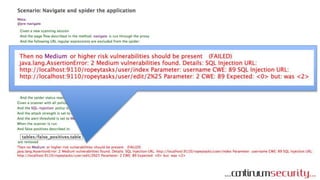
  • #18 False positives
  • #19 From
  • #24 From
  • #25 From