© 2015 , we45 1
Security in DevOps
Concept Presentation
Topics of Discussion
Current State of Application Delivery
Current Challenges with Application Security
The Application Driven Enterprise Goal
The we45 SecDevOps Framework
© 2015 , we45 2
Current State of Application Delivery
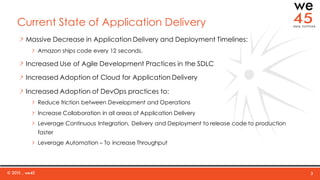
Massive Decrease in Application Delivery and Deployment Timelines:
Amazon ships code every 12 seconds.
Increased Use of Agile Development Practices in the SDLC
Increased Adoption of Cloud for Application Delivery
Increased Adoption of DevOps practices to:
Reduce friction between Development and Operations
Increase Collaboration in all areas of Application Delivery
Leverage Continuous Integration, Delivery and Deployment to release code to production
faster
Leverage Automation – To increase Throughput
© 2015 , we45 3
© 2015 , we45 4
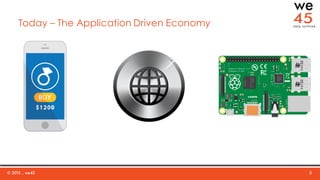
Today – The Application Driven Economy
© 2015 , we45 5
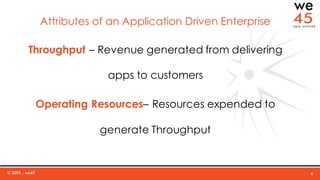
Attributes of an Application Driven Enterprise
Throughput – Revenue generated from delivering
apps to customers
Operating Resources– Resources expended to
generate Throughput
© 2015 , we45 6
The Goal
© 2015 , we45 7
Increase Throughput while
simultaneously reducing the Operating
Resources
© 2015 , we45 8
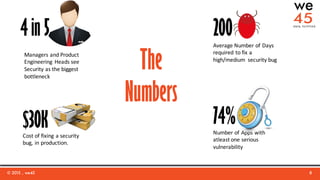
4 in 5
Cost	
  of	
  fixing	
  a	
  security	
  
bug,	
  in	
  production.
200
Average	
  Number	
  of	
  Days	
  
required	
  to	
  fix	
  a	
  
high/medium	
   security	
  bug
$30K
Managers	
  and	
  Product	
  
Engineering	
   Heads	
  see	
  
Security	
  as	
  the	
  biggest	
  
bottleneck
74%Number	
  of	
  Apps	
  with	
  
atleast one	
  serious	
  
vulnerability
The
Numbers
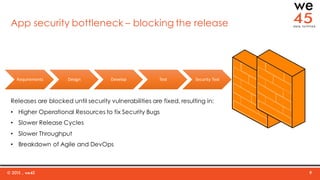
App security bottleneck – blocking the release
© 2015 , we45 9
Requirements Design Develop Test Security	
  Test
Releases are blocked until security vulnerabilities are fixed, resulting in:
• Higher Operational Resources to fix Security Bugs
• Slower Release Cycles
• Slower Throughput
• Breakdown of Agile and DevOps
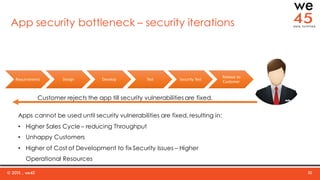
App security bottleneck – security iterations
© 2015 , we45 10
Requirements Design Develop Test Security	
  Test
Release	
  to	
  
Customer
Apps cannot be used until security vulnerabilities are fixed, resulting in:
• Higher Sales Cycle – reducing Throughput
• Unhappy Customers
• Higher of Cost of Development to fix Security Issues – Higher
Operational Resources
Customer rejects the app till security vulnerabilities are fixed.
Security Flaws always do the following:
Break down the Agile and DevOps lifecycle
Cause reduction of Application Delivery Throughput
Result in Lower Customer Satisfaction
Increase time and resources in fixing security flaws
© 2015 , we45 11
we45 SecDevOps Framework
Designed to Integrate Security into the organization’s DevOps
practices
Combination of Training + Consulting + Implementation =>
Delivering Maximum Impact on Application Security through a Multi-
Pronged Approach
Guaranteed to meet the goal:
Increase Throughput while reducing Operational Resources in Application
Delivery
© 2015 , we45 12
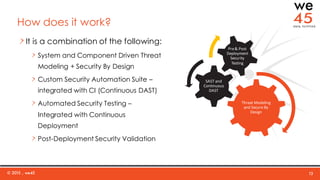
How does it work?
It is a combination of the following:
System and Component Driven Threat
Modeling + Security By Design
Custom Security Automation Suite –
integrated with CI (Continuous DAST)
Automated Security Testing –
Integrated with Continuous
Deployment
Post-Deployment Security Validation
© 2015 , we45 13
Threat	
  Modeling	
  
and	
  Secure	
  By	
  
Design
SAST	
  and	
  
Continuous	
  
DAST
Pre	
  &	
  Post	
  
Deployment	
  
Security	
  
Testing
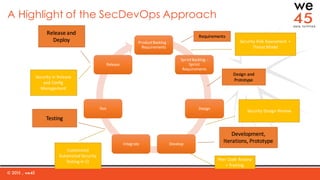
A Highlight of the SecDevOps Approach
© 2015 , we45
14
Product	
  Backlog	
  -­‐
Requirements
Sprint	
  Backlog	
  -­‐
Sprint	
  
Requirements
Design
DevelopIntegrate
Test
Release
Requirements
Design	
  and	
  
Prototype
Development,	
  
Iterations,	
  Prototype
Testing
Release	
  and	
  
Deploy Security	
  Risk	
  Assessment	
  +	
  
Threat	
  Model
Security	
  Design	
  Review
Peer	
  Code	
  Review	
  
+	
  Training
Customized	
  
Automated	
  Security	
  
Testing	
  in	
  CI
Security	
  in	
  Release	
  
and	
  Config
Management
© 2015 , we45 15
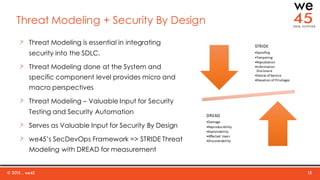
Threat Modeling + Security By Design
Threat Modeling is essential in integrating
security into the SDLC.
Threat Modeling done at the System and
specific component level provides micro and
macro perspectives
Threat Modeling – Valuable Input for Security
Testing and Security Automation
Serves as Valuable Input for Security By Design
we45’s SecDevOps Framework => STRIDE Threat
Modeling with DREAD for measurement
STRIDE
•Spoofing
•Tampering
•Repudiation
•Information	
  
Disclosure
•Denial	
  of	
  Service
•Elevation	
  of	
  Privileges
DREAD
•Damage
•Reproducibility
•Exploitability
•Affected	
  Users
•Discoverability
© 2015 , we45 16
Custom Security Automation Suite
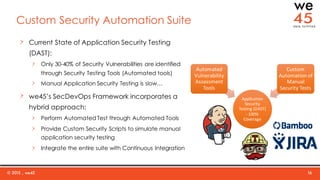
Current State of Application Security Testing
(DAST):
Only 30-40% of Security Vulnerabilities are identified
through Security Testing Tools (Automated tools)
Manual Application Security Testing is slow…
we45’s SecDevOps Framework incorporates a
hybrid approach:
Perform Automated Test through Automated Tools
Provide Custom Security Scripts to simulate manual
application security testing
Integrate the entire suite with Continuous Integration
Application	
  
Security	
  
Testing	
  (DAST)	
  
-­‐ 100%	
  
Coverage
Automated	
  
Vulnerability	
  
Assessment	
  
Tools
Custom	
  
Automation	
  of	
  
Manual	
  
Security	
  Tests
© 2015 , we45 17
Benefits – Custom Security Automation Suite
Perform a High Quality Penetration Test for EVERY RELEASE!! (Not quarterly/bi-
annual/annual)
Integrated with CI – Build Fails if Security has failed. No escape from fixing security
flaws
Greater Visibility – Complete Reporting of Tests, Payloads and Pass/Fail Information
Combination of Manual and Automated => 100% Vulnerability/Parameter
Coverage
Issues can be re-created and repeated without Penetration Testers being involved.
Granular Vulnerability Management using we45’s VME (Vulnerability Management
Engine)
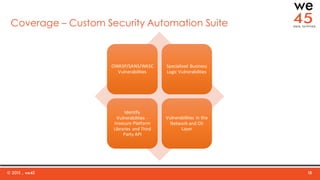
Coverage – Custom Security Automation Suite
© 2015 , we45 18
OWASP/SANS/WASC	
  
Vulnerabilities
Specialized	
  Business	
  
Logic	
  Vulnerabilities
Identify	
  
Vulnerabilities	
  -­‐
Insecure	
  Platform	
  
Libraries	
  and	
  Third	
  
Party	
  API
Vulnerabilities	
  in	
  the	
  
Network	
  and	
  OS	
  
Layer
© 2015 , we45 19
Automated Testing – Continuous Deployment
Automated Test Suite integrated with Continuous
Deployment products/standalone, to perform:
Host and OS Security Checks
Vulnerabilities in App Servers, DBs, NoSQL DBs, etc
Vulnerabilities in Network Configurations
Integrate with Continuous Deployment Products like Chef,
Ansible, Puppet, etc.
© 2015 , we45 20
Additional Elements – we45 SecDevOps Framework
Automated Static Code Analysis (SAST)
Designing a security oriented Continuous Monitoring Strategy
Focused Training Workshops for Different Teams:
Certified Web Security Professional (Developing Secure Web Apps and Web Services) –
Developers and Architects
Certified Mobile Security Professional (Developing Secure Mobile Apps and Web Services) –
Developers and Architects
Certified SecDevOps Professional (Comprehensive Insight into implementing SecDevOps for
your organization) – Developers, Architects, Operations Personnel, DevOps Engineers
© 2015 , we45 21
Conclusions
DevOps or Agile without Security is ineffective
Security is usually the most pervasive bottleneck
we45’s SecDevOps Framework ensures that Security is
integrated into the SDLC and DevOps Framework
This results in achievement of Enterprise Goals of:
Higher Throughput through Application Delivery with a simaltaneous reduction in
Operating Resources
thank you
22© 2015 , we45

we45 - SecDevOps Concept Presentation

  • 1.
    © 2015 ,we45 1 Security in DevOps Concept Presentation
  • 2.
    Topics of Discussion CurrentState of Application Delivery Current Challenges with Application Security The Application Driven Enterprise Goal The we45 SecDevOps Framework © 2015 , we45 2
  • 3.
    Current State ofApplication Delivery Massive Decrease in Application Delivery and Deployment Timelines: Amazon ships code every 12 seconds. Increased Use of Agile Development Practices in the SDLC Increased Adoption of Cloud for Application Delivery Increased Adoption of DevOps practices to: Reduce friction between Development and Operations Increase Collaboration in all areas of Application Delivery Leverage Continuous Integration, Delivery and Deployment to release code to production faster Leverage Automation – To increase Throughput © 2015 , we45 3
  • 4.
    © 2015 ,we45 4
  • 5.
    Today – TheApplication Driven Economy © 2015 , we45 5
  • 6.
    Attributes of anApplication Driven Enterprise Throughput – Revenue generated from delivering apps to customers Operating Resources– Resources expended to generate Throughput © 2015 , we45 6
  • 7.
    The Goal © 2015, we45 7 Increase Throughput while simultaneously reducing the Operating Resources
  • 8.
    © 2015 ,we45 8 4 in 5 Cost  of  fixing  a  security   bug,  in  production. 200 Average  Number  of  Days   required  to  fix  a   high/medium   security  bug $30K Managers  and  Product   Engineering   Heads  see   Security  as  the  biggest   bottleneck 74%Number  of  Apps  with   atleast one  serious   vulnerability The Numbers
  • 9.
    App security bottleneck– blocking the release © 2015 , we45 9 Requirements Design Develop Test Security  Test Releases are blocked until security vulnerabilities are fixed, resulting in: • Higher Operational Resources to fix Security Bugs • Slower Release Cycles • Slower Throughput • Breakdown of Agile and DevOps
  • 10.
    App security bottleneck– security iterations © 2015 , we45 10 Requirements Design Develop Test Security  Test Release  to   Customer Apps cannot be used until security vulnerabilities are fixed, resulting in: • Higher Sales Cycle – reducing Throughput • Unhappy Customers • Higher of Cost of Development to fix Security Issues – Higher Operational Resources Customer rejects the app till security vulnerabilities are fixed.
  • 11.
    Security Flaws alwaysdo the following: Break down the Agile and DevOps lifecycle Cause reduction of Application Delivery Throughput Result in Lower Customer Satisfaction Increase time and resources in fixing security flaws © 2015 , we45 11
  • 12.
    we45 SecDevOps Framework Designedto Integrate Security into the organization’s DevOps practices Combination of Training + Consulting + Implementation => Delivering Maximum Impact on Application Security through a Multi- Pronged Approach Guaranteed to meet the goal: Increase Throughput while reducing Operational Resources in Application Delivery © 2015 , we45 12
  • 13.
    How does itwork? It is a combination of the following: System and Component Driven Threat Modeling + Security By Design Custom Security Automation Suite – integrated with CI (Continuous DAST) Automated Security Testing – Integrated with Continuous Deployment Post-Deployment Security Validation © 2015 , we45 13 Threat  Modeling   and  Secure  By   Design SAST  and   Continuous   DAST Pre  &  Post   Deployment   Security   Testing
  • 14.
    A Highlight ofthe SecDevOps Approach © 2015 , we45 14 Product  Backlog  -­‐ Requirements Sprint  Backlog  -­‐ Sprint   Requirements Design DevelopIntegrate Test Release Requirements Design  and   Prototype Development,   Iterations,  Prototype Testing Release  and   Deploy Security  Risk  Assessment  +   Threat  Model Security  Design  Review Peer  Code  Review   +  Training Customized   Automated  Security   Testing  in  CI Security  in  Release   and  Config Management
  • 15.
    © 2015 ,we45 15 Threat Modeling + Security By Design Threat Modeling is essential in integrating security into the SDLC. Threat Modeling done at the System and specific component level provides micro and macro perspectives Threat Modeling – Valuable Input for Security Testing and Security Automation Serves as Valuable Input for Security By Design we45’s SecDevOps Framework => STRIDE Threat Modeling with DREAD for measurement STRIDE •Spoofing •Tampering •Repudiation •Information   Disclosure •Denial  of  Service •Elevation  of  Privileges DREAD •Damage •Reproducibility •Exploitability •Affected  Users •Discoverability
  • 16.
    © 2015 ,we45 16 Custom Security Automation Suite Current State of Application Security Testing (DAST): Only 30-40% of Security Vulnerabilities are identified through Security Testing Tools (Automated tools) Manual Application Security Testing is slow… we45’s SecDevOps Framework incorporates a hybrid approach: Perform Automated Test through Automated Tools Provide Custom Security Scripts to simulate manual application security testing Integrate the entire suite with Continuous Integration Application   Security   Testing  (DAST)   -­‐ 100%   Coverage Automated   Vulnerability   Assessment   Tools Custom   Automation  of   Manual   Security  Tests
  • 17.
    © 2015 ,we45 17 Benefits – Custom Security Automation Suite Perform a High Quality Penetration Test for EVERY RELEASE!! (Not quarterly/bi- annual/annual) Integrated with CI – Build Fails if Security has failed. No escape from fixing security flaws Greater Visibility – Complete Reporting of Tests, Payloads and Pass/Fail Information Combination of Manual and Automated => 100% Vulnerability/Parameter Coverage Issues can be re-created and repeated without Penetration Testers being involved. Granular Vulnerability Management using we45’s VME (Vulnerability Management Engine)
  • 18.
    Coverage – CustomSecurity Automation Suite © 2015 , we45 18 OWASP/SANS/WASC   Vulnerabilities Specialized  Business   Logic  Vulnerabilities Identify   Vulnerabilities  -­‐ Insecure  Platform   Libraries  and  Third   Party  API Vulnerabilities  in  the   Network  and  OS   Layer
  • 19.
    © 2015 ,we45 19 Automated Testing – Continuous Deployment Automated Test Suite integrated with Continuous Deployment products/standalone, to perform: Host and OS Security Checks Vulnerabilities in App Servers, DBs, NoSQL DBs, etc Vulnerabilities in Network Configurations Integrate with Continuous Deployment Products like Chef, Ansible, Puppet, etc.
  • 20.
    © 2015 ,we45 20 Additional Elements – we45 SecDevOps Framework Automated Static Code Analysis (SAST) Designing a security oriented Continuous Monitoring Strategy Focused Training Workshops for Different Teams: Certified Web Security Professional (Developing Secure Web Apps and Web Services) – Developers and Architects Certified Mobile Security Professional (Developing Secure Mobile Apps and Web Services) – Developers and Architects Certified SecDevOps Professional (Comprehensive Insight into implementing SecDevOps for your organization) – Developers, Architects, Operations Personnel, DevOps Engineers
  • 21.
    © 2015 ,we45 21 Conclusions DevOps or Agile without Security is ineffective Security is usually the most pervasive bottleneck we45’s SecDevOps Framework ensures that Security is integrated into the SDLC and DevOps Framework This results in achievement of Enterprise Goals of: Higher Throughput through Application Delivery with a simaltaneous reduction in Operating Resources
  • 22.