THREATS PROTECTION
IN A DISTRIBUTED WORLD


Using 42Crunch API Firewall on Kubernetes
ISABELLE MAUNY - Field CTO (isabelle@42crunch.com)
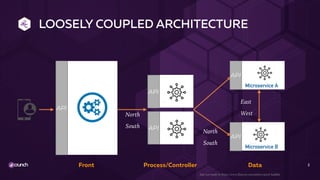
LOOSELY COUPLED ARCHITECTURE
2
App icon made by https://www.flaticon.com/authors/pixel-buddha
Microservice B
Microservice A
Front Process/Controller Data
North
South
North
South
East
West
API
API
API
API
API
HOW DO WE SECURE
APIS?
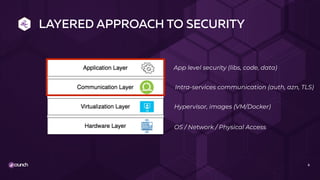
LAYERED APPROACH TO SECURITY
4
Hypervisor, images (VM/Docker)
Intra-services communication (auth, azn, TLS)
App level security (libs, code, data)
OS / Network / Physical Access
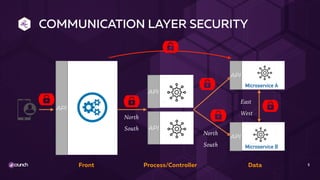
COMMUNICATION LAYER SECURITY
5
Microservice B
Microservice A
Front Process/Controller Data
North
South
North
South
East
West
API
API
API
API
API
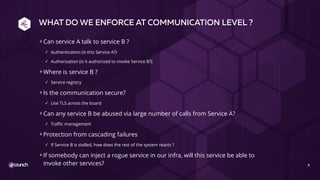
WHAT DO WE ENFORCE AT COMMUNICATION LEVEL ?
Can service A talk to service B ?
✓ Authentication (is this Service A?)
✓ Authorization (is it authorized to invoke Service B?)
Where is service B ?
✓ Service registry
Is the communication secure?
✓ Use TLS across the board
Can any service B be abused via large number of calls from Service A?
✓ Traffic management
Protection from cascading failures
✓ If Service B is stalled, how does the rest of the system reacts ?
If somebody can inject a rogue service in our infra, will this service be able to
invoke other services? 6
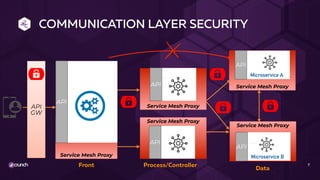
API
GW
Service Mesh Proxy
Service Mesh Proxy
Service Mesh Proxy
Service Mesh Proxy
Service Mesh Proxy
COMMUNICATION LAYER SECURITY
7
Microservice B
Front Process/Controller
Data
API
API
Microservice A
API
API
API
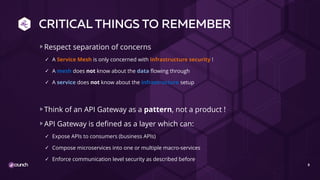
CRITICAL THINGS TO REMEMBER
Respect separation of concerns
✓ A Service Mesh is only concerned with infrastructure security !
✓ A mesh does not know about the data flowing through
✓ A service does not know about the infrastructure setup
Think of an API Gateway as a pattern, not a product !
API Gateway is defined as a layer which can:
✓ Expose APIs to consumers (business APIs)
✓ Compose microservices into one or multiple macro-services
✓ Enforce communication level security as described before
8
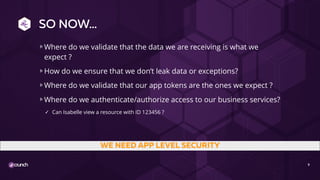
SO NOW…
Where do we validate that the data we are receiving is what we
expect ?
How do we ensure that we don’t leak data or exceptions?
Where do we validate that our app tokens are the ones we expect ?
Where do we authenticate/authorize access to our business services?
✓ Can Isabelle view a resource with ID 123456 ?
9
WE NEED APP LEVEL SECURITY
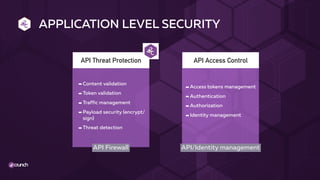
APPLICATION LEVEL SECURITY
API Threat Protection API Access Control
API/Identity managementAPI Firewall
➡ Content validation
➡ Token validation
➡ Traffic management
➡ Payload security (encrypt/
sign)
➡ Threat detection
➡ Access tokens management
➡ Authentication
➡ Authorization
➡ Identity management
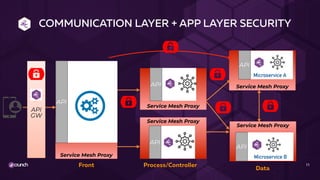
API
GW
Service Mesh Proxy
Service Mesh Proxy
Service Mesh Proxy
Service Mesh Proxy
Service Mesh Proxy
COMMUNICATION LAYER + APP LAYER SECURITY
11
Microservice B
Front Process/Controller
Data
API
API
Microservice A
API
API
API
APPLICATION LEVEL
SECURITY PRINCIPLES
13
GUIDING PRINCIPLE:
ZERO TRUST ARCHITECTURE
1
14
GUIDING PRINCIPLE:
ALL APIS ARE OPEN APIS
2
“Dance like no one is watching, encrypt like everyone is!”
Werner Vogels, Amazon CTO
15
GUIDING PRINCIPLE:
SECURITY IS ADAPTED
FROM RISK
3
WHAT IS SPECIAL
ABOUT API THREAT
PROTECTION?
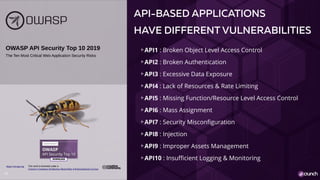
API-BASED APPLICATIONS
HAVE DIFFERENT VULNERABILITIES
API1 : Broken Object Level Access Control
API2 : Broken Authentication
API3 : Excessive Data Exposure
API4 : Lack of Resources & Rate Limiting
API5 : Missing Function/Resource Level Access Control
API6 : Mass Assignment
API7 : Security Misconfiguration
API8 : Injection
API9 : Improper Assets Management
API10 : Insufficient Logging & Monitoring
17
DOWNLOAD
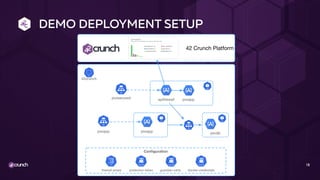
DEMO DEPLOYMENT SETUP
18
pixisecured pixiapp
42crunch
Configuration
firewall-props protection-token guardian-certs docker-credentials
apifirewall
42 Crunch Platform
pixiapp pixiapp pixidb
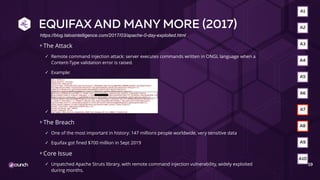
EQUIFAX AND MANY MORE (2017)
The Attack
✓ Remote command injection attack: server executes commands written in ONGL language when a
Content-Type validation error is raised.
✓ Example:
✓
The Breach
✓ One of the most important in history: 147 millions people worldwide, very sensitive data
✓ Equifax got fined $700 million in Sept 2019
Core Issue
✓ Unpatched Apache Struts library, with remote command injection vulnerability, widely exploited
during months.
19
A2
A3
A4
A5
A6
A10
A9
A8
A7
A1
https://blog.talosintelligence.com/2017/03/apache-0-day-exploited.html
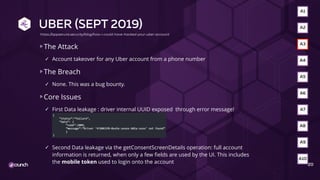
UBER (SEPT 2019)
The Attack
✓ Account takeover for any Uber account from a phone number
The Breach
✓ None. This was a bug bounty.
Core Issues
✓ First Data leakage : driver internal UUID exposed through error message!
✓ Second Data leakage via the getConsentScreenDetails operation: full account
information is returned, when only a few fields are used by the UI. This includes
the mobile token used to login onto the account 20
A2
A3
A4
A5
A6
A10
A9
A8
A7
A1
https://appsecure.security/blog/how-i-could-have-hacked-your-uber-account
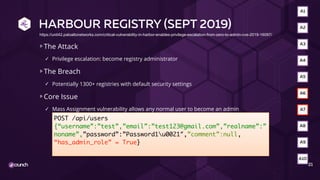
HARBOUR REGISTRY (SEPT 2019)
The Attack
✓ Privilege escalation: become registry administrator
The Breach
✓ Potentially 1300+ registries with default security settings
Core Issue
✓ Mass Assignment vulnerability allows any normal user to become an admin
POST /api/users
{“username”:”test”,”email”:”test123@gmail.com”,”realname”:”
noname”,”password”:”Password1u0021″,”comment”:null,
“has_admin_role” = True}
21
A2
A3
A4
A5
A6
A10
A9
A8
A7
A1
https://unit42.paloaltonetworks.com/critical-vulnerability-in-harbor-enables-privilege-escalation-from-zero-to-admin-cve-2019-16097/
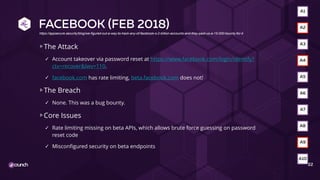
FACEBOOK (FEB 2018)
The Attack
✓ Account takeover via password reset at https://www.facebook.com/login/identify?
ctx=recover&lwv=110.
✓ facebook.com has rate limiting, beta.facebook.com does not!
The Breach
✓ None. This was a bug bounty.
Core Issues
✓ Rate limiting missing on beta APIs, which allows brute force guessing on password
reset code
✓ Misconfigured security on beta endpoints
22
A2
A3
A4
A5
A6
A10
A9
A8
A7
A1
https://appsecure.security/blog/we-figured-out-a-way-to-hack-any-of-facebook-s-2-billion-accounts-and-they-paid-us-a-15-000-bounty-for-it
PROTECTING APIS
AGAINST THREATS
REQUIRES A NEW APPROACH!
 © COPYRIGHT 42CRUNCH | CONFIDENTIAL
OPENAPI 

INITIATIVE
OpenAPI Specification
(formerly Swagger
Specification) is an API
description format for REST
APIs. An OpenAPI file allows
you to describe your entire
API, including: Available
endpoints ( /users ) and
operations on each endpoint
( GET /users , POST /users )
• Web Application Security is painful because
the security is not handled from beginning
• Developers cannot define how the web
application is built and designed
• After 20 years of R&D, detection and
protection tools have to use AI to understand
how the Web Application works...
=> Now we have a worldwide accepted and
used API standard: OpenAPI Specification
=> We build a whitelist based on OAS
POSITIVE SECURITY
MODEL FOR APIS
 © COPYRIGHT 42CRUNCH | CONFIDENTIAL
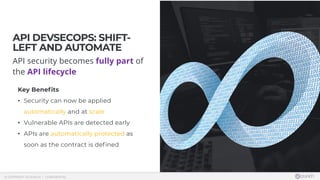
API DEVSECOPS: SHIFT-
LEFT AND AUTOMATE
API security becomes fully part of
the API lifecycle

Key Benefits
• Security can now be applied
automatically and at scale
• Vulnerable APIs are detected early
• APIs are automatically protected as
soon as the contract is defined
 © COPYRIGHT 42CRUNCH | CONFIDENTIAL
ZERO-TRUST
ARCHITECTURE FOR
MICROSERVICES
Low footprint, ultra-low latency
runtime that can be deployed in
Kubernetes

API micro-firewall can be deployed as:
• Sidecar proxy for defense in depth
• Reverse proxy (Gateway) for edge protection
Key Benefits
• Enables zero trust architecture: microservices must
not trust the environment
• Platform agnostic: any cloud, hybrid or on-premises
• Deployment agnostic: monolithic, microservices, and
service-mesh
• Supports multi-cloud, multi-geo zone deployments
 © COPYRIGHT 42CRUNCH | CONFIDENTIAL
RESOURCES
• 42Crunch Website
• Free OAS Security Audit
• OpenAPI VS Code Extension
• OpenAPI Spec Encyclopedia
• OWASP API Security Top 10
• APIsecurity.io
• Security Strategies for Microservices
Apps
• API Security Pentesting

Protecting Microservices APIs with 42Crunch API Firewall

  • 1.
    THREATS PROTECTION IN ADISTRIBUTED WORLD 
 Using 42Crunch API Firewall on Kubernetes ISABELLE MAUNY - Field CTO (isabelle@42crunch.com)
  • 2.
    LOOSELY COUPLED ARCHITECTURE 2 Appicon made by https://www.flaticon.com/authors/pixel-buddha Microservice B Microservice A Front Process/Controller Data North South North South East West API API API API API
  • 3.
    HOW DO WESECURE APIS?
  • 4.
    LAYERED APPROACH TOSECURITY 4 Hypervisor, images (VM/Docker) Intra-services communication (auth, azn, TLS) App level security (libs, code, data) OS / Network / Physical Access
  • 5.
    COMMUNICATION LAYER SECURITY 5 MicroserviceB Microservice A Front Process/Controller Data North South North South East West API API API API API
  • 6.
    WHAT DO WEENFORCE AT COMMUNICATION LEVEL ? Can service A talk to service B ? ✓ Authentication (is this Service A?) ✓ Authorization (is it authorized to invoke Service B?) Where is service B ? ✓ Service registry Is the communication secure? ✓ Use TLS across the board Can any service B be abused via large number of calls from Service A? ✓ Traffic management Protection from cascading failures ✓ If Service B is stalled, how does the rest of the system reacts ? If somebody can inject a rogue service in our infra, will this service be able to invoke other services? 6
  • 7.
    API GW Service Mesh Proxy ServiceMesh Proxy Service Mesh Proxy Service Mesh Proxy Service Mesh Proxy COMMUNICATION LAYER SECURITY 7 Microservice B Front Process/Controller Data API API Microservice A API API API
  • 8.
    CRITICAL THINGS TOREMEMBER Respect separation of concerns ✓ A Service Mesh is only concerned with infrastructure security ! ✓ A mesh does not know about the data flowing through ✓ A service does not know about the infrastructure setup Think of an API Gateway as a pattern, not a product ! API Gateway is defined as a layer which can: ✓ Expose APIs to consumers (business APIs) ✓ Compose microservices into one or multiple macro-services ✓ Enforce communication level security as described before 8
  • 9.
    SO NOW… Where dowe validate that the data we are receiving is what we expect ? How do we ensure that we don’t leak data or exceptions? Where do we validate that our app tokens are the ones we expect ? Where do we authenticate/authorize access to our business services? ✓ Can Isabelle view a resource with ID 123456 ? 9 WE NEED APP LEVEL SECURITY
  • 10.
    APPLICATION LEVEL SECURITY APIThreat Protection API Access Control API/Identity managementAPI Firewall ➡ Content validation ➡ Token validation ➡ Traffic management ➡ Payload security (encrypt/ sign) ➡ Threat detection ➡ Access tokens management ➡ Authentication ➡ Authorization ➡ Identity management
  • 11.
    API GW Service Mesh Proxy ServiceMesh Proxy Service Mesh Proxy Service Mesh Proxy Service Mesh Proxy COMMUNICATION LAYER + APP LAYER SECURITY 11 Microservice B Front Process/Controller Data API API Microservice A API API API
  • 12.
  • 13.
  • 14.
    14 GUIDING PRINCIPLE: ALL APISARE OPEN APIS 2 “Dance like no one is watching, encrypt like everyone is!” Werner Vogels, Amazon CTO
  • 15.
  • 16.
    WHAT IS SPECIAL ABOUTAPI THREAT PROTECTION?
  • 17.
    API-BASED APPLICATIONS HAVE DIFFERENTVULNERABILITIES API1 : Broken Object Level Access Control API2 : Broken Authentication API3 : Excessive Data Exposure API4 : Lack of Resources & Rate Limiting API5 : Missing Function/Resource Level Access Control API6 : Mass Assignment API7 : Security Misconfiguration API8 : Injection API9 : Improper Assets Management API10 : Insufficient Logging & Monitoring 17 DOWNLOAD
  • 18.
    DEMO DEPLOYMENT SETUP 18 pixisecuredpixiapp 42crunch Configuration firewall-props protection-token guardian-certs docker-credentials apifirewall 42 Crunch Platform pixiapp pixiapp pixidb
  • 19.
    EQUIFAX AND MANYMORE (2017) The Attack ✓ Remote command injection attack: server executes commands written in ONGL language when a Content-Type validation error is raised. ✓ Example: ✓ The Breach ✓ One of the most important in history: 147 millions people worldwide, very sensitive data ✓ Equifax got fined $700 million in Sept 2019 Core Issue ✓ Unpatched Apache Struts library, with remote command injection vulnerability, widely exploited during months. 19 A2 A3 A4 A5 A6 A10 A9 A8 A7 A1 https://blog.talosintelligence.com/2017/03/apache-0-day-exploited.html
  • 20.
    UBER (SEPT 2019) TheAttack ✓ Account takeover for any Uber account from a phone number The Breach ✓ None. This was a bug bounty. Core Issues ✓ First Data leakage : driver internal UUID exposed through error message! ✓ Second Data leakage via the getConsentScreenDetails operation: full account information is returned, when only a few fields are used by the UI. This includes the mobile token used to login onto the account 20 A2 A3 A4 A5 A6 A10 A9 A8 A7 A1 https://appsecure.security/blog/how-i-could-have-hacked-your-uber-account
  • 21.
    HARBOUR REGISTRY (SEPT2019) The Attack ✓ Privilege escalation: become registry administrator The Breach ✓ Potentially 1300+ registries with default security settings Core Issue ✓ Mass Assignment vulnerability allows any normal user to become an admin POST /api/users {“username”:”test”,”email”:”test123@gmail.com”,”realname”:” noname”,”password”:”Password1u0021″,”comment”:null, “has_admin_role” = True} 21 A2 A3 A4 A5 A6 A10 A9 A8 A7 A1 https://unit42.paloaltonetworks.com/critical-vulnerability-in-harbor-enables-privilege-escalation-from-zero-to-admin-cve-2019-16097/
  • 22.
    FACEBOOK (FEB 2018) TheAttack ✓ Account takeover via password reset at https://www.facebook.com/login/identify? ctx=recover&lwv=110. ✓ facebook.com has rate limiting, beta.facebook.com does not! The Breach ✓ None. This was a bug bounty. Core Issues ✓ Rate limiting missing on beta APIs, which allows brute force guessing on password reset code ✓ Misconfigured security on beta endpoints 22 A2 A3 A4 A5 A6 A10 A9 A8 A7 A1 https://appsecure.security/blog/we-figured-out-a-way-to-hack-any-of-facebook-s-2-billion-accounts-and-they-paid-us-a-15-000-bounty-for-it
  • 23.
  • 24.
     © COPYRIGHT 42CRUNCH| CONFIDENTIAL OPENAPI 
 INITIATIVE OpenAPI Specification (formerly Swagger Specification) is an API description format for REST APIs. An OpenAPI file allows you to describe your entire API, including: Available endpoints ( /users ) and operations on each endpoint ( GET /users , POST /users ) • Web Application Security is painful because the security is not handled from beginning • Developers cannot define how the web application is built and designed • After 20 years of R&D, detection and protection tools have to use AI to understand how the Web Application works... => Now we have a worldwide accepted and used API standard: OpenAPI Specification => We build a whitelist based on OAS POSITIVE SECURITY MODEL FOR APIS
  • 25.
     © COPYRIGHT 42CRUNCH| CONFIDENTIAL API DEVSECOPS: SHIFT- LEFT AND AUTOMATE API security becomes fully part of the API lifecycle
 Key Benefits • Security can now be applied automatically and at scale • Vulnerable APIs are detected early • APIs are automatically protected as soon as the contract is defined
  • 26.
     © COPYRIGHT 42CRUNCH| CONFIDENTIAL ZERO-TRUST ARCHITECTURE FOR MICROSERVICES Low footprint, ultra-low latency runtime that can be deployed in Kubernetes 
API micro-firewall can be deployed as: • Sidecar proxy for defense in depth • Reverse proxy (Gateway) for edge protection Key Benefits • Enables zero trust architecture: microservices must not trust the environment • Platform agnostic: any cloud, hybrid or on-premises • Deployment agnostic: monolithic, microservices, and service-mesh • Supports multi-cloud, multi-geo zone deployments
  • 27.
     © COPYRIGHT 42CRUNCH| CONFIDENTIAL RESOURCES • 42Crunch Website • Free OAS Security Audit • OpenAPI VS Code Extension • OpenAPI Spec Encyclopedia • OWASP API Security Top 10 • APIsecurity.io • Security Strategies for Microservices Apps • API Security Pentesting