APIs: The New Security Layer
Greg Brail, Apigee
Slideshare
slideshare.com/apigee
Apigee Community
https://community.apigee.com
YouTube
youtube.com/apigee
Today’s Speakers:
3©2008-16 Apigee Corp. All rights reserved.
Greg Brail
Apigee
• What Happens to Insecure APIs
• API Security Fundamentals
• The Result: Effective API Security
Agenda
No API Security?
Bad things happen
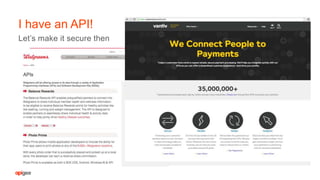
Let’s make it secure then
I have an API!
But I Don’t Have an API!
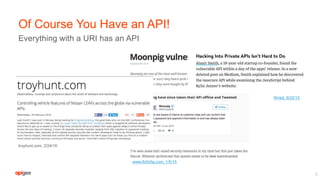
Everything with a URI has an API
Of Course You Have an API!
8
Wired, 9/22/15
www.ifc0nfig.com, 1/5/15
troyhunt.com, 2/24/16
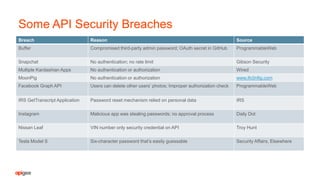
Breach Reason Source
Buffer Compromised third-party admin password; OAuth secret in GitHub ProgrammableWeb
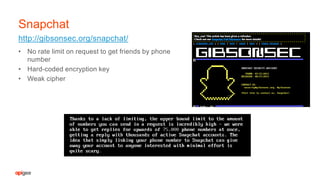
Snapchat No authentication; no rate limit Gibson Security
Multiple Kardashian Apps No authentication or authorization Wired
MoonPig No authentication or authorization www.ifc0nfig.com
Facebook Graph API Users can delete other users’ photos; Improper authorization check ProgrammableWeb
IRS GetTranscript Application Password reset mechanism relied on personal data IRS
Instagram Malicious app was stealing passwords; no approval process Daily Dot
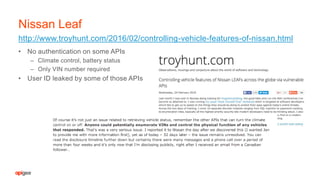
Nissan Leaf VIN number only security credential on API Troy Hunt
Tesla Model S Six-character password that’s easily guessable Security Affairs, Elsewhere
Some API Security Breaches
• No authentication on some APIs
– Climate control, battery status
– Only VIN number required
• User ID leaked by some of those APIs
http://www.troyhunt.com/2016/02/controlling-vehicle-features-of-nissan.html
Nissan Leaf
• No rate limit on request to get friends by phone
number
• Hard-coded encryption key
• Weak cipher
http://gibsonsec.org/snapchat/
Snapchat
Fundamental API Security
What every developer should know
You Have an API
• Prevent unauthorized applications
• Prevent unauthorized users
• Prevent excessive traffic
• Prevent content attacks
• Watch for trouble
• React to trouble
What You Need to Do
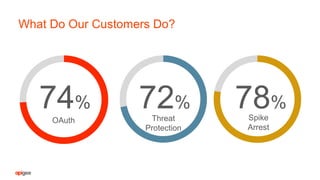
What Do Our Customers Do?
74%
OAuth
78%
Spike
Arrest
72%
Threat
Protection
• Application Authorization is a fundamental part of API security
– Best way to stop runaway applications
– Only options for certain types of apps (anonymous API access)
– Requirement for all forms of OAuth
• Best practices
– Use different credentials for each version of each app
– Makes it easier to pull a bad version
– Hide the app credentials as best you can
• Realize that they still can be stolen
– Have an approval process for apps
Prevent Unauthorized Applications
• Authenticate all end users for critical apps
– Only way to keep security credentials outside the
app
– Use OAuth carefully
• Use caution around “password” grant type
• Only as good as identity management
– For instance, dodgy password reset practices
– Can you get identity a service?
Prevent Unauthorized Users
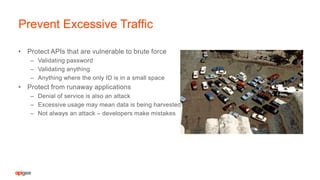
• Protect APIs that are vulnerable to brute force
– Validating password
– Validating anything
– Anything where the only ID is in a small space
• Protect from runaway applications
– Denial of service is also an attack
– Excessive usage may mean data is being harvested
– Not always an attack – developers make mistakes
Prevent Excessive Traffic
• Accepting JSON over the Internet?
– Excessive identifier length
– Excessive nesting
– Large arrays and elements
• Accepting XML over the Internet?
– All that and more
• Are you sure there can’t be SQL injection?
– Regular expression checks
Prevent Content Attacks
• Monitor the API
– Usage patterns
– Usage patterns by application
– Latency
– Error rate
• Monitor the world too
– Unusual tweets?
– Other social media?
Watch for Trouble
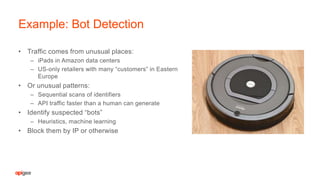
• Traffic comes from unusual places:
– iPads in Amazon data centers
– US-only retailers with many “customers” in Eastern
Europe
• Or unusual patterns:
– Sequential scans of identifiers
– API traffic faster than a human can generate
• Identify suspected “bots”
– Heuristics, machine learning
• Block them by IP or otherwise
Example: Bot Detection
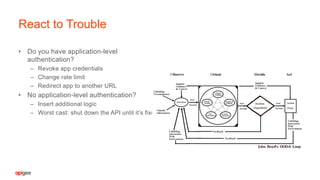
• Do you have application-level
authentication?
– Revoke app credentials
– Change rate limit
– Redirect app to another URL
• No application-level authentication?
– Insert additional logic
– Worst cast: shut down the API until it’s fixed
React to Trouble
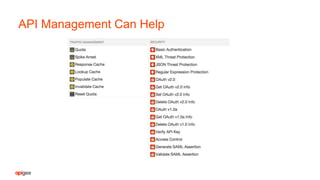
API Management Can Help
Effective API Security
Api == Contract == security
An API is a Contract
What is an API, really?
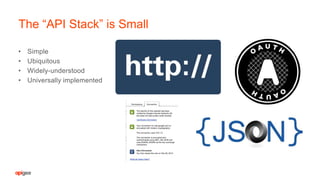
• Simple
• Ubiquitous
• Widely-understood
• Universally implemented
The “API Stack” is Small
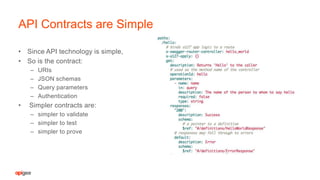
• Since API technology is simple,
• So is the contract:
– URIs
– JSON schemas
– Query parameters
– Authentication
• Simpler contracts are:
– simpler to validate
– simpler to test
– simpler to prove
API Contracts are Simple
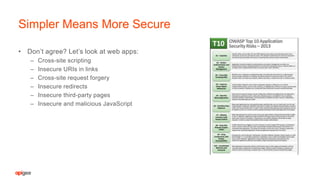
• Don’t agree? Let’s look at web apps:
– Cross-site scripting
– Insecure URIs in links
– Cross-site request forgery
– Insecure redirects
– Insecure third-party pages
– Insecure and malicious JavaScript
Simpler Means More Secure
• Well-known URI pattern
• Documented schemas
• Well-known authentication model
• Well-known authorization model
• One way to secure all API calls
Simpler is Better
• Totally dynamic URI pattern is harder
to test
• Specified inputs and outputs can be
tested
• Haphazard authentication hard to test
• Haphazard authorization hard to test
• Multiple implementations hard to test
Summing it Up
Back to the original point
• We saw lots of places where APIs were compromised
– Many of these had nothing to do with an “API”
• Biggest vulnerability is having an API and not realizing it
– Everything with a URL has an API
• Well-defined APIs can be secured
– Lots of widely-known techniques and technology
• A properly-secured API is verifiable
• Use it!
Conclusion
community.apigee.com
Thank you
CONFIDENTIAL

APIs: The New Security Layer

  • 1.
    APIs: The NewSecurity Layer Greg Brail, Apigee
  • 2.
  • 3.
    Today’s Speakers: 3©2008-16 ApigeeCorp. All rights reserved. Greg Brail Apigee
  • 4.
    • What Happensto Insecure APIs • API Security Fundamentals • The Result: Effective API Security Agenda
  • 5.
    No API Security? Badthings happen
  • 6.
    Let’s make itsecure then I have an API!
  • 7.
    But I Don’tHave an API!
  • 8.
    Everything with aURI has an API Of Course You Have an API! 8 Wired, 9/22/15 www.ifc0nfig.com, 1/5/15 troyhunt.com, 2/24/16
  • 9.
    Breach Reason Source BufferCompromised third-party admin password; OAuth secret in GitHub ProgrammableWeb Snapchat No authentication; no rate limit Gibson Security Multiple Kardashian Apps No authentication or authorization Wired MoonPig No authentication or authorization www.ifc0nfig.com Facebook Graph API Users can delete other users’ photos; Improper authorization check ProgrammableWeb IRS GetTranscript Application Password reset mechanism relied on personal data IRS Instagram Malicious app was stealing passwords; no approval process Daily Dot Nissan Leaf VIN number only security credential on API Troy Hunt Tesla Model S Six-character password that’s easily guessable Security Affairs, Elsewhere Some API Security Breaches
  • 10.
    • No authenticationon some APIs – Climate control, battery status – Only VIN number required • User ID leaked by some of those APIs http://www.troyhunt.com/2016/02/controlling-vehicle-features-of-nissan.html Nissan Leaf
  • 11.
    • No ratelimit on request to get friends by phone number • Hard-coded encryption key • Weak cipher http://gibsonsec.org/snapchat/ Snapchat
  • 12.
    Fundamental API Security Whatevery developer should know
  • 13.
  • 14.
    • Prevent unauthorizedapplications • Prevent unauthorized users • Prevent excessive traffic • Prevent content attacks • Watch for trouble • React to trouble What You Need to Do
  • 15.
    What Do OurCustomers Do? 74% OAuth 78% Spike Arrest 72% Threat Protection
  • 16.
    • Application Authorizationis a fundamental part of API security – Best way to stop runaway applications – Only options for certain types of apps (anonymous API access) – Requirement for all forms of OAuth • Best practices – Use different credentials for each version of each app – Makes it easier to pull a bad version – Hide the app credentials as best you can • Realize that they still can be stolen – Have an approval process for apps Prevent Unauthorized Applications
  • 17.
    • Authenticate allend users for critical apps – Only way to keep security credentials outside the app – Use OAuth carefully • Use caution around “password” grant type • Only as good as identity management – For instance, dodgy password reset practices – Can you get identity a service? Prevent Unauthorized Users
  • 18.
    • Protect APIsthat are vulnerable to brute force – Validating password – Validating anything – Anything where the only ID is in a small space • Protect from runaway applications – Denial of service is also an attack – Excessive usage may mean data is being harvested – Not always an attack – developers make mistakes Prevent Excessive Traffic
  • 19.
    • Accepting JSONover the Internet? – Excessive identifier length – Excessive nesting – Large arrays and elements • Accepting XML over the Internet? – All that and more • Are you sure there can’t be SQL injection? – Regular expression checks Prevent Content Attacks
  • 20.
    • Monitor theAPI – Usage patterns – Usage patterns by application – Latency – Error rate • Monitor the world too – Unusual tweets? – Other social media? Watch for Trouble
  • 21.
    • Traffic comesfrom unusual places: – iPads in Amazon data centers – US-only retailers with many “customers” in Eastern Europe • Or unusual patterns: – Sequential scans of identifiers – API traffic faster than a human can generate • Identify suspected “bots” – Heuristics, machine learning • Block them by IP or otherwise Example: Bot Detection
  • 22.
    • Do youhave application-level authentication? – Revoke app credentials – Change rate limit – Redirect app to another URL • No application-level authentication? – Insert additional logic – Worst cast: shut down the API until it’s fixed React to Trouble
  • 23.
  • 24.
    Effective API Security Api== Contract == security
  • 25.
    An API isa Contract What is an API, really?
  • 26.
    • Simple • Ubiquitous •Widely-understood • Universally implemented The “API Stack” is Small
  • 27.
    • Since APItechnology is simple, • So is the contract: – URIs – JSON schemas – Query parameters – Authentication • Simpler contracts are: – simpler to validate – simpler to test – simpler to prove API Contracts are Simple
  • 28.
    • Don’t agree?Let’s look at web apps: – Cross-site scripting – Insecure URIs in links – Cross-site request forgery – Insecure redirects – Insecure third-party pages – Insecure and malicious JavaScript Simpler Means More Secure
  • 29.
    • Well-known URIpattern • Documented schemas • Well-known authentication model • Well-known authorization model • One way to secure all API calls Simpler is Better • Totally dynamic URI pattern is harder to test • Specified inputs and outputs can be tested • Haphazard authentication hard to test • Haphazard authorization hard to test • Multiple implementations hard to test
  • 30.
    Summing it Up Backto the original point
  • 31.
    • We sawlots of places where APIs were compromised – Many of these had nothing to do with an “API” • Biggest vulnerability is having an API and not realizing it – Everything with a URL has an API • Well-defined APIs can be secured – Lots of widely-known techniques and technology • A properly-secured API is verifiable • Use it! Conclusion
  • 32.
  • 33.