
Hosting public domain chemicals
data online for the community – the
challenges of handling materials
Antony Williams
Opportunities in Materials Informatics, University of Wisconsin-Madison
February 9th
, 2015
0000-0002-2668-4821
About Me…
• I am NOT a materials chemist
• I am an NMR spectroscopist by training
• Worked on a LIMS while at Kodak
• 10 years in commercial cheminformatics
• Built the ChemSpider database as a hobby
• Worked on validating compounds on Wikipedia
• Manage cheminformatics team for RSC
• Believer in the value of social networking and
Open Data for science
• Dane Morgan asked me to tell jokes…
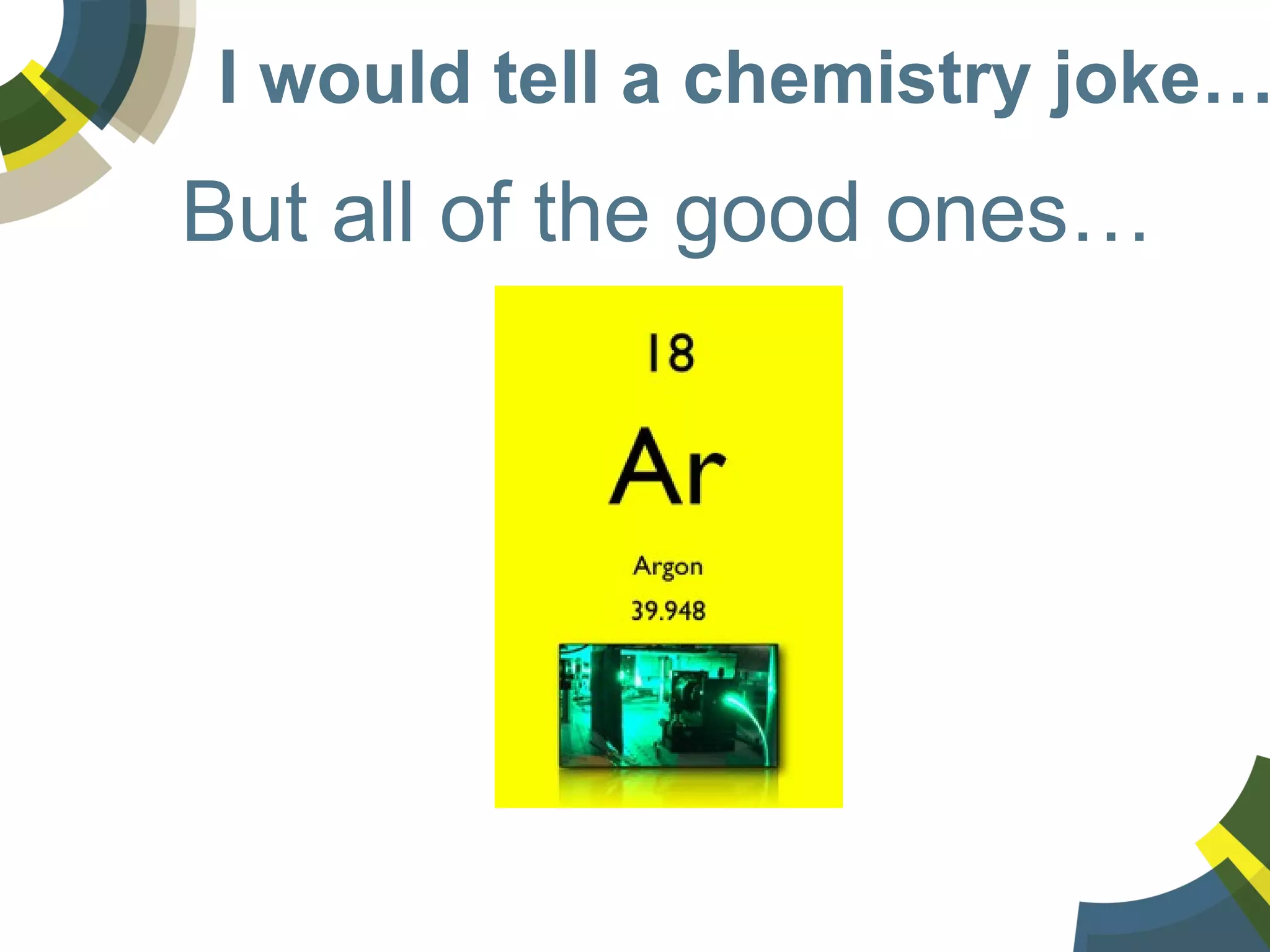
I would tell a chemistry joke…
But all of the good ones…
An ambitious idea….
• Let’s map together all online chemistry data
and build systems to integrate it
• Heck, let’s integrate chemistry and biology
data and add in disease data too if we can
• Let’s extract property data and model it and
see if we can extract new relationships –
quantitative and qualitative
• Let’s make it all available on the web…for free
What about this….
• We’re going to map the world
• We’re going to take photos of as many places
as we can and link them together
• We’ll let people annotate and curate the map
• Then let’s make it available free on the web
• We’ll make it available for decision making
• Put it on Mobile Devices, give it away…
Where is chemistry online?
• Encyclopedic articles (Wikipedia)
• Chemical vendor databases
• Metabolic pathway databases
• Property databases
• Patents with chemical structures
• Drug Discovery data
• Scientific publications
• Compound aggregators
• Blogs/Wikis and Open Notebook Science
Chemistry on the Internet…
• Most searching for chemistry on the internet…
• Name searching Google/Bing/Yahoo
• Name searching Wikipedia
• Name searching Wolfram Alpha
• Name, name, name, name…searching
• Structure searching DOZENS of websites, each
with different information or…
Chemistry on the Internet…
• Most searching for chemistry on the internet…
• Name searching Google/Bing/Yahoo
• Name searching Wikipedia
• Name searching Wolfram Alpha
• Name, name, name, name…searching
• Structure searching DOZENS of websites, each
with different information or…
• Search ONE website integrating the others!
• ~30 million chemicals and growing
• Data sourced from >500 different sources
• Crowd sourced curation and annotation
• Ongoing deposition of data from our
journals and our collaborators
• Structure centric hub for web-searching
• …and a really big dictionary!!!
• Note…NOT all websites connected
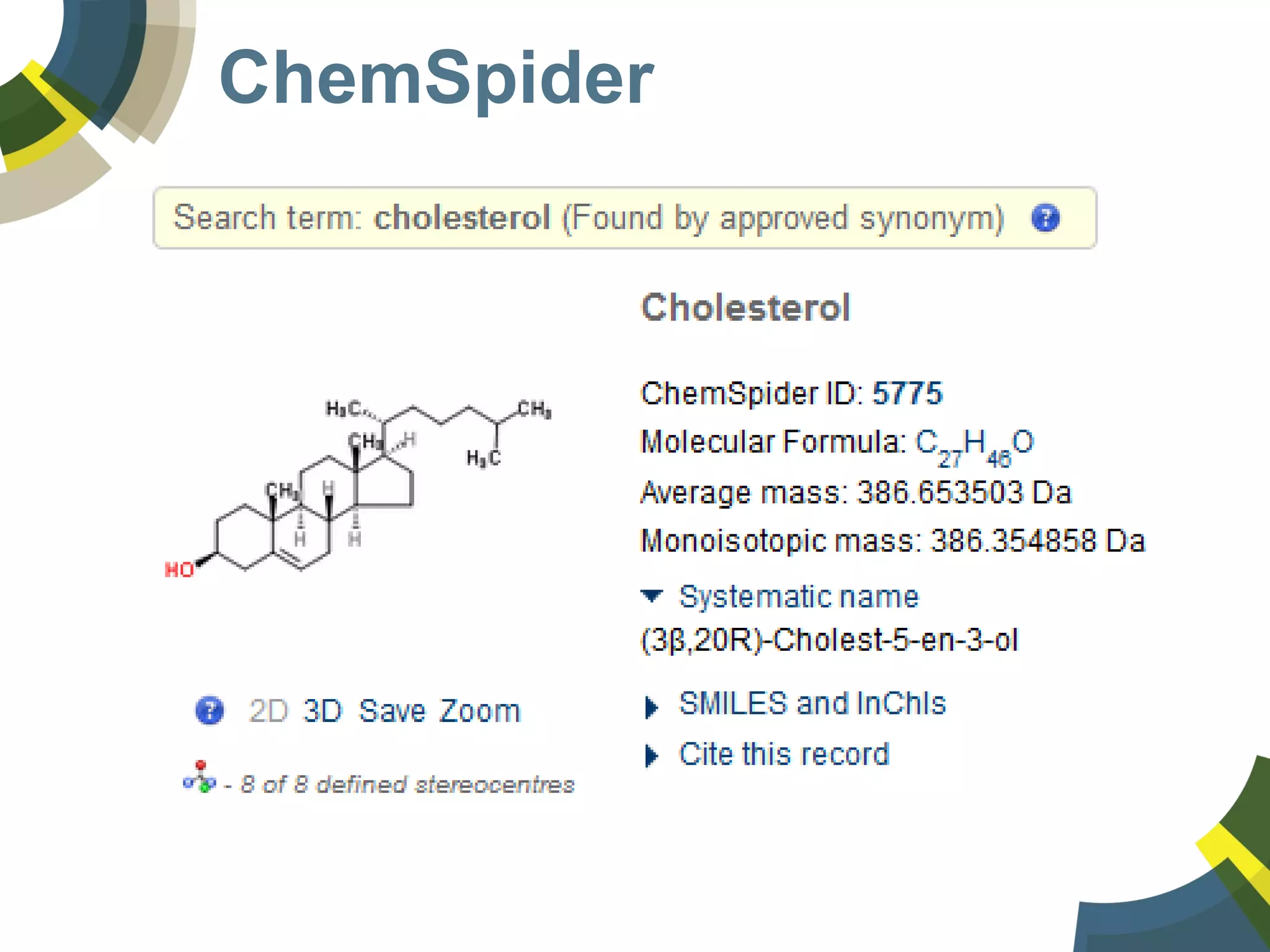
ChemSpider
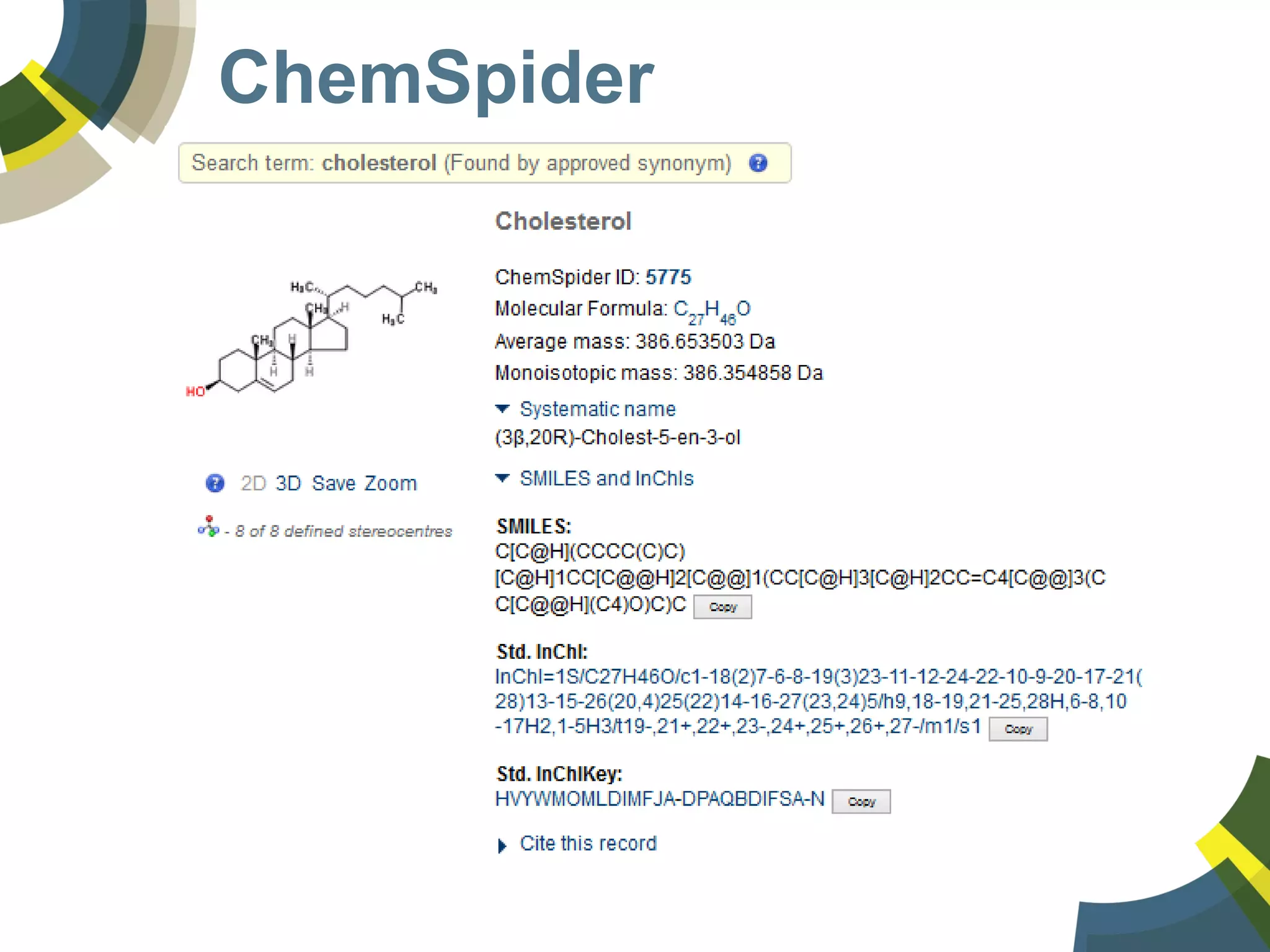
ChemSpider
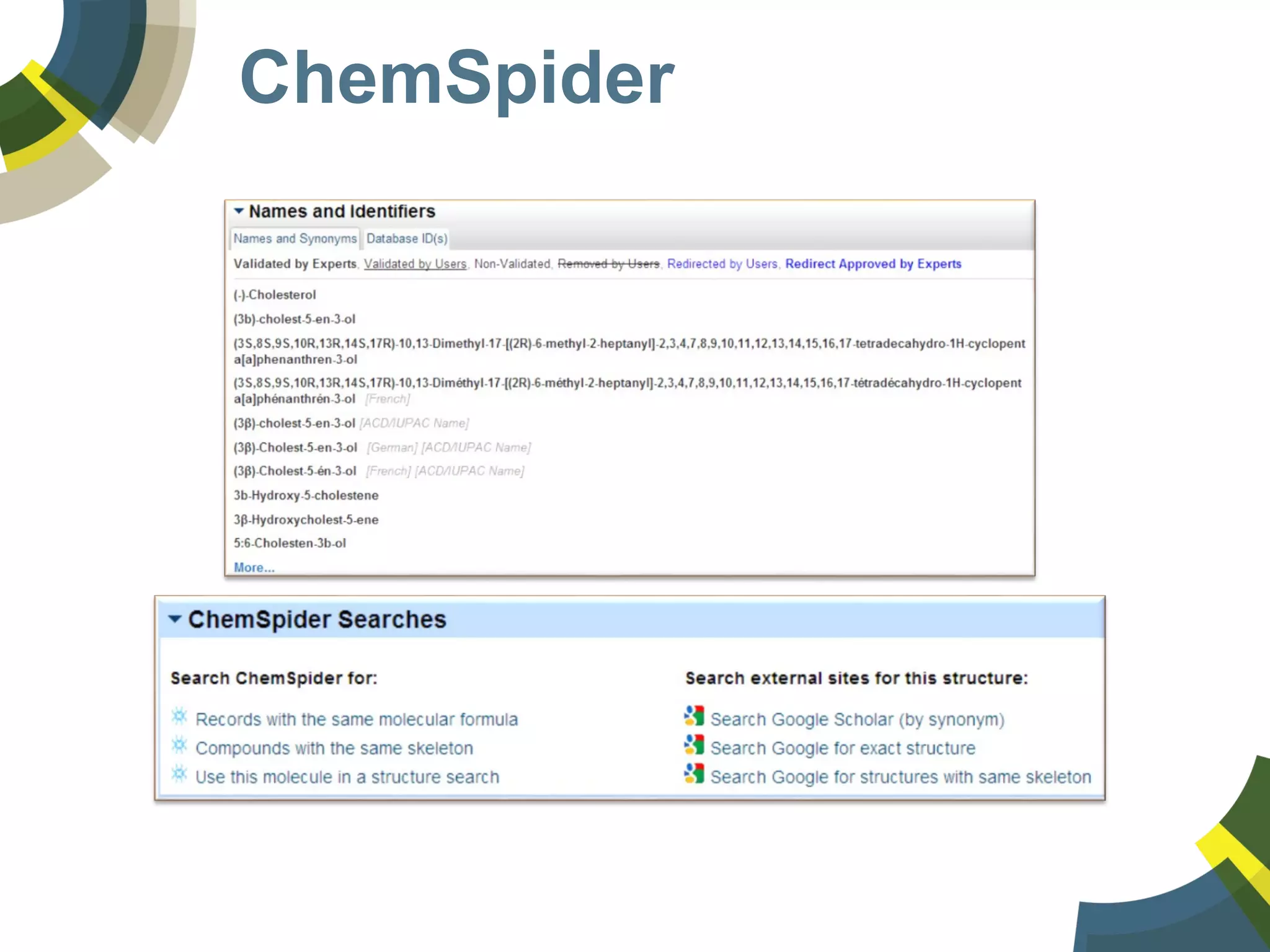
ChemSpider
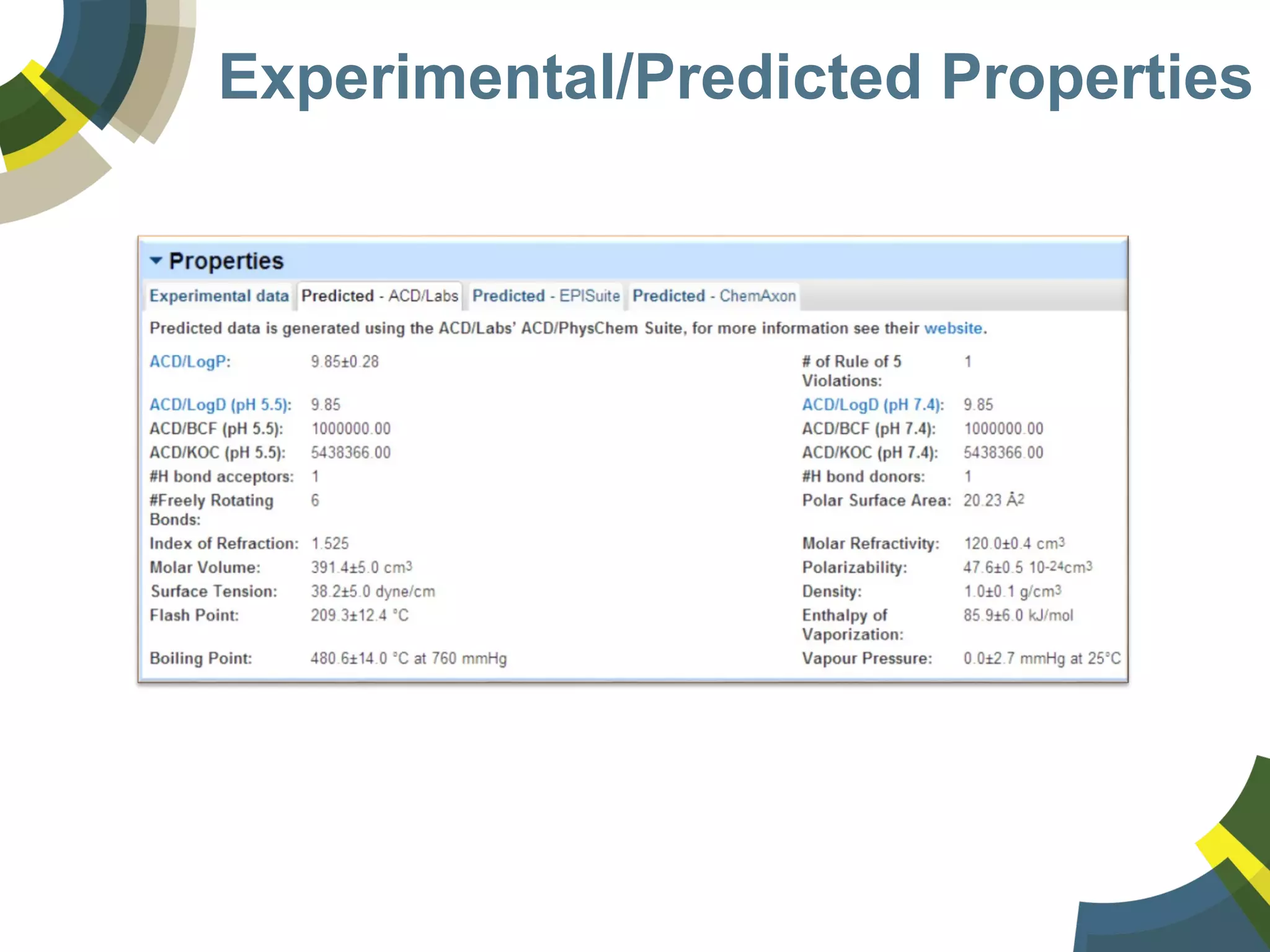
Experimental/Predicted Properties
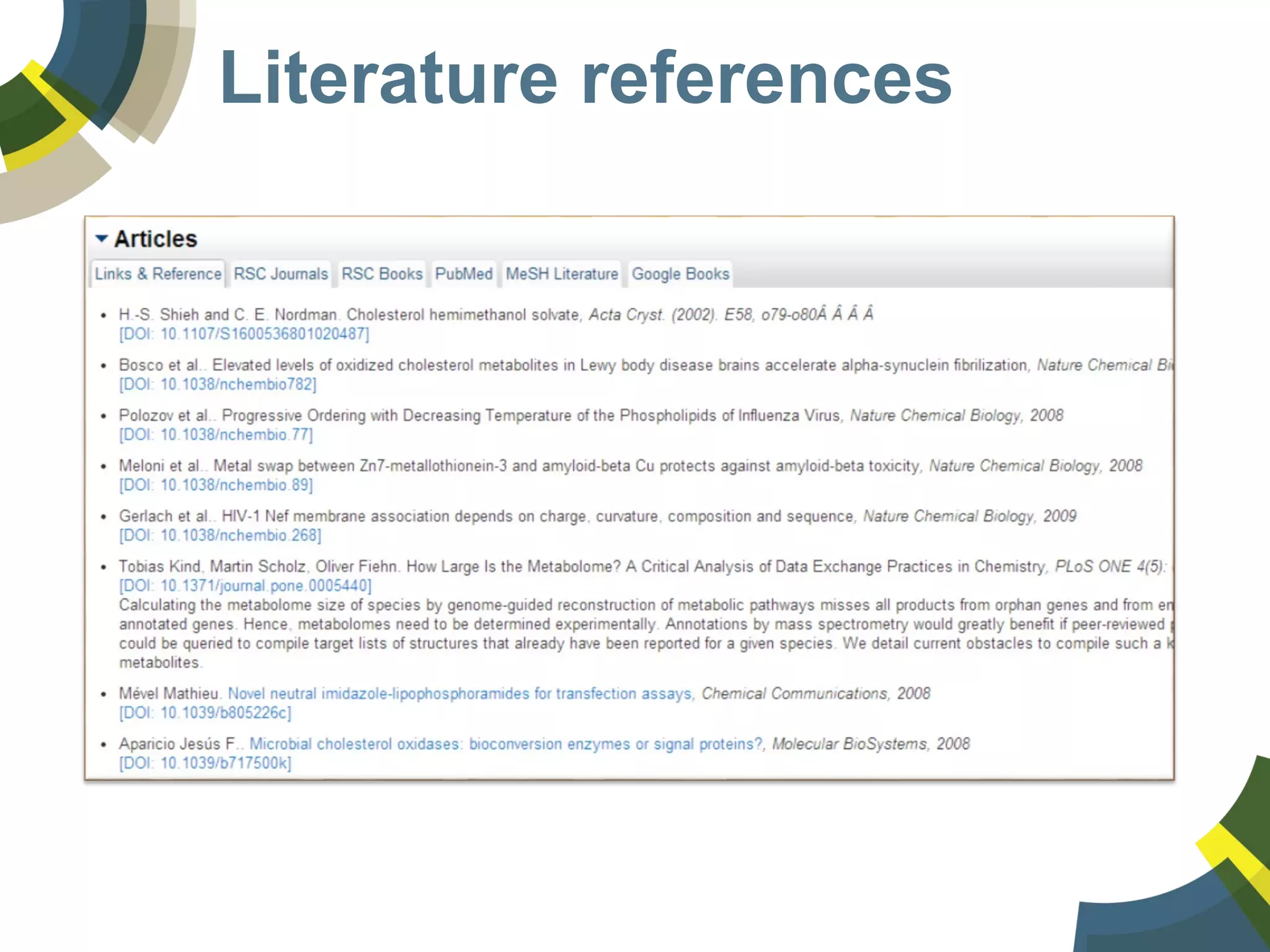
Literature references
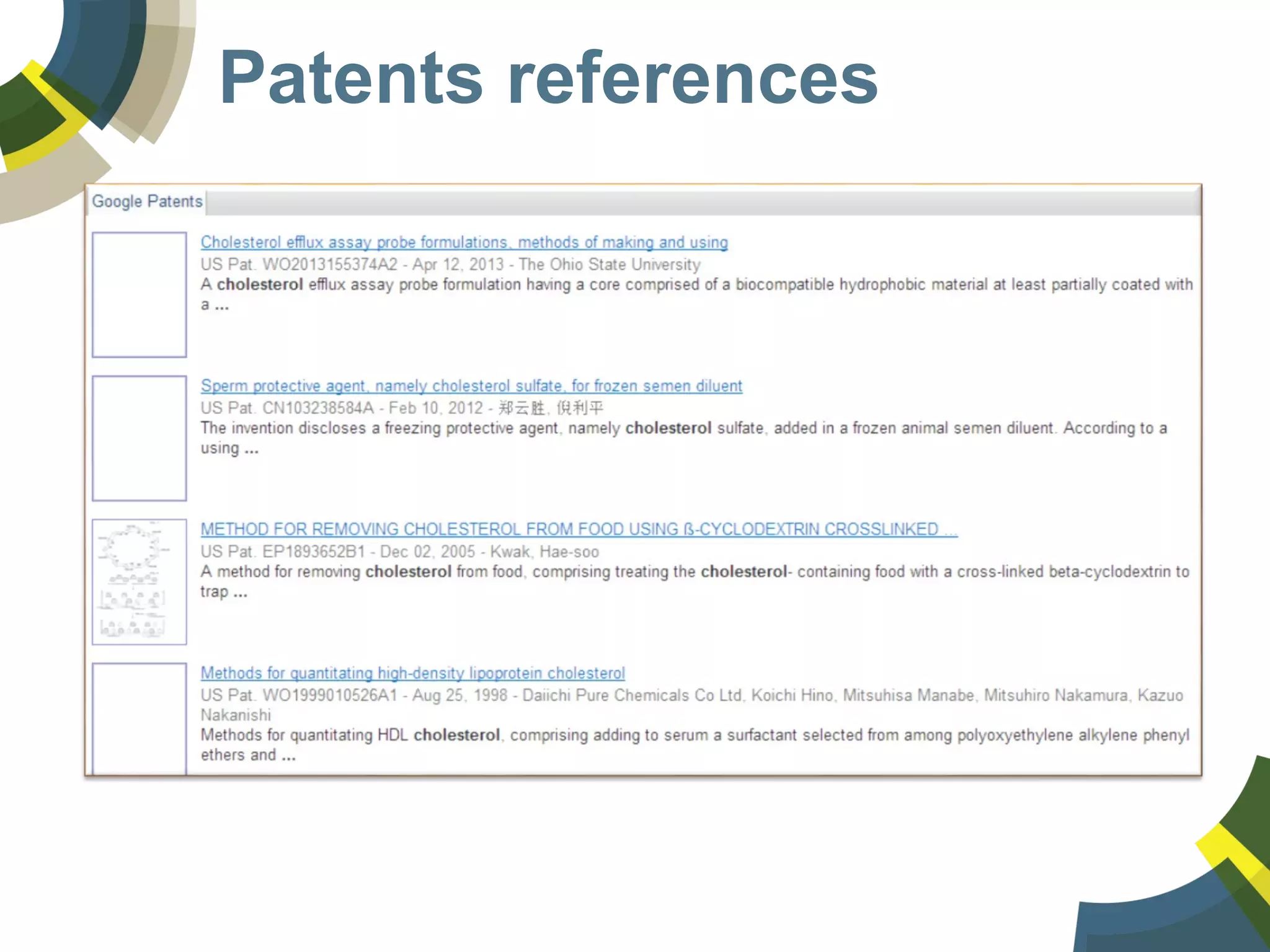
Patents references
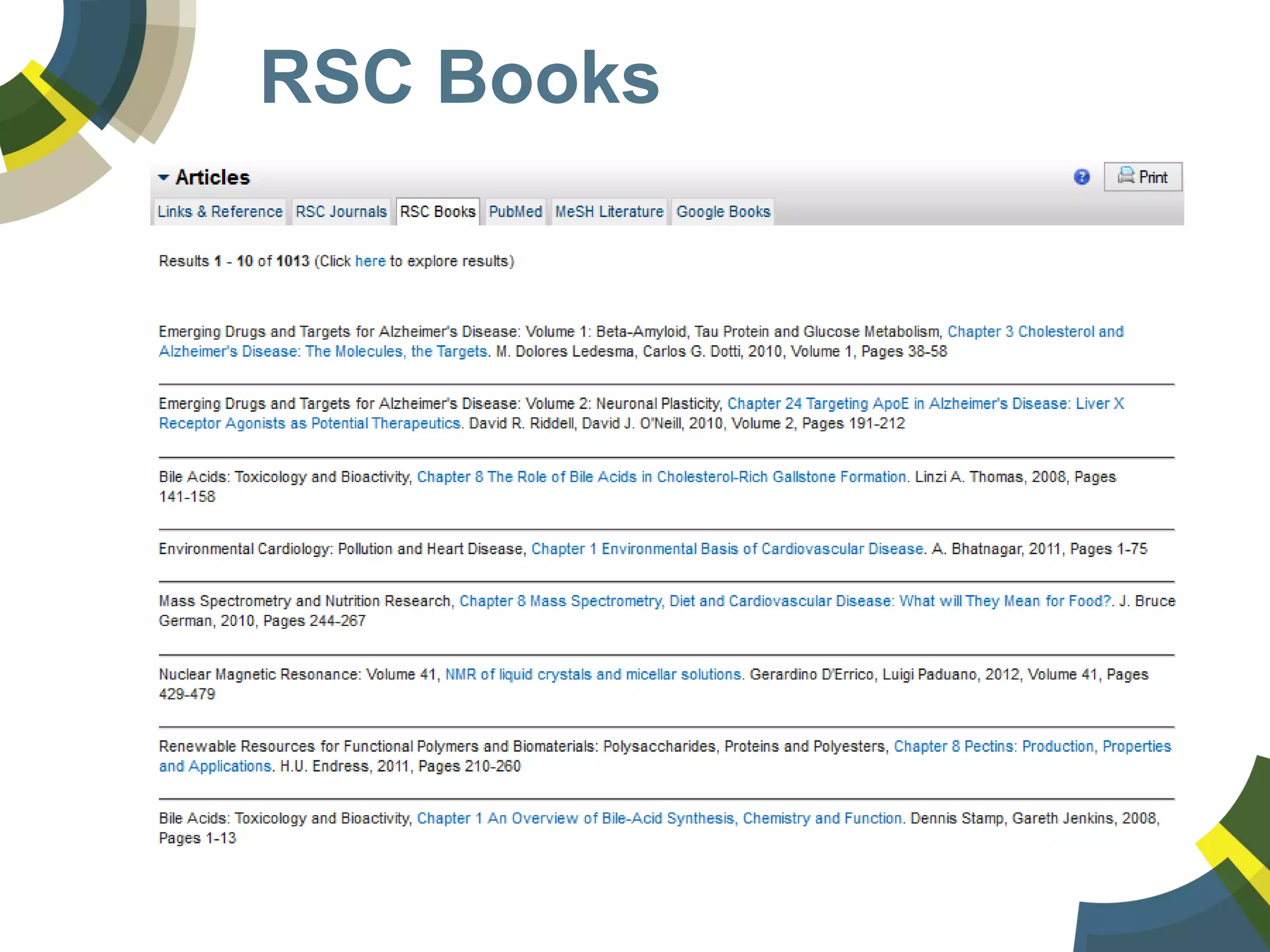
RSC Books
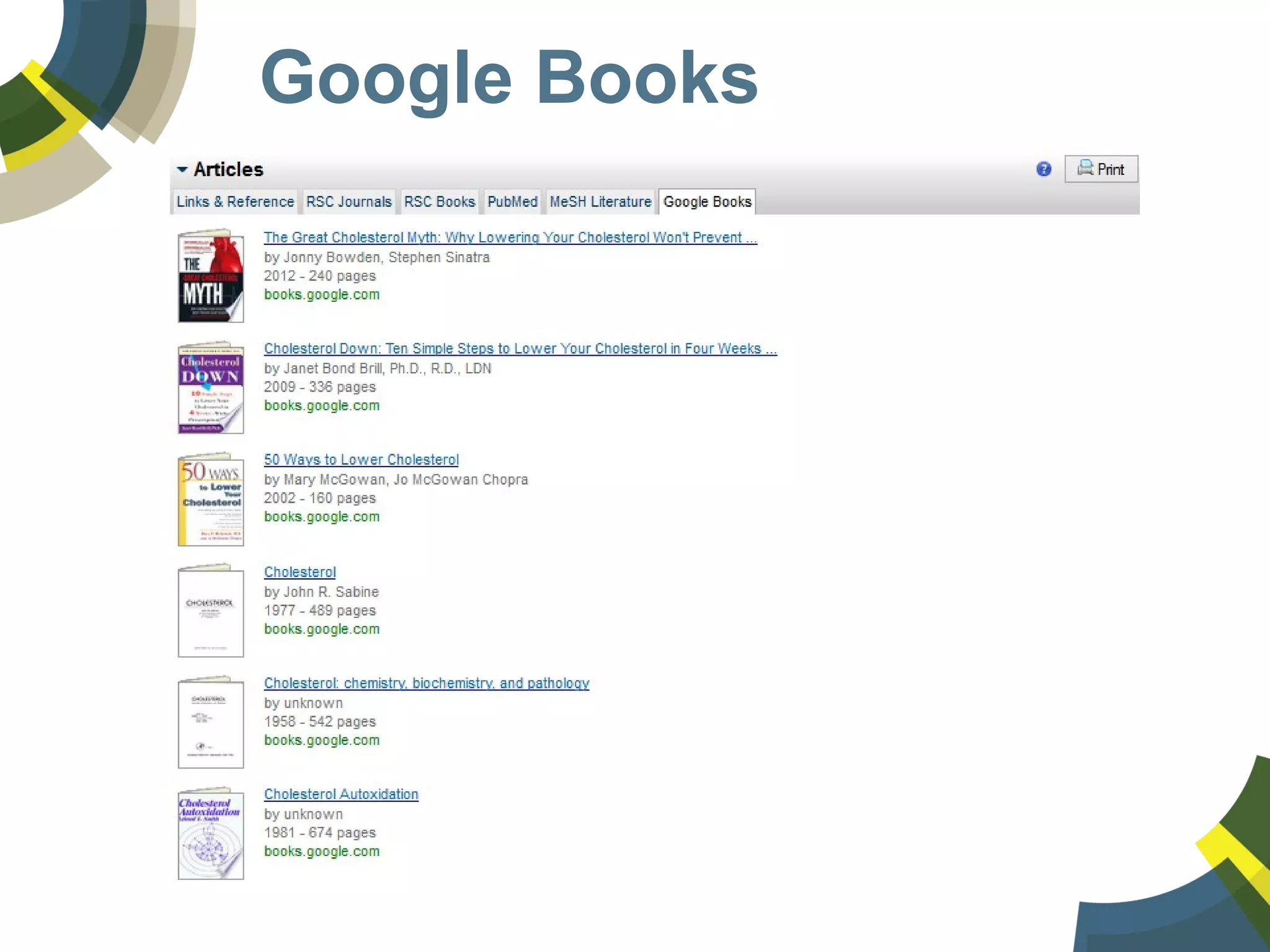
Google Books
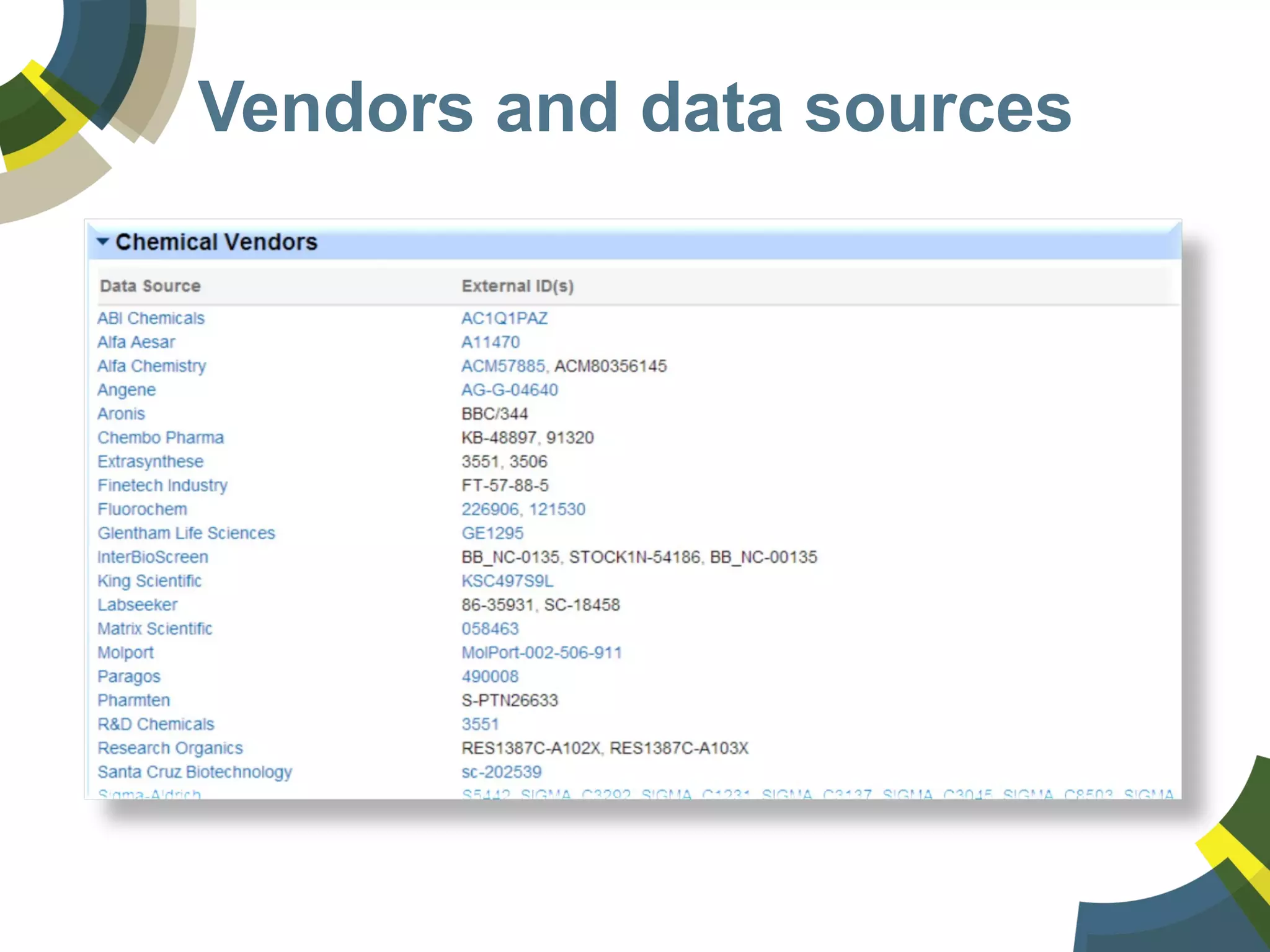
Vendors and data sources
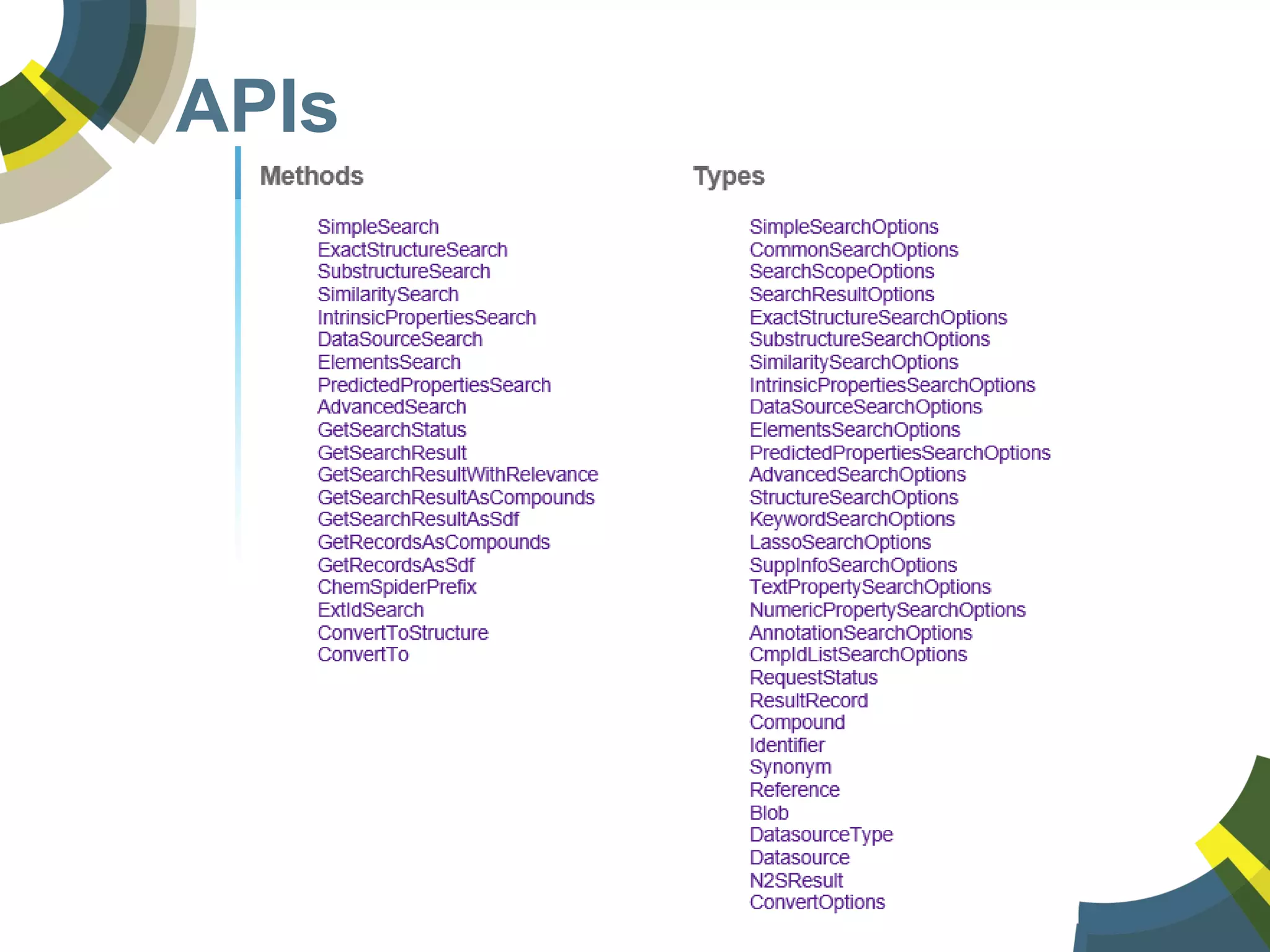
APIs
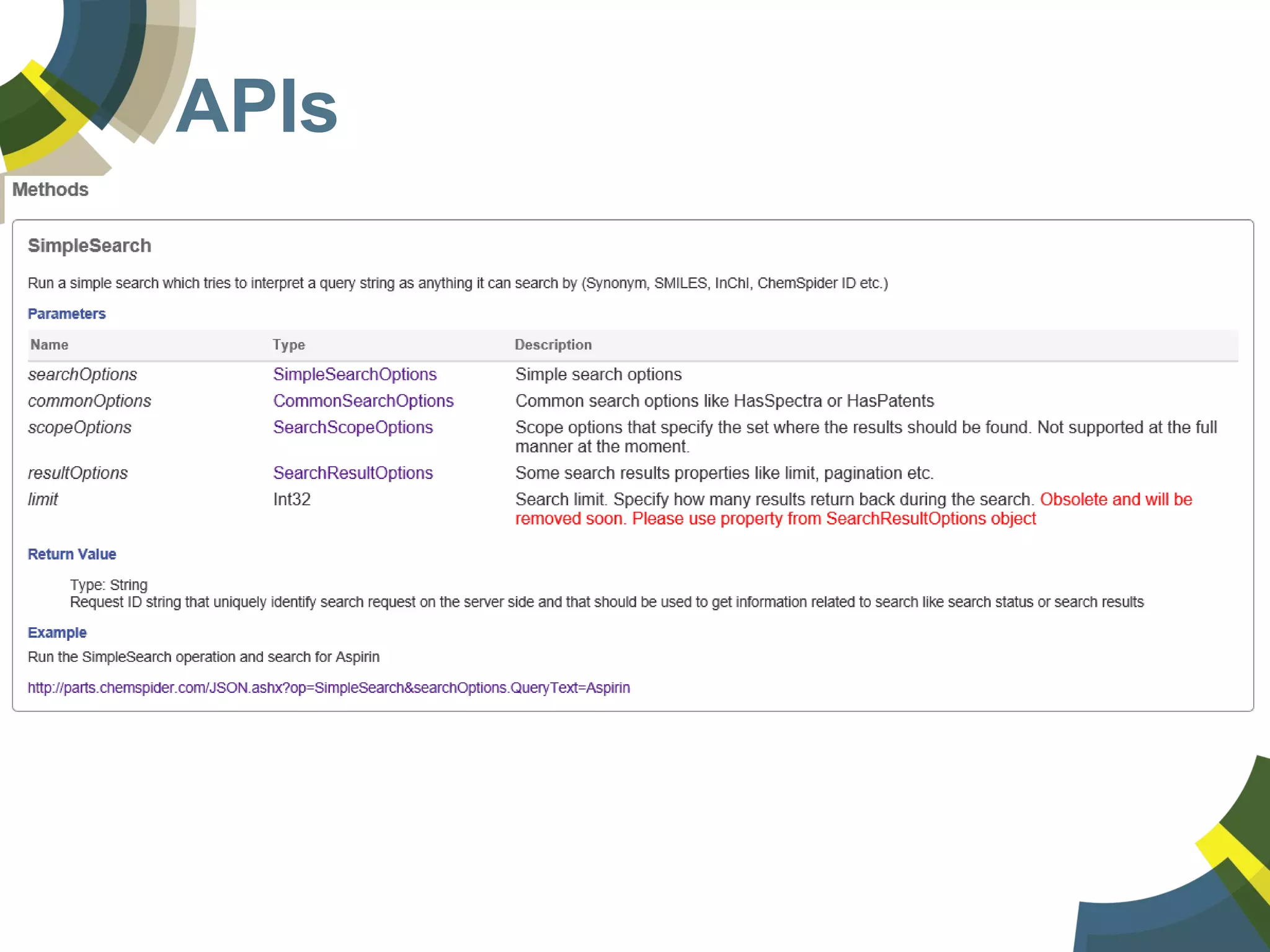
APIs
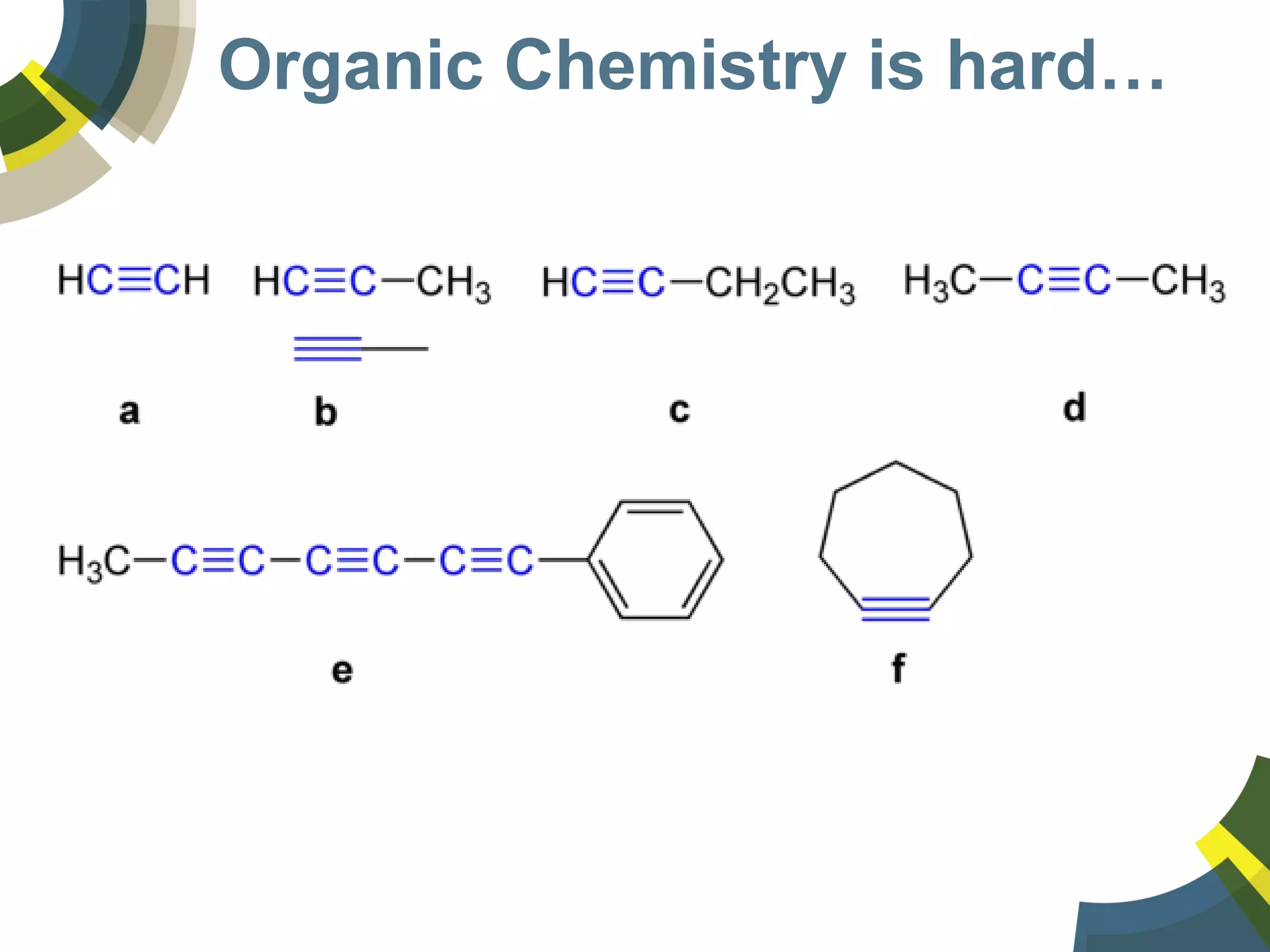
Organic Chemistry is hard…
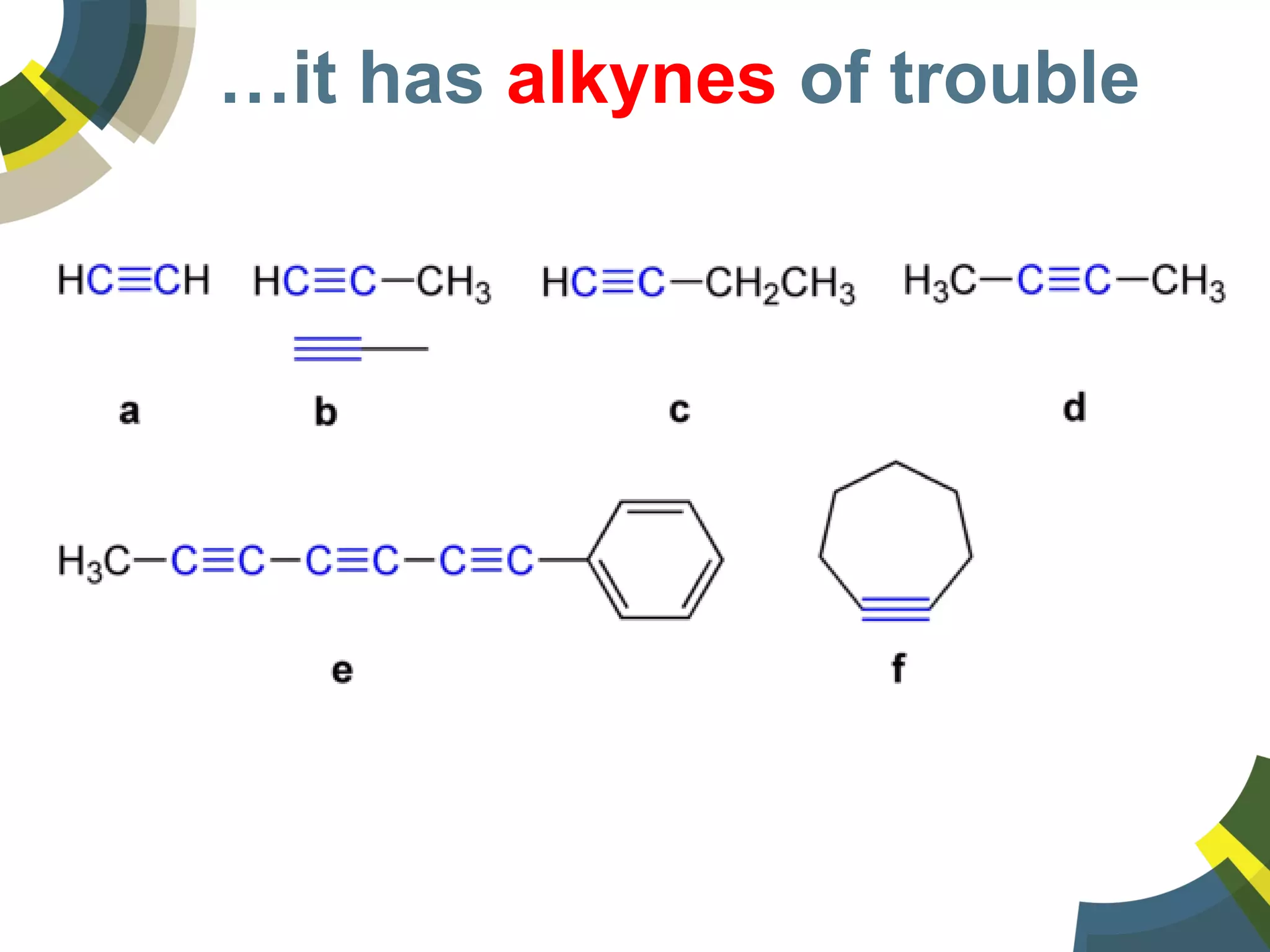
…it has alkynes of trouble
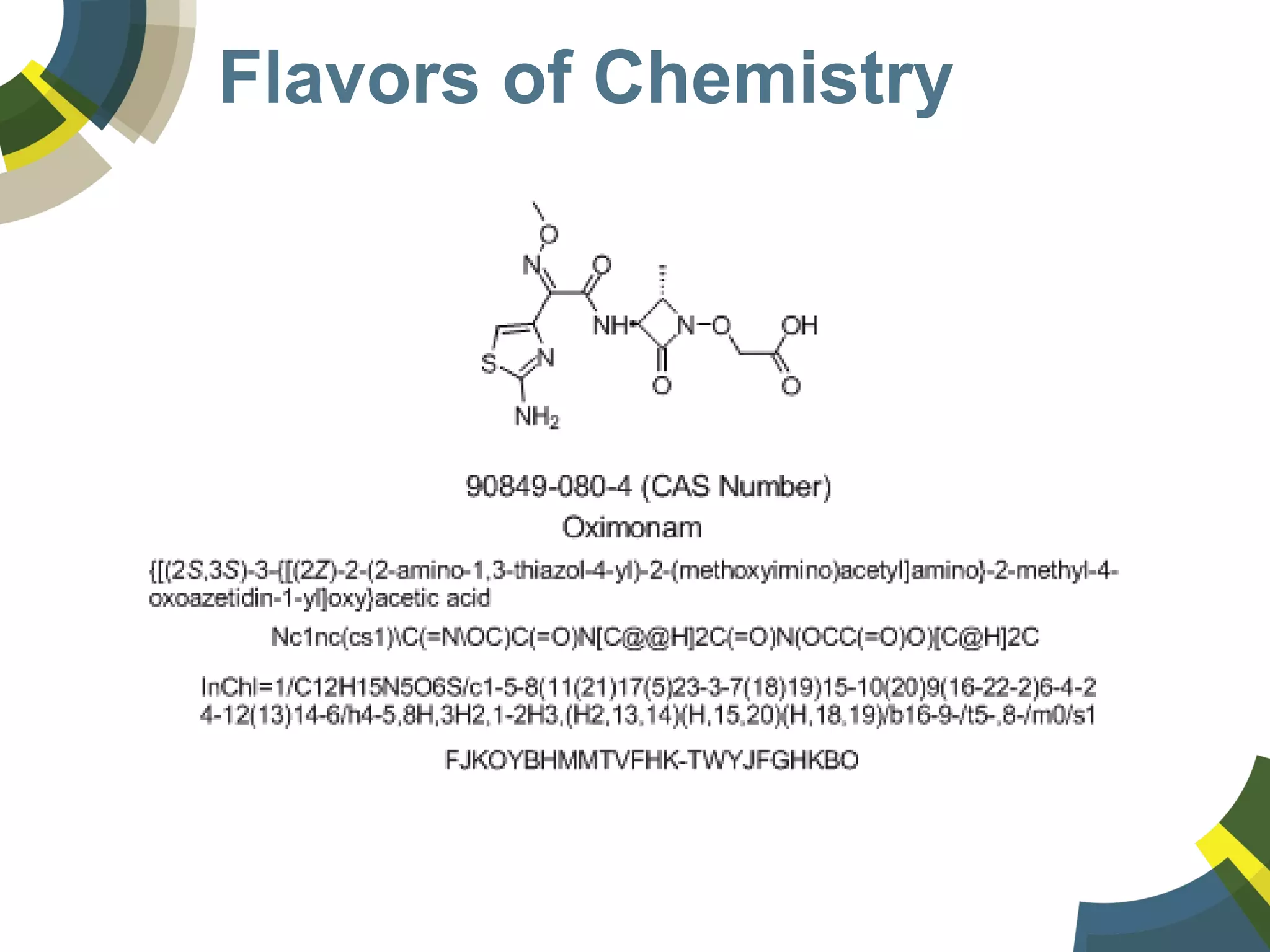
Flavors of Chemistry
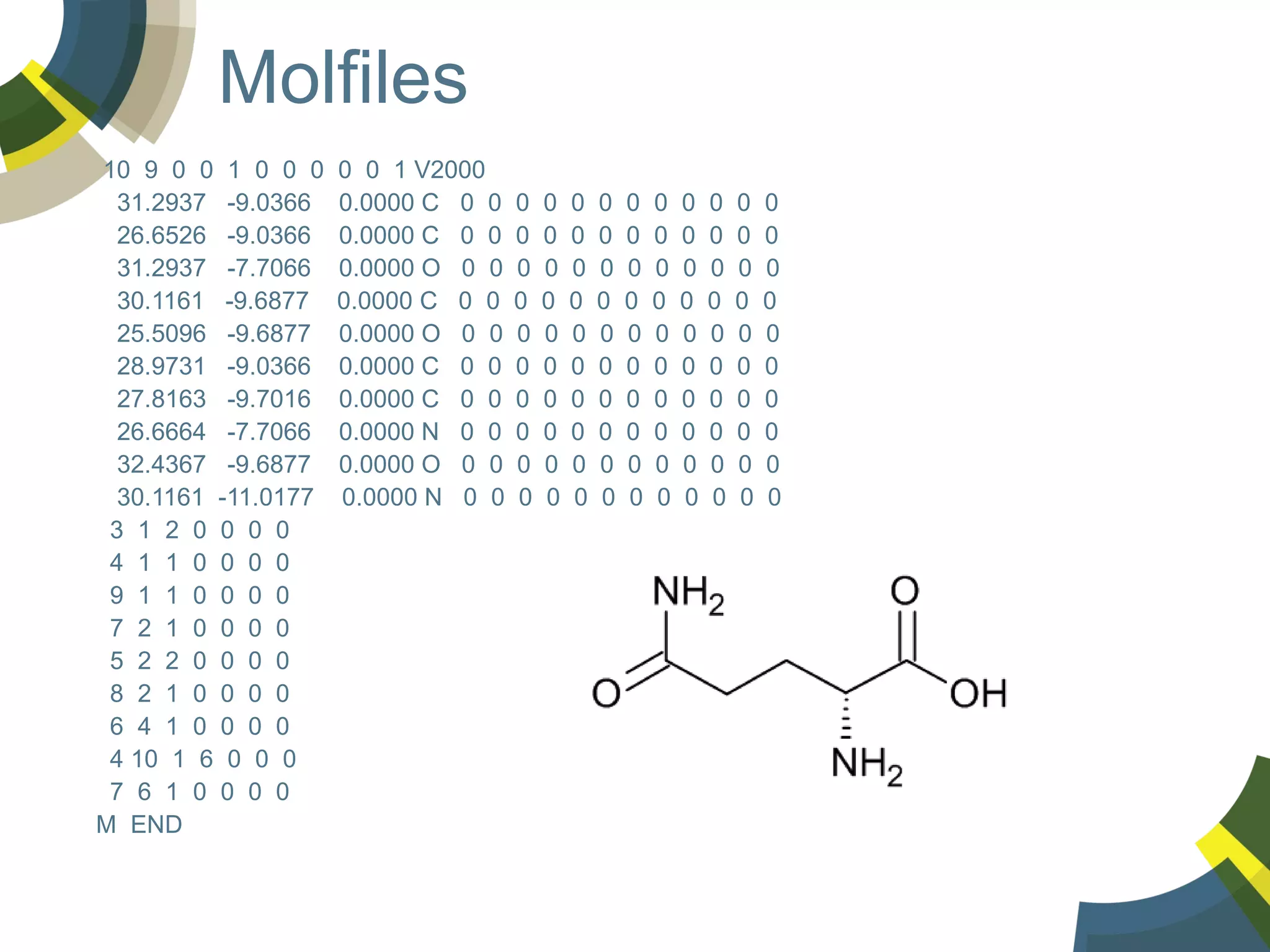
Molfiles
10 9 0 0 1 0 0 0 0 0 1 V2000
31.2937 -9.0366 0.0000 C 0 0 0 0 0 0 0 0 0 0 0 0
26.6526 -9.0366 0.0000 C 0 0 0 0 0 0 0 0 0 0 0 0
31.2937 -7.7066 0.0000 O 0 0 0 0 0 0 0 0 0 0 0 0
30.1161 -9.6877 0.0000 C 0 0 0 0 0 0 0 0 0 0 0 0
25.5096 -9.6877 0.0000 O 0 0 0 0 0 0 0 0 0 0 0 0
28.9731 -9.0366 0.0000 C 0 0 0 0 0 0 0 0 0 0 0 0
27.8163 -9.7016 0.0000 C 0 0 0 0 0 0 0 0 0 0 0 0
26.6664 -7.7066 0.0000 N 0 0 0 0 0 0 0 0 0 0 0 0
32.4367 -9.6877 0.0000 O 0 0 0 0 0 0 0 0 0 0 0 0
30.1161 -11.0177 0.0000 N 0 0 0 0 0 0 0 0 0 0 0 0
3 1 2 0 0 0 0
4 1 1 0 0 0 0
9 1 1 0 0 0 0
7 2 1 0 0 0 0
5 2 2 0 0 0 0
8 2 1 0 0 0 0
6 4 1 0 0 0 0
4 10 1 6 0 0 0
7 6 1 0 0 0 0
M END
Molfiles
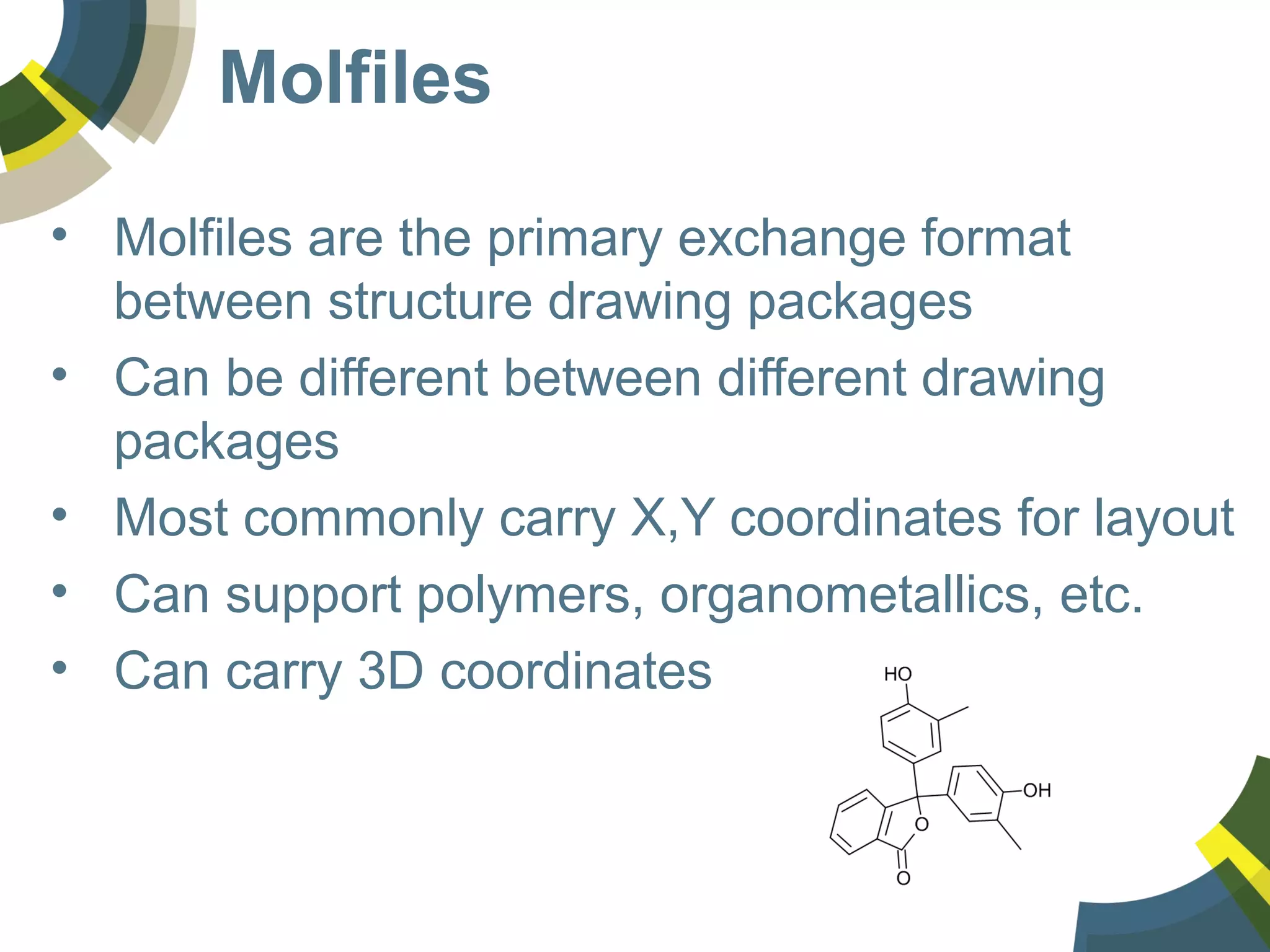
• Molfiles are the primary exchange format
between structure drawing packages
• Can be different between different drawing
packages
• Most commonly carry X,Y coordinates for layout
• Can support polymers, organometallics, etc.
• Can carry 3D coordinates
SMILES
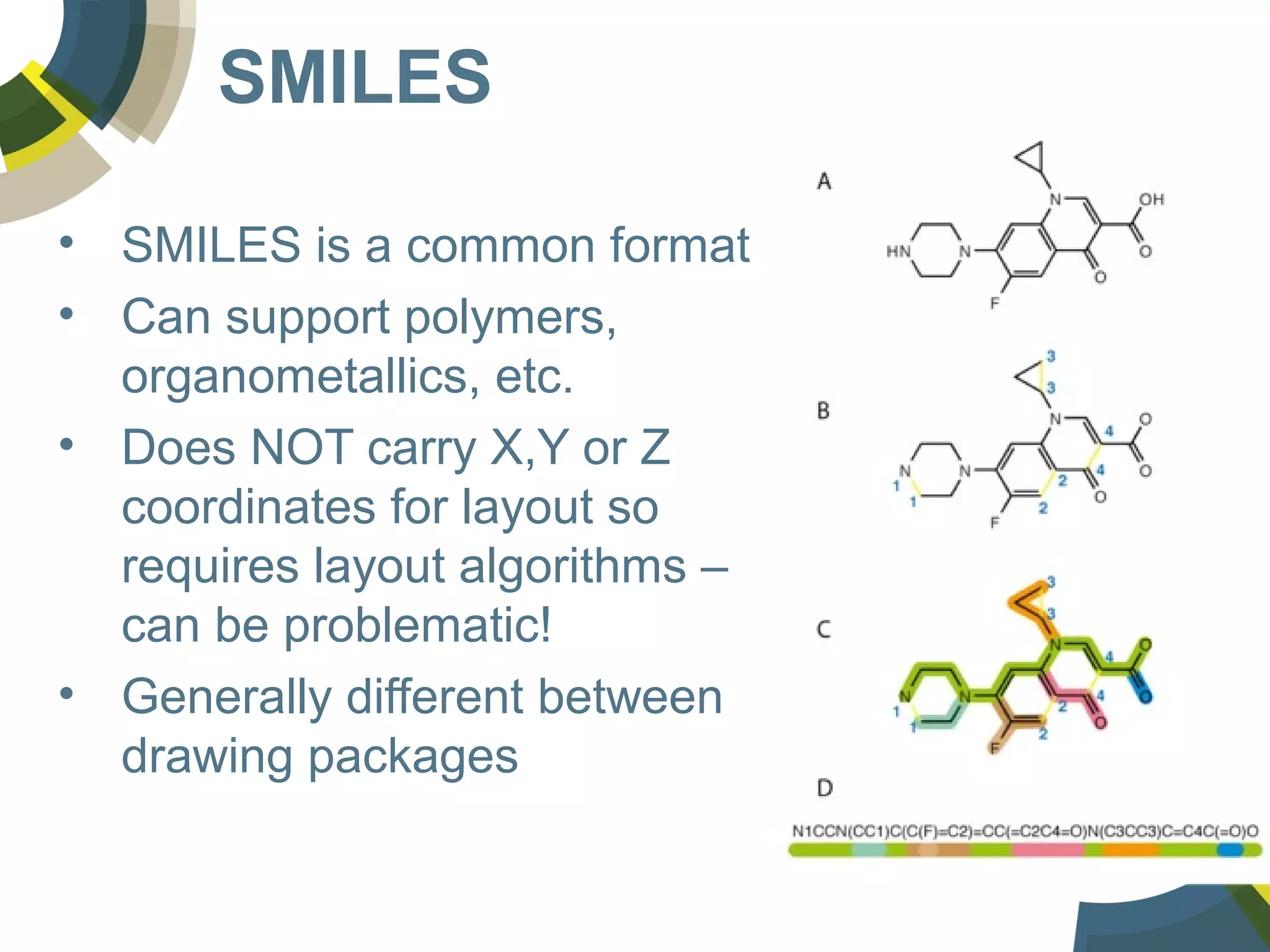
• SMILES is a common format
• Can support polymers,
organometallics, etc.
• Does NOT carry X,Y or Z
coordinates for layout so
requires layout algorithms –
can be problematic!
• Generally different between
drawing packages
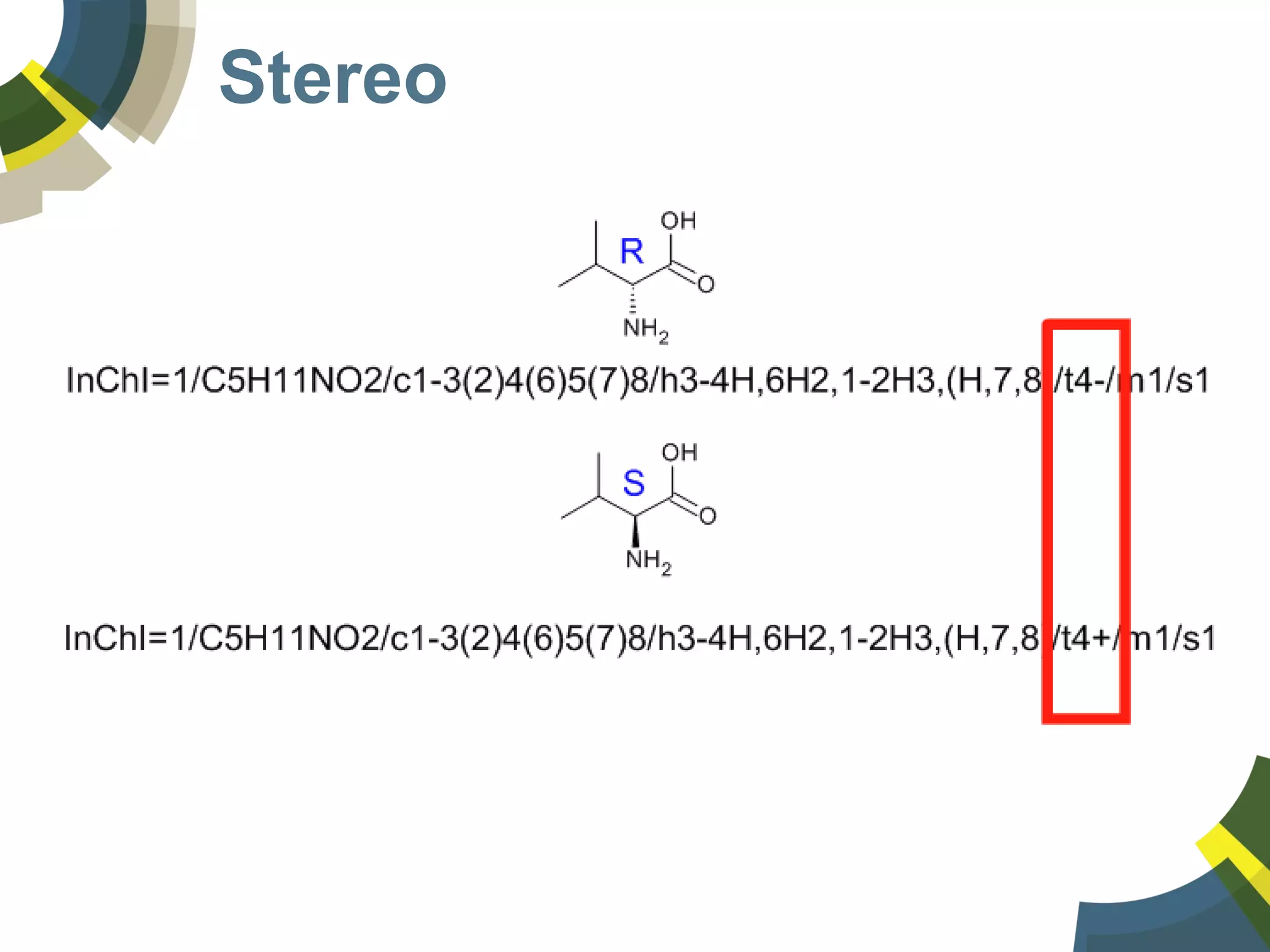
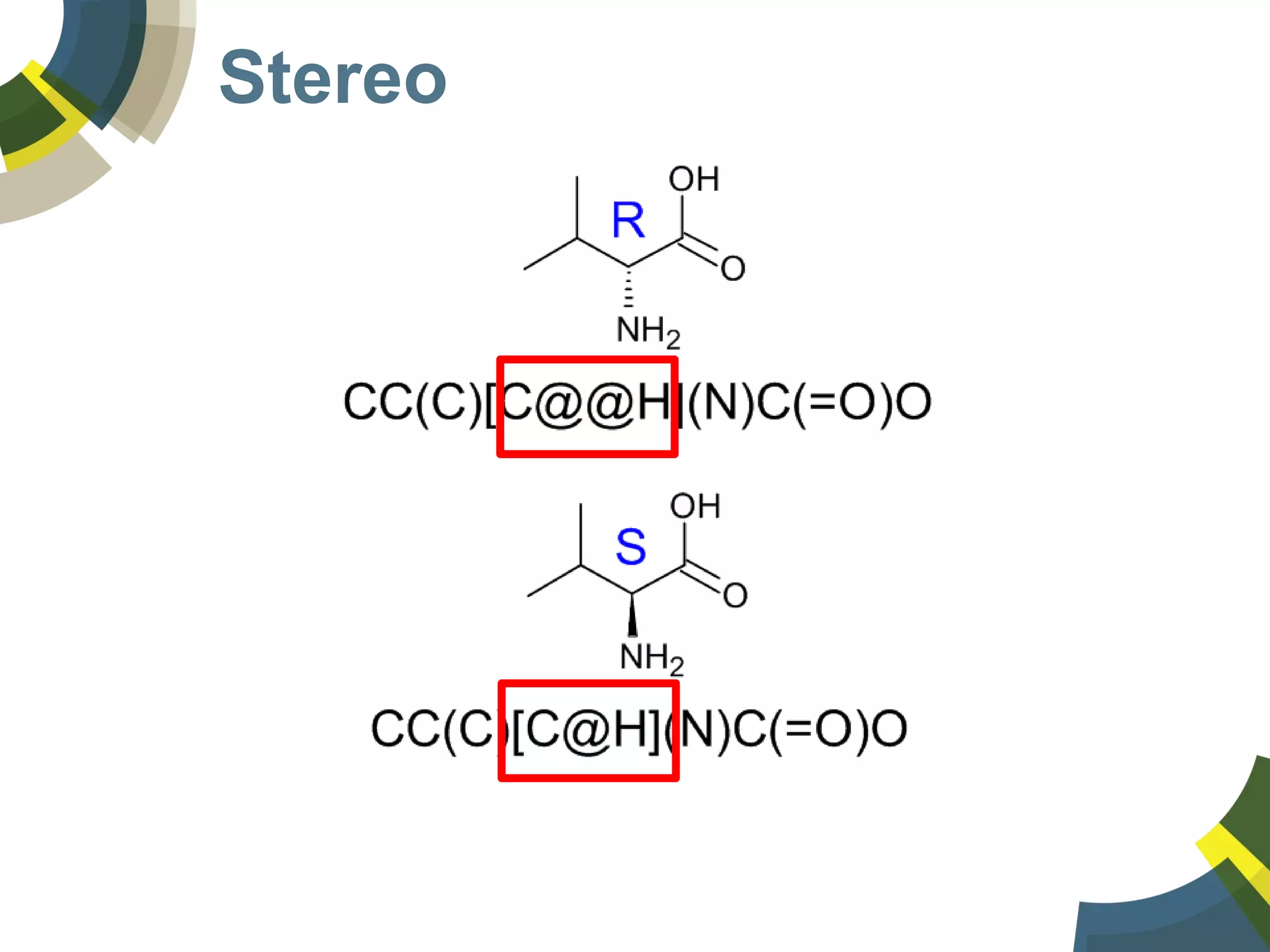
Stereo
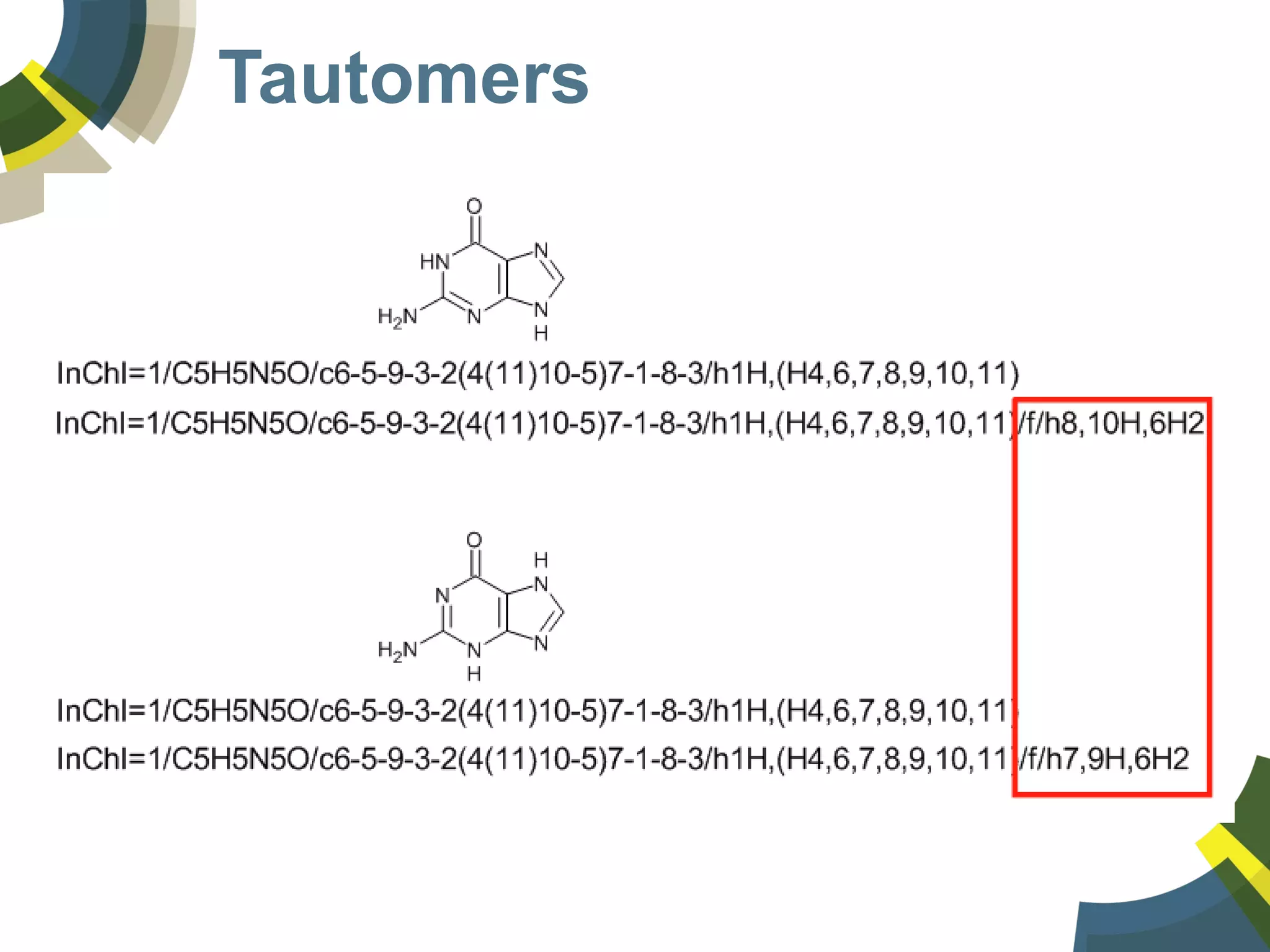
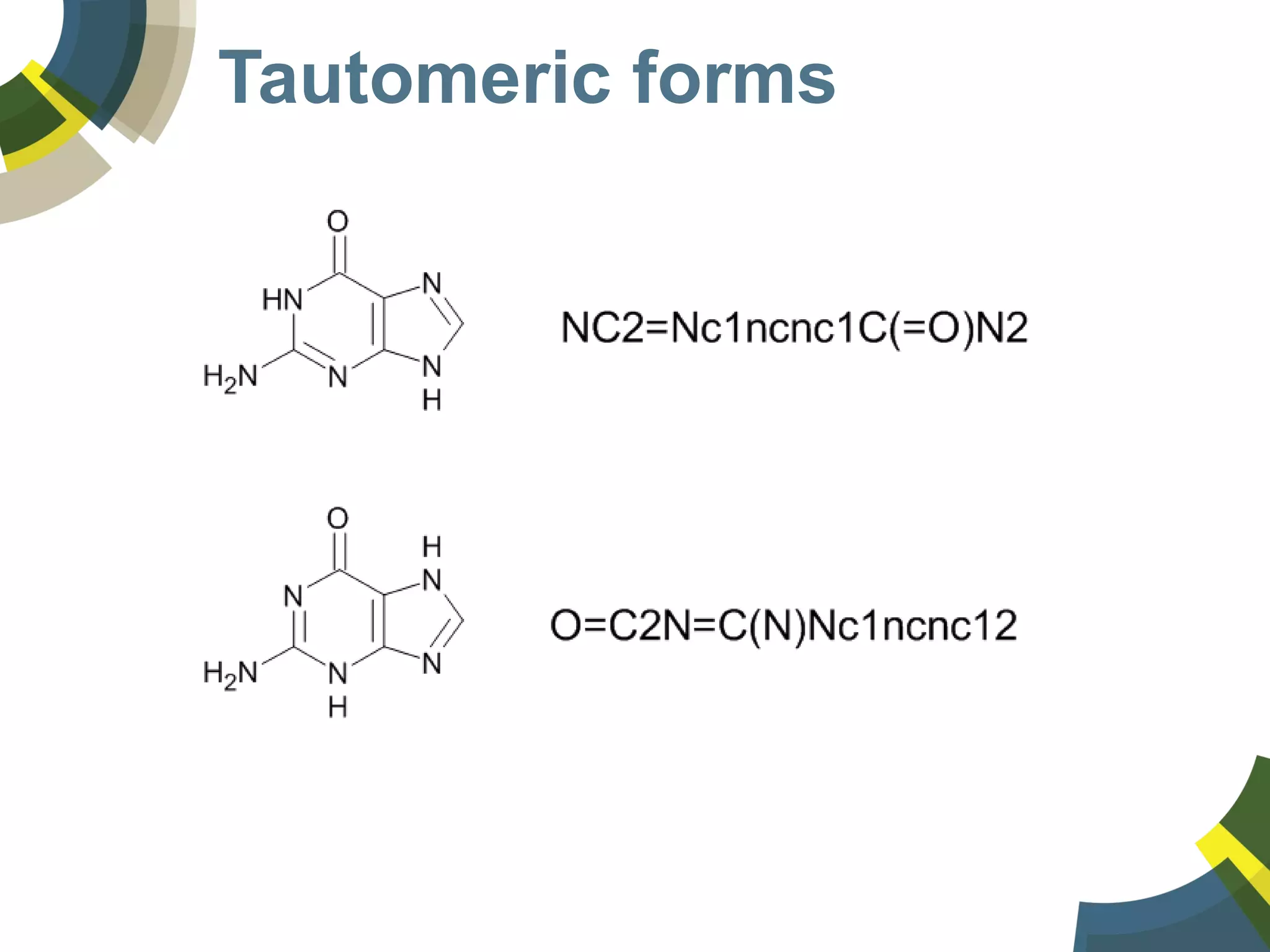
Tautomeric forms
Vendor-dependent SMILES
ACD/Labs
CC(C)CCC[C@@H](C)CCC[C@@H]
(C)CCCC(C)=CCC2=C(C)C(=O)c1ccccc1C2
=O
OpenEye
CC1=C(C(=O)c2ccccc2C1=O)C/C=C(C)/CC
C[C@H](C)CCC[C@H](C)CCCC(C)C
ChEMBL
CC(C)CCC[C@@H](C)CCC[C@@H]
(C)CCCC(=CCC1=C(C)C(=O)c2ccccc2C1=
Chemists are good…
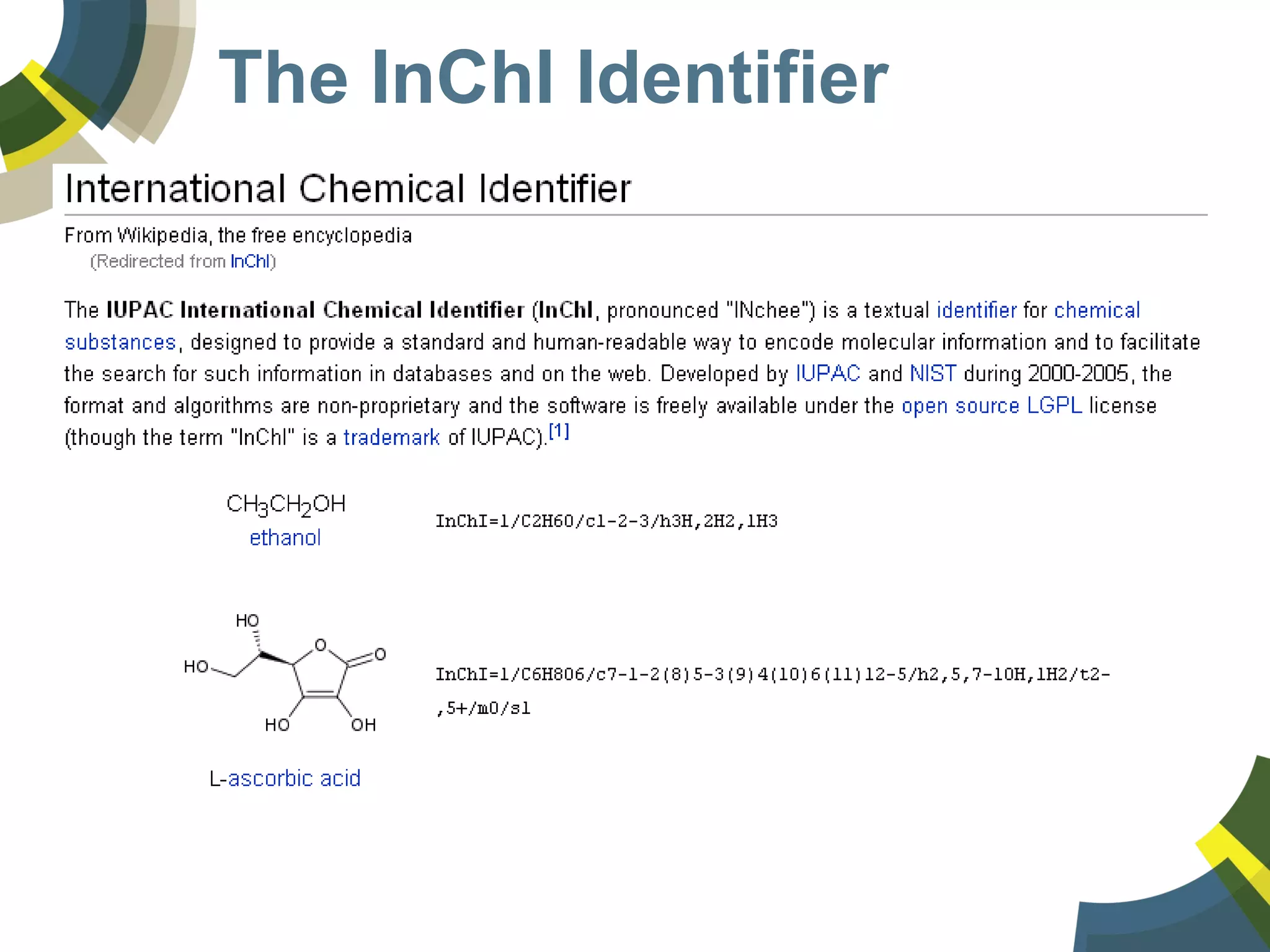
The InChI Identifier
InChI
• SINGLE code base managed by IUPAC –
integrated into drawing packages. No
variability as with SMILES
• InChI Strings can be reversed to structures –
same problem as with SMILES – no layout
• Adopted by the community (databases, blogs,
Wikipedia) – good for searching the internet
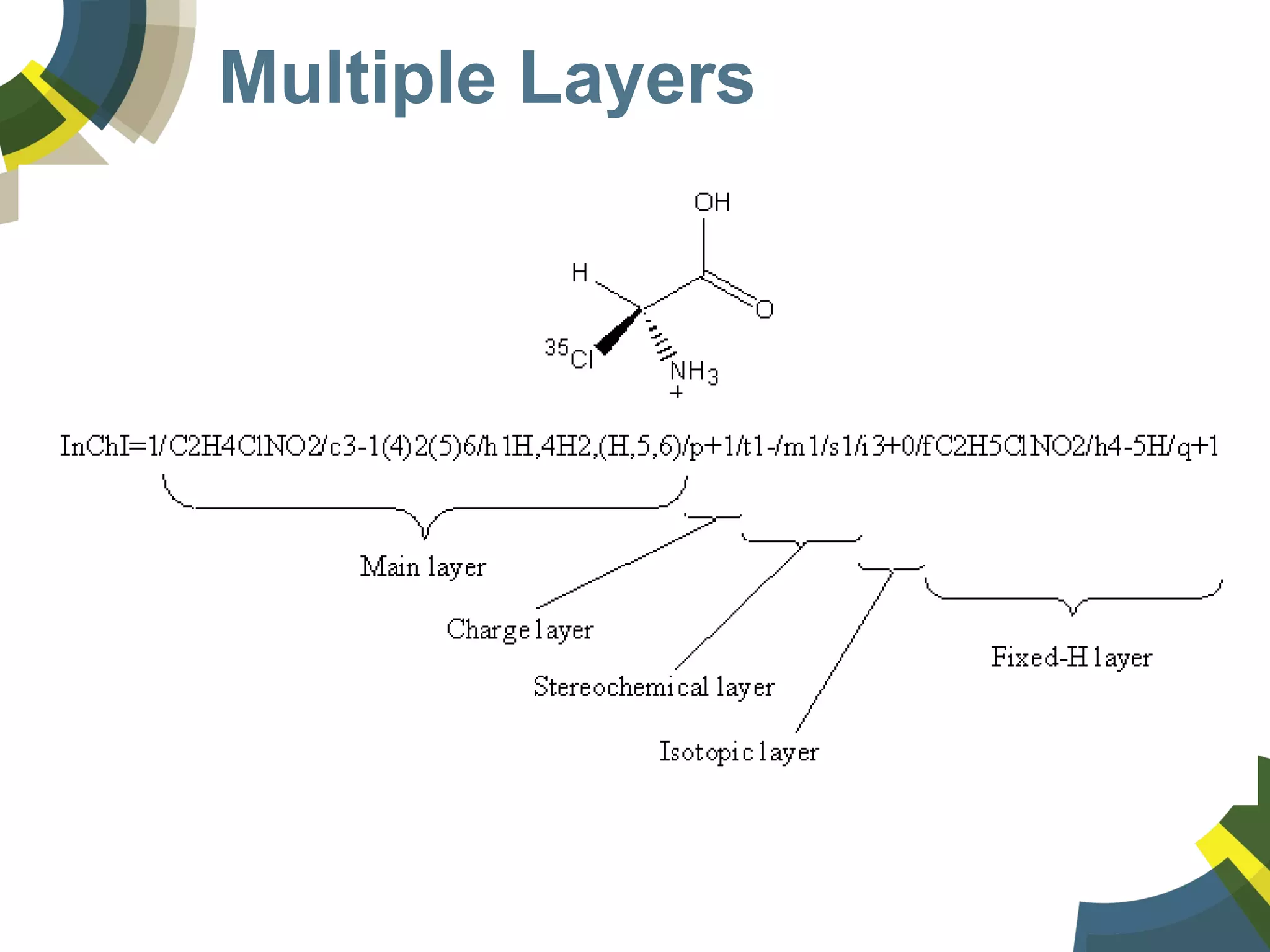
Multiple Layers
Tautomers
Stereo
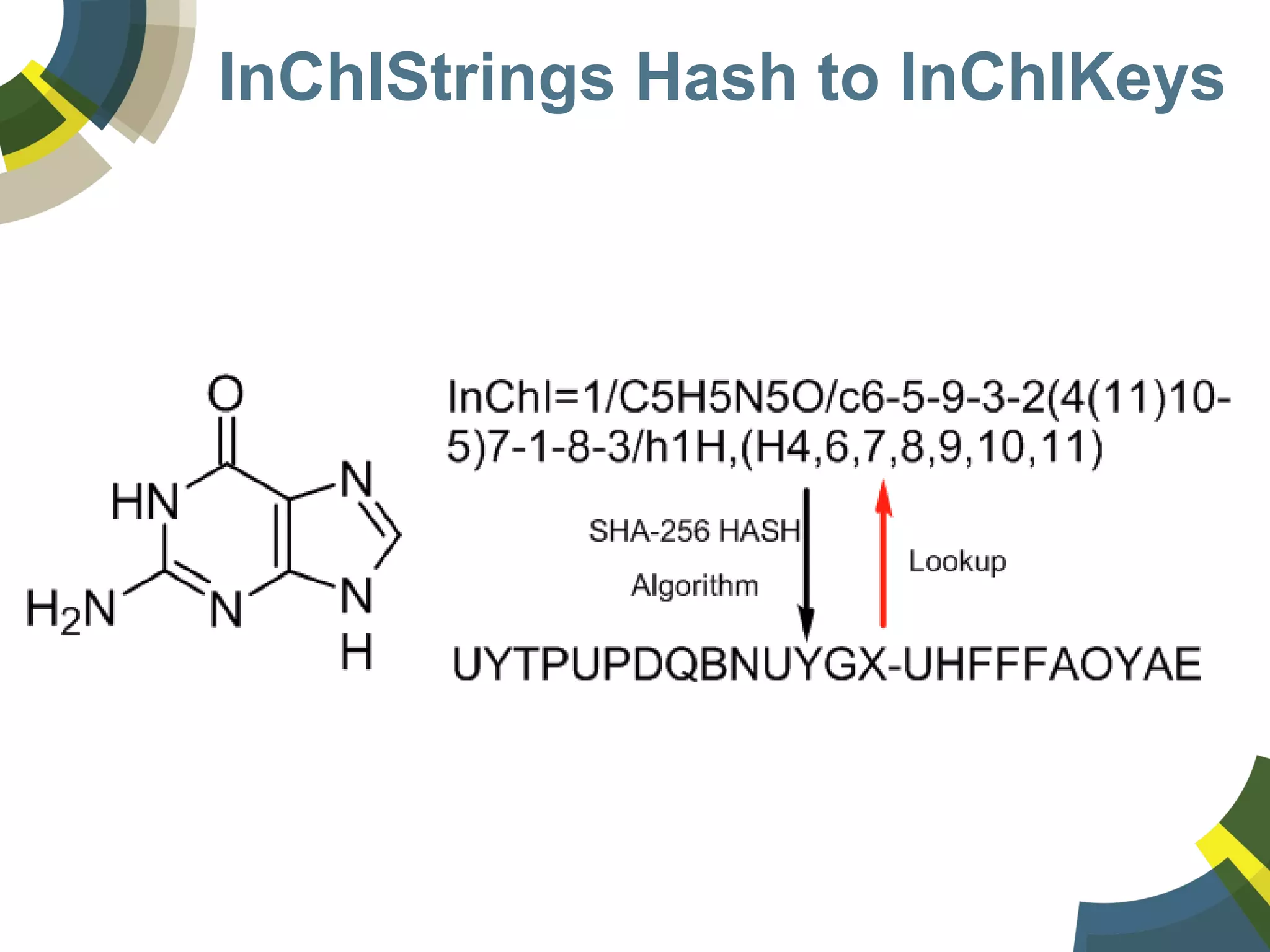
InChIStrings Hash to InChIKeys
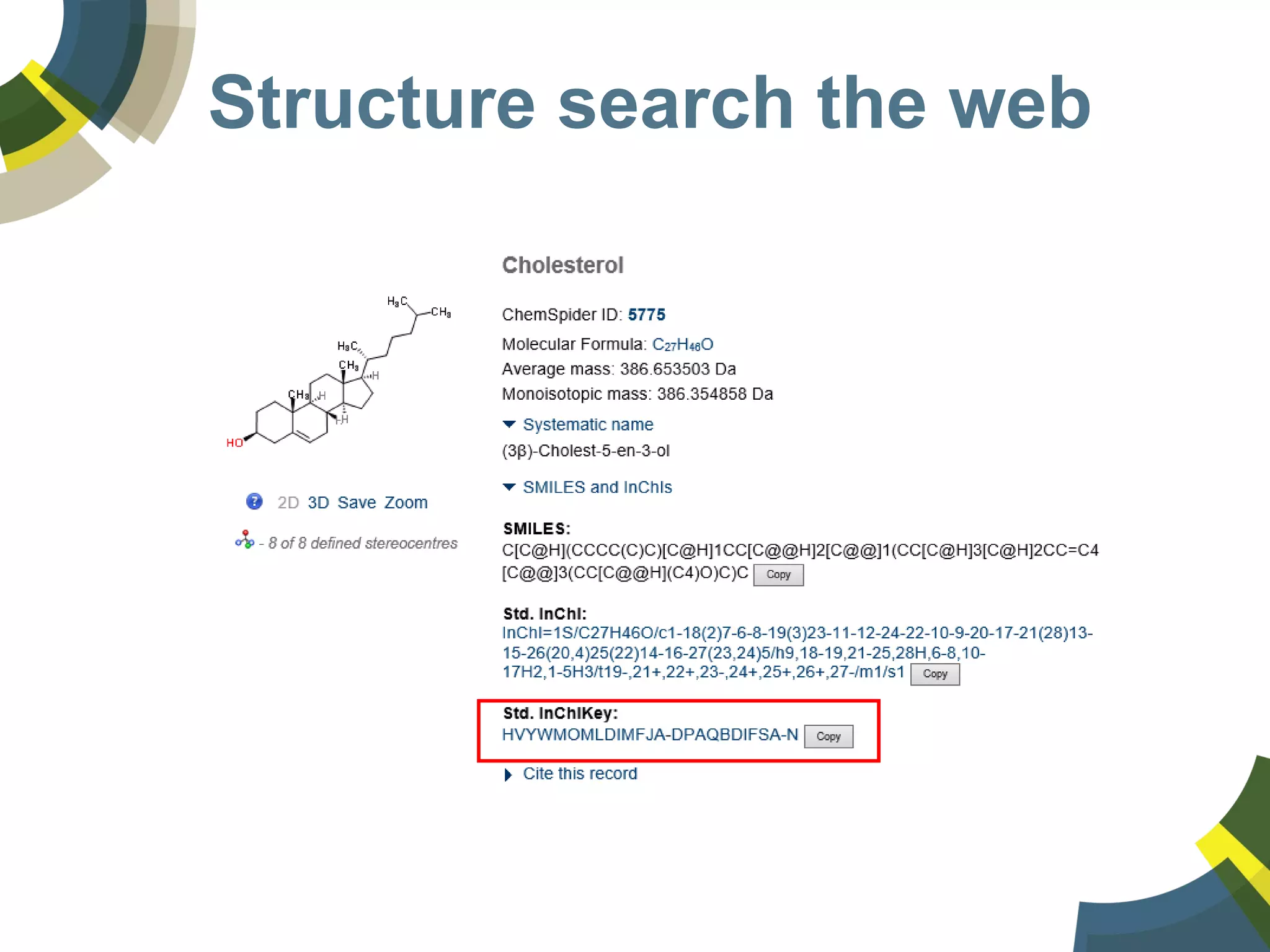
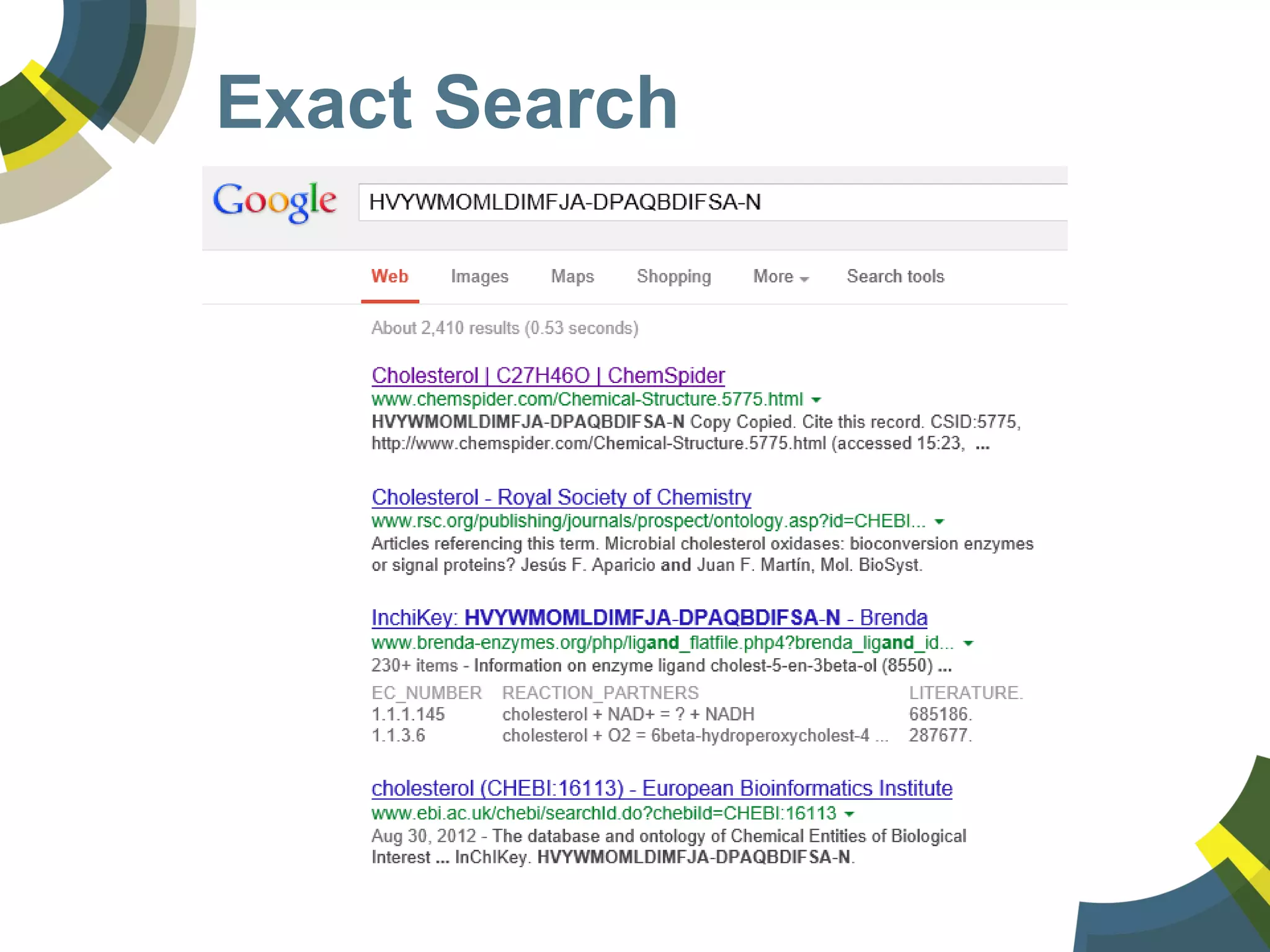
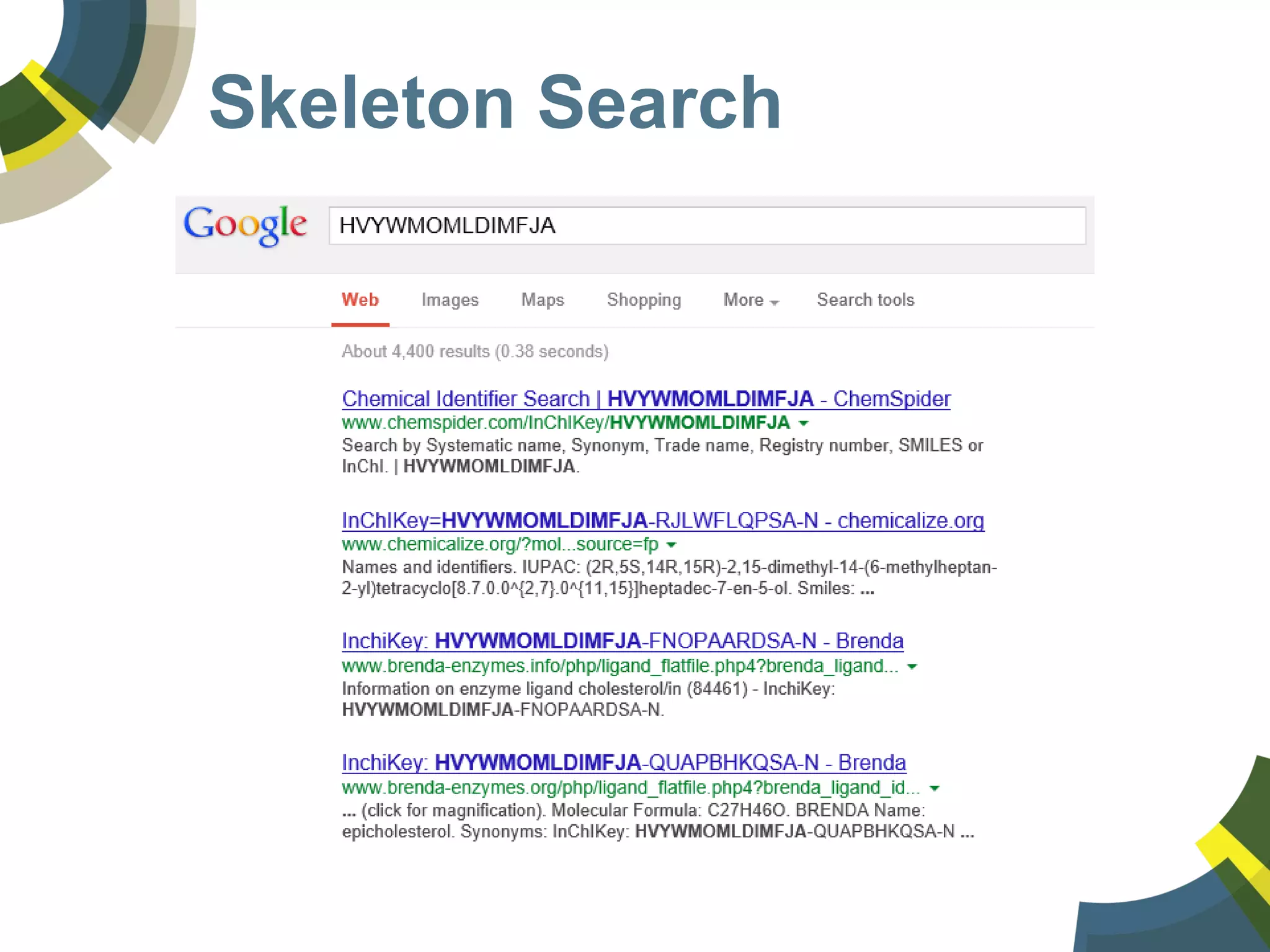
Structure search the web
Exact Search
Skeleton Search
Data Quality/Standardization
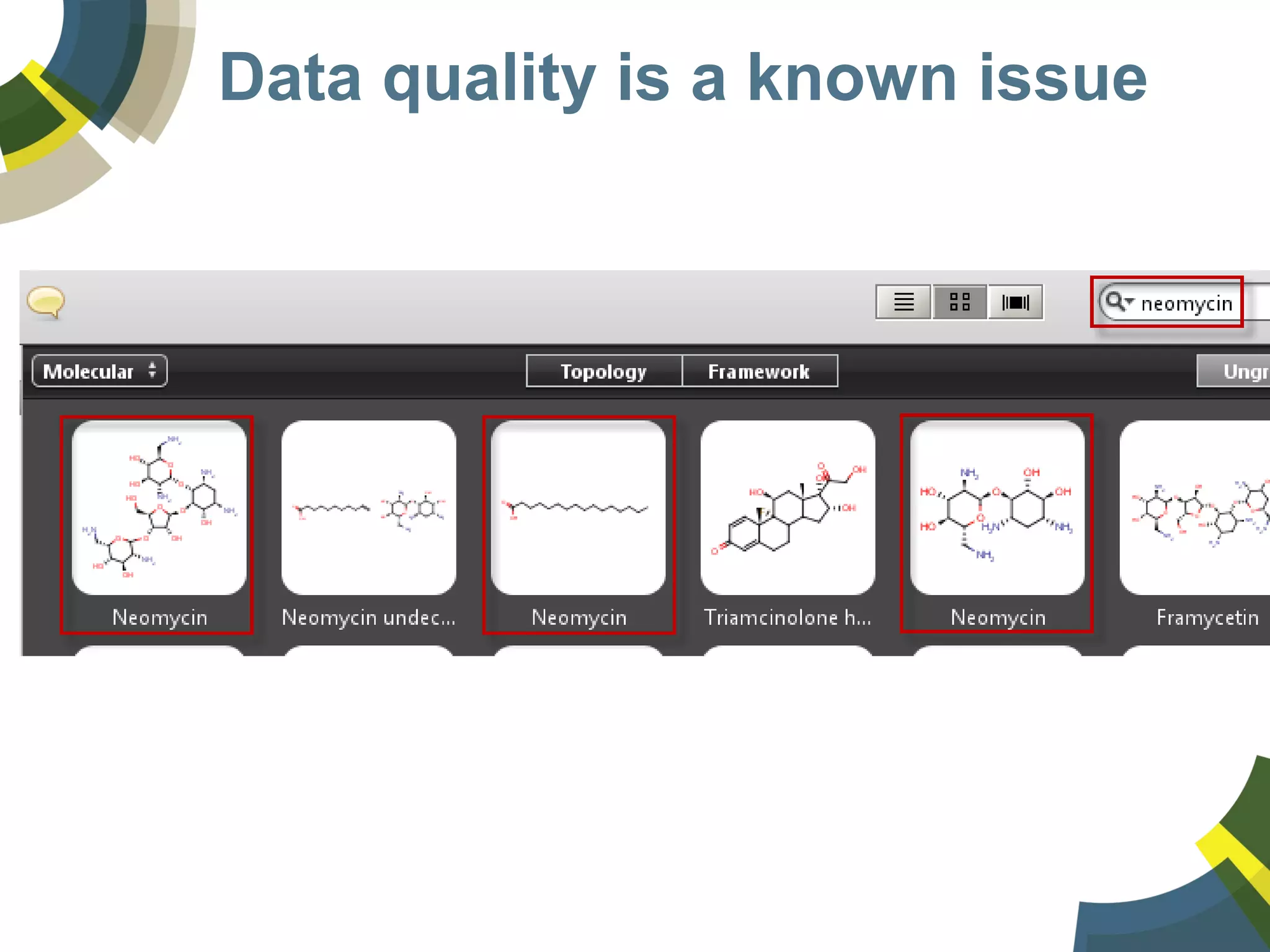
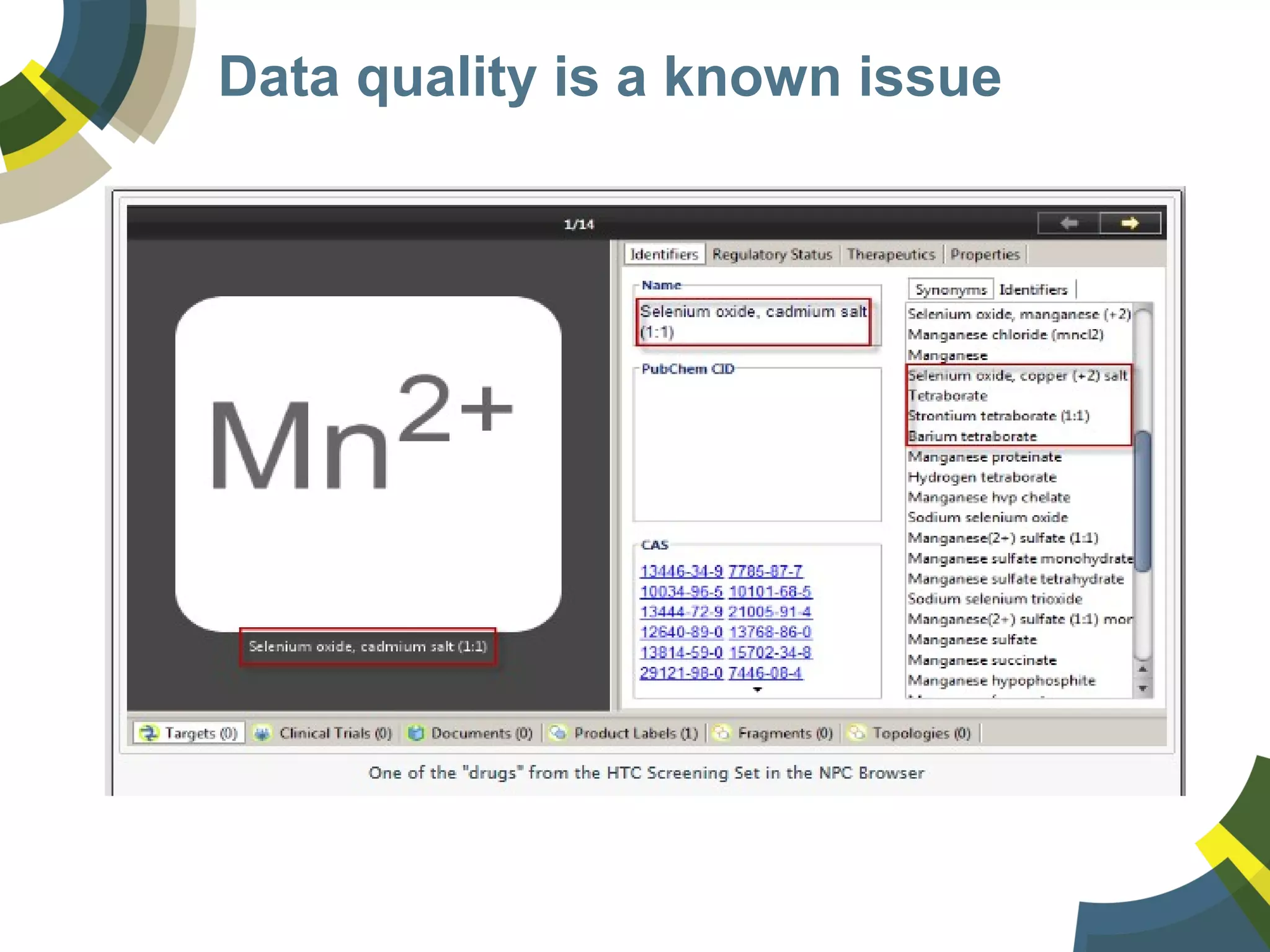
• MANY structures meant to be something
online are MISREPRESENTED.
• Commonly you will have better success finding
information by name searches than structure –
with many caveats of course…
• Validating chemical structure representations
is laborious work – and it’s shocking to review
data…
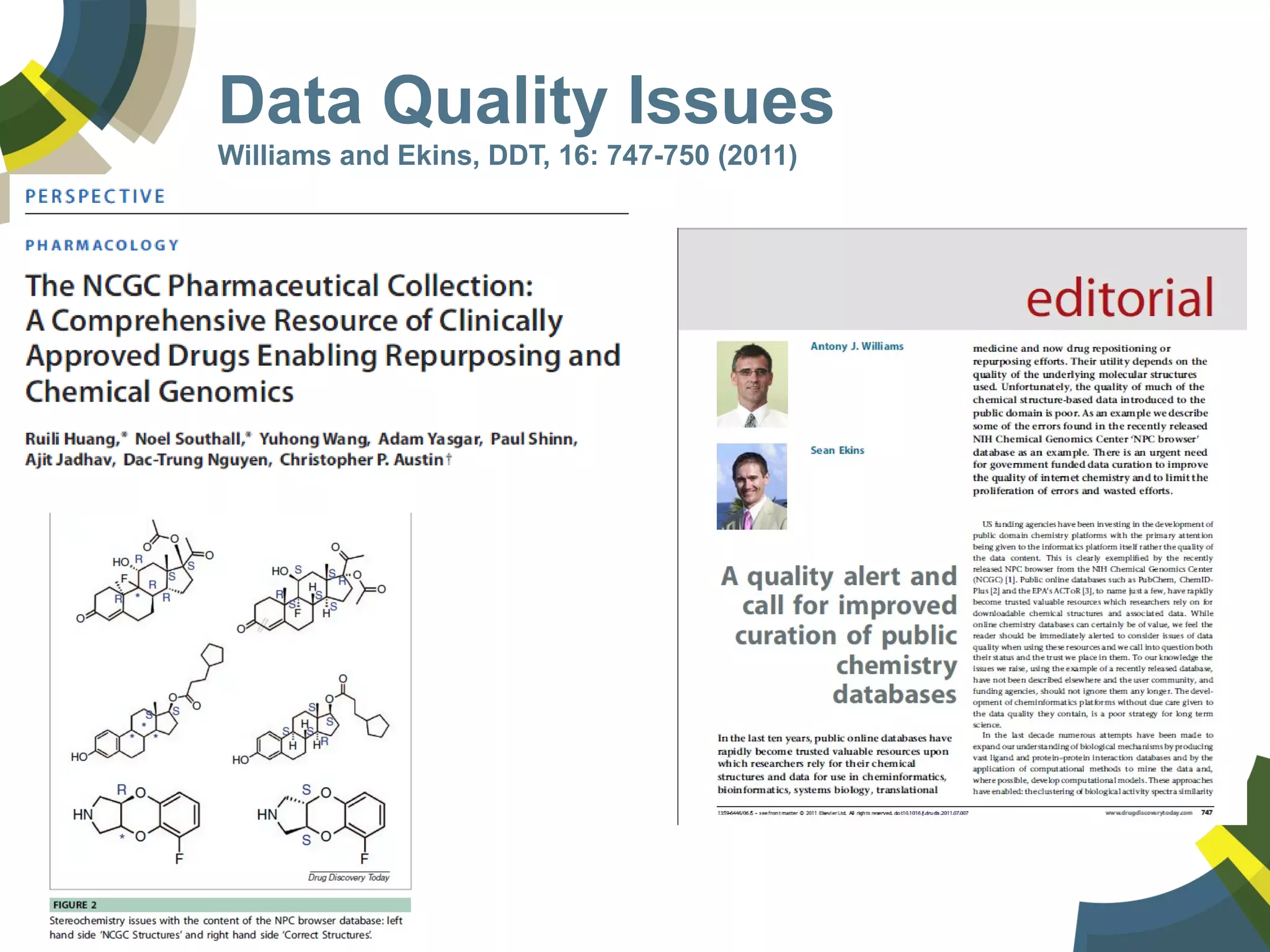
Data Quality Issues
Williams and Ekins, DDT, 16: 747-750 (2011)
Science Translational Medicine 2011
Data quality is a known issue
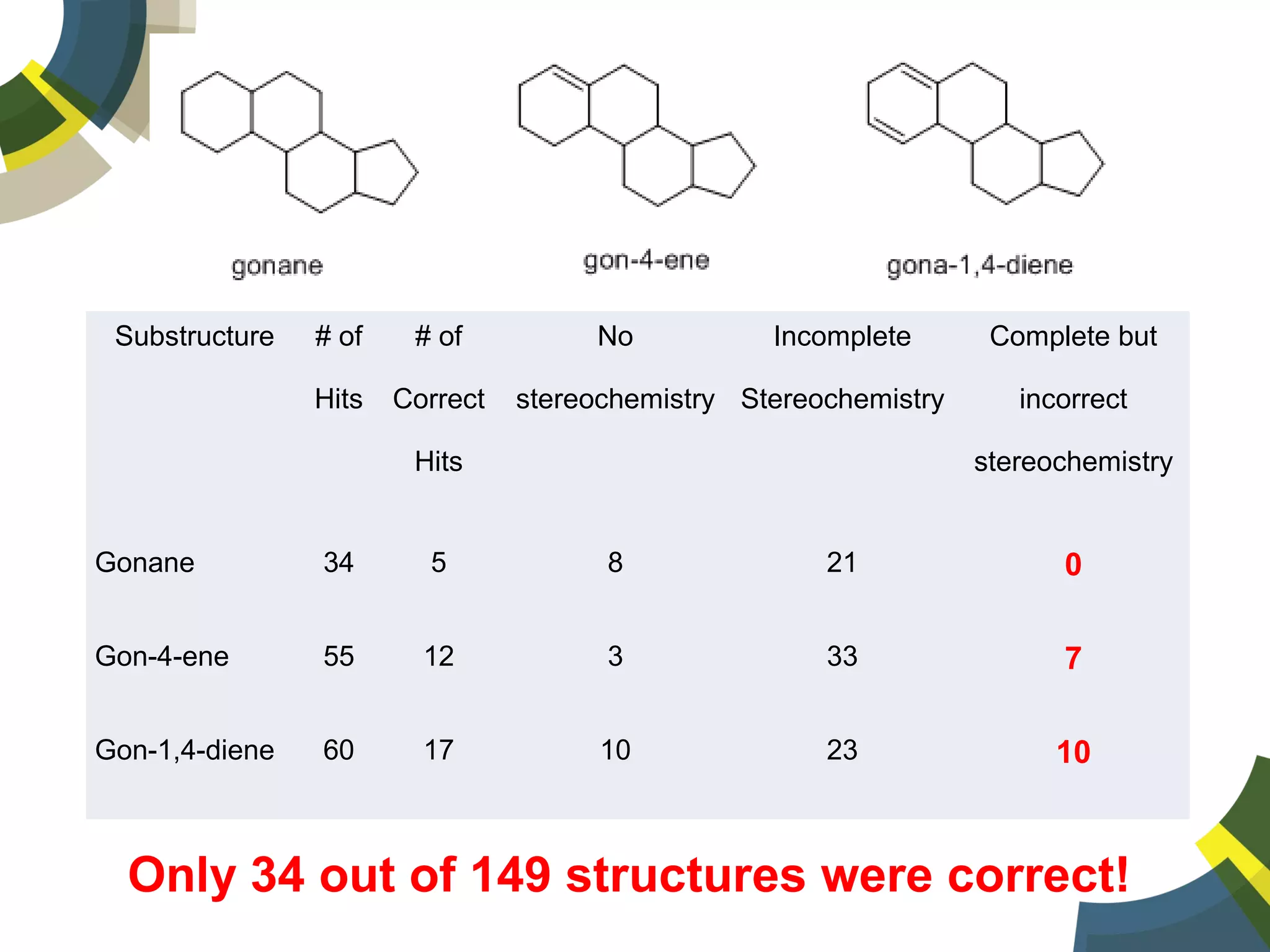
Substructure # of
Hits
# of
Correct
Hits
No
stereochemistry
Incomplete
Stereochemistry
Complete but
incorrect
stereochemistry
Gonane 34 5 8 21 0
Gon-4-ene 55 12 3 33 7
Gon-1,4-diene 60 17 10 23 10
Only 34 out of 149 structures were correct!
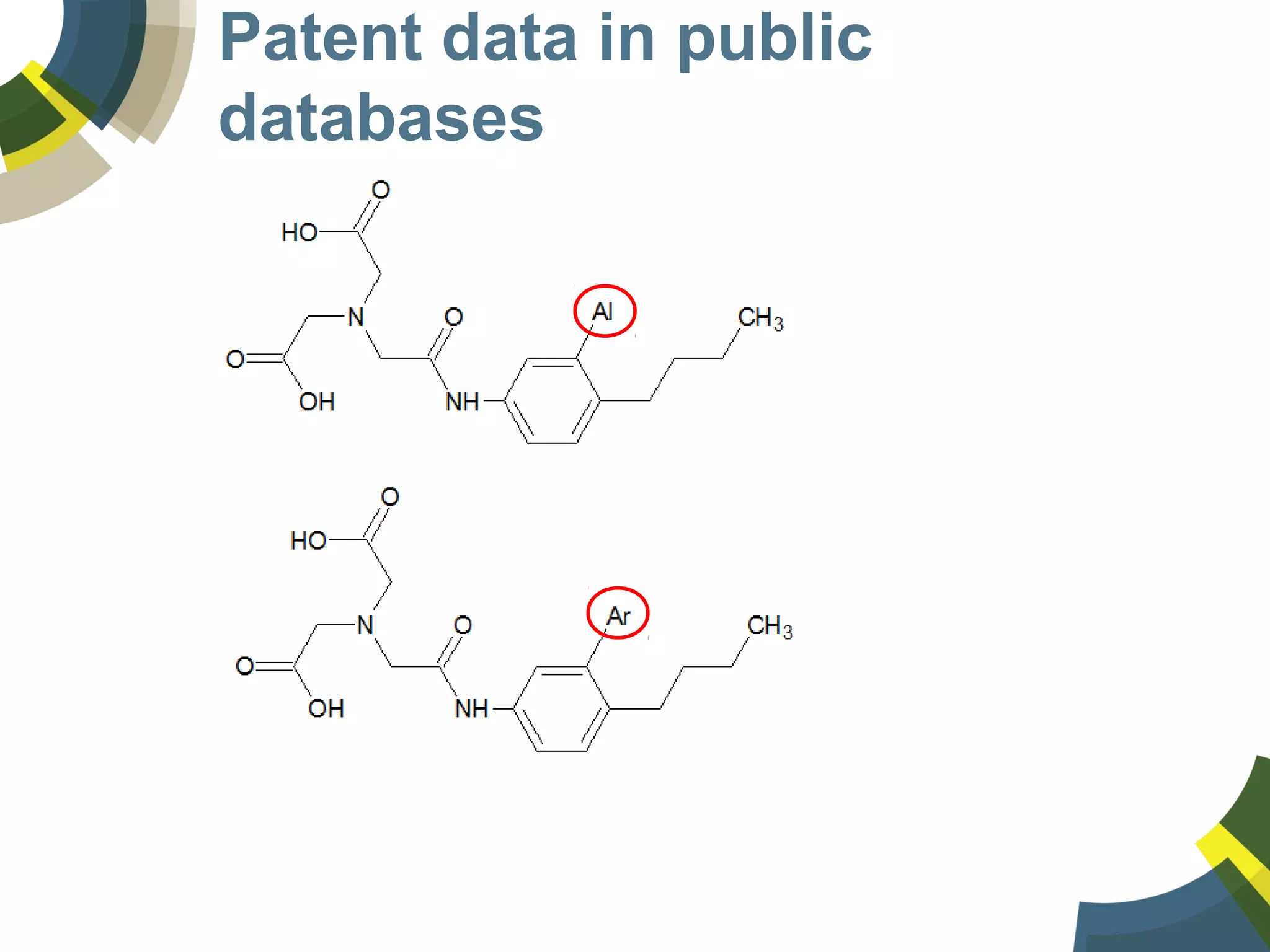
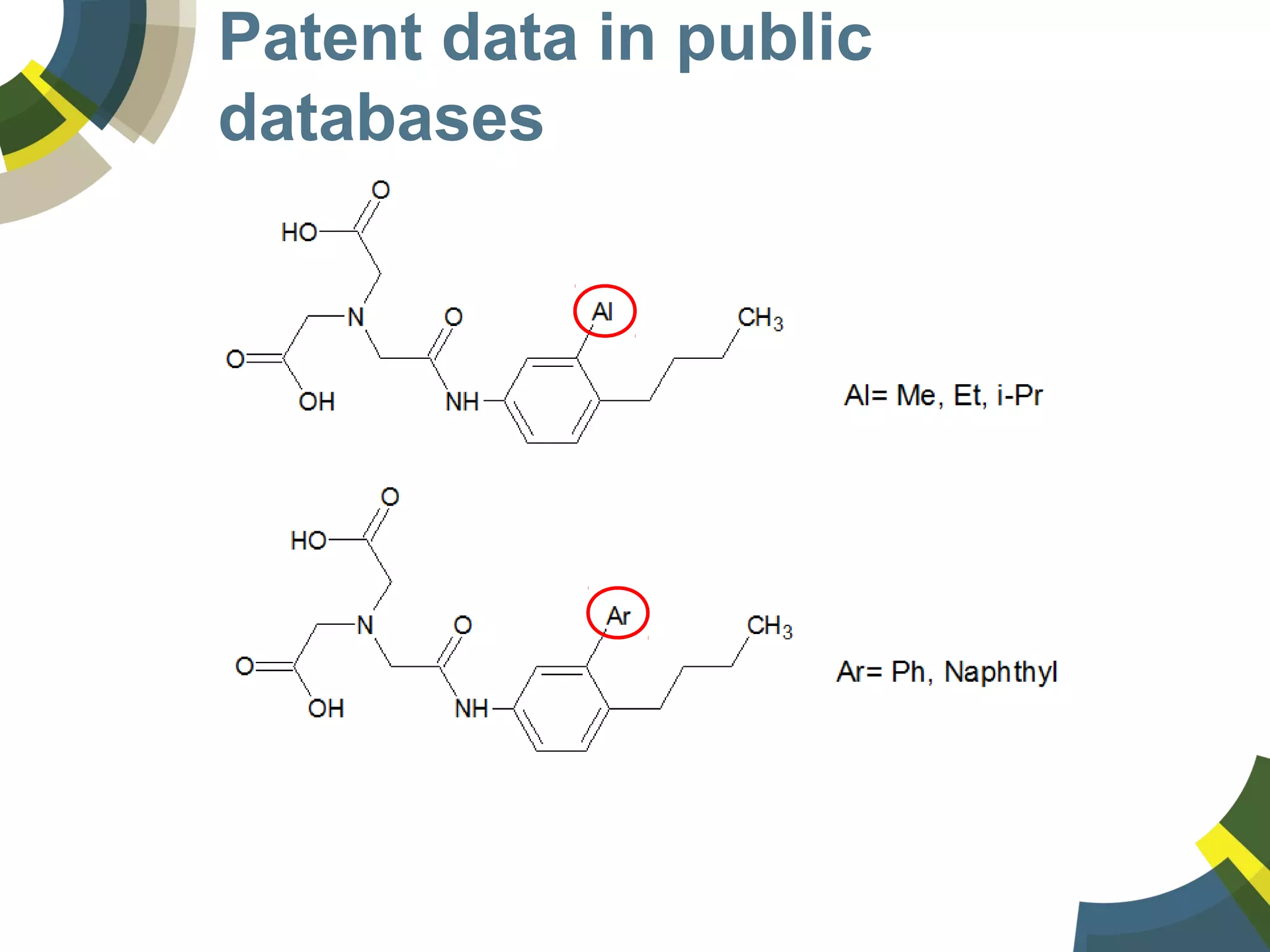
Patent data in public
databases
Patent data in public
databases
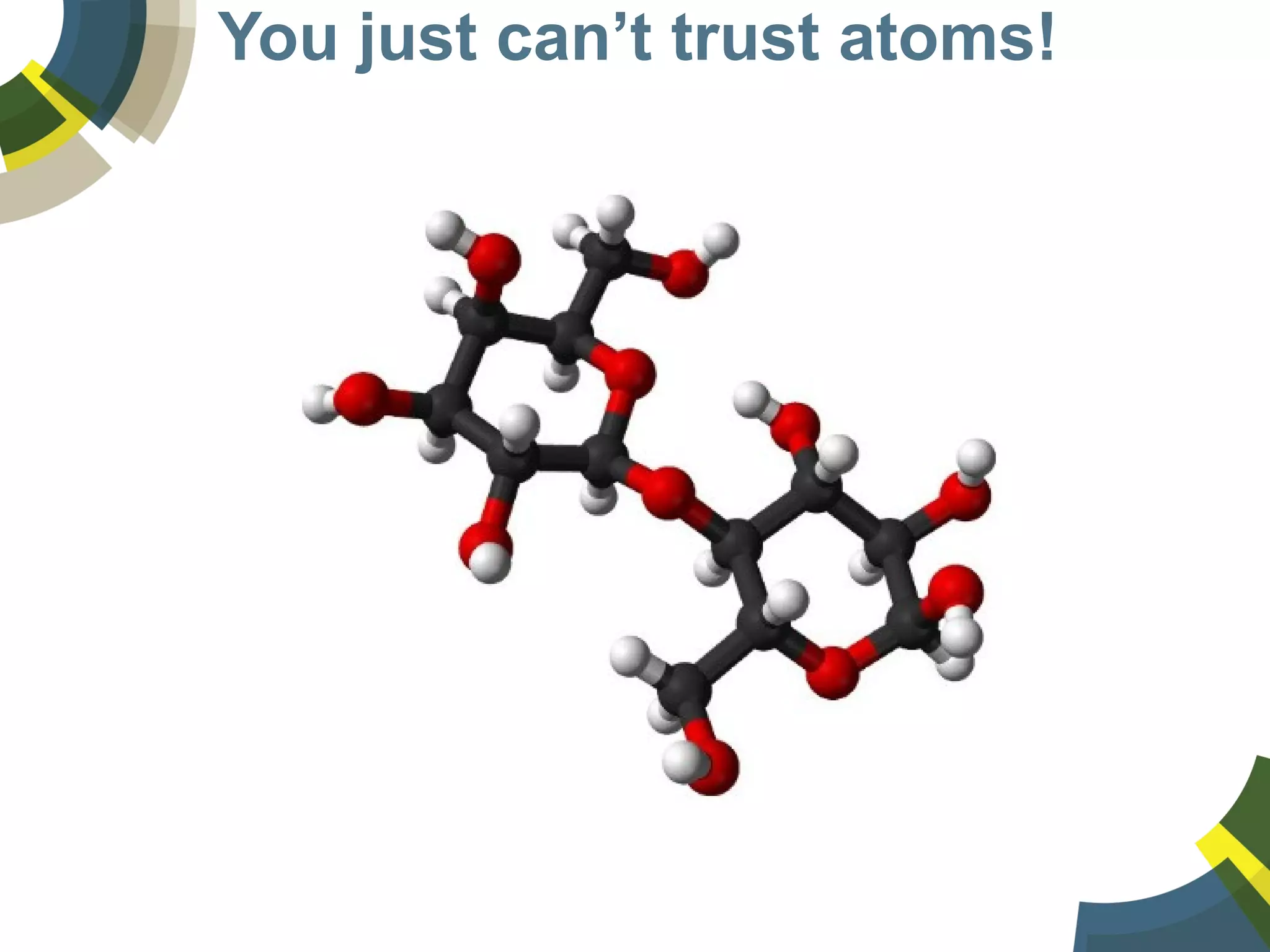
You just can’t trust atoms!
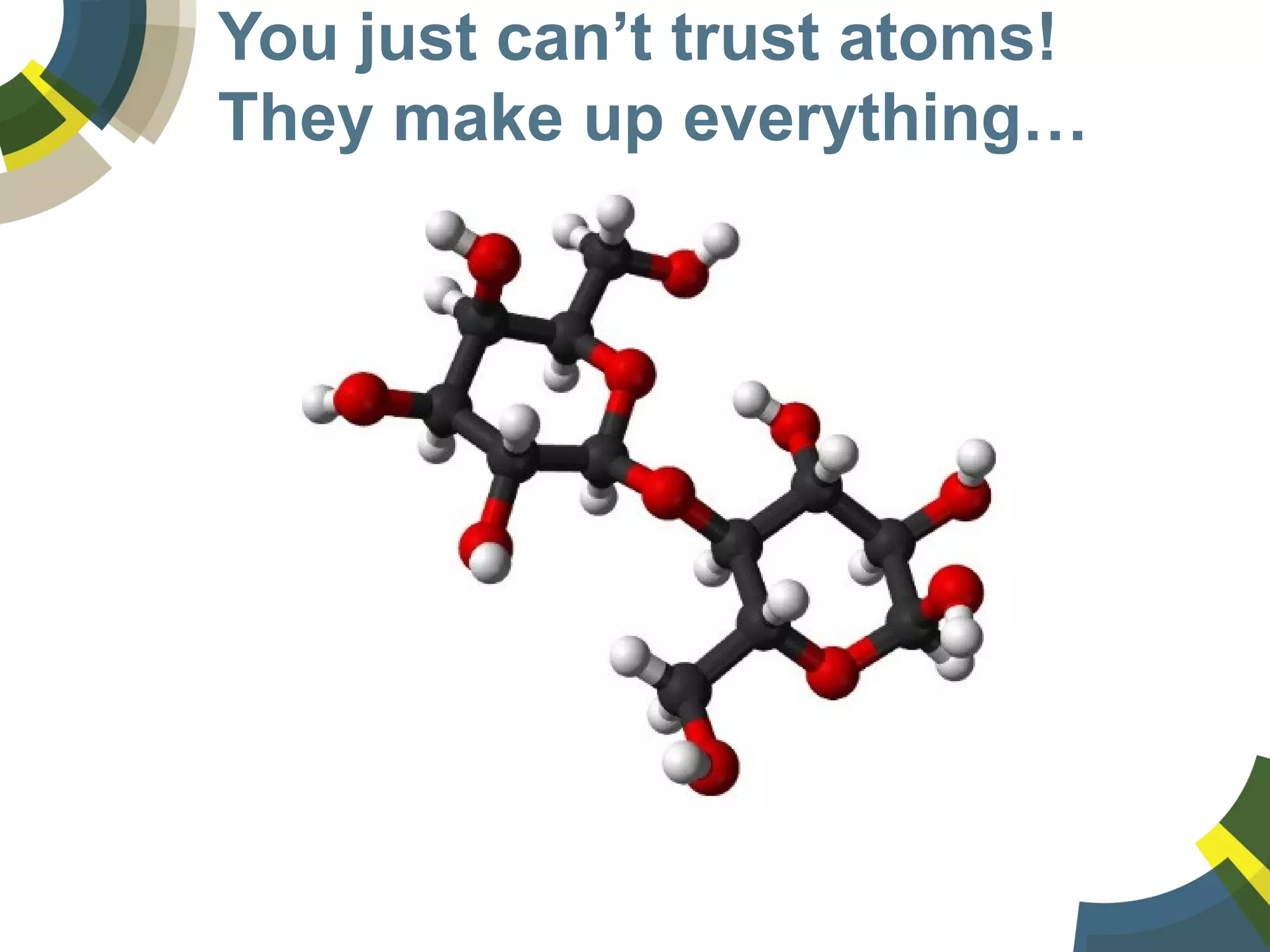
They make up everything…
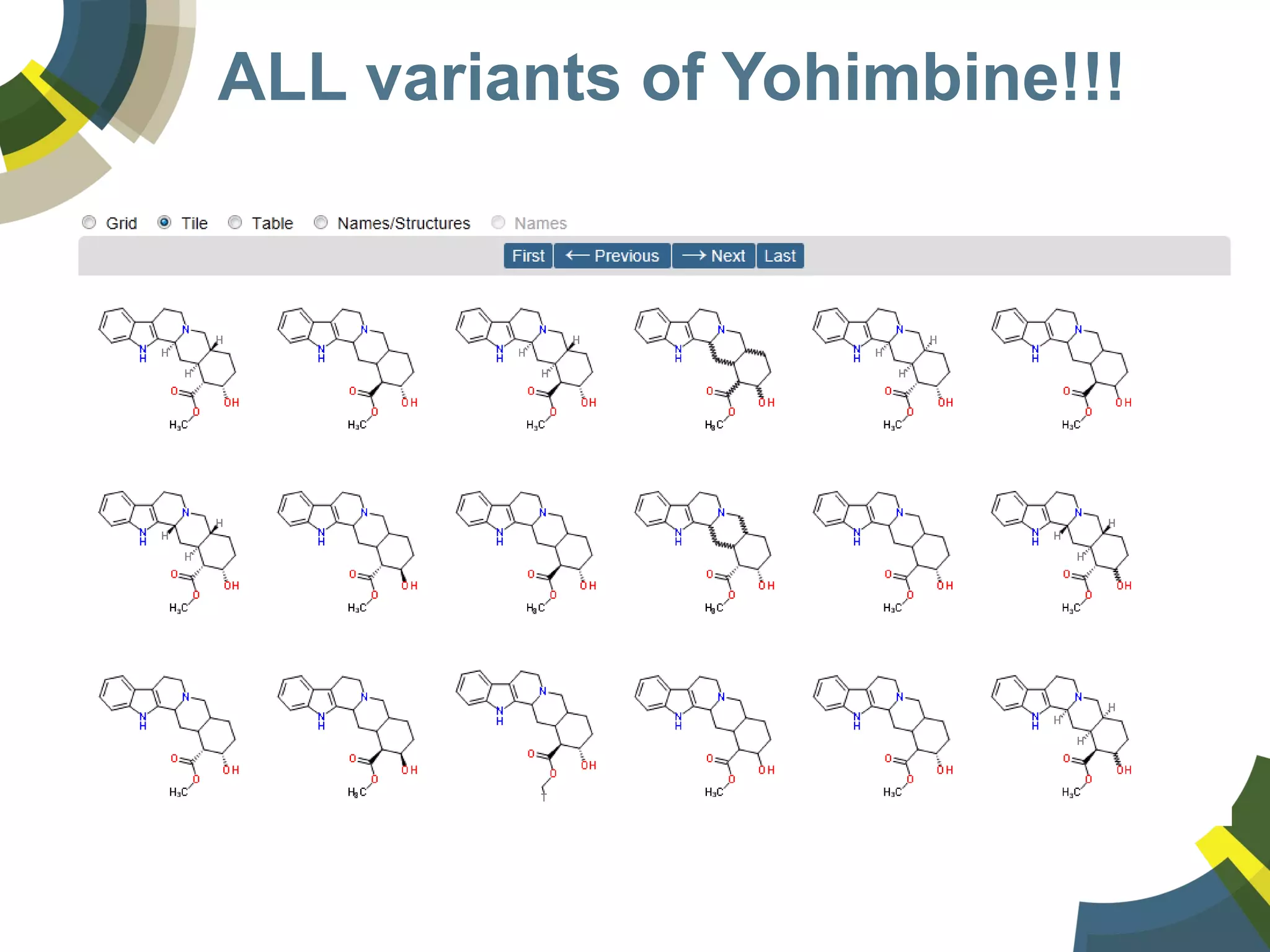
ALL variants of Yohimbine!!!
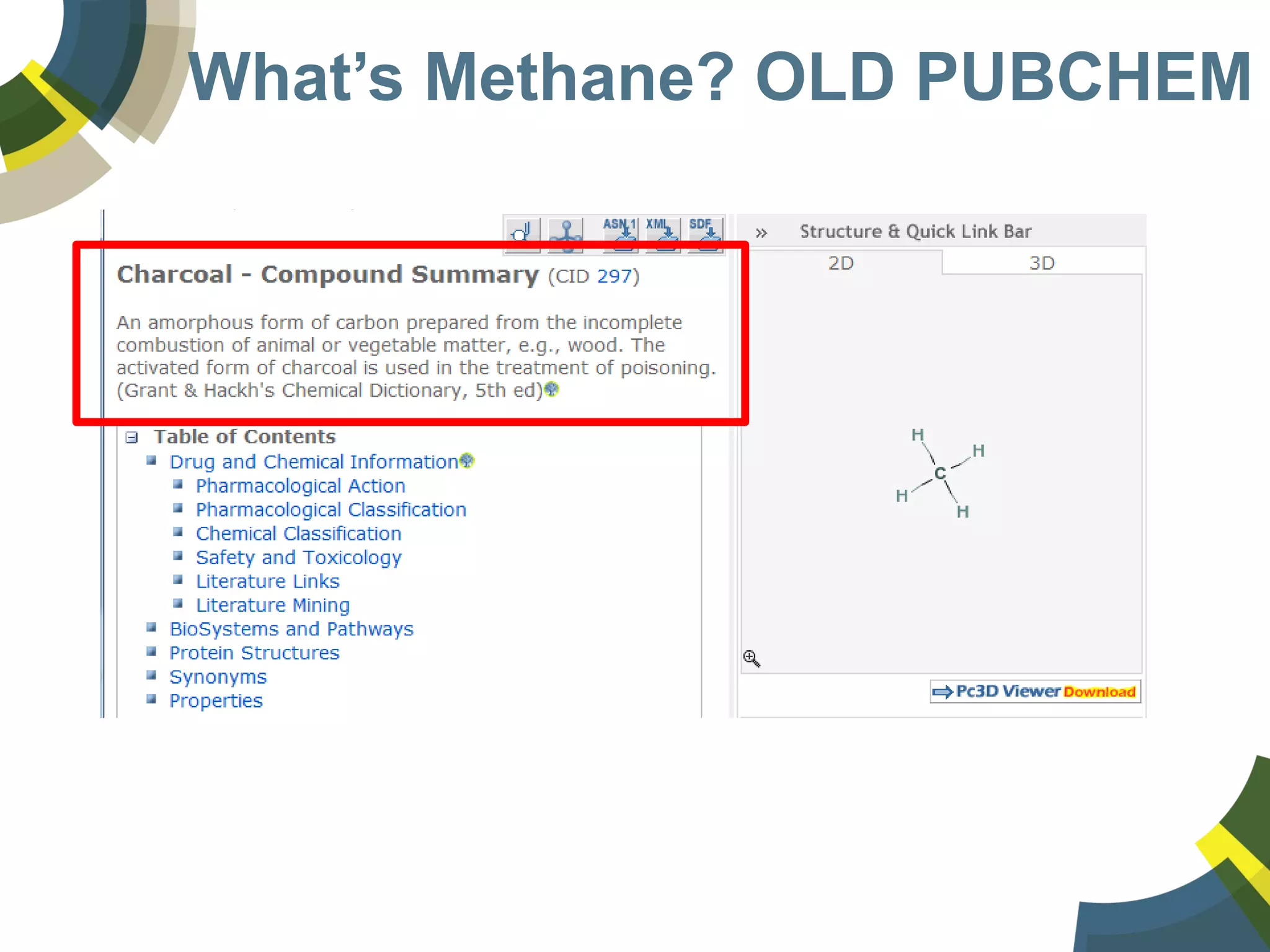
What’s Methane? OLD PUBCHEM
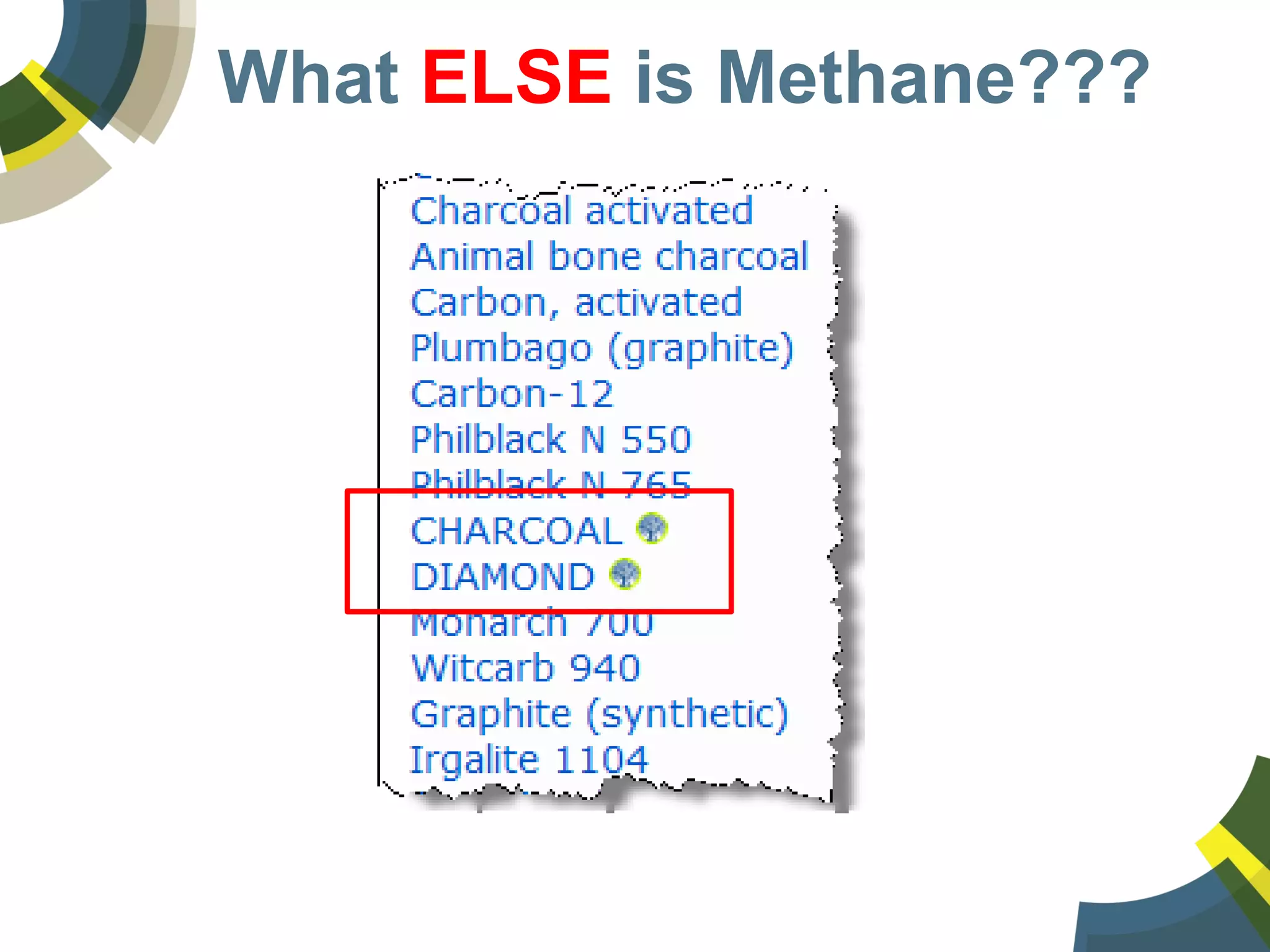
What ELSE is Methane???
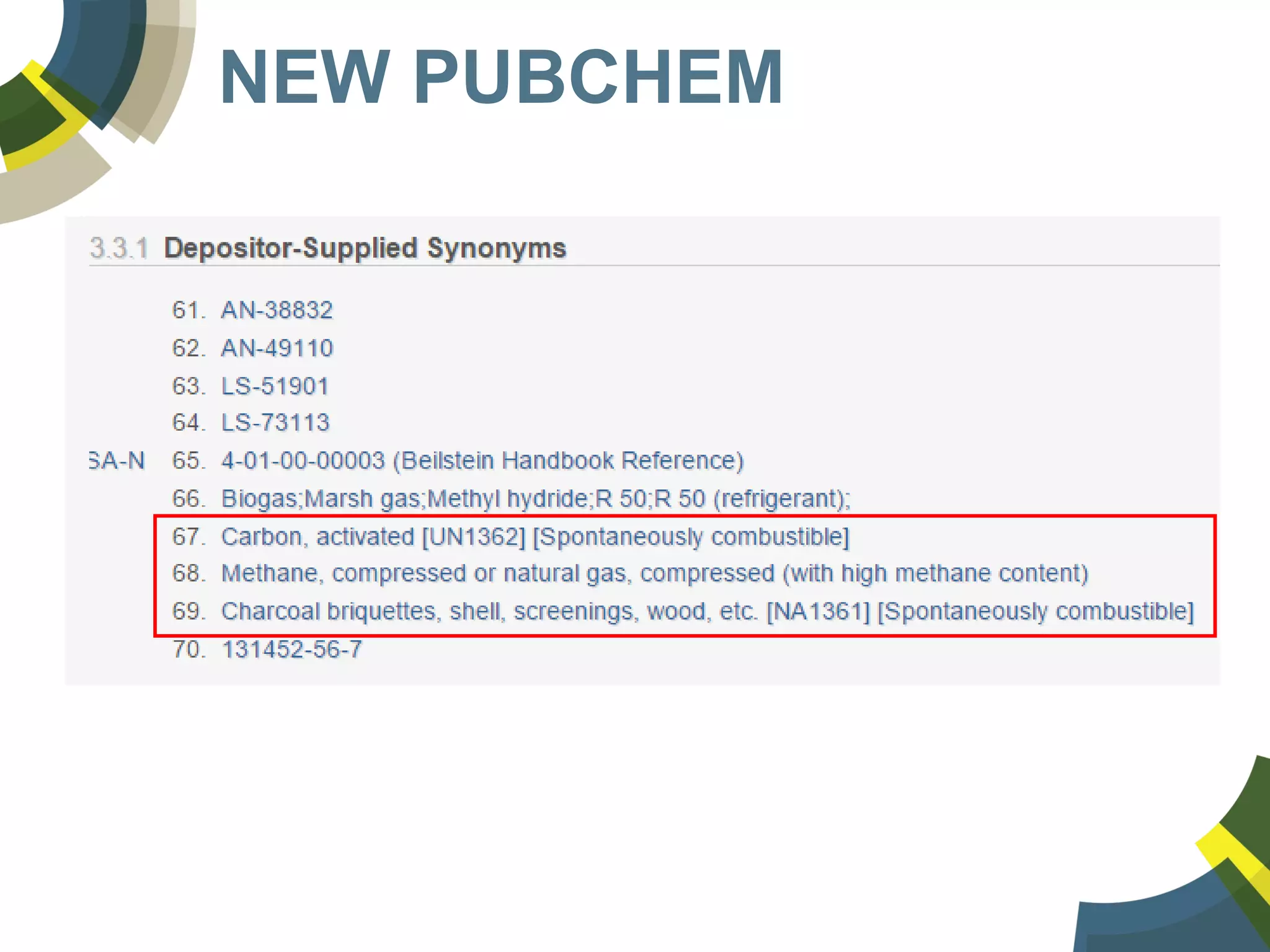
NEW PUBCHEM
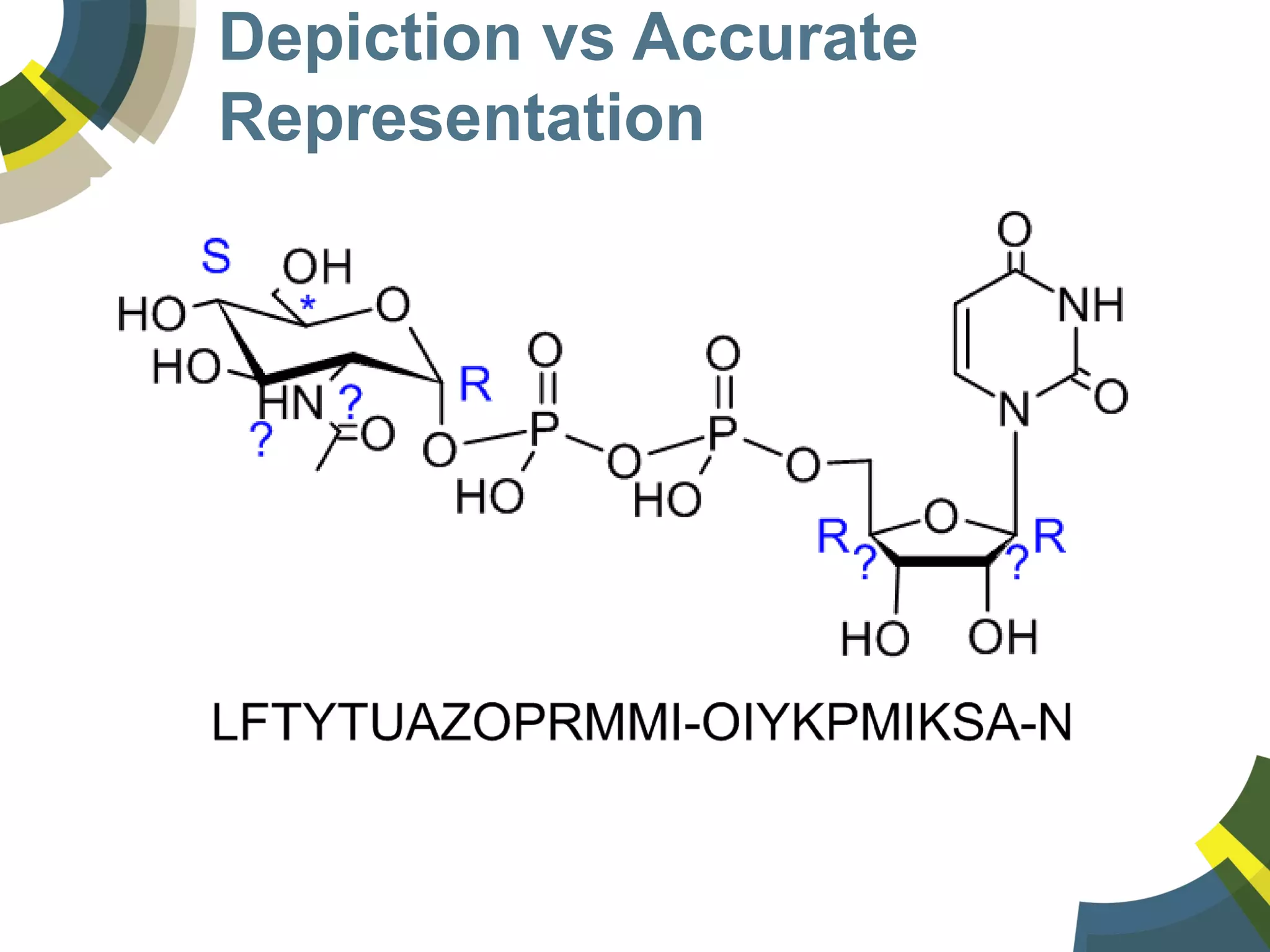
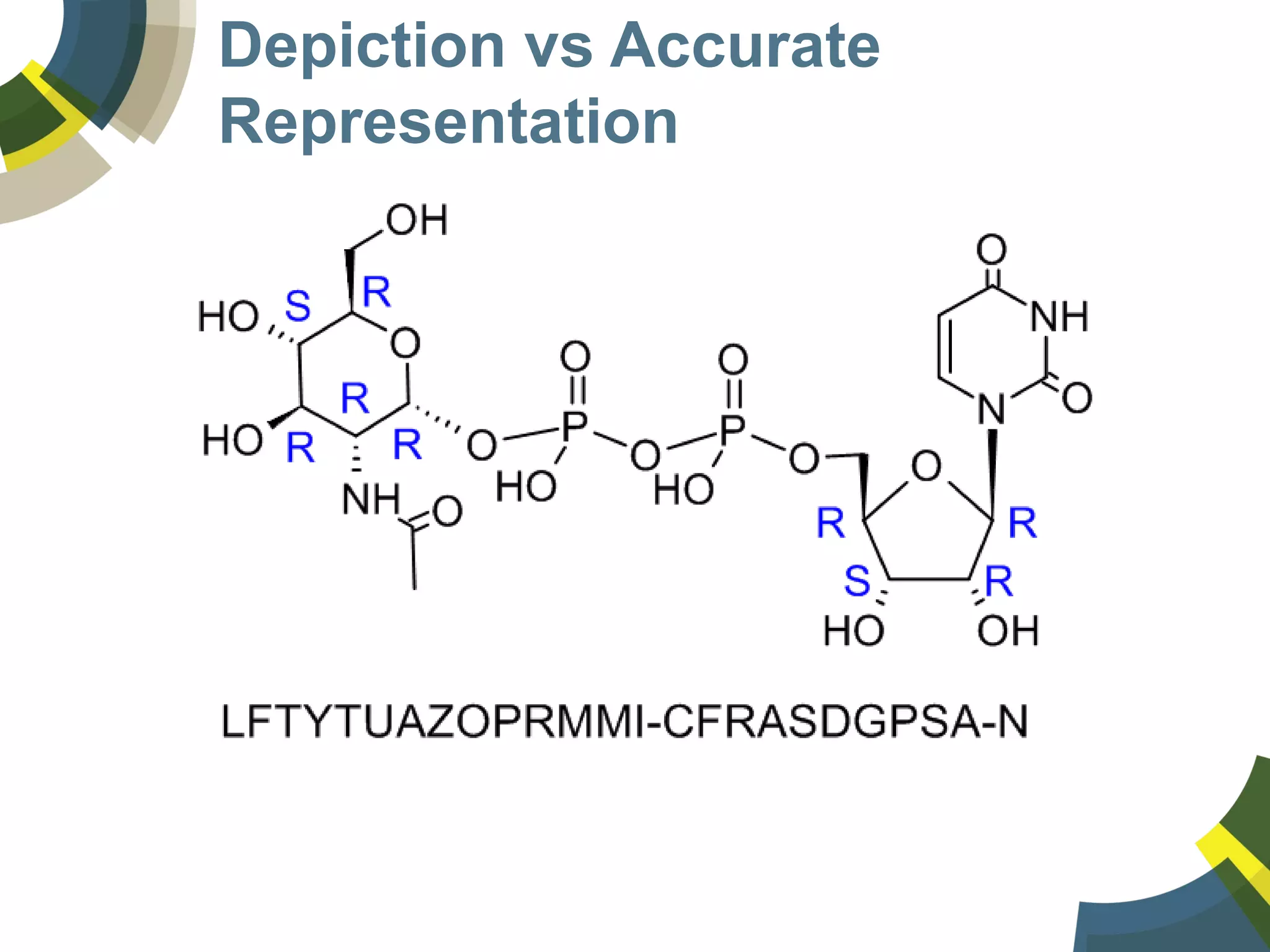
Depiction vs Accurate
Representation
Depiction vs Accurate
Representation
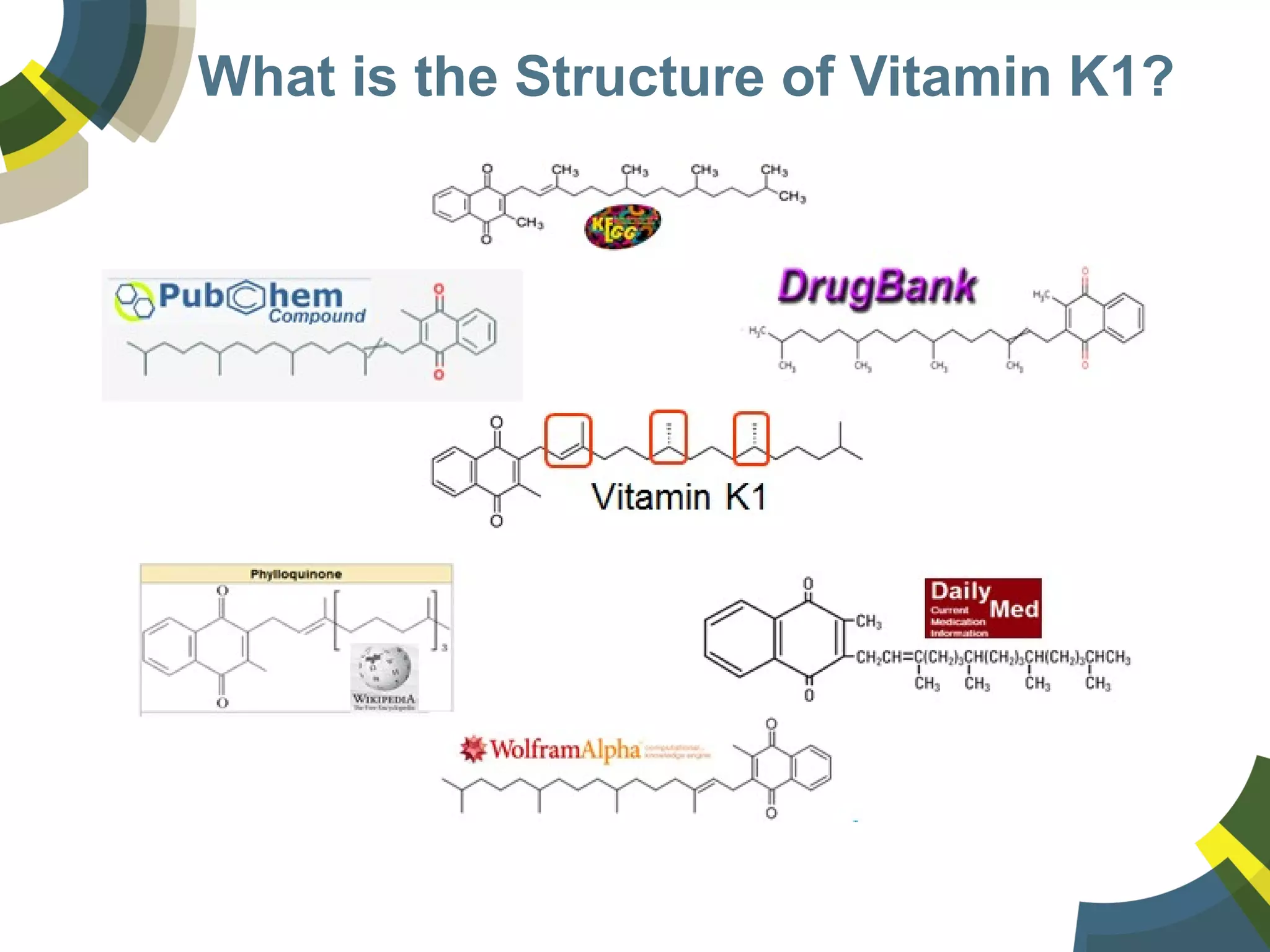
What is the Structure of Vitamin K1?
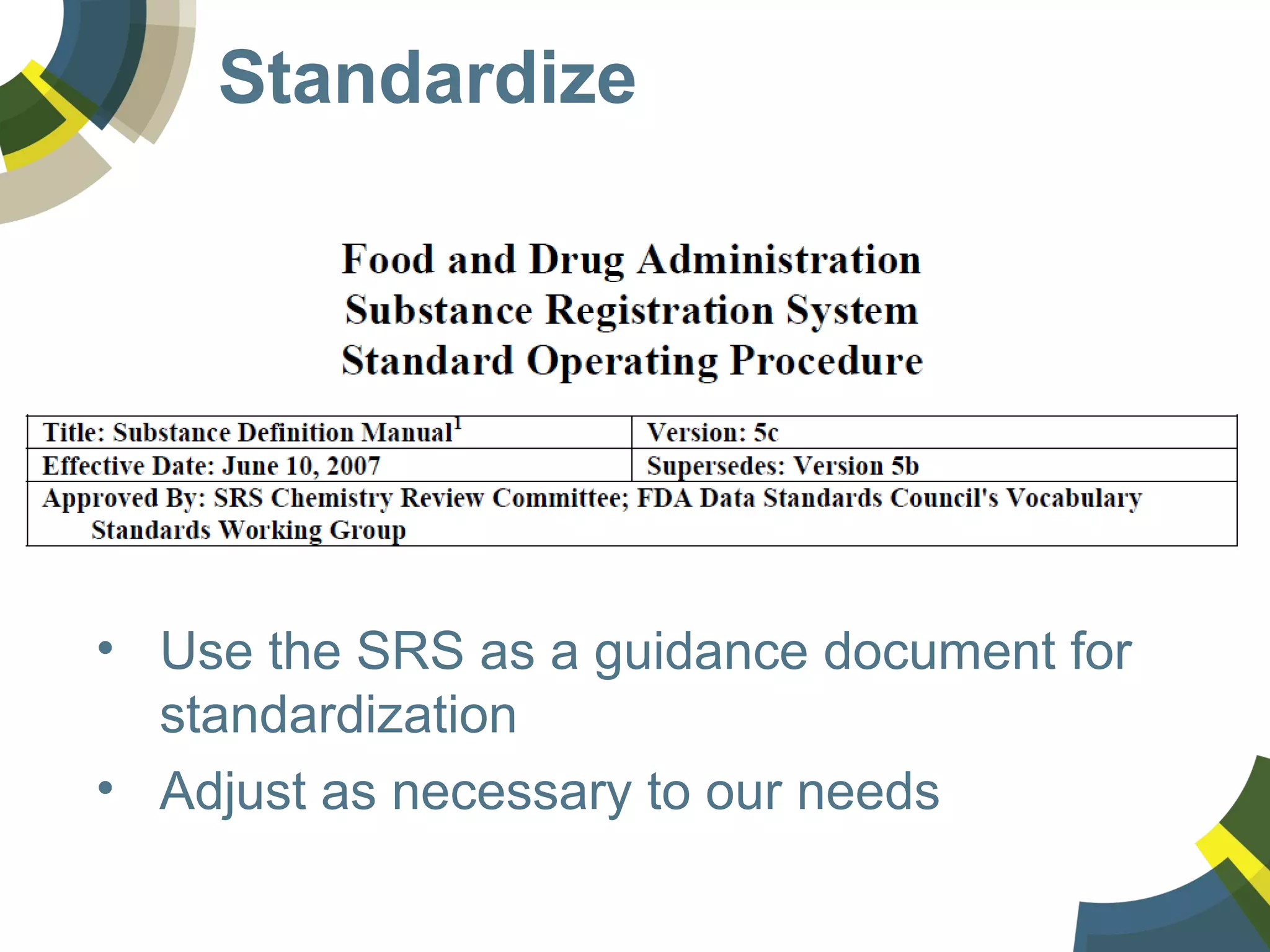
Standardize
• Use the SRS as a guidance document for
standardization
• Adjust as necessary to our needs
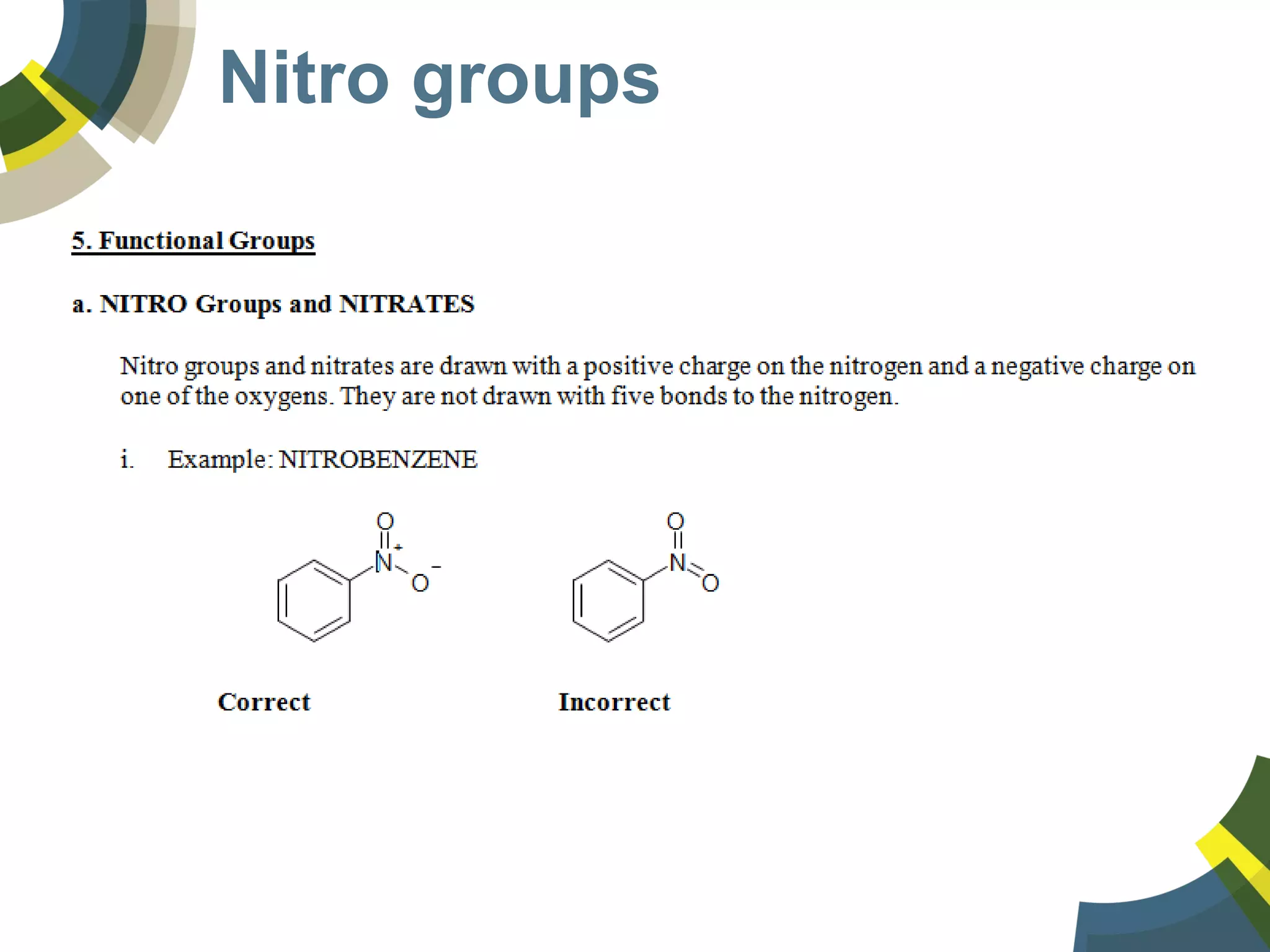
Nitro groups
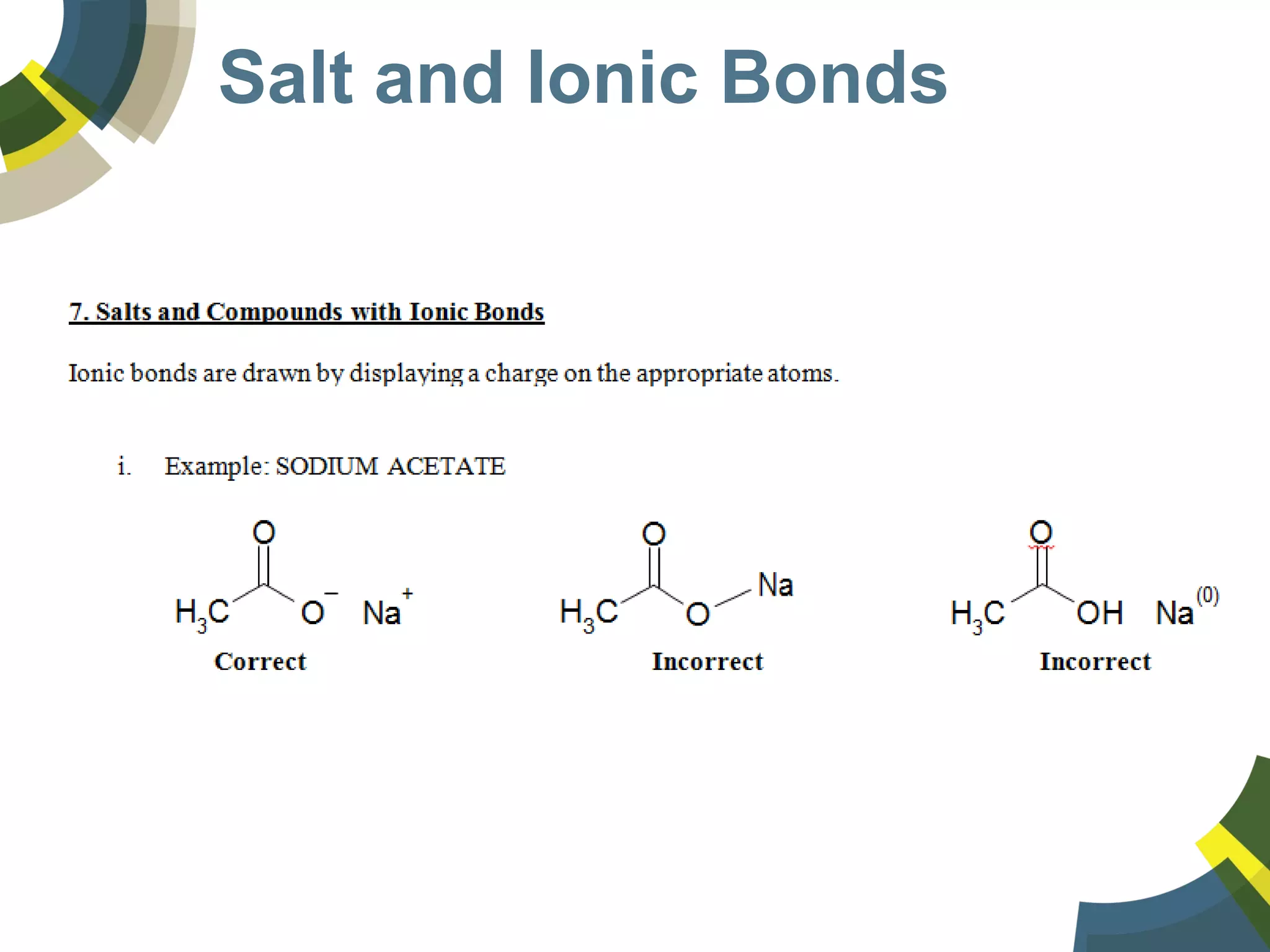
Salt and Ionic Bonds
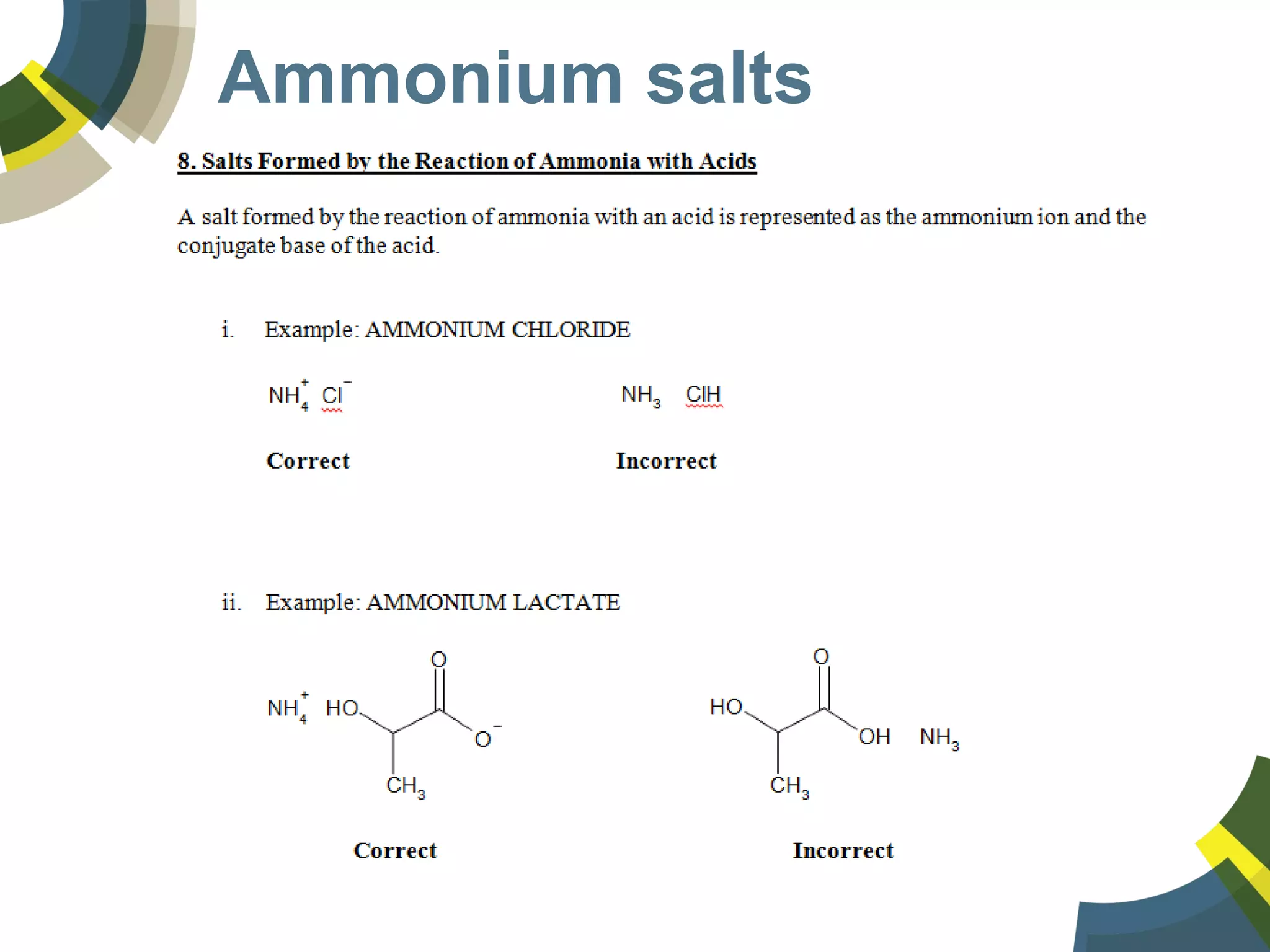
Ammonium salts
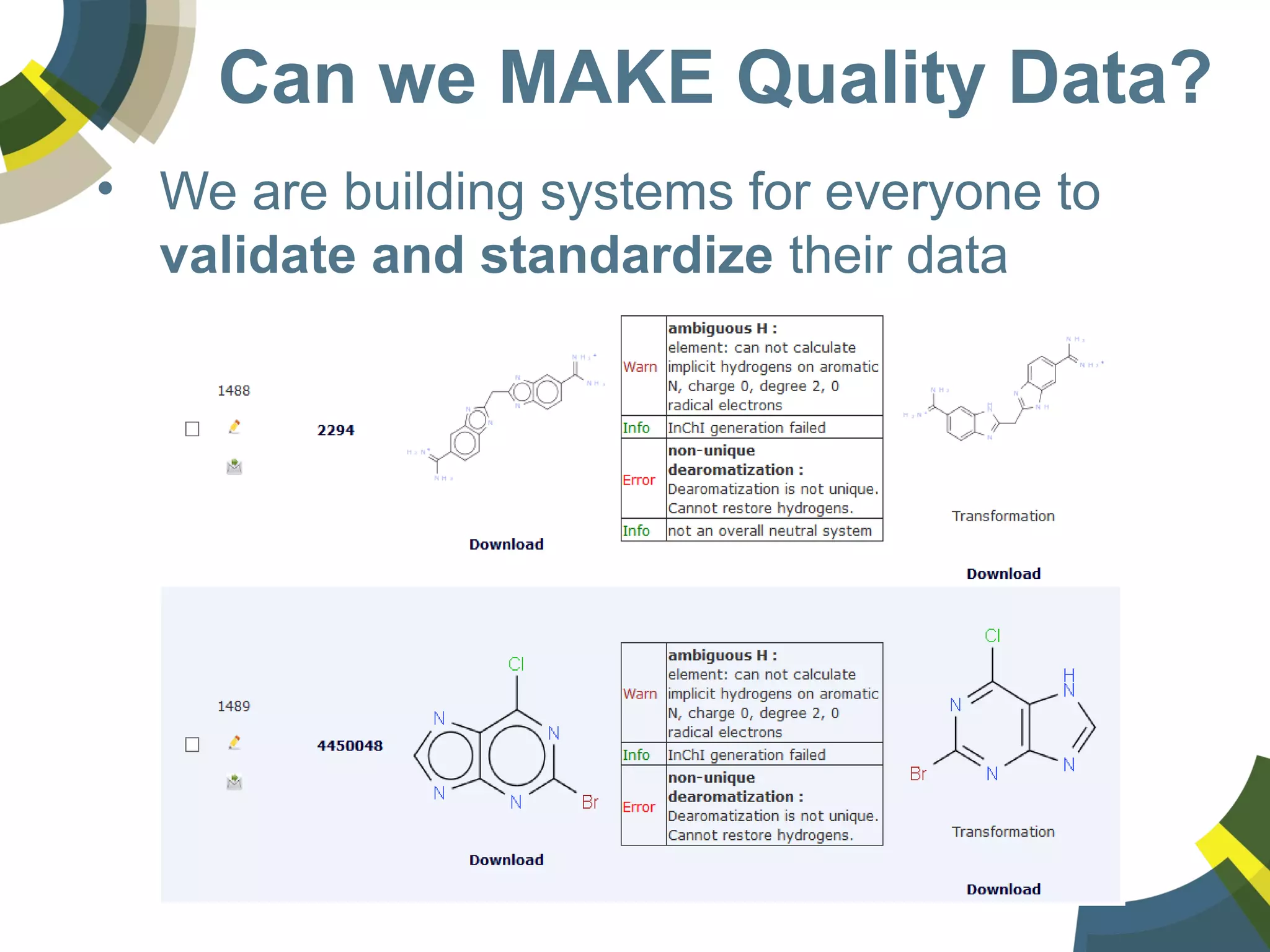
Can we MAKE Quality Data?
• We are building systems for everyone to
validate and standardize their data
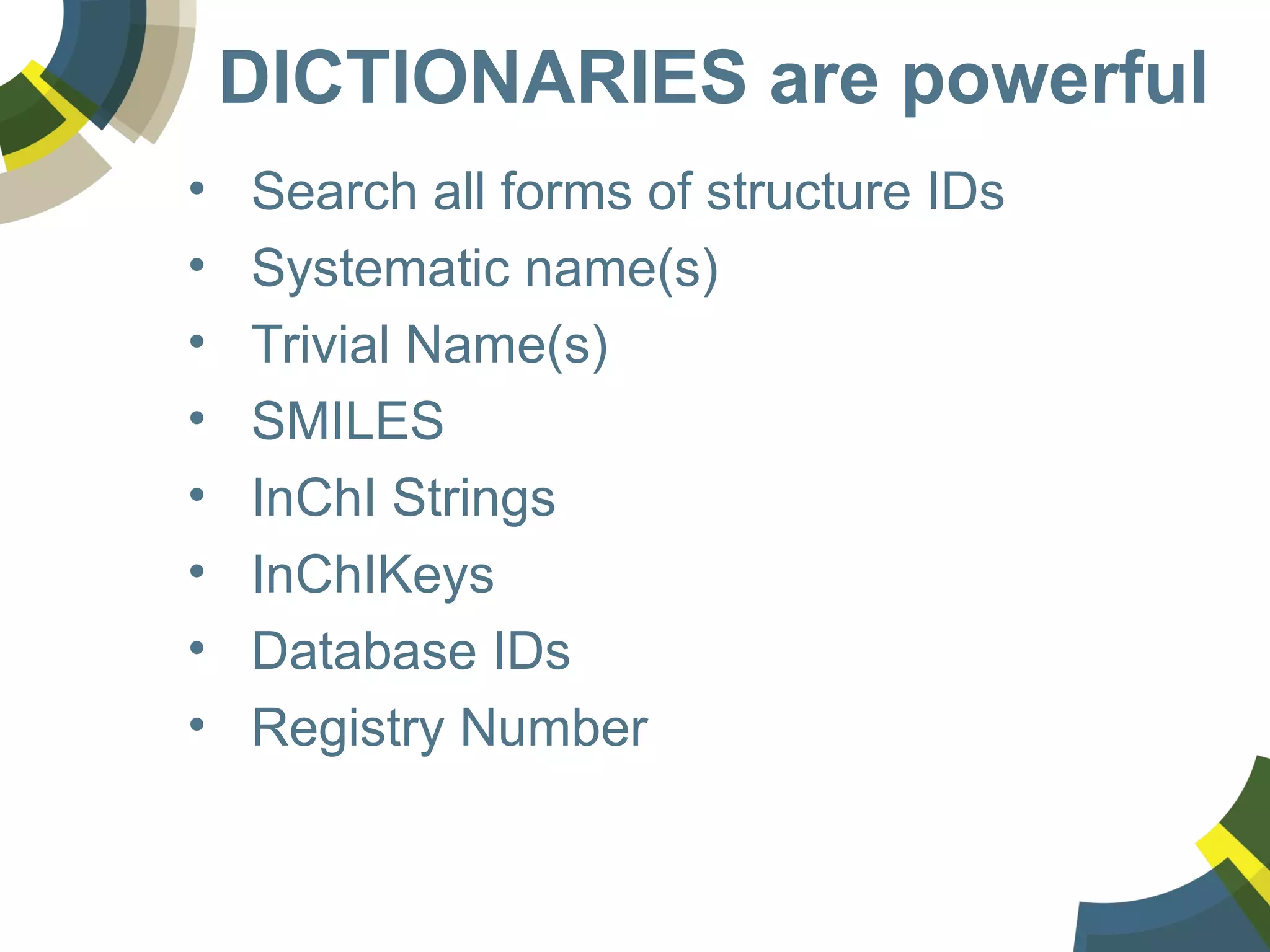
DICTIONARIES are powerful
• Search all forms of structure IDs
• Systematic name(s)
• Trivial Name(s)
• SMILES
• InChI Strings
• InChIKeys
• Database IDs
• Registry Number
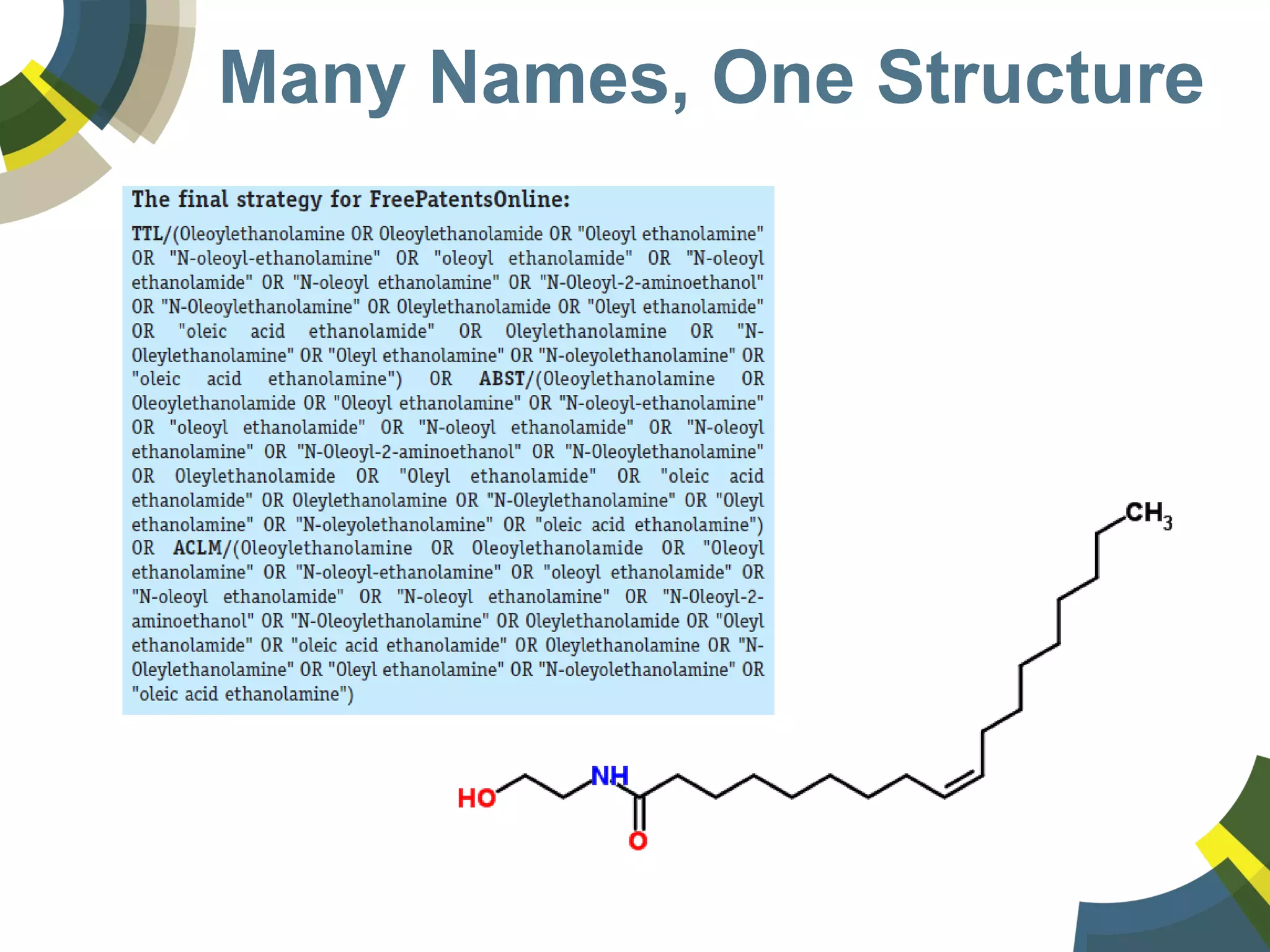
Many Names, One Structure
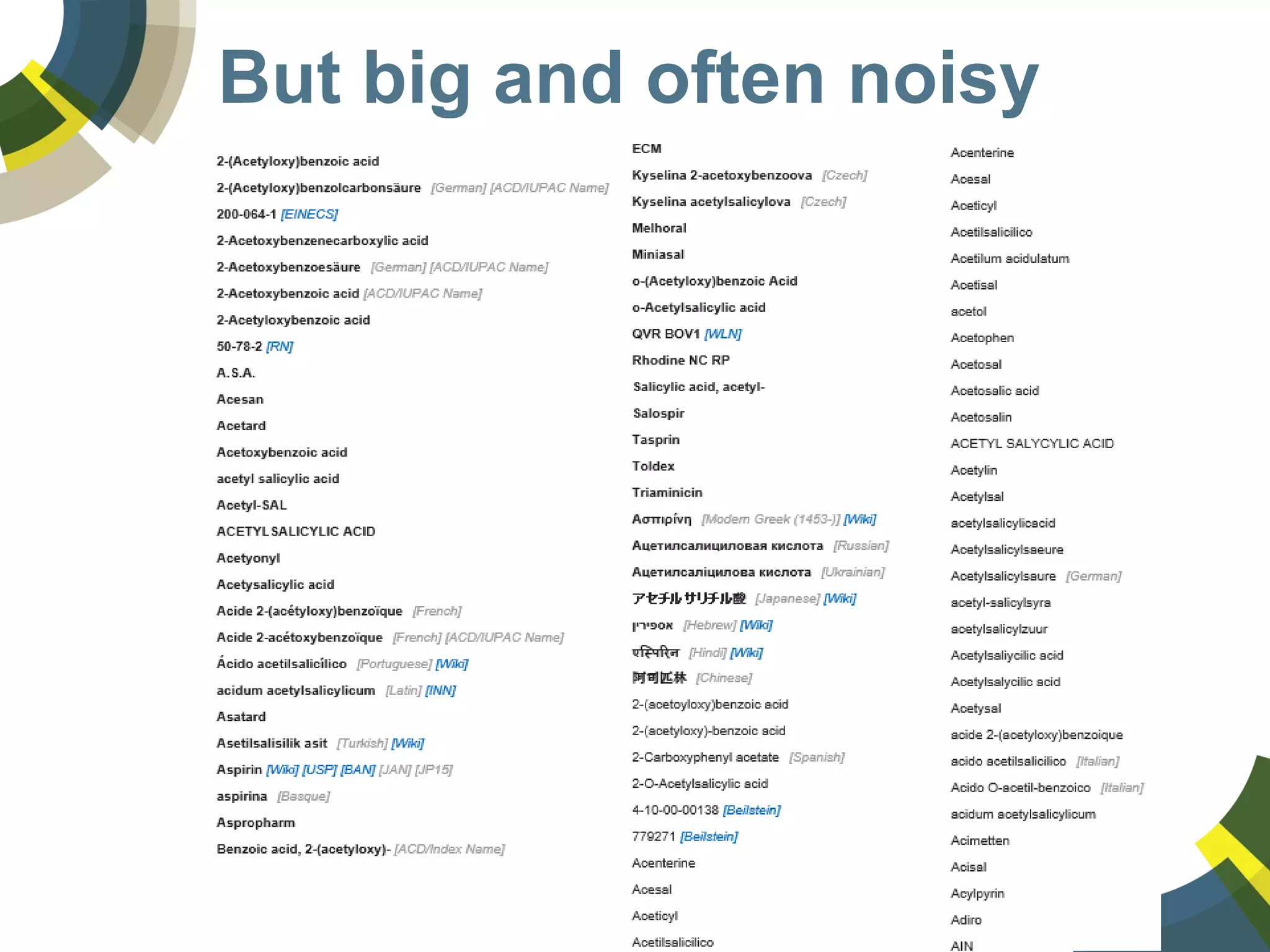
But big and often noisy
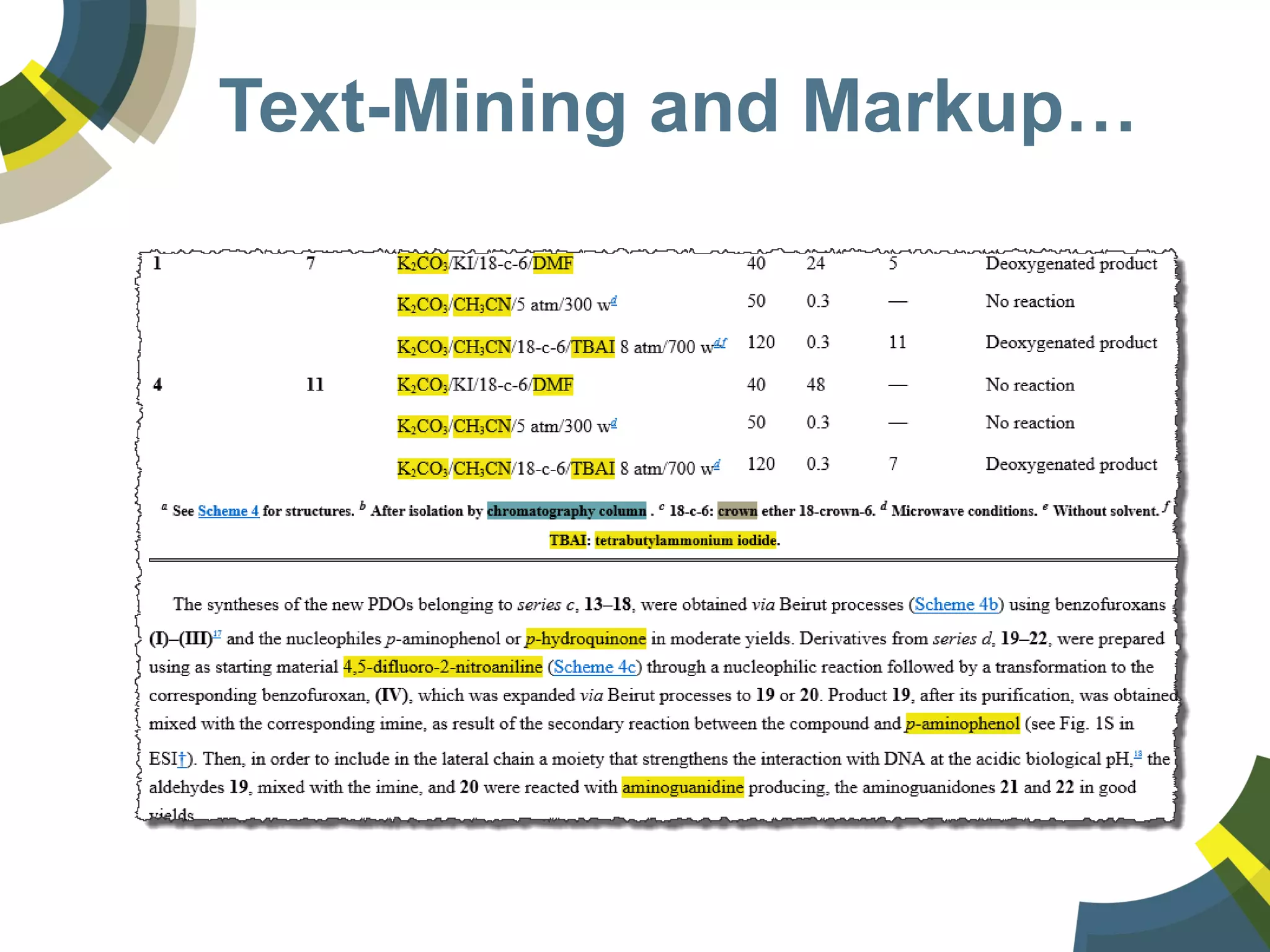
Text-Mining and Markup…
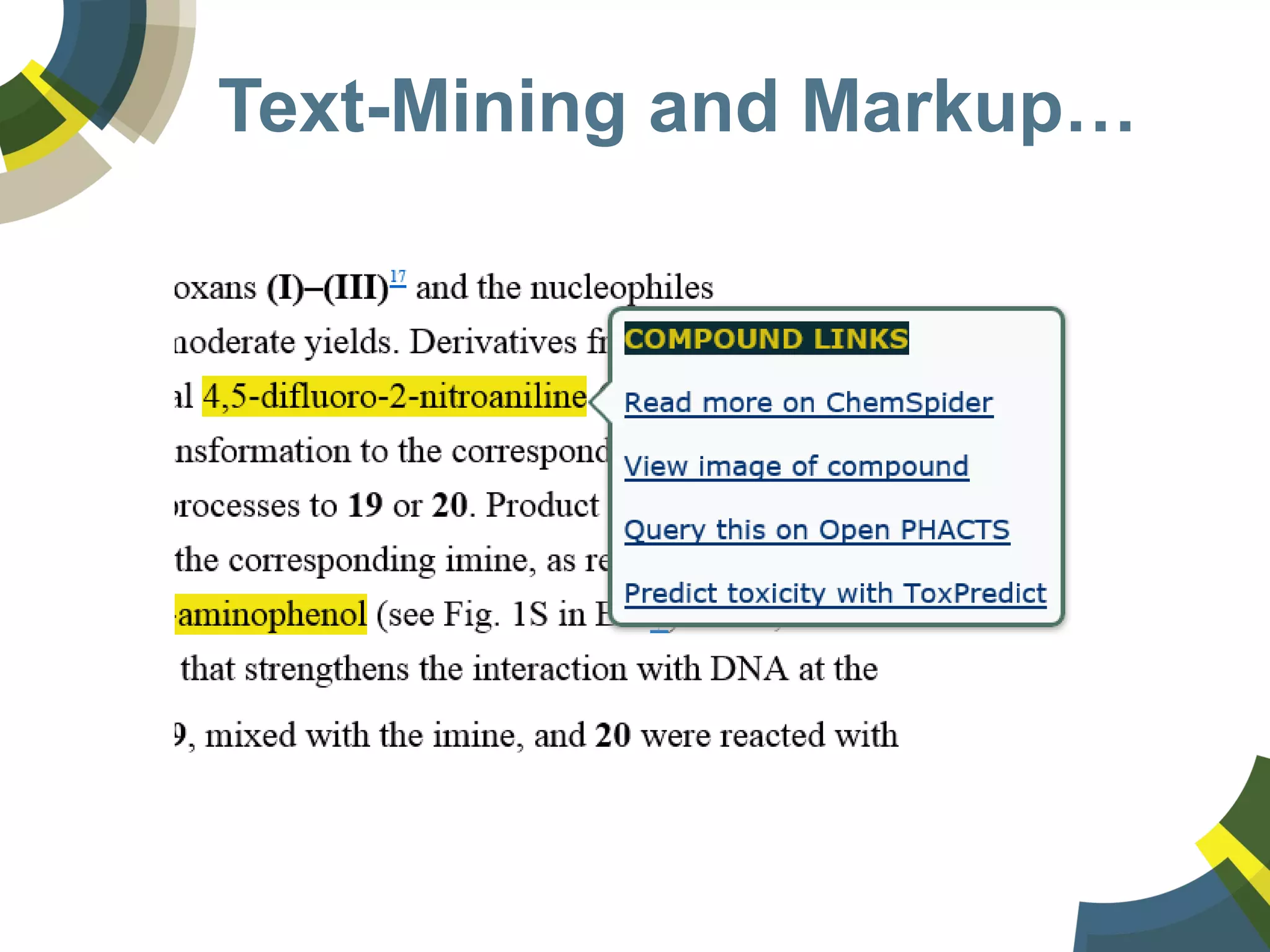
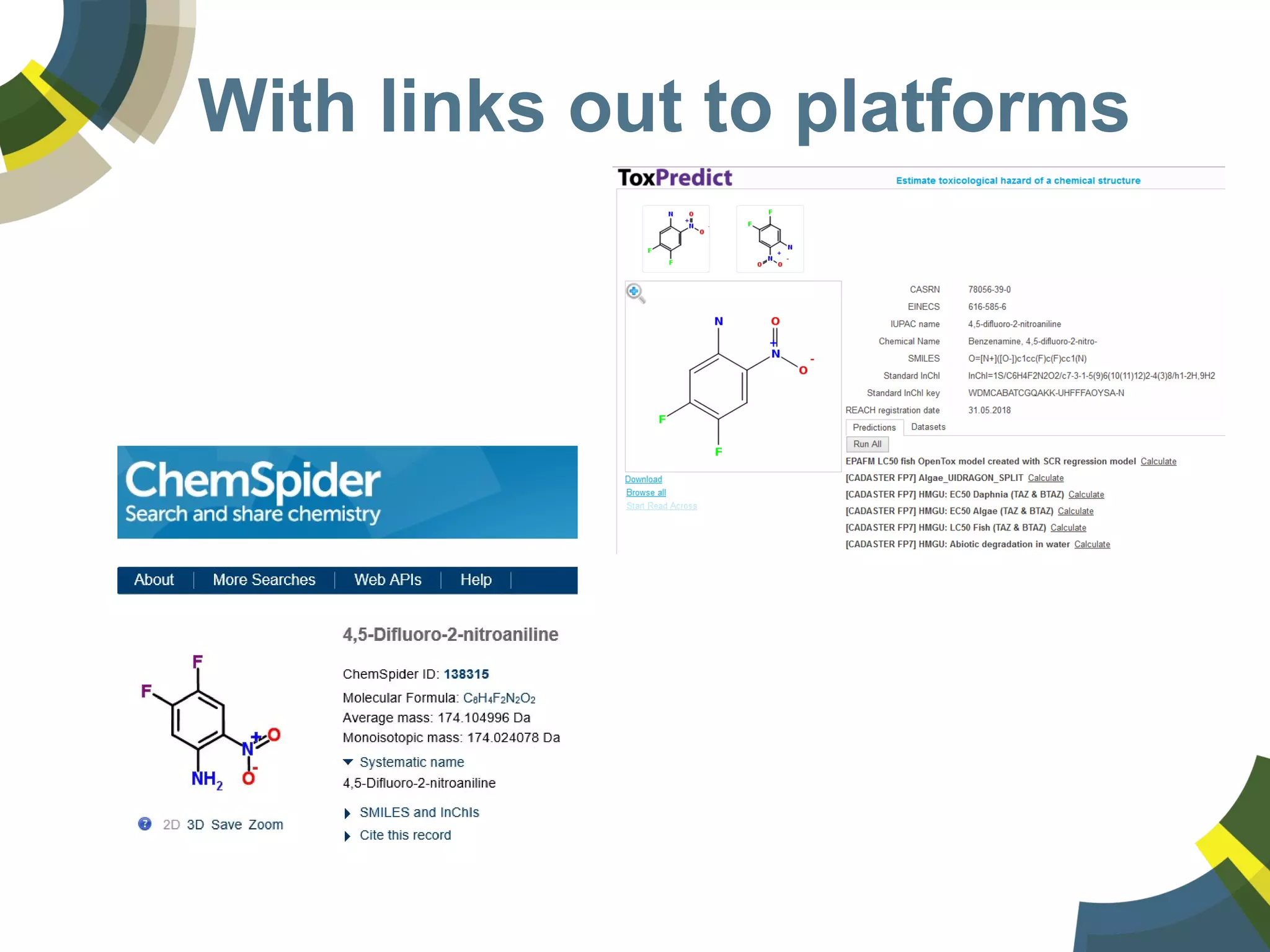
With links out to platforms
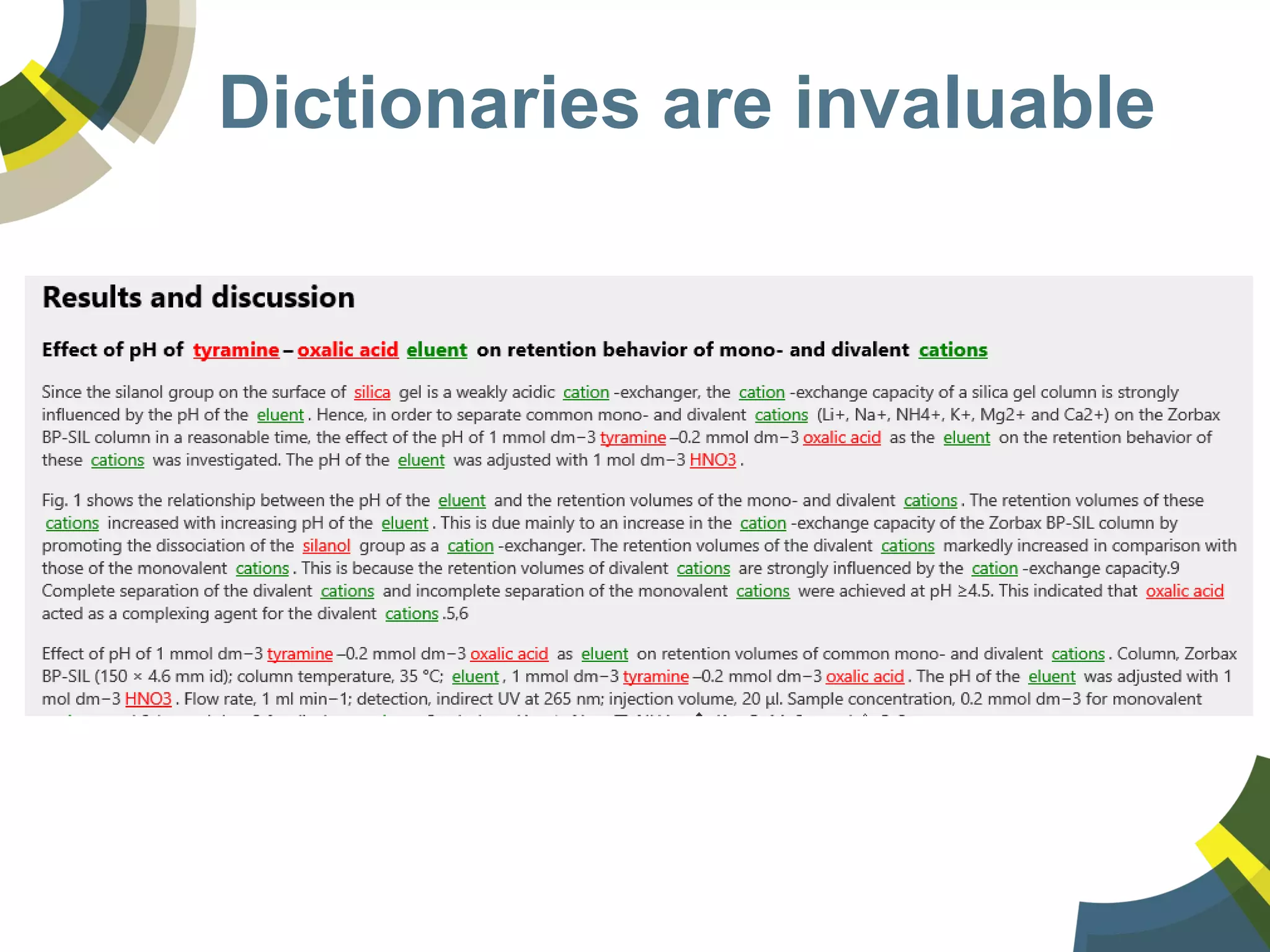
Dictionaries are invaluable
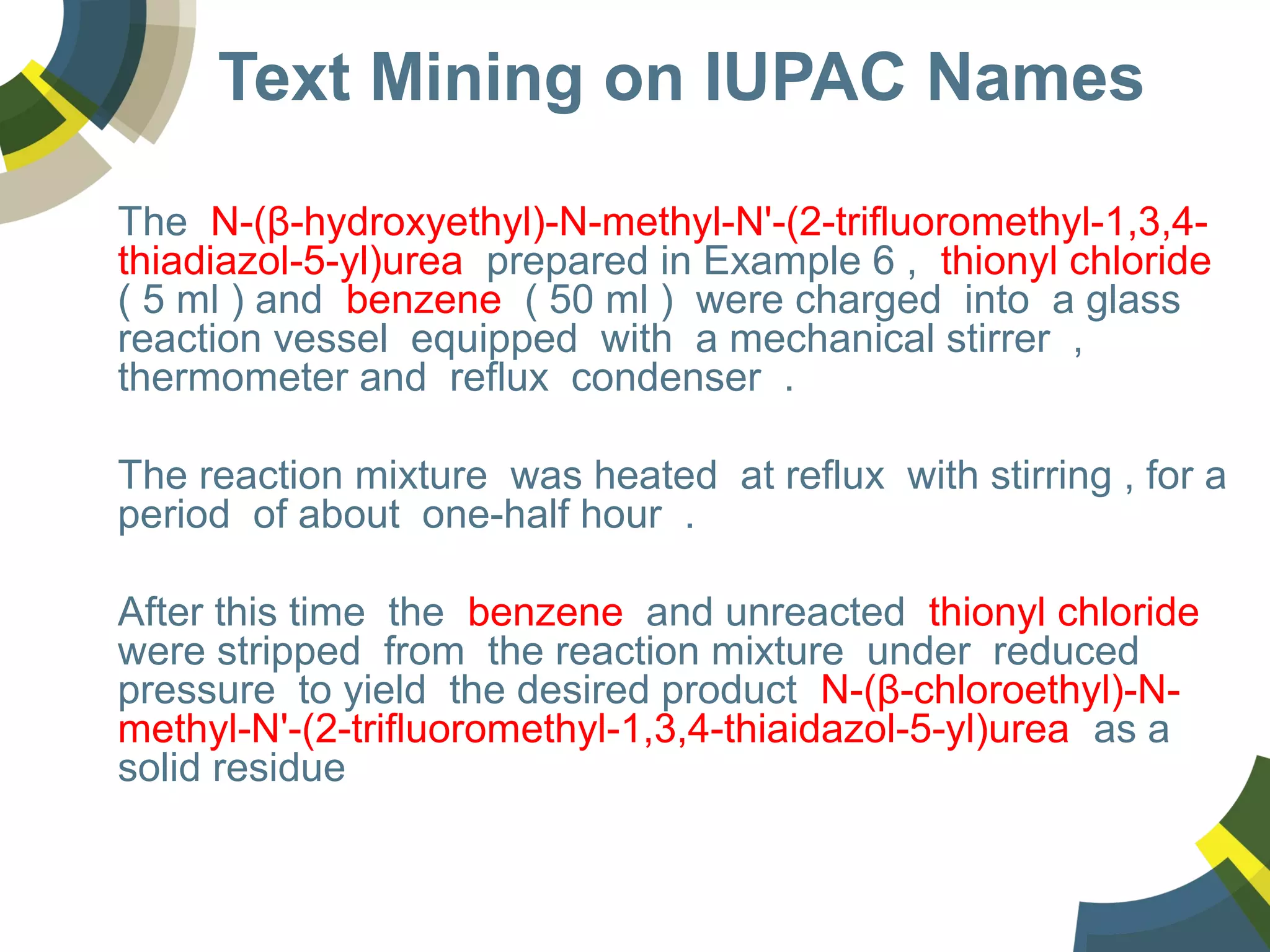
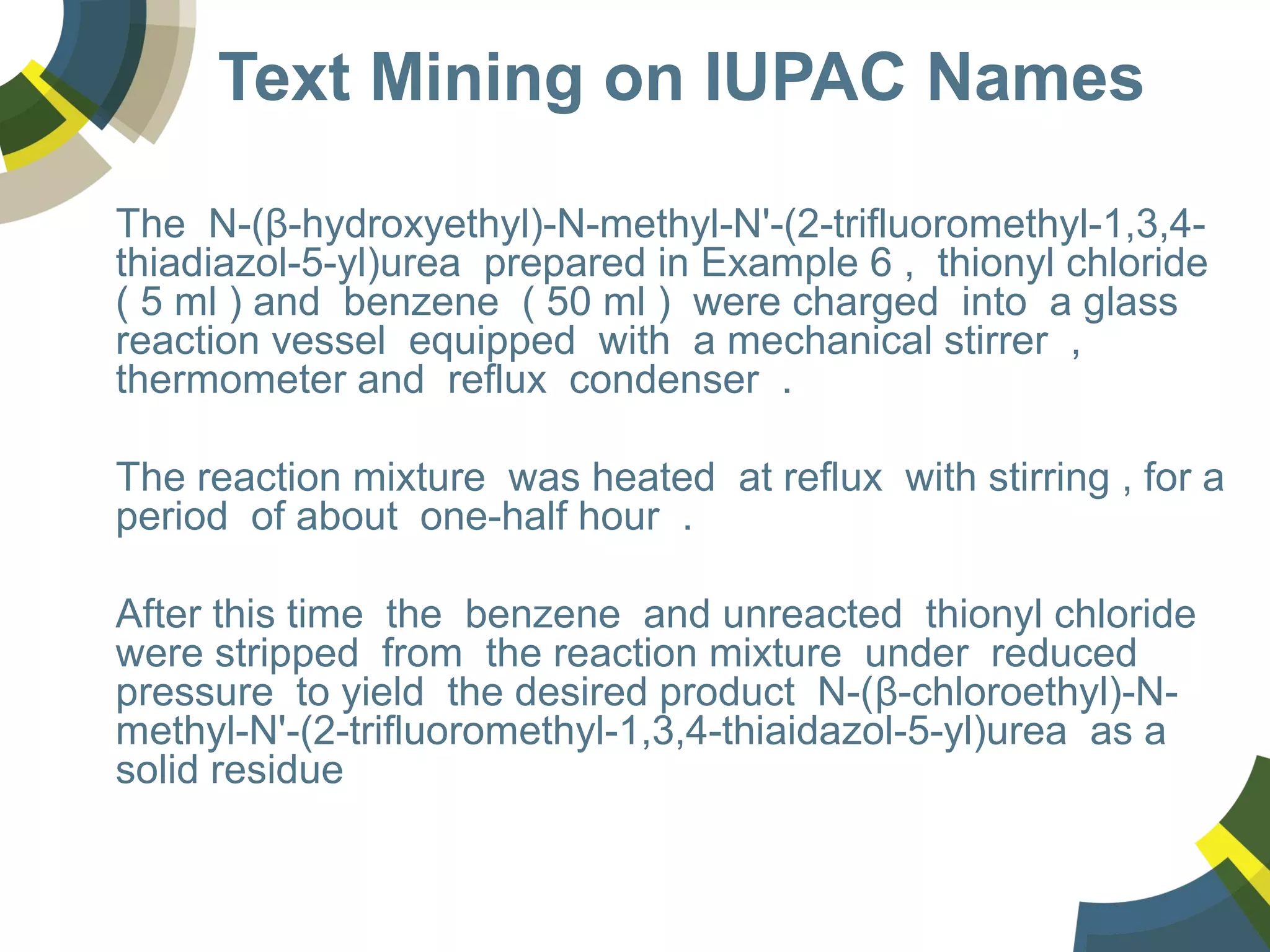
Text Mining on IUPAC Names
The N-(β-hydroxyethyl)-N-methyl-N'-(2-trifluoromethyl-1,3,4-
thiadiazol-5-yl)urea prepared in Example 6 , thionyl chloride
( 5 ml ) and benzene ( 50 ml ) were charged into a glass
reaction vessel equipped with a mechanical stirrer ,
thermometer and reflux condenser .
The reaction mixture was heated at reflux with stirring , for a
period of about one-half hour .
After this time the benzene and unreacted thionyl chloride
were stripped from the reaction mixture under reduced
pressure to yield the desired product N-(β-chloroethyl)-N-
methyl-N'-(2-trifluoromethyl-1,3,4-thiaidazol-5-yl)urea as a
solid residue
Text Mining on IUPAC Names
The N-(β-hydroxyethyl)-N-methyl-N'-(2-trifluoromethyl-1,3,4-
thiadiazol-5-yl)urea prepared in Example 6 , thionyl chloride
( 5 ml ) and benzene ( 50 ml ) were charged into a glass
reaction vessel equipped with a mechanical stirrer ,
thermometer and reflux condenser .
The reaction mixture was heated at reflux with stirring , for a
period of about one-half hour .
After this time the benzene and unreacted thionyl chloride
were stripped from the reaction mixture under reduced
pressure to yield the desired product N-(β-chloroethyl)-N-
methyl-N'-(2-trifluoromethyl-1,3,4-thiaidazol-5-yl)urea as a
solid residue
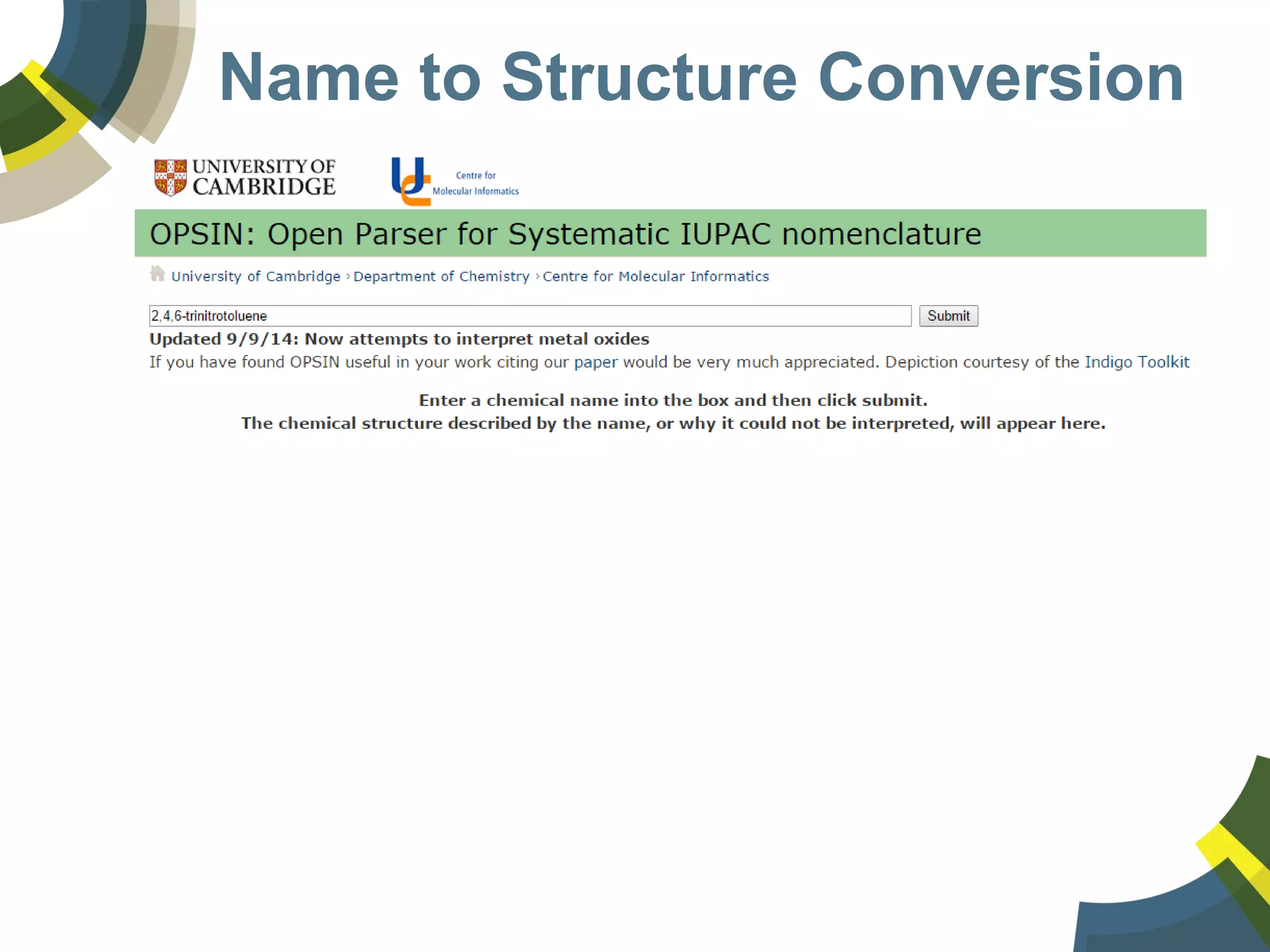
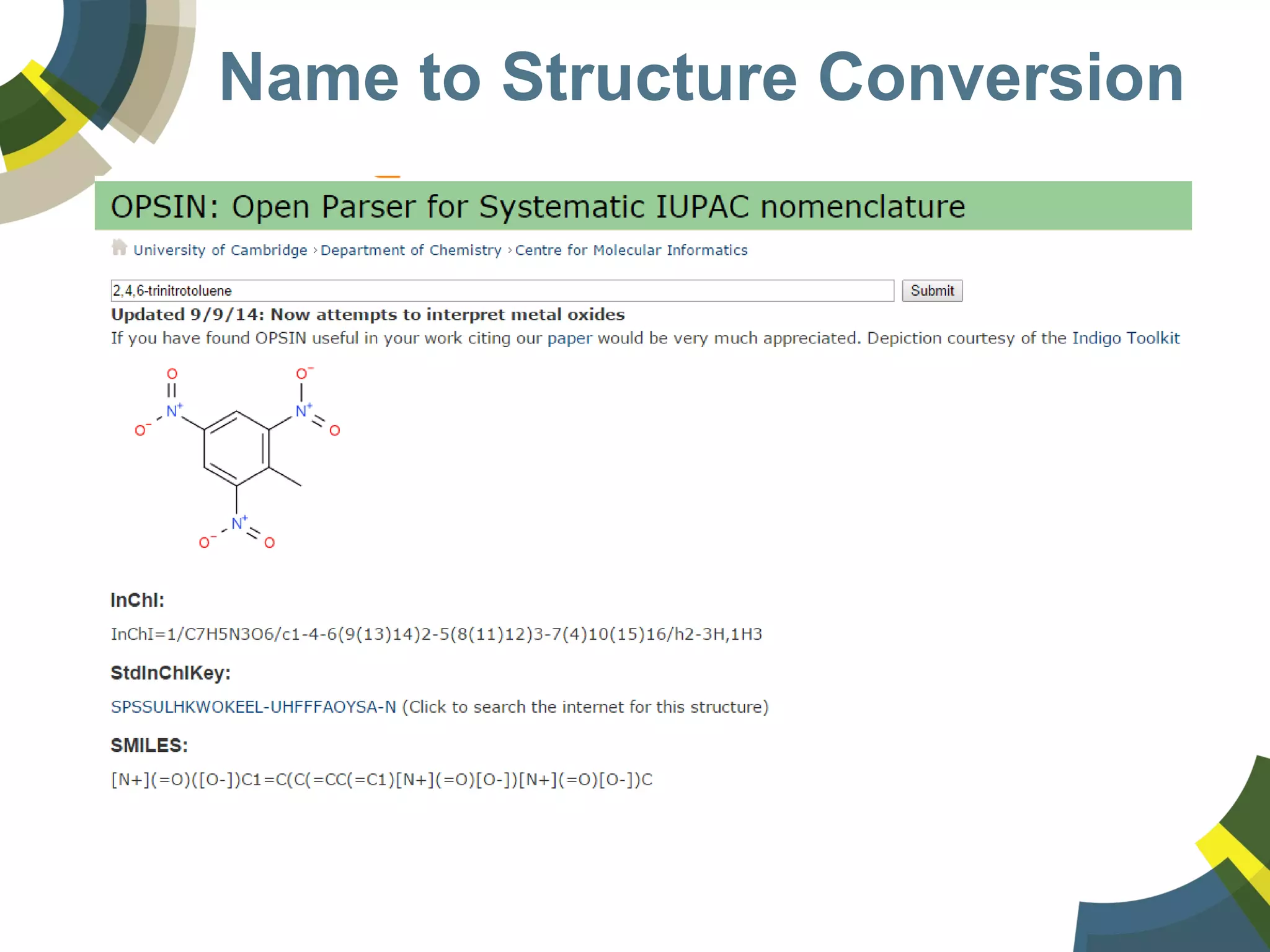
Name to Structure Conversion
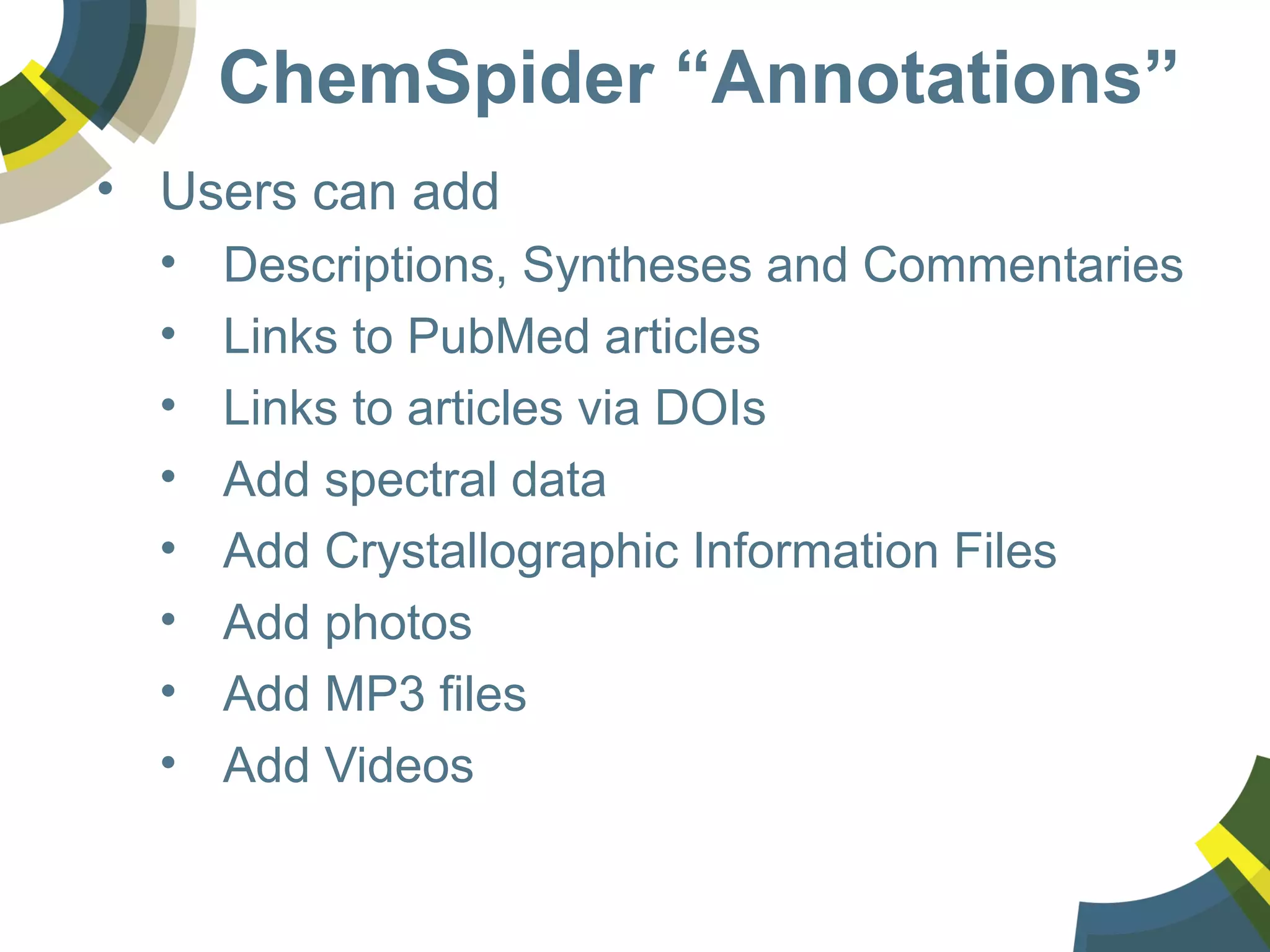
ChemSpider “Annotations”
• Users can add
• Descriptions, Syntheses and Commentaries
• Links to PubMed articles
• Links to articles via DOIs
• Add spectral data
• Add Crystallographic Information Files
• Add photos
• Add MP3 files
• Add Videos
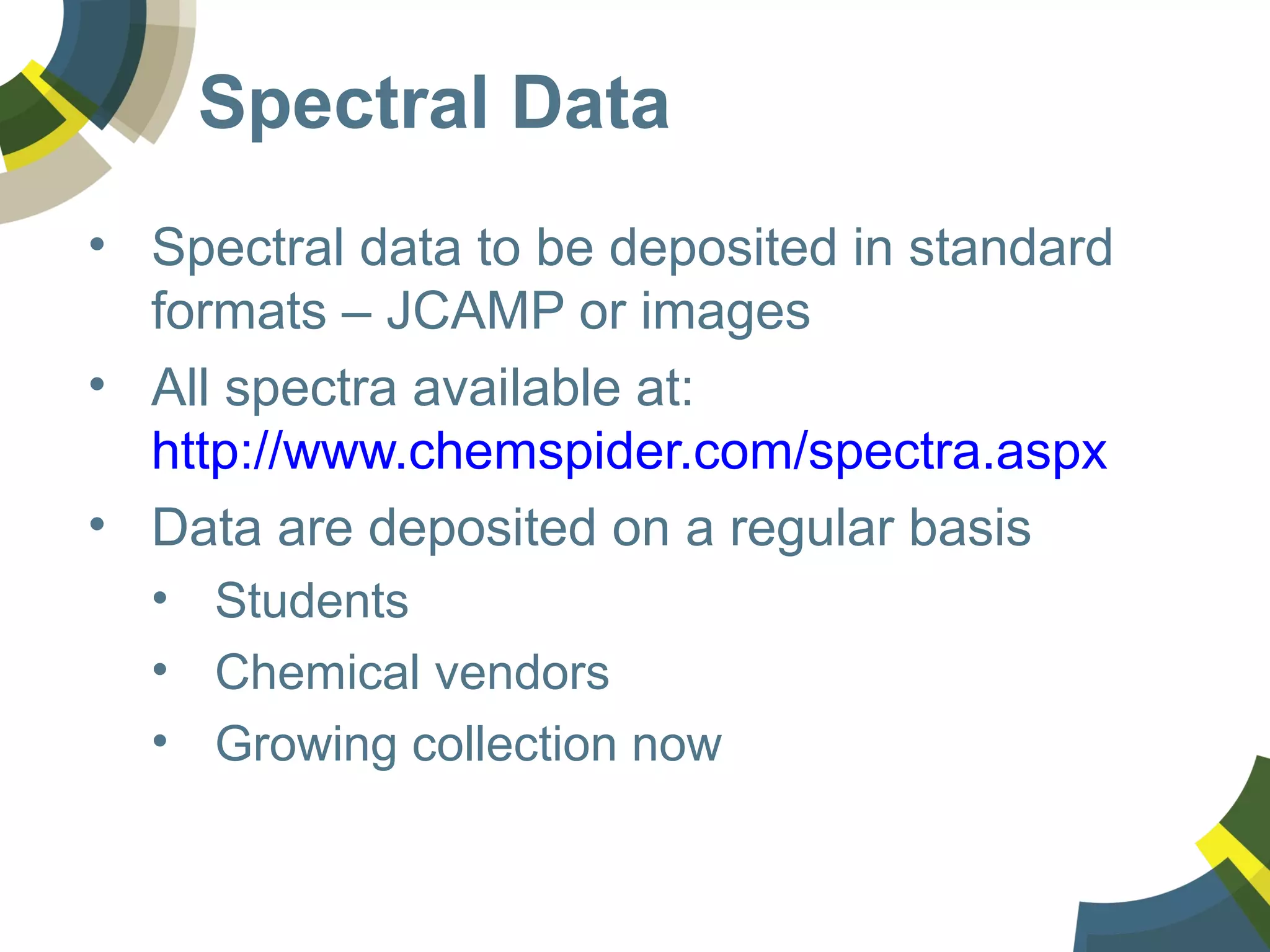
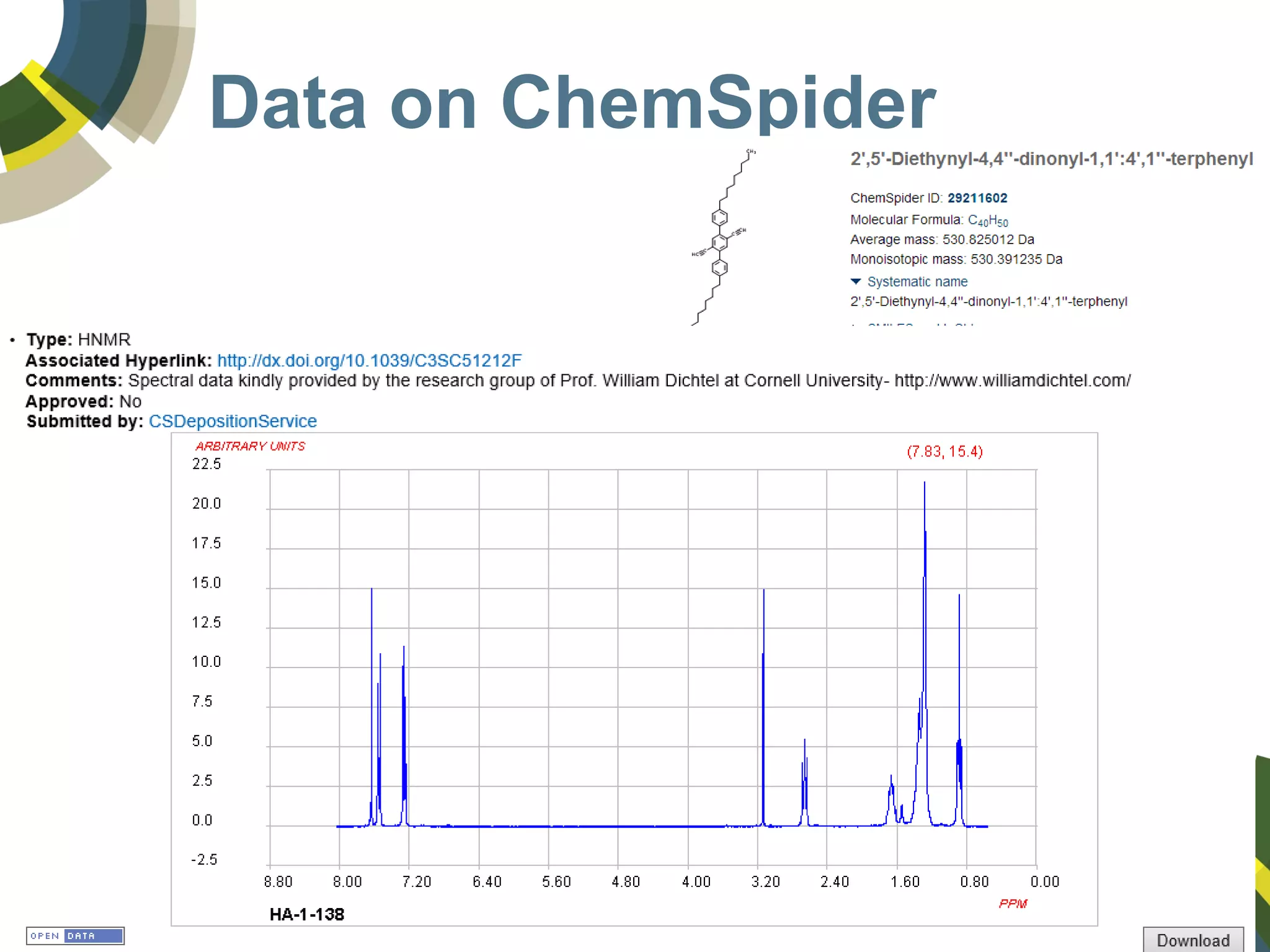
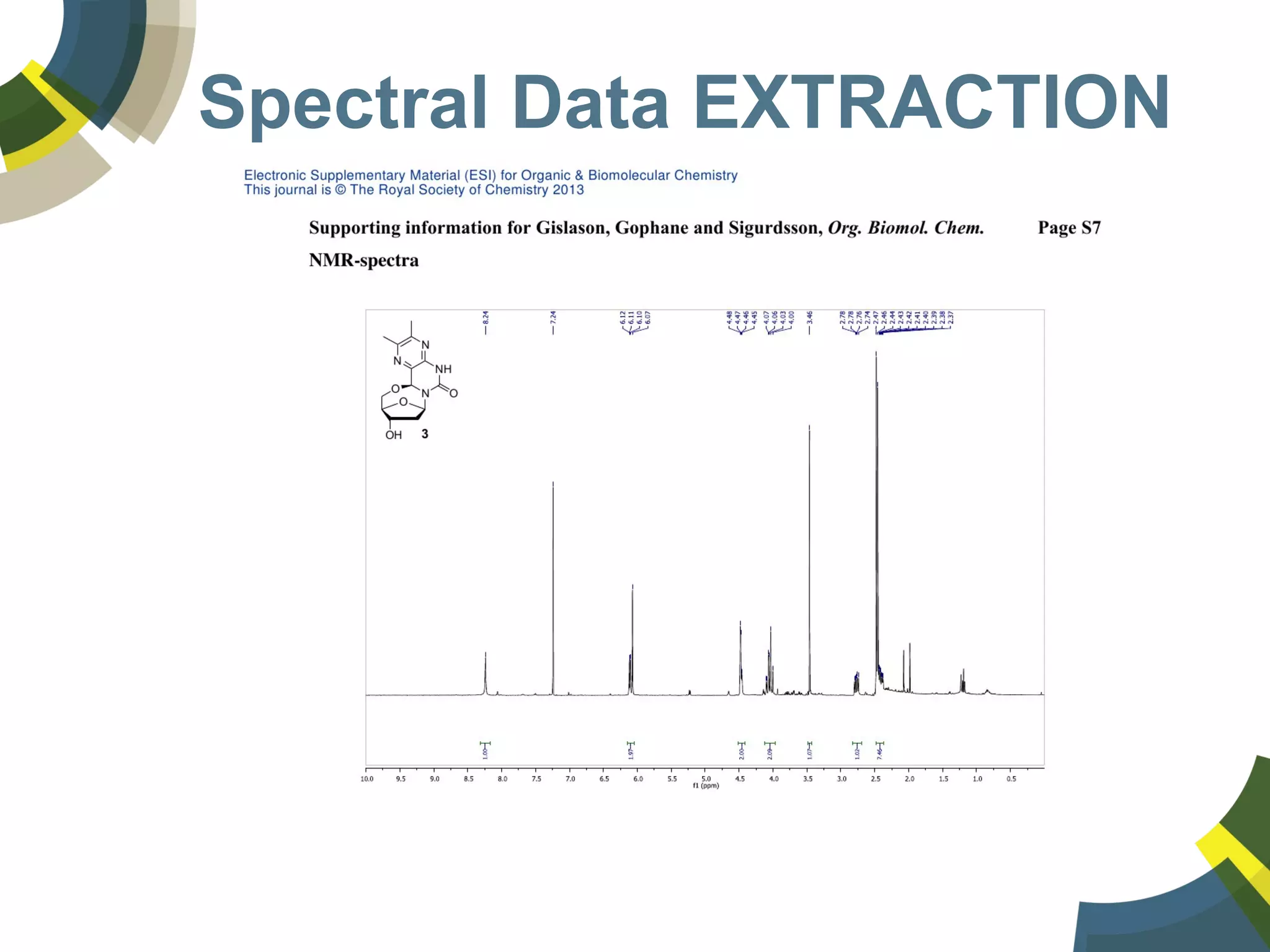
Spectral Data
• Spectral data to be deposited in standard
formats – JCAMP or images
• All spectra available at:
http://www.chemspider.com/spectra.aspx
• Data are deposited on a regular basis
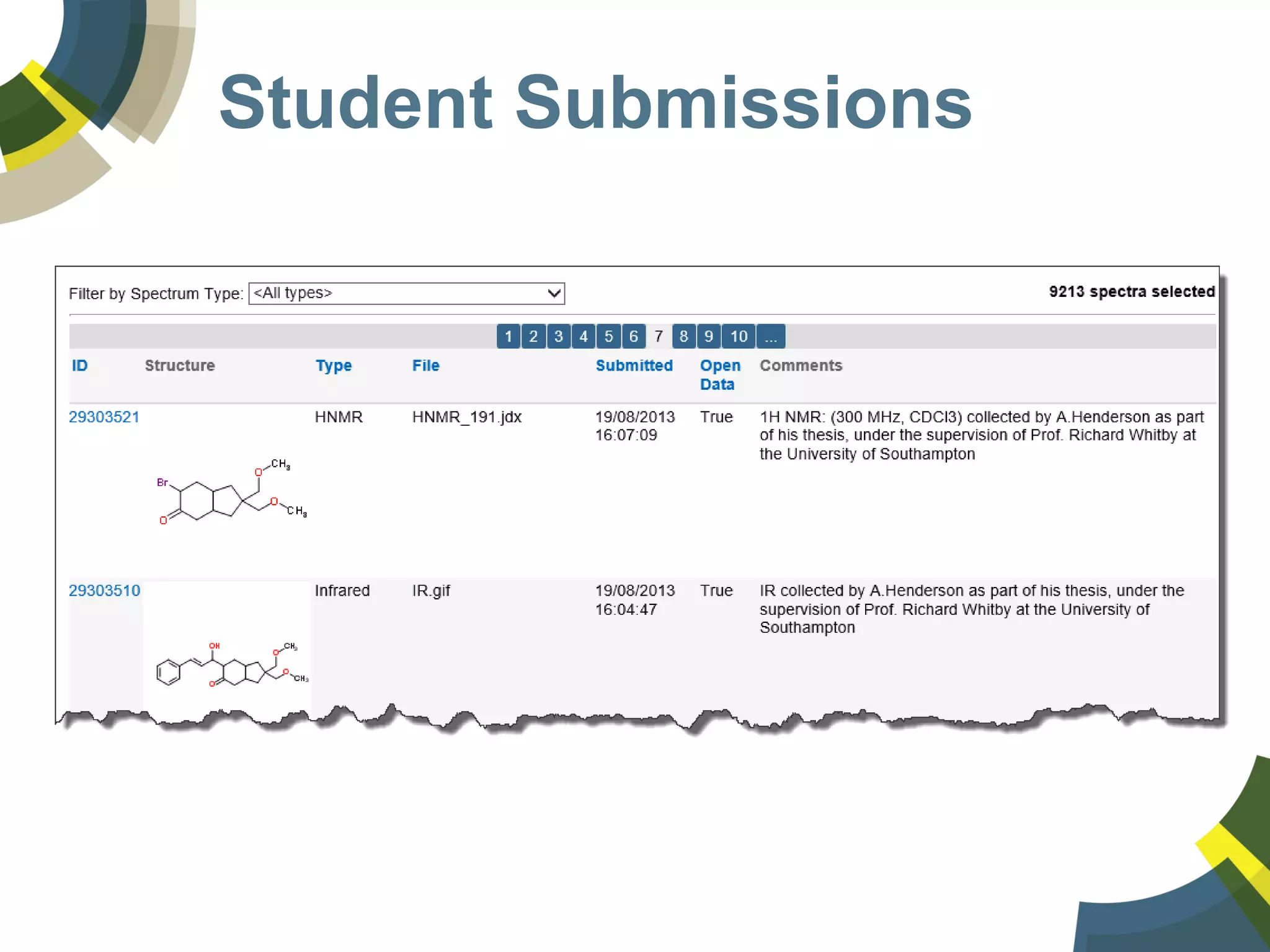
• Students
• Chemical vendors
• Growing collection now
Student Submissions
Data on ChemSpider
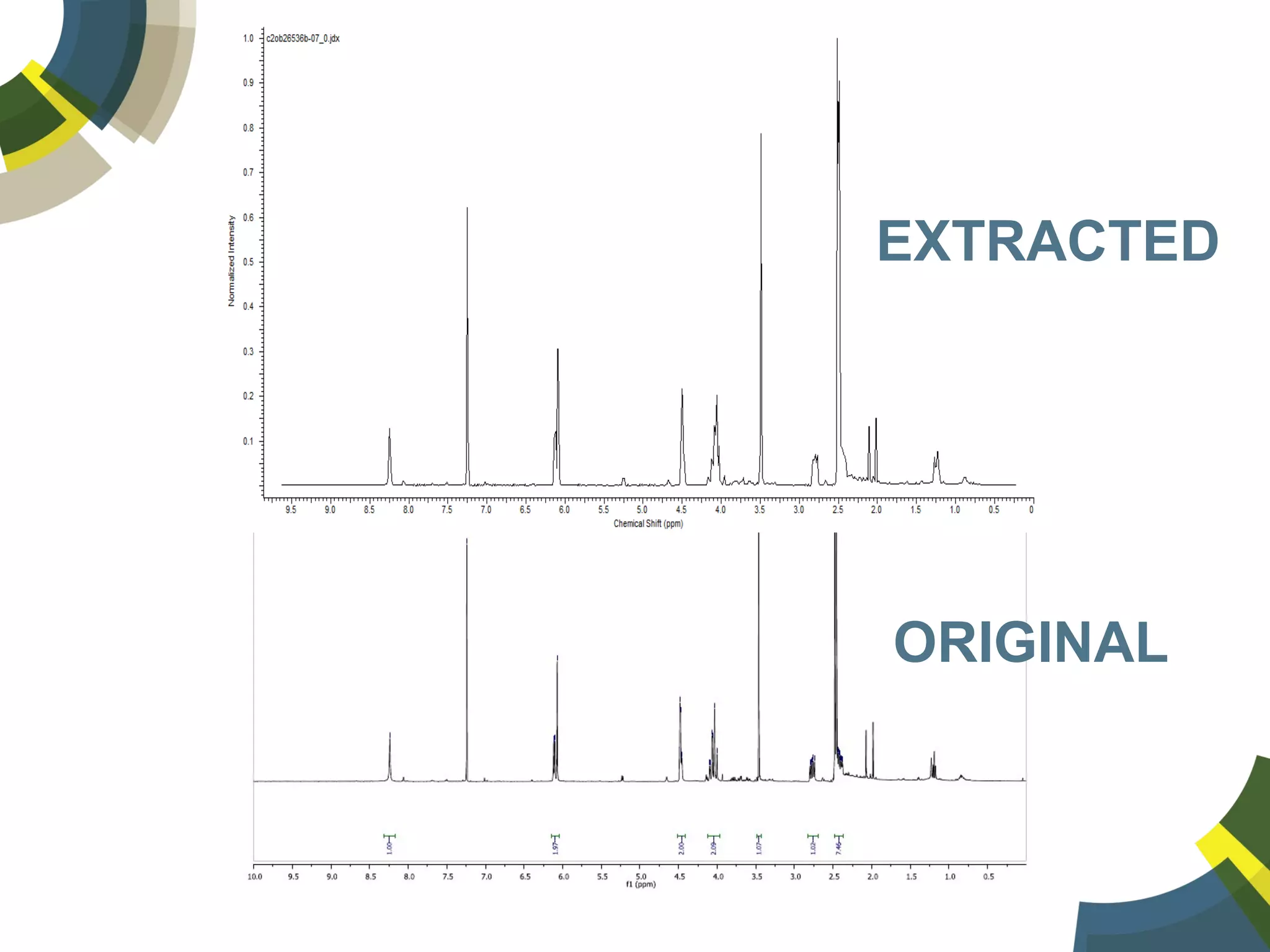
Spectral Data EXTRACTION
ORIGINAL
EXTRACTED
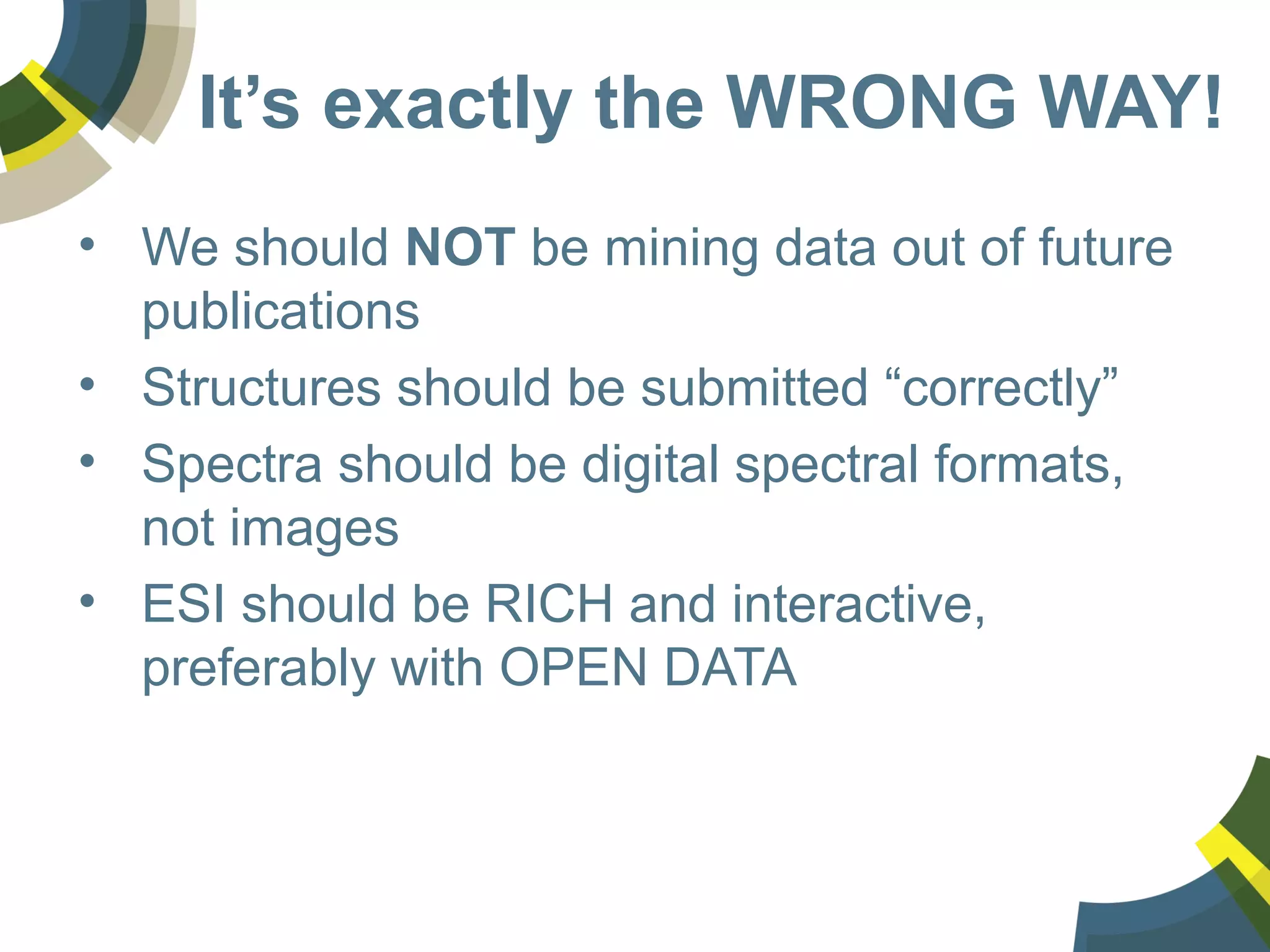
It’s exactly the WRONG WAY!
• We should NOT be mining data out of future
publications
• Structures should be submitted “correctly”
• Spectra should be digital spectral formats,
not images
• ESI should be RICH and interactive,
preferably with OPEN DATA
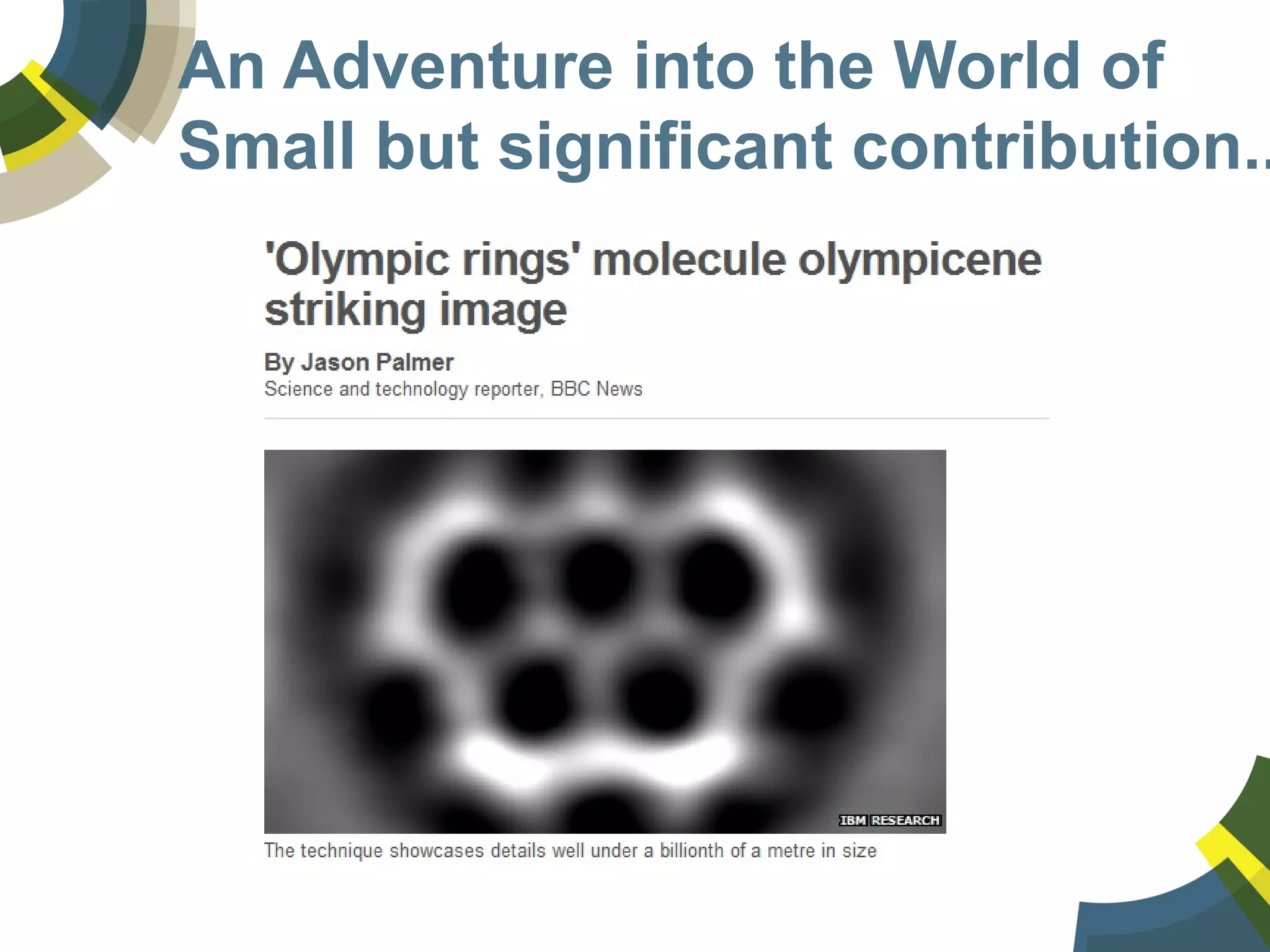
An Adventure into the World of
Small but significant contribution..
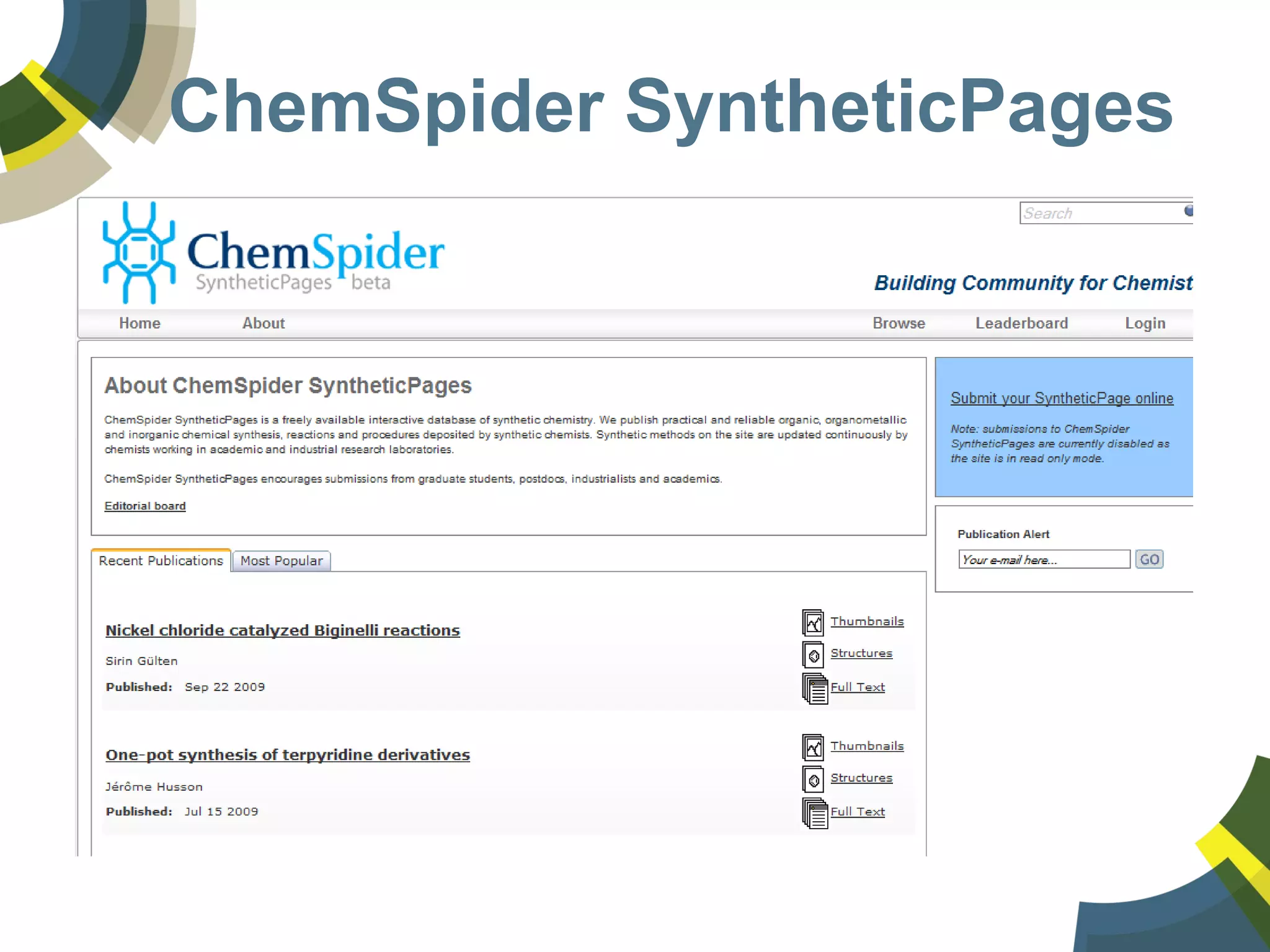
ChemSpider SyntheticPages
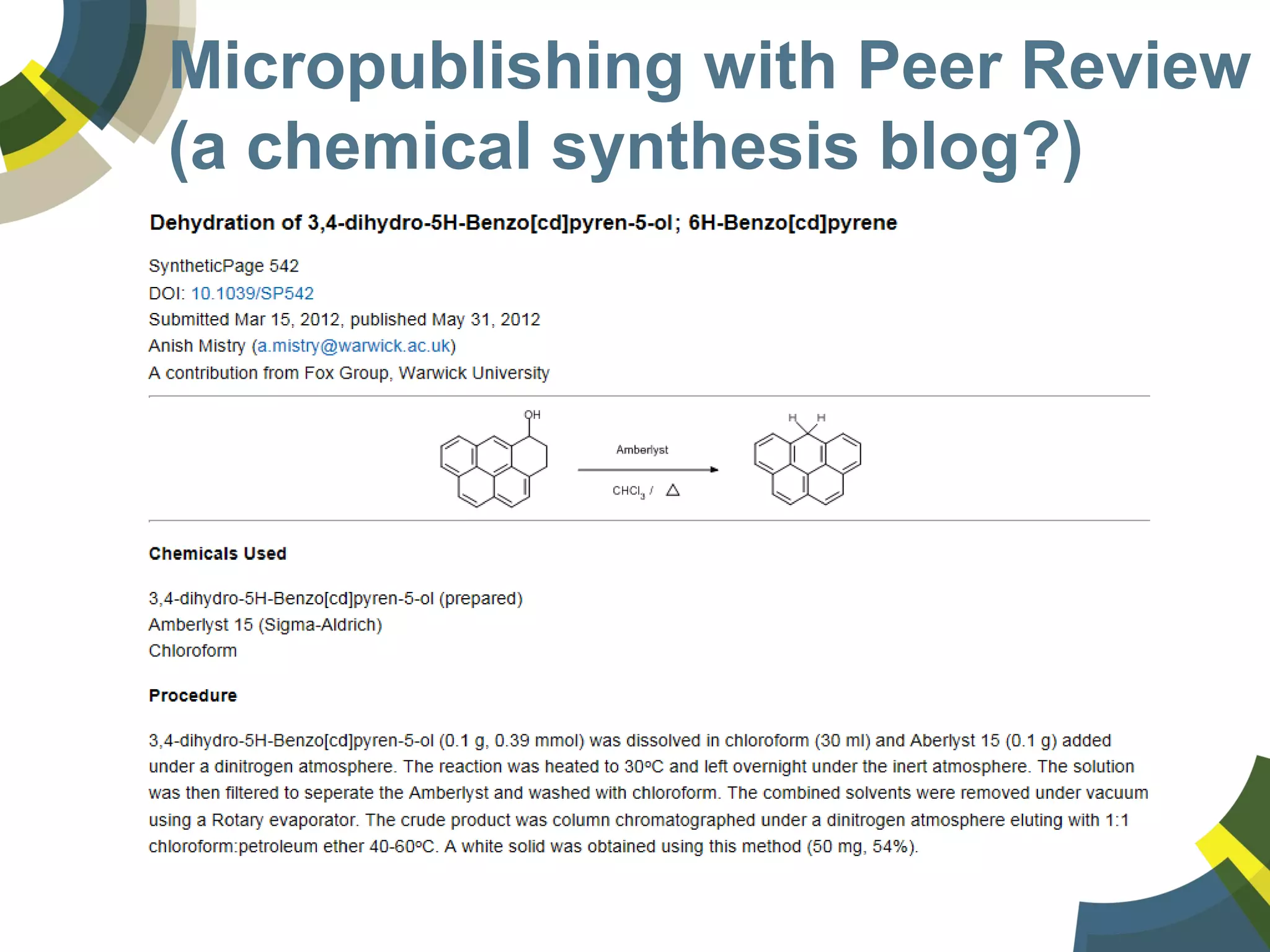
Micropublishing with Peer Review
(a chemical synthesis blog?)
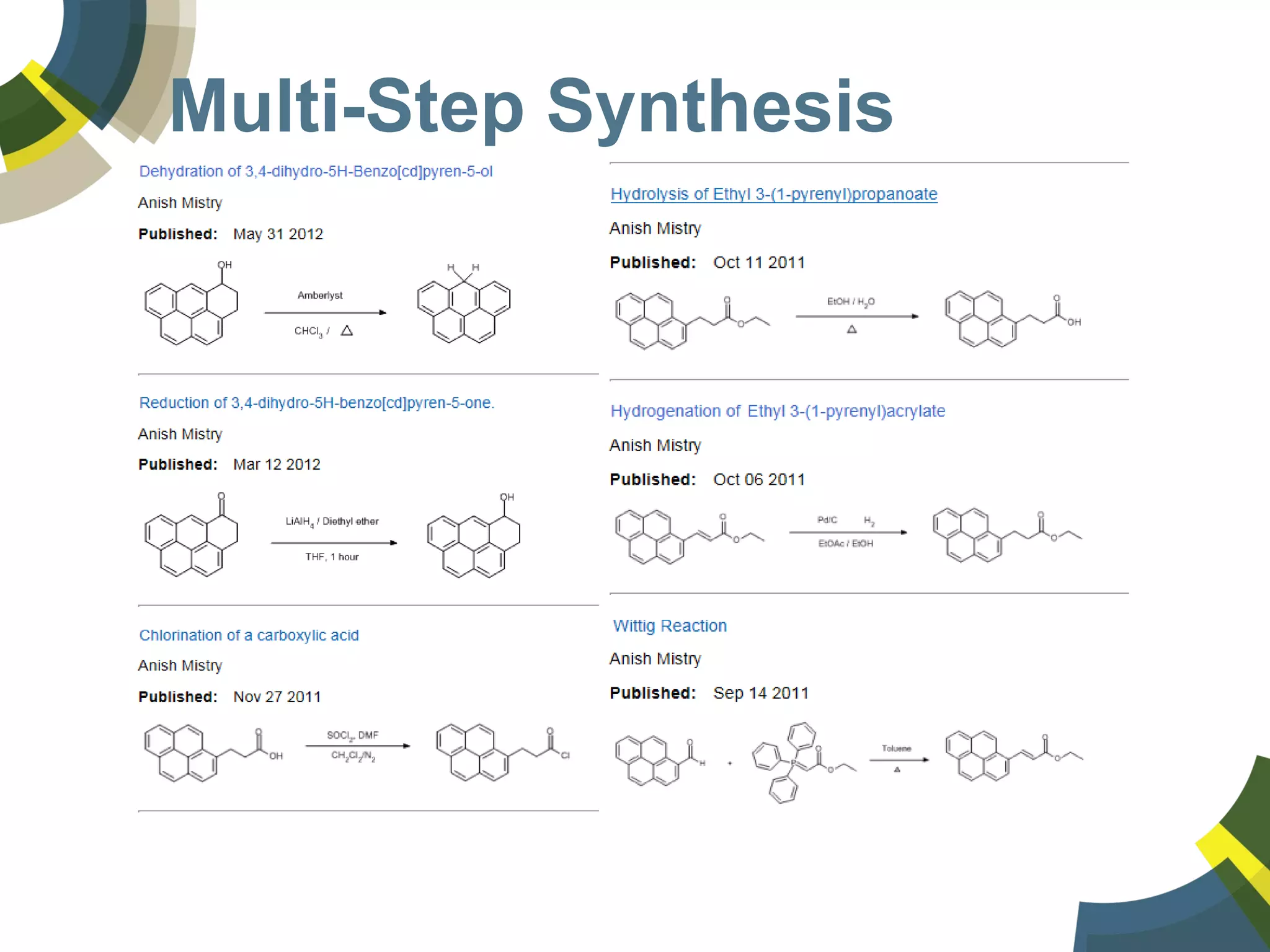
Multi-Step Synthesis
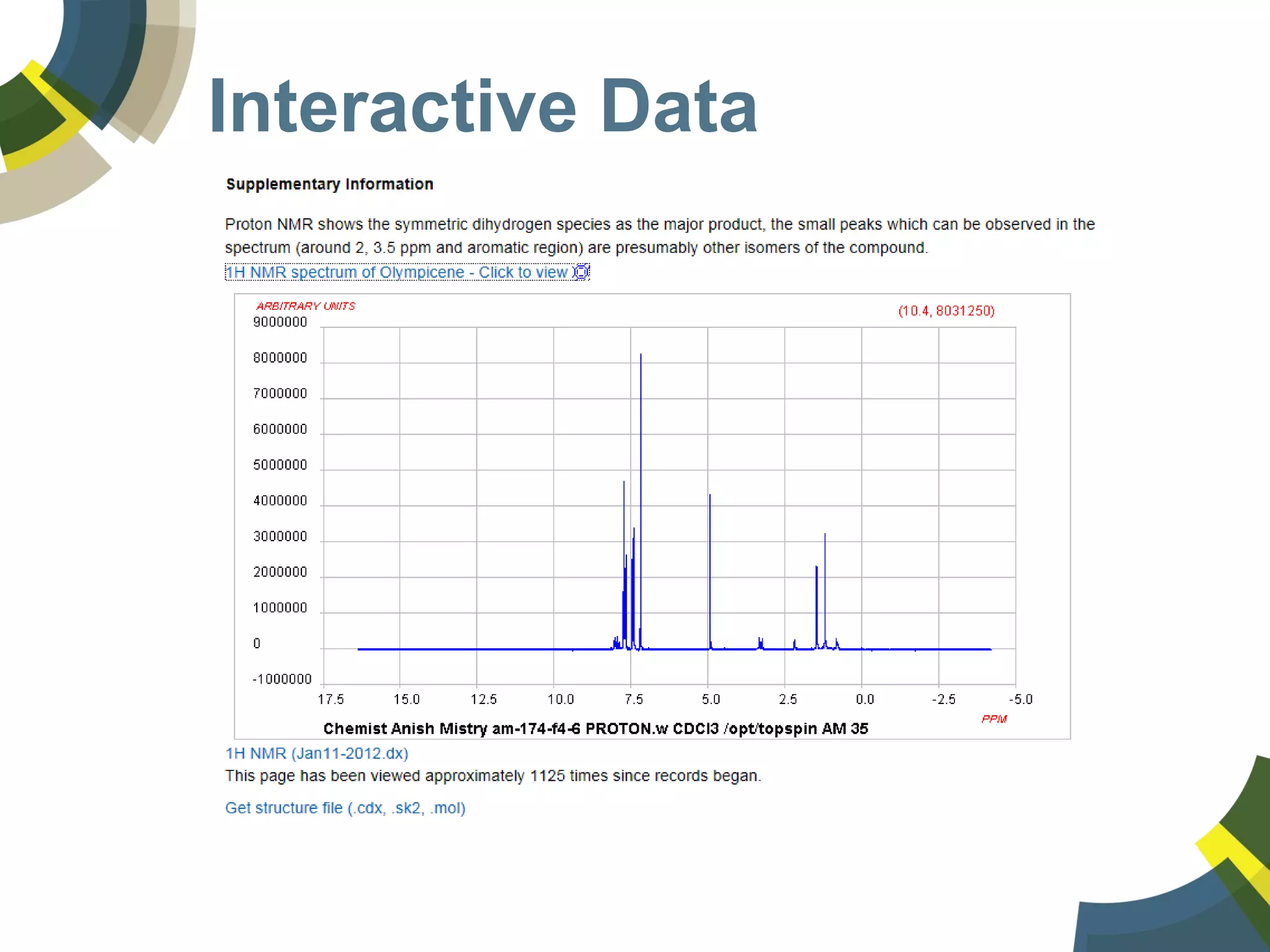
Interactive Data
Chemistry data is of value?
• Reference databases generate hundreds of
millions of dollars/euros per year
• So much data generated that could go public
• Maybe 5% of all data generated is published
• There is no “Journal of Failed Experiments”
• Funding agencies start to demand Open Data
• Scientists want funding but also recognition
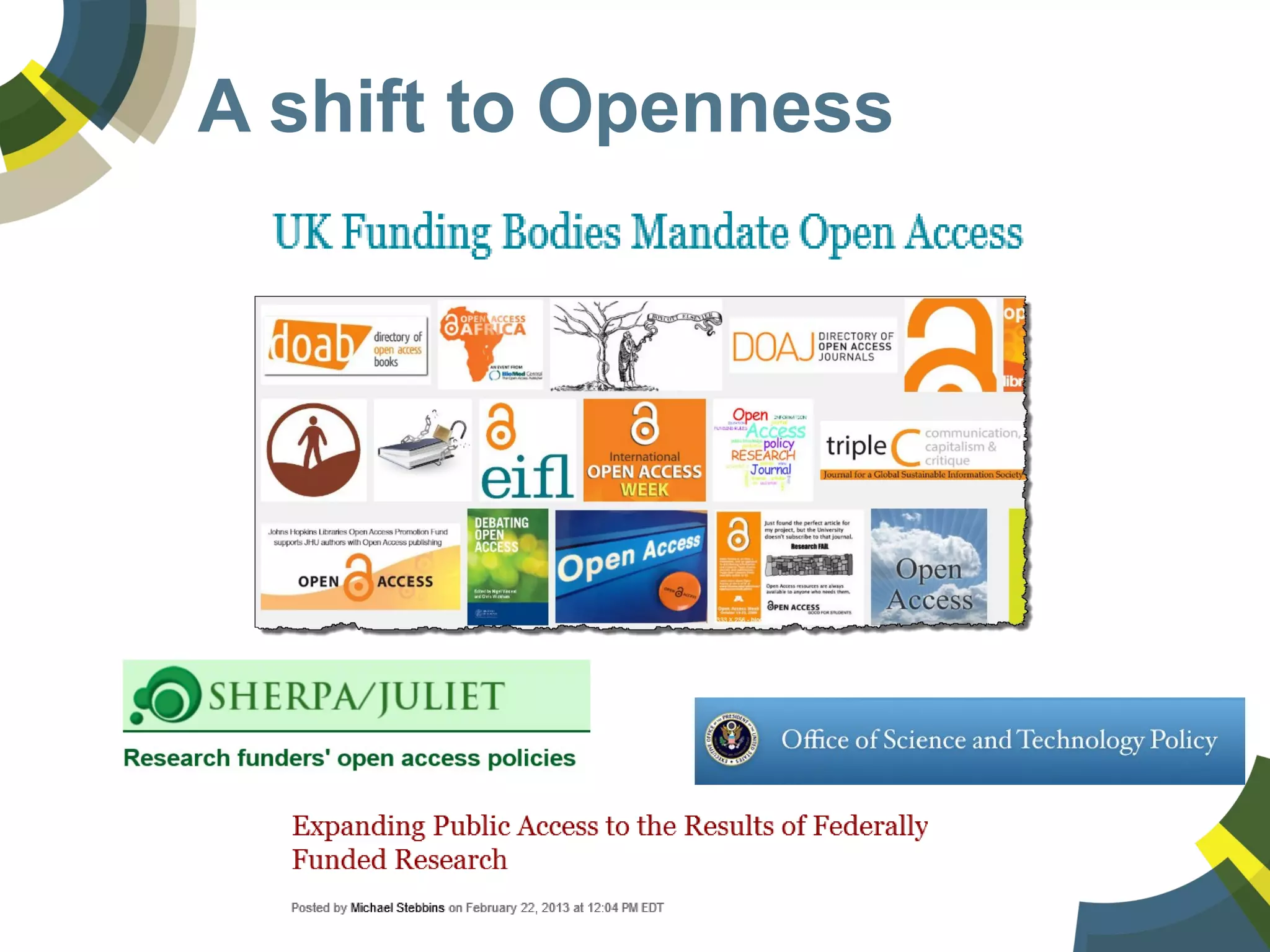
A shift to Openness
How will I get recognized?
• Who in the room has an ORCID?
Deposition of Research Data
• If we manage compounds, syntheses and
analytical data…
• If we have security and provenance of data…
• If we deliver user interfaces to satisfy the
various use cases…
• Then we have delivered electronic lab
notebooks for chemistry laboratories. ELNs
are research data repositories
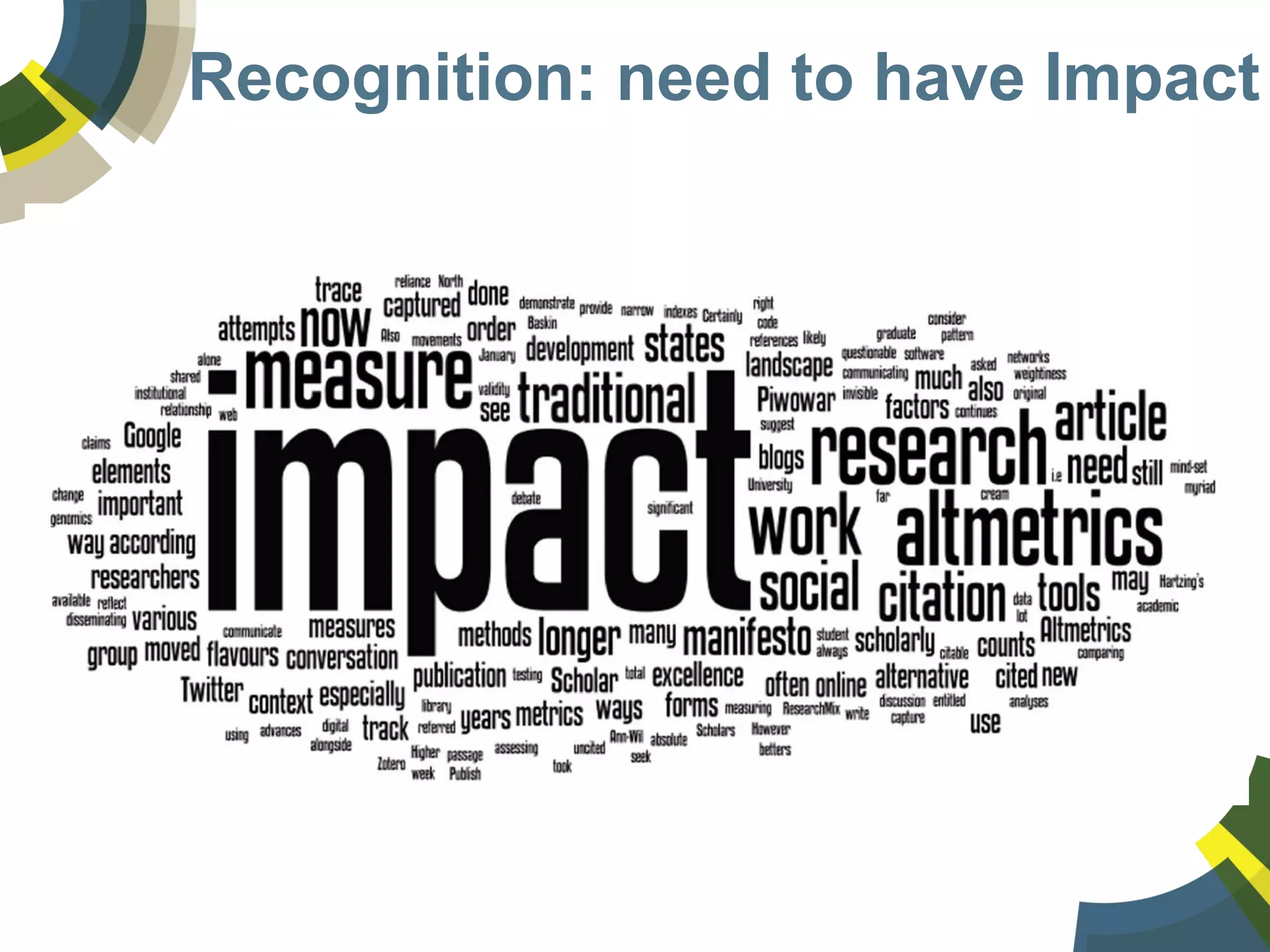
Recognition: need to have Impact
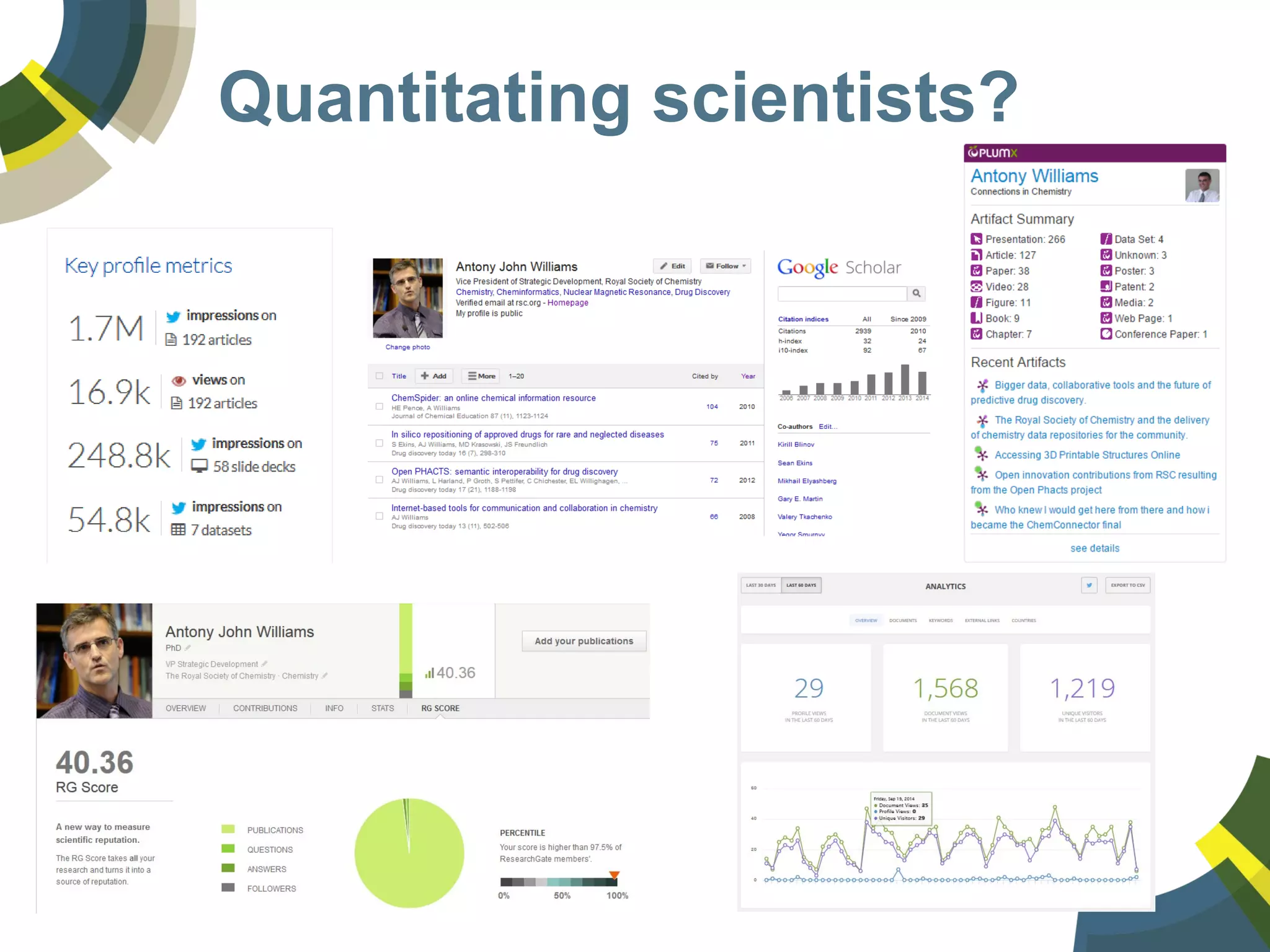
Quantitating scientists?
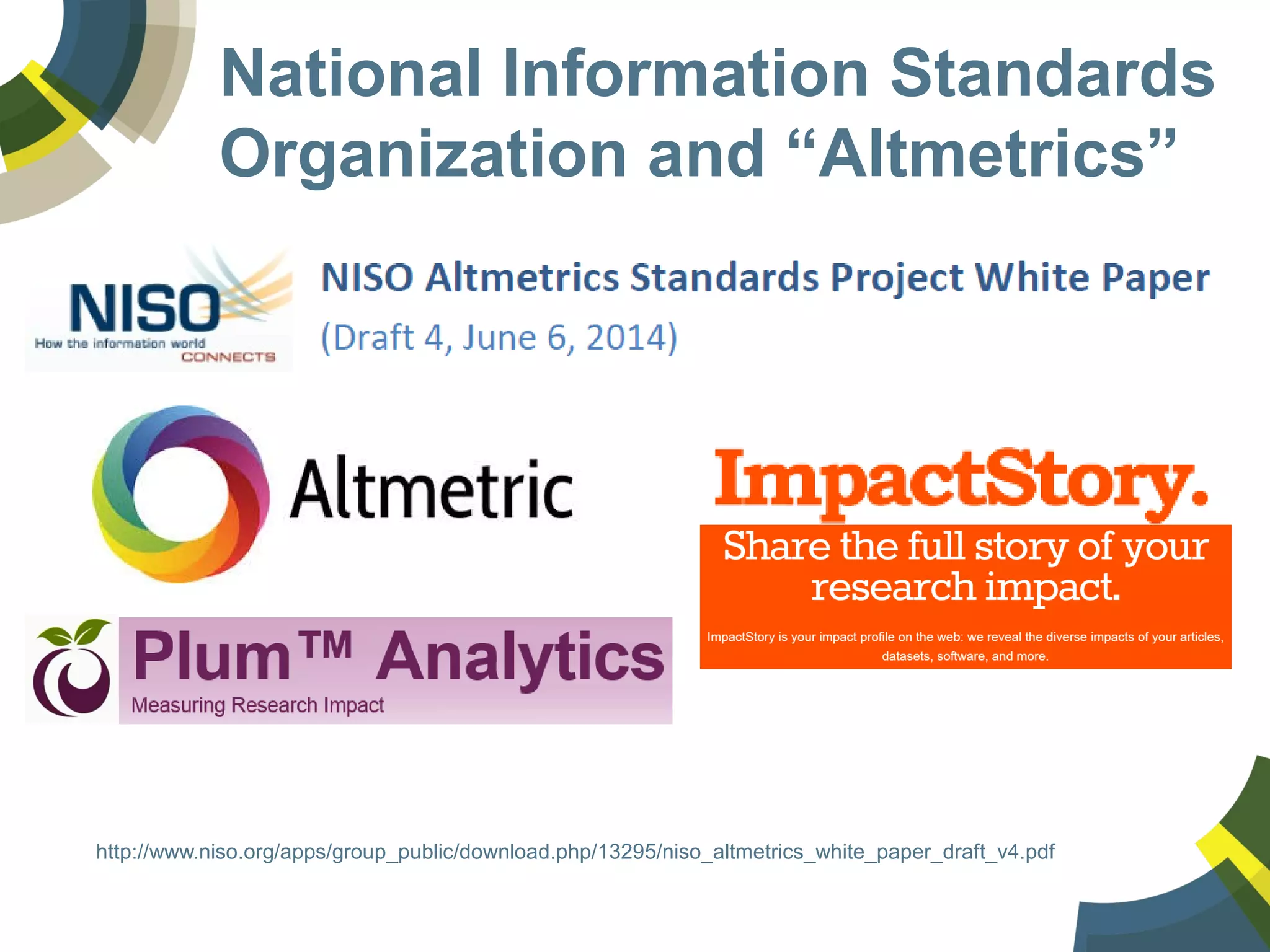
National Information Standards
Organization and “Altmetrics”
http://www.niso.org/apps/group_public/download.php/13295/niso_altmetrics_white_paper_draft_v4.pdf
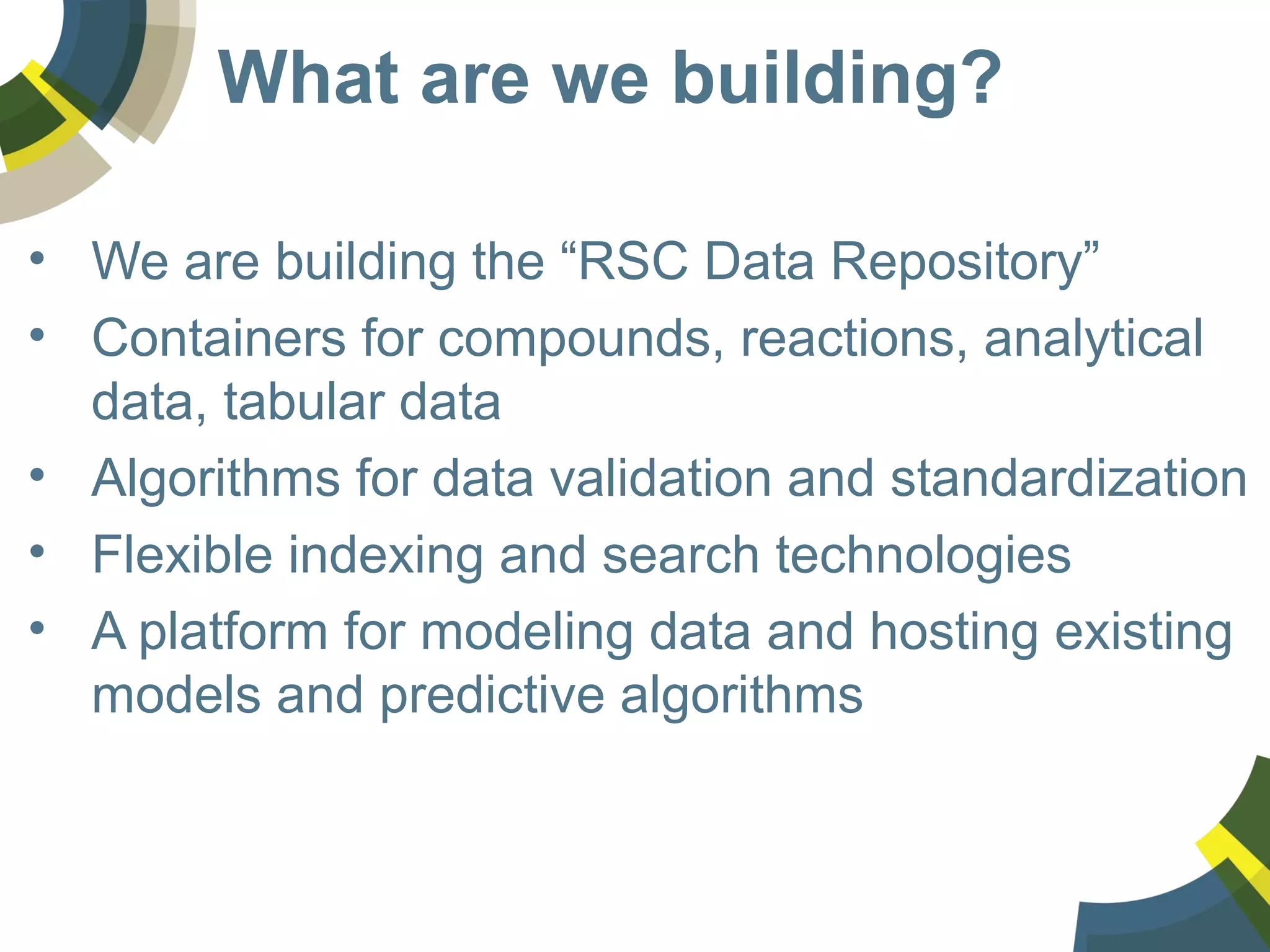
What are we building?
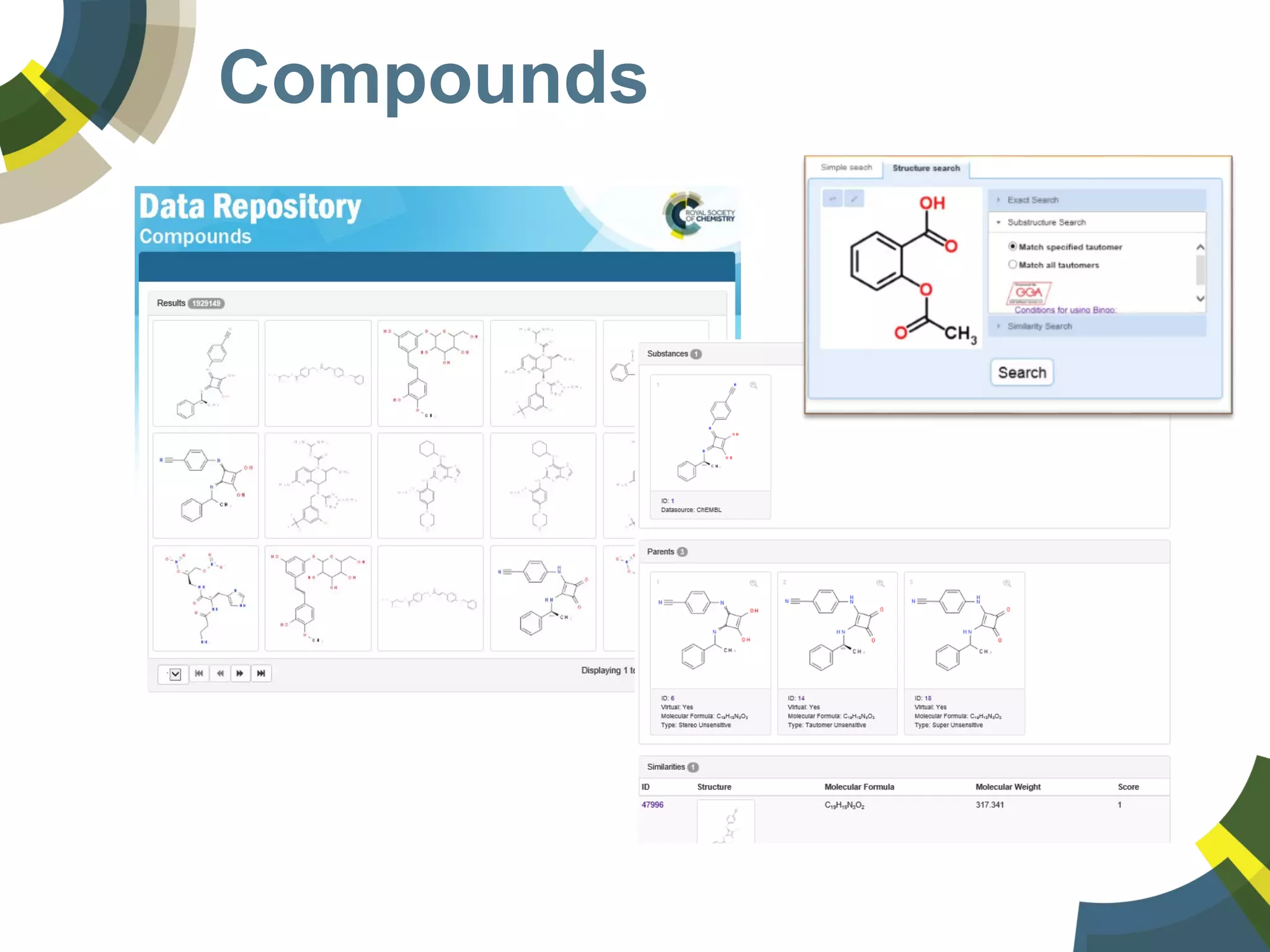
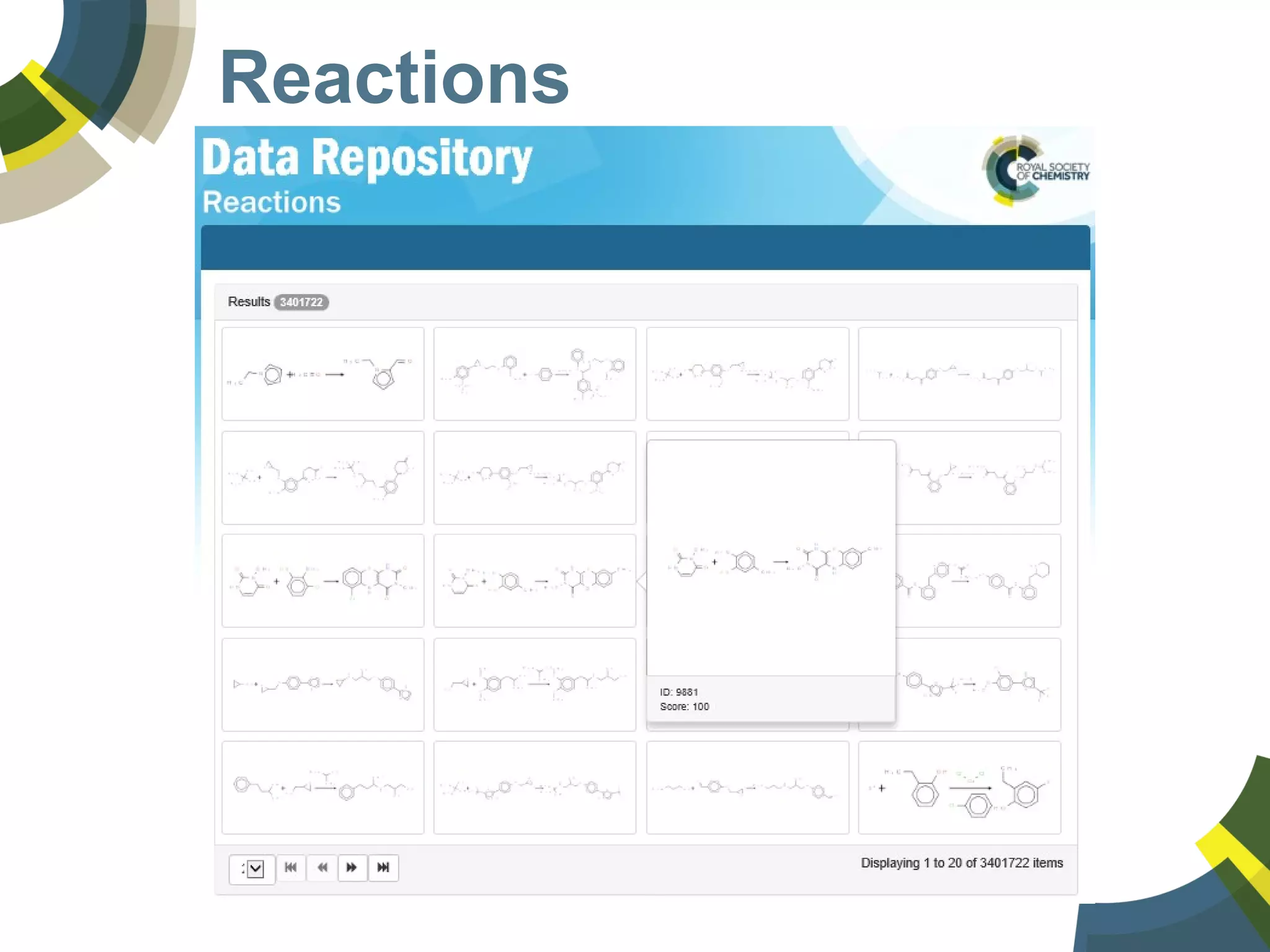
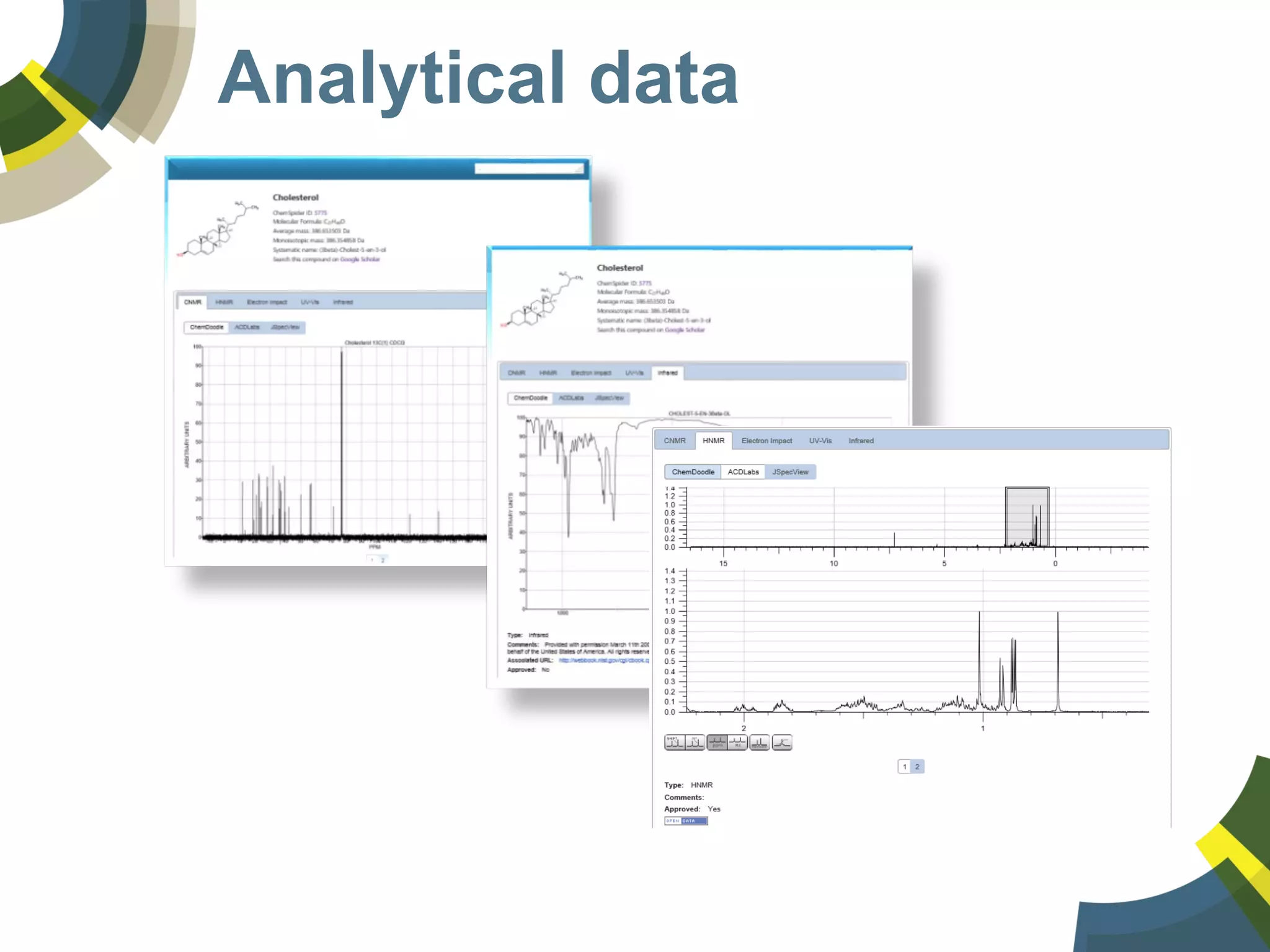
• We are building the “RSC Data Repository”
• Containers for compounds, reactions, analytical
data, tabular data
• Algorithms for data validation and standardization
• Flexible indexing and search technologies
• A platform for modeling data and hosting existing
models and predictive algorithms
Compounds
Reactions
Analytical data
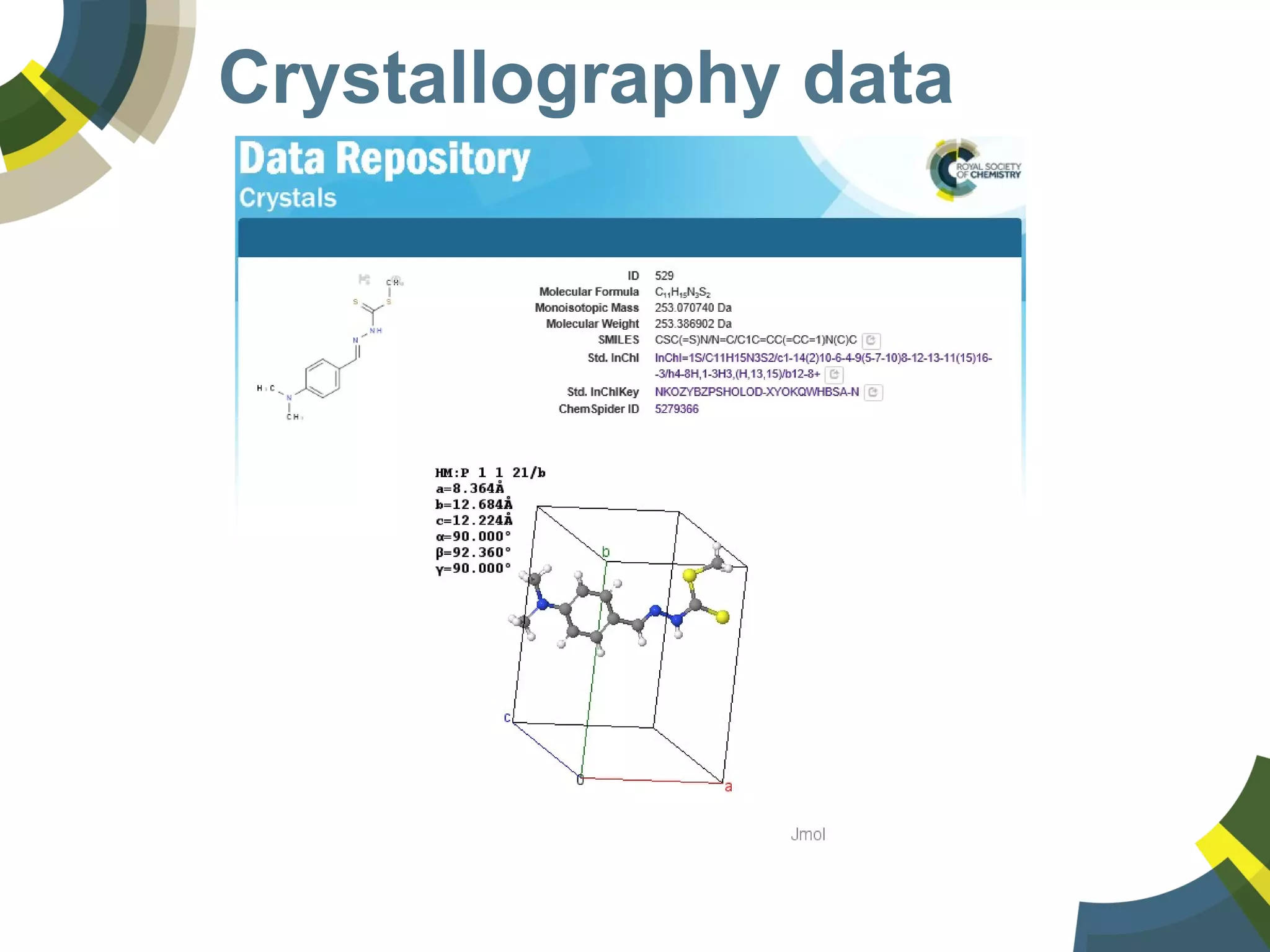
Crystallography data
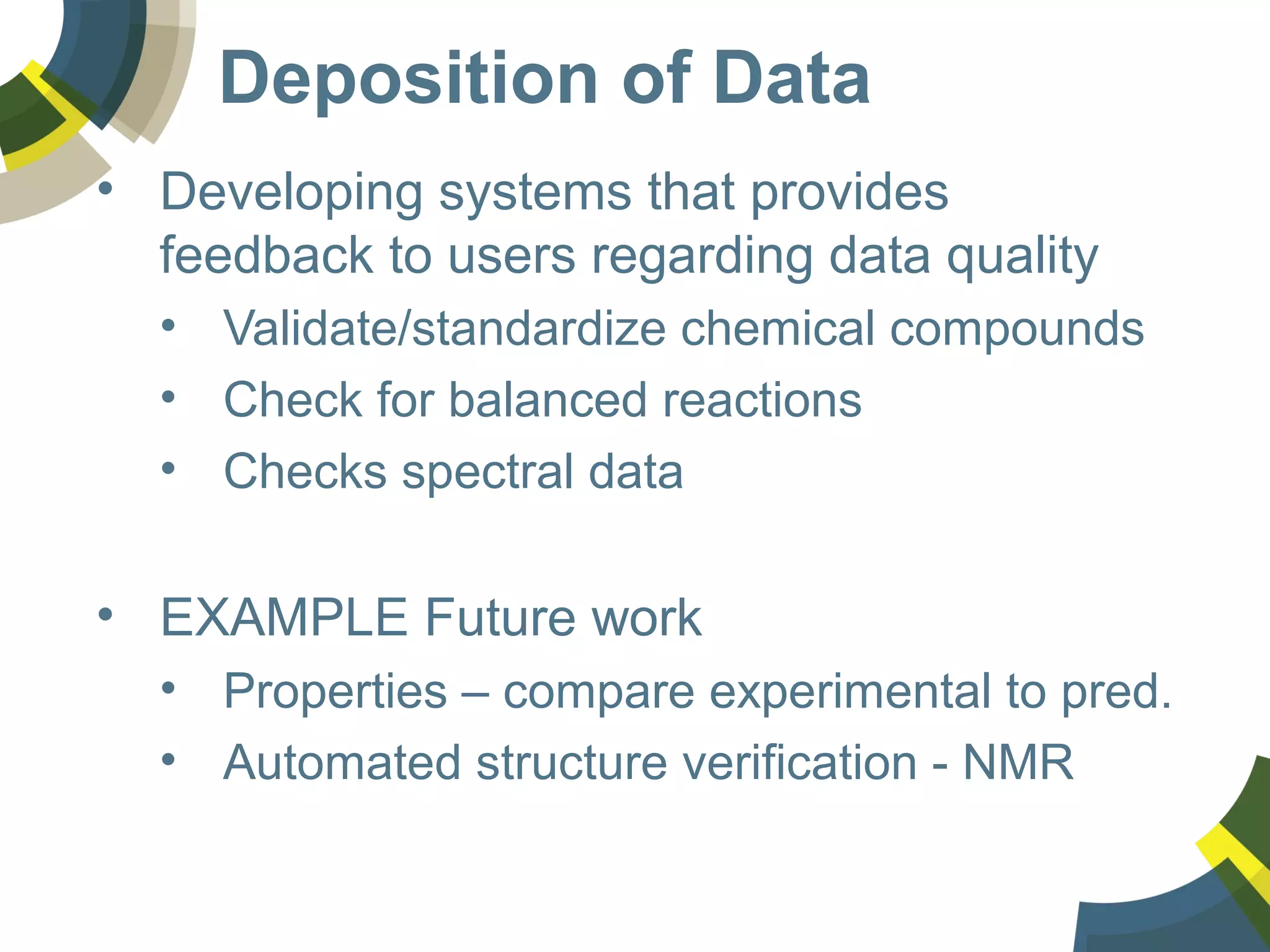
Deposition of Data
• Developing systems that provides
feedback to users regarding data quality
• Validate/standardize chemical compounds
• Check for balanced reactions
• Checks spectral data
• EXAMPLE Future work
• Properties – compare experimental to pred.
• Automated structure verification - NMR
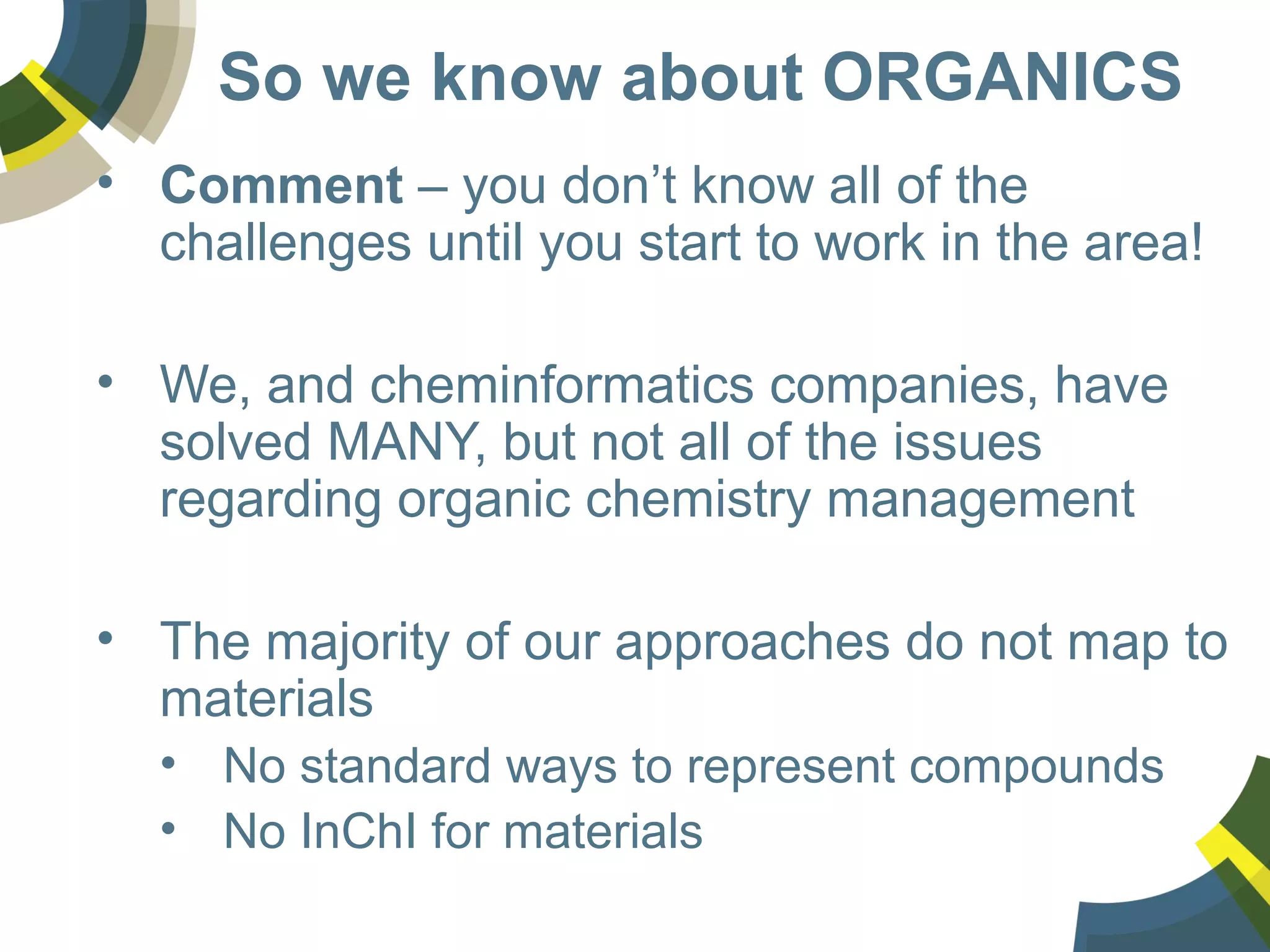
So we know about ORGANICS
• Comment – you don’t know all of the
challenges until you start to work in the area!
• We, and cheminformatics companies, have
solved MANY, but not all of the issues
regarding organic chemistry management
• The majority of our approaches do not map to
materials
• No standard ways to represent compounds
• No InChI for materials
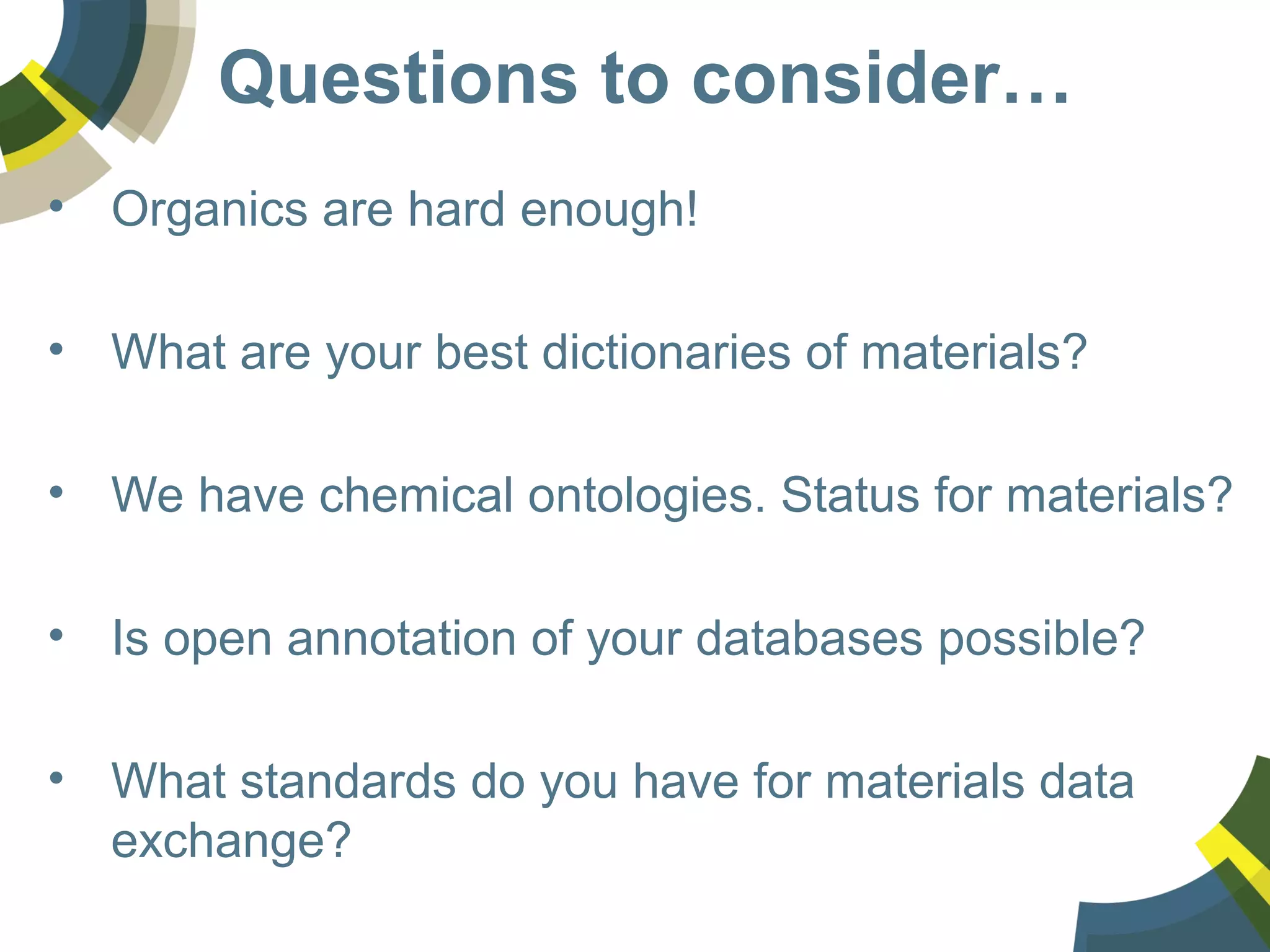
Questions to consider…
• Organics are hard enough!
• What are your best dictionaries of materials?
• We have chemical ontologies. Status for materials?
• Is open annotation of your databases possible?
• What standards do you have for materials data
exchange?
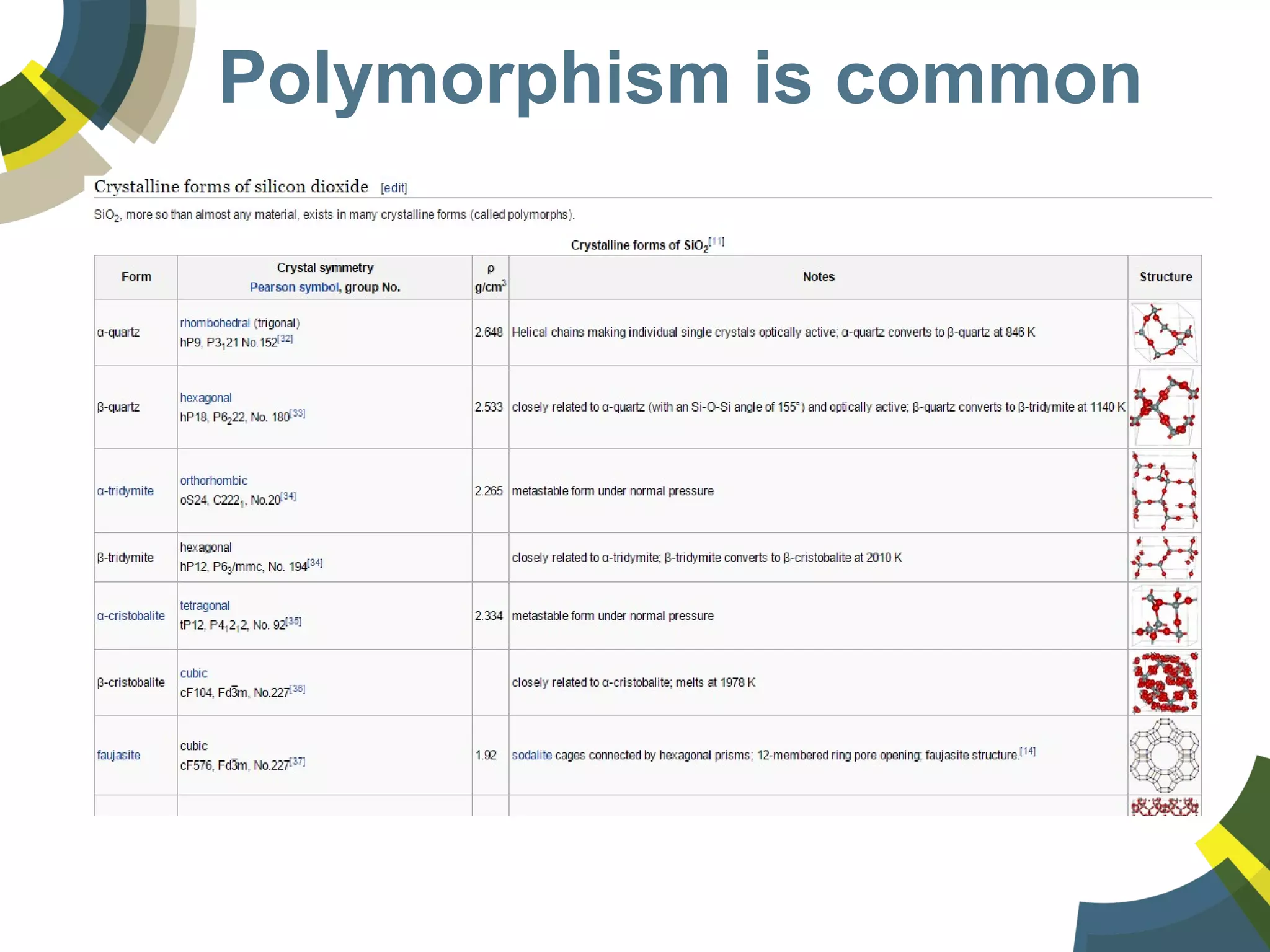
Polymorphism is common
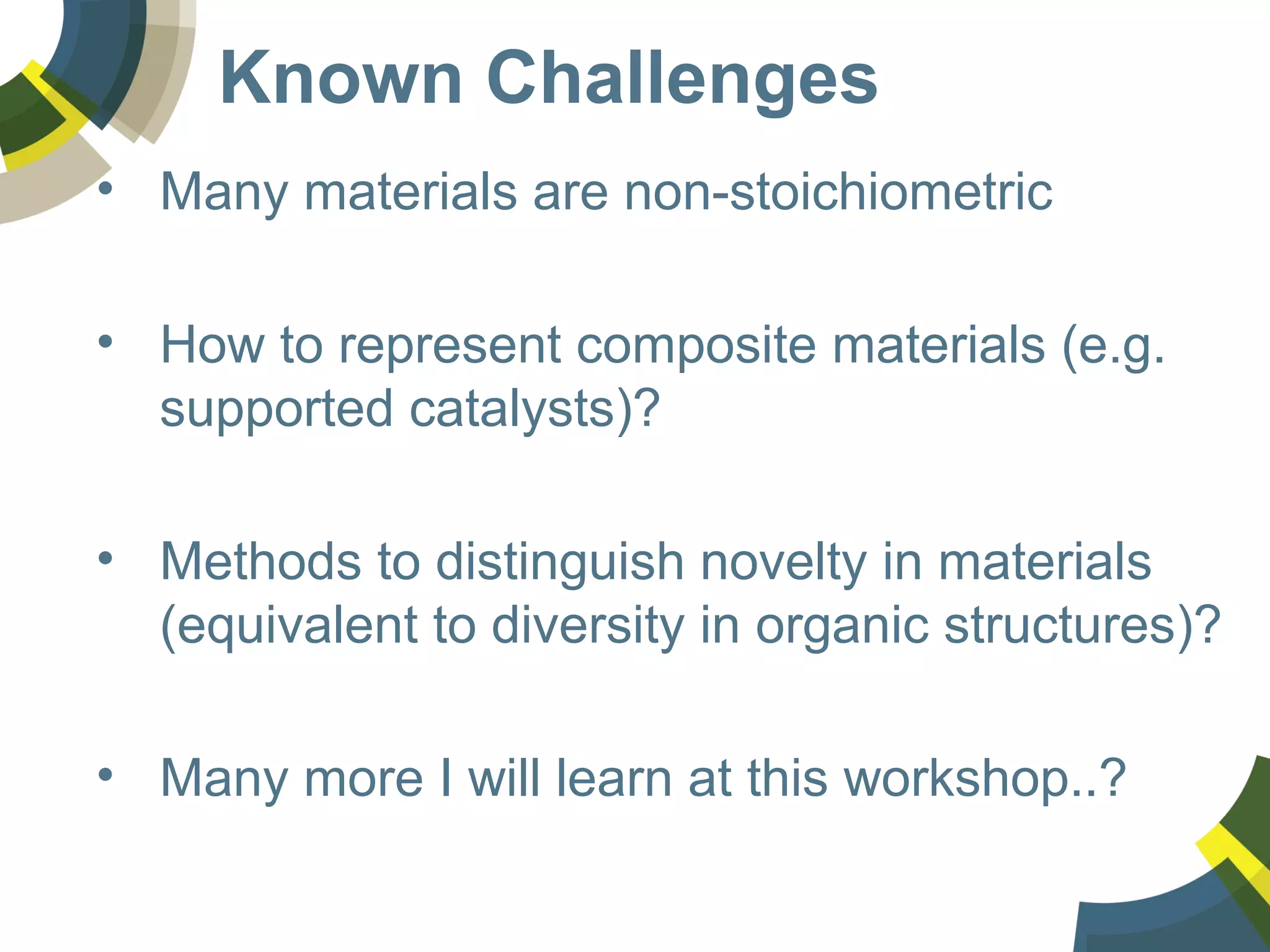
Known Challenges
• Many materials are non-stoichiometric
• How to represent composite materials (e.g.
supported catalysts)?
• Methods to distinguish novelty in materials
(equivalent to diversity in organic structures)?
• Many more I will learn at this workshop..?
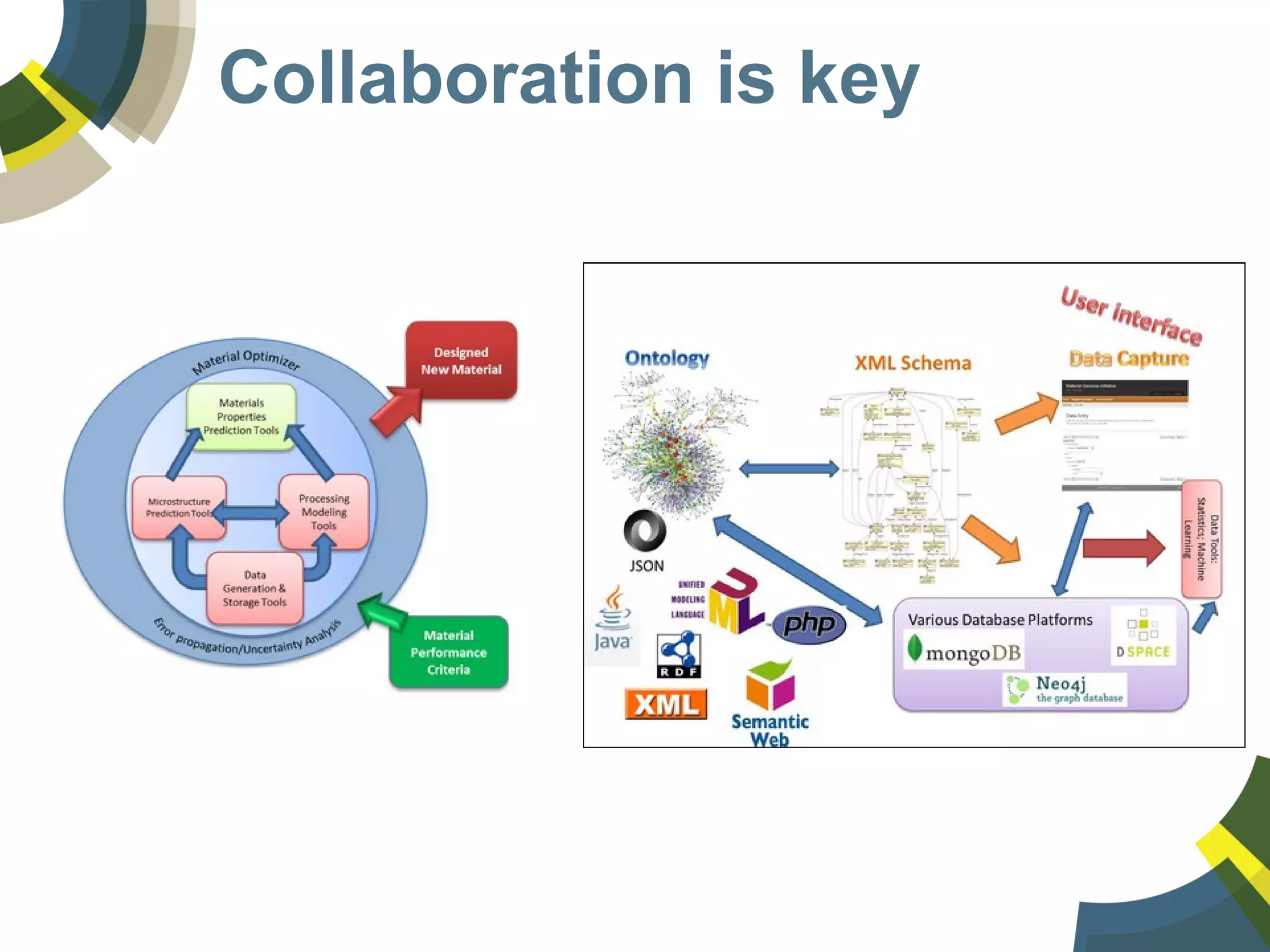
Collaboration is key
Internet Data
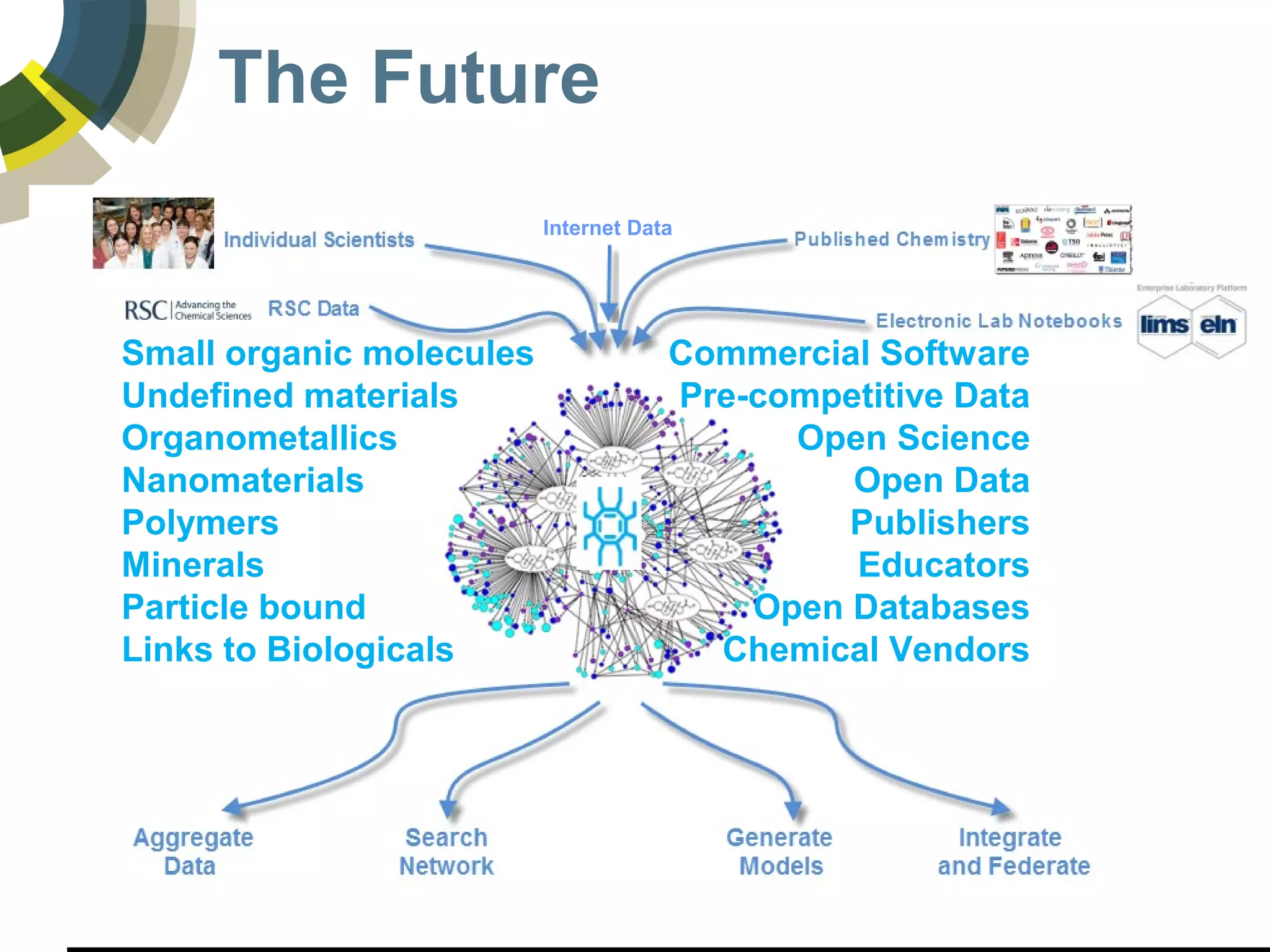
The Future
Commercial Software
Pre-competitive Data
Open Science
Open Data
Publishers
Educators
Open Databases
Chemical Vendors
Small organic molecules
Undefined materials
Organometallics
Nanomaterials
Polymers
Minerals
Particle bound
Links to Biologicals
Thank you
Email: williamsa@rsc.org
ORCID: 0000-0002-2668-4821
Twitter: @ChemConnector
Personal Blog: www.chemconnector.com
SLIDES: www.slideshare.net/AntonyWilliams

Hosting public domain chemicals data online for the community – the challenges of handling materials

  • 1.
    Hosting public domainchemicals data online for the community – the challenges of handling materials Antony Williams Opportunities in Materials Informatics, University of Wisconsin-Madison February 9th , 2015 0000-0002-2668-4821
  • 2.
    About Me… • Iam NOT a materials chemist • I am an NMR spectroscopist by training • Worked on a LIMS while at Kodak • 10 years in commercial cheminformatics • Built the ChemSpider database as a hobby • Worked on validating compounds on Wikipedia • Manage cheminformatics team for RSC • Believer in the value of social networking and Open Data for science • Dane Morgan asked me to tell jokes…
  • 3.
    I would tella chemistry joke… But all of the good ones…
  • 4.
    An ambitious idea…. •Let’s map together all online chemistry data and build systems to integrate it • Heck, let’s integrate chemistry and biology data and add in disease data too if we can • Let’s extract property data and model it and see if we can extract new relationships – quantitative and qualitative • Let’s make it all available on the web…for free
  • 6.
    What about this…. •We’re going to map the world • We’re going to take photos of as many places as we can and link them together • We’ll let people annotate and curate the map • Then let’s make it available free on the web • We’ll make it available for decision making • Put it on Mobile Devices, give it away…
  • 7.
    Where is chemistryonline? • Encyclopedic articles (Wikipedia) • Chemical vendor databases • Metabolic pathway databases • Property databases • Patents with chemical structures • Drug Discovery data • Scientific publications • Compound aggregators • Blogs/Wikis and Open Notebook Science
  • 8.
    Chemistry on theInternet… • Most searching for chemistry on the internet… • Name searching Google/Bing/Yahoo • Name searching Wikipedia • Name searching Wolfram Alpha • Name, name, name, name…searching • Structure searching DOZENS of websites, each with different information or…
  • 9.
    Chemistry on theInternet… • Most searching for chemistry on the internet… • Name searching Google/Bing/Yahoo • Name searching Wikipedia • Name searching Wolfram Alpha • Name, name, name, name…searching • Structure searching DOZENS of websites, each with different information or… • Search ONE website integrating the others!
  • 10.
    • ~30 millionchemicals and growing • Data sourced from >500 different sources • Crowd sourced curation and annotation • Ongoing deposition of data from our journals and our collaborators • Structure centric hub for web-searching • …and a really big dictionary!!! • Note…NOT all websites connected
  • 11.
  • 12.
  • 13.
  • 14.
  • 15.
  • 16.
  • 17.
  • 18.
  • 19.
  • 20.
  • 21.
  • 22.
  • 23.
  • 24.
  • 25.
    Molfiles 10 9 00 1 0 0 0 0 0 1 V2000 31.2937 -9.0366 0.0000 C 0 0 0 0 0 0 0 0 0 0 0 0 26.6526 -9.0366 0.0000 C 0 0 0 0 0 0 0 0 0 0 0 0 31.2937 -7.7066 0.0000 O 0 0 0 0 0 0 0 0 0 0 0 0 30.1161 -9.6877 0.0000 C 0 0 0 0 0 0 0 0 0 0 0 0 25.5096 -9.6877 0.0000 O 0 0 0 0 0 0 0 0 0 0 0 0 28.9731 -9.0366 0.0000 C 0 0 0 0 0 0 0 0 0 0 0 0 27.8163 -9.7016 0.0000 C 0 0 0 0 0 0 0 0 0 0 0 0 26.6664 -7.7066 0.0000 N 0 0 0 0 0 0 0 0 0 0 0 0 32.4367 -9.6877 0.0000 O 0 0 0 0 0 0 0 0 0 0 0 0 30.1161 -11.0177 0.0000 N 0 0 0 0 0 0 0 0 0 0 0 0 3 1 2 0 0 0 0 4 1 1 0 0 0 0 9 1 1 0 0 0 0 7 2 1 0 0 0 0 5 2 2 0 0 0 0 8 2 1 0 0 0 0 6 4 1 0 0 0 0 4 10 1 6 0 0 0 7 6 1 0 0 0 0 M END
  • 26.
    Molfiles • Molfiles arethe primary exchange format between structure drawing packages • Can be different between different drawing packages • Most commonly carry X,Y coordinates for layout • Can support polymers, organometallics, etc. • Can carry 3D coordinates
  • 27.
    SMILES • SMILES isa common format • Can support polymers, organometallics, etc. • Does NOT carry X,Y or Z coordinates for layout so requires layout algorithms – can be problematic! • Generally different between drawing packages
  • 28.
  • 29.
  • 30.
  • 31.
  • 32.
  • 33.
    InChI • SINGLE codebase managed by IUPAC – integrated into drawing packages. No variability as with SMILES • InChI Strings can be reversed to structures – same problem as with SMILES – no layout • Adopted by the community (databases, blogs, Wikipedia) – good for searching the internet
  • 34.
  • 35.
  • 36.
  • 37.
  • 38.
  • 39.
  • 40.
  • 41.
    Data Quality/Standardization • MANYstructures meant to be something online are MISREPRESENTED. • Commonly you will have better success finding information by name searches than structure – with many caveats of course… • Validating chemical structure representations is laborious work – and it’s shocking to review data…
  • 42.
    Data Quality Issues Williamsand Ekins, DDT, 16: 747-750 (2011) Science Translational Medicine 2011
  • 43.
    Data quality isa known issue
  • 44.
    Data quality isa known issue
  • 45.
    Substructure # of Hits #of Correct Hits No stereochemistry Incomplete Stereochemistry Complete but incorrect stereochemistry Gonane 34 5 8 21 0 Gon-4-ene 55 12 3 33 7 Gon-1,4-diene 60 17 10 23 10 Only 34 out of 149 structures were correct!
  • 46.
    Patent data inpublic databases
  • 47.
    Patent data inpublic databases
  • 48.
    You just can’ttrust atoms!
  • 49.
    You just can’ttrust atoms! They make up everything…
  • 50.
    ALL variants ofYohimbine!!!
  • 51.
  • 52.
    What ELSE isMethane???
  • 53.
  • 54.
  • 55.
  • 56.
    What is theStructure of Vitamin K1?
  • 57.
    Standardize • Use theSRS as a guidance document for standardization • Adjust as necessary to our needs
  • 58.
  • 59.
  • 60.
  • 61.
    Can we MAKEQuality Data? • We are building systems for everyone to validate and standardize their data
  • 62.
    DICTIONARIES are powerful •Search all forms of structure IDs • Systematic name(s) • Trivial Name(s) • SMILES • InChI Strings • InChIKeys • Database IDs • Registry Number
  • 63.
    Many Names, OneStructure
  • 64.
    But big andoften noisy
  • 65.
  • 66.
  • 67.
    With links outto platforms
  • 68.
  • 69.
    Text Mining onIUPAC Names The N-(β-hydroxyethyl)-N-methyl-N'-(2-trifluoromethyl-1,3,4- thiadiazol-5-yl)urea prepared in Example 6 , thionyl chloride ( 5 ml ) and benzene ( 50 ml ) were charged into a glass reaction vessel equipped with a mechanical stirrer , thermometer and reflux condenser . The reaction mixture was heated at reflux with stirring , for a period of about one-half hour . After this time the benzene and unreacted thionyl chloride were stripped from the reaction mixture under reduced pressure to yield the desired product N-(β-chloroethyl)-N- methyl-N'-(2-trifluoromethyl-1,3,4-thiaidazol-5-yl)urea as a solid residue
  • 70.
    Text Mining onIUPAC Names The N-(β-hydroxyethyl)-N-methyl-N'-(2-trifluoromethyl-1,3,4- thiadiazol-5-yl)urea prepared in Example 6 , thionyl chloride ( 5 ml ) and benzene ( 50 ml ) were charged into a glass reaction vessel equipped with a mechanical stirrer , thermometer and reflux condenser . The reaction mixture was heated at reflux with stirring , for a period of about one-half hour . After this time the benzene and unreacted thionyl chloride were stripped from the reaction mixture under reduced pressure to yield the desired product N-(β-chloroethyl)-N- methyl-N'-(2-trifluoromethyl-1,3,4-thiaidazol-5-yl)urea as a solid residue
  • 71.
  • 72.
  • 73.
    ChemSpider “Annotations” • Userscan add • Descriptions, Syntheses and Commentaries • Links to PubMed articles • Links to articles via DOIs • Add spectral data • Add Crystallographic Information Files • Add photos • Add MP3 files • Add Videos
  • 74.
    Spectral Data • Spectraldata to be deposited in standard formats – JCAMP or images • All spectra available at: http://www.chemspider.com/spectra.aspx • Data are deposited on a regular basis • Students • Chemical vendors • Growing collection now
  • 75.
  • 76.
  • 77.
  • 78.
  • 79.
    It’s exactly theWRONG WAY! • We should NOT be mining data out of future publications • Structures should be submitted “correctly” • Spectra should be digital spectral formats, not images • ESI should be RICH and interactive, preferably with OPEN DATA
  • 80.
    An Adventure intothe World of Small but significant contribution..
  • 81.
  • 82.
    Micropublishing with PeerReview (a chemical synthesis blog?)
  • 83.
  • 84.
  • 85.
    Chemistry data isof value? • Reference databases generate hundreds of millions of dollars/euros per year • So much data generated that could go public • Maybe 5% of all data generated is published • There is no “Journal of Failed Experiments” • Funding agencies start to demand Open Data • Scientists want funding but also recognition
  • 86.
    A shift toOpenness
  • 87.
    How will Iget recognized? • Who in the room has an ORCID?
  • 88.
    Deposition of ResearchData • If we manage compounds, syntheses and analytical data… • If we have security and provenance of data… • If we deliver user interfaces to satisfy the various use cases… • Then we have delivered electronic lab notebooks for chemistry laboratories. ELNs are research data repositories
  • 89.
  • 90.
  • 91.
    National Information Standards Organizationand “Altmetrics” http://www.niso.org/apps/group_public/download.php/13295/niso_altmetrics_white_paper_draft_v4.pdf
  • 92.
    What are webuilding? • We are building the “RSC Data Repository” • Containers for compounds, reactions, analytical data, tabular data • Algorithms for data validation and standardization • Flexible indexing and search technologies • A platform for modeling data and hosting existing models and predictive algorithms
  • 93.
  • 94.
  • 95.
  • 96.
  • 97.
    Deposition of Data •Developing systems that provides feedback to users regarding data quality • Validate/standardize chemical compounds • Check for balanced reactions • Checks spectral data • EXAMPLE Future work • Properties – compare experimental to pred. • Automated structure verification - NMR
  • 98.
    So we knowabout ORGANICS • Comment – you don’t know all of the challenges until you start to work in the area! • We, and cheminformatics companies, have solved MANY, but not all of the issues regarding organic chemistry management • The majority of our approaches do not map to materials • No standard ways to represent compounds • No InChI for materials
  • 99.
    Questions to consider… •Organics are hard enough! • What are your best dictionaries of materials? • We have chemical ontologies. Status for materials? • Is open annotation of your databases possible? • What standards do you have for materials data exchange?
  • 100.
  • 101.
    Known Challenges • Manymaterials are non-stoichiometric • How to represent composite materials (e.g. supported catalysts)? • Methods to distinguish novelty in materials (equivalent to diversity in organic structures)? • Many more I will learn at this workshop..?
  • 102.
  • 103.
    Internet Data The Future CommercialSoftware Pre-competitive Data Open Science Open Data Publishers Educators Open Databases Chemical Vendors Small organic molecules Undefined materials Organometallics Nanomaterials Polymers Minerals Particle bound Links to Biologicals
  • 104.
    Thank you Email: williamsa@rsc.org ORCID:0000-0002-2668-4821 Twitter: @ChemConnector Personal Blog: www.chemconnector.com SLIDES: www.slideshare.net/AntonyWilliams