Outstanding Early Years TeachingJames Nottingham  		james@jnpartnership.comwww.osiriseducational.co.uk
Outstanding Early Years What is “outstanding” EY practice?
 How can we scaffold and stretch children’s learning?
 What type of praise underpins outstanding EY practice?
 What role does reviewing play?222
Focus on learning, not grades“Pupils show greater motivation, are better behaved and are more likely to be independent and strategic thinkers when teachers are not obsessed by grades.”“If there is one new thing we need in our school system right now, it is a well-developed focus on learning.”Chris Watkins, Institute of Education, Aug 2010From an analysis of 100 international studies on how children learn
A new government, a new curriculum?“The best schools & nurseries design learning for their pupils and then cross check against the national expectations to see they have done right by the pupils in terms of the agreedentitlement for all the nation’s children. The attainment targets give a touchstone for the expected standards and that’s it.”Many schools believe the myths that have been peddled about the national curriculum and some current ministers seem to believe them too. The truth is nothing can be changed by statute until 2012. Even then, it will only be the national expectations. It doesn’t really matter what comes from government; how it is packaged, what it contains. In the end, the curriculum is the one that children in schools and nurseries meet day in, day out.
Tickell Review Recommendations
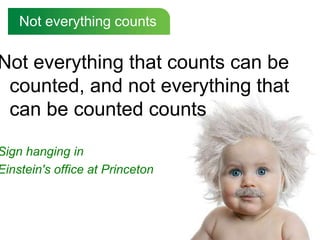
Not everything countsNot everything that counts can be counted, and not everything that can be counted countsSign hanging inEinstein's office at Princeton
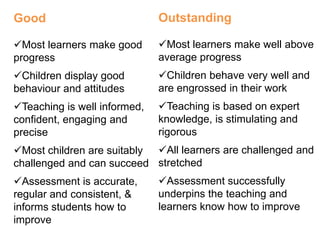
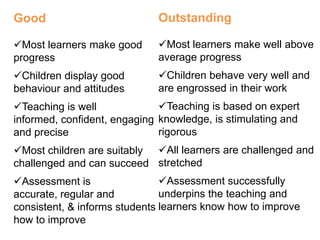
OutstandingMost learners make well above average progress
Children behave very well and are engrossed in their work
Teaching is based on expert knowledge, is stimulating and rigorous
All learners are challenged and stretched
Assessment successfully underpins the teaching and learners know how to improveGoodMost learners make good progress
Children display good behaviour and attitudes
Teaching is well informed, confident, engaging and precise
Most children are suitably challenged and can succeed
Assessment is accurate, regular and consistent, & informs students how to improveWhat do these 3 have in common?
ChallengeWe need more stories and less facts, for narrative develops an understanding of sequence; we need more dialogue and less transmission of knowledge, for it is through dialogue that we learn most; and we need more challenge and less instruction, since it is from challenge that one grows in body, mind and spirit.  Matthew Lipman, 1991
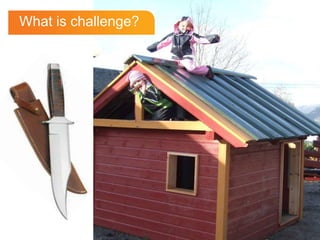
What is challenge?
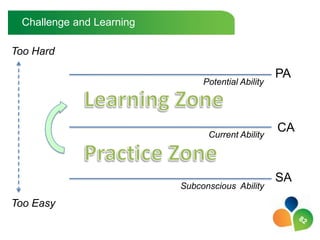
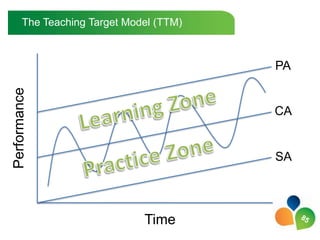
Challenge and LearningToo HardPAPotential AbilityLearning ZoneCACurrent AbilityPractice ZoneSASubconscious  AbilityToo Easy82
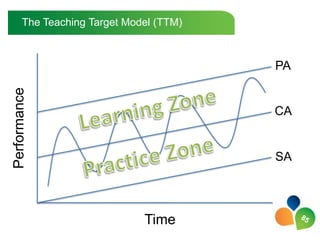
The Teaching Target Model (TTM)PALearning ZoneCAPerformancePractice ZoneSATime85
A continuously improving setting will have well-qualified and experienced staff who:“... are committed to the development of sustained shared thinking by offering encouragement, clarifying ideas and asking open questions which support and extend children’s thinking and help them make connections in learning – while ensuring a balance between adult-led and child initiated activities”	(EYFS 1.27)
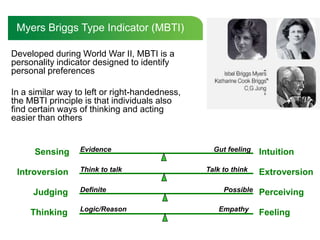
Myers Briggs Type Indicator (MBTI)Developed during World War II, MBTI is a personality indicator designed to identify personal preferencesIn a similar way to left or right-handedness, the MBTI principle is that individuals also find certain ways of thinking and acting easier than othersEvidenceGut feelingSensingIntuitionThink to talkTalk to thinkIntroversionExtroversionDefinitePossibleJudgingPerceivingLogic/ReasonEmpathyThinkingFeeling
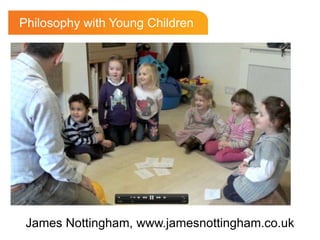
Philosophy with Young ChildrenJames Nottingham, www.jamesnottingham.co.uk
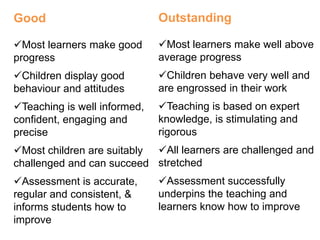
OutstandingMost learners make well above average progress
Children behave very well and are engrossed in their work
Teaching is based on expert knowledge, is stimulating and rigorous
All learners are challenged and stretched
Assessment successfully underpins the teaching and learners know how to improveGoodMost learners make good progress
Children display good behaviour and attitudes
Teaching is well informed, confident, engaging and precise
Most children are suitably challenged and can succeed
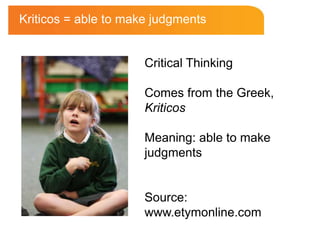
Assessment is accurate, regular and consistent, & informs students how to improveKriticos = able to make judgmentsCritical ThinkingComes from the Greek, KriticosMeaning: able to make judgmentsSource: www.etymonline.com
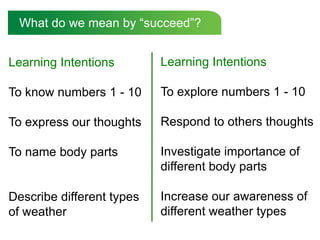
What do we mean by “succeed”?Learning IntentionsTo explore numbers 1 - 10Respond to others thoughtsInvestigate importance of different body partsIncrease our awareness of different weather typesLearning IntentionsTo know numbers 1 - 10To express our thoughtsTo name body partsDescribe different types of weather
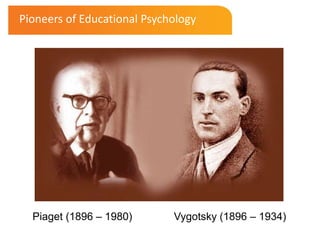
Pioneers of Educational PsychologyPiaget (1896 – 1980)Vygotsky (1896 – 1934)
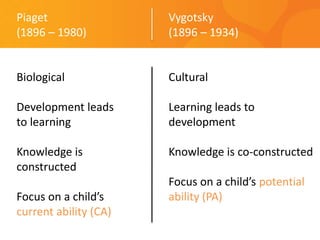
Piaget (1896 – 1980)BiologicalDevelopment leads to learningKnowledge is constructedFocus on a child’s current ability (CA)Vygotsky(1896 – 1934)CulturalLearning leads to development Knowledge is co-constructedFocus on a child’s potential ability (PA)
The Teaching Target Model (TTM)PALearning ZoneCAPerformancePractice ZoneSATime85
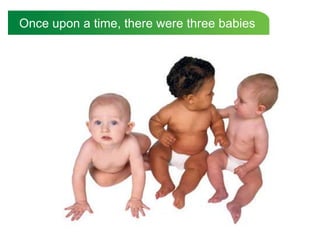
Once upon a time, there were three babies
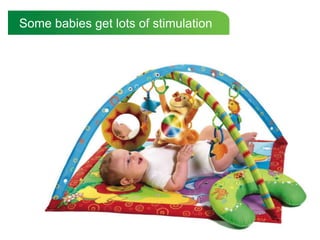
Some babies get lots of stimulation
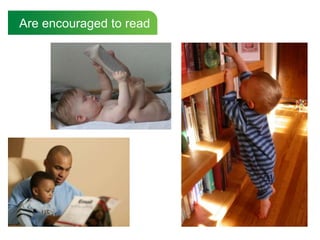
Are encouraged to read
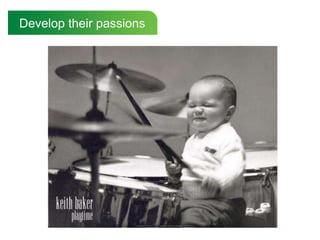
Develop their passions
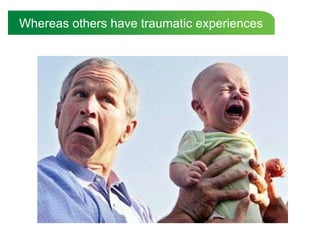
Whereas others have traumatic experiences
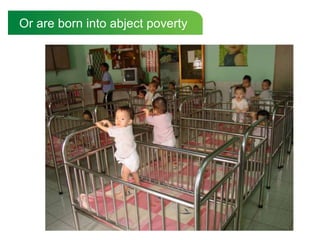
Or are born into abject poverty
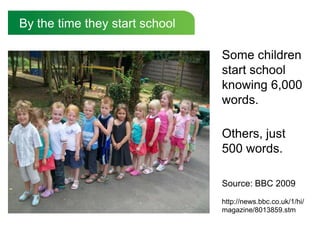
By the time they start schoolSome children start school knowing 6,000 words.Others, just 500 words.Source: BBC 2009http://news.bbc.co.uk/1/hi/magazine/8013859.stm
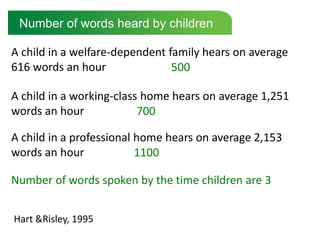
Number of words heard by childrenA child in a welfare-dependent family hears on average 616 words an hour500A child in a working-class home hears on average 1,251 words an hour700A child in a professional home hears on average 2,153 words an hour1100Number of words spoken by the time children are 3Hart & Risley, 1995
Carol Dweckwww.carol-dweck.co.uk
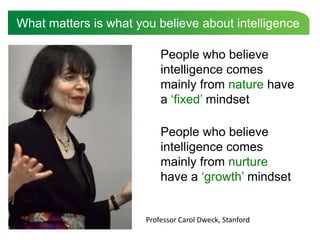
What matters is what you believe about intelligencePeople who believe intelligence comes mainly from nature have a ‘fixed’ mindsetPeople who believe intelligence comes mainly from nurture have a ‘growth’ mindsetProfessor Carol Dweck, Stanford
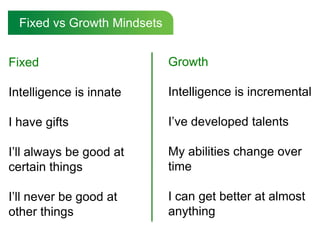
Fixed vs Growth MindsetsGrowthIntelligence is incrementalI’ve developed talentsMy abilities change over timeI can get better at almost anythingFixedIntelligence is innateI have giftsI’ll always be good at certain thingsI’ll never be good at other things
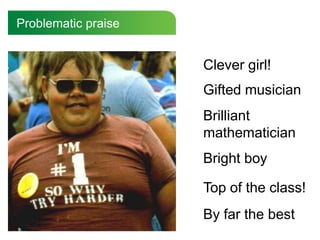
Problematic praiseClever girl!Gifted musicianBrilliant mathematicianBright boyTop of the class!By far the best

Outstanding Early Years

  • 1.
    Outstanding Early YearsTeachingJames Nottingham james@jnpartnership.comwww.osiriseducational.co.uk
  • 2.
    Outstanding Early YearsWhat is “outstanding” EY practice?
  • 3.
    How canwe scaffold and stretch children’s learning?
  • 4.
    What typeof praise underpins outstanding EY practice?
  • 5.
    What roledoes reviewing play?222
  • 6.
    Focus on learning,not grades“Pupils show greater motivation, are better behaved and are more likely to be independent and strategic thinkers when teachers are not obsessed by grades.”“If there is one new thing we need in our school system right now, it is a well-developed focus on learning.”Chris Watkins, Institute of Education, Aug 2010From an analysis of 100 international studies on how children learn
  • 7.
    A new government,a new curriculum?“The best schools & nurseries design learning for their pupils and then cross check against the national expectations to see they have done right by the pupils in terms of the agreedentitlement for all the nation’s children. The attainment targets give a touchstone for the expected standards and that’s it.”Many schools believe the myths that have been peddled about the national curriculum and some current ministers seem to believe them too. The truth is nothing can be changed by statute until 2012. Even then, it will only be the national expectations. It doesn’t really matter what comes from government; how it is packaged, what it contains. In the end, the curriculum is the one that children in schools and nurseries meet day in, day out.
  • 8.
  • 9.
    Not everything countsNoteverything that counts can be counted, and not everything that can be counted countsSign hanging inEinstein's office at Princeton
  • 10.
    OutstandingMost learners makewell above average progress
  • 11.
    Children behave verywell and are engrossed in their work
  • 12.
    Teaching is basedon expert knowledge, is stimulating and rigorous
  • 13.
    All learners arechallenged and stretched
  • 14.
    Assessment successfully underpinsthe teaching and learners know how to improveGoodMost learners make good progress
  • 15.
    Children display goodbehaviour and attitudes
  • 16.
    Teaching is wellinformed, confident, engaging and precise
  • 17.
    Most children aresuitably challenged and can succeed
  • 18.
    Assessment is accurate,regular and consistent, & informs students how to improveWhat do these 3 have in common?
  • 19.
    ChallengeWe need morestories and less facts, for narrative develops an understanding of sequence; we need more dialogue and less transmission of knowledge, for it is through dialogue that we learn most; and we need more challenge and less instruction, since it is from challenge that one grows in body, mind and spirit. Matthew Lipman, 1991
  • 21.
  • 22.
    Challenge and LearningTooHardPAPotential AbilityLearning ZoneCACurrent AbilityPractice ZoneSASubconscious AbilityToo Easy82
  • 23.
    The Teaching TargetModel (TTM)PALearning ZoneCAPerformancePractice ZoneSATime85
  • 24.
    A continuously improvingsetting will have well-qualified and experienced staff who:“... are committed to the development of sustained shared thinking by offering encouragement, clarifying ideas and asking open questions which support and extend children’s thinking and help them make connections in learning – while ensuring a balance between adult-led and child initiated activities” (EYFS 1.27)
  • 25.
    Myers Briggs TypeIndicator (MBTI)Developed during World War II, MBTI is a personality indicator designed to identify personal preferencesIn a similar way to left or right-handedness, the MBTI principle is that individuals also find certain ways of thinking and acting easier than othersEvidenceGut feelingSensingIntuitionThink to talkTalk to thinkIntroversionExtroversionDefinitePossibleJudgingPerceivingLogic/ReasonEmpathyThinkingFeeling
  • 26.
    Philosophy with YoungChildrenJames Nottingham, www.jamesnottingham.co.uk
  • 27.
    OutstandingMost learners makewell above average progress
  • 28.
    Children behave verywell and are engrossed in their work
  • 29.
    Teaching is basedon expert knowledge, is stimulating and rigorous
  • 30.
    All learners arechallenged and stretched
  • 31.
    Assessment successfully underpinsthe teaching and learners know how to improveGoodMost learners make good progress
  • 32.
    Children display goodbehaviour and attitudes
  • 33.
    Teaching is wellinformed, confident, engaging and precise
  • 34.
    Most children aresuitably challenged and can succeed
  • 35.
    Assessment is accurate,regular and consistent, & informs students how to improveKriticos = able to make judgmentsCritical ThinkingComes from the Greek, KriticosMeaning: able to make judgmentsSource: www.etymonline.com
  • 36.
    What do wemean by “succeed”?Learning IntentionsTo explore numbers 1 - 10Respond to others thoughtsInvestigate importance of different body partsIncrease our awareness of different weather typesLearning IntentionsTo know numbers 1 - 10To express our thoughtsTo name body partsDescribe different types of weather
  • 37.
    Pioneers of EducationalPsychologyPiaget (1896 – 1980)Vygotsky (1896 – 1934)
  • 38.
    Piaget (1896 –1980)BiologicalDevelopment leads to learningKnowledge is constructedFocus on a child’s current ability (CA)Vygotsky(1896 – 1934)CulturalLearning leads to development Knowledge is co-constructedFocus on a child’s potential ability (PA)
  • 39.
    The Teaching TargetModel (TTM)PALearning ZoneCAPerformancePractice ZoneSATime85
  • 40.
    Once upon atime, there were three babies
  • 41.
    Some babies getlots of stimulation
  • 42.
  • 43.
  • 44.
    Whereas others havetraumatic experiences
  • 45.
    Or are borninto abject poverty
  • 46.
    By the timethey start schoolSome children start school knowing 6,000 words.Others, just 500 words.Source: BBC 2009http://news.bbc.co.uk/1/hi/magazine/8013859.stm
  • 47.
    Number of wordsheard by childrenA child in a welfare-dependent family hears on average 616 words an hour500A child in a working-class home hears on average 1,251 words an hour700A child in a professional home hears on average 2,153 words an hour1100Number of words spoken by the time children are 3Hart & Risley, 1995
  • 48.
  • 49.
    What matters iswhat you believe about intelligencePeople who believe intelligence comes mainly from nature have a ‘fixed’ mindsetPeople who believe intelligence comes mainly from nurture have a ‘growth’ mindsetProfessor Carol Dweck, Stanford
  • 50.
    Fixed vs GrowthMindsetsGrowthIntelligence is incrementalI’ve developed talentsMy abilities change over timeI can get better at almost anythingFixedIntelligence is innateI have giftsI’ll always be good at certain thingsI’ll never be good at other things
  • 51.
    Problematic praiseClever girl!GiftedmusicianBrilliant mathematicianBright boyTop of the class!By far the best
  • 52.
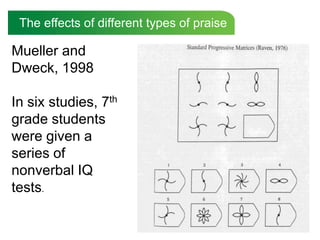
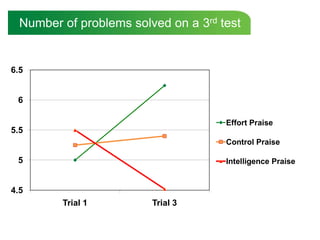
    The effects ofdifferent types of praise Mueller and Dweck, 1998In six studies, 7th grade students were given a series of nonverbal IQ tests.
  • 53.
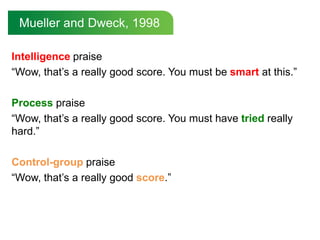
    Mueller and Dweck,1998Intelligence praise“Wow, that’s a really good score. You must be smart at this.” Process praise“Wow, that’s a really good score. You must have tried really hard.”Control-group praise“Wow, that’s a really good score.”
  • 54.
    Number of problemssolved on a 3rd test
  • 55.
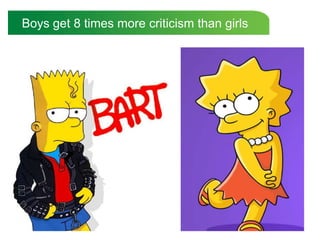
    Boys get 8times more criticism than girls
  • 56.
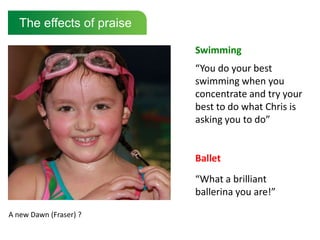
    The effects ofpraiseSwimming“You do your best swimming when you concentrate and try your best to do what Chris is asking you to do”Ballet“What a brilliant ballerina you are!”A new Dawn (Fraser) ?
  • 57.
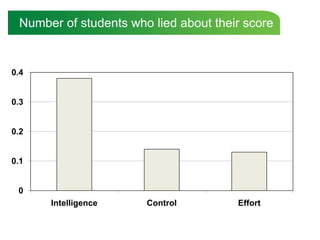
    Number of studentswho lied about their score
  • 58.
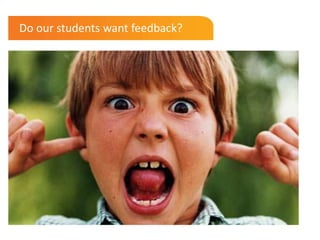
    Do our studentswant feedback?
  • 59.
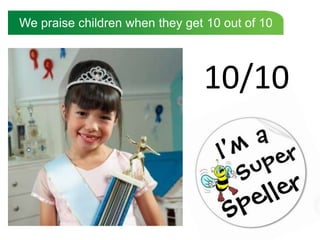
    We praise childrenwhen they get 10 out of 1010/10
  • 61.
  • 62.
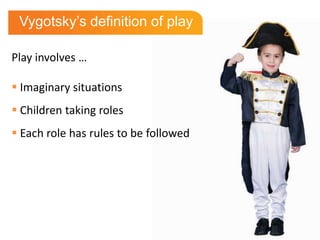
    Vygotsky’s definition ofplayPlay involves … Imaginary situations
  • 63.
  • 64.
    Each rolehas rules to be followed21
  • 65.
  • 67.
    OutstandingMost learners makewell above average progress
  • 68.
    Children behave verywell and are engrossed in their work
  • 69.
    Teaching is basedon expert knowledge, is stimulating and rigorous
  • 70.
    All learners arechallenged and stretched
  • 71.
    Assessment successfully underpinsthe teaching and learners know how to improveGoodMost learners make good progress
  • 72.
    Children display goodbehaviour and attitudes
  • 73.
    Teaching is wellinformed, confident, engaging and precise
  • 74.
    Most children aresuitably challenged and can succeed
  • 75.
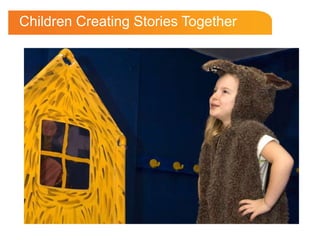
    Assessment is accurate,regular and consistent, & informs students how to improveChildren Creating Stories Together
  • 76.
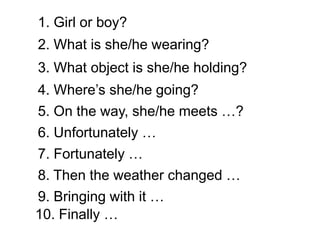
    1. Girl orboy?2. What is she/he wearing?3. What object is she/he holding?4. Where’s she/he going?5. On the way, she/he meets …?6. Unfortunately …7. Fortunately …8. Then the weather changed …9. Bringing with it …10. Finally …
  • 77.