Statutory Framework for the Early Years Foundation Stage
What this means for your child What the EYFS is and why it was introduced Please stop me at any point to ask a question How we monitor your child's progress
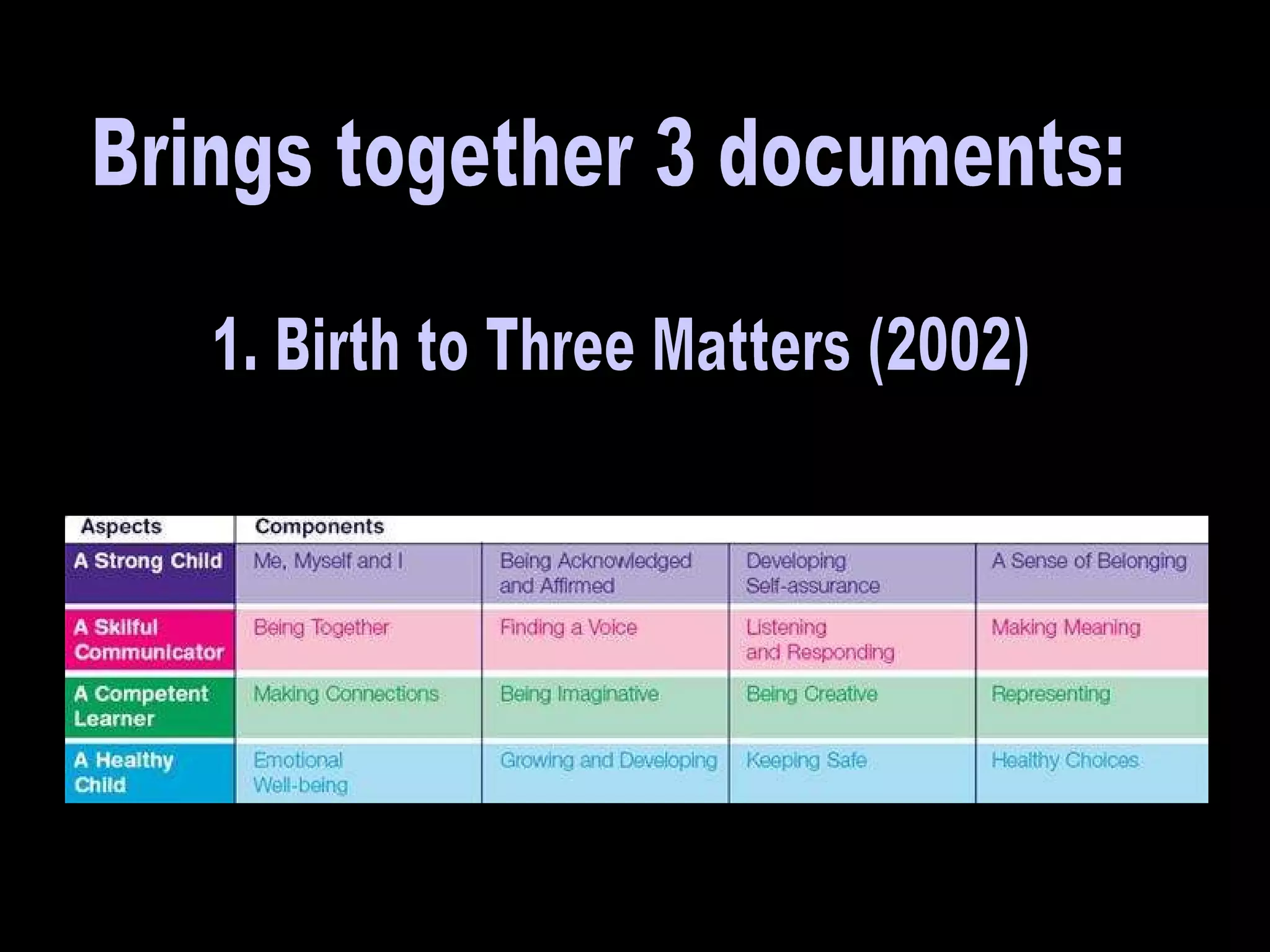
Brings together 3 documents: 1. Birth to Three Matters (2002)
2. National standards for under 8s day care and childminding (2003)
3. Curriculum Guidance for the Foundation Stage (2000)
Every Child Matters: Change for Children (2004) It is based on the document…
The overarching aim of the EYFS is to help young children achieve the 5 Every Child Matters outcomes Be Healthy Stay Safe Enjoy and Achieve Make a positive contribution and Achieve economic well-being
It aims to ensure a consistent approach to care, learning and development from birth to the end of the Foundation Stage Helps practitioners plan care and learning that is right for each child at their stage of development.
The EYFS is based on four themes, which are underpinned by 4 principles. Each principle is supported by 4  commitments which describe how the principle can be put into practice. THEME PRINCIPLE COMMITMENT COMMITMENT COMMITMENT COMMITMENT
A Unique Child Every child is a competent learner from birth who can be resilient, capable, confident and self-assured . 1.1 Child Development 1.2 Inclusive Practice 1.3 Keeping Safe 1.4 Health and Well-being
Positive Relationships Children learn to be strong and independent from a base of loving and secure relationships with parents and/or a key person. 2.1 Respecting each other 2.2 Parents as Partners 2.3 Supporting Learning 2.4 Key Person
Enabling Environments The environment plays a key role in supporting and extending children’s development and learning. 3.1 Observation, assessment and Planning 3.2 Supporting Every Child 3.3 The Learning Environment 3.4 The Wider Context
Learning and development Children develop and learn in different ways and at different rates and all areas of Learning and Development are equally important and inter-connected. 4.1 Play and Exploration 4.2 Active Learning 4.3 Creativity and Critical Thinking 4.4 Areas of Learning and Development
Specific Legal Requirements Must have effective systems to ensure individual needs of all children are met Promote equal opportunity Each child must be assigned a key person Must ensure there is a balance of adult led and freely chosen or child initiated activities through indoor and outdoor play
Providers must undertake sensitive observational assessment in order to plan to meet young children’s needs Providers must plan and provide experiences which are appropriate to each child’s stage of development as they progress towards the early learning goals.
Stages of development Birth to 11 months 8-20 months 16-26 months 22-36 months 30-50 months 40-60+ months
Key Issues Not using a topic based approach Avoiding product outcome activities Child led display work Outdoor Play
The 6 Areas of Learning Personal, Social and Emotional Development Communication, Language and Literacy Problem Solving, Reasoning and Numeracy Knowledge and Understanding of the World Physical development Creative development
Personal, Social and Emotional Development Dispositions and Attitudes Self confidence and self esteem Making relationships Behaviour and self control Self care Sense of community
Communication, Language and Literacy Language for communication Language for thinking Linking sounds and letters Reading Writing Handwriting
Problem Solving, Reasoning and Numeracy Numbers as labels for counting Calculating Shape space and measures
Knowledge and Understanding of the World Exploration and investigation Designing and making ICT Time Place Communities
Physical development Movement and Space Health and bodily awareness Using equipment and materials
Creative development Being creative – responding to experiences  and communicating ideas Exploring media and materials Creating Music and Dance Developing imagination and imaginative play

Early Year Foundation Stage

  • 1.
    Statutory Framework forthe Early Years Foundation Stage
  • 2.
    What this meansfor your child What the EYFS is and why it was introduced Please stop me at any point to ask a question How we monitor your child's progress
  • 3.
    Brings together 3documents: 1. Birth to Three Matters (2002)
  • 4.
    2. National standardsfor under 8s day care and childminding (2003)
  • 5.
    3. Curriculum Guidancefor the Foundation Stage (2000)
  • 6.
    Every Child Matters:Change for Children (2004) It is based on the document…
  • 7.
    The overarching aimof the EYFS is to help young children achieve the 5 Every Child Matters outcomes Be Healthy Stay Safe Enjoy and Achieve Make a positive contribution and Achieve economic well-being
  • 8.
    It aims toensure a consistent approach to care, learning and development from birth to the end of the Foundation Stage Helps practitioners plan care and learning that is right for each child at their stage of development.
  • 9.
    The EYFS isbased on four themes, which are underpinned by 4 principles. Each principle is supported by 4 commitments which describe how the principle can be put into practice. THEME PRINCIPLE COMMITMENT COMMITMENT COMMITMENT COMMITMENT
  • 10.
    A Unique ChildEvery child is a competent learner from birth who can be resilient, capable, confident and self-assured . 1.1 Child Development 1.2 Inclusive Practice 1.3 Keeping Safe 1.4 Health and Well-being
  • 11.
    Positive Relationships Childrenlearn to be strong and independent from a base of loving and secure relationships with parents and/or a key person. 2.1 Respecting each other 2.2 Parents as Partners 2.3 Supporting Learning 2.4 Key Person
  • 12.
    Enabling Environments Theenvironment plays a key role in supporting and extending children’s development and learning. 3.1 Observation, assessment and Planning 3.2 Supporting Every Child 3.3 The Learning Environment 3.4 The Wider Context
  • 13.
    Learning and developmentChildren develop and learn in different ways and at different rates and all areas of Learning and Development are equally important and inter-connected. 4.1 Play and Exploration 4.2 Active Learning 4.3 Creativity and Critical Thinking 4.4 Areas of Learning and Development
  • 14.
    Specific Legal RequirementsMust have effective systems to ensure individual needs of all children are met Promote equal opportunity Each child must be assigned a key person Must ensure there is a balance of adult led and freely chosen or child initiated activities through indoor and outdoor play
  • 15.
    Providers must undertakesensitive observational assessment in order to plan to meet young children’s needs Providers must plan and provide experiences which are appropriate to each child’s stage of development as they progress towards the early learning goals.
  • 16.
    Stages of developmentBirth to 11 months 8-20 months 16-26 months 22-36 months 30-50 months 40-60+ months
  • 17.
    Key Issues Notusing a topic based approach Avoiding product outcome activities Child led display work Outdoor Play
  • 18.
    The 6 Areasof Learning Personal, Social and Emotional Development Communication, Language and Literacy Problem Solving, Reasoning and Numeracy Knowledge and Understanding of the World Physical development Creative development
  • 19.
    Personal, Social andEmotional Development Dispositions and Attitudes Self confidence and self esteem Making relationships Behaviour and self control Self care Sense of community
  • 20.
    Communication, Language andLiteracy Language for communication Language for thinking Linking sounds and letters Reading Writing Handwriting
  • 21.
    Problem Solving, Reasoningand Numeracy Numbers as labels for counting Calculating Shape space and measures
  • 22.
    Knowledge and Understandingof the World Exploration and investigation Designing and making ICT Time Place Communities
  • 23.
    Physical development Movementand Space Health and bodily awareness Using equipment and materials
  • 24.
    Creative development Beingcreative – responding to experiences and communicating ideas Exploring media and materials Creating Music and Dance Developing imagination and imaginative play

Editor's Notes

  • #2 In essence what it does is to bring recent documentation/guidance about child welfare and child protection under one umbrella alongside education.
  • #4 Primarily aimed at practitioners, Birth to three provides information on child development, effective practice, examples of play activities to promote play and learning, guidance on planning and resourcing and meeting diverse needs. The framework also reflects the diversity of types of organised provision for children in this age group and recognises the importance of wider issues including equal opportunities and relationships with parents
  • #7 Every Child Matters: Change for Children is a new approach to the well-being of children and young people from birth to age 19. Somewhat tragically it came about as a result of the death of Victoria Climbie, who was horrifically abused and tortured by her great aunt and the man she lived with. This sparked much debate about child welfore and accountability and the government produced a green paper (Every Child Matters) in 2003 The Government's aim is for every child, whatever their background or their circumstances, to have the support they need to: Be healthy Stay safe Enjoy and achieve Make a positive contribution Achieve economic well-being