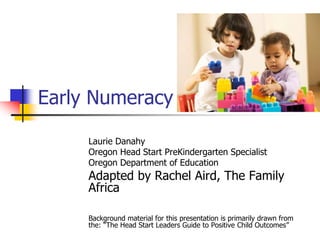
Early Numeracy
Laurie Danahy
Oregon Head Start PreKindergarten Specialist
Oregon Department of Education
Adapted by Rachel Aird, The Family
Africa
Background material for this presentation is primarily drawn from
the: “The Head Start Leaders Guide to Positive Child Outcomes”
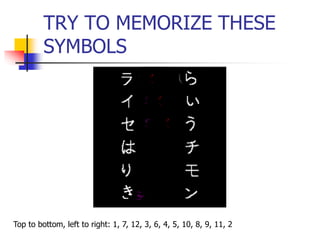
TRY TO MEMORIZE THESE
SYMBOLS
Top to bottom, left to right: 1, 7, 12, 3, 6, 4, 5, 10, 8, 9, 11, 2
NOW TEST YOURSELF:
5359502262995807
•This is a taste of what a
child has to accomplish when
learning numbers.
Numeracy
It is not just about
counting 1 to 10.
Numbers in our lives…
 Think about getting to this workshop
today. Were there any numbers or
math concepts involved in the process?
What were they?
 Turn to a partner. Share a favourite
activity or sport. Together, list at least
three ways numbers or maths are
involved in each of your activities.
Numbers in children’s lives
Numbers are everywhere and
we can make Maths a lot of
fun if we use things in the
child’s environment.
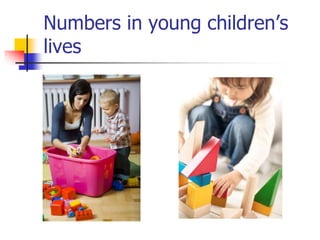
Numbers in young children’s
lives
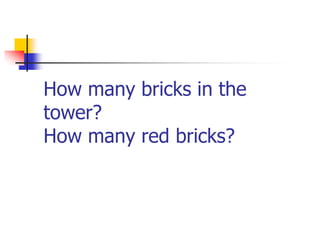
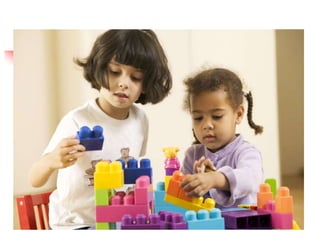
How many bricks in the
tower?
How many red bricks?
Numbers in young children’s
lives
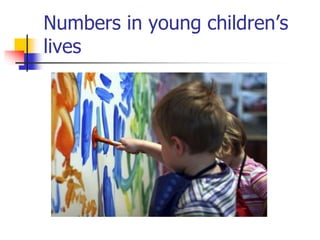
How many blobs of paint?
How many stripes of red
paint?
Etc.
Numbers in young children’s
lives
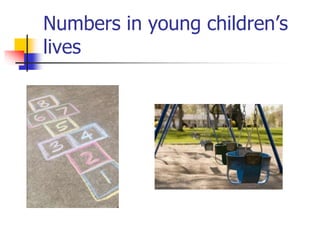
To play Hopscotch children
need to know their numbers.
You throw a stone and you
hop that many squares. There
are other simple games you
can play like this.
How many swings? How many
children can swing at the
same time?
What is early numeracy?
Numeracy or "numerical
literacy." It refers to the
ability to reason with
numbers and apply
mathematical concepts.
*T
 Early numeracy refers to
the foundations of
mathematical reasoning,
acquired in early
childhood.
Why is early numeracy important?
 helps children observe, organize and find
meaning in their environment
 focuses on reasoning, connecting ideas
and thinking logically – important tools
children can use to make sense of their
world
 relates to other curriculum areas, such as
science, social studies, art and music
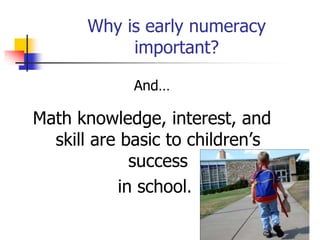
Why is early numeracy
important?
And…
Math knowledge, interest, and
skill are basic to children’s
success
in school.
What does the research say
about early numeracy?
According to the National Council of Teachers
of Mathematics (NCTM)…
 Learning about maths is neither short-
term nor rote (e.g. chanting 1 -10)
 Children need to manipulate objects
and explore math concepts in a
materials-rich environment.
 This means they need to have the
opportunity to touch things when
they count.
 Use a variety of different things to
count: blocks, dolls, cars, dried peas
or beans etc.
 To give children the
opportunity to understand
mathematical concepts
through real events e.g.
time, length, weight etc
What does the research say
about early numeracy?
According to the National Council of
Teachers of Mathematics (NCTM)…
 Technology, (computers,
calculators) if used age
appropriately, can be one
component of early math
education.
 Children need time and
freedom to construct, test,
and reflect on (think about)
their ideas about maths.
What does the research say
about early numeracy?
According to the National Council of
Teachers of Mathematics (NCTM)…
 Natural conversations with adults help
children extend their thinking about
maths
 Activities/concepts should be grounded
in the familiar and their everyday life.
What does the research say
about early numeracy?
According to the authors of “Mathematical Language
in Early Childhood Settings: What Really Counts?” *
 Language is an important tool for
teaching mathematics.
 People who work with young children
are not using enough mathematical
language, especially language that goes
beyond the most basic concepts.
What does the research say
about early numeracy?
According to the authors of “Mathematical Language
in Early Childhood Settings: What Really Counts?” *
 The most effective mathematics
instruction occurs when people working
with children take a “playful approach.”
 We need to “stack the deck” so that
children have a wealth of opportunities
to encounter interesting mathematics.
In other words…
We support young children’s numeracy
development when we purposefully
introduce and use mathematical
language and concepts during
enjoyable activities and every day
experiences.
Some people call this process
“mathematizing.”
Mathematical language and concepts
for young children fall into three
main categories
 1. Numbers and operations
 2. Geometry and spatial sense
 3. Patterns and measurement
1. Numbers and operations
 Number sense involves the
ability to think and work with
numbers and to understand
their uses and relationships.
 “Operations” is the formal
mathematical term referring to
addition, subtraction,
multiplication, and division of
numbers.
Children learning about numbers and
operations…
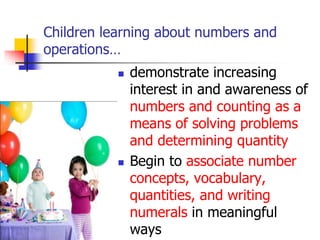
 demonstrate increasing
interest in and awareness of
numbers and counting as a
means of solving problems
and determining quantity
 Begin to associate number
concepts, vocabulary,
quantities, and writing
numerals in meaningful
ways
Children learning about numbers and
operations…
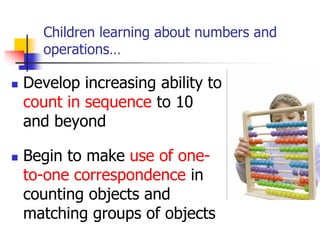
 Develop increasing ability to
count in sequence to 10
and beyond
 Begin to make use of one-
to-one correspondence in
counting objects and
matching groups of objects
Remember
 that just because a child can count
to 10, it does not mean they
understand how many the number 10
represents.
 They need to understand what 1
means by showing them what 1 looks
like, and what 2 looks like etc. They
need to understand that 10 is more
than 9 etc.
Children learning about numbers and
operations…
 Begin to use language to
compare numbers of
objects with terms such as
more, less, greater than,
fewer, equal to
 Develop increased abilities
to combine, separate and
name “how many”
concrete objects
Numbers and operations: Opportunities to
Mathematize
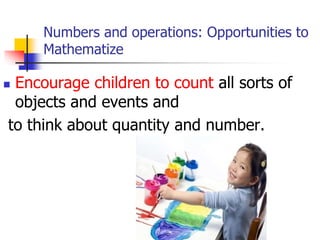
 Encourage children to count all sorts of
objects and events and
to think about quantity and number.
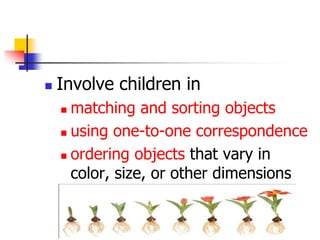
 Involve children in
 matching and sorting objects
 using one-to-one correspondence
 ordering objects that vary in
color, size, or other dimensions
 Counting – count plastic animals,
bricks, tables, chairs. Make sure
they learn to move their finger to
the next object as they count
 Matching – coloured lids to colored
paints. One to one – paint brush
for every paint cup
Numbers and operations: Opportunities to
Mathematize
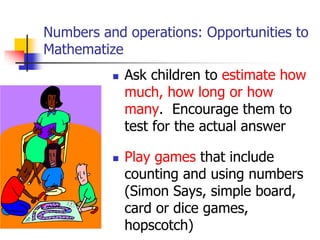
 Draw attention to numbers
and how they are used such
as addresses, prices of objects
and shoe sizes.
 Use strategies that help
children learn to count
accurately and efficiently such
as pointing
to/touching/moving each
object being counted.
 Draw attention to numbers. Ask
someone for a favourite number
between one and ten. Ask
everyone to look around the
room for that number.
e.g. Can you see a number 5?
Numbers and operations: Opportunities to
Mathematize
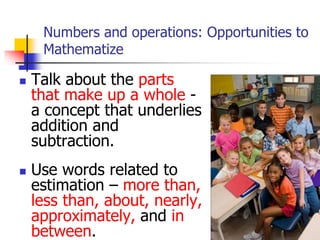
 Talk about the parts
that make up a whole -
a concept that underlies
addition and
subtraction.
 Use words related to
estimation – more than,
less than, about, nearly,
approximately, and in
between.
Example of a game
 Bring up six volunteers. Count
the whole group. Count and
recombine sub groups (three
with sweaters, three with
turtlenecks; two with tie shoes,
four with buckle shoes; etc.
Numbers and operations: Opportunities to
Mathematize
 Ask children to estimate how
much, how long or how
many. Encourage them to
test for the actual answer
 Play games that include
counting and using numbers
(Simon Says, simple board,
card or dice games,
hopscotch)
 How many bricks ( or sweets or
balls or pencils) do you think I
have?
 children guess and then count
them together.
2. Geometry and Spatial Sense
 Geometry is the area of mathematics
that involves shape, size, space,
position, direction and movement. It
helps describe and classify the world
we live in.
 Spatial sense gives children an
awareness of themselves in relation
to people and objects.
Children who are learning about
geometry and spatial sense…
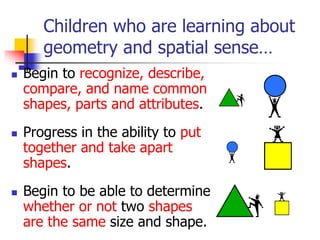
 Begin to recognize, describe,
compare, and name common
shapes, parts and attributes.
 Progress in the ability to put
together and take apart
shapes.
 Begin to be able to determine
whether or not two shapes
are the same size and shape.
Children who are learning about
geometry and spatial sense…
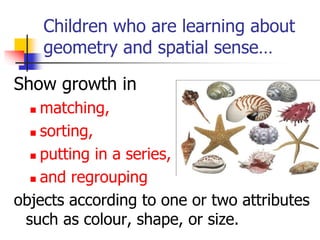
Show growth in
 matching,
 sorting,
 putting in a series,
 and regrouping
objects according to one or two attributes
such as colour, shape, or size.
Children who are learning about
geometry and spatial sense…
Build an increasing
understanding of
 directionality, order and
position of objects and
 words such as up,
down, over, under, top,
bottom, inside, outside,
in front and behind.
Geometry and spatial sense:
Opportunities to Mathematize
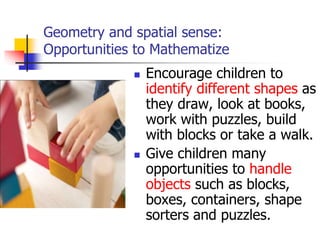
 Encourage children to
identify different shapes as
they draw, look at books,
work with puzzles, build
with blocks or take a walk.
 Give children many
opportunities to handle
objects such as blocks,
boxes, containers, shape
sorters and puzzles.
Geometry and spatial sense:
Opportunities to Mathematize
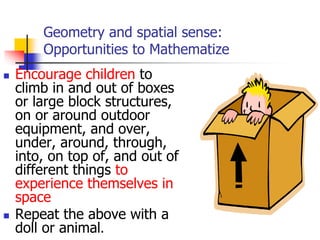
 Encourage children to
climb in and out of boxes
or large block structures,
on or around outdoor
equipment, and over,
under, around, through,
into, on top of, and out of
different things to
experience themselves in
space
 Repeat the above with a
doll or animal.
Geometry and spatial sense:
Opportunities to Mathematize
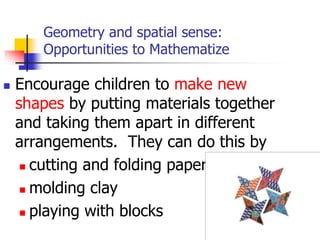
 Encourage children to make new
shapes by putting materials together
and taking them apart in different
arrangements. They can do this by
 cutting and folding paper
 molding clay
 playing with blocks
 Six volunteers – give each a shape,
name and describe the shapes as
handing them out. Challenge them
to find someone that has a shape
that matches theirs. Then ask
them to use their shapes to make a
new shape.
Geometry and spatial sense:
Opportunities to Mathematize
Introduce spatial vocabulary, including
 location and position words – on/off,
over/under, in/out, above/below, in
front/behind…
 movement words – up/down,
forward/backward, toward/away from,
straight/curving…
 distance words – near/far, close to/far
from, shortest/longest…
3. Patterns and Measurement
 Understanding and identifying
patterns and relationships means
recognizing rhythm and repetition as
well as sorting, categorizing, and
ordering from shortest to longest,
smallest to largest.
 Measurement is an important
way for young children to look
at relationships in the real world
– length, height, weight, time.
Children who are learning about
patterns and measurement…
 Enhance their abilities to recognize, duplicate,
and extend simple patterns using a variety of
materials.
 Show increasing abilities to match, sort, put in
a series, and regroup objects according to one
or two attributes such as shape and size.
 You can use coloured blocks
and make a pattern e.g. red,
blue, green, red, blue green
and then put red and ask what
comes next in this pattern?
Children who are learning about
patterns and measurement…
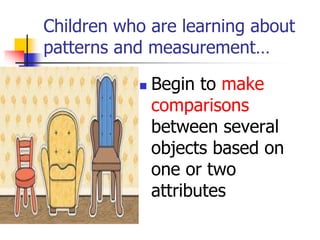
 Begin to make
comparisons
between several
objects based on
one or two
attributes
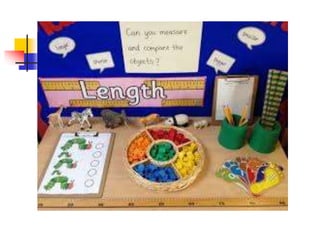
 Which is the biggest animal?
 Which animal is the
smallest?
 Is this brick bigger or smaller
than this one?
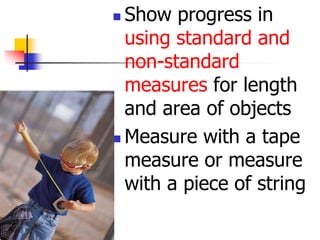
 Show progress in
using standard and
non-standard
measures for length
and area of objects
 Measure with a tape
measure or measure
with a piece of string
Patterns and measurement: Opportunities
to Mathematize
 Increase awareness of patterns. Help
children find patterns in
 designs and pictures,
 movements,
 reoccurring events.
 Engage children in creating and noticing
patterns as they play.
 Identify pattern in an
illustration or picture.
 Ask them to look for other
patterns around the room
Patterns and measurement: Opportunities
to Mathematize
 Let children figure out their own units for
measurement. Children better understand
standard units like centimetres and
metres when they have lots of
experiences working with their own ways
of measuring and comparing.
Patterns and measurement: Opportunities
to Mathematize
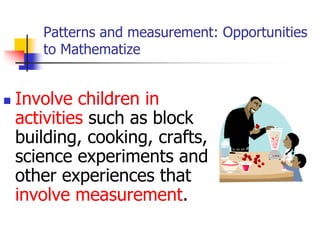
 Involve children in
activities such as block
building, cooking, crafts,
science experiments and
other experiences that
involve measurement.
Patterns and measurement: Opportunities
to Mathematize
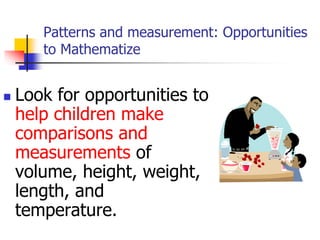
 Look for opportunities to
help children make
comparisons and
measurements of
volume, height, weight,
length, and
temperature.
 Have some packets of food and
ask which one do you think is
heavier, then you can look at
the weight on the packet and
see who is right.
Understanding Volume
 Use jugs and cups with water.
Which one holds the most
water?
 See how many cups of water it
takes to fill the jug.
Patterns and measurement: Opportunities
to Mathematize
 Provide simple experiences
that help children begin to
develop and understanding
of time concepts…
 time events by counting out
seconds
 compare how long different
activities take
Patterns and measurement: Opportunities
to Mathematize
 start with daily time
references (after the story,
before lunch) and progress
to more abstract concepts
(yesterday, tomorrow,
months, years, etc.
Patterns and measurement: Opportunities
to Mathematize
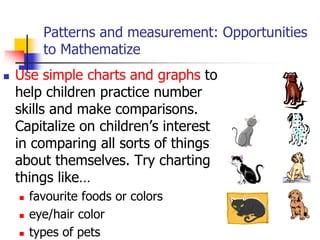
 Use simple charts and graphs to
help children practice number
skills and make comparisons.
Capitalize on children’s interest
in comparing all sorts of things
about themselves. Try charting
things like…
 favourite foods or colors
 eye/hair color
 types of pets
Pair and Share:
Storytime ideas
 Choose a book and consider it’s
“mathematizing” potential.
 Identify opportunities to discuss and explore
 number and operations,
 geometry and spatial sense and/or,
 patterns and measurement.
 Brainstorm story-related, hands on, concrete
numeracy activities.
Storytime Ideas: Small Groups
 Get into a group of four.
 Each group should briefly present their
book and the “mathematized”
discussion and activities it stimulated.
 Each small group should identify one
unique idea they’d like to share with
the whole group.
Storytime Ideas: Whole Group
Share a unique “mathematized” storytime
activity and its related book.
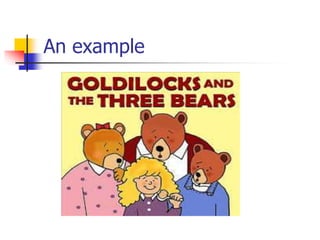
An example
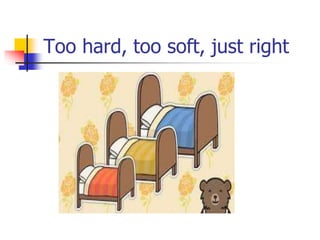
Three of everything
 3 bowls – a very big bowl for
Daddy bear
 A medium sized one for Mummy
bear
 And a small bowl for baby bear
 And so on with the chairs and the
beds.
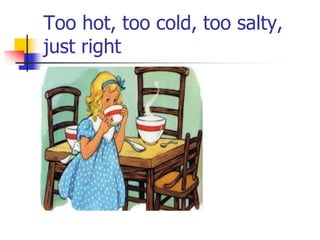
Too hot, too cold, too salty,
just right
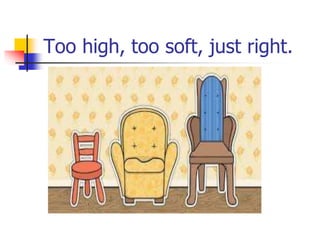
Too high, too soft, just right.
Too hard, too soft, just right
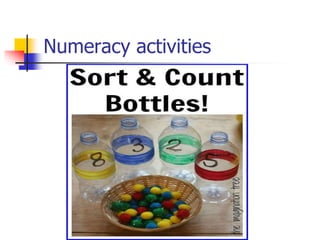
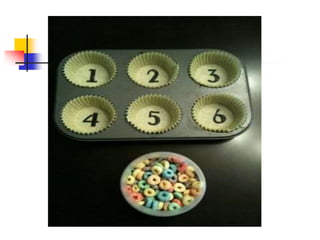
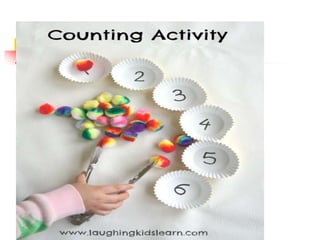
Numeracy activities
Thank you!
Go forth and
“mathematize”!
Questions
 1. Numeracy ("numerical literacy.“)
refers to the ability to reason with
numbers and apply mathematical
concepts.
 True or False
 2. Is Maths just about learning to
count?
 A) Yes
 B) No
 C) I don’t know
 3) Mathematical language and concepts
for young children fall into three main
categories: (choose the correct three)
A)Numbers and operations
B)Geometry and spatial sense
C)Patterns and measurement
D) Learning the alphabet
E) Geography
4. “Operations” in Maths
means
 A) addition, subtraction, multiplication,
and division of numbers.
 B) Going into hospital to have your
appendix removed.
 C) I have no idea
 5) Mathematics has nothing to do with
language
 True or False
 6) Which activities can be used to
teach maths?
 A) Reading a story
 B) Playing with water using cups and jugs
 C) Recognising patterns
 D) measuring
 E) Counting how many seconds it takes to
run a distance.
 F) Teaching about position by using a
cardboard box and a doll.
 G) All of the above.
Answers
 1. Numeracy ("numerical literacy.“)
refers to the ability to reason with
numbers and apply mathematical
concepts.
 True
 2. Is Maths just about learning to
count?
 B) No
 3) Mathematical language and concepts
for young children fall into three main
categories: (choose the correct three)
A)Numbers and operations
B)Geometry and spatial sense
C)Patterns and measuremen
4. “Operations” in Maths
means
 A) addition, subtraction, multiplication,
and division of numbers.
 5) Mathematics has nothing to do with
language
 False
 6) Which activities can be used to
teach maths?
 A) Reading a story
 B) Playing with water using cups and jugs
 C) Recognising patterns
 D) measuring
 E) Counting how many seconds it takes to
run a distance.
 F) Teaching about position by using a
cardboard box and a doll.
 G) All of the above. They can all be used.

Early Numeracy

  • 1.
    Early Numeracy Laurie Danahy OregonHead Start PreKindergarten Specialist Oregon Department of Education Adapted by Rachel Aird, The Family Africa Background material for this presentation is primarily drawn from the: “The Head Start Leaders Guide to Positive Child Outcomes”
  • 2.
    TRY TO MEMORIZETHESE SYMBOLS Top to bottom, left to right: 1, 7, 12, 3, 6, 4, 5, 10, 8, 9, 11, 2
  • 3.
  • 4.
    •This is ataste of what a child has to accomplish when learning numbers.
  • 5.
    Numeracy It is notjust about counting 1 to 10.
  • 6.
    Numbers in ourlives…  Think about getting to this workshop today. Were there any numbers or math concepts involved in the process? What were they?  Turn to a partner. Share a favourite activity or sport. Together, list at least three ways numbers or maths are involved in each of your activities.
  • 7.
    Numbers in children’slives Numbers are everywhere and we can make Maths a lot of fun if we use things in the child’s environment.
  • 8.
    Numbers in youngchildren’s lives
  • 9.
    How many bricksin the tower? How many red bricks?
  • 10.
    Numbers in youngchildren’s lives
  • 11.
    How many blobsof paint? How many stripes of red paint? Etc.
  • 12.
    Numbers in youngchildren’s lives
  • 13.
    To play Hopscotchchildren need to know their numbers. You throw a stone and you hop that many squares. There are other simple games you can play like this. How many swings? How many children can swing at the same time?
  • 14.
    What is earlynumeracy? Numeracy or "numerical literacy." It refers to the ability to reason with numbers and apply mathematical concepts. *T
  • 15.
     Early numeracyrefers to the foundations of mathematical reasoning, acquired in early childhood.
  • 16.
    Why is earlynumeracy important?  helps children observe, organize and find meaning in their environment  focuses on reasoning, connecting ideas and thinking logically – important tools children can use to make sense of their world  relates to other curriculum areas, such as science, social studies, art and music
  • 17.
    Why is earlynumeracy important? And… Math knowledge, interest, and skill are basic to children’s success in school.
  • 18.
    What does theresearch say about early numeracy? According to the National Council of Teachers of Mathematics (NCTM)…  Learning about maths is neither short- term nor rote (e.g. chanting 1 -10)  Children need to manipulate objects and explore math concepts in a materials-rich environment.
  • 19.
     This meansthey need to have the opportunity to touch things when they count.  Use a variety of different things to count: blocks, dolls, cars, dried peas or beans etc.
  • 20.
     To givechildren the opportunity to understand mathematical concepts through real events e.g. time, length, weight etc
  • 21.
    What does theresearch say about early numeracy? According to the National Council of Teachers of Mathematics (NCTM)…  Technology, (computers, calculators) if used age appropriately, can be one component of early math education.
  • 22.
     Children needtime and freedom to construct, test, and reflect on (think about) their ideas about maths.
  • 23.
    What does theresearch say about early numeracy? According to the National Council of Teachers of Mathematics (NCTM)…  Natural conversations with adults help children extend their thinking about maths  Activities/concepts should be grounded in the familiar and their everyday life.
  • 24.
    What does theresearch say about early numeracy? According to the authors of “Mathematical Language in Early Childhood Settings: What Really Counts?” *  Language is an important tool for teaching mathematics.  People who work with young children are not using enough mathematical language, especially language that goes beyond the most basic concepts.
  • 25.
    What does theresearch say about early numeracy? According to the authors of “Mathematical Language in Early Childhood Settings: What Really Counts?” *  The most effective mathematics instruction occurs when people working with children take a “playful approach.”  We need to “stack the deck” so that children have a wealth of opportunities to encounter interesting mathematics.
  • 26.
    In other words… Wesupport young children’s numeracy development when we purposefully introduce and use mathematical language and concepts during enjoyable activities and every day experiences. Some people call this process “mathematizing.”
  • 27.
    Mathematical language andconcepts for young children fall into three main categories  1. Numbers and operations  2. Geometry and spatial sense  3. Patterns and measurement
  • 28.
    1. Numbers andoperations  Number sense involves the ability to think and work with numbers and to understand their uses and relationships.  “Operations” is the formal mathematical term referring to addition, subtraction, multiplication, and division of numbers.
  • 29.
    Children learning aboutnumbers and operations…  demonstrate increasing interest in and awareness of numbers and counting as a means of solving problems and determining quantity  Begin to associate number concepts, vocabulary, quantities, and writing numerals in meaningful ways
  • 30.
    Children learning aboutnumbers and operations…  Develop increasing ability to count in sequence to 10 and beyond  Begin to make use of one- to-one correspondence in counting objects and matching groups of objects
  • 31.
    Remember  that justbecause a child can count to 10, it does not mean they understand how many the number 10 represents.  They need to understand what 1 means by showing them what 1 looks like, and what 2 looks like etc. They need to understand that 10 is more than 9 etc.
  • 32.
    Children learning aboutnumbers and operations…  Begin to use language to compare numbers of objects with terms such as more, less, greater than, fewer, equal to  Develop increased abilities to combine, separate and name “how many” concrete objects
  • 33.
    Numbers and operations:Opportunities to Mathematize  Encourage children to count all sorts of objects and events and to think about quantity and number.
  • 34.
     Involve childrenin  matching and sorting objects  using one-to-one correspondence  ordering objects that vary in color, size, or other dimensions
  • 35.
     Counting –count plastic animals, bricks, tables, chairs. Make sure they learn to move their finger to the next object as they count  Matching – coloured lids to colored paints. One to one – paint brush for every paint cup
  • 36.
    Numbers and operations:Opportunities to Mathematize  Draw attention to numbers and how they are used such as addresses, prices of objects and shoe sizes.  Use strategies that help children learn to count accurately and efficiently such as pointing to/touching/moving each object being counted.
  • 37.
     Draw attentionto numbers. Ask someone for a favourite number between one and ten. Ask everyone to look around the room for that number. e.g. Can you see a number 5?
  • 38.
    Numbers and operations:Opportunities to Mathematize  Talk about the parts that make up a whole - a concept that underlies addition and subtraction.  Use words related to estimation – more than, less than, about, nearly, approximately, and in between.
  • 39.
    Example of agame  Bring up six volunteers. Count the whole group. Count and recombine sub groups (three with sweaters, three with turtlenecks; two with tie shoes, four with buckle shoes; etc.
  • 40.
    Numbers and operations:Opportunities to Mathematize  Ask children to estimate how much, how long or how many. Encourage them to test for the actual answer  Play games that include counting and using numbers (Simon Says, simple board, card or dice games, hopscotch)
  • 41.
     How manybricks ( or sweets or balls or pencils) do you think I have?  children guess and then count them together.
  • 42.
    2. Geometry andSpatial Sense  Geometry is the area of mathematics that involves shape, size, space, position, direction and movement. It helps describe and classify the world we live in.  Spatial sense gives children an awareness of themselves in relation to people and objects.
  • 43.
    Children who arelearning about geometry and spatial sense…  Begin to recognize, describe, compare, and name common shapes, parts and attributes.  Progress in the ability to put together and take apart shapes.  Begin to be able to determine whether or not two shapes are the same size and shape.
  • 44.
    Children who arelearning about geometry and spatial sense… Show growth in  matching,  sorting,  putting in a series,  and regrouping objects according to one or two attributes such as colour, shape, or size.
  • 45.
    Children who arelearning about geometry and spatial sense… Build an increasing understanding of  directionality, order and position of objects and  words such as up, down, over, under, top, bottom, inside, outside, in front and behind.
  • 46.
    Geometry and spatialsense: Opportunities to Mathematize  Encourage children to identify different shapes as they draw, look at books, work with puzzles, build with blocks or take a walk.  Give children many opportunities to handle objects such as blocks, boxes, containers, shape sorters and puzzles.
  • 47.
    Geometry and spatialsense: Opportunities to Mathematize  Encourage children to climb in and out of boxes or large block structures, on or around outdoor equipment, and over, under, around, through, into, on top of, and out of different things to experience themselves in space  Repeat the above with a doll or animal.
  • 48.
    Geometry and spatialsense: Opportunities to Mathematize  Encourage children to make new shapes by putting materials together and taking them apart in different arrangements. They can do this by  cutting and folding paper  molding clay  playing with blocks
  • 49.
     Six volunteers– give each a shape, name and describe the shapes as handing them out. Challenge them to find someone that has a shape that matches theirs. Then ask them to use their shapes to make a new shape.
  • 50.
    Geometry and spatialsense: Opportunities to Mathematize Introduce spatial vocabulary, including  location and position words – on/off, over/under, in/out, above/below, in front/behind…  movement words – up/down, forward/backward, toward/away from, straight/curving…  distance words – near/far, close to/far from, shortest/longest…
  • 51.
    3. Patterns andMeasurement  Understanding and identifying patterns and relationships means recognizing rhythm and repetition as well as sorting, categorizing, and ordering from shortest to longest, smallest to largest.
  • 52.
     Measurement isan important way for young children to look at relationships in the real world – length, height, weight, time.
  • 53.
    Children who arelearning about patterns and measurement…  Enhance their abilities to recognize, duplicate, and extend simple patterns using a variety of materials.  Show increasing abilities to match, sort, put in a series, and regroup objects according to one or two attributes such as shape and size.
  • 54.
     You canuse coloured blocks and make a pattern e.g. red, blue, green, red, blue green and then put red and ask what comes next in this pattern?
  • 55.
    Children who arelearning about patterns and measurement…  Begin to make comparisons between several objects based on one or two attributes
  • 56.
     Which isthe biggest animal?  Which animal is the smallest?  Is this brick bigger or smaller than this one?
  • 57.
     Show progressin using standard and non-standard measures for length and area of objects  Measure with a tape measure or measure with a piece of string
  • 58.
    Patterns and measurement:Opportunities to Mathematize  Increase awareness of patterns. Help children find patterns in  designs and pictures,  movements,  reoccurring events.  Engage children in creating and noticing patterns as they play.
  • 59.
     Identify patternin an illustration or picture.  Ask them to look for other patterns around the room
  • 60.
    Patterns and measurement:Opportunities to Mathematize  Let children figure out their own units for measurement. Children better understand standard units like centimetres and metres when they have lots of experiences working with their own ways of measuring and comparing.
  • 61.
    Patterns and measurement:Opportunities to Mathematize  Involve children in activities such as block building, cooking, crafts, science experiments and other experiences that involve measurement.
  • 62.
    Patterns and measurement:Opportunities to Mathematize  Look for opportunities to help children make comparisons and measurements of volume, height, weight, length, and temperature.
  • 63.
     Have somepackets of food and ask which one do you think is heavier, then you can look at the weight on the packet and see who is right.
  • 64.
    Understanding Volume  Usejugs and cups with water. Which one holds the most water?  See how many cups of water it takes to fill the jug.
  • 65.
    Patterns and measurement:Opportunities to Mathematize  Provide simple experiences that help children begin to develop and understanding of time concepts…  time events by counting out seconds  compare how long different activities take
  • 66.
    Patterns and measurement:Opportunities to Mathematize  start with daily time references (after the story, before lunch) and progress to more abstract concepts (yesterday, tomorrow, months, years, etc.
  • 67.
    Patterns and measurement:Opportunities to Mathematize  Use simple charts and graphs to help children practice number skills and make comparisons. Capitalize on children’s interest in comparing all sorts of things about themselves. Try charting things like…  favourite foods or colors  eye/hair color  types of pets
  • 68.
    Pair and Share: Storytimeideas  Choose a book and consider it’s “mathematizing” potential.  Identify opportunities to discuss and explore  number and operations,  geometry and spatial sense and/or,  patterns and measurement.  Brainstorm story-related, hands on, concrete numeracy activities.
  • 69.
    Storytime Ideas: SmallGroups  Get into a group of four.  Each group should briefly present their book and the “mathematized” discussion and activities it stimulated.  Each small group should identify one unique idea they’d like to share with the whole group.
  • 70.
    Storytime Ideas: WholeGroup Share a unique “mathematized” storytime activity and its related book.
  • 71.
  • 72.
    Three of everything 3 bowls – a very big bowl for Daddy bear  A medium sized one for Mummy bear  And a small bowl for baby bear  And so on with the chairs and the beds.
  • 73.
    Too hot, toocold, too salty, just right
  • 74.
    Too high, toosoft, just right.
  • 75.
    Too hard, toosoft, just right
  • 76.
  • 86.
    Thank you! Go forthand “mathematize”!
  • 87.
    Questions  1. Numeracy("numerical literacy.“) refers to the ability to reason with numbers and apply mathematical concepts.  True or False
  • 88.
     2. IsMaths just about learning to count?  A) Yes  B) No  C) I don’t know
  • 89.
     3) Mathematicallanguage and concepts for young children fall into three main categories: (choose the correct three) A)Numbers and operations B)Geometry and spatial sense C)Patterns and measurement D) Learning the alphabet E) Geography
  • 90.
    4. “Operations” inMaths means  A) addition, subtraction, multiplication, and division of numbers.  B) Going into hospital to have your appendix removed.  C) I have no idea
  • 91.
     5) Mathematicshas nothing to do with language  True or False
  • 92.
     6) Whichactivities can be used to teach maths?  A) Reading a story  B) Playing with water using cups and jugs  C) Recognising patterns  D) measuring  E) Counting how many seconds it takes to run a distance.  F) Teaching about position by using a cardboard box and a doll.  G) All of the above.
  • 93.
    Answers  1. Numeracy("numerical literacy.“) refers to the ability to reason with numbers and apply mathematical concepts.  True
  • 94.
     2. IsMaths just about learning to count?  B) No
  • 95.
     3) Mathematicallanguage and concepts for young children fall into three main categories: (choose the correct three) A)Numbers and operations B)Geometry and spatial sense C)Patterns and measuremen
  • 96.
    4. “Operations” inMaths means  A) addition, subtraction, multiplication, and division of numbers.
  • 97.
     5) Mathematicshas nothing to do with language  False
  • 98.
     6) Whichactivities can be used to teach maths?  A) Reading a story  B) Playing with water using cups and jugs  C) Recognising patterns  D) measuring  E) Counting how many seconds it takes to run a distance.  F) Teaching about position by using a cardboard box and a doll.  G) All of the above. They can all be used.