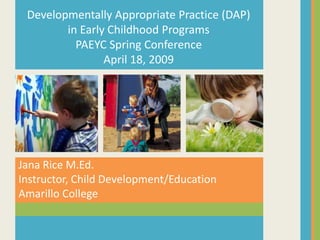
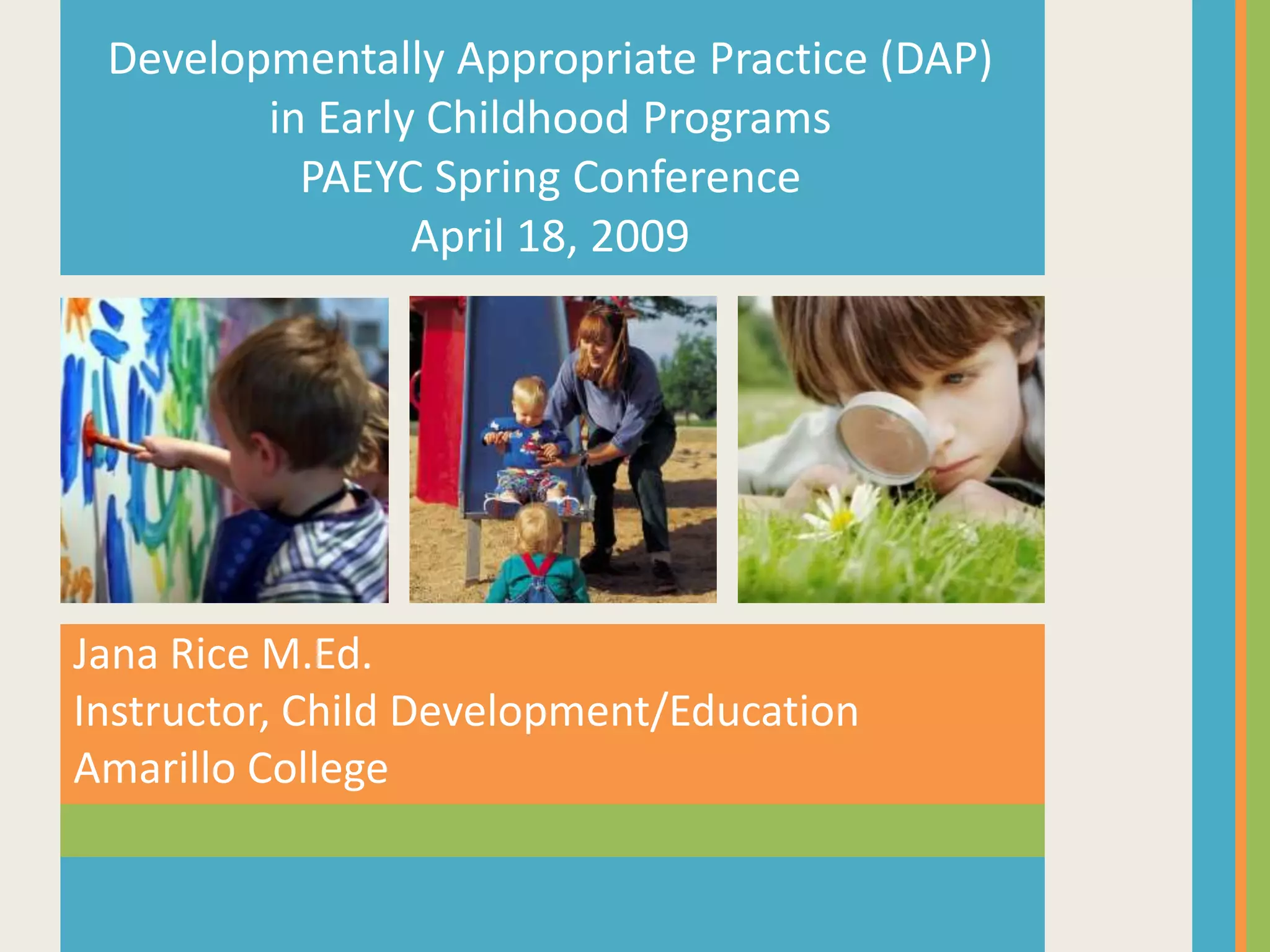
Jana Rice M.Ed.
Instructor, Child Development/Education
Amarillo College
Developmentally Appropriate Practice (DAP)
in Early Childhood Programs
PAEYC Spring Conference
April 18, 2009
Developmentally Appropriate
Practice (DAP)
NAEYC
NationalAssociationfortheEducationofYoung
Children
What is Developmentally Appropriate
Practice?
www.naeyc.org
NAEYC Position Statement DAP
Key Messages of the Position Statement
DAP Video Training Clip
“Your Baby’s Development” Handouts
Zero to Three web site
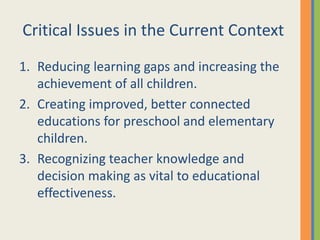
Professional Development
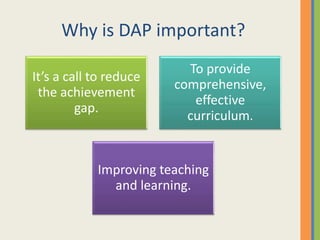
Baby Brain Map
Why is DAP important?
It’s a call to reduce
the achievement
gap.
To provide
comprehensive,
effective
curriculum.
Improving teaching
and learning.
Critical Issues in the Current Context
1. Reducing learning gaps and increasing the
achievement of all children.
2. Creating improved, better connected
educations for preschool and elementary
children.
3. Recognizing teacher knowledge and
decision making as vital to educational
effectiveness.
1. What is known about child
development and learning—
referring to knowledge of
age-related characteristics
that permits general
predictions about what
experiences are likely to best
promote children’s learning
and development.
3 Core Considerations in DAP
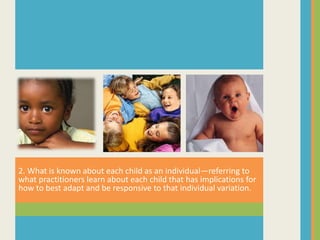
2. What is known about each child as an individual—referring to
what practitioners learn about each child that has implications for
how to best adapt and be responsive to that individual variation.
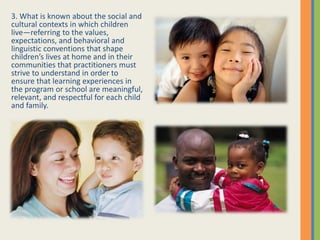
3. What is known about the social and
cultural contexts in which children
live—referring to the values,
expectations, and behavioral and
linguistic conventions that shape
children’s lives at home and in their
communities that practitioners must
strive to understand in order to
ensure that learning experiences in
the program or school are meaningful,
relevant, and respectful for each child
and family.
When thinking about how to
implement DAP…
Ongoing observations about a child’s unique skills, progress,
interests, resources and needs is at the heart of individualizing
the curriculum.
Some of these strategies include:
• Recording children’s behavior to identify current functioning and emerging skills.
• Communicating with parents and other caregivers about behavior in the home and
other settings.
• Identifying different ways children learn and expanding the experiences to
incorporate different learning styles; and
• Modifying the materials, experiences, or environment to encourage new skills.
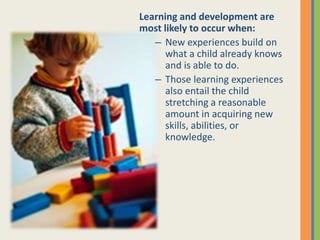
Learning and development are
most likely to occur when:
– New experiences build on
what a child already knows
and is able to do.
– Those learning experiences
also entail the child
stretching a reasonable
amount in acquiring new
skills, abilities, or
knowledge.
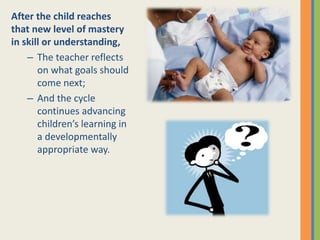
After the child reaches
that new level of mastery
in skill or understanding,
– The teacher reflects
on what goals should
come next;
– And the cycle
continues advancing
children’s learning in
a developmentally
appropriate way.
Such effective teaching doesn’t happen by
chance.
– A hallmark of developmentally
appropriate teaching is
intentionality.
– Good teachers are intentional in
everything they do—setting up the
classroom, planning curriculum,
making use of various teaching
strategies, assessing children,
interacting with them, and working
with their families.
– Intentional teachers are purposeful
and thoughtful about the actions
they take.
– Teachers direct their teaching
toward the goals the program is
trying to help the children reach.
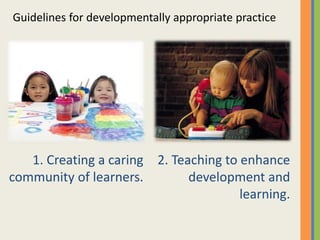
1. Creating a caring
community of learners.
2. Teaching to enhance
development and
learning.
Guidelines for developmentally appropriate practice
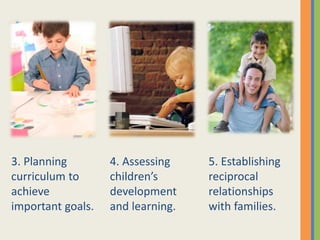
3. Planning
curriculum to
achieve
important goals.
4. Assessing
children’s
development
and learning.
5. Establishing
reciprocal
relationships
with families.
Post-It
Each person needs 5 post-it notes.
There are 5 charts posted around the room.
Each chart contains one of the guidelines for developmentally appropriate practice.
Your task is to write down one thing you do as a teacher to meet each of these
guidelines (include the age you care for).
Then place each post-it on the proper chart.
After the post-its are in place, we will go in groups of 5-10 people and read the ideas
shared.
Write down at least 2 ideas you want to try in your classroom on Monday morning or
in the future!
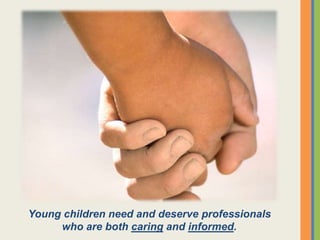
Young children need and deserve professionals
who are both caring and informed.
Resources
• NAEYC, Developmentally Appropriate
Practice in Early Childhood Programs, 3rd
edition, 2009; www.naeyc.org
• Zero to Three, www.zerotothree.org
• Developmental Screening, Assessment, and
Evaluation: Key Elements Individualizing
Curricula in Early Head Start Programs,
Early Head Start National Resource Center,
1996

Dap ppt

  • 1.
    Jana Rice M.Ed. Instructor,Child Development/Education Amarillo College Developmentally Appropriate Practice (DAP) in Early Childhood Programs PAEYC Spring Conference April 18, 2009
  • 2.
  • 3.
    What is DevelopmentallyAppropriate Practice? www.naeyc.org NAEYC Position Statement DAP Key Messages of the Position Statement DAP Video Training Clip
  • 4.
    “Your Baby’s Development”Handouts Zero to Three web site Professional Development Baby Brain Map
  • 5.
    Why is DAPimportant? It’s a call to reduce the achievement gap. To provide comprehensive, effective curriculum. Improving teaching and learning.
  • 6.
    Critical Issues inthe Current Context 1. Reducing learning gaps and increasing the achievement of all children. 2. Creating improved, better connected educations for preschool and elementary children. 3. Recognizing teacher knowledge and decision making as vital to educational effectiveness.
  • 7.
    1. What isknown about child development and learning— referring to knowledge of age-related characteristics that permits general predictions about what experiences are likely to best promote children’s learning and development. 3 Core Considerations in DAP
  • 8.
    2. What isknown about each child as an individual—referring to what practitioners learn about each child that has implications for how to best adapt and be responsive to that individual variation.
  • 9.
    3. What isknown about the social and cultural contexts in which children live—referring to the values, expectations, and behavioral and linguistic conventions that shape children’s lives at home and in their communities that practitioners must strive to understand in order to ensure that learning experiences in the program or school are meaningful, relevant, and respectful for each child and family.
  • 10.
    When thinking abouthow to implement DAP… Ongoing observations about a child’s unique skills, progress, interests, resources and needs is at the heart of individualizing the curriculum. Some of these strategies include: • Recording children’s behavior to identify current functioning and emerging skills. • Communicating with parents and other caregivers about behavior in the home and other settings. • Identifying different ways children learn and expanding the experiences to incorporate different learning styles; and • Modifying the materials, experiences, or environment to encourage new skills.
  • 11.
    Learning and developmentare most likely to occur when: – New experiences build on what a child already knows and is able to do. – Those learning experiences also entail the child stretching a reasonable amount in acquiring new skills, abilities, or knowledge.
  • 12.
    After the childreaches that new level of mastery in skill or understanding, – The teacher reflects on what goals should come next; – And the cycle continues advancing children’s learning in a developmentally appropriate way.
  • 13.
    Such effective teachingdoesn’t happen by chance. – A hallmark of developmentally appropriate teaching is intentionality. – Good teachers are intentional in everything they do—setting up the classroom, planning curriculum, making use of various teaching strategies, assessing children, interacting with them, and working with their families. – Intentional teachers are purposeful and thoughtful about the actions they take. – Teachers direct their teaching toward the goals the program is trying to help the children reach.
  • 14.
    1. Creating acaring community of learners. 2. Teaching to enhance development and learning. Guidelines for developmentally appropriate practice
  • 15.
    3. Planning curriculum to achieve importantgoals. 4. Assessing children’s development and learning. 5. Establishing reciprocal relationships with families.
  • 16.
    Post-It Each person needs5 post-it notes. There are 5 charts posted around the room. Each chart contains one of the guidelines for developmentally appropriate practice. Your task is to write down one thing you do as a teacher to meet each of these guidelines (include the age you care for). Then place each post-it on the proper chart. After the post-its are in place, we will go in groups of 5-10 people and read the ideas shared. Write down at least 2 ideas you want to try in your classroom on Monday morning or in the future!
  • 17.
    Young children needand deserve professionals who are both caring and informed.
  • 18.
    Resources • NAEYC, DevelopmentallyAppropriate Practice in Early Childhood Programs, 3rd edition, 2009; www.naeyc.org • Zero to Three, www.zerotothree.org • Developmental Screening, Assessment, and Evaluation: Key Elements Individualizing Curricula in Early Head Start Programs, Early Head Start National Resource Center, 1996