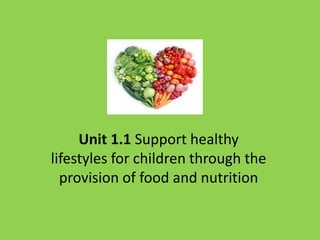
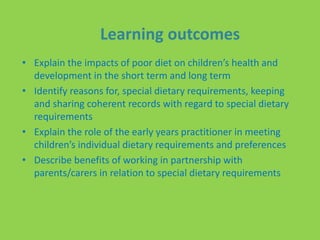
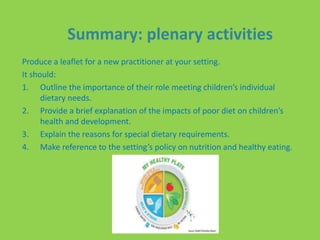
1. The document discusses supporting healthy lifestyles for children through proper nutrition. It outlines the negative impacts of poor diet on children's short and long-term health and development, including issues like malnutrition, obesity, and increased disease risk.
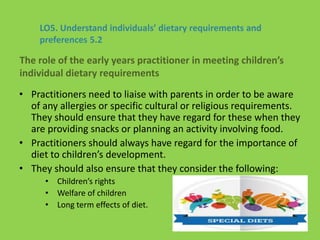
2. There are many reasons a child may have special dietary requirements, including lifestyle preferences, religious or cultural practices, allergies, and medical conditions. It is important for practitioners to keep accurate records and share information to meet individual children's needs.
3. Practitioners play an important role in meeting children's nutritional needs by liaising with parents, considering children's rights and welfare, and acting as a good role model. Working closely in partnership with parents is key to

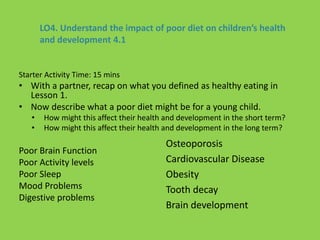
![LO4. Understand the impact of poor diet on children’s health
and development [AC 4.1]
In the short term a poor diet can lead to:
• Malnutrition can cause poor growth and physical
development – a failure to gain height and weight
• Loss of concentration
• Tiredness
• Increased susceptibility to infections
• Tooth decay – caused by sugary foods
• Bleeding gums
• Poor skin and hair condition
• Obesity.
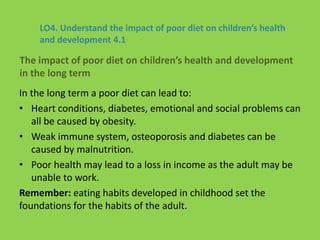
The impact of poor diet on children’s health and development
in the short term](https://image.slidesharecdn.com/u1-151028195148-lva1-app6892/85/U1-1-lesson3-lo4-lo5-4-320.jpg)
![LO4. Understand the impact of poor diet on children’s health
and development [AC 4.1]
Time: 15 mins
With a partner discuss how the short term issues may have an
impact in the long term.
• Consider how they may impact on a person’s health, mental
and social well-being.
• How can loss of concentration impact on health and
development in the long term?
• What is the difference between malnutrition and under-
nutrition?](https://image.slidesharecdn.com/u1-151028195148-lva1-app6892/85/U1-1-lesson3-lo4-lo5-5-320.jpg)
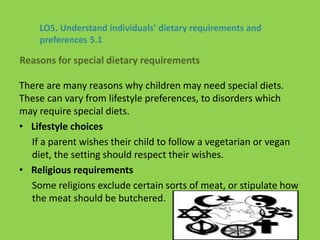
![• Cultural requirements
Many cultures have special food for special festivals, e.g.
pancakes on Shrove Tuesday.
Sort your given cultural variations in diet hand out produce a
table
• Disorders
Food allergies, food intolerances, diabetes,
overweight/underweight children, children who have
digestive or chewing difficulties.
LO5. Understand individuals’ dietary requirements and
preferences [AC 5.1]
Reasons for special dietary requirements (continued)](https://image.slidesharecdn.com/u1-151028195148-lva1-app6892/85/U1-1-lesson3-lo4-lo5-8-320.jpg)
![• Practitioners should have regard to all relevant legislation.
• According to the EYFS, before admitting a child to the setting,
the practitioner should ask if the child has any special dietary
needs or food allergies and should ensure that they have an
emergency contact number. They will also need to take
account of parents’ wishes, e.g. cultural or religious
requirements.
• Practitioners will need to ensure that this information is
regularly updated and should share it with all adults who
work with the children to ensure their health and safety.
LO5. Understand individuals’ dietary requirements and
preferences [AC 5.1]
Reasons for keeping and sharing coherent records with regard
to special dietary requirements](https://image.slidesharecdn.com/u1-151028195148-lva1-app6892/85/U1-1-lesson3-lo4-lo5-9-320.jpg)
![• It is important to collect this information so that the practitioner is
fully informed. When providing snacks, meals or carrying out food
activities, the practitioner will use this information to ensure the
safety of all children, e.g. if a child is lactose intolerant they will
need to be given options other than milk to drink.
• If children bring in sweets for a birthday treat to share with the
class, practitioners may need to know of any cultural requirements
as some sweets containing gelatin may not be allowed.
• A practitioner will need to know of any children who are allergic to
peanuts, as this could result in anaphylactic shock and the
practitioner will need to know what to do in this situation.
• Anyone who works with the children will need to share this
information.
LO5. Understand individuals’ dietary requirements and
preferences [AC 5.1]
Reasons for keeping and sharing coherent records with regard
to special dietary requirements (continued)](https://image.slidesharecdn.com/u1-151028195148-lva1-app6892/85/U1-1-lesson3-lo4-lo5-10-320.jpg)
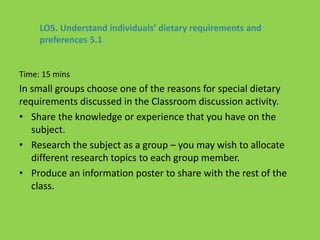
![Time: 15 mins
1. What is the difference between a food allergy and a food
intolerance?
• Research the symptoms of an allergic reaction and what you,
as a practitioner, should do if a child has one.
2. What is anaphylaxis?
• Research this and what to do if a child has an anaphylactic
shock.
3. Why is gelatin banned in some religions?
• Research the use of gelatin in sweets.
LO5. Understand individuals’ dietary requirements and
preferences [AC 5.1]](https://image.slidesharecdn.com/u1-151028195148-lva1-app6892/85/U1-1-lesson3-lo4-lo5-11-320.jpg)
![Time: 15 mins
Now that you have researched food allergies and food
intolerances, work together to list other reasons there might be
for special dietary requirements.
Consider:
• Health reasons
• Religious reasons
• Personal preferences.
List issues under all of these reasons.
LO5. Understand individuals’ dietary requirements and
preferences [AC 5.1]](https://image.slidesharecdn.com/u1-151028195148-lva1-app6892/85/U1-1-lesson3-lo4-lo5-12-320.jpg)
![LO5. Understand individuals’ dietary requirements and
preferences [AC 5.3]
Benefits of working in partnership with parents/carers in
relation to special dietary requirements
• Practitioners need to remember that the parent/carer is the
‘expert’ on their child. It is, therefore, very important for
practitioners to work closely with parents or carers. An open door
policy is helpful in achieving this.
• Parents/carers can update practitioners on changing dietary
conditions, they can explain the child’s condition to the practitioner
and educate them about the condition, they can suggest alternative
foods.
• Parents could be invited into the setting to run food activities with
groups of children. This could introduce children to foods from
other cultures.](https://image.slidesharecdn.com/u1-151028195148-lva1-app6892/85/U1-1-lesson3-lo4-lo5-15-320.jpg)
![Time: 15 mins
What is the role of the practitioner in meeting children’s individual
dietary requirements?
Consider:
• Children’s rights
• Current frameworks
• The welfare of children
• Long term effects on children
• Providing a good role model.
Focus on:
Liaising with parents/carers.
LO5. Understand individuals’ dietary requirements and
preferences [AC 5.2, 5.3]](https://image.slidesharecdn.com/u1-151028195148-lva1-app6892/85/U1-1-lesson3-lo4-lo5-16-320.jpg)
![Time: 15 mins
Research the following conditions:
• Coeliac condition
• Cystic fibrosis
• Galactosaemia
• Diabetes.
Choose one of these and write a weekly menu for a child in your
setting with this condition.
LO5. Understand individuals’ dietary requirements and
preferences [AC 5.1, 5.2]](https://image.slidesharecdn.com/u1-151028195148-lva1-app6892/85/U1-1-lesson3-lo4-lo5-17-320.jpg)
![U1.5 lesson3[lo4,lo8]](https://cdn.slidesharecdn.com/ss_thumbnails/u1-150917095042-lva1-app6891-thumbnail.jpg?width=640&height=640&fit=bounds)

![U1.4 lesson4[lo4]](https://cdn.slidesharecdn.com/ss_thumbnails/u1-151115201506-lva1-app6891-thumbnail.jpg?width=640&height=640&fit=bounds)
![U1.5 lesson2[lo2,lo3]](https://cdn.slidesharecdn.com/ss_thumbnails/u1-150917093644-lva1-app6891-thumbnail.jpg?width=640&height=640&fit=bounds)
![U1.4 lesson3[lo3] copy](https://cdn.slidesharecdn.com/ss_thumbnails/u1-151115201251-lva1-app6892-thumbnail.jpg?width=640&height=640&fit=bounds)
![U3.1 lesson1[lo1,lo2,lo3]](https://cdn.slidesharecdn.com/ss_thumbnails/u3-160429093724-thumbnail.jpg?width=640&height=640&fit=bounds)


![U1.1 lesson2[lo2]](https://cdn.slidesharecdn.com/ss_thumbnails/u1-151028190936-lva1-app6891-thumbnail.jpg?width=640&height=640&fit=bounds)
![U1.1 lesson3[lo3]](https://cdn.slidesharecdn.com/ss_thumbnails/u1-151028192313-lva1-app6891-thumbnail.jpg?width=640&height=640&fit=bounds)
![U1.1 lesson5[lo6]](https://cdn.slidesharecdn.com/ss_thumbnails/u1-151028201916-lva1-app6892-thumbnail.jpg?width=640&height=640&fit=bounds)
![U2.2 lesson5[lo3]](https://cdn.slidesharecdn.com/ss_thumbnails/u2-160107133302-thumbnail.jpg?width=640&height=640&fit=bounds)
![U1.3 lesson1[lo1]](https://cdn.slidesharecdn.com/ss_thumbnails/u1-150904124606-lva1-app6891-thumbnail.jpg?width=640&height=640&fit=bounds)

![U1.5 lesson1[lo1]](https://cdn.slidesharecdn.com/ss_thumbnails/u1-150917093400-lva1-app6892-thumbnail.jpg?width=640&height=640&fit=bounds)
![U1.5 lesson5[lo6]](https://cdn.slidesharecdn.com/ss_thumbnails/u1-150924185608-lva1-app6891-thumbnail.jpg?width=640&height=640&fit=bounds)
![U1.3 lesson4[lo6]](https://cdn.slidesharecdn.com/ss_thumbnails/u1-150904125355-lva1-app6892-thumbnail.jpg?width=640&height=640&fit=bounds)
![U2.2 lesson3[lo2]](https://cdn.slidesharecdn.com/ss_thumbnails/u2-160107133108-thumbnail.jpg?width=640&height=640&fit=bounds)


![U1.4 lesson1[lo1] copy](https://cdn.slidesharecdn.com/ss_thumbnails/u1-151115200808-lva1-app6891-thumbnail.jpg?width=640&height=640&fit=bounds)

![U1.3 lesson2[lo2,lo3,lo4]](https://cdn.slidesharecdn.com/ss_thumbnails/u1-150904124808-lva1-app6891-thumbnail.jpg?width=640&height=640&fit=bounds)


