OUTCOME-BASED EDUCATION (OBE)
UTHM
&
Pusat Pembelajaran & Pengajaran,
Akademi Kepimpinan Pengajian Tinggi (AKEPT)
Acknowledgement
Prof. Ir. Dr. Mohd Jailani Mohd Nor (UKM)
Prof. Ir. Dr. Riza Atiq Abdullah O.K. Rahmat (UKM)
Prof. Ir. Dr. Wan Hamidon (UKM)
Prof Dr. Shahrin Mohammad (UTM)
Prof. Dr. Wahid Razzaly (UTHM)
Prof. John Biggs (HKOU)
AP Dr. Claus Brabrand (IT-University of Copenhagen)
Faculty of Civil & Environmental Engineering (UTHM)
Others who have contributed.
Outcomes
 Constructive Alignment
 Continuous Quality Improvement (CQI)
 Closing the Loop
 Outcome-Based Education (OBE)
 Learning & Teaching (Delivery)
 Learning & Teaching (Assessment)
 Learning & Teaching (KPI)
PROJECT CA1
2/24/2024 4
• Develop a learning and teaching plan on the
topic that demonstrate how CA is applied in the
learning and teaching process.
Outcome
• Select a programme of your expert area.
• Select a topic of a course.
• Develop a learning and teaching plan on the
topic.
• Demonstrate how the delivery and the
assessment could be assured of contributing to
the desired Learning Outcomes.
Process
• Well designed CA document
• Present your design to other participants
Performance
Indicators
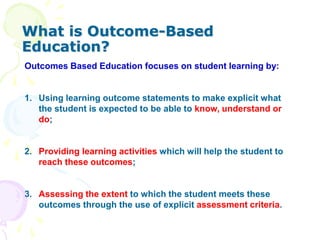
What is Outcome-Based
Education?
Outcomes Based Education focuses on student learning by:
1. Using learning outcome statements to make explicit what
the student is expected to be able to know, understand or
do;
2. Providing learning activities which will help the student to
reach these outcomes;
3. Assessing the extent to which the student meets these
outcomes through the use of explicit assessment criteria.
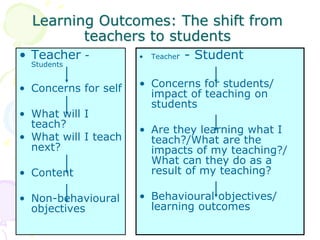
Learning Outcomes: The shift from
teachers to students
• Teacher -
Students
• Concerns for self
• What will I
teach?
• What will I teach
next?
• Content
• Non-behavioural
objectives
• Teacher - Student
• Concerns for students/
impact of teaching on
students
• Are they learning what I
teach?/What are the
impacts of my teaching?/
What can they do as a
result of my teaching?
• Behavioural objectives/
learning outcomes
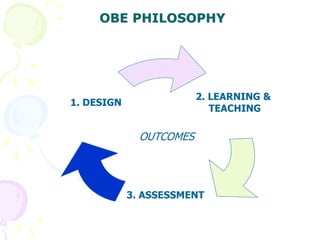
OBE PHILOSOPHY
2. LEARNING &
TEACHING
3. ASSESSMENT
1. DESIGN
OUTCOMES
OUTCOME BASED EDUCATION
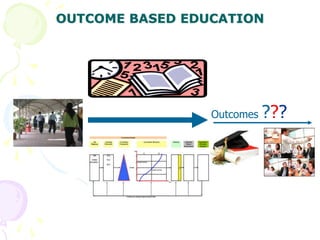
Outcomes ???
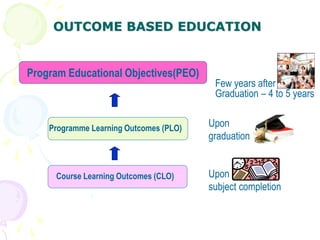
Program Educational Objectives(PEO)
Programme Learning Outcomes (PLO)
Course Learning Outcomes (CLO)
Upon
graduation
Upon
subject completion
Few years after
Graduation – 4 to 5 years
OUTCOME BASED EDUCATION
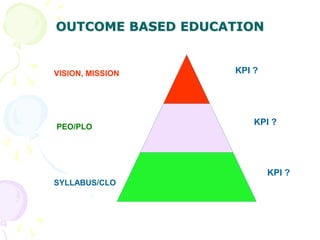
PEO/PLO
SYLLABUS/CLO
VISION, MISSION KPI ?
KPI ?
KPI ?
OUTCOME BASED EDUCATION
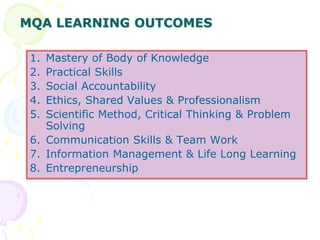
MQA LEARNING OUTCOMES
1. Mastery of Body of Knowledge
2. Practical Skills
3. Social Accountability
4. Ethics, Shared Values & Professionalism
5. Scientific Method, Critical Thinking & Problem
Solving
6. Communication Skills & Team Work
7. Information Management & Life Long Learning
8. Entrepreneurship
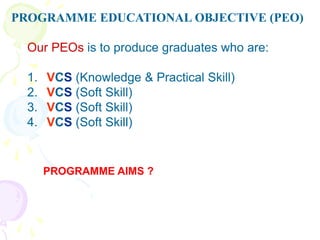
PROGRAMME EDUCATIONAL OBJECTIVE (PEO)
Our PEOs is to produce graduates who are:
1. VCS (Knowledge & Practical Skill)
2. VCS (Soft Skill)
3. VCS (Soft Skill)
4. VCS (Soft Skill)
PROGRAMME AIMS ?
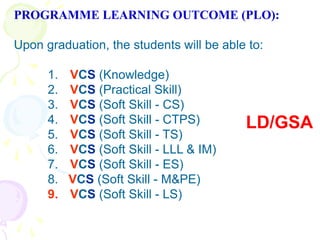
PROGRAMME LEARNING OUTCOME (PLO):
Upon graduation, the students will be able to:
1. VCS (Knowledge)
2. VCS (Practical Skill)
3. VCS (Soft Skill - CS)
4. VCS (Soft Skill - CTPS)
5. VCS (Soft Skill - TS)
6. VCS (Soft Skill - LLL & IM)
7. VCS (Soft Skill - ES)
8. VCS (Soft Skill - M&PE)
9. VCS (Soft Skill - LS)
LD/GSA
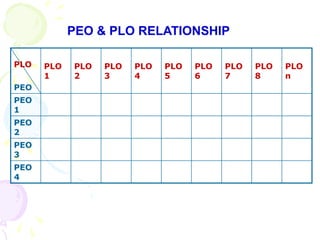
PEO & PLO RELATIONSHIP
PLO
PEO
PLO
1
PLO
2
PLO
3
PLO
4
PLO
5
PLO
6
PLO
7
PLO
8
PLO
n
PEO
1
PEO
2
PEO
3
PEO
4
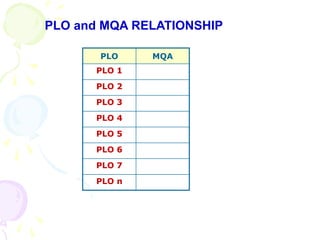
PLO and MQA RELATIONSHIP
PLO MQA
PLO 1
PLO 2
PLO 3
PLO 4
PLO 5
PLO 6
PLO 7
PLO n
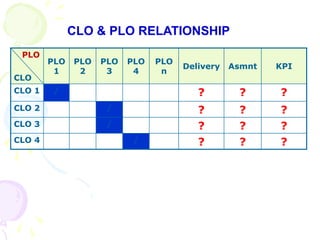
CLO & PLO RELATIONSHIP
PLO
CLO
PLO
1
PLO
2
PLO
3
PLO
4
PLO
n
Delivery Asmnt KPI
CLO 1 / ? ? ?
CLO 2 / ? ? ?
CLO 3 / ? ? ?
CLO 4 / ? ? ?
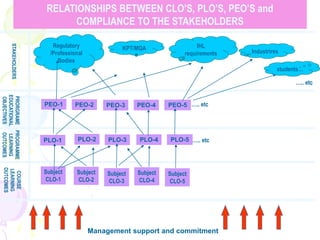
STAKEHOLDERS
PRORGRAME
EDUCATIONAL
OBJECTIVES
Management support and commitment
PEO-1
Regulatory
/Professional
Bodies
RELATIONSHIPS BETWEEN CLO’S, PLO’S, PEO’S and
COMPLIANCE TO THE STAKEHOLDERS
KPT/MQA IHL
requirements Industrires
students…
….. etc
PEO-2 PEO-3 PEO-4 PEO-5 ….. etc
PLO-1 PLO-2 PLO-3 PLO-4 PLO-5 ….. etc
PROGRAMME
LEARNING
OUTCOMES
Subject
CLO-1
COURSE
LEARNING
OUTCOMES
Subject
CLO-3
Subject
CLO-4
Subject
CLO-5
Subject
CLO-2
LEARNING OUTCOMES DEVELOPMENT
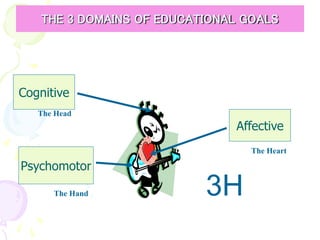
THE 3 DOMAINS OF EDUCATIONAL GOALS
Psychomotor
Affective
Cognitive
The Heart
The Hand
The Head
3H
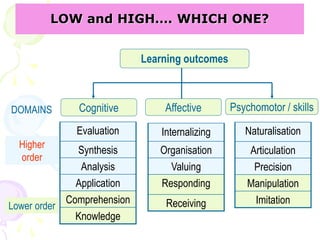
Learning outcomes
Cognitive Affective Psychomotor / skills
DOMAINS
Evaluation
Synthesis
Analysis
Application
Comprehension
Knowledge
Internalizing
Organisation
Valuing
Responding
Receiving
Naturalisation
Articulation
Precision
Manipulation
Imitation
Higher
order
Lower order
LOW and HIGH…. WHICH ONE?
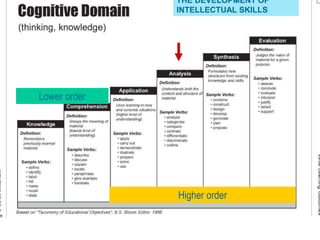
Higher order
Lower order
THE DEVELOPMENT OF
INTELLECTUAL SKILLS
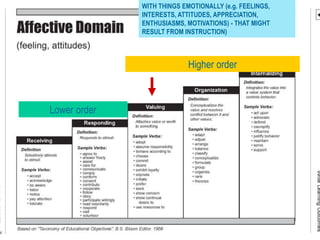
Higher order
Lower order
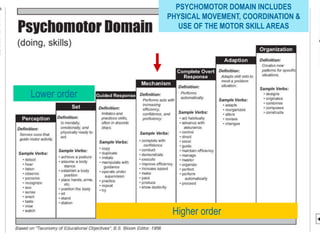
PSYCHOMOTOR DOMAIN INCLUDES
PHYSICAL MOVEMENT, COORDINATION &
USE OF THE MOTOR SKILL AREAS
Higher order
Lower order
WITH THINGS EMOTIONALLY (e.g. FEELINGS,
INTERESTS, ATTITUDES, APPRECIATION,
ENTHUSIASMS, MOTIVATIONS) - THAT MIGHT
RESULT FROM INSTRUCTION)
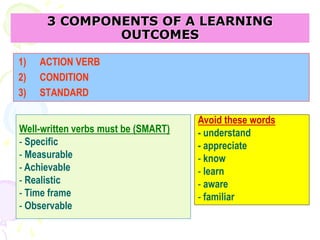
3 COMPONENTS OF A LEARNING
OUTCOMES
1) ACTION VERB
2) CONDITION
3) STANDARD
Well-written verbs must be (SMART)
- Specific
- Measurable
- Achievable
- Realistic
- Time frame
- Observable
Avoid these words
- understand
- appreciate
- know
- learn
- aware
- familiar
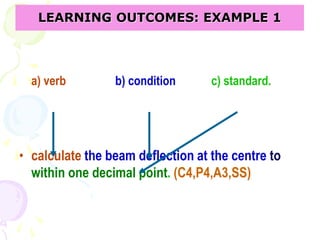
LEARNING OUTCOMES: EXAMPLE 1
a) verb b) condition c) standard.
• calculate the beam deflection at the centre to
within one decimal point. (C4,P4,A3,SS)
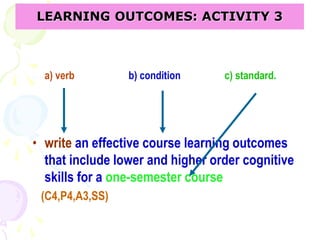
a) verb b) condition c) standard.
• write an effective course learning outcomes
that include lower and higher order cognitive
skills for a one-semester course
(C4,P4,A3,SS)
LEARNING OUTCOMES: ACTIVITY 3
“Bad Teacher complains,
Mediocre Teacher teaches,
Good Teacher explains,
Better Teacher demonstrates,
Best Teacher motivates and
Great Teacher inspires.”
(King Teacher)
Constructive Alignment
"When there is alignment between what we want,
how we teach and how we assess... students
are entrapped in a web of consistency, optimising
the likelihood that they will engage the
appropriate learning activities, but paradoxically
leaving them free to construct their knowledge
their way." (Biggs, 2003: 27)
What is Constructive Alignment?
Constructive alignment is the idea that whenever we design
and teach a new unit, subject or course, we should:
• Think about what we believe students should be able to do
by the end (intended learning outcomes);
• Think about how we might assess those outcomes
(assessment tasks and marking criteria);
What is Constructive Alignment? Cont..
• Look at what students need to know and understand in
order to achieve those outcomes (concepts, practical
skills, content);
• Design teaching/learning activities which will help students
develop the understanding and skills they need to achieve
intended learning outcomes (teaching/learning activities);
• Make the links between intended learning outcomes,
assessment and learning activities clear to students.
There are two parts to constructive alignment:
• Students construct meaning from what they do to learn.
• The teacher aligns the planned learning activities with
the learning outcomes.
Essentially, in summary, Biggs’ model of ‘constructive
alignment’ requires a shift in thinking about the process
of course design, to the following three stage model:
• Identify clear learning outcomes.
• Design appropriate assessment tasks that will directly
assess whether each of the learning outcomes has been
met.
• Design appropriate learning opportunities for the
students to get them to a point where they can
successfully undertake the assessment tasks.
Critical components to consider for
constructive alignment are:
§ The curriculum
§ The teaching methods
§ The assessment procedures
§ The student-teacher relation
§ The institutional climate
The curriculum has to be at the centre and must determine
the TLAs (teaching and learning activities) and the
assessment.
[ 63 ]
Claus Brabrand (ITU) DMLF Årsmøde 2007 – keynote Sep 20, 2007
Teacher’s
intention
Student’s
activity
Exam’s
assessment

e.g.
- explain
- relate
- prove
- apply
e.g.
- memorize
- describe
UNALIGNED COURSE
e.g.
- memorize
- describe
"Dealing with the test"
[ 64 ]
Claus Brabrand (ITU) DMLF Årsmøde 2007 – keynote Sep 20, 2007
Teacher’s
intention
Student’s
activity
Exam’s
assessment

e.g.
- explain
- relate
- prove
- apply
ALIGNED COURSE
e.g.
- explain
- relate
- prove
- apply
e.g.
- explain
- relate
- prove
- apply
e.g.
- explain
- relate
- prove
- apply
e.g.
- explain
- relate
- prove
- apply
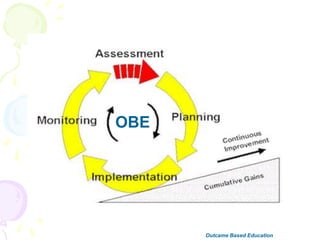
OBE
Outcame Based Education
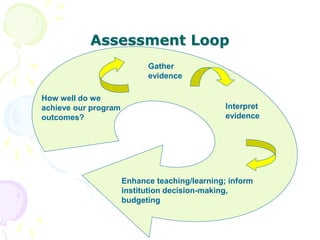
Assessment Loop
How well do we
achieve our program
outcomes?
Gather
evidence
Interpret
evidence
Enhance teaching/learning; inform
institution decision-making,
budgeting
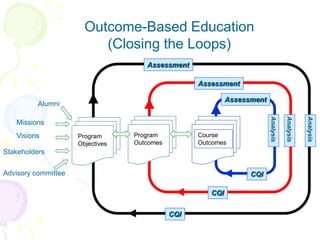
Program
Outcomes
Program
Objectives
Missions
Visions
Stakeholders
Course
Outcomes
Advisory committee
Outcome-Based Education
(Closing the Loops)
Alumni
Assessment
Assessment
Assessment
CQI
CQI
CQI
Analysis
Analysis
Analysis
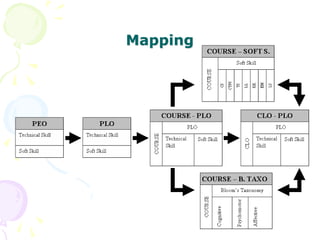
Mapping
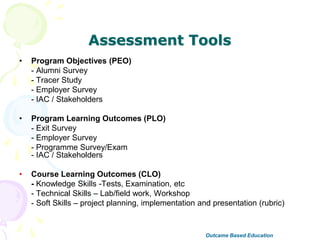
Assessment Tools
• Program Objectives (PEO)
- Alumni Survey
- Tracer Study
- Employer Survey
- IAC / Stakeholders
• Program Learning Outcomes (PLO)
- Exit Survey
- Employer Survey
- Programme Survey/Exam
- IAC / Stakeholders
• Course Learning Outcomes (CLO)
- Knowledge Skills -Tests, Examination, etc
- Technical Skills – Lab/field work, Workshop
- Soft Skills – project planning, implementation and presentation (rubric)
Outcame Based Education
Program
Outcomes
Program
Objectives
Missions
Visions
Stakeholders
Course
Outcomes
Advisory committee
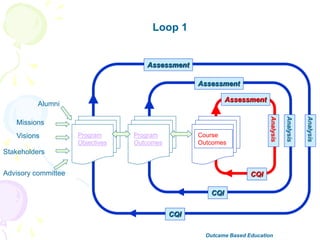
Loop 1
Alumni
Assessment
Assessment
Assessment
CQI
CQI
CQI
Analysis
Analysis
Analysis
Outcame Based Education
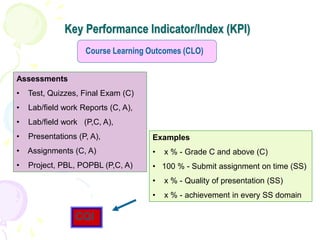
Key Performance Indicator/Index (KPI)
Course Learning Outcomes (CLO)
Examples
• x % - Grade C and above (C)
• 100 % - Submit assignment on time (SS)
• x % - Quality of presentation (SS)
• x % - achievement in every SS domain
Assessments
• Test, Quizzes, Final Exam (C)
• Lab/field work Reports (C, A),
• Lab/field work (P,C, A),
• Presentations (P, A),
• Assignments (C, A)
• Project, PBL, POPBL (P,C, A)
CQI
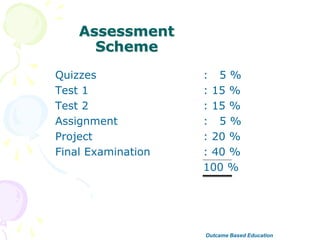
Assessment
Scheme
Quizzes : 5 %
Test 1 : 15 %
Test 2 : 15 %
Assignment : 5 %
Project : 20 %
Final Examination : 40 %
100 %
Outcame Based Education
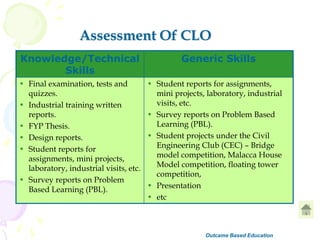
Assessment Of CLO
Knowledge/Technical
Skills
Generic Skills
• Final examination, tests and
quizzes.
• Industrial training written
reports.
• FYP Thesis.
• Design reports.
• Student reports for
assignments, mini projects,
laboratory, industrial visits, etc.
• Survey reports on Problem
Based Learning (PBL).
• Student reports for assignments,
mini projects, laboratory, industrial
visits, etc.
• Survey reports on Problem Based
Learning (PBL).
• Student projects under the Civil
Engineering Club (CEC) – Bridge
model competition, Malacca House
Model competition, floating tower
competition,
• Presentation
• etc
Outcame Based Education
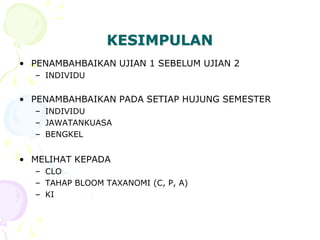
KESIMPULAN
• PENAMBAHBAIKAN UJIAN 1 SEBELUM UJIAN 2
– INDIVIDU
• PENAMBAHBAIKAN PADA SETIAP HUJUNG SEMESTER
– INDIVIDU
– JAWATANKUASA
– BENGKEL
• MELIHAT KEPADA
– CLO
– TAHAP BLOOM TAXANOMI (C, P, A)
– KI
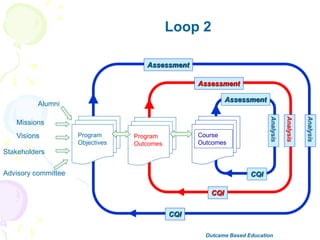
Program
Outcomes
Program
Objectives
Missions
Visions
Stakeholders
Course
Outcomes
Advisory committee
Loop 2
Alumni
Assessment
Assessment
Assessment
CQI
CQI
CQI
Analysis
Analysis
Analysis
Outcame Based Education
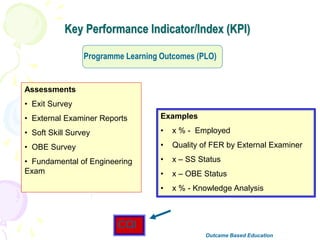
Key Performance Indicator/Index (KPI)
Programme Learning Outcomes (PLO)
Assessments
• Exit Survey
• External Examiner Reports
• Soft Skill Survey
• OBE Survey
• Fundamental of Engineering
Exam
Examples
• x % - Employed
• Quality of FER by External Examiner
• x – SS Status
• x – OBE Status
• x % - Knowledge Analysis
CQI
Outcame Based Education
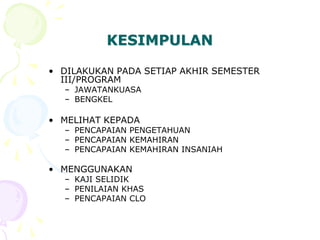
KESIMPULAN
• DILAKUKAN PADA SETIAP AKHIR SEMESTER
III/PROGRAM
– JAWATANKUASA
– BENGKEL
• MELIHAT KEPADA
– PENCAPAIAN PENGETAHUAN
– PENCAPAIAN KEMAHIRAN
– PENCAPAIAN KEMAHIRAN INSANIAH
• MENGGUNAKAN
– KAJI SELIDIK
– PENILAIAN KHAS
– PENCAPAIAN CLO
Program
Outcomes
Program
Objectives
Missions
Visions
Stakeholders
Course
Outcomes
Advisory committee
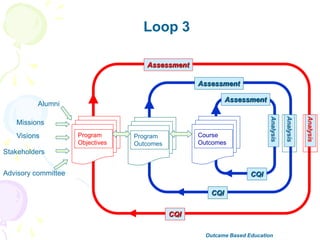
Loop 3
Alumni
Assessment
Assessment
Assessment
CQI
CQI
CQI
Analysis
Analysis
Analysis
Outcame Based Education
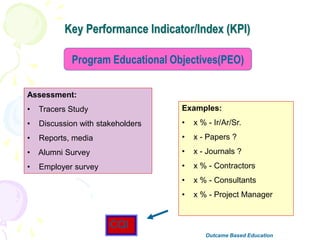
Key Performance Indicator/Index (KPI)
Program Educational Objectives(PEO)
Examples:
• x % - Ir/Ar/Sr.
• x - Papers ?
• x - Journals ?
• x % - Contractors
• x % - Consultants
• x % - Project Manager
Assessment:
• Tracers Study
• Discussion with stakeholders
• Reports, media
• Alumni Survey
• Employer survey
CQI
Outcame Based Education
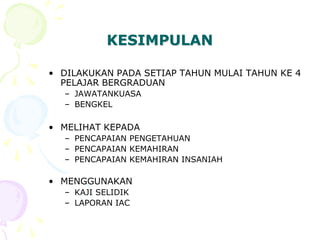
KESIMPULAN
• DILAKUKAN PADA SETIAP TAHUN MULAI TAHUN KE 4
PELAJAR BERGRADUAN
– JAWATANKUASA
– BENGKEL
• MELIHAT KEPADA
– PENCAPAIAN PENGETAHUAN
– PENCAPAIAN KEMAHIRAN
– PENCAPAIAN KEMAHIRAN INSANIAH
• MENGGUNAKAN
– KAJI SELIDIK
– LAPORAN IAC
DOKUMENKAN!!!!!!!
Outcomes
 Constructive Alignment
 Continuous Quality Improvement (CQI)
 Closing the Loop
 Outcome-Based Education (OBE)
 Learning & Teaching (Delivery)
 Learning & Teaching (Assessment)
 Learning & Teaching (KPI)
Output Based Education curriculum in masters

Output Based Education curriculum in masters

  • 1.
    OUTCOME-BASED EDUCATION (OBE) UTHM & PusatPembelajaran & Pengajaran, Akademi Kepimpinan Pengajian Tinggi (AKEPT)
  • 2.
    Acknowledgement Prof. Ir. Dr.Mohd Jailani Mohd Nor (UKM) Prof. Ir. Dr. Riza Atiq Abdullah O.K. Rahmat (UKM) Prof. Ir. Dr. Wan Hamidon (UKM) Prof Dr. Shahrin Mohammad (UTM) Prof. Dr. Wahid Razzaly (UTHM) Prof. John Biggs (HKOU) AP Dr. Claus Brabrand (IT-University of Copenhagen) Faculty of Civil & Environmental Engineering (UTHM) Others who have contributed.
  • 3.
    Outcomes  Constructive Alignment Continuous Quality Improvement (CQI)  Closing the Loop  Outcome-Based Education (OBE)  Learning & Teaching (Delivery)  Learning & Teaching (Assessment)  Learning & Teaching (KPI)
  • 4.
    PROJECT CA1 2/24/2024 4 •Develop a learning and teaching plan on the topic that demonstrate how CA is applied in the learning and teaching process. Outcome • Select a programme of your expert area. • Select a topic of a course. • Develop a learning and teaching plan on the topic. • Demonstrate how the delivery and the assessment could be assured of contributing to the desired Learning Outcomes. Process • Well designed CA document • Present your design to other participants Performance Indicators
  • 5.
    What is Outcome-Based Education? OutcomesBased Education focuses on student learning by: 1. Using learning outcome statements to make explicit what the student is expected to be able to know, understand or do; 2. Providing learning activities which will help the student to reach these outcomes; 3. Assessing the extent to which the student meets these outcomes through the use of explicit assessment criteria.
  • 6.
    Learning Outcomes: Theshift from teachers to students • Teacher - Students • Concerns for self • What will I teach? • What will I teach next? • Content • Non-behavioural objectives • Teacher - Student • Concerns for students/ impact of teaching on students • Are they learning what I teach?/What are the impacts of my teaching?/ What can they do as a result of my teaching? • Behavioural objectives/ learning outcomes
  • 7.
    OBE PHILOSOPHY 2. LEARNING& TEACHING 3. ASSESSMENT 1. DESIGN OUTCOMES
  • 9.
  • 10.
    Program Educational Objectives(PEO) ProgrammeLearning Outcomes (PLO) Course Learning Outcomes (CLO) Upon graduation Upon subject completion Few years after Graduation – 4 to 5 years OUTCOME BASED EDUCATION
  • 11.
    PEO/PLO SYLLABUS/CLO VISION, MISSION KPI? KPI ? KPI ? OUTCOME BASED EDUCATION
  • 12.
    MQA LEARNING OUTCOMES 1.Mastery of Body of Knowledge 2. Practical Skills 3. Social Accountability 4. Ethics, Shared Values & Professionalism 5. Scientific Method, Critical Thinking & Problem Solving 6. Communication Skills & Team Work 7. Information Management & Life Long Learning 8. Entrepreneurship
  • 13.
    PROGRAMME EDUCATIONAL OBJECTIVE(PEO) Our PEOs is to produce graduates who are: 1. VCS (Knowledge & Practical Skill) 2. VCS (Soft Skill) 3. VCS (Soft Skill) 4. VCS (Soft Skill) PROGRAMME AIMS ?
  • 14.
    PROGRAMME LEARNING OUTCOME(PLO): Upon graduation, the students will be able to: 1. VCS (Knowledge) 2. VCS (Practical Skill) 3. VCS (Soft Skill - CS) 4. VCS (Soft Skill - CTPS) 5. VCS (Soft Skill - TS) 6. VCS (Soft Skill - LLL & IM) 7. VCS (Soft Skill - ES) 8. VCS (Soft Skill - M&PE) 9. VCS (Soft Skill - LS) LD/GSA
  • 15.
    PEO & PLORELATIONSHIP PLO PEO PLO 1 PLO 2 PLO 3 PLO 4 PLO 5 PLO 6 PLO 7 PLO 8 PLO n PEO 1 PEO 2 PEO 3 PEO 4
  • 16.
    PLO and MQARELATIONSHIP PLO MQA PLO 1 PLO 2 PLO 3 PLO 4 PLO 5 PLO 6 PLO 7 PLO n
  • 17.
    CLO & PLORELATIONSHIP PLO CLO PLO 1 PLO 2 PLO 3 PLO 4 PLO n Delivery Asmnt KPI CLO 1 / ? ? ? CLO 2 / ? ? ? CLO 3 / ? ? ? CLO 4 / ? ? ?
  • 18.
    STAKEHOLDERS PRORGRAME EDUCATIONAL OBJECTIVES Management support andcommitment PEO-1 Regulatory /Professional Bodies RELATIONSHIPS BETWEEN CLO’S, PLO’S, PEO’S and COMPLIANCE TO THE STAKEHOLDERS KPT/MQA IHL requirements Industrires students… ….. etc PEO-2 PEO-3 PEO-4 PEO-5 ….. etc PLO-1 PLO-2 PLO-3 PLO-4 PLO-5 ….. etc PROGRAMME LEARNING OUTCOMES Subject CLO-1 COURSE LEARNING OUTCOMES Subject CLO-3 Subject CLO-4 Subject CLO-5 Subject CLO-2
  • 19.
  • 20.
    THE 3 DOMAINSOF EDUCATIONAL GOALS Psychomotor Affective Cognitive The Heart The Hand The Head 3H
  • 21.
    Learning outcomes Cognitive AffectivePsychomotor / skills DOMAINS Evaluation Synthesis Analysis Application Comprehension Knowledge Internalizing Organisation Valuing Responding Receiving Naturalisation Articulation Precision Manipulation Imitation Higher order Lower order LOW and HIGH…. WHICH ONE?
  • 22.
    Higher order Lower order THEDEVELOPMENT OF INTELLECTUAL SKILLS
  • 23.
    Higher order Lower order PSYCHOMOTORDOMAIN INCLUDES PHYSICAL MOVEMENT, COORDINATION & USE OF THE MOTOR SKILL AREAS
  • 24.
    Higher order Lower order WITHTHINGS EMOTIONALLY (e.g. FEELINGS, INTERESTS, ATTITUDES, APPRECIATION, ENTHUSIASMS, MOTIVATIONS) - THAT MIGHT RESULT FROM INSTRUCTION)
  • 25.
    3 COMPONENTS OFA LEARNING OUTCOMES 1) ACTION VERB 2) CONDITION 3) STANDARD Well-written verbs must be (SMART) - Specific - Measurable - Achievable - Realistic - Time frame - Observable Avoid these words - understand - appreciate - know - learn - aware - familiar
  • 26.
    LEARNING OUTCOMES: EXAMPLE1 a) verb b) condition c) standard. • calculate the beam deflection at the centre to within one decimal point. (C4,P4,A3,SS)
  • 27.
    a) verb b)condition c) standard. • write an effective course learning outcomes that include lower and higher order cognitive skills for a one-semester course (C4,P4,A3,SS) LEARNING OUTCOMES: ACTIVITY 3
  • 28.
    “Bad Teacher complains, MediocreTeacher teaches, Good Teacher explains, Better Teacher demonstrates, Best Teacher motivates and Great Teacher inspires.” (King Teacher)
  • 29.
  • 30.
    Constructive Alignment "When thereis alignment between what we want, how we teach and how we assess... students are entrapped in a web of consistency, optimising the likelihood that they will engage the appropriate learning activities, but paradoxically leaving them free to construct their knowledge their way." (Biggs, 2003: 27)
  • 31.
    What is ConstructiveAlignment? Constructive alignment is the idea that whenever we design and teach a new unit, subject or course, we should: • Think about what we believe students should be able to do by the end (intended learning outcomes); • Think about how we might assess those outcomes (assessment tasks and marking criteria);
  • 32.
    What is ConstructiveAlignment? Cont.. • Look at what students need to know and understand in order to achieve those outcomes (concepts, practical skills, content); • Design teaching/learning activities which will help students develop the understanding and skills they need to achieve intended learning outcomes (teaching/learning activities); • Make the links between intended learning outcomes, assessment and learning activities clear to students.
  • 33.
    There are twoparts to constructive alignment: • Students construct meaning from what they do to learn. • The teacher aligns the planned learning activities with the learning outcomes.
  • 34.
    Essentially, in summary,Biggs’ model of ‘constructive alignment’ requires a shift in thinking about the process of course design, to the following three stage model: • Identify clear learning outcomes. • Design appropriate assessment tasks that will directly assess whether each of the learning outcomes has been met. • Design appropriate learning opportunities for the students to get them to a point where they can successfully undertake the assessment tasks.
  • 35.
    Critical components toconsider for constructive alignment are: § The curriculum § The teaching methods § The assessment procedures § The student-teacher relation § The institutional climate The curriculum has to be at the centre and must determine the TLAs (teaching and learning activities) and the assessment.
  • 36.
    [ 63 ] ClausBrabrand (ITU) DMLF Årsmøde 2007 – keynote Sep 20, 2007 Teacher’s intention Student’s activity Exam’s assessment  e.g. - explain - relate - prove - apply e.g. - memorize - describe UNALIGNED COURSE e.g. - memorize - describe "Dealing with the test"
  • 37.
    [ 64 ] ClausBrabrand (ITU) DMLF Årsmøde 2007 – keynote Sep 20, 2007 Teacher’s intention Student’s activity Exam’s assessment  e.g. - explain - relate - prove - apply ALIGNED COURSE e.g. - explain - relate - prove - apply e.g. - explain - relate - prove - apply e.g. - explain - relate - prove - apply e.g. - explain - relate - prove - apply
  • 38.
  • 39.
    Assessment Loop How welldo we achieve our program outcomes? Gather evidence Interpret evidence Enhance teaching/learning; inform institution decision-making, budgeting
  • 40.
    Program Outcomes Program Objectives Missions Visions Stakeholders Course Outcomes Advisory committee Outcome-Based Education (Closingthe Loops) Alumni Assessment Assessment Assessment CQI CQI CQI Analysis Analysis Analysis
  • 41.
  • 42.
    Assessment Tools • ProgramObjectives (PEO) - Alumni Survey - Tracer Study - Employer Survey - IAC / Stakeholders • Program Learning Outcomes (PLO) - Exit Survey - Employer Survey - Programme Survey/Exam - IAC / Stakeholders • Course Learning Outcomes (CLO) - Knowledge Skills -Tests, Examination, etc - Technical Skills – Lab/field work, Workshop - Soft Skills – project planning, implementation and presentation (rubric) Outcame Based Education
  • 43.
  • 44.
    Key Performance Indicator/Index(KPI) Course Learning Outcomes (CLO) Examples • x % - Grade C and above (C) • 100 % - Submit assignment on time (SS) • x % - Quality of presentation (SS) • x % - achievement in every SS domain Assessments • Test, Quizzes, Final Exam (C) • Lab/field work Reports (C, A), • Lab/field work (P,C, A), • Presentations (P, A), • Assignments (C, A) • Project, PBL, POPBL (P,C, A) CQI
  • 45.
    Assessment Scheme Quizzes : 5% Test 1 : 15 % Test 2 : 15 % Assignment : 5 % Project : 20 % Final Examination : 40 % 100 % Outcame Based Education
  • 46.
    Assessment Of CLO Knowledge/Technical Skills GenericSkills • Final examination, tests and quizzes. • Industrial training written reports. • FYP Thesis. • Design reports. • Student reports for assignments, mini projects, laboratory, industrial visits, etc. • Survey reports on Problem Based Learning (PBL). • Student reports for assignments, mini projects, laboratory, industrial visits, etc. • Survey reports on Problem Based Learning (PBL). • Student projects under the Civil Engineering Club (CEC) – Bridge model competition, Malacca House Model competition, floating tower competition, • Presentation • etc Outcame Based Education
  • 47.
    KESIMPULAN • PENAMBAHBAIKAN UJIAN1 SEBELUM UJIAN 2 – INDIVIDU • PENAMBAHBAIKAN PADA SETIAP HUJUNG SEMESTER – INDIVIDU – JAWATANKUASA – BENGKEL • MELIHAT KEPADA – CLO – TAHAP BLOOM TAXANOMI (C, P, A) – KI
  • 48.
  • 49.
    Key Performance Indicator/Index(KPI) Programme Learning Outcomes (PLO) Assessments • Exit Survey • External Examiner Reports • Soft Skill Survey • OBE Survey • Fundamental of Engineering Exam Examples • x % - Employed • Quality of FER by External Examiner • x – SS Status • x – OBE Status • x % - Knowledge Analysis CQI Outcame Based Education
  • 50.
    KESIMPULAN • DILAKUKAN PADASETIAP AKHIR SEMESTER III/PROGRAM – JAWATANKUASA – BENGKEL • MELIHAT KEPADA – PENCAPAIAN PENGETAHUAN – PENCAPAIAN KEMAHIRAN – PENCAPAIAN KEMAHIRAN INSANIAH • MENGGUNAKAN – KAJI SELIDIK – PENILAIAN KHAS – PENCAPAIAN CLO
  • 51.
  • 52.
    Key Performance Indicator/Index(KPI) Program Educational Objectives(PEO) Examples: • x % - Ir/Ar/Sr. • x - Papers ? • x - Journals ? • x % - Contractors • x % - Consultants • x % - Project Manager Assessment: • Tracers Study • Discussion with stakeholders • Reports, media • Alumni Survey • Employer survey CQI Outcame Based Education
  • 53.
    KESIMPULAN • DILAKUKAN PADASETIAP TAHUN MULAI TAHUN KE 4 PELAJAR BERGRADUAN – JAWATANKUASA – BENGKEL • MELIHAT KEPADA – PENCAPAIAN PENGETAHUAN – PENCAPAIAN KEMAHIRAN – PENCAPAIAN KEMAHIRAN INSANIAH • MENGGUNAKAN – KAJI SELIDIK – LAPORAN IAC
  • 54.
  • 55.
    Outcomes  Constructive Alignment Continuous Quality Improvement (CQI)  Closing the Loop  Outcome-Based Education (OBE)  Learning & Teaching (Delivery)  Learning & Teaching (Assessment)  Learning & Teaching (KPI)