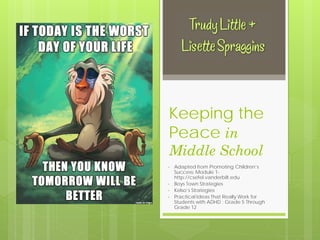
Keeping the
Peace in
Middle School
• Adapted from Promoting Children’s
Success; Module 1-
http://csefel.vanderbilt.edu
• Boys Town Strategies
• Kelso’s Strategies
• Practical Ideas That Really Work for
Students with ADHD : Grade 5 Through
Grade 12
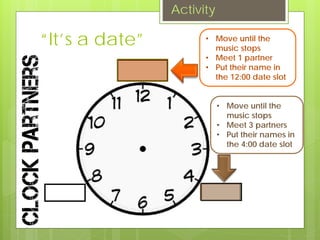
“It’s a date” • Move until the
music stops
• Meet 1 partner
• Put their name in
the 12:00 date slot
• Move until the
music stops
• Meet 3 partners
• Put their names in
the 4:00 date slot
Activity
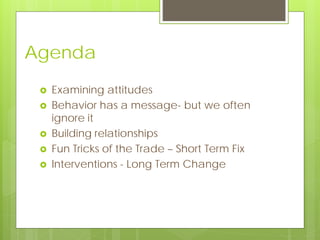
Agenda
 Examining attitudes
 Behavior has a message- but we often
ignore it
 Building relationships
 Fun Tricks of the Trade – Short Term Fix
 Interventions - Long Term Change
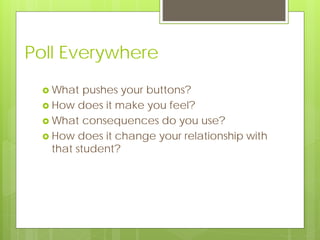
Poll Everywhere
 What pushes your buttons?
 How does it make you feel?
 What consequences do you use?
 How does it change your relationship with
that student?
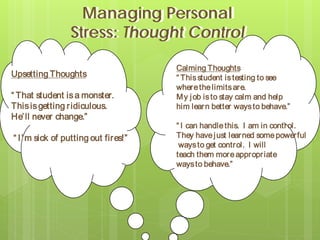
Managing Personal
Stress: Thought Control
Managing Personal
Stress: Thought Control
Calming Thoughts
“ Thisstudent istesting to see
wherethelimitsare.
My job isto stay calm and help
him learn better waysto behave.”
“ I can handlethis. I am in control.
They havejust learned somepowerful
waysto get control. I will
teach them moreappropriate
waysto behave.”
Upsetting Thoughts
“ That student isa monster.
Thisisgetting ridiculous.
He’ll never change.”
“ I’m sick of putting out fires!”
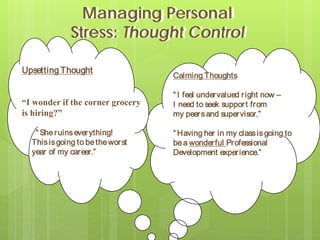
Managing Personal
Stress: Thought Control
Managing Personal
Stress: Thought Control
Calming Thoughts
“ I feel undervalued right now –
I need to seek support from
my peersand supervisor.”
“ Having her in my classisgoing to
bea wonderful Professional
Development experience.”
Upsetting Thought
“I wonder if the corner grocery
is hiring?”
“ Sheruinseverything!
Thisisgoing to betheworst
year of my career.”
“If a child doesn’t know how to read, we teach.
If a child doesn’t know how to swim, we teach.
If a child doesn’t know how to multiply, we teach.
If a child doesn’t know how to drive, we teach.
If a child doesn’t know how to behave,
we……..... …….teach? ……punish?
Why can’t we finish the last sentence as automatically
as we do the others?”
Tom Herner (NASDE President ) Counterpoint 1998, p.2)
Some Basic Assumptions
 Challenging behavior usually has a
message- I am bored, I am sad, you hurt
my feelings, I need some attention.
 Students often use challenging behavior
when they don’t have the social or
communication skills they need to
engage in more appropriate interactions.
Some Basic Assumptions
 Behavior that persists over time is usually
working for the student.
 We need to focus on teaching student
what to do in place of the challenging
behavior.
Promote Student’s Success
 Create an environment where EVERY student
feels good about coming to school.
 Design an environment that promotes student
engagement.
 Focus on teaching students what To Do!
 Teach expectations and routines.
 Teach skills that students can use in place of
challenging behaviors.
Building Relationships
 Helps each student feel accepted in the
group
 Encourages feelings of empathy and
mutual respect among students and
adults
 Provides a supportive environment in
which students can learn and practice
appropriate and acceptable behaviors
as individuals and as a group
Building Relationships with
Students
Why is it important?
 Students with the most challenging behaviors
especially need these relationships, and yet
their behaviors often prevent them from
benefiting from those relationships.
 Adults’ time and attention are very important
to student, and we need to be sure that we
are giving them that time and attention at
times other than when they are engaging in
challenging behavior.
TED Talks- Rita Pierson
Every kid needs a champion
Video
Date Time!!!
Go meet your 12:00 Date!
Activity
Fast Fingers Brain Break
1) Students stand in pairs. (Your 12:00 date)
2) Everyone puts their hands behind back.
3) Teacher says ‘1,2,3,go!’ and students must
bring one of their hands forward in front of
themselves with a random number of
fingers showing.
4) The two students must then count the sum
of their partner’s fingers and their own
fingers and shout out the total.
5) Winner gets one point. Students keep
track of points.
Activity
Fast Fingers Modifications
 Students bring forth two hands and add the
total fingers on all four hands.
 Students bring forth one hand each and
multiple the two numbers
 Each finger is worth 10 and students add or
multiple fingers
 One student is positive the other negative.
Students bring forth one hand and they
must add the positive number to the
negative number.
 Have groups of three or four students do the
above.
Activity
Let’s Fix it, NOW, please
Tricks of the Trade from :
Practical Ideas That Really
Work for Students with
ADHD : Grade 5 Through
Grade 12
Second Edition- Kathleen
McConnell & Gail R. Ryser
Positive Reinforcement
 Be specific about the behavior
 Pick one behavior at a time
 Raise your hand before talking
 Use descriptive praise statements
 Thanks for waiting so patiently
 Avoid “good job” by itself. Be more
descriptive
 Have a selection of reinforcers
 Menu*
 Coupon jar*
 Cube*
 Bragging Buddies*
Quick Fixes
*handout
Get ‘em organized
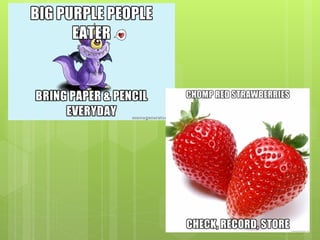
1. Mnemonics for habits or procedures
a. Big Purple People Eater
i. Bring Paper and Pen Everyday
b. Chomp Red Strawberries
ii. Check, Record, Store
2. Have “De-Clutter” Day Weekly
a. Go through
b. Throw away
c. Hole punch
d. File To Dos & Take Homes
3. Homework Buddies- Change frequently if needed
Quick Fixes
Teacher Talk Time
1. TWO Rules:
a. No talking unless called on by name
b. Stay seated
2. SET A TIMER :10-20 minutes
a. Promise to STOP at end of timer NMW
(no matter what) You can continue later
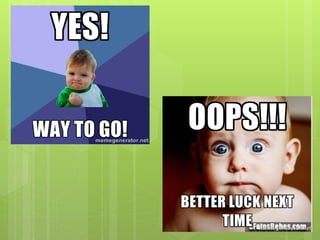
3. Place Yes/No tickets in jar during lecture as
students meet expectations or not
a. No voice reprimands, just tickets
4. Praise class for “YES”s and draw a ticket from the
jar (after class, later in day, end of week)
a. Yes = Class reward
b. No = OOPS (Other Opportunity Practice Success)
Better luck next time!!!
Quick Fixes
*handout
Nonverbal Signal System
 Large Signal Cards
1. Color Coded
2. Attached to Desk with tape or velcro
a. I’m working hard
b. I need help
c. Restroom Break
 Small Signal Cards
1. Color Coded
2. Attached to ring or bracelet
a. ?
b. SOS
c. I need help
Quick Fixes
*handout
Stay or Go? Free hall pass
 Pass out passes at beginning of week,
month, grading period, semester, etc.
1. Suggested 2 per student, but modify for
students who need more frequent breaks
2. Write names in INK
 Students turn in pass when need to leave
class
 Unredeemed passes earn points or other
rewards
Quick Fixes
*handout
Date Time!!!
Go meet your 4:00 Date!
Activity
Timed Round Robin
1. Decide who is A, B, C, D
2. Who starts? The person who…. (fill in the blank)
3. Take a turn identifying and explaining
one strategy to decrease challenging
behaviors
4. Each person has 15 seconds to speak
5. You MAY assist your team member
6. You MAY NOT repeat a strategy
Activity
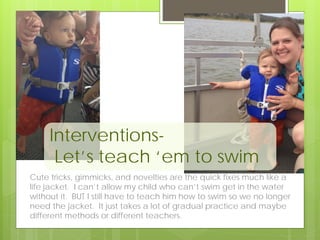
Interventions-
Let’s teach ‘em to swim
Cute tricks, gimmicks, and novelties are the quick fixes much like a
life jacket. I can’t allow my child who can’t swim get in the water
without it. BUT I still have to teach him how to swim so we no longer
need the jacket. It just takes a lot of gradual practice and maybe
different methods or different teachers.
Social Skills- Boys Town
Getting Someone’s Attention
1. Wait until the other person is finished
speaking.
2. Look at the person.
3. Say “Excuse me”.
4. Wait until the person looks at or speaks to
you.
5. Proceed with what you want to say.
Interventions
*handout
Social Skills- Boys Town
Asking for Help
1. Look at the person.
2. Ask the person if he or she has time to
help you now or later).
3. Clearly describe the problem or what
kind of help you need.
4. Thank the person for helping.
Interventions
*handout
Social Skills- Boys Town
Dealing with Frustration
1. Identify frustrated feelings when they
arise.
2. Breath deeply and relax.
3. Discuss frustrations with a caring adult or
friend.
4. Figure out what causes your frustration.
5. Find things to do that bring feelings of
success and well-being.
Interventions
*handout
Problem Solving
Boys Town Model
1. Stop, take a deep breath and count to
five.
2. Decide what the problem is and how you
feel.
3. Think about your choices and their
consequences.
4. Decide on your best choice.
5. Do it.
Interventions
*handout
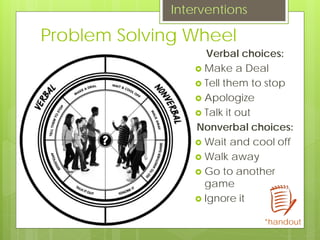
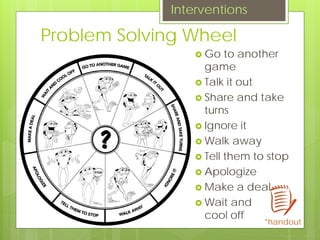
Problem Solving Wheel
Verbal choices:
 Make a Deal
 Tell them to stop
 Apologize
 Talk it out
Nonverbal choices:
 Wait and cool off
 Walk away
 Go to another
game
 Ignore it
*handout
Interventions
Problem Solving Wheel
 Go to another
game
 Talk it out
 Share and take
turns
 Ignore it
 Walk away
 Tell them to stop
 Apologize
 Make a deal
 Wait and
cool off
*handout
Interventions
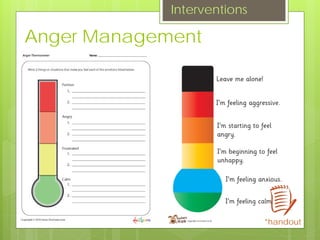
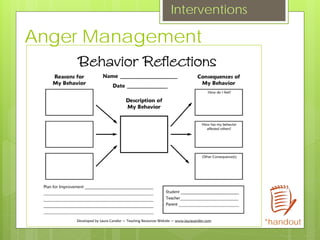
Anger Management
Interventions
*handout
Anger Management
Boys Town Model
1. If a person is talking to you continue to listen and
acknowledge them
2. Monitor your body’s feelings and how quickly
you are breathing
3. Breathe slowly and deeply
4. Give yourself directions to breathe and relax
5. Calmly ask the other person for a few minutes by
your self
6. While you are alone continue to monitor your
feelings and instruct yourself to relax
Interventions
*handout
Anger Management
Interventions
*handout
Key Points of Instruction
1. Teach the skill
2. Model the skill
a. Directly
b. Indirectly
c. Videos
d. Puppets
e. Peers
3. Role Play (practice)
4. Problem Solve
5. Reward
Interventions
Prevent Escalation
1. Build a relationship
2. Identify triggers
3. Identify where they feel their anger or frustration
in their body*
4. Identify a relaxation technique the student
would like to implement
5. Identify a way for the student to communicate
that they need to be excused to the safe place
or quiet space
• Practice the escape or chill out process
6. Practice the relaxation technique
• During calm moments throughout day
• Before crisis
• Privately
Interventions
*handout
Turn to your neighbor
Explain the 3 strategies will
you test drive in the fall
and why.
Activity
DJ Batiste &
Conscious Discipline
Video
Lisette
Spraggins,
Behavior
Consultant
325-675-8676
lspraggins@esc14.net
http://behaveyour4u.blog
spot.com/
http://www.esc14.net/
default.aspx?name=
ctl_beh_home

Keeping the PEACE in Middle School

  • 1.
    Keeping the Peace in MiddleSchool • Adapted from Promoting Children’s Success; Module 1- http://csefel.vanderbilt.edu • Boys Town Strategies • Kelso’s Strategies • Practical Ideas That Really Work for Students with ADHD : Grade 5 Through Grade 12
  • 2.
    “It’s a date”• Move until the music stops • Meet 1 partner • Put their name in the 12:00 date slot • Move until the music stops • Meet 3 partners • Put their names in the 4:00 date slot Activity
  • 3.
    Agenda  Examining attitudes Behavior has a message- but we often ignore it  Building relationships  Fun Tricks of the Trade – Short Term Fix  Interventions - Long Term Change
  • 4.
    Poll Everywhere  Whatpushes your buttons?  How does it make you feel?  What consequences do you use?  How does it change your relationship with that student?
  • 5.
    Managing Personal Stress: ThoughtControl Managing Personal Stress: Thought Control Calming Thoughts “ Thisstudent istesting to see wherethelimitsare. My job isto stay calm and help him learn better waysto behave.” “ I can handlethis. I am in control. They havejust learned somepowerful waysto get control. I will teach them moreappropriate waysto behave.” Upsetting Thoughts “ That student isa monster. Thisisgetting ridiculous. He’ll never change.” “ I’m sick of putting out fires!”
  • 6.
    Managing Personal Stress: ThoughtControl Managing Personal Stress: Thought Control Calming Thoughts “ I feel undervalued right now – I need to seek support from my peersand supervisor.” “ Having her in my classisgoing to bea wonderful Professional Development experience.” Upsetting Thought “I wonder if the corner grocery is hiring?” “ Sheruinseverything! Thisisgoing to betheworst year of my career.”
  • 7.
    “If a childdoesn’t know how to read, we teach. If a child doesn’t know how to swim, we teach. If a child doesn’t know how to multiply, we teach. If a child doesn’t know how to drive, we teach. If a child doesn’t know how to behave, we……..... …….teach? ……punish? Why can’t we finish the last sentence as automatically as we do the others?” Tom Herner (NASDE President ) Counterpoint 1998, p.2)
  • 8.
    Some Basic Assumptions Challenging behavior usually has a message- I am bored, I am sad, you hurt my feelings, I need some attention.  Students often use challenging behavior when they don’t have the social or communication skills they need to engage in more appropriate interactions.
  • 9.
    Some Basic Assumptions Behavior that persists over time is usually working for the student.  We need to focus on teaching student what to do in place of the challenging behavior.
  • 10.
    Promote Student’s Success Create an environment where EVERY student feels good about coming to school.  Design an environment that promotes student engagement.  Focus on teaching students what To Do!  Teach expectations and routines.  Teach skills that students can use in place of challenging behaviors.
  • 11.
    Building Relationships  Helpseach student feel accepted in the group  Encourages feelings of empathy and mutual respect among students and adults  Provides a supportive environment in which students can learn and practice appropriate and acceptable behaviors as individuals and as a group
  • 12.
    Building Relationships with Students Whyis it important?  Students with the most challenging behaviors especially need these relationships, and yet their behaviors often prevent them from benefiting from those relationships.  Adults’ time and attention are very important to student, and we need to be sure that we are giving them that time and attention at times other than when they are engaging in challenging behavior.
  • 13.
    TED Talks- RitaPierson Every kid needs a champion Video
  • 14.
    Date Time!!! Go meetyour 12:00 Date! Activity
  • 15.
    Fast Fingers BrainBreak 1) Students stand in pairs. (Your 12:00 date) 2) Everyone puts their hands behind back. 3) Teacher says ‘1,2,3,go!’ and students must bring one of their hands forward in front of themselves with a random number of fingers showing. 4) The two students must then count the sum of their partner’s fingers and their own fingers and shout out the total. 5) Winner gets one point. Students keep track of points. Activity
  • 16.
    Fast Fingers Modifications Students bring forth two hands and add the total fingers on all four hands.  Students bring forth one hand each and multiple the two numbers  Each finger is worth 10 and students add or multiple fingers  One student is positive the other negative. Students bring forth one hand and they must add the positive number to the negative number.  Have groups of three or four students do the above. Activity
  • 17.
    Let’s Fix it,NOW, please Tricks of the Trade from : Practical Ideas That Really Work for Students with ADHD : Grade 5 Through Grade 12 Second Edition- Kathleen McConnell & Gail R. Ryser
  • 18.
    Positive Reinforcement  Bespecific about the behavior  Pick one behavior at a time  Raise your hand before talking  Use descriptive praise statements  Thanks for waiting so patiently  Avoid “good job” by itself. Be more descriptive  Have a selection of reinforcers  Menu*  Coupon jar*  Cube*  Bragging Buddies* Quick Fixes *handout
  • 19.
    Get ‘em organized 1.Mnemonics for habits or procedures a. Big Purple People Eater i. Bring Paper and Pen Everyday b. Chomp Red Strawberries ii. Check, Record, Store 2. Have “De-Clutter” Day Weekly a. Go through b. Throw away c. Hole punch d. File To Dos & Take Homes 3. Homework Buddies- Change frequently if needed Quick Fixes
  • 21.
    Teacher Talk Time 1.TWO Rules: a. No talking unless called on by name b. Stay seated 2. SET A TIMER :10-20 minutes a. Promise to STOP at end of timer NMW (no matter what) You can continue later 3. Place Yes/No tickets in jar during lecture as students meet expectations or not a. No voice reprimands, just tickets 4. Praise class for “YES”s and draw a ticket from the jar (after class, later in day, end of week) a. Yes = Class reward b. No = OOPS (Other Opportunity Practice Success) Better luck next time!!! Quick Fixes *handout
  • 23.
    Nonverbal Signal System Large Signal Cards 1. Color Coded 2. Attached to Desk with tape or velcro a. I’m working hard b. I need help c. Restroom Break  Small Signal Cards 1. Color Coded 2. Attached to ring or bracelet a. ? b. SOS c. I need help Quick Fixes *handout
  • 24.
    Stay or Go?Free hall pass  Pass out passes at beginning of week, month, grading period, semester, etc. 1. Suggested 2 per student, but modify for students who need more frequent breaks 2. Write names in INK  Students turn in pass when need to leave class  Unredeemed passes earn points or other rewards Quick Fixes *handout
  • 25.
    Date Time!!! Go meetyour 4:00 Date! Activity
  • 26.
    Timed Round Robin 1.Decide who is A, B, C, D 2. Who starts? The person who…. (fill in the blank) 3. Take a turn identifying and explaining one strategy to decrease challenging behaviors 4. Each person has 15 seconds to speak 5. You MAY assist your team member 6. You MAY NOT repeat a strategy Activity
  • 27.
    Interventions- Let’s teach ‘emto swim Cute tricks, gimmicks, and novelties are the quick fixes much like a life jacket. I can’t allow my child who can’t swim get in the water without it. BUT I still have to teach him how to swim so we no longer need the jacket. It just takes a lot of gradual practice and maybe different methods or different teachers.
  • 28.
    Social Skills- BoysTown Getting Someone’s Attention 1. Wait until the other person is finished speaking. 2. Look at the person. 3. Say “Excuse me”. 4. Wait until the person looks at or speaks to you. 5. Proceed with what you want to say. Interventions *handout
  • 29.
    Social Skills- BoysTown Asking for Help 1. Look at the person. 2. Ask the person if he or she has time to help you now or later). 3. Clearly describe the problem or what kind of help you need. 4. Thank the person for helping. Interventions *handout
  • 30.
    Social Skills- BoysTown Dealing with Frustration 1. Identify frustrated feelings when they arise. 2. Breath deeply and relax. 3. Discuss frustrations with a caring adult or friend. 4. Figure out what causes your frustration. 5. Find things to do that bring feelings of success and well-being. Interventions *handout
  • 31.
    Problem Solving Boys TownModel 1. Stop, take a deep breath and count to five. 2. Decide what the problem is and how you feel. 3. Think about your choices and their consequences. 4. Decide on your best choice. 5. Do it. Interventions *handout
  • 32.
    Problem Solving Wheel Verbalchoices:  Make a Deal  Tell them to stop  Apologize  Talk it out Nonverbal choices:  Wait and cool off  Walk away  Go to another game  Ignore it *handout Interventions
  • 33.
    Problem Solving Wheel Go to another game  Talk it out  Share and take turns  Ignore it  Walk away  Tell them to stop  Apologize  Make a deal  Wait and cool off *handout Interventions
  • 34.
  • 35.
    Anger Management Boys TownModel 1. If a person is talking to you continue to listen and acknowledge them 2. Monitor your body’s feelings and how quickly you are breathing 3. Breathe slowly and deeply 4. Give yourself directions to breathe and relax 5. Calmly ask the other person for a few minutes by your self 6. While you are alone continue to monitor your feelings and instruct yourself to relax Interventions *handout
  • 36.
  • 37.
    Key Points ofInstruction 1. Teach the skill 2. Model the skill a. Directly b. Indirectly c. Videos d. Puppets e. Peers 3. Role Play (practice) 4. Problem Solve 5. Reward Interventions
  • 38.
    Prevent Escalation 1. Builda relationship 2. Identify triggers 3. Identify where they feel their anger or frustration in their body* 4. Identify a relaxation technique the student would like to implement 5. Identify a way for the student to communicate that they need to be excused to the safe place or quiet space • Practice the escape or chill out process 6. Practice the relaxation technique • During calm moments throughout day • Before crisis • Privately Interventions *handout
  • 39.
    Turn to yourneighbor Explain the 3 strategies will you test drive in the fall and why. Activity
  • 40.
    DJ Batiste & ConsciousDiscipline Video
  • 41.