How to Manage Your Classroom So
        You Can Teach!

       IMPACT on Behavior
              Thomas J. Stacho Ed.S.

              State Support Team 11

     Educational Service Center of Central Ohio
Others
Others
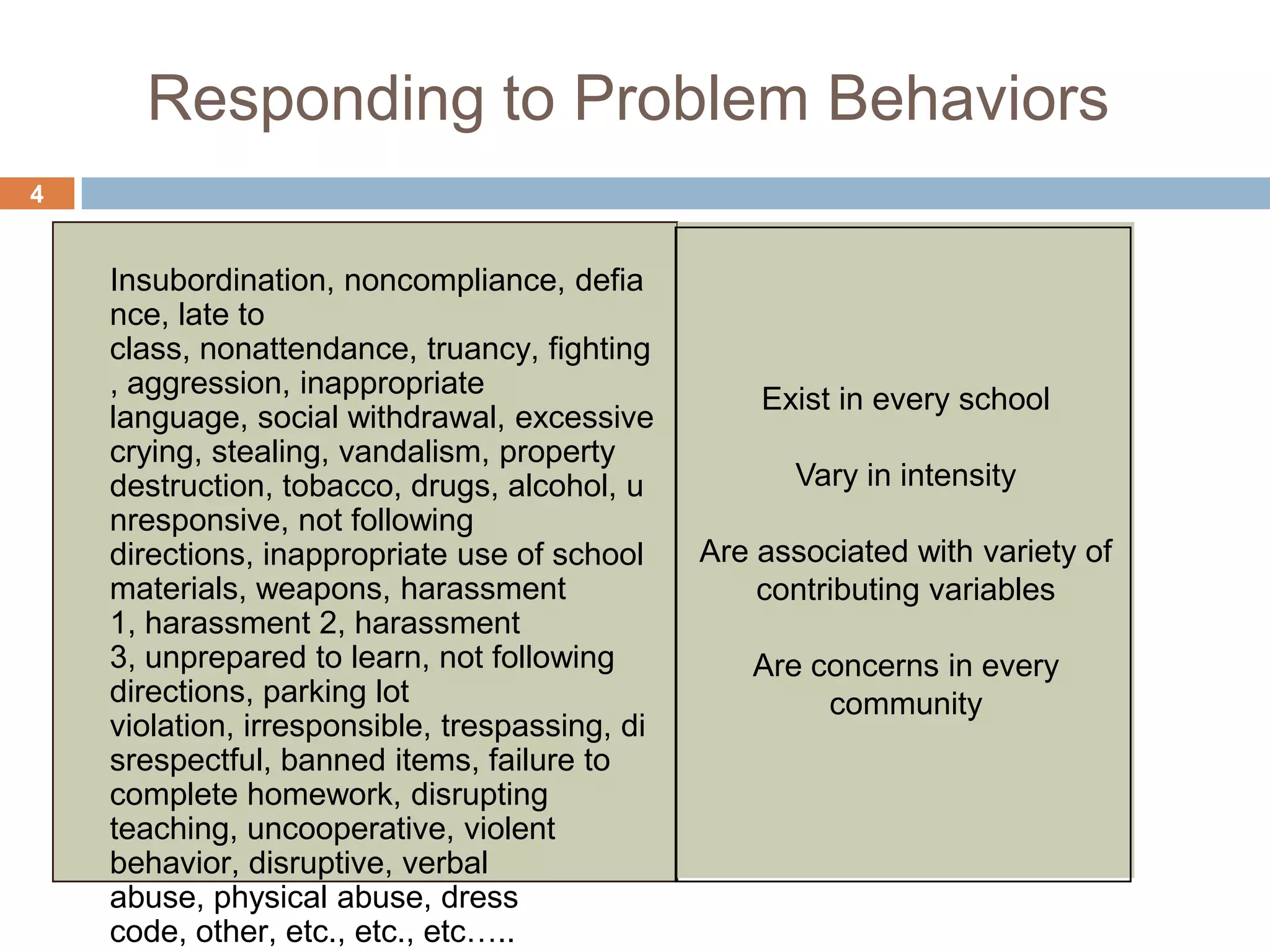
Responding to Problem Behaviors
4


    Insubordination, noncompliance, defia
    nce, late to
    class, nonattendance, truancy, fighting
    , aggression, inappropriate
                                                    Exist in every school
    language, social withdrawal, excessive
    crying, stealing, vandalism, property
    destruction, tobacco, drugs, alcohol, u           Vary in intensity
    nresponsive, not following
    directions, inappropriate use of school     Are associated with variety of
    materials, weapons, harassment                  contributing variables
    1, harassment 2, harassment
    3, unprepared to learn, not following          Are concerns in every
    directions, parking lot                             community
    violation, irresponsible, trespassing, di
    srespectful, banned items, failure to
    complete homework, disrupting
    teaching, uncooperative, violent
    behavior, disruptive, verbal
    abuse, physical abuse, dress
    code, other, etc., etc., etc…..
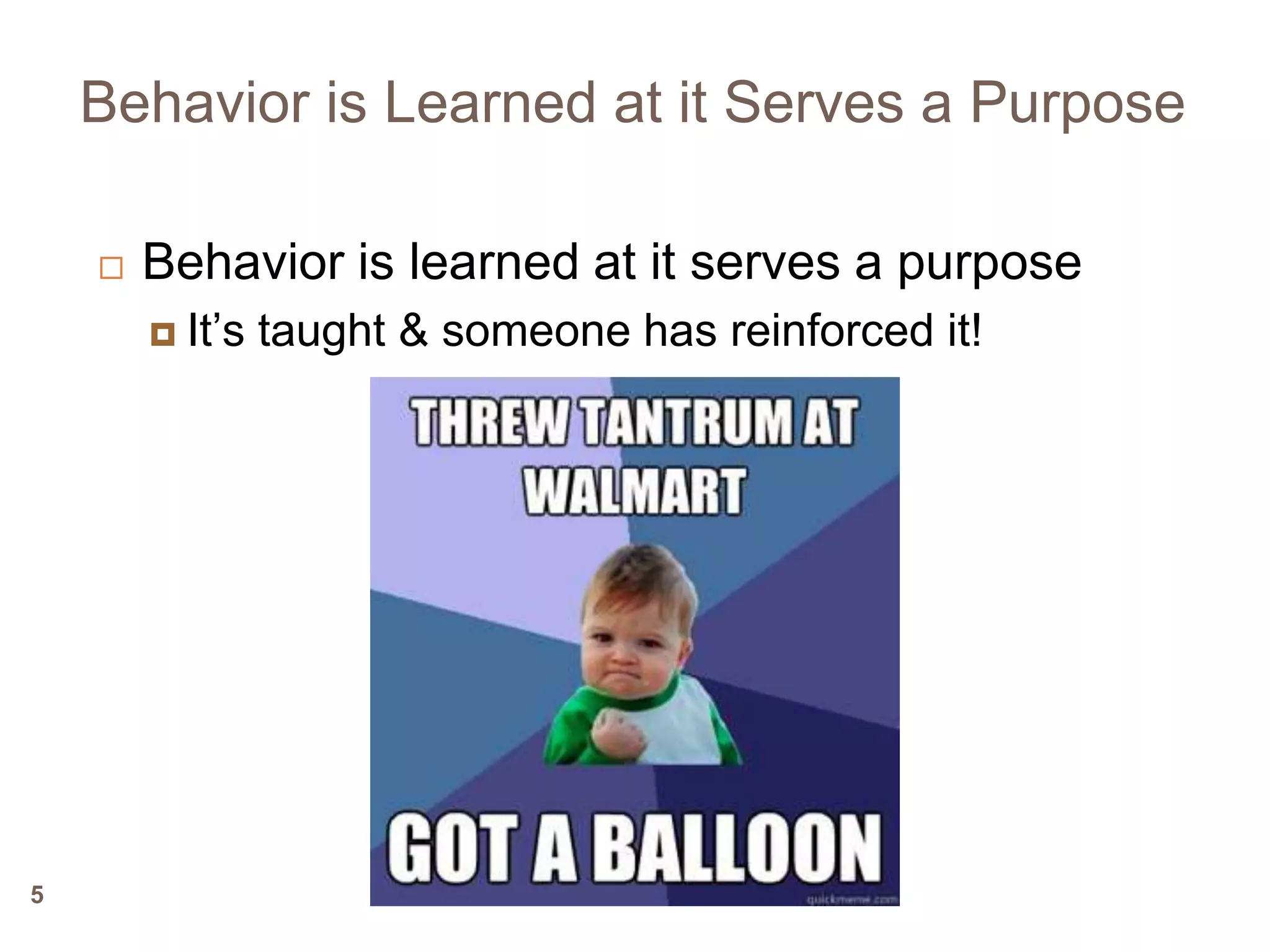
Behavior is Learned at it Serves a Purpose

       Behavior is learned at it serves a purpose
           It’s taught & someone has reinforced it!


5
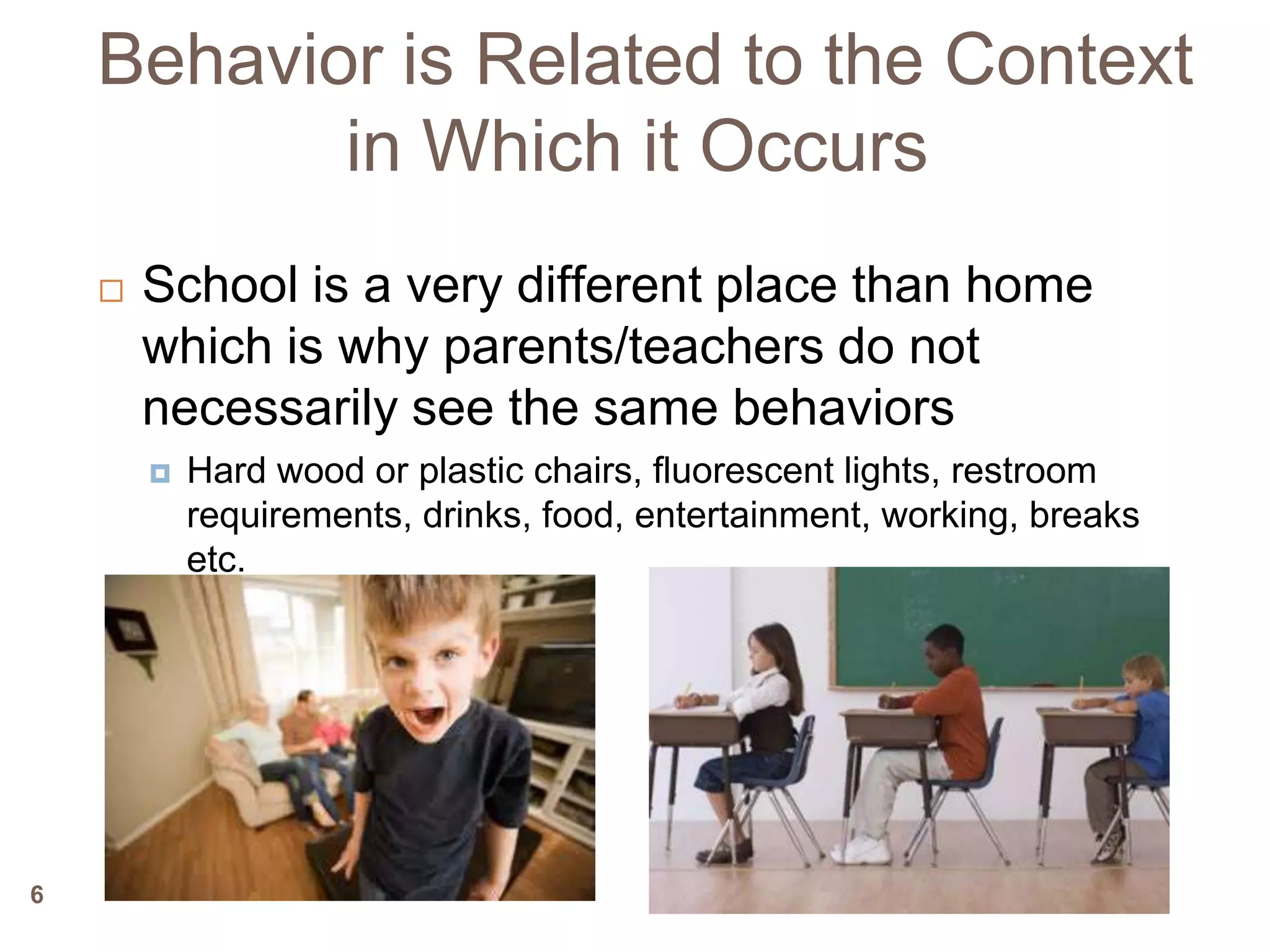
Behavior is Related to the Context
           in Which it Occurs
       School is a very different place than home
        which is why parents/teachers do not
        necessarily see the same behaviors
           Hard wood or plastic chairs, fluorescent lights, restroom
            requirements, drinks, food, entertainment, working, breaks
            etc.


6
For every year a behavior has been in
    place, consider one month of
    consistent appropriate intervention for
    us to see a change!


7
Hard Facts
       Behavior is learned and serves a purpose

       Behavior is related to the context in which it
        occurs

       For every year a behavior is in place it takes at
        least one months for that behavior to have
        significant change

       Children comply with the rules 80% of the time.
        However they are complimented for their
8       behavior less than.....
9


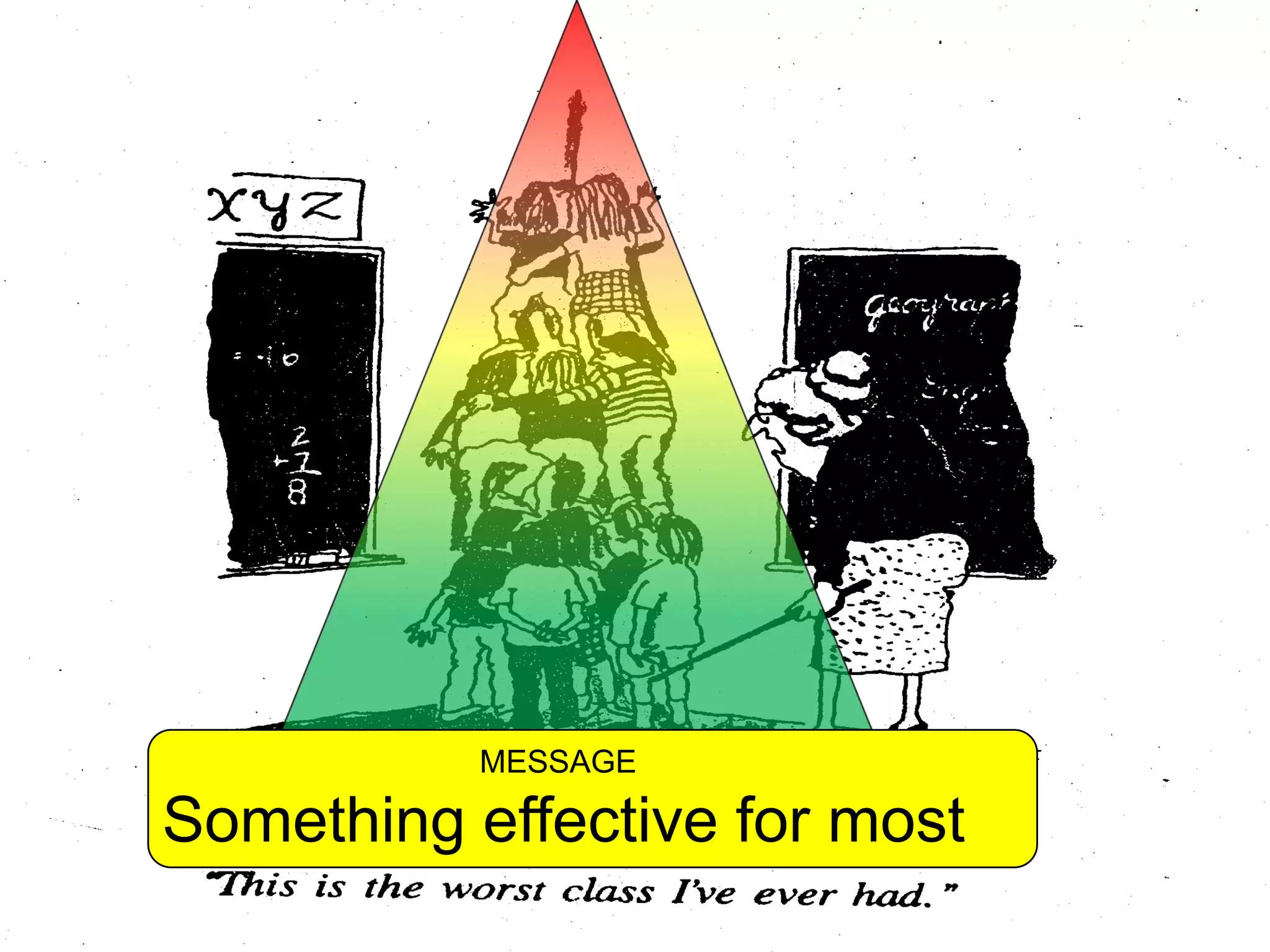
               MESSAGE

    Something effective for most
SIMPLE SOLUTION #1
     Over-reliance on “Role-Bound” Authority
10


        “Students should behave because I’m the
         teacher”

        Thinking that the person with the most power
         can MAKE THE KID STOP (principal)

        “SYMBOLIC POWER” of authority
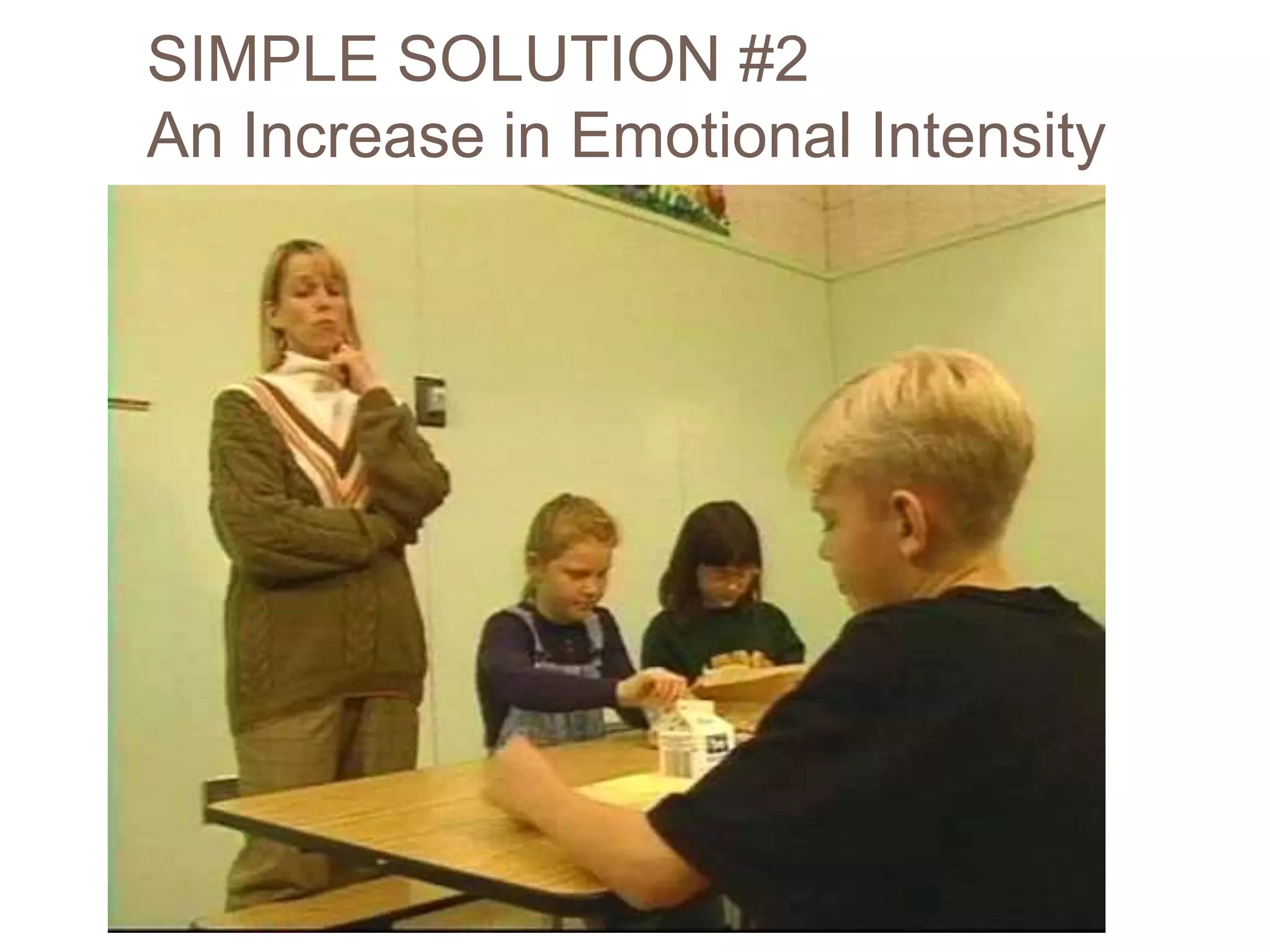
SIMPLE SOLUTION #2
An Increase in Emotional Intensity
SIMPLE SOLUTION #3
         Over-Reliance on PUNISHMENT
12

         WHY DO WE OVER-RELY On
         PUNISHMENT?

      It’s Quick!
      It’s Easy to Administer?
      It’s Cheap!
      It Works!!!


     (with students without challenging behaviors 80-
       95%)
A quote from Haim Ginott…
I have come to a frightening conclusion that I am
the decisive element in the classroom. It is my
personal approach that creates the climate. It is
my daily mood that makes the weather. As a
teacher I possess tremendous power to make a
child’s life miserable or joyous. I can be a tool of
torture or an instrument of inspiration. I can
humiliate or humor, hurt or heal. In all
situations, it is my response that decides
whether a crisis will be escalated or de-
escalated, and a child humanized or de-
humanized.
             Between Teacher and Child
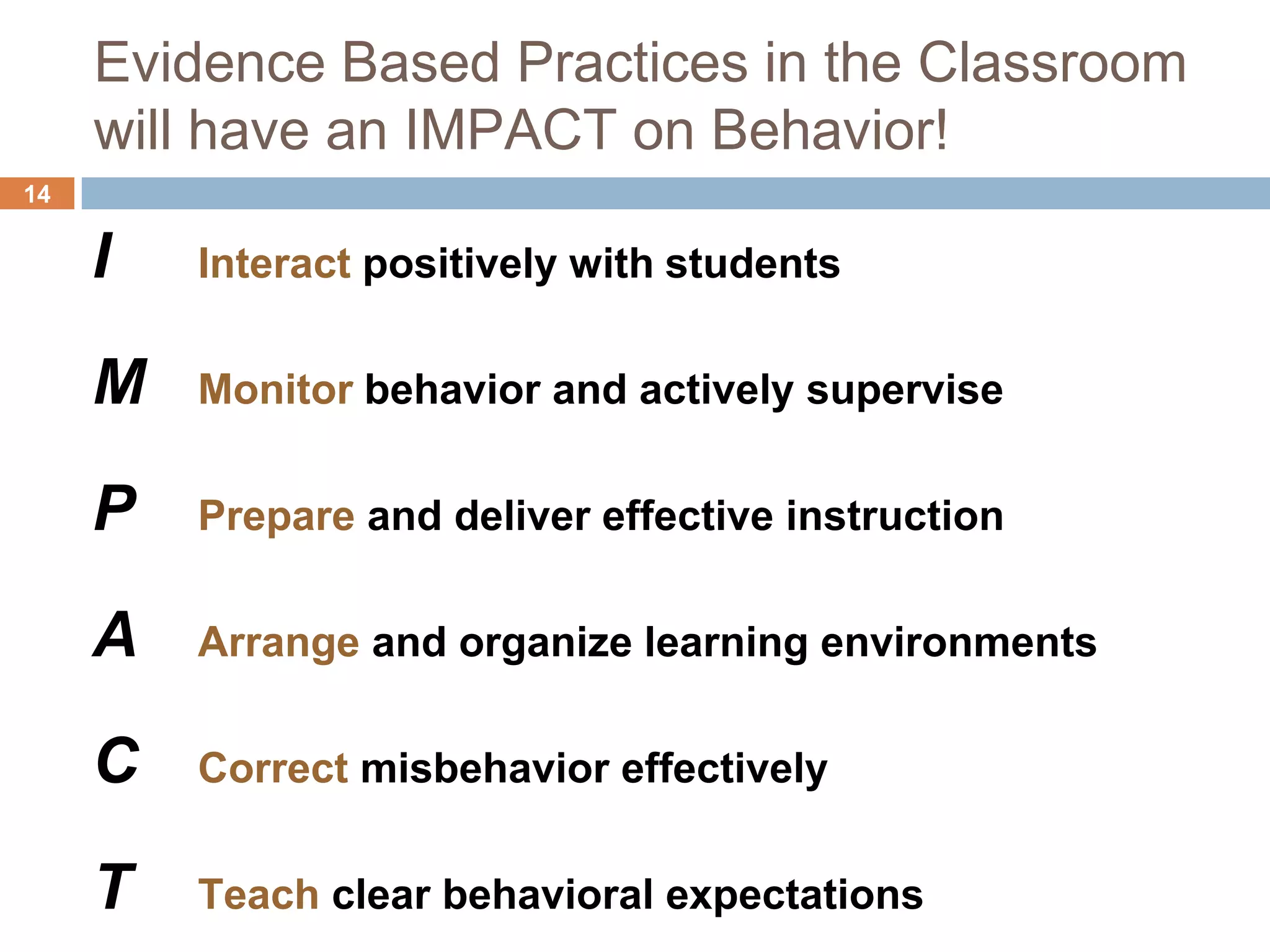
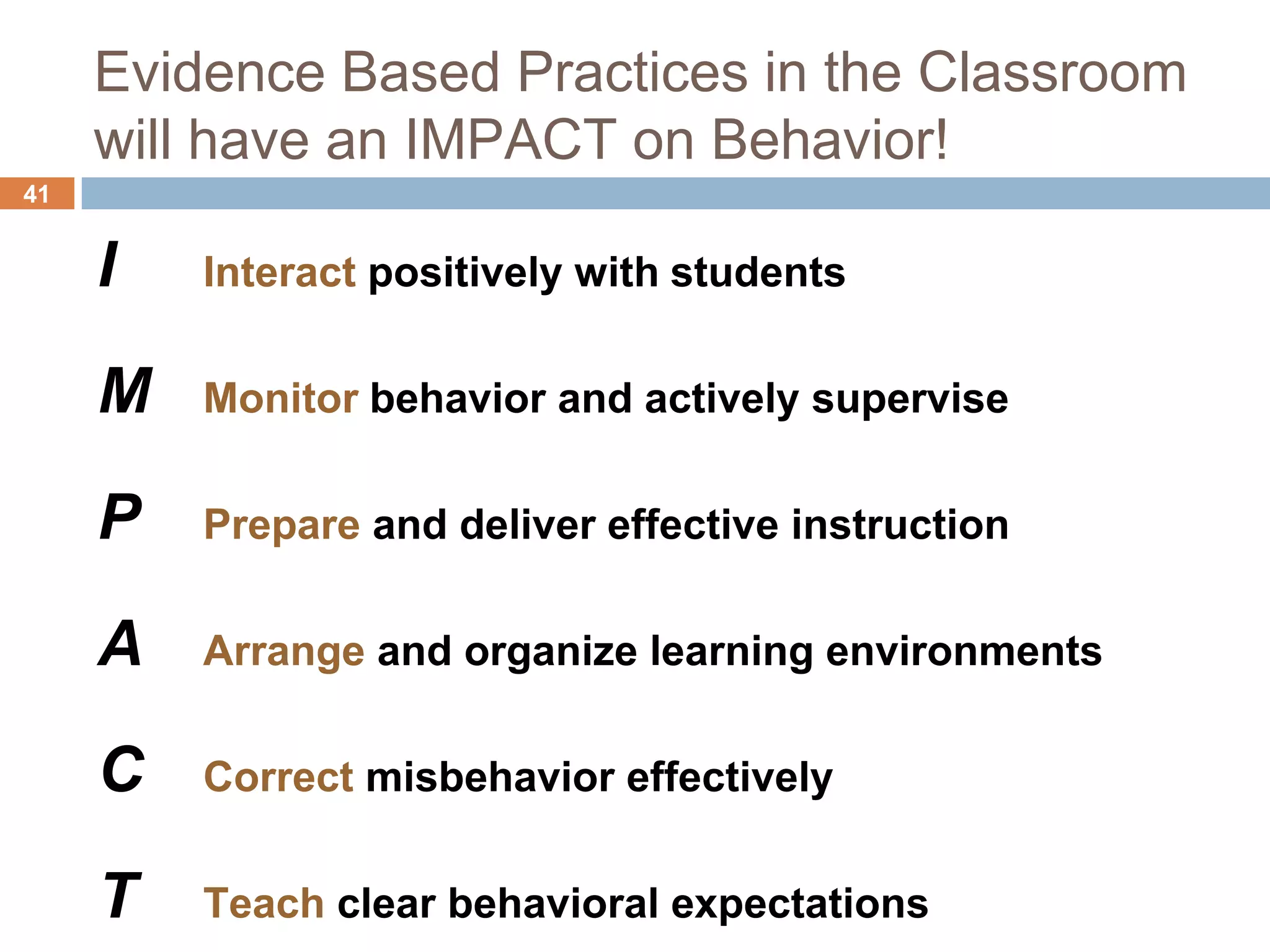
Evidence Based Practices in the Classroom
     will have an IMPACT on Behavior!
14


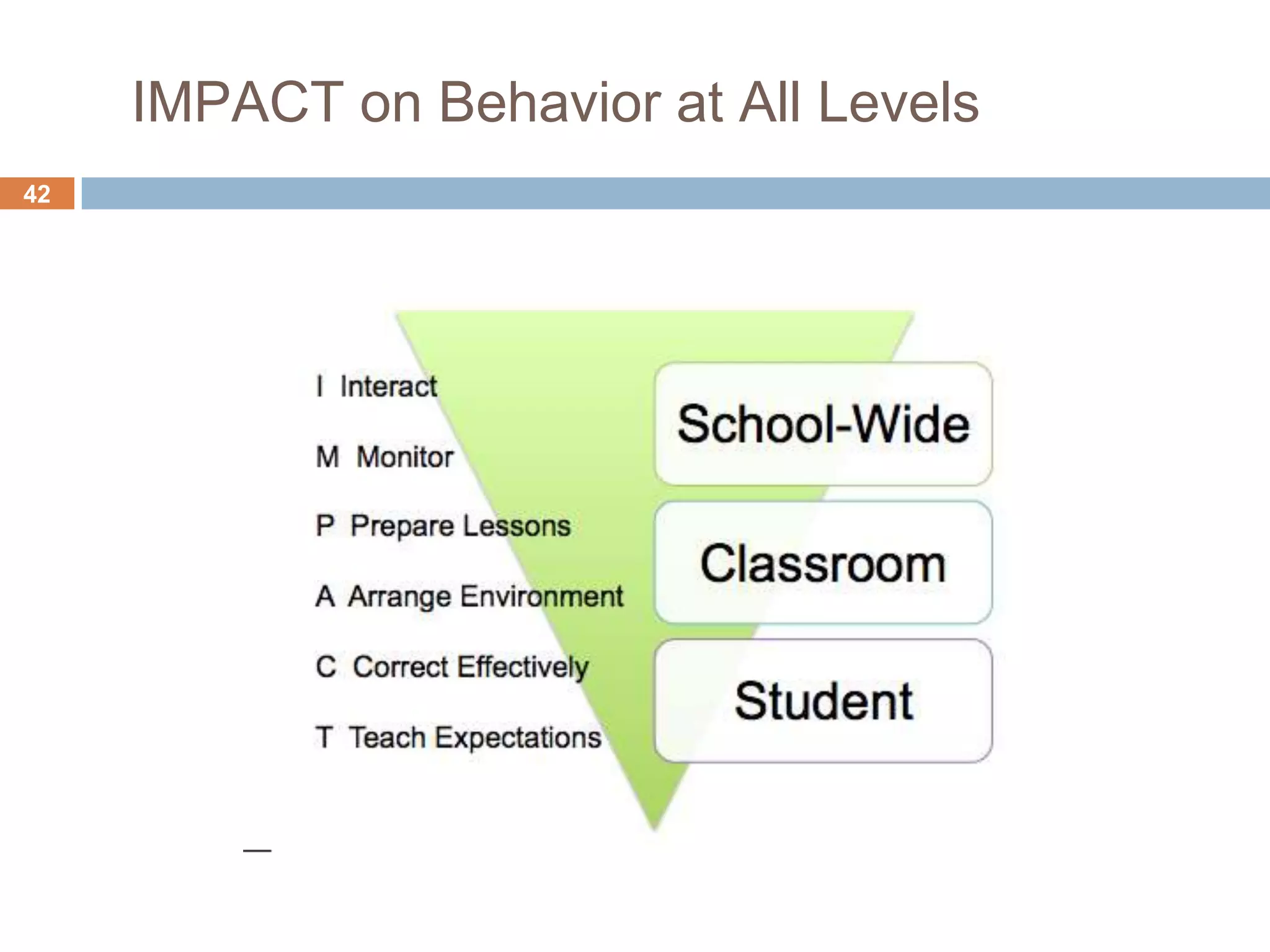
     I   Interact positively with students

     M   Monitor behavior and actively supervise

     P   Prepare and deliver effective instruction

     A   Arrange and organize learning environments

     C   Correct misbehavior effectively

     T   Teach clear behavioral expectations
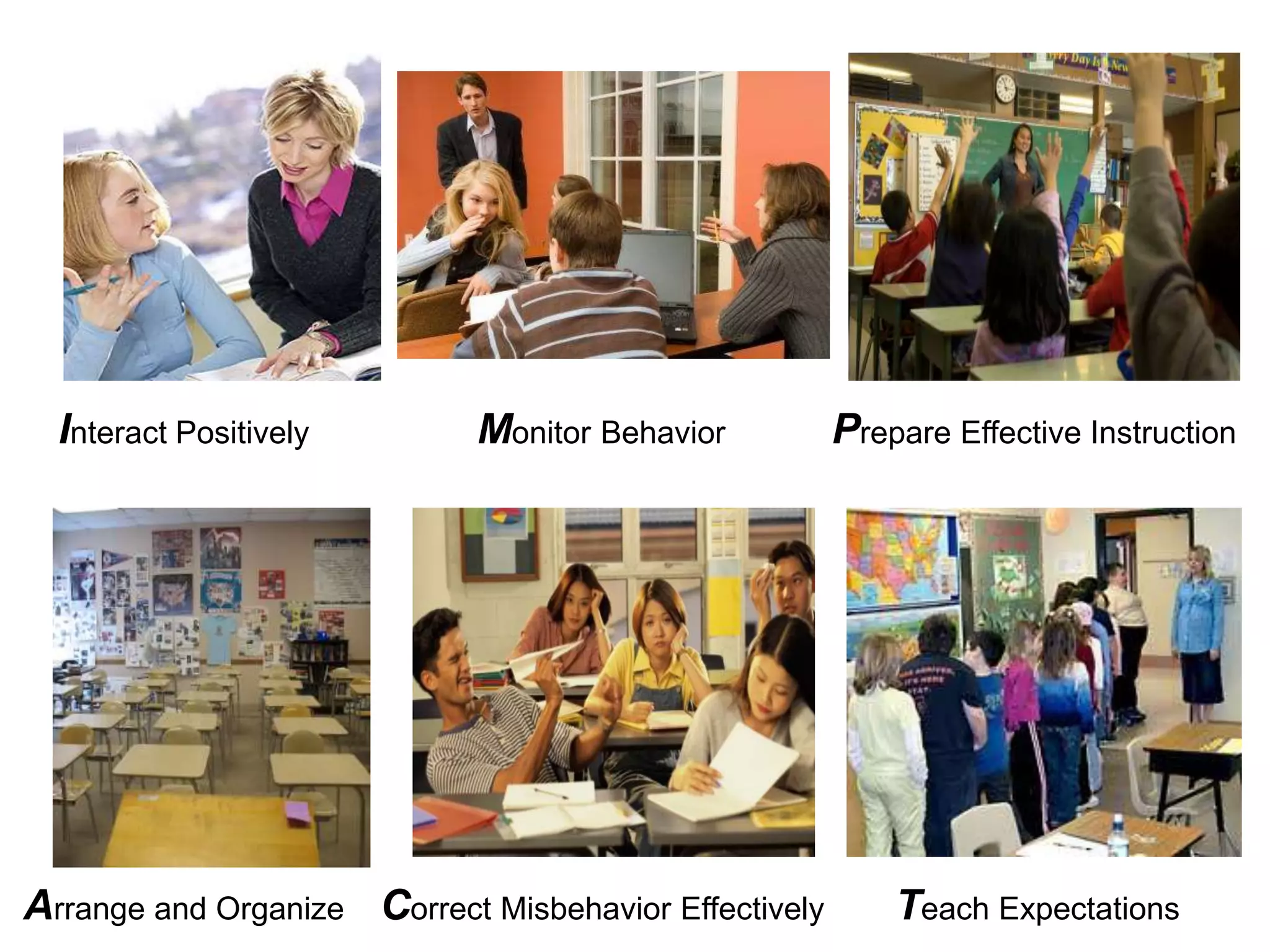
Interact Positively        Monitor Behavior          Prepare Effective Instruction


Arrange and Organize Correct Misbehavior Effectively       Teach Expectations
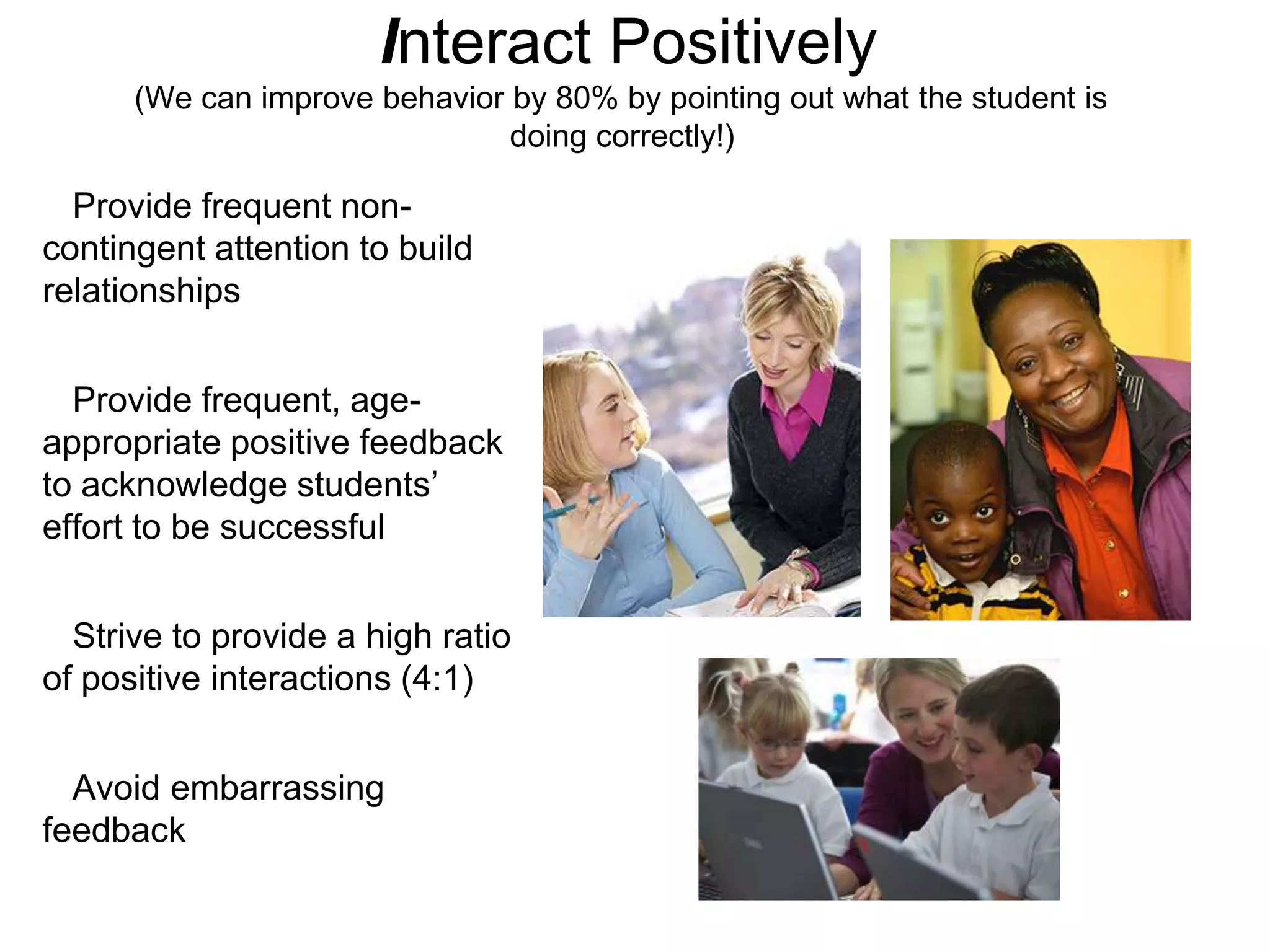
Interact Positively
      (We can improve behavior by 80% by pointing out what the student is
                               doing correctly!)

  Provide frequent non-
contingent attention to build
relationships


  Provide frequent, age-
appropriate positive feedback
to acknowledge students’
effort to be successful


  Strive to provide a high ratio
of positive interactions (4:1)


  Avoid embarrassing
feedback
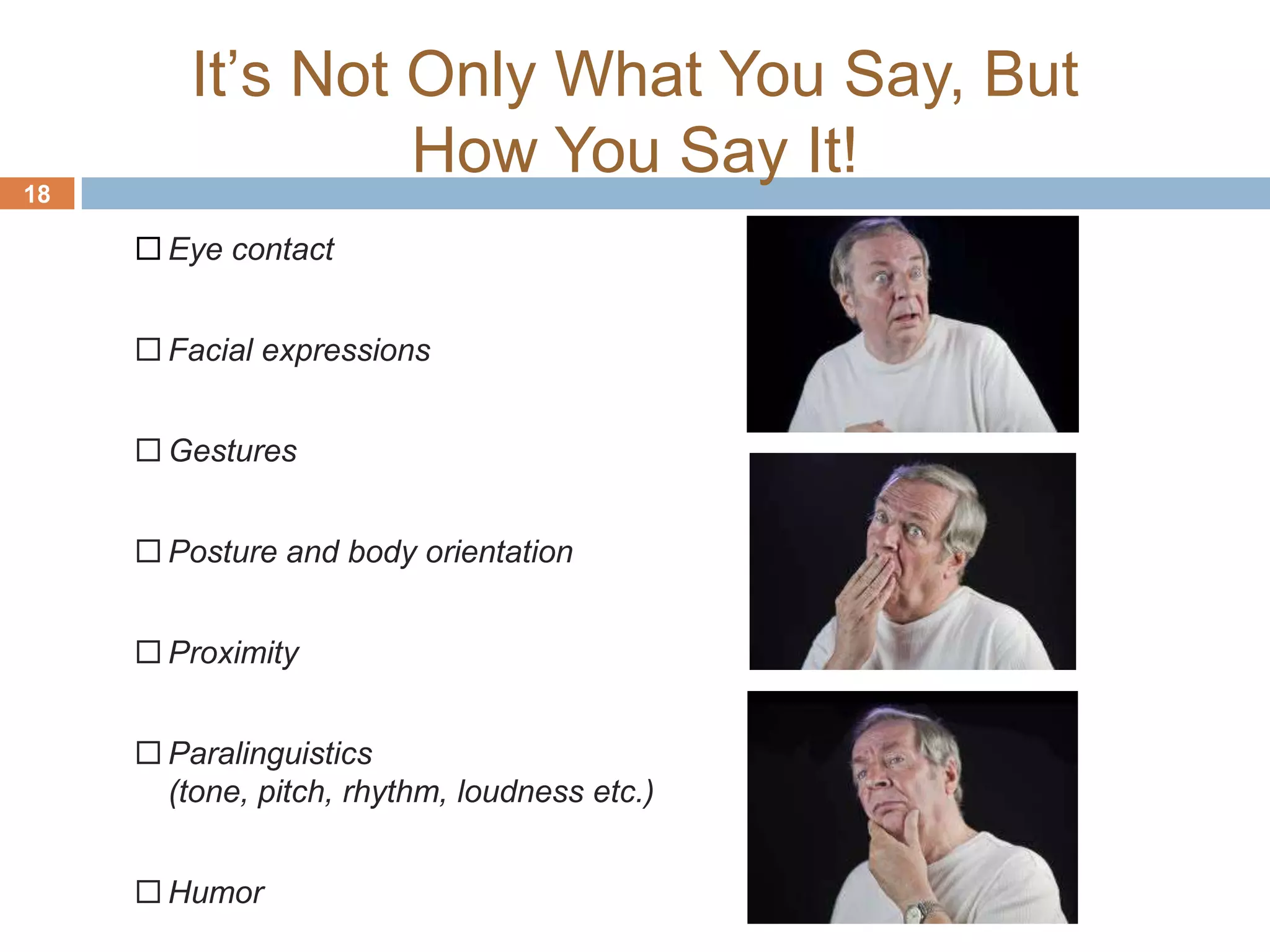
It’s Not Only What You Say, But
18
                  How You Say It!
      Eye contact


      Facial expressions


      Gestures


      Posture and body orientation


      Proximity


      Paralinguistics
       (tone, pitch, rhythm, loudness etc.)


      Humor
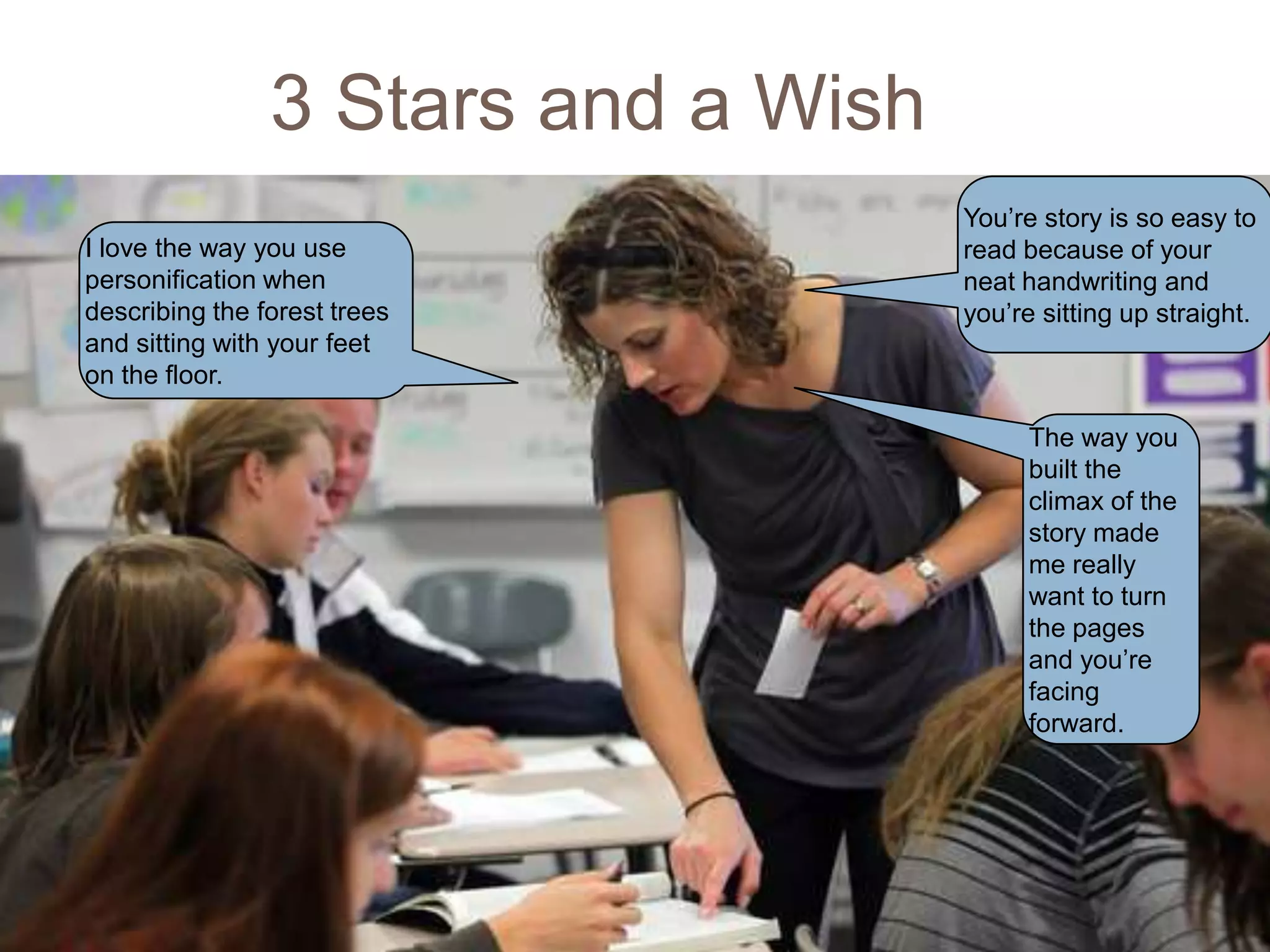
3 Stars and a Wish
19
                                          You’re story is so easy to
     I love the way you use               read because of your
     personification when                 neat handwriting and
     describing the forest trees          you’re sitting up straight.
     and sitting with your feet
     on the floor.

                                                The way you
                                                built the
                                                climax of the
                                                story made
                                                me really
                                                want to turn
                                                the pages
                                                and you’re
                                                facing
                                                forward.
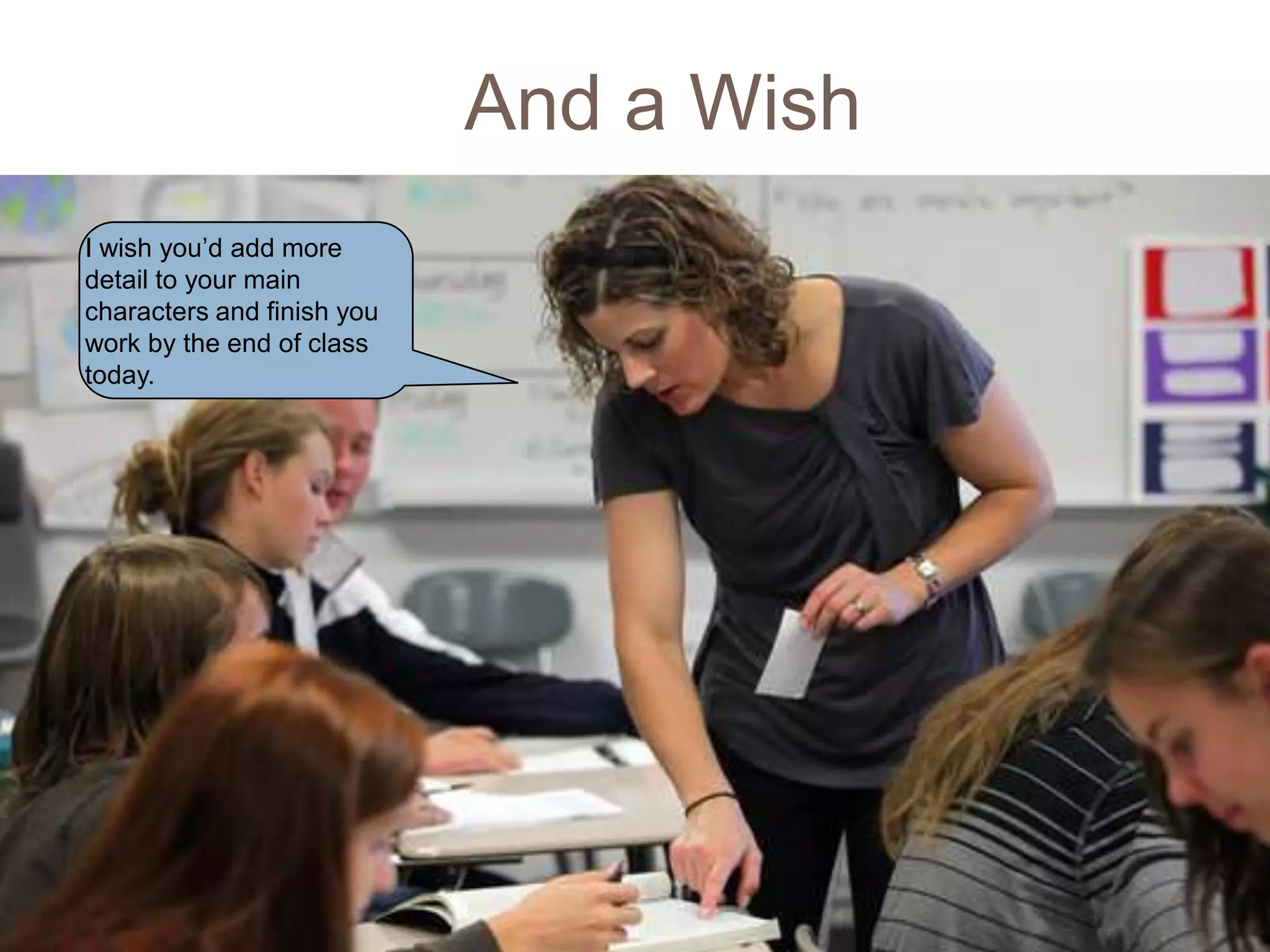
And a Wish
20

     I wish you’d add more
     detail to your main
     characters and finish you
     work by the end of class
     today.
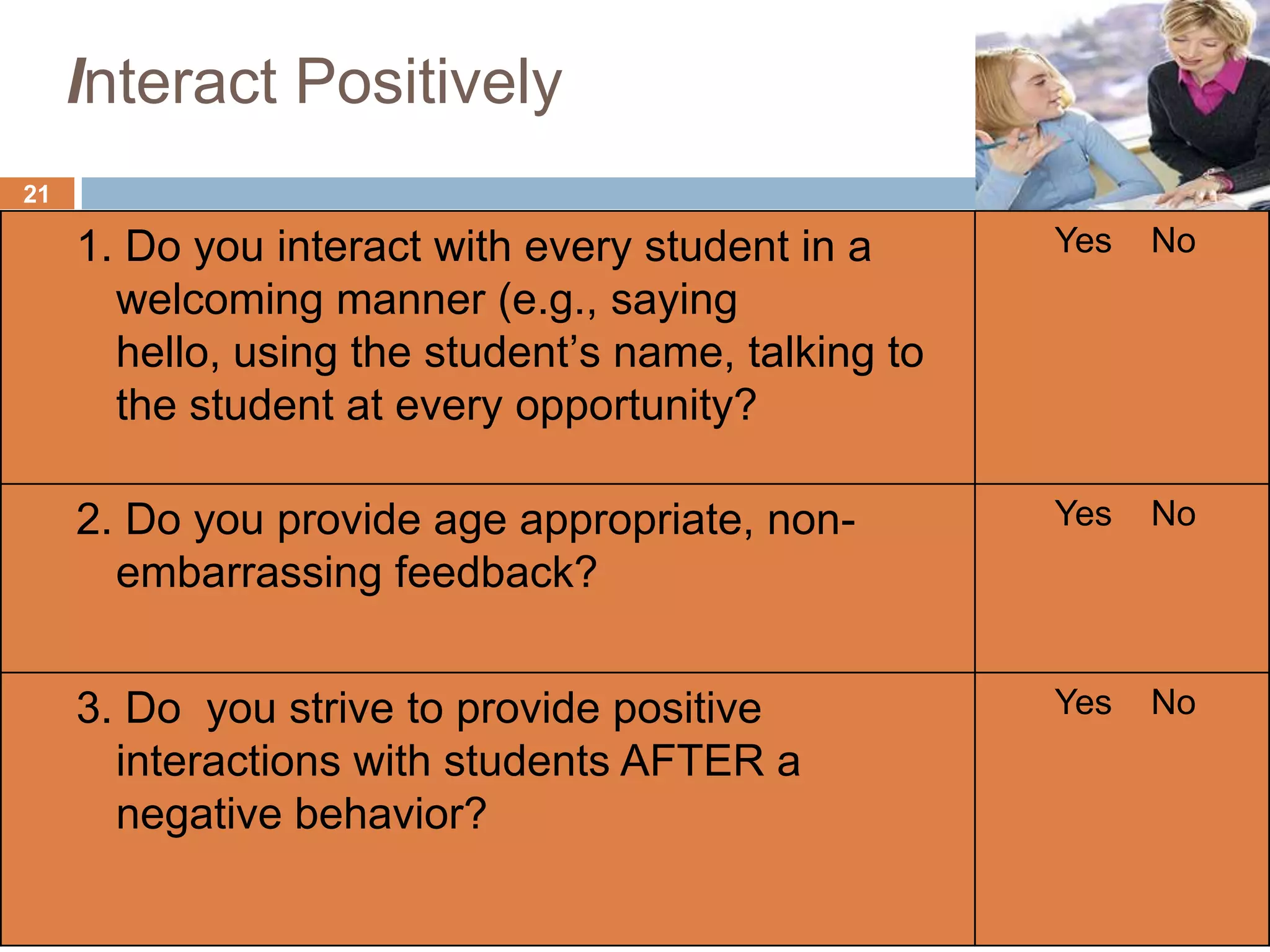
Interact Positively
21

     1. Do you interact with every student in a      Yes   No
       welcoming manner (e.g., saying
       hello, using the student’s name, talking to
       the student at every opportunity?

     2. Do you provide age appropriate, non-         Yes   No
       embarrassing feedback?


     3. Do you strive to provide positive            Yes   No
       interactions with students AFTER a
       negative behavior?
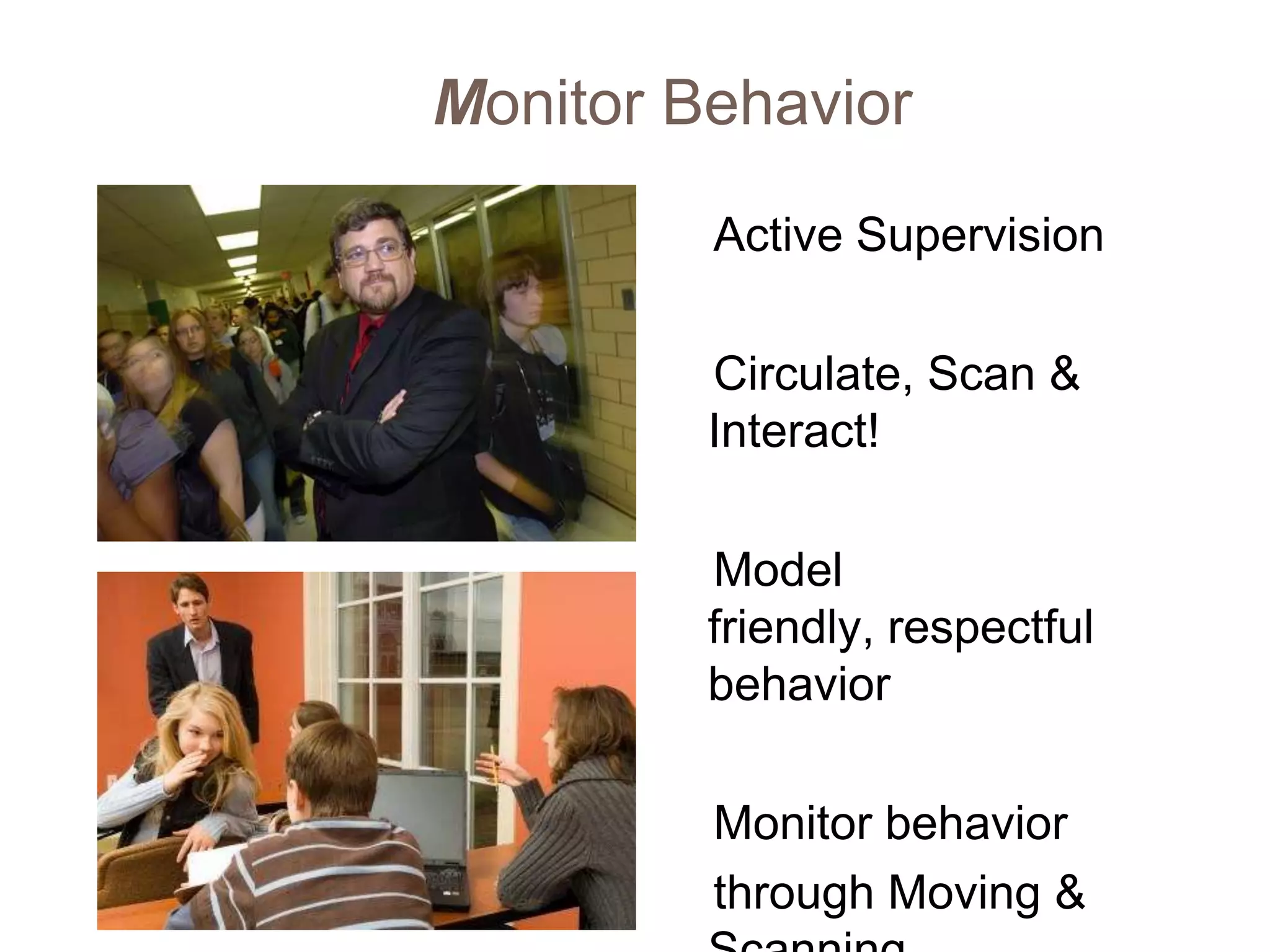
Monitor Behavior
         Active Supervision

         Circulate, Scan &
         Interact!

         Model
         friendly, respectful
         behavior

         Monitor behavior
         through Moving &
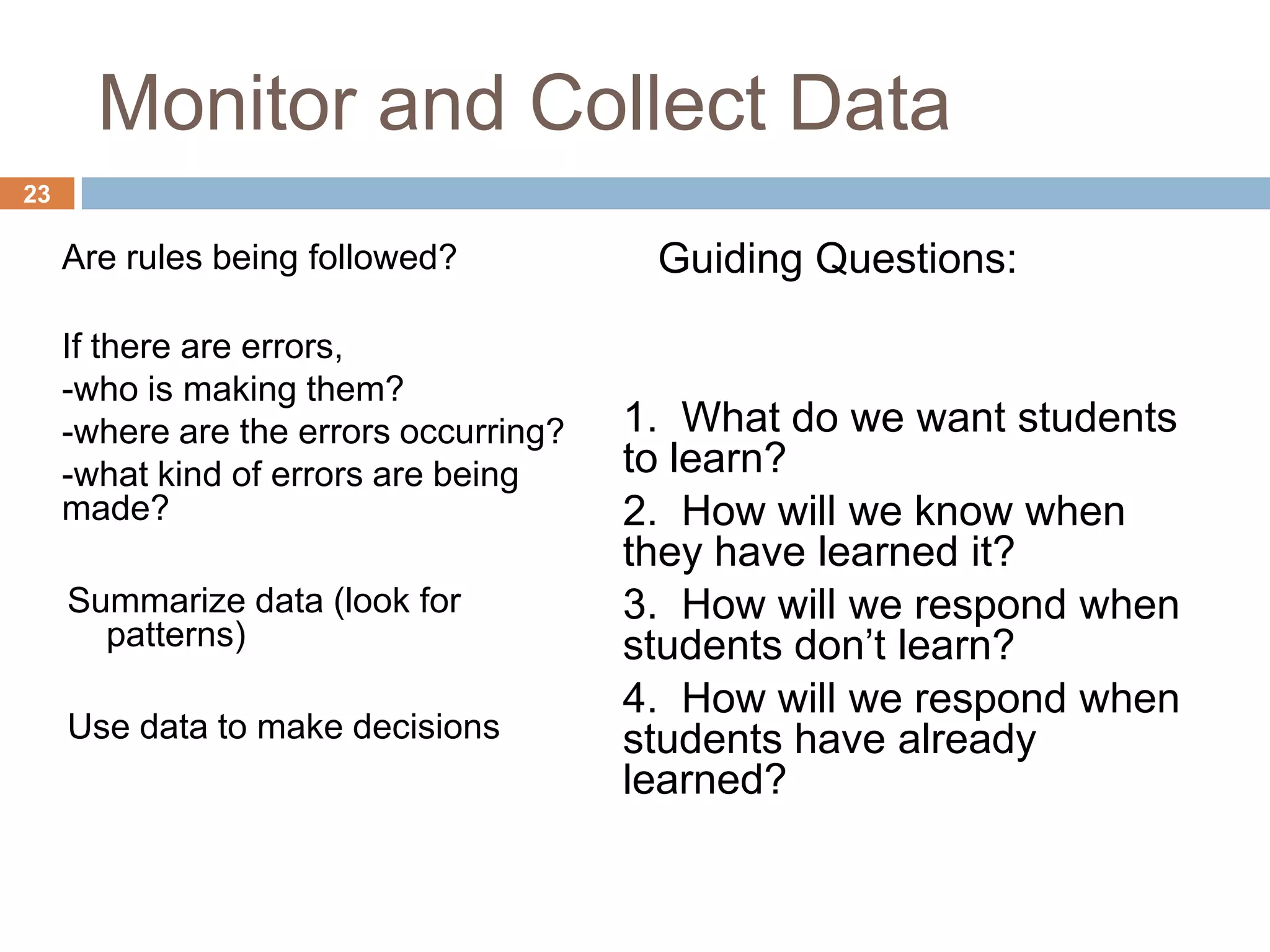
Monitor and Collect Data
23

     Are rules being followed?           Guiding Questions:

     If there are errors,
     -who is making them?
     -where are the errors occurring?   1. What do we want students
     -what kind of errors are being     to learn?
     made?                              2. How will we know when
                                        they have learned it?
     Summarize data (look for           3. How will we respond when
       patterns)                        students don’t learn?
                                        4. How will we respond when
     Use data to make decisions         students have already
                                        learned?
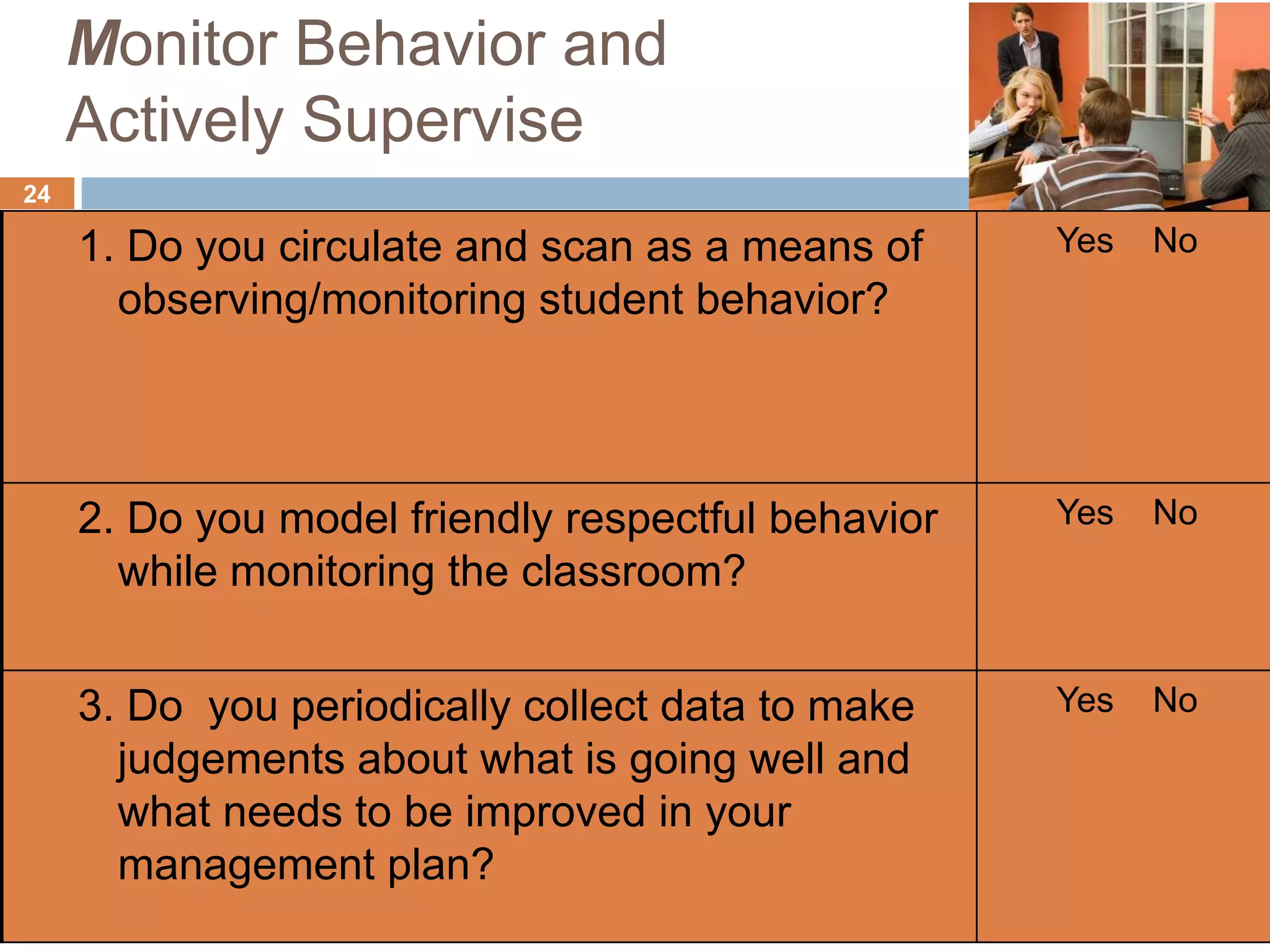
Monitor Behavior and
     Actively Supervise
24

     1. Do you circulate and scan as a means of     Yes   No
       observing/monitoring student behavior?


     2. Do you model friendly respectful behavior   Yes   No
       while monitoring the classroom?


     3. Do you periodically collect data to make    Yes   No
       judgements about what is going well and
       what needs to be improved in your
       management plan?
Prepare Effective Instruction

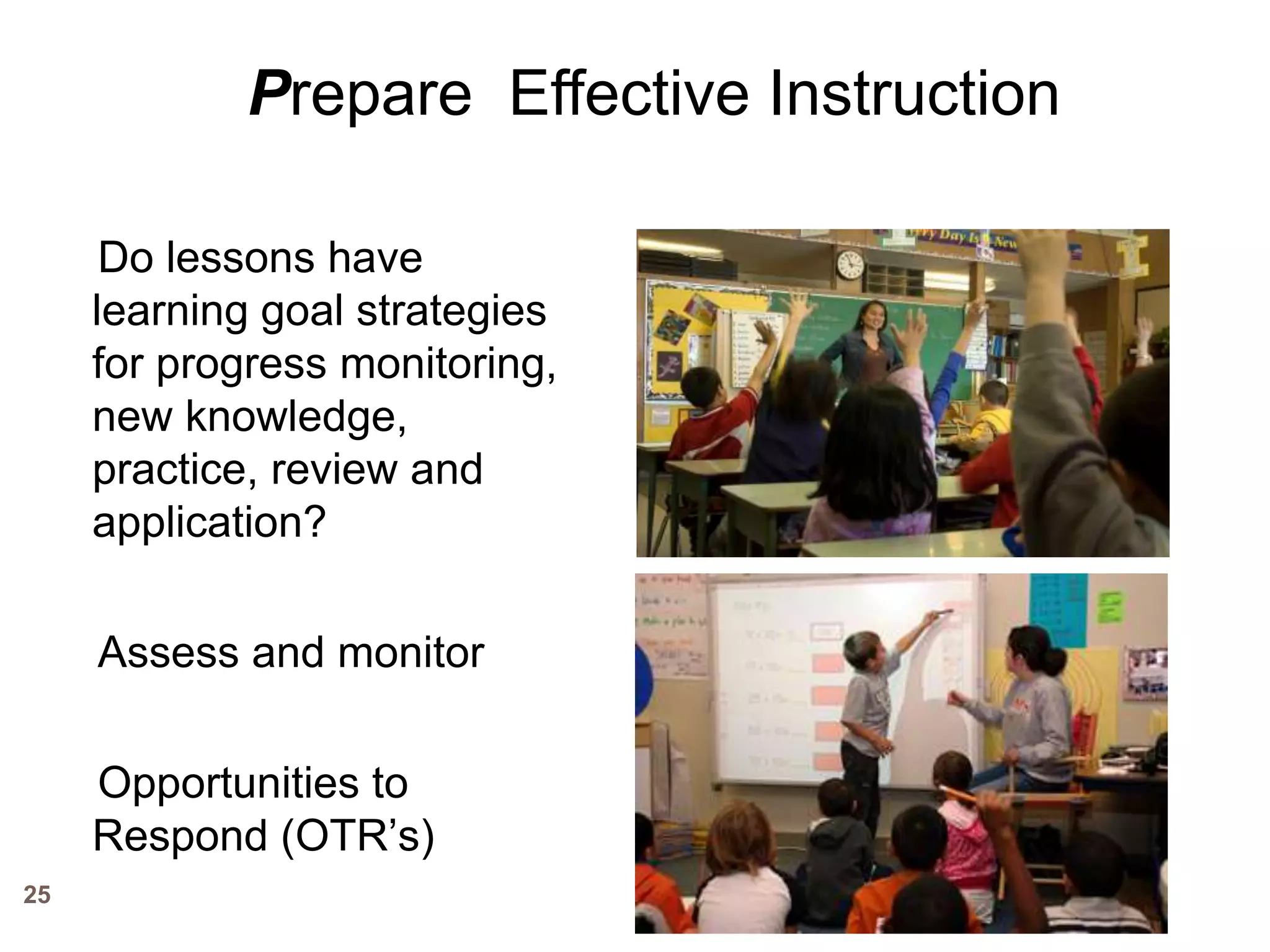
      Do lessons have
     learning goal strategies
     for progress monitoring,
     new knowledge,
     practice, review and
     application?

     Assess and monitor

     Opportunities to
     Respond (OTR’s)
25
Prepare and Deliver
     Effective Instruction
26

     1. Are lessons designed establishing learning   Yes   No
       goals, strategies for monitoring
       progress, introducing new
       knowledge, practicing, reviewing and
       application?
     2. Do you frequently assess performance and     Yes   No
       monitor student's academic progress?


     3. Do students have ample opportunity to        Yes   No
       respond (OTR’s) during instruction?
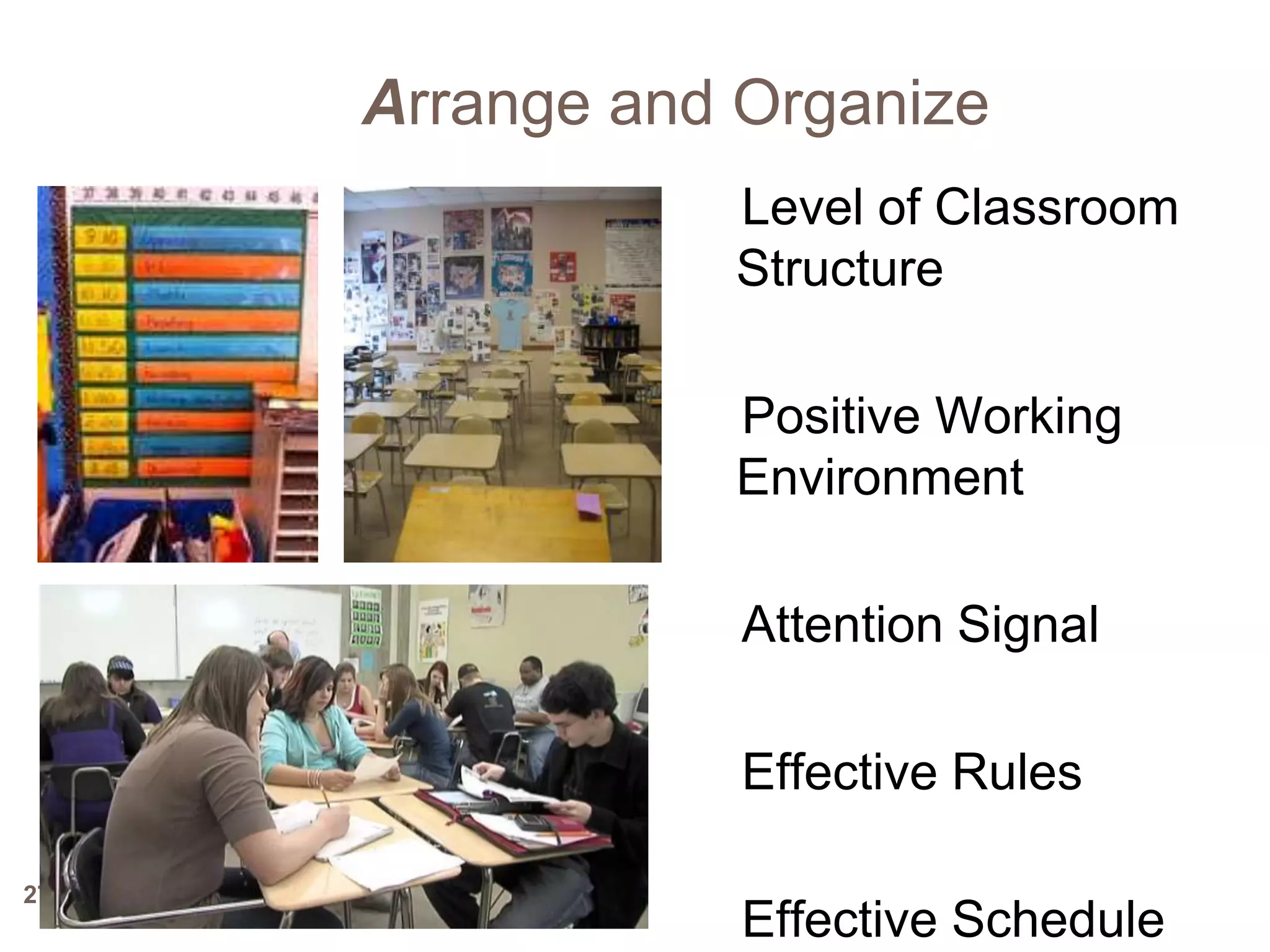
Arrange and Organize
                Level of Classroom
                Structure

                Positive Working
                Environment

                 Attention Signal

                 Effective Rules

27
                 Effective Schedule
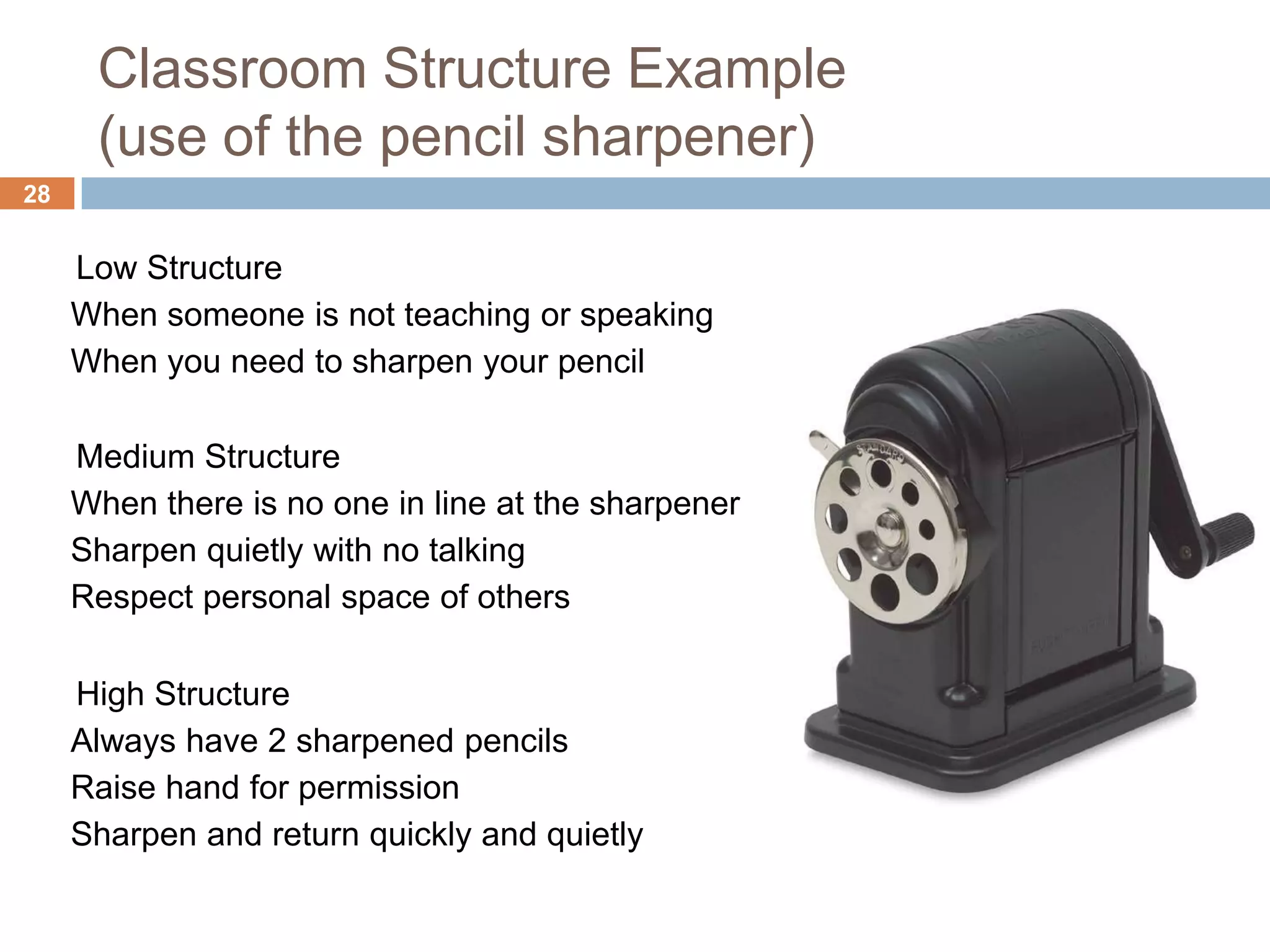
Classroom Structure Example
      (use of the pencil sharpener)
28


     Low Structure
     When someone is not teaching or speaking
     When you need to sharpen your pencil

     Medium Structure
     When there is no one in line at the sharpener
     Sharpen quietly with no talking
     Respect personal space of others

     High Structure
     Always have 2 sharpened pencils
     Raise hand for permission
     Sharpen and return quickly and quietly
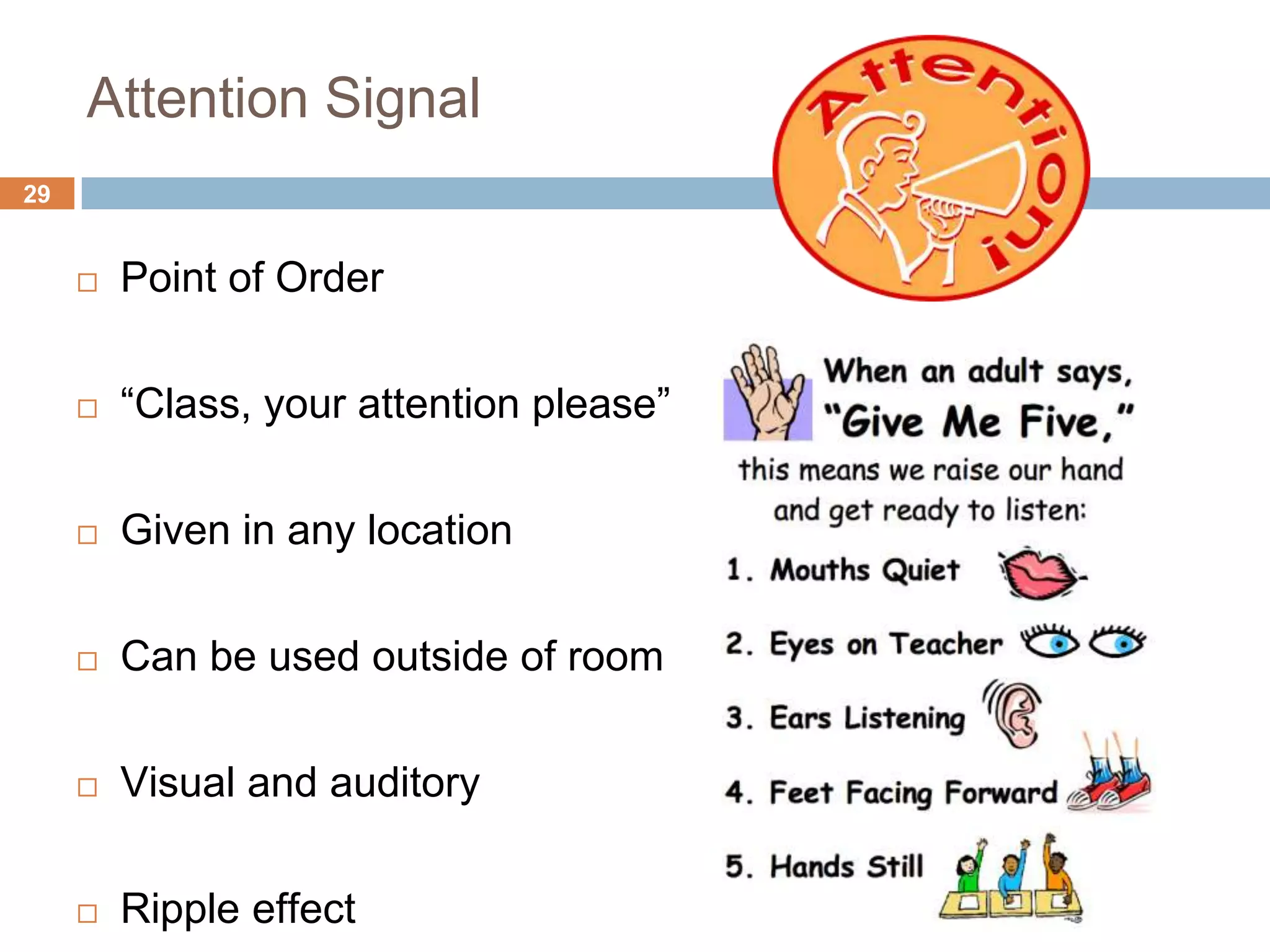
Attention Signal
29


        Point of Order

        “Class, your attention please”

        Given in any location

        Can be used outside of room

        Visual and auditory

        Ripple effect
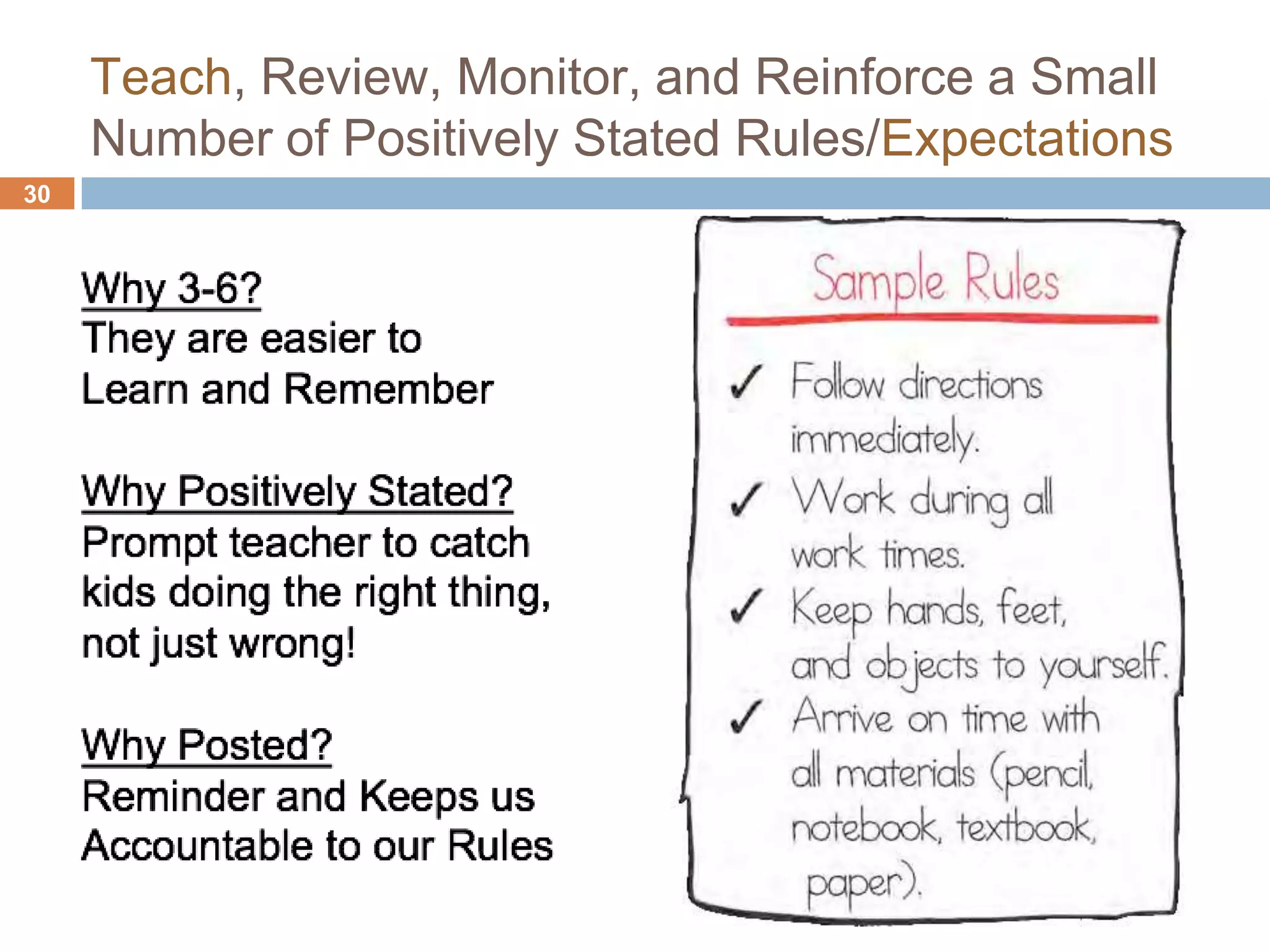
Teach, Review, Monitor, and Reinforce a Small
     Number of Positively Stated Rules/Expectations
30
31
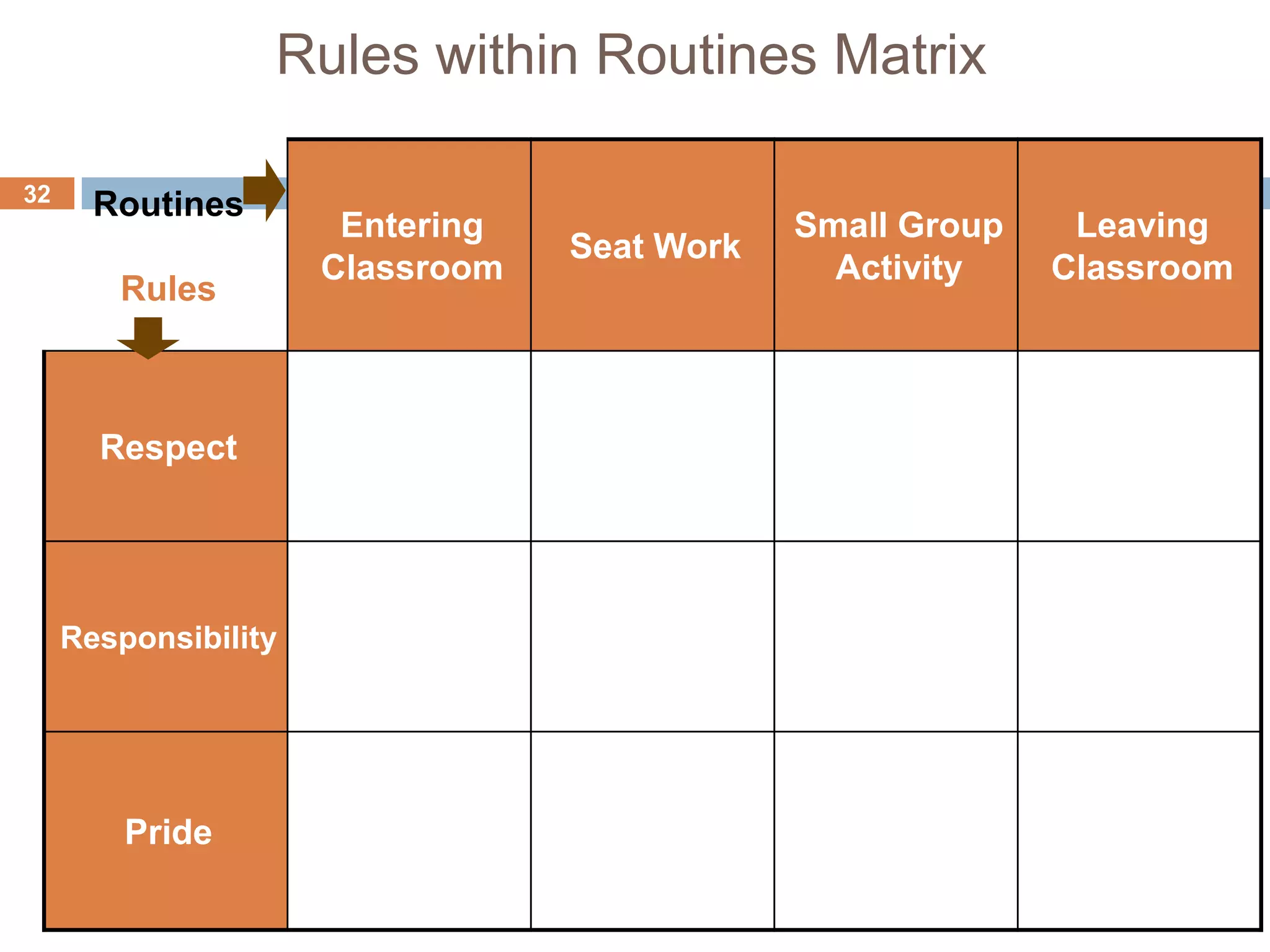
Rules within Routines Matrix

32
       Routines
                       Entering               Small Group    Leaving
                                  Seat Work
                      Classroom                 Activity    Classroom
        Rules


       Respect


     Responsibility


         Pride
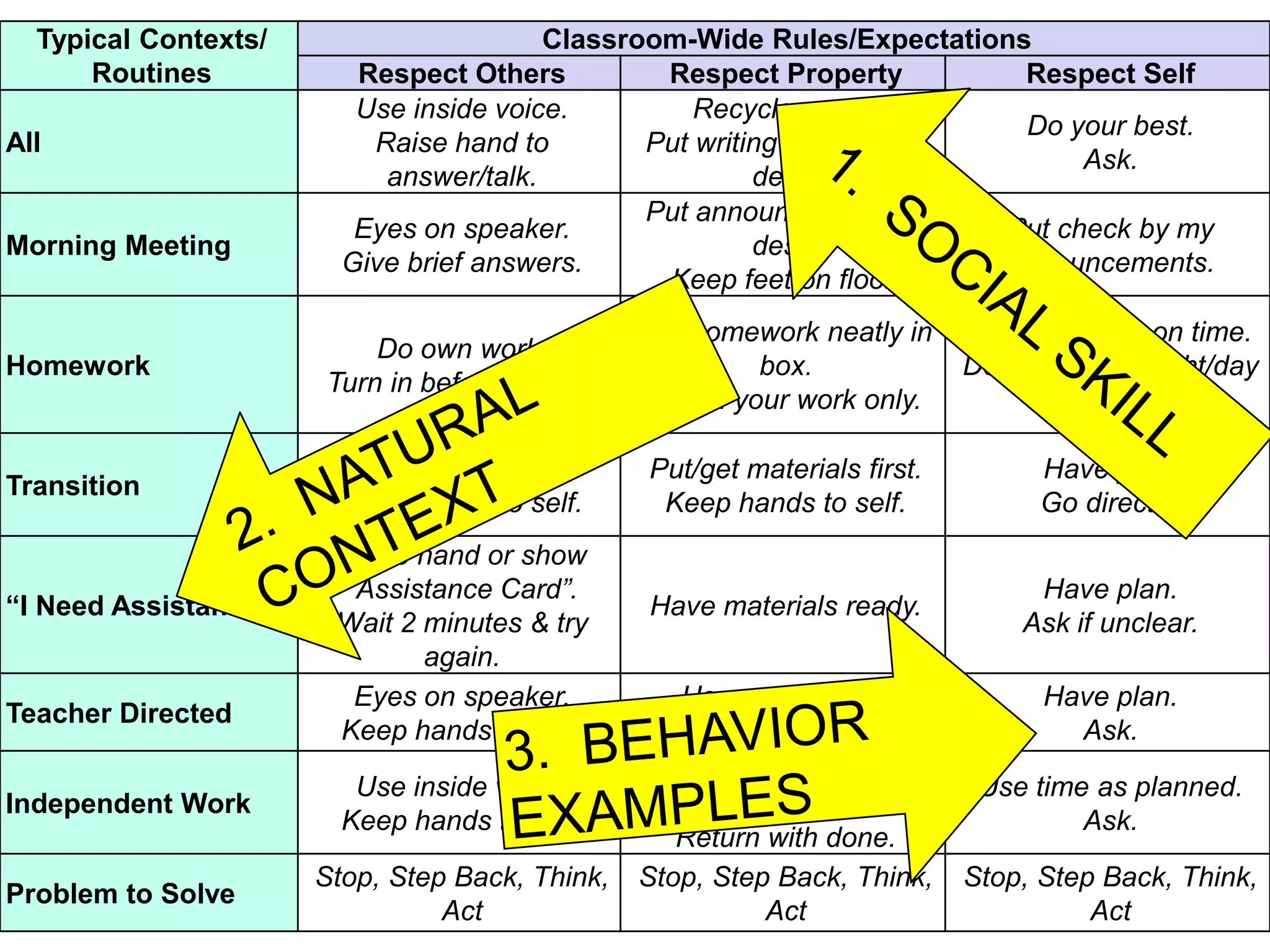
Typical Contexts/                     Classroom-Wide Rules/Expectations
      Routines           Respect Others         Respect Property         Respect Self
                         Use inside voice.         Recycle paper.
                                                                         Do your best.
All                       Raise hand to        Put writing tools inside
                                                                              Ask.
                           answer/talk.                 desk.
 33
                                               Put announcements in
                         Eyes on speaker.                               Put check by my
Morning Meeting                                         desk.
                        Give brief answers.                             announcements.
                                                Keep feet on floor.
                                                Put homework neatly in     Turn in lesson on time.
                          Do own work.
Homework                                                 box.              Do homework night/day
                      Turn in before lesson.
                                                 Touch your work only.              before.

                         Use inside voice.      Put/get materials first.         Have plan.
Transition
                        Keep hands to self.      Keep hands to self.             Go directly.
                       Raise hand or show
                       “Assistance Card”.                                       Have plan.
“I Need Assistance”                             Have materials ready.
                       Wait 2 minutes & try                                    Ask if unclear.
                              again.
                        Eyes on speaker.           Use materials as              Have plan.
Teacher Directed
                       Keep hands to self.             intended.                   Ask.
                                                   Use materials as
                         Use inside voice.                                  Use time as planned.
Independent Work                                       intended.
                        Keep hands to self.                                         Ask.
                                                   Return with done.
                      Stop, Step Back, Think,   Stop, Step Back, Think,    Stop, Step Back, Think,
Problem to Solve
                                Act                       Act                        Act
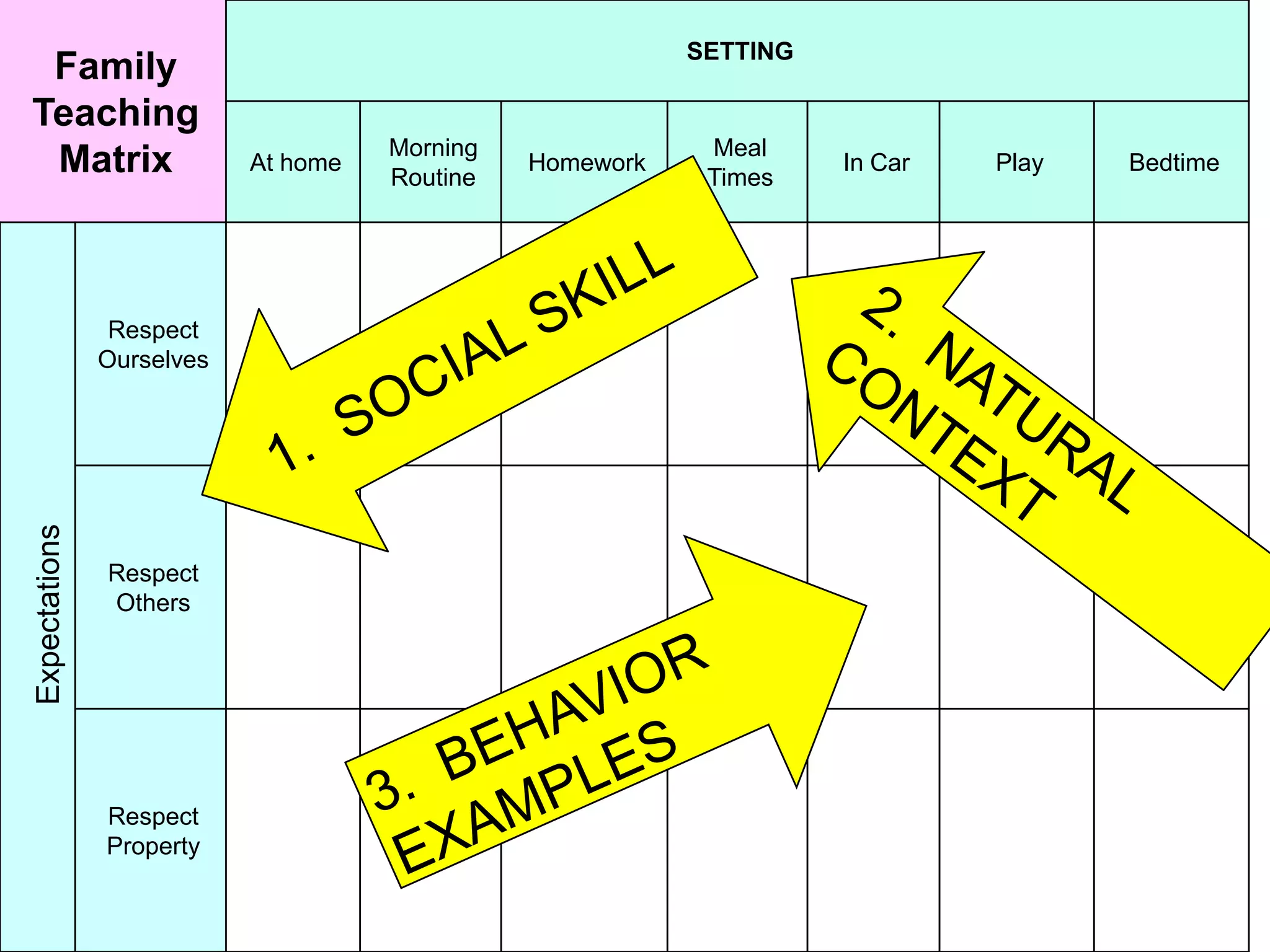
SETTING
 Family
Teaching
                                     Morning               Meal
 Matrix                    At home
                                     Routine
                                               Homework
                                                           Times
                                                                    In Car   Play   Bedtime


                Respect
               Ourselves
Expectations


               Respect
               Others


               Respect
               Property
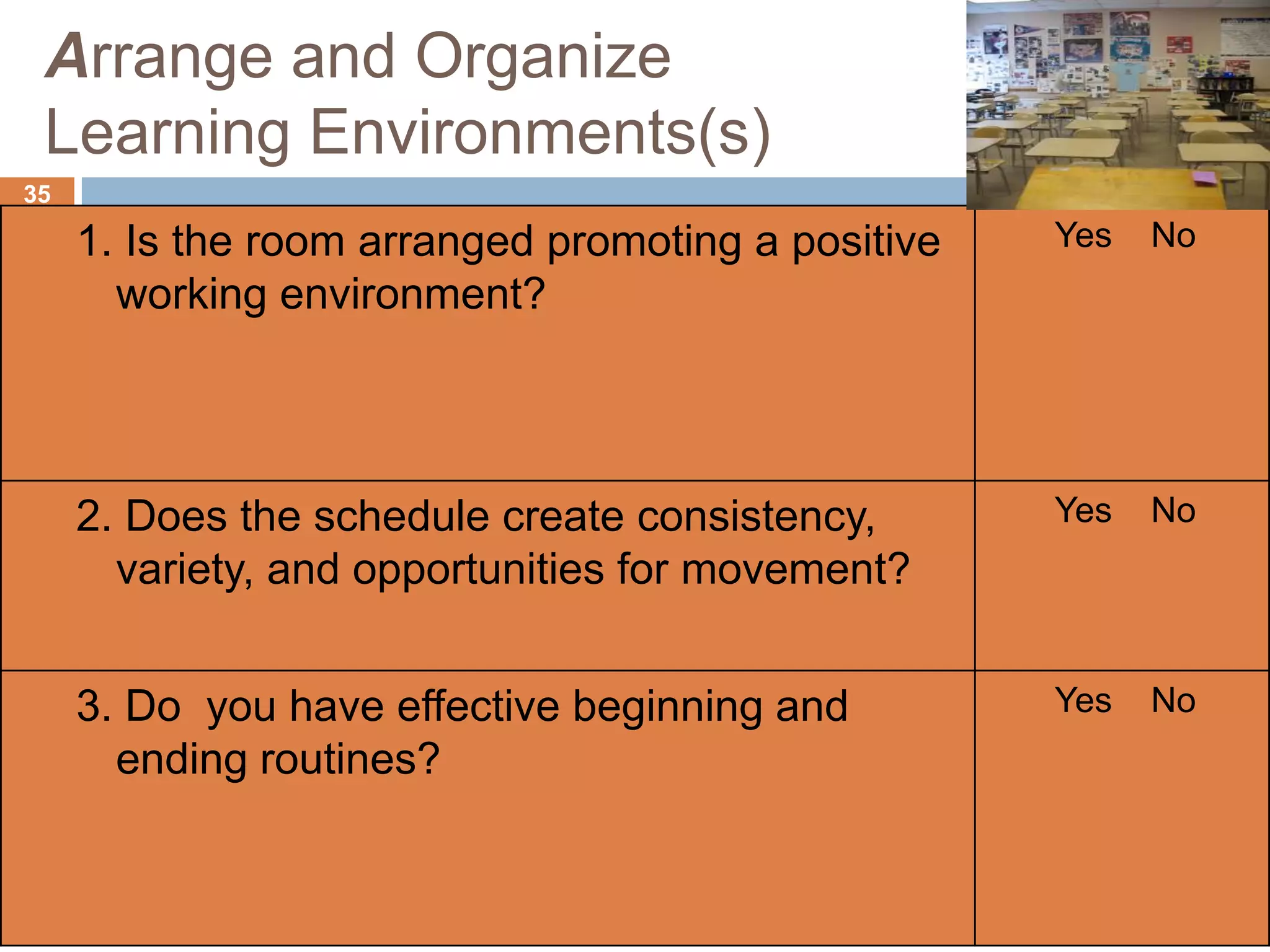
Arrange and Organize
 Learning Environments(s)
35

     1. Is the room arranged promoting a positive   Yes   No
       working environment?


     2. Does the schedule create consistency,       Yes   No
       variety, and opportunities for movement?


     3. Do you have effective beginning and         Yes   No
       ending routines?
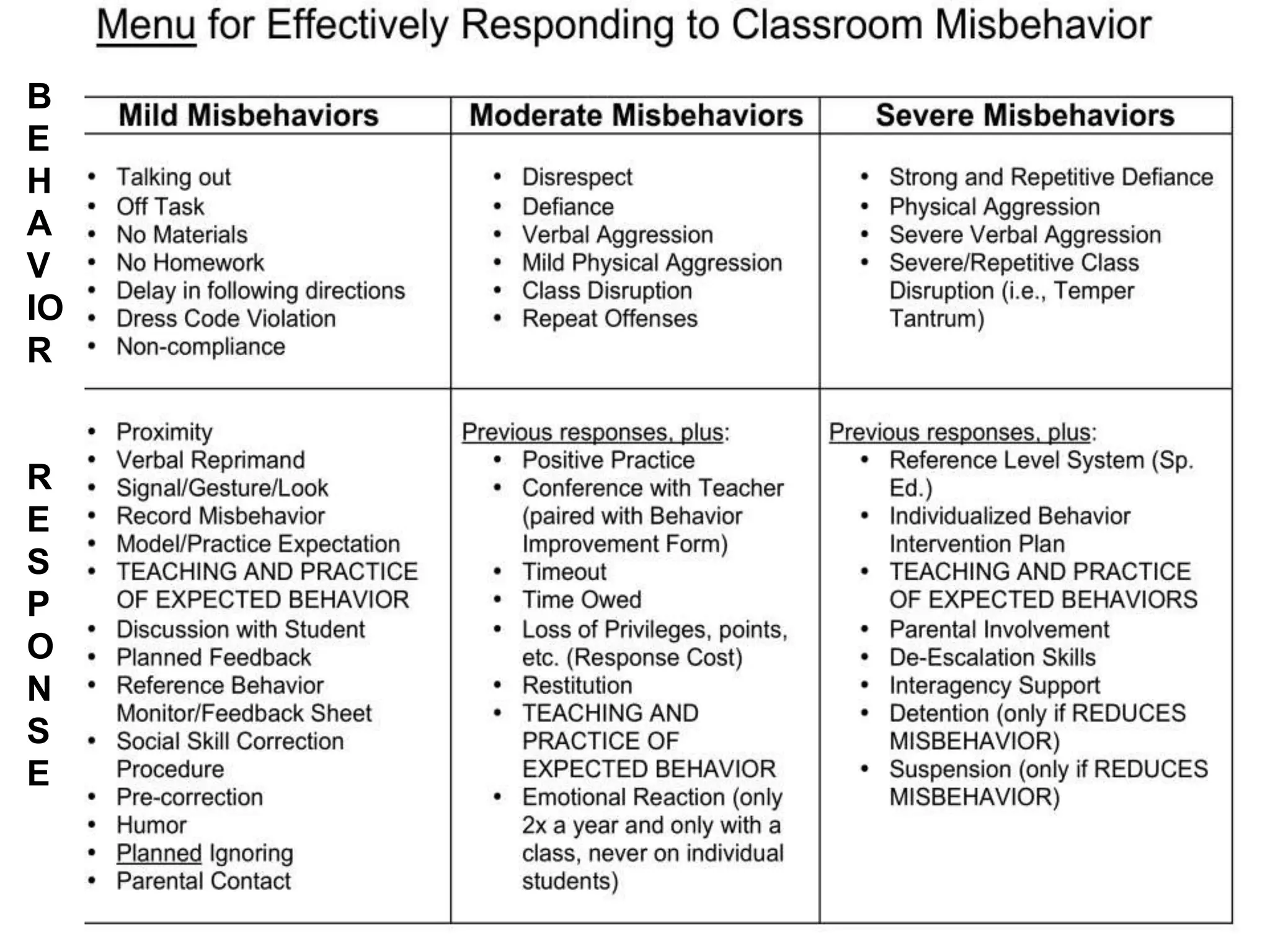
Correct Misbehavior Effectively

Do you correct misbehavior
calmly, immediately and
briefly?

 In a business-like fashion?

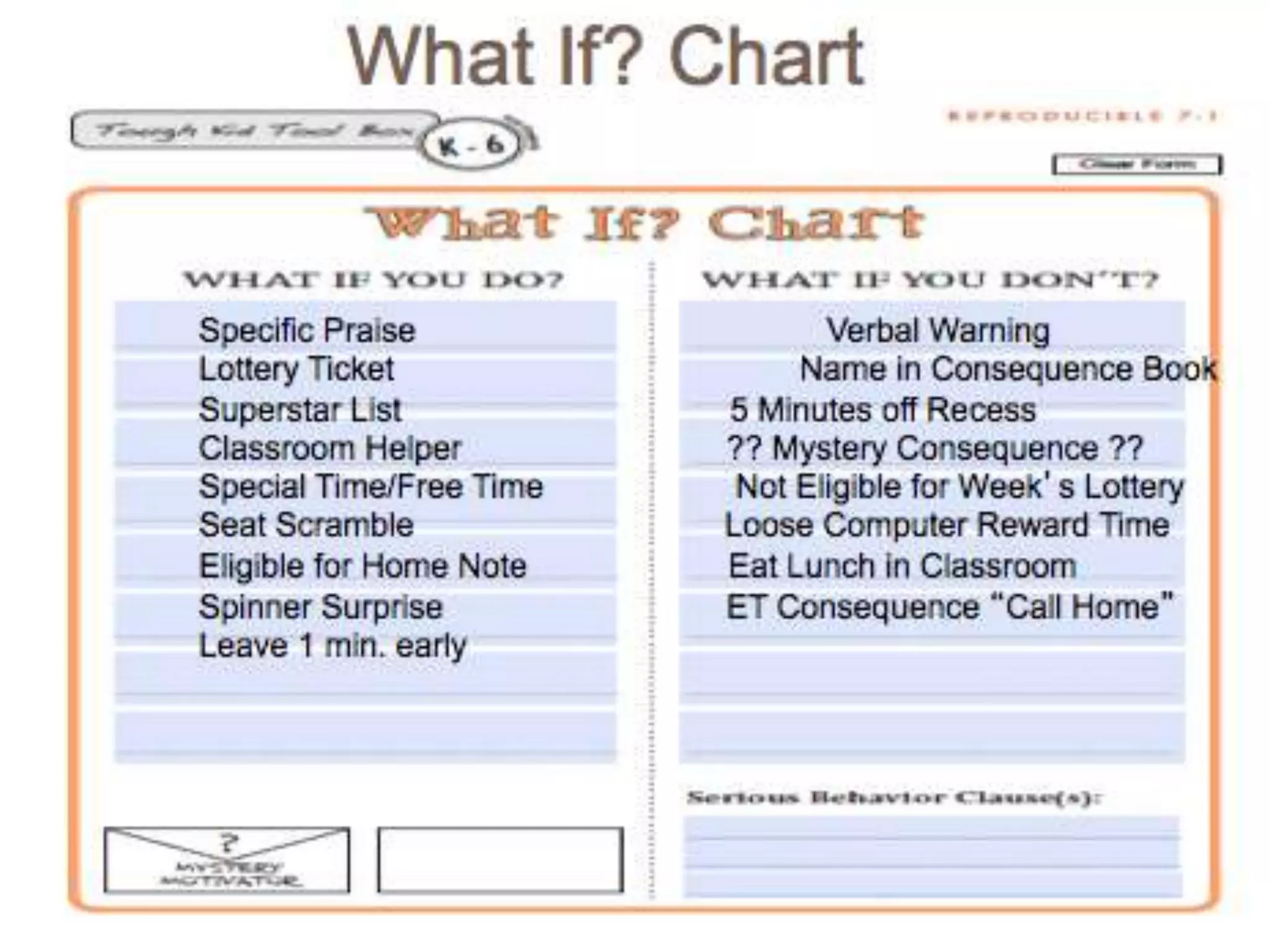
Menu of in class
consequences?

 Do you have a plan when...

 Gentle verbal reprimand
36
B
E
H
A
V
IO
R


R
E
S
P
O
N
S
E
Correct Misbehavior
     Effectively
38

     1. Do you correct consistently?                   Yes   No


     2. Do you correct calmly?                         Yes   No


     3. Do you correct immediately?                    Yes   No


     4. Do you correct briefly?                        Yes   No


     5. Do you correct respectfully?                   Yes   No


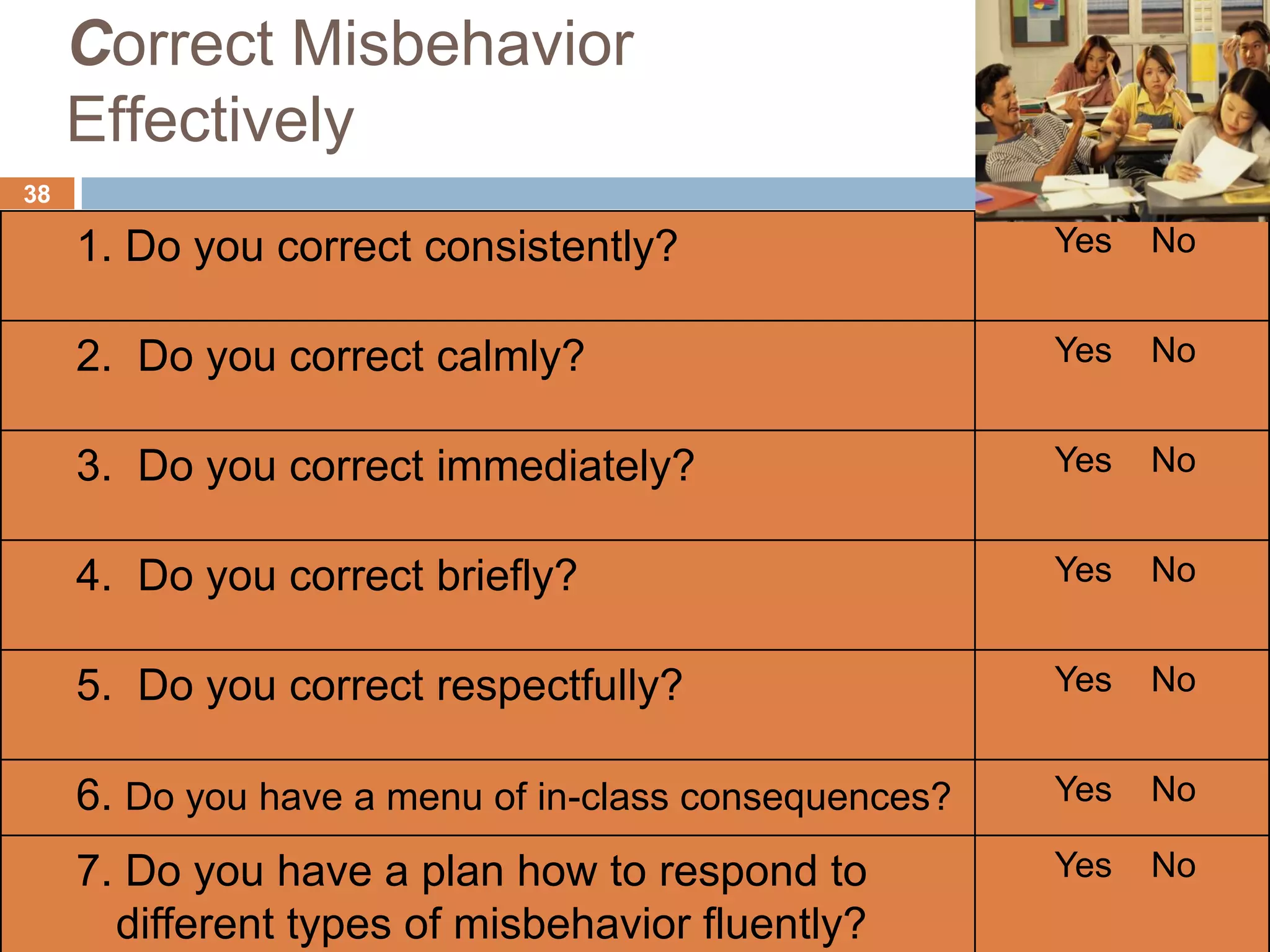
     6. Do you have a menu of in-class consequences?   Yes   No

     7. Do you have a plan how to respond to           Yes   No
       different types of misbehavior fluently?
Teach Expectations
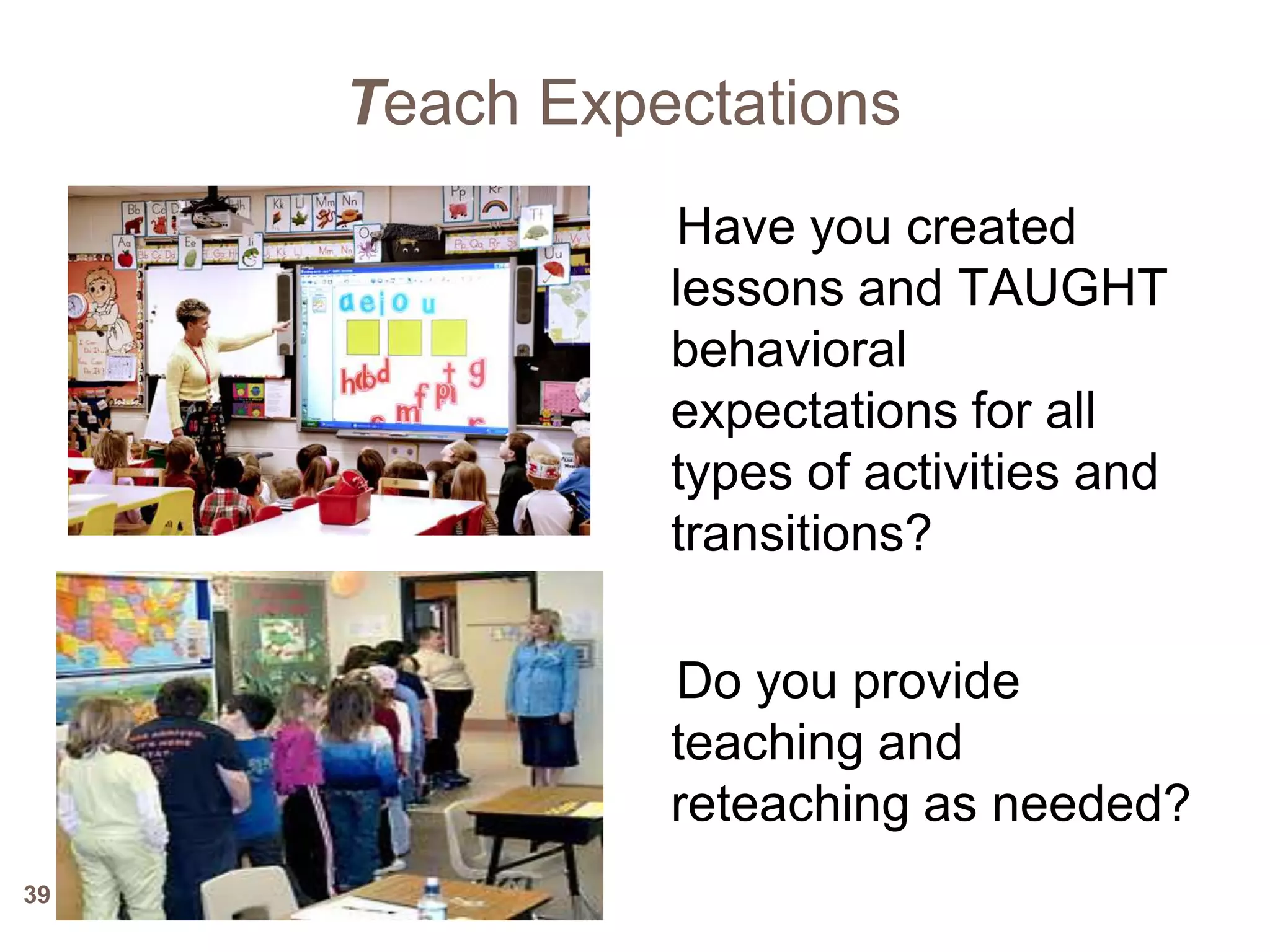
               Have you created
               lessons and TAUGHT
               behavioral
               expectations for all
               types of activities and
               transitions?

               Do you provide
               teaching and
               reteaching as needed?
39
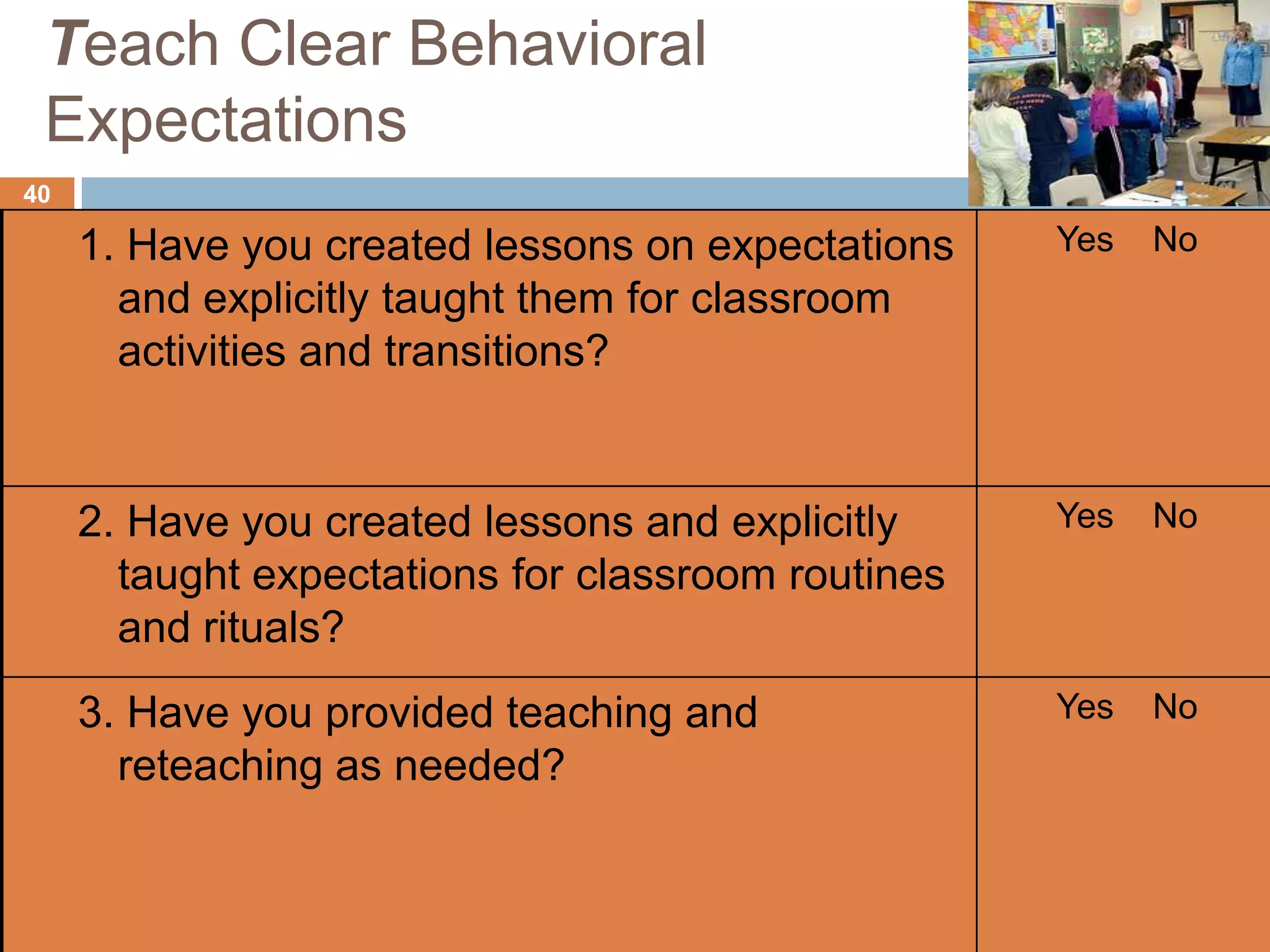
Teach Clear Behavioral
 Expectations
40

     1. Have you created lessons on expectations    Yes   No
       and explicitly taught them for classroom
       activities and transitions?


     2. Have you created lessons and explicitly     Yes   No
       taught expectations for classroom routines
       and rituals?
     3. Have you provided teaching and              Yes   No
       reteaching as needed?
Evidence Based Practices in the Classroom
     will have an IMPACT on Behavior!
41


     I   Interact positively with students

     M   Monitor behavior and actively supervise

     P   Prepare and deliver effective instruction

     A   Arrange and organize learning environments

     C   Correct misbehavior effectively

     T   Teach clear behavioral expectations
IMPACT on Behavior at All Levels
42
43
         References and Resources


        Dr. Laura Riffel at www.BehaviorDoctor.org
        Dr. Randy Sprick at www.SafeAndCivilSchools.com
Contact Info:
44


       Thomas J. Stacho Ed.S.
        State Support Team 11
     Educational Service Center of
         Central Ohio (ESCCO)
             614.753.4693
      thomas.stacho@escco.org

How To Manage Your Classroom So You Can Teach

  • 1.
    How to ManageYour Classroom So You Can Teach! IMPACT on Behavior Thomas J. Stacho Ed.S. State Support Team 11 Educational Service Center of Central Ohio
  • 2.
  • 3.
  • 4.
    Responding to ProblemBehaviors 4 Insubordination, noncompliance, defia nce, late to class, nonattendance, truancy, fighting , aggression, inappropriate Exist in every school language, social withdrawal, excessive crying, stealing, vandalism, property destruction, tobacco, drugs, alcohol, u Vary in intensity nresponsive, not following directions, inappropriate use of school Are associated with variety of materials, weapons, harassment contributing variables 1, harassment 2, harassment 3, unprepared to learn, not following Are concerns in every directions, parking lot community violation, irresponsible, trespassing, di srespectful, banned items, failure to complete homework, disrupting teaching, uncooperative, violent behavior, disruptive, verbal abuse, physical abuse, dress code, other, etc., etc., etc…..
  • 5.
    Behavior is Learnedat it Serves a Purpose  Behavior is learned at it serves a purpose  It’s taught & someone has reinforced it! 5
  • 6.
    Behavior is Relatedto the Context in Which it Occurs  School is a very different place than home which is why parents/teachers do not necessarily see the same behaviors  Hard wood or plastic chairs, fluorescent lights, restroom requirements, drinks, food, entertainment, working, breaks etc. 6
  • 7.
    For every yeara behavior has been in place, consider one month of consistent appropriate intervention for us to see a change! 7
  • 8.
    Hard Facts  Behavior is learned and serves a purpose  Behavior is related to the context in which it occurs  For every year a behavior is in place it takes at least one months for that behavior to have significant change  Children comply with the rules 80% of the time. However they are complimented for their 8 behavior less than.....
  • 9.
    9 MESSAGE Something effective for most
  • 10.
    SIMPLE SOLUTION #1 Over-reliance on “Role-Bound” Authority 10  “Students should behave because I’m the teacher”  Thinking that the person with the most power can MAKE THE KID STOP (principal)  “SYMBOLIC POWER” of authority
  • 11.
    SIMPLE SOLUTION #2 AnIncrease in Emotional Intensity
  • 12.
    SIMPLE SOLUTION #3 Over-Reliance on PUNISHMENT 12 WHY DO WE OVER-RELY On PUNISHMENT?  It’s Quick!  It’s Easy to Administer?  It’s Cheap!  It Works!!! (with students without challenging behaviors 80- 95%)
  • 13.
    A quote fromHaim Ginott… I have come to a frightening conclusion that I am the decisive element in the classroom. It is my personal approach that creates the climate. It is my daily mood that makes the weather. As a teacher I possess tremendous power to make a child’s life miserable or joyous. I can be a tool of torture or an instrument of inspiration. I can humiliate or humor, hurt or heal. In all situations, it is my response that decides whether a crisis will be escalated or de- escalated, and a child humanized or de- humanized. Between Teacher and Child
  • 14.
    Evidence Based Practicesin the Classroom will have an IMPACT on Behavior! 14 I Interact positively with students M Monitor behavior and actively supervise P Prepare and deliver effective instruction A Arrange and organize learning environments C Correct misbehavior effectively T Teach clear behavioral expectations
  • 15.
    Interact Positively Monitor Behavior Prepare Effective Instruction Arrange and Organize Correct Misbehavior Effectively Teach Expectations
  • 16.
    Interact Positively (We can improve behavior by 80% by pointing out what the student is doing correctly!) Provide frequent non- contingent attention to build relationships Provide frequent, age- appropriate positive feedback to acknowledge students’ effort to be successful Strive to provide a high ratio of positive interactions (4:1) Avoid embarrassing feedback
  • 18.
    It’s Not OnlyWhat You Say, But 18 How You Say It!  Eye contact  Facial expressions  Gestures  Posture and body orientation  Proximity  Paralinguistics (tone, pitch, rhythm, loudness etc.)  Humor
  • 19.
    3 Stars anda Wish 19 You’re story is so easy to I love the way you use read because of your personification when neat handwriting and describing the forest trees you’re sitting up straight. and sitting with your feet on the floor. The way you built the climax of the story made me really want to turn the pages and you’re facing forward.
  • 20.
    And a Wish 20 I wish you’d add more detail to your main characters and finish you work by the end of class today.
  • 21.
    Interact Positively 21 1. Do you interact with every student in a Yes No welcoming manner (e.g., saying hello, using the student’s name, talking to the student at every opportunity? 2. Do you provide age appropriate, non- Yes No embarrassing feedback? 3. Do you strive to provide positive Yes No interactions with students AFTER a negative behavior?
  • 22.
    Monitor Behavior Active Supervision Circulate, Scan & Interact! Model friendly, respectful behavior Monitor behavior through Moving &
  • 23.
    Monitor and CollectData 23 Are rules being followed? Guiding Questions: If there are errors, -who is making them? -where are the errors occurring? 1. What do we want students -what kind of errors are being to learn? made? 2. How will we know when they have learned it? Summarize data (look for 3. How will we respond when patterns) students don’t learn? 4. How will we respond when Use data to make decisions students have already learned?
  • 24.
    Monitor Behavior and Actively Supervise 24 1. Do you circulate and scan as a means of Yes No observing/monitoring student behavior? 2. Do you model friendly respectful behavior Yes No while monitoring the classroom? 3. Do you periodically collect data to make Yes No judgements about what is going well and what needs to be improved in your management plan?
  • 25.
    Prepare Effective Instruction Do lessons have learning goal strategies for progress monitoring, new knowledge, practice, review and application? Assess and monitor Opportunities to Respond (OTR’s) 25
  • 26.
    Prepare and Deliver Effective Instruction 26 1. Are lessons designed establishing learning Yes No goals, strategies for monitoring progress, introducing new knowledge, practicing, reviewing and application? 2. Do you frequently assess performance and Yes No monitor student's academic progress? 3. Do students have ample opportunity to Yes No respond (OTR’s) during instruction?
  • 27.
    Arrange and Organize Level of Classroom Structure Positive Working Environment Attention Signal Effective Rules 27 Effective Schedule
  • 28.
    Classroom Structure Example (use of the pencil sharpener) 28 Low Structure When someone is not teaching or speaking When you need to sharpen your pencil Medium Structure When there is no one in line at the sharpener Sharpen quietly with no talking Respect personal space of others High Structure Always have 2 sharpened pencils Raise hand for permission Sharpen and return quickly and quietly
  • 29.
    Attention Signal 29  Point of Order  “Class, your attention please”  Given in any location  Can be used outside of room  Visual and auditory  Ripple effect
  • 30.
    Teach, Review, Monitor,and Reinforce a Small Number of Positively Stated Rules/Expectations 30
  • 31.
  • 32.
    Rules within RoutinesMatrix 32 Routines Entering Small Group Leaving Seat Work Classroom Activity Classroom Rules Respect Responsibility Pride
  • 33.
    Typical Contexts/ Classroom-Wide Rules/Expectations Routines Respect Others Respect Property Respect Self Use inside voice. Recycle paper. Do your best. All Raise hand to Put writing tools inside Ask. answer/talk. desk. 33 Put announcements in Eyes on speaker. Put check by my Morning Meeting desk. Give brief answers. announcements. Keep feet on floor. Put homework neatly in Turn in lesson on time. Do own work. Homework box. Do homework night/day Turn in before lesson. Touch your work only. before. Use inside voice. Put/get materials first. Have plan. Transition Keep hands to self. Keep hands to self. Go directly. Raise hand or show “Assistance Card”. Have plan. “I Need Assistance” Have materials ready. Wait 2 minutes & try Ask if unclear. again. Eyes on speaker. Use materials as Have plan. Teacher Directed Keep hands to self. intended. Ask. Use materials as Use inside voice. Use time as planned. Independent Work intended. Keep hands to self. Ask. Return with done. Stop, Step Back, Think, Stop, Step Back, Think, Stop, Step Back, Think, Problem to Solve Act Act Act
  • 34.
    SETTING Family Teaching Morning Meal Matrix At home Routine Homework Times In Car Play Bedtime Respect Ourselves Expectations Respect Others Respect Property
  • 35.
    Arrange and Organize Learning Environments(s) 35 1. Is the room arranged promoting a positive Yes No working environment? 2. Does the schedule create consistency, Yes No variety, and opportunities for movement? 3. Do you have effective beginning and Yes No ending routines?
  • 36.
    Correct Misbehavior Effectively Doyou correct misbehavior calmly, immediately and briefly? In a business-like fashion? Menu of in class consequences? Do you have a plan when... Gentle verbal reprimand 36
  • 37.
  • 38.
    Correct Misbehavior Effectively 38 1. Do you correct consistently? Yes No 2. Do you correct calmly? Yes No 3. Do you correct immediately? Yes No 4. Do you correct briefly? Yes No 5. Do you correct respectfully? Yes No 6. Do you have a menu of in-class consequences? Yes No 7. Do you have a plan how to respond to Yes No different types of misbehavior fluently?
  • 39.
    Teach Expectations Have you created lessons and TAUGHT behavioral expectations for all types of activities and transitions? Do you provide teaching and reteaching as needed? 39
  • 40.
    Teach Clear Behavioral Expectations 40 1. Have you created lessons on expectations Yes No and explicitly taught them for classroom activities and transitions? 2. Have you created lessons and explicitly Yes No taught expectations for classroom routines and rituals? 3. Have you provided teaching and Yes No reteaching as needed?
  • 41.
    Evidence Based Practicesin the Classroom will have an IMPACT on Behavior! 41 I Interact positively with students M Monitor behavior and actively supervise P Prepare and deliver effective instruction A Arrange and organize learning environments C Correct misbehavior effectively T Teach clear behavioral expectations
  • 42.
    IMPACT on Behaviorat All Levels 42
  • 43.
    43 References and Resources  Dr. Laura Riffel at www.BehaviorDoctor.org  Dr. Randy Sprick at www.SafeAndCivilSchools.com
  • 44.
    Contact Info: 44 Thomas J. Stacho Ed.S. State Support Team 11 Educational Service Center of Central Ohio (ESCCO) 614.753.4693 thomas.stacho@escco.org