LIFE 
SKILLS 
Dr.C.Karthik Deepa 
Assistant Professor 
Department of Education 
Avinashilingam University
Life-Skills Education as 
defined by the UNICEF 
"a behaviour change or 
behaviour development 
approach to address a 
balance of three areas; 
knowledge, attitude and 
skills"
World Health Organization 
defined Life Skills as 
"the abilities for adaptive 
and positive behaviour that 
enable individuals to deal 
effectively with the 
demands and challenges 
of everyday
Life Skills are defined in the 
Targeting Life Skills (TLS) Model 
(Hendricks, 1996) as “Skills that 
help an individual to be successful 
in living a productive and satisfying 
life.” 
Yarham (1919) defined Life Skills 
as “the personal competence that 
enables a person to deal effectively 
with the demands and 
challengesconfronted in everyday
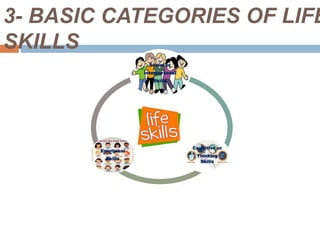
3- BASIC CATEGORIES OF LIFE 
SKILLS 
Social or 
Interpersonal 
Skills 
Cognitive or 
Thinking 
Skills 
Emotional 
Skills
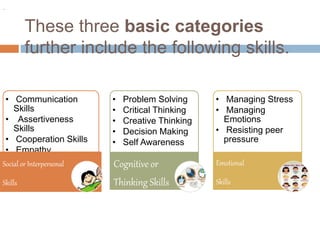
These three basic categories 
further include the following skills. 
. 
• Communication 
Skills 
• Assertiveness 
Skills 
• Cooperation Skills 
• Empathy 
Social or Interpersonal 
Skills 
• Problem Solving 
• Critical Thinking 
• Creative Thinking 
• Decision Making 
• Self Awareness 
Cognitive or 
Thinking Skills 
• Managing Stress 
• Managing 
Emotions 
• Resisting peer 
pressure 
Emotional 
Skills
: 
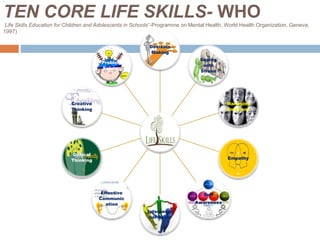
TEN CORE LIFE SKILLS- WHO 
Life Skills Education for Children and Adolescents in Schools”-Programme on Mental Health, World Health Organization, Geneva, 
1997) 
Decision 
Making 
Coping 
with 
Stress 
Managing 
Emotions 
Empathy 
Self 
Awareness 
Interperso 
nal Skills 
Effective 
Communic 
ation 
Creative 
Thinking 
Critical 
Thinking 
Problem 
Solving
1. Self Awareness 
 recognition of 'self', our character, our 
strengths and weaknesses, desires and 
dislikes. 
 help us recognize when we are stressed 
or under pressure. 
 prerequisite to effective communication 
and interpersonal relations, as well as for 
developing empathy with others.
2. Empathy 
 ability to imagine what life is like for another 
person. 
 help us to accept others who may be very 
different from ourselves. 
 improve social interactions, especially, in 
situations of ethnic or cultural diversities. 
 encourage nurturing positive behaviour 
towards people in need of care and 
assistance, or tolerance 
 required to develop a successful relationship 
with our loved ones and society at large.
3. Critical Thinking 
 an ability to analyze information and 
experiences in an objective manner. 
 contribute to a well balanced way of life by 
helping us to recognize and assess the factors 
that influence attitudes and behaviour, such as 
values, peer pressure and the media.
4. Creative Thinking 
 a novel way of seeing or doing things 
that is characteristic of four 
components-fluency 
(generating new ideas), 
flexibility (shifting perspective 
easily), originality (conceiving of 
something new), and 
 elaboration (building on others' 
ideas).
5. Decision Making 
 helps us to deal constructively with 
decisions about our lives. 
 teach people how to actively make 
decisions about their actions in relation to 
a healthy assessment of different options 
and, what effects these different decisions 
are likely to have.
6. Problem Solving 
 helps us to deal constructively with problems 
in our lives. 
 problems that are left unresolved can cause 
mental stress and give rise to accompanying 
physical strain.
7. Interpersonal skills 
 help us to relate in positive ways with people 
we interact with. 
 to make and keep friendly relationships, which 
can be of great importance to our mental and 
social well-being. 
 To maintaining good relations with family 
members who are the most important source 
of social support. 
 an ability to end relationships constructively.
8. Effective Communication 
 ability to express ourselves, both verbally and 
non-verbally, in ways that are appropriate to 
our cultures and situations. 
 ability to express opinions and desires, and 
also needs and fears. 
 being able to ask for advice and help in the 
time of need.
9. Coping with Stress 
 recognizing the sources of stress in our lives, 
 recognizing how they affect us, and 
 how we act in a way that helps us control our 
levels of stress by changing our environment 
or lifestyle, and learning how to relax.
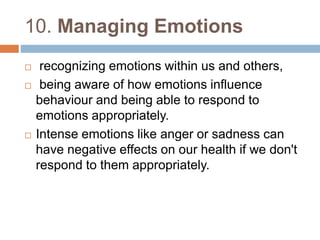
10. Managing Emotions 
 recognizing emotions within us and others, 
 being aware of how emotions influence 
behaviour and being able to respond to 
emotions appropriately. 
 Intense emotions like anger or sadness can 
have negative effects on our health if we don't 
respond to them appropriately.
Life skills

Life skills

  • 1.
    LIFE SKILLS Dr.C.KarthikDeepa Assistant Professor Department of Education Avinashilingam University
  • 2.
    Life-Skills Education as defined by the UNICEF "a behaviour change or behaviour development approach to address a balance of three areas; knowledge, attitude and skills"
  • 3.
    World Health Organization defined Life Skills as "the abilities for adaptive and positive behaviour that enable individuals to deal effectively with the demands and challenges of everyday
  • 4.
    Life Skills aredefined in the Targeting Life Skills (TLS) Model (Hendricks, 1996) as “Skills that help an individual to be successful in living a productive and satisfying life.” Yarham (1919) defined Life Skills as “the personal competence that enables a person to deal effectively with the demands and challengesconfronted in everyday
  • 5.
    3- BASIC CATEGORIESOF LIFE SKILLS Social or Interpersonal Skills Cognitive or Thinking Skills Emotional Skills
  • 6.
    These three basiccategories further include the following skills. . • Communication Skills • Assertiveness Skills • Cooperation Skills • Empathy Social or Interpersonal Skills • Problem Solving • Critical Thinking • Creative Thinking • Decision Making • Self Awareness Cognitive or Thinking Skills • Managing Stress • Managing Emotions • Resisting peer pressure Emotional Skills
  • 7.
    : TEN CORELIFE SKILLS- WHO Life Skills Education for Children and Adolescents in Schools”-Programme on Mental Health, World Health Organization, Geneva, 1997) Decision Making Coping with Stress Managing Emotions Empathy Self Awareness Interperso nal Skills Effective Communic ation Creative Thinking Critical Thinking Problem Solving
  • 8.
    1. Self Awareness  recognition of 'self', our character, our strengths and weaknesses, desires and dislikes.  help us recognize when we are stressed or under pressure.  prerequisite to effective communication and interpersonal relations, as well as for developing empathy with others.
  • 9.
    2. Empathy ability to imagine what life is like for another person.  help us to accept others who may be very different from ourselves.  improve social interactions, especially, in situations of ethnic or cultural diversities.  encourage nurturing positive behaviour towards people in need of care and assistance, or tolerance  required to develop a successful relationship with our loved ones and society at large.
  • 10.
    3. Critical Thinking  an ability to analyze information and experiences in an objective manner.  contribute to a well balanced way of life by helping us to recognize and assess the factors that influence attitudes and behaviour, such as values, peer pressure and the media.
  • 11.
    4. Creative Thinking  a novel way of seeing or doing things that is characteristic of four components-fluency (generating new ideas), flexibility (shifting perspective easily), originality (conceiving of something new), and  elaboration (building on others' ideas).
  • 12.
    5. Decision Making  helps us to deal constructively with decisions about our lives.  teach people how to actively make decisions about their actions in relation to a healthy assessment of different options and, what effects these different decisions are likely to have.
  • 13.
    6. Problem Solving  helps us to deal constructively with problems in our lives.  problems that are left unresolved can cause mental stress and give rise to accompanying physical strain.
  • 14.
    7. Interpersonal skills  help us to relate in positive ways with people we interact with.  to make and keep friendly relationships, which can be of great importance to our mental and social well-being.  To maintaining good relations with family members who are the most important source of social support.  an ability to end relationships constructively.
  • 15.
    8. Effective Communication  ability to express ourselves, both verbally and non-verbally, in ways that are appropriate to our cultures and situations.  ability to express opinions and desires, and also needs and fears.  being able to ask for advice and help in the time of need.
  • 16.
    9. Coping withStress  recognizing the sources of stress in our lives,  recognizing how they affect us, and  how we act in a way that helps us control our levels of stress by changing our environment or lifestyle, and learning how to relax.
  • 17.
    10. Managing Emotions  recognizing emotions within us and others,  being aware of how emotions influence behaviour and being able to respond to emotions appropriately.  Intense emotions like anger or sadness can have negative effects on our health if we don't respond to them appropriately.