Creating a comfortable learning environment Maria Parra and Míriam García
What is a comfortable learning environment? Physical conditions.  Social conditions. Pedagogical conditions.
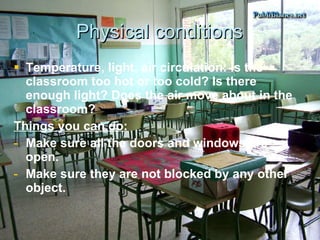
Physical conditions Temperature, light, air circulation: Is the classroom too hot or too cold? Is there enough light? Does the air move about in the classroom? Things you can do:   Make sure all the doors and windows are open. Make sure they are not blocked by any other object.
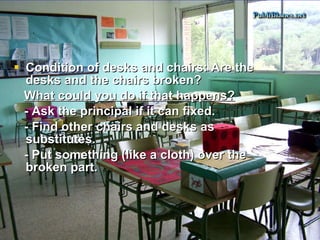
Condition of desks and chairs: Are the desks and the chairs broken? What could you do if that happens? - Ask the principal if it can fixed. - Find other chairs and desks as substitutes. - Put something (like a cloth) over the broken part.
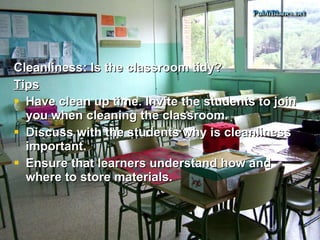
Cleanliness: Is the classroom tidy? Tips Have clean up time. Invite the students to join you when cleaning the classroom. Discuss with the students why is cleanliness important. Ensure that learners understand how and where to store materials.
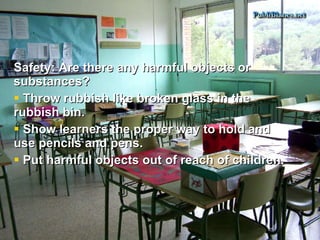
Safety: Are there any harmful objects or substances? Throw rubbish like broken glass in the rubbish bin. Show learners the proper way to hold and use pencils and pens.  Put harmful objects out of reach of children.
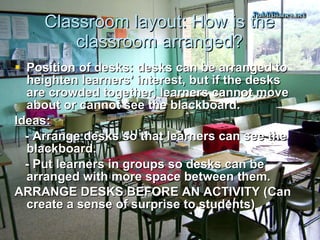
Classroom layout: How is the classroom arranged? Position of desks: desks can be arranged to heighten learners’ interest, but if the desks are crowded together, learners cannot move about or cannot see the blackboard.  Ideas: - Arrange desks so that learners can see the blackboard. - Put learners in groups so desks can be arranged with more space between them. ARRANGE DESKS BEFORE AN ACTIVITY (Can create a sense of surprise to students)
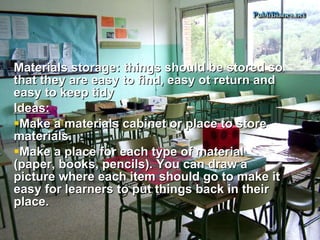
Materials storage: things should be stored so that they are easy to find, easy ot return and easy to keep tidy Ideas:   Make a materials cabinet or place to store materials.  Make a place for each type of material (paper, books, pencils). You can draw a picture where each item should go to make it easy for learners to put things back in their place.
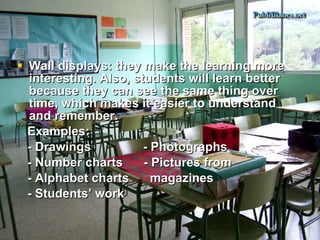
Wall displays: they make the learning more interesting. Also, students will learn better because they can see the same thing over time, which makes it easier to understand and remember.  Examples: - Drawings  - Photographs - Number charts  - Pictures from - Alphabet charts  magazines - Students’ work
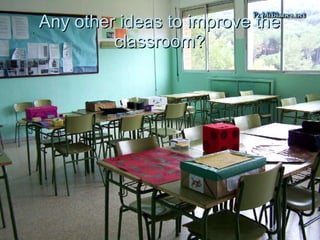
Any other ideas to improve the classroom?
Social conditions Building positive teacher-student relationships  Creating positive peer relationships
Building positive teacher-student relationships Research indicates that academic achievement and student behaviour are influenced by the quality of teacher-student relationship (Jones and Jones, 2001) Its quality affects dramatically whether students’ personal needs are met in the classroom.
Use of effective communication skills The foundation for a good classroom environment.  Benefit us by allowing to meet our own needs more effectively and achieve our professional goals.  We can distinguish between sending skills and receivign skills.
Sending skills Maintining a high ratio of positive and negative statements Children are sensitive to praise and criticism given by adults. Increasing the ration of positive and negative remarks can increase on-task behaviour and it can rapidly create a more positive classroom environment.
Giving feedback Studies indicate that teachers are not effective using feedback. Feedback to students must have three qualities: - Contingency: praise must follow desired  behaviours rather than beign used as a  motivator. - Specificity: praise should describe the be- haviour that is being reinforced. - Credibility: praise should be appropiate for  situation.
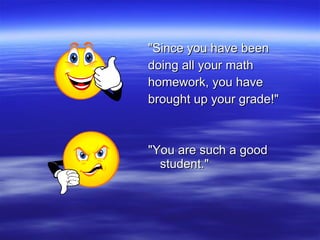
"Since you have been doing all your math homework, you have brought up your grade!"  "You are such a good student."
Receiving skills When listening skills are used effectively they create relationships that allow students to feel significant, accepted.  Empathic listening: involves providing the speaker with a sense that he/she has been clearly heard.  Two basic approaches: - Making responses such as “M-hm”, “Right” (it encourages the speaker to continue talking). - Paraphrase: restate the students’ expressed ideas in your own words.
Creating an open dialogue Create an open dialogue with students. You need to decide how open and involved you wish to be with them. Types of dialogues: - Almost complete openness, we share a range of personal concerns and values. - Openness related to our reactions and our feelings about the school environment. - An almost exclusive focus on a role-bound relationship, we share no feelings.
Communicating high expectations to students We must think through what we really expect from our students and then see if our own behaviour is consistent with those expectations.  If we expect students to be polite to each other, for example, you should treat students in the same manner.
Promoting students’ self-esteem Self-esteem is the overall opinion that each person holds of himself/herself. A strong self-concept may emerge as one experiences frequent success, and it is weakened by repeated failures.  One of our main responsibilities is to create an atmosphere where self-esteem can grow.
Help students feel capable: build the confidence that success is possible. Help students become involved and interact with others. - Accept students sincerely and unconditionally - Make yourself available to students. 3) Help students contribute. 4) Show affection and respect to our students.
Creating positive peer relationships Peers play an important role in determining the quality of the learning environment. It is important that teachers implement strategies that encourage development of positive peer interactions in class. If the classroom group is to function in a supportive manner, we must initially set time for activities that enable students to know each other, to develop a feeling of being included…
Group cohesiveness It refers to the extent to which a group experiences a sense of oneness, identity, and esprit de corps.  Characterised by warm, friendly interactions among all members.
How we can create group cohesiveness? By making the group seem attractive and distinguished from other groups. By involving the group in cooperative enterprises By helping students view themselves as an important component in the group.

Creating a comfortable learning environment

  • 1.
    Creating a comfortablelearning environment Maria Parra and Míriam García
  • 2.
    What is acomfortable learning environment? Physical conditions. Social conditions. Pedagogical conditions.
  • 3.
    Physical conditions Temperature,light, air circulation: Is the classroom too hot or too cold? Is there enough light? Does the air move about in the classroom? Things you can do: Make sure all the doors and windows are open. Make sure they are not blocked by any other object.
  • 4.
    Condition of desksand chairs: Are the desks and the chairs broken? What could you do if that happens? - Ask the principal if it can fixed. - Find other chairs and desks as substitutes. - Put something (like a cloth) over the broken part.
  • 5.
    Cleanliness: Is theclassroom tidy? Tips Have clean up time. Invite the students to join you when cleaning the classroom. Discuss with the students why is cleanliness important. Ensure that learners understand how and where to store materials.
  • 6.
    Safety: Are thereany harmful objects or substances? Throw rubbish like broken glass in the rubbish bin. Show learners the proper way to hold and use pencils and pens. Put harmful objects out of reach of children.
  • 7.
    Safety: Are thereany harmful objects or substances? Throw rubbish like broken glass in the rubbish bin. Show learners the proper way to hold and use pencils and pens. Put harmful objects out of reach of children.
  • 8.
    Classroom layout: Howis the classroom arranged? Position of desks: desks can be arranged to heighten learners’ interest, but if the desks are crowded together, learners cannot move about or cannot see the blackboard. Ideas: - Arrange desks so that learners can see the blackboard. - Put learners in groups so desks can be arranged with more space between them. ARRANGE DESKS BEFORE AN ACTIVITY (Can create a sense of surprise to students)
  • 9.
    Materials storage: thingsshould be stored so that they are easy to find, easy ot return and easy to keep tidy Ideas: Make a materials cabinet or place to store materials. Make a place for each type of material (paper, books, pencils). You can draw a picture where each item should go to make it easy for learners to put things back in their place.
  • 10.
    Wall displays: theymake the learning more interesting. Also, students will learn better because they can see the same thing over time, which makes it easier to understand and remember. Examples: - Drawings - Photographs - Number charts - Pictures from - Alphabet charts magazines - Students’ work
  • 11.
    Any other ideasto improve the classroom?
  • 12.
    Social conditions Buildingpositive teacher-student relationships Creating positive peer relationships
  • 13.
    Building positive teacher-studentrelationships Research indicates that academic achievement and student behaviour are influenced by the quality of teacher-student relationship (Jones and Jones, 2001) Its quality affects dramatically whether students’ personal needs are met in the classroom.
  • 14.
    Use of effectivecommunication skills The foundation for a good classroom environment. Benefit us by allowing to meet our own needs more effectively and achieve our professional goals. We can distinguish between sending skills and receivign skills.
  • 15.
    Sending skills Maintininga high ratio of positive and negative statements Children are sensitive to praise and criticism given by adults. Increasing the ration of positive and negative remarks can increase on-task behaviour and it can rapidly create a more positive classroom environment.
  • 16.
    Giving feedback Studiesindicate that teachers are not effective using feedback. Feedback to students must have three qualities: - Contingency: praise must follow desired behaviours rather than beign used as a motivator. - Specificity: praise should describe the be- haviour that is being reinforced. - Credibility: praise should be appropiate for situation.
  • 17.
    "Since you havebeen doing all your math homework, you have brought up your grade!" "You are such a good student."
  • 18.
    Receiving skills Whenlistening skills are used effectively they create relationships that allow students to feel significant, accepted. Empathic listening: involves providing the speaker with a sense that he/she has been clearly heard. Two basic approaches: - Making responses such as “M-hm”, “Right” (it encourages the speaker to continue talking). - Paraphrase: restate the students’ expressed ideas in your own words.
  • 19.
    Creating an opendialogue Create an open dialogue with students. You need to decide how open and involved you wish to be with them. Types of dialogues: - Almost complete openness, we share a range of personal concerns and values. - Openness related to our reactions and our feelings about the school environment. - An almost exclusive focus on a role-bound relationship, we share no feelings.
  • 20.
    Communicating high expectationsto students We must think through what we really expect from our students and then see if our own behaviour is consistent with those expectations. If we expect students to be polite to each other, for example, you should treat students in the same manner.
  • 21.
    Promoting students’ self-esteemSelf-esteem is the overall opinion that each person holds of himself/herself. A strong self-concept may emerge as one experiences frequent success, and it is weakened by repeated failures. One of our main responsibilities is to create an atmosphere where self-esteem can grow.
  • 22.
    Help students feelcapable: build the confidence that success is possible. Help students become involved and interact with others. - Accept students sincerely and unconditionally - Make yourself available to students. 3) Help students contribute. 4) Show affection and respect to our students.
  • 23.
    Creating positive peerrelationships Peers play an important role in determining the quality of the learning environment. It is important that teachers implement strategies that encourage development of positive peer interactions in class. If the classroom group is to function in a supportive manner, we must initially set time for activities that enable students to know each other, to develop a feeling of being included…
  • 24.
    Group cohesiveness Itrefers to the extent to which a group experiences a sense of oneness, identity, and esprit de corps. Characterised by warm, friendly interactions among all members.
  • 25.
    How we cancreate group cohesiveness? By making the group seem attractive and distinguished from other groups. By involving the group in cooperative enterprises By helping students view themselves as an important component in the group.