Behavior Management: Guiding Young Children
Attachment Theory and Challenging Behaviors: Reconstructing the Nature of Relationships
 Children’s development and socialization are products of their relationships with their caregivers.
 Adults guides and supports the child as they strive for autonomy and mastery of the physical and social environment
(Ainsworth, 1978).
 Supportive experiences allow children to develop secure attachments and view relationships as reciprocal and
cooperative.
 Children who are securely attached build internal working models of their caregivers (Bowlby 1969).
 Children acquire skills and understandings needed to regulate their emotions and cognitively guide their own
behavior.
-Families and teachers need to provide guidance, support and limits that children need to be successful.
- Children who cannot rely on the important adults in their lives to meet their needs, build their attachment
relationships on mistrust.
- The appropriate response depends on the individual child, the nature of the teacher-child relationship and the
resources available.
Collaborative relationships:
1. Know child’s attachment history
2. Patience and perseverance
3. Personal autonomy or choice
4. Develop a sense of trust to cope with the normal stresses of living and work with others. Undo child’s history of
mistrust.
5. Teach social and emotional skills to reduce emotional outbursts and potential harm to self or others.
Behavior Management: Guiding Young Children
Caring relationships:
1. Find ways to like the child and to let the child know they are liked.
2. Spend playful time to get to know the child, connect to the child’s world and be supportive.
3. Share food or have a conversation, build a trusting relationship.
4. Discuss what happened
5. Provide support instead of consequences
Democratic Discipline: Children Creating Solutions
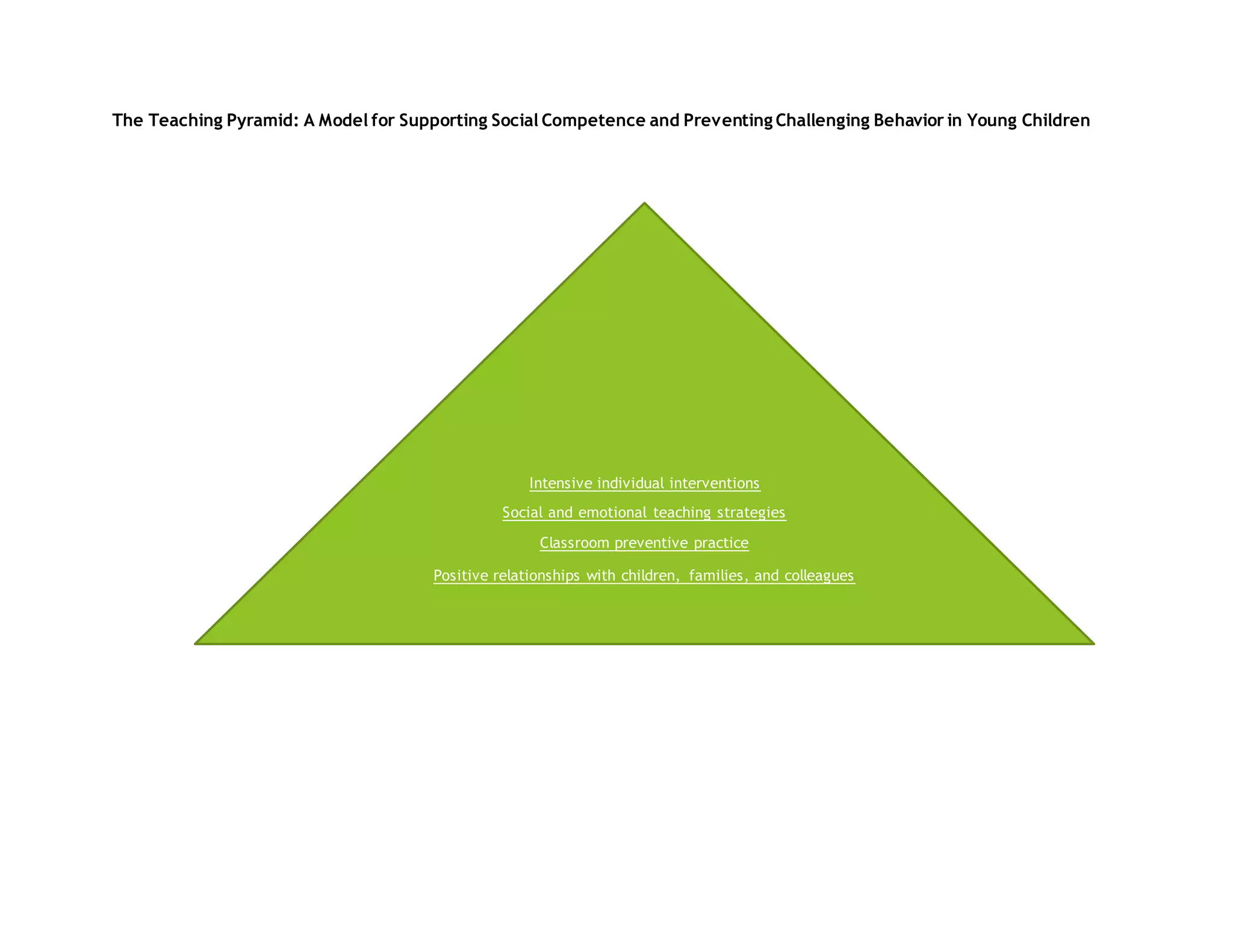
- The Teaching Pyramid: A Model of Supporting Social Competence and Preventing Challenging Behavior in Young Children
- Offer positive words to encourage children
- Offer choice activities some of the time
- Respect individual differences in achievement and problem solving styles.
Develop a few Class Rules that express what to do rather than what not to do.
 Treat others as you want to be treated
 Talk one at a time in the big group
 Use gentle hands and words with others.
The Class Meeting Approach (Nelson, Lott, & Glenn, 1993) fosters a child-centered discipline strategy encouraging
empowerment, personal responsibility and consequences.
1. Incorporate an open-ended activity by having children paint self-portraits and write about their hopes for the school year to
help children identify and care about their own and others’ wishes for the class.
2. Self-portraits and wishes are tangible evidence of the differences and similarities in a classroom.
3. Children connect the kind of class they want to have with the rules that they must live by to make the class happen.
4. Class meetings are the cornerstone of the new discipline plan.
5. Class meeting occur daily and grow naturally from the children’s issues.
6. Children fashion solutions
7. Deciding as a group seemed to assert appositive pressure over children to select solutions that encourage rather than punish
8. Encourage children to solve problems on their own.
9. Develops self-confidence and a shared approach with deliberate, solution-seeking mindset.
The Teaching Pyramid: A Model for Supporting Social Competence and Preventing Challenging Behavior in Young Children
Intensive individual interventions
Social and emotional teaching strategies
Classroom preventive practice
Positive relationships with children, families, and colleagues
Behavior Management: Guiding Young Children
Practical Strategies for Building Positive Relationship
1. Play following child’s lead
2. Greet every child at the door
3. Have a conversation during meal times
4. Listen to a child’s ideas and stories and be an appreciative audience
5. Send home positive notes
6. Offer praise and encouragement.
7. Share information about yourself, and find something in common with the child
8. Ask children to bring family photos, and give them an opportunity to share them with you and their peers.
9. Post children’s work at their eye level.
10.Have a star of the week who brings in special things form home and get to share them during circle time.
Make sure everyone has fun.
11.Acknowledge children’s efforts.
12.Give compliments liberally.
13.In front of a child, call the family to say what a great day the child is having.
14.Find out what a child’s favorite book is and read it to the whole class.
15.Let the children make personal all about me books and share them at circle time.
16.Write on a T-shirt all the special things about a given child and let them wear it around.
17.Play a game with a child.
18.Learn key phrases in the child’s home language.
19.Give hugs, hi-5’s and thumbs-up for accomplishing tasks
20.Hold child’s hand.
21.Call aside a child who has a bad day and say. I’m sorry we had a bad day today. I know tomorrow is going
to be better.
22.Tell children how much they were missed whenthey were absent.
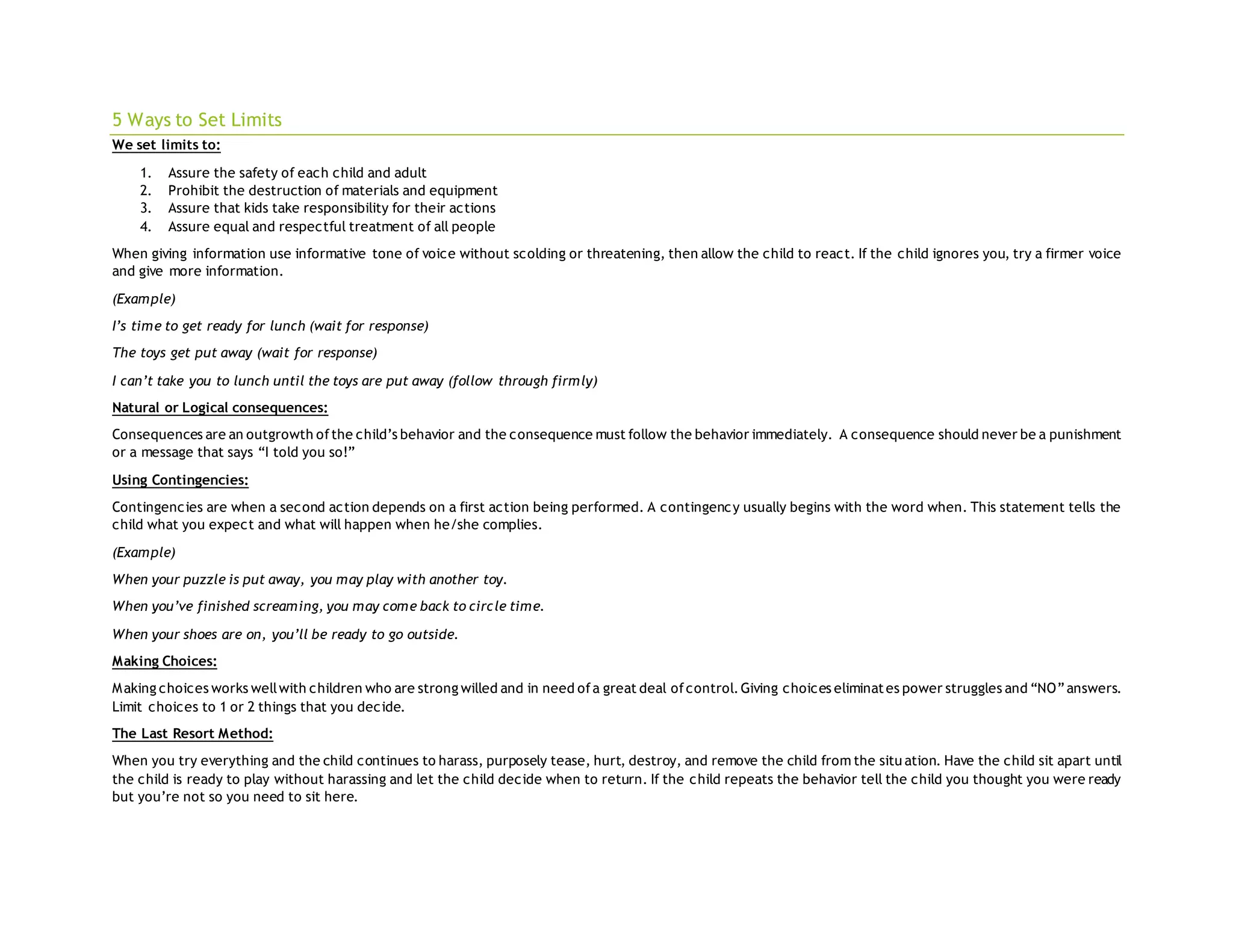
5 Ways to Set Limits
We set limits to:
1. Assure the safety of each child and adult
2. Prohibit the destruction of materials and equipment
3. Assure that kids take responsibility for their actions
4. Assure equal and respectful treatment of all people
When giving information use informative tone of voice without scolding or threatening, then allow the child to react. If the child ignores you, try a firmer voice
and give more information.
(Example)
I’s time to get ready for lunch (wait for response)
The toys get put away (wait for response)
I can’t take you to lunch until the toys are put away (follow through firmly)
Natural or Logical consequences:
Consequences are an outgrowth ofthe child’s behavior and the consequence must follow the behavior immediately. A consequence should never be a punishment
or a message that says “I told you so!”
Using Contingencies:
Contingencies are when a second action depends on a first action being performed. A contingency usually begins with the word when. This statement tells the
child what you expect and what will happen when he/she complies.
(Example)
When your puzzle is put away, you may play with another toy.
When you’ve finished screaming, you may come back to circle time.
When your shoes are on, you’ll be ready to go outside.
Making Choices:
Making choices works wellwith children who are strong willed and in need ofa great deal ofcontrol.Giving choices eliminates power struggles and “NO”answers.
Limit choices to 1 or 2 things that you decide.
The Last Resort Method:
When you try everything and the child continues to harass, purposely tease, hurt, destroy, and remove the child from the situ ation. Have the child sit apart until
the child is ready to play without harassing and let the child decide when to return. If the child repeats the behavior tell the child you thought you were ready
but you’re not so you need to sit here.
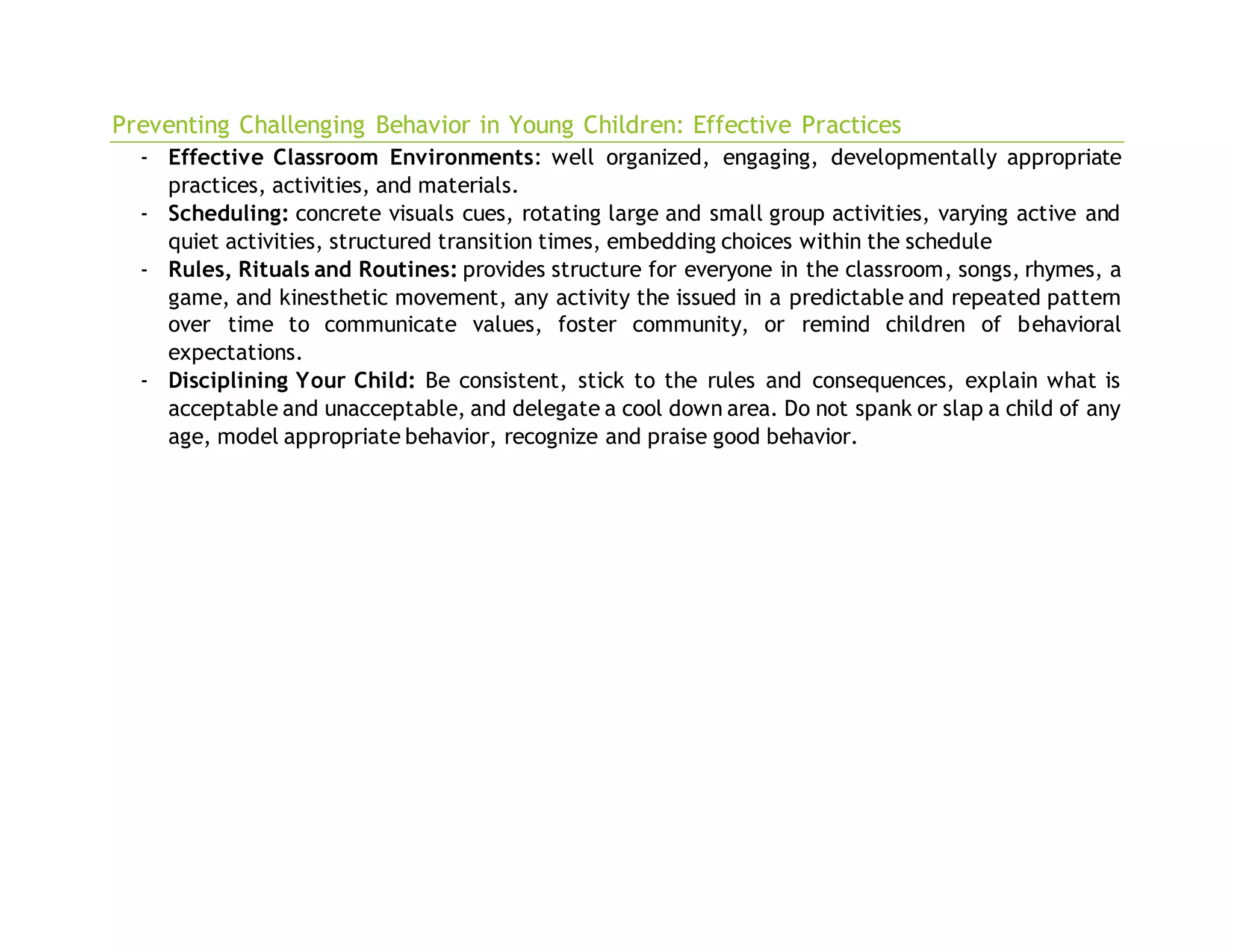
Preventing Challenging Behavior in Young Children: Effective Practices
- Effective Classroom Environments: well organized, engaging, developmentally appropriate
practices, activities, and materials.
- Scheduling: concrete visuals cues, rotating large and small group activities, varying active and
quiet activities, structured transition times, embedding choices within the schedule
- Rules, Rituals and Routines: provides structure for everyone in the classroom, songs, rhymes, a
game, and kinesthetic movement, any activity the issued in a predictable and repeated pattern
over time to communicate values, foster community, or remind children of behavioral
expectations.
- Disciplining Your Child: Be consistent, stick to the rules and consequences, explain what is
acceptable and unacceptable, and delegate a cool down area. Do not spank or slap a child of any
age, model appropriate behavior, recognize and praise good behavior.

Behavior Management

  • 1.
    Behavior Management: GuidingYoung Children Attachment Theory and Challenging Behaviors: Reconstructing the Nature of Relationships  Children’s development and socialization are products of their relationships with their caregivers.  Adults guides and supports the child as they strive for autonomy and mastery of the physical and social environment (Ainsworth, 1978).  Supportive experiences allow children to develop secure attachments and view relationships as reciprocal and cooperative.  Children who are securely attached build internal working models of their caregivers (Bowlby 1969).  Children acquire skills and understandings needed to regulate their emotions and cognitively guide their own behavior. -Families and teachers need to provide guidance, support and limits that children need to be successful. - Children who cannot rely on the important adults in their lives to meet their needs, build their attachment relationships on mistrust. - The appropriate response depends on the individual child, the nature of the teacher-child relationship and the resources available. Collaborative relationships: 1. Know child’s attachment history 2. Patience and perseverance 3. Personal autonomy or choice 4. Develop a sense of trust to cope with the normal stresses of living and work with others. Undo child’s history of mistrust. 5. Teach social and emotional skills to reduce emotional outbursts and potential harm to self or others.
  • 2.
    Behavior Management: GuidingYoung Children Caring relationships: 1. Find ways to like the child and to let the child know they are liked. 2. Spend playful time to get to know the child, connect to the child’s world and be supportive. 3. Share food or have a conversation, build a trusting relationship. 4. Discuss what happened 5. Provide support instead of consequences Democratic Discipline: Children Creating Solutions - The Teaching Pyramid: A Model of Supporting Social Competence and Preventing Challenging Behavior in Young Children - Offer positive words to encourage children - Offer choice activities some of the time - Respect individual differences in achievement and problem solving styles. Develop a few Class Rules that express what to do rather than what not to do.  Treat others as you want to be treated  Talk one at a time in the big group  Use gentle hands and words with others. The Class Meeting Approach (Nelson, Lott, & Glenn, 1993) fosters a child-centered discipline strategy encouraging empowerment, personal responsibility and consequences. 1. Incorporate an open-ended activity by having children paint self-portraits and write about their hopes for the school year to help children identify and care about their own and others’ wishes for the class. 2. Self-portraits and wishes are tangible evidence of the differences and similarities in a classroom. 3. Children connect the kind of class they want to have with the rules that they must live by to make the class happen. 4. Class meetings are the cornerstone of the new discipline plan. 5. Class meeting occur daily and grow naturally from the children’s issues. 6. Children fashion solutions 7. Deciding as a group seemed to assert appositive pressure over children to select solutions that encourage rather than punish 8. Encourage children to solve problems on their own. 9. Develops self-confidence and a shared approach with deliberate, solution-seeking mindset.
  • 3.
    The Teaching Pyramid:A Model for Supporting Social Competence and Preventing Challenging Behavior in Young Children Intensive individual interventions Social and emotional teaching strategies Classroom preventive practice Positive relationships with children, families, and colleagues
  • 4.
    Behavior Management: GuidingYoung Children Practical Strategies for Building Positive Relationship 1. Play following child’s lead 2. Greet every child at the door 3. Have a conversation during meal times 4. Listen to a child’s ideas and stories and be an appreciative audience 5. Send home positive notes 6. Offer praise and encouragement. 7. Share information about yourself, and find something in common with the child 8. Ask children to bring family photos, and give them an opportunity to share them with you and their peers. 9. Post children’s work at their eye level. 10.Have a star of the week who brings in special things form home and get to share them during circle time. Make sure everyone has fun. 11.Acknowledge children’s efforts. 12.Give compliments liberally. 13.In front of a child, call the family to say what a great day the child is having. 14.Find out what a child’s favorite book is and read it to the whole class. 15.Let the children make personal all about me books and share them at circle time. 16.Write on a T-shirt all the special things about a given child and let them wear it around. 17.Play a game with a child. 18.Learn key phrases in the child’s home language. 19.Give hugs, hi-5’s and thumbs-up for accomplishing tasks 20.Hold child’s hand. 21.Call aside a child who has a bad day and say. I’m sorry we had a bad day today. I know tomorrow is going to be better. 22.Tell children how much they were missed whenthey were absent.
  • 5.
    5 Ways toSet Limits We set limits to: 1. Assure the safety of each child and adult 2. Prohibit the destruction of materials and equipment 3. Assure that kids take responsibility for their actions 4. Assure equal and respectful treatment of all people When giving information use informative tone of voice without scolding or threatening, then allow the child to react. If the child ignores you, try a firmer voice and give more information. (Example) I’s time to get ready for lunch (wait for response) The toys get put away (wait for response) I can’t take you to lunch until the toys are put away (follow through firmly) Natural or Logical consequences: Consequences are an outgrowth ofthe child’s behavior and the consequence must follow the behavior immediately. A consequence should never be a punishment or a message that says “I told you so!” Using Contingencies: Contingencies are when a second action depends on a first action being performed. A contingency usually begins with the word when. This statement tells the child what you expect and what will happen when he/she complies. (Example) When your puzzle is put away, you may play with another toy. When you’ve finished screaming, you may come back to circle time. When your shoes are on, you’ll be ready to go outside. Making Choices: Making choices works wellwith children who are strong willed and in need ofa great deal ofcontrol.Giving choices eliminates power struggles and “NO”answers. Limit choices to 1 or 2 things that you decide. The Last Resort Method: When you try everything and the child continues to harass, purposely tease, hurt, destroy, and remove the child from the situ ation. Have the child sit apart until the child is ready to play without harassing and let the child decide when to return. If the child repeats the behavior tell the child you thought you were ready but you’re not so you need to sit here.
  • 6.
    Preventing Challenging Behaviorin Young Children: Effective Practices - Effective Classroom Environments: well organized, engaging, developmentally appropriate practices, activities, and materials. - Scheduling: concrete visuals cues, rotating large and small group activities, varying active and quiet activities, structured transition times, embedding choices within the schedule - Rules, Rituals and Routines: provides structure for everyone in the classroom, songs, rhymes, a game, and kinesthetic movement, any activity the issued in a predictable and repeated pattern over time to communicate values, foster community, or remind children of behavioral expectations. - Disciplining Your Child: Be consistent, stick to the rules and consequences, explain what is acceptable and unacceptable, and delegate a cool down area. Do not spank or slap a child of any age, model appropriate behavior, recognize and praise good behavior.