BIOSTATISTICS AND RESEARCH METHODOLOGY
Unit-1: Origin and History of Statistics
PRESENTED BY
Gokara Madhuri
B. Pharmacy IV Year
UNDER THE GUIDANCE OF
Gangu Sreelatha M.Pharm., (Ph.D)
Assistant Professor
CMR College of Pharmacy, Hyderabad.
email: sreelatha1801@gmail.com
ORIGIN
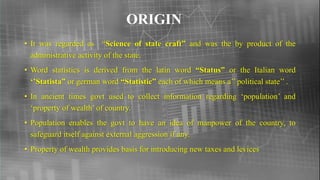
• It was regarded as “Science of state craft” and was the by product of the
administrative activity of the state.
• Word statistics is derived from the latin word “Status” or the Italian word
‘’Statista” or german word “Statistic” each of which means a’’ political state’’ .
• In ancient times govt used to collect information regarding ‘population’ and
‘property of wealth’ of country.
• Population enables the govt to have an idea of manpower of the country, to
safeguard itself against external aggression if any.
• Property of wealth provides basis for introducing new taxes and levices
HISTORY
YEARS INFORMATION
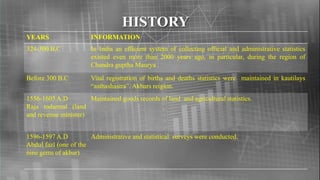
324-300 B.C In India an efficient system of collecting official and administrative statistics
existed even more than 2000 years ago, in particular, during the region of
Chandra guptha Maurya .
Before 300 B.C Vital registration of births and deaths statistics were maintained in kautilays
“asthashastra”. Akbars reigion.
1556-1605 A.D
Raja todarmal (land
and revenue minister)
Maintained goods records of land and agricultural statistics.
1596-1597 A.D
Abdul fazl (one of the
nine gems of akbar)
Administrative and statistical surveys were conducted.
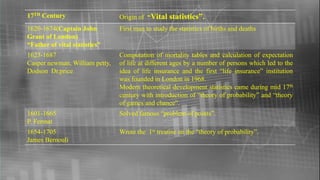
17TH Century Origin of “Vital statistics”.
1620-1674(Captain John
Grant of London)
“Father of vital statistics”
First man to study the statistics of births and deaths
1623-1687
Casper newman, William petty,
Dodson Dr.price
Computation of mortality tables and calculation of expectation
of life at different ages by a number of persons which led to the
idea of life insurance and the first “life insurance” institution
was founded in London in 1968.
Modern theoretical development statistics came during mid 17th
century with introduction of “theory of probability” and “theory
of games and chance”.
1601-1665
P. Fermat
Solved famous “problem of points”.
1654-1705
James Bernouli
Wrote the 1st treatise on the “theory of probability”.
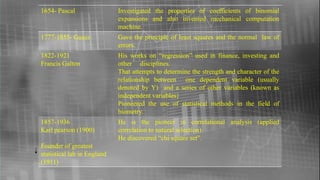
1654- Pascal Investigated the properties of coefficients of binomial
expansions and also invented mechanical computation
machine.
1777-1855- Gauss Gave the principle of least squares and the normal law of
errors.
1822-1921
Francis Galton
His works on “regression” used in finance, investing and
other disciplines.
That attempts to determine the strength and character of the
relationship between one dependent variable (usually
denoted by Y) and a series of other variables (known as
independent variables}
Pioneered the use of statistical methods in the field of
biometry.
1857-1936
Karl pearson (1900)
Founder of greatest
statistical lab in England
(1911)
He is the pioneer in correlational analysis (applied
correlation to natural selection).
He discovered “chi square set”.
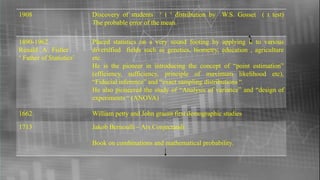
1908 Discovery of students ‘ t ‘ distribution by W.S. Gosset ( t test)
The probable error of the mean.
1890-1962
Renald . A . Fisher
‘ Father of Statistics’
Placed statistics on a very sound footing by applying it to various
diversified fields such as genetics, biometry, education , agriculture
etc.
He is the pioneer in introducing the concept of “point estimation”
(efficiency, sufficiency, principle of maximum likelihood etc),
“Fiducial inference” and “exact sampling distributions “.
He also pioneered the study of “Analysis of variance” and “design of
experiments “ (ANOVA)
1662 William petty and John graunt first demographic studies
1713 Jakob Bernoulli – Ars Conjectandi
Book on combinations and mathematical probability.
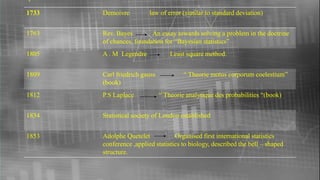
1733 Demoivre law of error (similar to standard deviation)
1763 Rev. Bayes An essay towards solving a problem in the doctrine
of chances, foundation for “Bayesian statistics”
1805 A . M Legendre Least square method.
1809 Carl friedrich gauss “ Theorie motus corporum coelestium”
(book)
1812 P.S Laplace “ Theorie analytique des probabilities “(book)
1834 Statistical society of London established
1853 Adolphe Quetelet Organised first international statistics
conference ,applied statistics to biology, described the bell – shaped
structure.
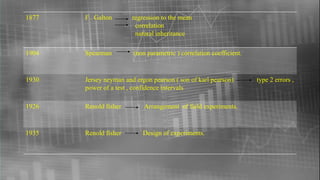
1877 F . Galton regression to the mean
correlation
natural inheritance
1904 Spearman (non parametric ) correlation coefficient.
1930 Jersey neyman and ergon pearson ( son of karl pearson) type 2 errors ,
power of a test , confidence intervals
1926 Renold fisher Arrangement of field experiments.
1935 Renold fisher Design of experiments.
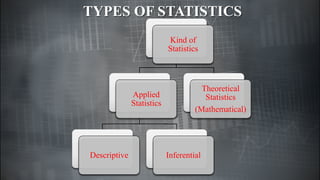
TYPES OF STATISTICS
Kind of
Statistics
Applied
Statistics
Descriptive Inferential
Theoretical
Statistics
(Mathematical)
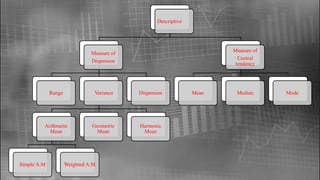
Descriptive
Measure of
Dispersion
Range Variance
Arithmetic
Mean
Simple A.M Weighted A.M
Geometric
Mean
Harmonic
Mean
Dispersion
Measure of
Central
tendency
Mean Median Mode
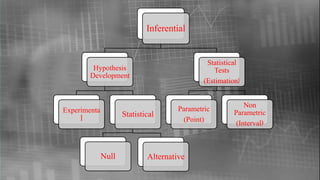
Inferential
Hypothesis
Development
Experimenta
l
Statistical
Null Alternative
Statistical
Tests
(Estimation}
Parametric
(Point)
Non
Parametric
(Interval)
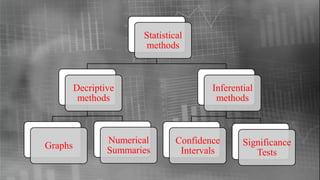
Statistical
methods
Decriptive
methods
Graphs
Numerical
Summaries
Inferential
methods
Confidence
Intervals
Significance
Tests
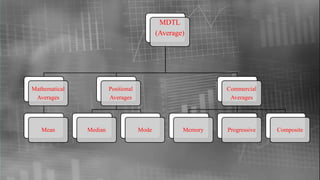
MDTL
(Average)
Mathematical
Averages
Mean
Positional
Averages
Median Mode
Commercial
Averages
Memory Progressive Composite

origin.pptx

  • 1.
    BIOSTATISTICS AND RESEARCHMETHODOLOGY Unit-1: Origin and History of Statistics PRESENTED BY Gokara Madhuri B. Pharmacy IV Year UNDER THE GUIDANCE OF Gangu Sreelatha M.Pharm., (Ph.D) Assistant Professor CMR College of Pharmacy, Hyderabad. email: sreelatha1801@gmail.com
  • 2.
    ORIGIN • It wasregarded as “Science of state craft” and was the by product of the administrative activity of the state. • Word statistics is derived from the latin word “Status” or the Italian word ‘’Statista” or german word “Statistic” each of which means a’’ political state’’ . • In ancient times govt used to collect information regarding ‘population’ and ‘property of wealth’ of country. • Population enables the govt to have an idea of manpower of the country, to safeguard itself against external aggression if any. • Property of wealth provides basis for introducing new taxes and levices
  • 3.
    HISTORY YEARS INFORMATION 324-300 B.CIn India an efficient system of collecting official and administrative statistics existed even more than 2000 years ago, in particular, during the region of Chandra guptha Maurya . Before 300 B.C Vital registration of births and deaths statistics were maintained in kautilays “asthashastra”. Akbars reigion. 1556-1605 A.D Raja todarmal (land and revenue minister) Maintained goods records of land and agricultural statistics. 1596-1597 A.D Abdul fazl (one of the nine gems of akbar) Administrative and statistical surveys were conducted.
  • 4.
    17TH Century Originof “Vital statistics”. 1620-1674(Captain John Grant of London) “Father of vital statistics” First man to study the statistics of births and deaths 1623-1687 Casper newman, William petty, Dodson Dr.price Computation of mortality tables and calculation of expectation of life at different ages by a number of persons which led to the idea of life insurance and the first “life insurance” institution was founded in London in 1968. Modern theoretical development statistics came during mid 17th century with introduction of “theory of probability” and “theory of games and chance”. 1601-1665 P. Fermat Solved famous “problem of points”. 1654-1705 James Bernouli Wrote the 1st treatise on the “theory of probability”.
  • 5.
    1654- Pascal Investigatedthe properties of coefficients of binomial expansions and also invented mechanical computation machine. 1777-1855- Gauss Gave the principle of least squares and the normal law of errors. 1822-1921 Francis Galton His works on “regression” used in finance, investing and other disciplines. That attempts to determine the strength and character of the relationship between one dependent variable (usually denoted by Y) and a series of other variables (known as independent variables} Pioneered the use of statistical methods in the field of biometry. 1857-1936 Karl pearson (1900) Founder of greatest statistical lab in England (1911) He is the pioneer in correlational analysis (applied correlation to natural selection). He discovered “chi square set”.
  • 6.
    1908 Discovery ofstudents ‘ t ‘ distribution by W.S. Gosset ( t test) The probable error of the mean. 1890-1962 Renald . A . Fisher ‘ Father of Statistics’ Placed statistics on a very sound footing by applying it to various diversified fields such as genetics, biometry, education , agriculture etc. He is the pioneer in introducing the concept of “point estimation” (efficiency, sufficiency, principle of maximum likelihood etc), “Fiducial inference” and “exact sampling distributions “. He also pioneered the study of “Analysis of variance” and “design of experiments “ (ANOVA) 1662 William petty and John graunt first demographic studies 1713 Jakob Bernoulli – Ars Conjectandi Book on combinations and mathematical probability.
  • 7.
    1733 Demoivre lawof error (similar to standard deviation) 1763 Rev. Bayes An essay towards solving a problem in the doctrine of chances, foundation for “Bayesian statistics” 1805 A . M Legendre Least square method. 1809 Carl friedrich gauss “ Theorie motus corporum coelestium” (book) 1812 P.S Laplace “ Theorie analytique des probabilities “(book) 1834 Statistical society of London established 1853 Adolphe Quetelet Organised first international statistics conference ,applied statistics to biology, described the bell – shaped structure.
  • 8.
    1877 F .Galton regression to the mean correlation natural inheritance 1904 Spearman (non parametric ) correlation coefficient. 1930 Jersey neyman and ergon pearson ( son of karl pearson) type 2 errors , power of a test , confidence intervals 1926 Renold fisher Arrangement of field experiments. 1935 Renold fisher Design of experiments.
  • 9.
    TYPES OF STATISTICS Kindof Statistics Applied Statistics Descriptive Inferential Theoretical Statistics (Mathematical)
  • 10.
    Descriptive Measure of Dispersion Range Variance Arithmetic Mean SimpleA.M Weighted A.M Geometric Mean Harmonic Mean Dispersion Measure of Central tendency Mean Median Mode
  • 11.
  • 12.
  • 13.