Strategies to AVOIDErrors/Bias in research
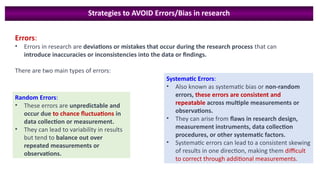
Errors:
• Errors in research are deviations or mistakes that occur during the research process that can
introduce inaccuracies or inconsistencies into the data or findings.
There are two main types of errors:
Systematic Errors:
• Also known as systematic bias or non-random
errors, these errors are consistent and
repeatable across multiple measurements or
observations.
• They can arise from flaws in research design,
measurement instruments, data collection
procedures, or other systematic factors.
• Systematic errors can lead to a consistent skewing
of results in one direction, making them difficult
to correct through additional measurements.
Random Errors:
• These errors are unpredictable and
occur due to chance fluctuations in
data collection or measurement.
• They can lead to variability in results
but tend to balance out over
repeated measurements or
observations.
3.
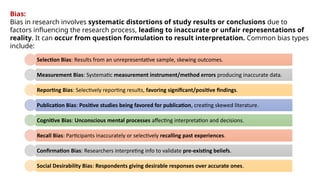
Bias:
Bias in researchinvolves systematic distortions of study results or conclusions due to
factors influencing the research process, leading to inaccurate or unfair representations of
reality. It can occur from question formulation to result interpretation. Common bias types
include:
Selection Bias: Results from an unrepresentative sample, skewing outcomes.
Measurement Bias: Systematic measurement instrument/method errors producing inaccurate data.
Reporting Bias: Selectively reporting results, favoring significant/positive findings.
Publication Bias: Positive studies being favored for publication, creating skewed literature.
Cognitive Bias: Unconscious mental processes affecting interpretation and decisions.
Recall Bias: Participants inaccurately or selectively recalling past experiences.
Confirmation Bias: Researchers interpreting info to validate pre-existing beliefs.
Social Desirability Bias: Respondents giving desirable responses over accurate ones.
4.
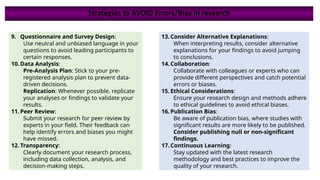
Strategies to AVOIDErrors/Bias in research
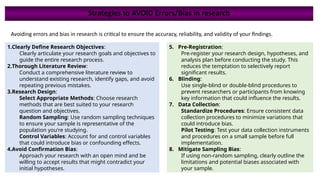
Avoiding errors and bias in research is critical to ensure the accuracy, reliability, and validity of your findings.
1.Clearly Define Research Objectives:
Clearly articulate your research goals and objectives to
guide the entire research process.
2.Thorough Literature Review:
Conduct a comprehensive literature review to
understand existing research, identify gaps, and avoid
repeating previous mistakes.
3.Research Design:
Select Appropriate Methods: Choose research
methods that are best suited to your research
question and objectives.
Random Sampling: Use random sampling techniques
to ensure your sample is representative of the
population you're studying.
Control Variables: Account for and control variables
that could introduce bias or confounding effects.
4.Avoid Confirmation Bias:
Approach your research with an open mind and be
willing to accept results that might contradict your
initial hypotheses.
5. Pre-Registration:
Pre-register your research design, hypotheses, and
analysis plan before conducting the study. This
reduces the temptation to selectively report
significant results.
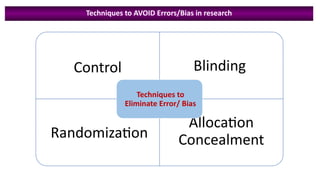
6. Blinding:
Use single-blind or double-blind procedures to
prevent researchers or participants from knowing
key information that could influence the results.
7. Data Collection:
Standardize Procedures: Ensure consistent data
collection procedures to minimize variations that
could introduce bias.
Pilot Testing: Test your data collection instruments
and procedures on a small sample before full
implementation.
8. Mitigate Sampling Bias:
If using non-random sampling, clearly outline the
limitations and potential biases associated with
your sample.
5.
9. Questionnaire andSurvey Design:
Use neutral and unbiased language in your
questions to avoid leading participants to
certain responses.
10. Data Analysis:
Pre-Analysis Plan: Stick to your pre-
registered analysis plan to prevent data-
driven decisions.
Replication: Whenever possible, replicate
your analyses or findings to validate your
results.
11. Peer Review:
Submit your research for peer review by
experts in your field. Their feedback can
help identify errors and biases you might
have missed.
12. Transparency:
Clearly document your research process,
including data collection, analysis, and
decision-making steps.
13. Consider Alternative Explanations:
When interpreting results, consider alternative
explanations for your findings to avoid jumping
to conclusions.
14. Collaboration:
Collaborate with colleagues or experts who can
provide different perspectives and catch potential
errors or biases.
15. Ethical Considerations:
Ensure your research design and methods adhere
to ethical guidelines to avoid ethical biases.
16. Publication Bias:
Be aware of publication bias, where studies with
significant results are more likely to be published.
Consider publishing null or non-significant
findings.
17. Continuous Learning:
Stay updated with the latest research
methodology and best practices to improve the
quality of your research.
Strategies to AVOID Errors/Bias in research
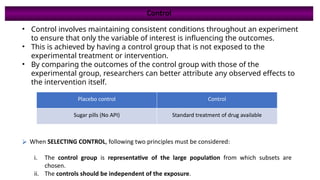
• Control involvesmaintaining consistent conditions throughout an experiment
to ensure that only the variable of interest is influencing the outcomes.
• This is achieved by having a control group that is not exposed to the
experimental treatment or intervention.
• By comparing the outcomes of the control group with those of the
experimental group, researchers can better attribute any observed effects to
the intervention itself.
Placebo control Control
Sugar pills (No API) Standard treatment of drug available
⮚ When SELECTING CONTROL, following two principles must be considered:
i. The control group is representative of the large population from which subsets are
chosen.
ii. The controls should be independent of the exposure.
Control
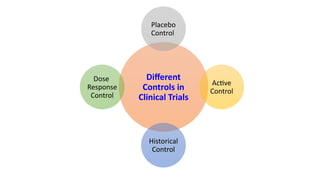
Placebo-Control:
• A placebocontrol involves using an inactive
substance for treatment (placebo) that has no
therapeutic effect.
• This control is used to assess the true impact
of the experimental treatment by comparing
it to a group that receives no active
intervention.
• The placebo effect refers to the psychological
or physiological response that occurs in some
participants who believe they are receiving
treatment, even though they are not.
• Placebo controls help account for this effect
and provide a more accurate measure of the
treatment's efficacy.
Active Control:
• An active control involves
comparing the experimental
treatment to an existing standard
treatment or an established active
intervention rather than a placebo.
• This approach is used when it's
unethical or impractical to give a
placebo to participants, particularly
if an effective treatment already
exists.
• Active controls help determine
whether the new treatment is as
good as, better than, or worse than
the established treatment.
10.
Historical Control:
• Ahistorical control involves using data
from past studies or patient records as a
baseline for comparison with the
outcomes of the current study.
• This approach is utilized when it's not
feasible to enroll a control group due to
ethical, logistical, or financial reasons.
• However, historical controls can be less
reliable due to differences in study
populations, protocols, and other
variables over time.
Dose-Response Control:
• In a dose-response control, different
doses of the experimental treatment
are compared to evaluate the
relationship between the dose
administered and the treatment's
effect.
• This control helps determine the
optimal dose that provides the desired
therapeutic effect with minimal side
effects.
11.
Method: Participants receivea placebo (inactive treatment) alongside the active treatment group.
Implementation: Placebos are designed to be indistinguishable from the active treatment.
Example: Testing a new pain medication where participants might receive either the actual medication or a placebo,
without knowing which.
Placebo-Controlled Trials:
• Blinding is often used in clinical trials involving medications.
• Participants are given either the experimental drug or a placebo, and they are unaware of which they're
receiving.
• This prevents psychological and physiological responses that might occur if participants knew they were receiving
the real drug, affecting the study's validity.
12.
Active Comparator Trials:
Method:Instead of a placebo, participants receive a different active treatment for comparison.
Implementation: The active comparators should be matched for factors other than the treatment
itself.
Example: Comparing the effectiveness of two different antidepressant drugs by giving one drug to
one group and another drug to the comparison group.
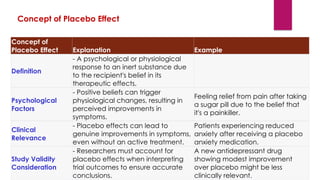
13.
Concept of
Placebo EffectExplanation Example
Definition
- A psychological or physiological
response to an inert substance due
to the recipient's belief in its
therapeutic effects.
Psychological
Factors
- Positive beliefs can trigger
physiological changes, resulting in
perceived improvements in
symptoms.
Feeling relief from pain after taking
a sugar pill due to the belief that
it's a painkiller.
Clinical
Relevance
- Placebo effects can lead to
genuine improvements in symptoms,
even without an active treatment.
Patients experiencing reduced
anxiety after receiving a placebo
anxiety medication.
Study Validity
Consideration
- Researchers must account for
placebo effects when interpreting
trial outcomes to ensure accurate
conclusions.
A new antidepressant drug
showing modest improvement
over placebo might be less
clinically relevant.
Concept of Placebo Effect
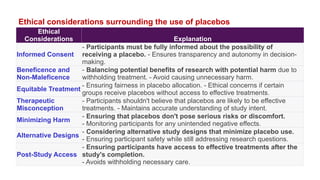
14.
Ethical
Considerations Explanation
Informed Consent
-Participants must be fully informed about the possibility of
receiving a placebo. - Ensures transparency and autonomy in decision-
making.
Beneficence and
Non-Maleficence
- Balancing potential benefits of research with potential harm due to
withholding treatment. - Avoid causing unnecessary harm.
Equitable Treatment
- Ensuring fairness in placebo allocation. - Ethical concerns if certain
groups receive placebos without access to effective treatments.
Therapeutic
Misconception
- Participants shouldn't believe that placebos are likely to be effective
treatments. - Maintains accurate understanding of study intent.
Minimizing Harm
- Ensuring that placebos don't pose serious risks or discomfort.
- Monitoring participants for any unintended negative effects.
Alternative Designs
- Considering alternative study designs that minimize placebo use.
- Ensuring participant safety while still addressing research questions.
Post-Study Access
- Ensuring participants have access to effective treatments after the
study's completion.
- Avoids withholding necessary care.
Ethical considerations surrounding the use of placebos
15.
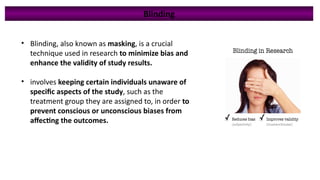
• Blinding, alsoknown as masking, is a crucial
technique used in research to minimize bias and
enhance the validity of study results.
• involves keeping certain individuals unaware of
specific aspects of the study, such as the
treatment group they are assigned to, in order to
prevent conscious or unconscious biases from
affecting the outcomes.
Blinding
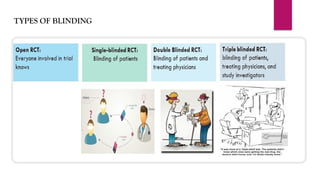
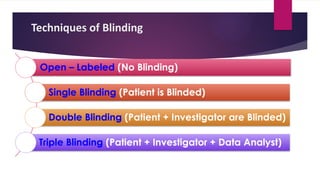
Techniques of Blinding
Open– Labeled (No Blinding)
Single Blinding (Patient is Blinded)
Double Blinding (Patient + Investigator are Blinded)
Triple Blinding (Patient + Investigator + Data Analyst)
18.
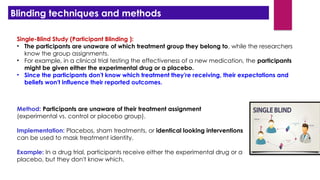
Method: Participants areunaware of their treatment assignment
(experimental vs. control or placebo group).
Implementation: Placebos, sham treatments, or identical looking interventions
can be used to mask treatment identity.
Example: In a drug trial, participants receive either the experimental drug or a
placebo, but they don't know which.
Single-Blind Study (Participant Blinding ):
• The participants are unaware of which treatment group they belong to, while the researchers
know the group assignments.
• For example, in a clinical trial testing the effectiveness of a new medication, the participants
might be given either the experimental drug or a placebo.
• Since the participants don't know which treatment they're receiving, their expectations and
beliefs won't influence their reported outcomes.
Blinding techniques and methods
19.
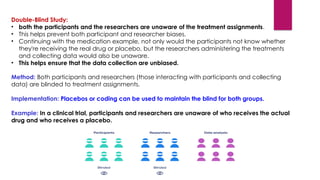
Method: Both participantsand researchers (those interacting with participants and collecting
data) are blinded to treatment assignments.
Implementation: Placebos or coding can be used to maintain the blind for both groups.
Example: In a clinical trial, participants and researchers are unaware of who receives the actual
drug and who receives a placebo.
Double-Blind Study:
• both the participants and the researchers are unaware of the treatment assignments.
• This helps prevent both participant and researcher biases.
• Continuing with the medication example, not only would the participants not know whether
they're receiving the real drug or placebo, but the researchers administering the treatments
and collecting data would also be unaware.
• This helps ensure that the data collection are unbiased.
20.
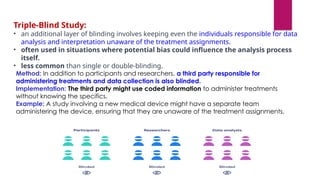
Method: In additionto participants and researchers, a third party responsible for
administering treatments and data collection is also blinded.
Implementation: The third party might use coded information to administer treatments
without knowing the specifics.
Example: A study involving a new medical device might have a separate team
administering the device, ensuring that they are unaware of the treatment assignments.
Triple-Blind Study:
• an additional layer of blinding involves keeping even the individuals responsible for data
analysis and interpretation unaware of the treatment assignments.
• often used in situations where potential bias could influence the analysis process
itself.
• less common than single or double-blinding.
21.
Sequential Blinding:
Method: Blindingis implemented in stages, so that participants, researchers, or analysts are only
exposed to information when necessary.
Implementation: Participants might be blinded during the trial and researchers blinded during
data collection, with analysts blinded during data analysis.
Example: A study where participants and data collectors are blinded during the trial, and only the
statisticians analyzing the data are aware of the treatment assignments.
22.
Minimizes Bias: Preventsparticipants and researchers from being influenced by their
expectations, reducing biased outcomes.
Enhances Credibility: Blinded studies are considered more credible and reliable within the
scientific community.
Reduces Placebo Effects: Mitigates benefits or negative effects due to participants' beliefs.
Minimizes Observer Bias: Ensures objectivity in data collection and interpretation, reducing
researcher biases.
Increases Objectivity and Reproducibility: Enhances the objectivity of results and makes
study replication more consistent.
Advantages of blinding techniques
23.
Reduces Differential Dropout:Balances participant representation across treatment
groups by minimizing biased dropout.
Prevents Unintentional Manipulation: Shields participants from unintentional cues or
influences by researchers.
Enhances Validity of Conclusions: Increases the reliability of attributing effects to
interventions, enhancing overall study validity.
24.
Feasibility and Practicality:
Blindingmight be impractical in certain studies, such as those involving complex interventions or
surgical procedures.
Ethical Considerations:
Blinding can raise ethical concerns related to informed consent and participants' right to know their
treatment conditions.
Resource Intensive:
Blinding requires extra resources, potentially increasing study costs and complexity.
Potential for Bias in Blinding:
Despite blinding, biases can still arise due to participant suspicions or inadvertent researcher cues.
Blinding Breakdown:
Maintaining blinding throughout the study can be challenging, risking leaks of information or
inadvertent cues.
Limitations of blinding techniques
25.
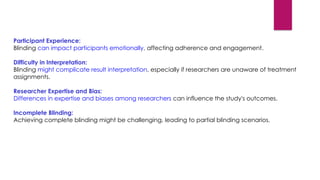
Participant Experience:
Blinding canimpact participants emotionally, affecting adherence and engagement.
Difficulty in Interpretation:
Blinding might complicate result interpretation, especially if researchers are unaware of treatment
assignments.
Researcher Expertise and Bias:
Differences in expertise and biases among researchers can influence the study's outcomes.
Incomplete Blinding:
Achieving complete blinding might be challenging, leading to partial blinding scenarios.
26.
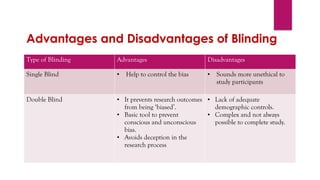
Advantages and Disadvantagesof Blinding
Type of Blinding Advantages Disadvantages
Single Blind • Help to control the bias • Sounds more unethical to
study participants
Double Blind • It prevents research outcomes
from being ‘biased’.
• Basic tool to prevent
conscious and unconscious
bias.
• Avoids deception in the
research process
• Lack of adequate
demographic controls.
• Complex and not always
possible to complete study.
27.
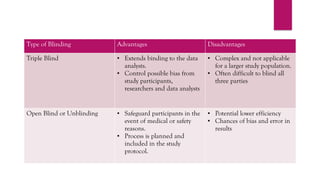
Type of BlindingAdvantages Disadvantages
Triple Blind • Extends binding to the data
analysts.
• Control possible bias from
study participants,
researchers and data analysts
• Complex and not applicable
for a larger study population.
• Often difficult to blind all
three parties
Open Blind or Unblinding • Safeguard participants in the
event of medical or safety
reasons.
• Process is planned and
included in the study
protocol.
• Potential lower efficiency
• Chances of bias and error in
results
28.
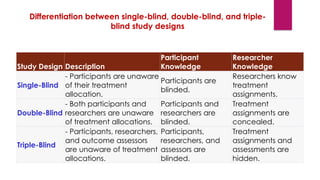
Study Design Description
Participant
Knowledge
Researcher
Knowledge
Single-Blind
-Participants are unaware
of their treatment
allocation.
Participants are
blinded.
Researchers know
treatment
assignments.
Double-Blind
- Both participants and
researchers are unaware
of treatment allocations.
Participants and
researchers are
blinded.
Treatment
assignments are
concealed.
Triple-Blind
- Participants, researchers,
and outcome assessors
are unaware of treatment
allocations.
Participants,
researchers, and
assessors are
blinded.
Treatment
assignments and
assessments are
hidden.
Differentiation between single-blind, double-blind, and triple-
blind study designs
29.
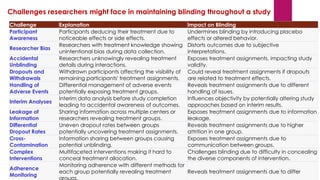
Challenge Explanation Impacton Blinding
Participant
Awareness
Participants deducing their treatment due to
noticeable effects or side effects.
Undermines blinding by introducing placebo
effects or altered behavior.
Researcher Bias
Researchers with treatment knowledge showing
unintentional bias during data collection.
Distorts outcomes due to subjective
interpretations.
Accidental
Unblinding
Researchers unknowingly revealing treatment
details during interactions.
Exposes treatment assignments, impacting study
validity.
Dropouts and
Withdrawals
Withdrawn participants affecting the visibility of
remaining participants' treatment assignments.
Could reveal treatment assignments if dropouts
are related to treatment effects.
Handling of
Adverse Events
Differential management of adverse events
potentially exposing treatment groups.
Reveals treatment assignments due to different
handling of issues.
Interim Analyses
Interim data analysis before study completion
leading to accidental awareness of outcomes.
Influences objectivity by potentially altering study
approaches based on interim results.
Leakage of
Information
Sharing information across multiple centers or
researchers revealing treatment groups.
Exposes treatment assignments due to information
leakage.
Differential
Dropout Rates
Uneven dropout rates between groups
potentially uncovering treatment assignments.
Reveals treatment assignments due to higher
attrition in one group.
Cross-
Contamination
Information sharing between groups causing
potential unblinding.
Exposes treatment assignments due to
communication between groups.
Complex
Interventions
Multifaceted interventions making it hard to
conceal treatment allocation.
Challenges blinding due to difficulty in concealing
the diverse components of intervention.
Adherence
Monitoring
Monitoring adherence with different methods for
each group potentially revealing treatment Reveals treatment assignments due to differ
Challenges researchers might face in maintaining blinding throughout a study