Nastic Movements
Dr. V. I. Kahalkar
Department of Botany
M. G. College, Armori
Nastic Movements
• The plant movements which are independent of
the external stimulus are called ‘nastic
movements’. These will be no bending curvature
toward or against the direction of stimulus in
nastic movements . The direction of response is
predetermined by internal control mechanism
(within the tissue). These plant responses can be
either growth movements or turgor movements .
Growth movements are permanent (irreversible),
while turgor movements are temporary and
reversible.
1 Nyctinasty:
• The sleep movements (opening and closing) of
plant organs due to day and night periods of
daily rhythm are called ‘nyctinastic
movements’. Ex. Leaves and flowers. Leaves
of many nyctinastic plants open during day
time and close (sleep) during night time .
Nyctinastic movement caused by change in
light intensity is called photonasty, while that
is caused by change in temperature is
‘thermonasty’.
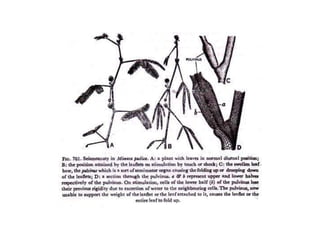
2 Seismonasty:
• Movement in plants or plant parts in response
to touch or physical contact with regard to the
direction of stimulus is called Seismonasty.
The mechanical disturbance such as shaking,
wind, rain drops and intense heat or burning
also cause Seismonastic movement. Ex. the
leaflet of Mimosa pudica rapidly folds and
bends in response to external stimulus touch or
heat.
Thigmonastic or Haptonastic
• The plant movement in response to touch or
physical contact but without regard to the
direction of stimulus is called Thigmonastic
movement. Thigmonastic movement are
present in insectivorus plant that show
movement of trap leaves, when they come in
contact with any insect. Ex. Dionaea.
Droscera.
• Hydronasty:- Plant movements in response to
atmospheric moisture or humidity is called
Hydronasty. Ex. Opening and closing of of some
flowers.
• Epinasty and hyponasty :- the plant part show
curvature due to more cell division in one specific
region. If the curvature is on upper side then it is
called Epinasty. Ex. Leaves curve upwards
because more growth is present on lower side. If
the curveture is on lower side then it is called
hyponasty. Ex. Thalamus and petals curve
towords downwords as more growth can be
observed on upper side.
• THANK YOU