Bija
Dr. V. I. Kahalkar
Department of Botany
M. G. College, Armori
Bija
• Botanical name :- Pterocarpus marsupium
• Family :- Fabaceae
• Local Name :- Bija/Indian Kino
• Origin & Distribution –
The tree yields a red gum known as 'kino'. It is
obtained from wounds made in the bark. It is
native to India. It is also occur in Western Ghat,
Karnataka, Maharashtra and in the forest of
centreal India. It is also found in Nepal and
Shrilanka.
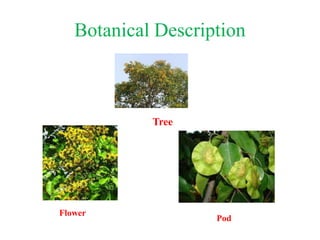
Botanical Description
• The large deciduous, glabrous trees. Leaves imparipinnate
compound, leaflets 5-9, sub-opposite, entire margin. Flowers
in short, axillary and terminal panicles shorter than the leaves;
pedicels short, jointed beneath the flower. yellow. Corolla
yellow, 10–12 mm long; petals with crisped margins. Pods
orbicular 1-2 seeded. Seeds reniform, pale brown.
Botanical Description
Tree
Flower
Pod
Cultivation
• The tree are propagated from seed. Seedling
are raised in nursery beds or in polythene bags.
Seed beds are well manure. The seed sowing
time in most of the region extend from first
March to June. The seedling are ready for
transplantation in 10 to 12 month after sowing.
The seedlings are transplanted after 12 months
in the field. The planting is generally done in
rainy season.
Uses
• The wood is strong, tough, very hard, durable, takes a fine polish.
A good quality wood, it is used for various purposes including
musical instruments, door and window frames, boat building,
railway carriages etc.
• The wood is used for building purpose such as door, window
frames, rafters, beams.
• It is also used in agriculture implements, drums, tools handles,
camp furniture, picture frame.
• The leaves are often applied externally as a remedy for skin
diseases.
• The maintenance of a healthy blood sugar level is one of the most
common reasons for taking pterocarpus. (Practitioners of the
Ayurveda system often use a cup made from the heartwood of
pterocarpus. They fill the cup with water and allow it to stand
overnight. Volatile oils in the wood leach into the water, turning it
blue. This water is then drunk the next day)
• THANK YOU

Bija

  • 1.
    Bija Dr. V. I.Kahalkar Department of Botany M. G. College, Armori
  • 2.
    Bija • Botanical name:- Pterocarpus marsupium • Family :- Fabaceae • Local Name :- Bija/Indian Kino • Origin & Distribution – The tree yields a red gum known as 'kino'. It is obtained from wounds made in the bark. It is native to India. It is also occur in Western Ghat, Karnataka, Maharashtra and in the forest of centreal India. It is also found in Nepal and Shrilanka.
  • 3.
    Botanical Description • Thelarge deciduous, glabrous trees. Leaves imparipinnate compound, leaflets 5-9, sub-opposite, entire margin. Flowers in short, axillary and terminal panicles shorter than the leaves; pedicels short, jointed beneath the flower. yellow. Corolla yellow, 10–12 mm long; petals with crisped margins. Pods orbicular 1-2 seeded. Seeds reniform, pale brown.
  • 4.
  • 5.
    Cultivation • The treeare propagated from seed. Seedling are raised in nursery beds or in polythene bags. Seed beds are well manure. The seed sowing time in most of the region extend from first March to June. The seedling are ready for transplantation in 10 to 12 month after sowing. The seedlings are transplanted after 12 months in the field. The planting is generally done in rainy season.
  • 6.
    Uses • The woodis strong, tough, very hard, durable, takes a fine polish. A good quality wood, it is used for various purposes including musical instruments, door and window frames, boat building, railway carriages etc. • The wood is used for building purpose such as door, window frames, rafters, beams. • It is also used in agriculture implements, drums, tools handles, camp furniture, picture frame. • The leaves are often applied externally as a remedy for skin diseases. • The maintenance of a healthy blood sugar level is one of the most common reasons for taking pterocarpus. (Practitioners of the Ayurveda system often use a cup made from the heartwood of pterocarpus. They fill the cup with water and allow it to stand overnight. Volatile oils in the wood leach into the water, turning it blue. This water is then drunk the next day)
  • 7.