Lecture 6. Nitrogen-containing hydrocarbon
derivatives.
Nitro compounds
Nitrogen-containing organic compounds include those containing nitrogen atoms
directly bonded to carbon atoms. They are divided into: nitro compounds
(RNO2), nitroso compounds (RNO), amines (RNH2, R2NH, R3N), nitriles of
carboxylic acids or cyanides (RC≡N), azo compounds (RN═NR), hydroxyl
amine derivatives (RNH―OH), etc. . In all the above formulas, R is an alkyl,
cycloalkyl or aryl radicale.
The most important are nitro compounds and amines.
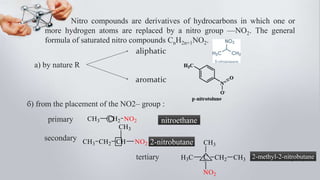
Nitro compounds are derivatives of hydrocarbons in which one or
more hydrogen atoms are replaced by a nitro group —NO2. The general
formula of saturated nitro compounds CnН2n+1NО2.
3
б) from the placement of the NO2– group :
primary
а) by nature R
aliphatic
aromatic
secondary
tertiary
nitroethane
2-nitrobutane
2-methyl-2-nitrobutane
Nomenclature
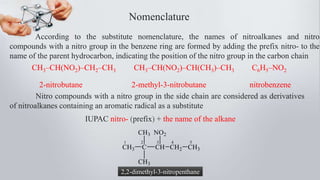
According to the substitute nomenclature, the names of nitroalkanes and nitro
compounds with a nitro group in the benzene ring are formed by adding the prefix nitro- to the
name of the parent hydrocarbon, indicating the position of the nitro group in the carbon chain
CH3–CH(NO2)–CH2–CH3 CH3–CH(NO2)–CH(CH3)–CH3 C6H5–NO2
2-nitrobutane 2-methyl-3-nitrobutane nitrobenzene
Nitro compounds with a nitro group in the side chain are considered as derivatives
of nitroalkanes containing an aromatic radical as a substitute
IUPAC nitro- (prefix) + the name of the alkane
2,2-dimethyl-3-nitropenthane
Isomerism
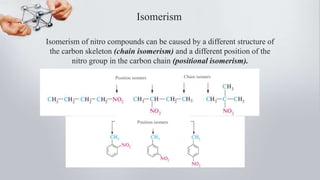
Isomerism of nitro compounds can be caused by a different structure of
the carbon skeleton (chain isomerism) and a different position of the
nitro group in the carbon chain (positional isomerism).
Position isomers
Position isomers
Chain isomers
Methods of obtaining
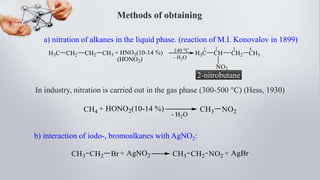
a) nitration of alkanes in the liquid phase. (reaction of M.I. Konovalov in 1899)
In industry, nitration is carried out in the gas phase (300-500 °C) (Hess, 1930)
b) interaction of iodo-, bromoalkanes with AgNO2:
2-nitrobutane
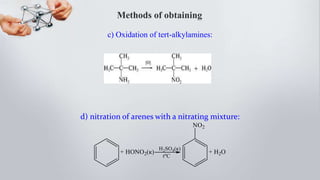
d) nitration of arenes with a nitrating mixture:
Methods of obtaining
c) Oxidation of tert-alkylamines:
Physical properties
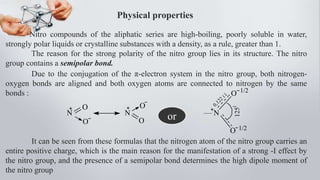
Nitro compounds of the aliphatic series are high-boiling, poorly soluble in water,
strongly polar liquids or crystalline substances with a density, as a rule, greater than 1.
The reason for the strong polarity of the nitro group lies in its structure. The nitro
group contains a semipolar bond.
Due to the conjugation of the π-electron system in the nitro group, both nitrogen-
oxygen bonds are aligned and both oxygen atoms are connected to nitrogen by the same
bonds : 1/2
N
O
O
àáî N
O
O 1/2
125
î
O
O
N
0,122
í ì
It can be seen from these formulas that the nitrogen atom of the nitro group carries an
entire positive charge, which is the main reason for the manifestation of a strong -I effect by
the nitro group, and the presence of a semipolar bond determines the high dipole moment of
the nitro group
or
Chemical properties
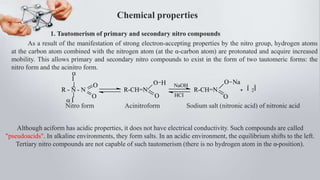
1. Tautomerism of primary and secondary nitro compounds
As a result of the manifestation of strong electron-accepting properties by the nitro group, hydrogen atoms
at the carbon atom combined with the nitrogen atom (at the α-carbon atom) are protonated and acquire increased
mobility. This allows primary and secondary nitro compounds to exist in the form of two tautomeric forms: the
nitro form and the acinitro form.
Nitro form Acinitroform Sodium salt (nitronic acid) of nitronic acid
HCI
NaOH
Í 2Î
R-CH=N
O
O H
O
O
R - Ñ - N
Í
Í


Na
R-CH=N
O
O
Although aciform has acidic properties, it does not have electrical conductivity. Such compounds are called
"pseudoacids". In alkaline environments, they form salts. In an acidic environment, the equilibrium shifts to the left.
Tertiary nitro compounds are not capable of such tautomerism (there is no hydrogen atom in the α-position).
Chemical properties
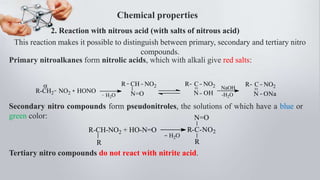
2. Reaction with nitrous acid (with salts of nitrous acid)
This reaction makes it possible to distinguish between primary, secondary and tertiary nitro
compounds.
Primary nitroalkanes form nitrolic acids, which with alkali give red salts:
H2O
 R C NO2
N OH
NaOH
-H2O N ONa
R C NO2
R-CH2 NO2 HONO
R CH NO2
N=O
Secondary nitro compounds form pseudonitroles, the solutions of which have a blue or
green color:
H2O
R-CH-NO2 + HO-N=O R-C-NO2
N=O
R
R
Tertiary nitro compounds do not react with nitrite acid.
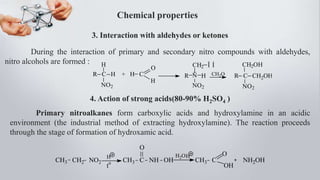
3. Interaction with aldehydes or ketones
Chemical properties
During the interaction of primary and secondary nitro compounds with aldehydes,
nitro alcohols are formed : H
NO2 NO2
CH2
NO2
CH2OH
CH2O
Î Í
R C H + H C R H R C CH2OH
Ñ
O
H
4. Action of strong acids(80-90% Н2SО4 )
Primary nitroalkanes form carboxylic acids and hydroxylamine in an acidic
environment (the industrial method of extracting hydroxylamine). The reaction proceeds
through the stage of formation of hydroxamic acid.
CH3 CH2 NO2 CH3 C NH OH CH3 C NH2OH
H H
to
O
H2O O
OH
Chemical properties
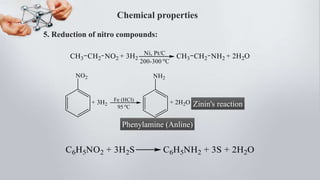
5. Reduction of nitro compounds:
Zinin's reaction
Phenylamine (Anline)
Aromatic nitro compounds
Methods of obtaining
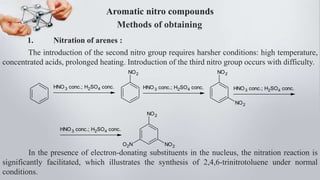
1. Nitration of arenes :
The introduction of the second nitro group requires harsher conditions: high temperature,
concentrated acids, prolonged heating. Introduction of the third nitro group occurs with difficulty.
HNO3 conc.; H2SO4 conc.
NO2
HNO3 conc.; H2SO4 conc.
NO2
NO2
HNO3 conc.; H2SO4 conc.
NO2
NO2
O2N
In the presence of electron-donating substituents in the nucleus, the nitration reaction is
significantly facilitated, which illustrates the synthesis of 2,4,6-trinitrotoluene under normal
conditions.
Aromatic nitro compounds
Methods of obtaining
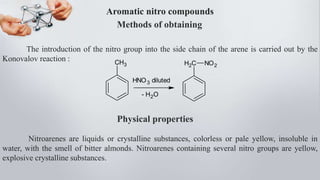
The introduction of the nitro group into the side chain of the arene is carried out by the
Konovalov reaction : CH3
HNO3 diluted
C
H2 NO2
- H2O
Physical properties
Nitroarenes are liquids or crystalline substances, colorless or pale yellow, insoluble in
water, with the smell of bitter almonds. Nitroarenes containing several nitro groups are yellow,
explosive crystalline substances.
Chemical properties
1. Reduction of nitroarenes (Zinin's reaction):
C6H5NO2 + 6[H] → C6H5NH2 + 2H2O
Depending on the pH of the reaction medium, the recovery process can follow two directions.
In a neutral and acidic medium :
When restored in a neutral environment, the reaction can be stopped at any stage. In an
acidic environment, it is impossible to isolate intermediate products.
Aromatic nitro compounds
Chemical properties
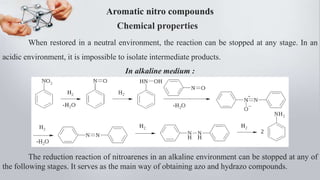
When restored in a neutral environment, the reaction can be stopped at any stage. In an
acidic environment, it is impossible to isolate intermediate products.
In alkaline medium :
The reduction reaction of nitroarenes in an alkaline environment can be stopped at any of
the following stages. It serves as the main way of obtaining azo and hydrazo compounds.
Aromatic nitro compounds
Chemical properties
2. Reactions from the aromatic nucleus.
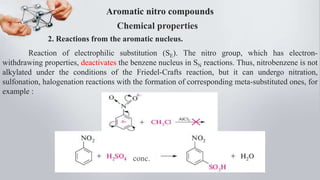
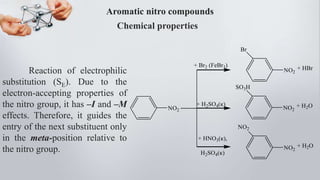
Reaction of electrophilic substitution (SE). The nitro group, which has electron-
withdrawing properties, deactivates the benzene nucleus in SN reactions. Thus, nitrobenzene is not
alkylated under the conditions of the Friedel-Crafts reaction, but it can undergo nitration,
sulfonation, halogenation reactions with the formation of corresponding meta-substituted ones, for
example :
conc.
Aromatic nitro compounds
Chemical properties
Reaction of electrophilic
substitution (SE). Due to the
electron-accepting properties of
the nitro group, it has –I and –M
effects. Therefore, it guides the
entry of the next substituent only
in the meta-position relative to
the nitro group.
Aromatic nitro compounds
Chemical properties
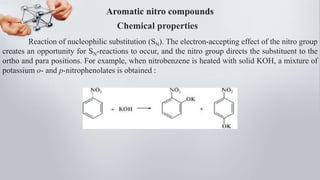
Reaction of nucleophilic substitution (SN). The electron-accepting effect of the nitro group
creates an opportunity for SN-reactions to occur, and the nitro group directs the substituent to the
ortho and para positions. For example, when nitrobenzene is heated with solid KOH, a mixture of
potassium o- and p-nitrophenolates is obtained :
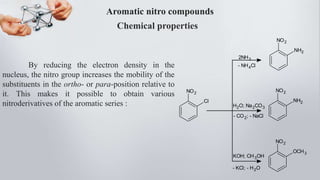
NO2
Cl
2NH3
- NH4Cl
NO2
NH2
NO2
NH2
H2O; Na2CO3
- CO2; - NaCl
NO2
OCH3
KOH; CH3OH
- KCl; - H2O
By reducing the electron density in the
nucleus, the nitro group increases the mobility of the
substituents in the ortho- or para-position relative to
it. This makes it possible to obtain various
nitroderivatives of the aromatic series :
Aromatic nitro compounds
Chemical properties
Aromatic nitro compounds
Chemical properties
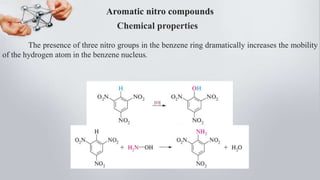
The presence of three nitro groups in the benzene ring dramatically increases the mobility
of the hydrogen atom in the benzene nucleus.
Individual representatives
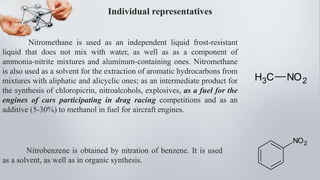
Nitrobenzene is obtained by nitration of benzene. It is used
as a solvent, as well as in organic synthesis.
NO2
Nitromethane is used as an independent liquid frost-resistant
liquid that does not mix with water, as well as as a component of
ammonia-nitrite mixtures and aluminum-containing ones. Nitromethane
is also used as a solvent for the extraction of aromatic hydrocarbons from
mixtures with aliphatic and alicyclic ones; as an intermediate product for
the synthesis of chloropicrin, nitroalcohols, explosives, as a fuel for the
engines of cars participating in drag racing competitions and as an
additive (5-30%) to methanol in fuel for aircraft engines.
C
H3 NO2
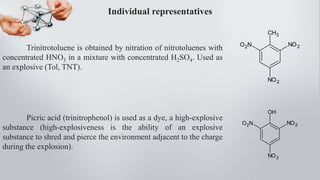
Picric acid (trinitrophenol) is used as a dye, a high-explosive
substance (high-explosiveness is the ability of an explosive
substance to shred and pierce the environment adjacent to the charge
during the explosion).
NO2
O2N
NO2
OH
Trinitrotoluene is obtained by nitration of nitrotoluenes with
concentrated HNO3 in a mixture with concentrated H2SO4. Used as
an explosive (Tol, TNT).
NO2
O2N
NO2
CH3
Individual representatives

Org.chem_Lecture_6_Nitro_componds.pptx

  • 1.
    Lecture 6. Nitrogen-containinghydrocarbon derivatives. Nitro compounds
  • 2.
    Nitrogen-containing organic compoundsinclude those containing nitrogen atoms directly bonded to carbon atoms. They are divided into: nitro compounds (RNO2), nitroso compounds (RNO), amines (RNH2, R2NH, R3N), nitriles of carboxylic acids or cyanides (RC≡N), azo compounds (RN═NR), hydroxyl amine derivatives (RNH―OH), etc. . In all the above formulas, R is an alkyl, cycloalkyl or aryl radicale. The most important are nitro compounds and amines.
  • 3.
    Nitro compounds arederivatives of hydrocarbons in which one or more hydrogen atoms are replaced by a nitro group —NO2. The general formula of saturated nitro compounds CnН2n+1NО2. 3 б) from the placement of the NO2– group : primary а) by nature R aliphatic aromatic secondary tertiary nitroethane 2-nitrobutane 2-methyl-2-nitrobutane
  • 4.
    Nomenclature According to thesubstitute nomenclature, the names of nitroalkanes and nitro compounds with a nitro group in the benzene ring are formed by adding the prefix nitro- to the name of the parent hydrocarbon, indicating the position of the nitro group in the carbon chain CH3–CH(NO2)–CH2–CH3 CH3–CH(NO2)–CH(CH3)–CH3 C6H5–NO2 2-nitrobutane 2-methyl-3-nitrobutane nitrobenzene Nitro compounds with a nitro group in the side chain are considered as derivatives of nitroalkanes containing an aromatic radical as a substitute IUPAC nitro- (prefix) + the name of the alkane 2,2-dimethyl-3-nitropenthane
  • 5.
    Isomerism Isomerism of nitrocompounds can be caused by a different structure of the carbon skeleton (chain isomerism) and a different position of the nitro group in the carbon chain (positional isomerism). Position isomers Position isomers Chain isomers
  • 6.
    Methods of obtaining a)nitration of alkanes in the liquid phase. (reaction of M.I. Konovalov in 1899) In industry, nitration is carried out in the gas phase (300-500 °C) (Hess, 1930) b) interaction of iodo-, bromoalkanes with AgNO2: 2-nitrobutane
  • 7.
    d) nitration ofarenes with a nitrating mixture: Methods of obtaining c) Oxidation of tert-alkylamines:
  • 8.
    Physical properties Nitro compoundsof the aliphatic series are high-boiling, poorly soluble in water, strongly polar liquids or crystalline substances with a density, as a rule, greater than 1. The reason for the strong polarity of the nitro group lies in its structure. The nitro group contains a semipolar bond. Due to the conjugation of the π-electron system in the nitro group, both nitrogen- oxygen bonds are aligned and both oxygen atoms are connected to nitrogen by the same bonds : 1/2 N O O àáî N O O 1/2 125 î O O N 0,122 í ì It can be seen from these formulas that the nitrogen atom of the nitro group carries an entire positive charge, which is the main reason for the manifestation of a strong -I effect by the nitro group, and the presence of a semipolar bond determines the high dipole moment of the nitro group or
  • 9.
    Chemical properties 1. Tautomerismof primary and secondary nitro compounds As a result of the manifestation of strong electron-accepting properties by the nitro group, hydrogen atoms at the carbon atom combined with the nitrogen atom (at the α-carbon atom) are protonated and acquire increased mobility. This allows primary and secondary nitro compounds to exist in the form of two tautomeric forms: the nitro form and the acinitro form. Nitro form Acinitroform Sodium salt (nitronic acid) of nitronic acid HCI NaOH Í 2Î R-CH=N O O H O O R - Ñ - N Í Í   Na R-CH=N O O Although aciform has acidic properties, it does not have electrical conductivity. Such compounds are called "pseudoacids". In alkaline environments, they form salts. In an acidic environment, the equilibrium shifts to the left. Tertiary nitro compounds are not capable of such tautomerism (there is no hydrogen atom in the α-position).
  • 10.
    Chemical properties 2. Reactionwith nitrous acid (with salts of nitrous acid) This reaction makes it possible to distinguish between primary, secondary and tertiary nitro compounds. Primary nitroalkanes form nitrolic acids, which with alkali give red salts: H2O  R C NO2 N OH NaOH -H2O N ONa R C NO2 R-CH2 NO2 HONO R CH NO2 N=O Secondary nitro compounds form pseudonitroles, the solutions of which have a blue or green color: H2O R-CH-NO2 + HO-N=O R-C-NO2 N=O R R Tertiary nitro compounds do not react with nitrite acid.
  • 11.
    3. Interaction withaldehydes or ketones Chemical properties During the interaction of primary and secondary nitro compounds with aldehydes, nitro alcohols are formed : H NO2 NO2 CH2 NO2 CH2OH CH2O Î Í R C H + H C R H R C CH2OH Ñ O H 4. Action of strong acids(80-90% Н2SО4 ) Primary nitroalkanes form carboxylic acids and hydroxylamine in an acidic environment (the industrial method of extracting hydroxylamine). The reaction proceeds through the stage of formation of hydroxamic acid. CH3 CH2 NO2 CH3 C NH OH CH3 C NH2OH H H to O H2O O OH
  • 12.
    Chemical properties 5. Reductionof nitro compounds: Zinin's reaction Phenylamine (Anline)
  • 13.
    Aromatic nitro compounds Methodsof obtaining 1. Nitration of arenes : The introduction of the second nitro group requires harsher conditions: high temperature, concentrated acids, prolonged heating. Introduction of the third nitro group occurs with difficulty. HNO3 conc.; H2SO4 conc. NO2 HNO3 conc.; H2SO4 conc. NO2 NO2 HNO3 conc.; H2SO4 conc. HNO3 conc.; H2SO4 conc. NO2 NO2 O2N In the presence of electron-donating substituents in the nucleus, the nitration reaction is significantly facilitated, which illustrates the synthesis of 2,4,6-trinitrotoluene under normal conditions.
  • 14.
    Aromatic nitro compounds Methodsof obtaining The introduction of the nitro group into the side chain of the arene is carried out by the Konovalov reaction : CH3 HNO3 diluted C H2 NO2 - H2O Physical properties Nitroarenes are liquids or crystalline substances, colorless or pale yellow, insoluble in water, with the smell of bitter almonds. Nitroarenes containing several nitro groups are yellow, explosive crystalline substances.
  • 15.
    Chemical properties 1. Reductionof nitroarenes (Zinin's reaction): C6H5NO2 + 6[H] → C6H5NH2 + 2H2O Depending on the pH of the reaction medium, the recovery process can follow two directions. In a neutral and acidic medium : When restored in a neutral environment, the reaction can be stopped at any stage. In an acidic environment, it is impossible to isolate intermediate products. Aromatic nitro compounds
  • 16.
    Chemical properties When restoredin a neutral environment, the reaction can be stopped at any stage. In an acidic environment, it is impossible to isolate intermediate products. In alkaline medium : The reduction reaction of nitroarenes in an alkaline environment can be stopped at any of the following stages. It serves as the main way of obtaining azo and hydrazo compounds. Aromatic nitro compounds
  • 17.
    Aromatic nitro compounds Chemicalproperties 2. Reactions from the aromatic nucleus. Reaction of electrophilic substitution (SE). The nitro group, which has electron- withdrawing properties, deactivates the benzene nucleus in SN reactions. Thus, nitrobenzene is not alkylated under the conditions of the Friedel-Crafts reaction, but it can undergo nitration, sulfonation, halogenation reactions with the formation of corresponding meta-substituted ones, for example : conc.
  • 18.
    Aromatic nitro compounds Chemicalproperties Reaction of electrophilic substitution (SE). Due to the electron-accepting properties of the nitro group, it has –I and –M effects. Therefore, it guides the entry of the next substituent only in the meta-position relative to the nitro group.
  • 19.
    Aromatic nitro compounds Chemicalproperties Reaction of nucleophilic substitution (SN). The electron-accepting effect of the nitro group creates an opportunity for SN-reactions to occur, and the nitro group directs the substituent to the ortho and para positions. For example, when nitrobenzene is heated with solid KOH, a mixture of potassium o- and p-nitrophenolates is obtained :
  • 20.
    NO2 Cl 2NH3 - NH4Cl NO2 NH2 NO2 NH2 H2O; Na2CO3 -CO2; - NaCl NO2 OCH3 KOH; CH3OH - KCl; - H2O By reducing the electron density in the nucleus, the nitro group increases the mobility of the substituents in the ortho- or para-position relative to it. This makes it possible to obtain various nitroderivatives of the aromatic series : Aromatic nitro compounds Chemical properties
  • 21.
    Aromatic nitro compounds Chemicalproperties The presence of three nitro groups in the benzene ring dramatically increases the mobility of the hydrogen atom in the benzene nucleus.
  • 22.
    Individual representatives Nitrobenzene isobtained by nitration of benzene. It is used as a solvent, as well as in organic synthesis. NO2 Nitromethane is used as an independent liquid frost-resistant liquid that does not mix with water, as well as as a component of ammonia-nitrite mixtures and aluminum-containing ones. Nitromethane is also used as a solvent for the extraction of aromatic hydrocarbons from mixtures with aliphatic and alicyclic ones; as an intermediate product for the synthesis of chloropicrin, nitroalcohols, explosives, as a fuel for the engines of cars participating in drag racing competitions and as an additive (5-30%) to methanol in fuel for aircraft engines. C H3 NO2
  • 23.
    Picric acid (trinitrophenol)is used as a dye, a high-explosive substance (high-explosiveness is the ability of an explosive substance to shred and pierce the environment adjacent to the charge during the explosion). NO2 O2N NO2 OH Trinitrotoluene is obtained by nitration of nitrotoluenes with concentrated HNO3 in a mixture with concentrated H2SO4. Used as an explosive (Tol, TNT). NO2 O2N NO2 CH3 Individual representatives