1
B. Sc. Third Year
Semester-V
1
CH-02:- Module-1 : OMC-Introduction and A] Organomagnesium Compounds
Dr. B. N. Gawade
M. Sc. CSIR-UGC-NET (JRF), Ph. D.
Assistant Professor
Department of Chemistry
Anandrao Dhonde Alias Babaji Mahavidyalaya, Kada.
Tal. Ashti. Dist. Beed - 414 202, Maharashtra, INDIA
CH-02: Organometallic Compounds
Welcome
2
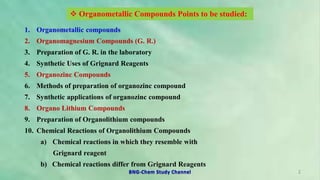
1. Organometallic compounds
2. Organomagnesium Compounds (G. R.)
3. Preparation of G. R. in the laboratory
4. Synthetic Uses of Grignard Reagents
5. Organozinc Compounds
6. Methods of preparation of organozinc compound
7. Synthetic applications of organozinc compound
8. Organo Lithium Compounds
9. Preparation of Organolithium compounds
10. Chemical Reactions of Organolithium Compounds
a) Chemical reactions in which they resemble with
Grignard reagent
b) Chemical reactions differ from Grignard Reagents
 Organometallic Compounds Points to be studied:
BNG-Chem Study Channel
CH-02: Organometallic Compounds
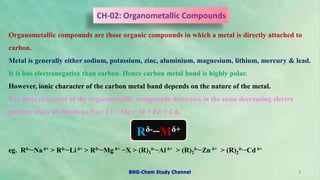
Organometallic compounds are those organic compounds in which a metal is directly attached to
carbon.
Metal is generally either sodium, potassium, zinc, aluminium, magnesium, lithium, mercury & lead.
It is less electronegative than carbon. Hence carbon metal bond is highly polar.
However, ionic character of the carbon metal band depends on the nature of the metal.
The ionic character of the organometallic compounds decreases in the same decreasing electro
positive order of metals as Na > Li > Mg > Al > Zn > Cd.
eg. Rδ-−Na δ+ > Rδ-−Li δ+ > Rδ-−Mg δ+ −X > (R)3
δ-−Al δ+ > (R)2
δ-−Zn δ+ > (R)2
δ-−Cd δ+
Rδ-−Mδ+
3
BNG-Chem Study Channel
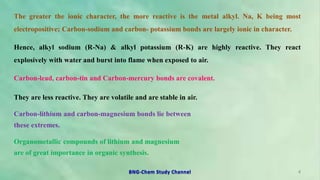
The greater the ionic character, the more reactive is the metal alkyl. Na, K being most
electropositive; Carbon-sodium and carbon- potassium bonds are largely ionic in character.
Hence, alkyl sodium (R-Na) & alkyl potassium (R-K) are highly reactive. They react
explosively with water and burst into flame when exposed to air.
Carbon-lead, carbon-tin and Carbon-mercury bonds are covalent.
They are less reactive. They are volatile and are stable in air.
Carbon-lithium and carbon-magnesium bonds lie between
these extremes.
Organometallic compounds of lithium and magnesium
are of great importance in organic synthesis.
4
BNG-Chem Study Channel
Organomagnesium halides R-Mg-X were discovered by the French chemist victor Grignard in
1900. Grignard received the Nobel Prize for his discovery in 1912 and organomagnesium halides
are called Grignard reagents in his honour.
Discovered by Victor Grignard in 1900
– Key factors are ethereal solvent
and water-free conditions
Awarded Nobel Prize in 1912
Victor Grignard, 1871–1935, French chemist. He shared the 1912 Nobel Prize in
Chemistry for his work in organic synthesis based on his discovery (1900) of the
Grignard Reagent. He taught at the Univ. of Nancy (1909–19) and at the Univ. of
Lyons (from 1919 until the end of his career). 5
A] ORGANOMAGNESIUM COMPOUNDS
BNG-Chem Study Channel
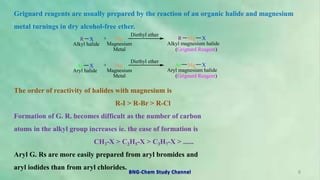
Grignard reagents are usually prepared by the reaction of an organic halide and magnesium
metal turnings in dry alcohol-free ether.
The order of reactivity of halides with magnesium is
R-I > R-Br > R-Cl
Formation of G. R. becomes difficult as the number of carbon
atoms in the alkyl group increases ie. the ease of formation is
CH3-X > C2H5-X > C3H7-X > ......
Aryl G. Rs are more easily prepared from aryl bromides and
aryl iodides than from aryl chlorides.
R X + Mg
Diethyl ether
R Mg X
Alkyl halide Magnesium
Metal
Alkyl magnesium halide
(Grignard Reagent)
Ar X + Mg
Diethyl ether
Ar Mg X
Aryl halide Magnesium
Metal
Aryl magnesium halide
(Grignard Reagent)
6
BNG-Chem Study Channel
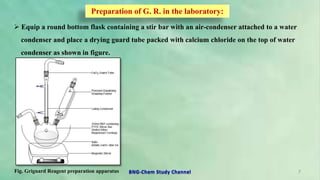
Preparation of G. R. in the laboratory:
 Equip a round bottom flask containing a stir bar with an air-condenser attached to a water
condenser and place a drying guard tube packed with calcium chloride on the top of water
condenser as shown in figure.
Fig. Grignard Reagent preparation apparatus 7
BNG-Chem Study Channel
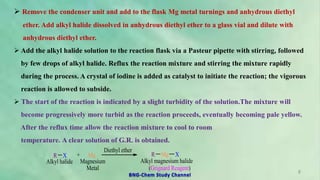
 Remove the condenser unit and add to the flask Mg metal turnings and anhydrous diethyl
ether. Add alkyl halide dissolved in anhydrous diethyl ether to a glass vial and dilute with
anhydrous diethyl ether.
 Add the alkyl halide solution to the reaction flask via a Pasteur pipette with stirring, followed
by few drops of alkyl halide. Reflux the reaction mixture and stirring the mixture rapidly
during the process. A crystal of iodine is added as catalyst to initiate the reaction; the vigorous
reaction is allowed to subside.
 The start of the reaction is indicated by a slight turbidity of the solution.The mixture will
become progressively more turbid as the reaction proceeds, eventually becoming pale yellow.
After the reflux time allow the reaction mixture to cool to room
temperature. A clear solution of G.R. is obtained.
R X + Mg
Diethyl ether
R Mg X
Alkyl halide Magnesium
Metal
Alkyl magnesium halide
(Grignard Reagent)
8
BNG-Chem Study Channel
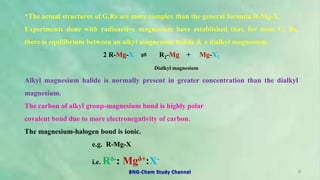
*The actual structures of G.Rs are more complex than the general formula R-Mg-X.
Experiments done with radioactive magnesium have established that, for most G. Rs,
there is equilibrium between an alkyl magnesium halide & a dialkyl magnesium.
2 R-Mg-X ⇌ R2-Mg + Mg-X2
Dialkyl magnesium
Alkyl magnesium halide is normally present in greater concentration than the dialkyl
magnesium.
The carbon of alkyl group-magnesium bond is highly polar
covalent bond due to more electronegativity of carbon.
The magnesium-halogen bond is ionic.
e.g. R-Mg-X
i.e. Rδ-: Mgδ+:X-
9
BNG-Chem Study Channel
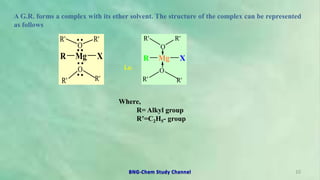
A G.R. forms a complex with its ether solvent. The structure of the complex can be represented
as follows
i.e.
Where,
R= Alkyl group
R’=C2H5- group
R Mg X
O
O
R'
R'
R' R'
R Mg X
O
O
R'
R'
R' R'
10
BNG-Chem Study Channel
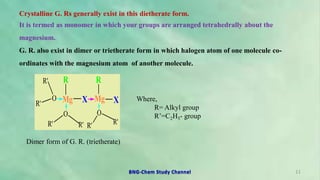
Crystalline G. Rs generally exist in this dietherate form.
It is termed as monomer in which your groups are arranged tetrahedrally about the
magnesium.
G. R. also exist in dimer or trietherate form in which halogen atom of one molecule co-
ordinates with the magnesium atom of another molecule.
Where,
R= Alkyl group
R’=C2H5- group
Dimer form of G. R. (trietherate)
R
Mg X
O
O
R'
R'
R' R'
Mg
R
X
O
R' R'
11
BNG-Chem Study Channel
12
BNG-Chem Study Channel

CH-02- Module-1-OMC-Introduction and a] Organomagnesium Compounds

  • 1.
    1 B. Sc. ThirdYear Semester-V 1 CH-02:- Module-1 : OMC-Introduction and A] Organomagnesium Compounds Dr. B. N. Gawade M. Sc. CSIR-UGC-NET (JRF), Ph. D. Assistant Professor Department of Chemistry Anandrao Dhonde Alias Babaji Mahavidyalaya, Kada. Tal. Ashti. Dist. Beed - 414 202, Maharashtra, INDIA CH-02: Organometallic Compounds Welcome
  • 2.
    2 1. Organometallic compounds 2.Organomagnesium Compounds (G. R.) 3. Preparation of G. R. in the laboratory 4. Synthetic Uses of Grignard Reagents 5. Organozinc Compounds 6. Methods of preparation of organozinc compound 7. Synthetic applications of organozinc compound 8. Organo Lithium Compounds 9. Preparation of Organolithium compounds 10. Chemical Reactions of Organolithium Compounds a) Chemical reactions in which they resemble with Grignard reagent b) Chemical reactions differ from Grignard Reagents  Organometallic Compounds Points to be studied: BNG-Chem Study Channel
  • 3.
    CH-02: Organometallic Compounds Organometalliccompounds are those organic compounds in which a metal is directly attached to carbon. Metal is generally either sodium, potassium, zinc, aluminium, magnesium, lithium, mercury & lead. It is less electronegative than carbon. Hence carbon metal bond is highly polar. However, ionic character of the carbon metal band depends on the nature of the metal. The ionic character of the organometallic compounds decreases in the same decreasing electro positive order of metals as Na > Li > Mg > Al > Zn > Cd. eg. Rδ-−Na δ+ > Rδ-−Li δ+ > Rδ-−Mg δ+ −X > (R)3 δ-−Al δ+ > (R)2 δ-−Zn δ+ > (R)2 δ-−Cd δ+ Rδ-−Mδ+ 3 BNG-Chem Study Channel
  • 4.
    The greater theionic character, the more reactive is the metal alkyl. Na, K being most electropositive; Carbon-sodium and carbon- potassium bonds are largely ionic in character. Hence, alkyl sodium (R-Na) & alkyl potassium (R-K) are highly reactive. They react explosively with water and burst into flame when exposed to air. Carbon-lead, carbon-tin and Carbon-mercury bonds are covalent. They are less reactive. They are volatile and are stable in air. Carbon-lithium and carbon-magnesium bonds lie between these extremes. Organometallic compounds of lithium and magnesium are of great importance in organic synthesis. 4 BNG-Chem Study Channel
  • 5.
    Organomagnesium halides R-Mg-Xwere discovered by the French chemist victor Grignard in 1900. Grignard received the Nobel Prize for his discovery in 1912 and organomagnesium halides are called Grignard reagents in his honour. Discovered by Victor Grignard in 1900 – Key factors are ethereal solvent and water-free conditions Awarded Nobel Prize in 1912 Victor Grignard, 1871–1935, French chemist. He shared the 1912 Nobel Prize in Chemistry for his work in organic synthesis based on his discovery (1900) of the Grignard Reagent. He taught at the Univ. of Nancy (1909–19) and at the Univ. of Lyons (from 1919 until the end of his career). 5 A] ORGANOMAGNESIUM COMPOUNDS BNG-Chem Study Channel
  • 6.
    Grignard reagents areusually prepared by the reaction of an organic halide and magnesium metal turnings in dry alcohol-free ether. The order of reactivity of halides with magnesium is R-I > R-Br > R-Cl Formation of G. R. becomes difficult as the number of carbon atoms in the alkyl group increases ie. the ease of formation is CH3-X > C2H5-X > C3H7-X > ...... Aryl G. Rs are more easily prepared from aryl bromides and aryl iodides than from aryl chlorides. R X + Mg Diethyl ether R Mg X Alkyl halide Magnesium Metal Alkyl magnesium halide (Grignard Reagent) Ar X + Mg Diethyl ether Ar Mg X Aryl halide Magnesium Metal Aryl magnesium halide (Grignard Reagent) 6 BNG-Chem Study Channel
  • 7.
    Preparation of G.R. in the laboratory:  Equip a round bottom flask containing a stir bar with an air-condenser attached to a water condenser and place a drying guard tube packed with calcium chloride on the top of water condenser as shown in figure. Fig. Grignard Reagent preparation apparatus 7 BNG-Chem Study Channel
  • 8.
     Remove thecondenser unit and add to the flask Mg metal turnings and anhydrous diethyl ether. Add alkyl halide dissolved in anhydrous diethyl ether to a glass vial and dilute with anhydrous diethyl ether.  Add the alkyl halide solution to the reaction flask via a Pasteur pipette with stirring, followed by few drops of alkyl halide. Reflux the reaction mixture and stirring the mixture rapidly during the process. A crystal of iodine is added as catalyst to initiate the reaction; the vigorous reaction is allowed to subside.  The start of the reaction is indicated by a slight turbidity of the solution.The mixture will become progressively more turbid as the reaction proceeds, eventually becoming pale yellow. After the reflux time allow the reaction mixture to cool to room temperature. A clear solution of G.R. is obtained. R X + Mg Diethyl ether R Mg X Alkyl halide Magnesium Metal Alkyl magnesium halide (Grignard Reagent) 8 BNG-Chem Study Channel
  • 9.
    *The actual structuresof G.Rs are more complex than the general formula R-Mg-X. Experiments done with radioactive magnesium have established that, for most G. Rs, there is equilibrium between an alkyl magnesium halide & a dialkyl magnesium. 2 R-Mg-X ⇌ R2-Mg + Mg-X2 Dialkyl magnesium Alkyl magnesium halide is normally present in greater concentration than the dialkyl magnesium. The carbon of alkyl group-magnesium bond is highly polar covalent bond due to more electronegativity of carbon. The magnesium-halogen bond is ionic. e.g. R-Mg-X i.e. Rδ-: Mgδ+:X- 9 BNG-Chem Study Channel
  • 10.
    A G.R. formsa complex with its ether solvent. The structure of the complex can be represented as follows i.e. Where, R= Alkyl group R’=C2H5- group R Mg X O O R' R' R' R' R Mg X O O R' R' R' R' 10 BNG-Chem Study Channel
  • 11.
    Crystalline G. Rsgenerally exist in this dietherate form. It is termed as monomer in which your groups are arranged tetrahedrally about the magnesium. G. R. also exist in dimer or trietherate form in which halogen atom of one molecule co- ordinates with the magnesium atom of another molecule. Where, R= Alkyl group R’=C2H5- group Dimer form of G. R. (trietherate) R Mg X O O R' R' R' R' Mg R X O R' R' 11 BNG-Chem Study Channel
  • 12.