GRIGNARD’S
REAGENT
PREPaRATION
AND IT’S USES
SUBMITTED TO : Dr. MANMOHAN SIR
SUBMITTED BY : NISHTHA
SRIVASTAVA
CONTENTS :-
WHAT IS GRIGNARD’S
REAGENT ?
GRIGNARD REAGENTS
PREPARATION OF GRIGNARD R
EAGENTS
REACTIONS OF GRIGNARD REA
GENTS
WHAT IS GRIGNARD’S REAGENT ?
• A Grignard reagent is an organomagnesium compound
which can be described by the chemical formula ‘R-Mg-
X’ where R refers to an alkyl or aryl group and X refers to a
halogen.
• They are generally produced by reacting an aryl halide or an
alkyl halide with magnesium.
• These reagents were discovered by the French chemist
Victor Grignard, who won the Nobel Prize in Chemistry in
the year 1912 for his work on these compounds.
GRIGNARD REAGENTS
• Grignard reagents (RMgX) are commonly used for organic synthesis.
However, these highly reactive compounds are supplied inflammable
solvents, which cause extra complexity in their transport. Herein we note
that Grignard reagents with linear alkyl chains can be trapped and
stabilized by the macrocyclic host pillar arene while retaining their
reactivity.
• Reactions that form carbon-carbon bonds are among the most beneficial
to synthetic organic chemist. In 1912, Victor Grignard was awarded the
Nobel Prize in Chemistry for his discovery of a new sequence of reactions
resulting in the creation of a carbon-carbon bond. Grignard synthesis
involves the preparation of an organomagnesium reagent through the
reaction of an alkyl bromide with magnesium metal.
• The Grignard reaction is an organic reaction used to
produce a variety of products through the reaction of an
organomagnesium compound, also known as an
electrophilic “Grignard reagent,” followed by an acidic
reaction. The Grignard reagent is formed by the reaction of
an alkyl or aryl halide with magnesium metal via a radical
mechanism.
• The process of preparing Grignard reagents
is described in the points provided below. It
can be noted that many of these reagents
can also be purchased commercially.
1.These reagents are prepared via the
treatment of magnesium with organic
halides such as alkyl or aryl halides.
2.This is done with the help of solvents
comprising ethers (which are described by
the formula R-O-R’) because the ligands
provided by these solvents help in the
stabilization of the organomagnesium
compound.
PREPARATION
OF GRIGNARD
REAGENTS
4. Water and air are very harmful to this synthesis and
can quickly destroy the Grignard reagent which is being
formed via protonolysis or via oxidation of the reagent.
Therefore, the process must be carried out in air-free
conditions.
5. Alternatively, the magnesium can be activated to
make it consume water when wet solvents are used
with the help of ultrasound.
6. After the slow induction period of the reaction, the
process can be quite exothermic. This is a very
important factor to consider while industrially
producing the Grignard reagent.
The organic halides used in these reactions include aryl
or alkyl chlorides, bromides, and iodides. Aryl fluorides
and alkyl fluorides are not very reactive and are hence
not commonly used. However, with the help of Rieke
metals, the magnesium can be activated to make the
fluoride more reactive
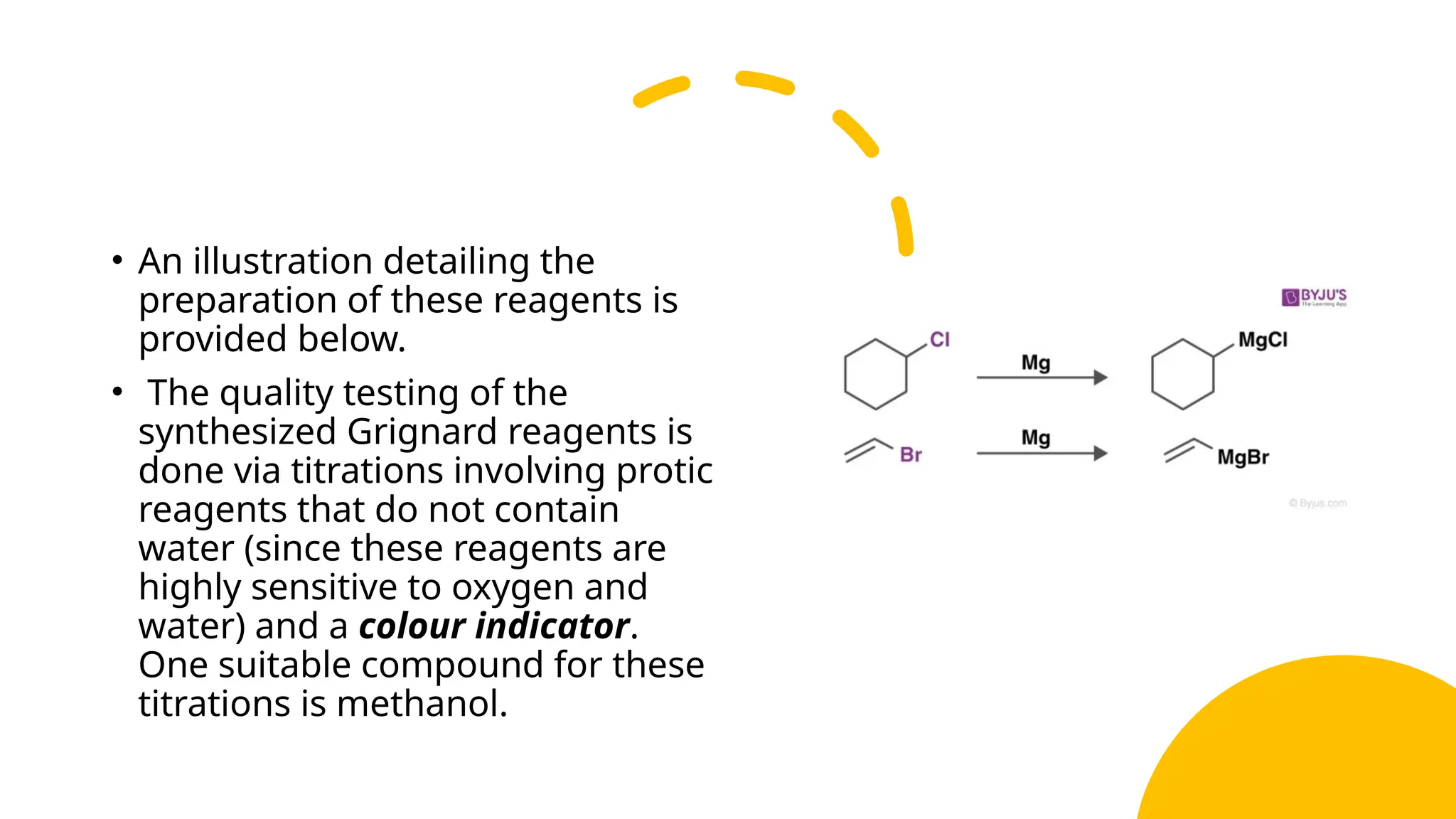
• An illustration detailing the
preparation of these reagents is
provided below.
• The quality testing of the
synthesized Grignard reagents is
done via titrations involving protic
reagents that do not contain
water (since these reagents are
highly sensitive to oxygen and
water) and a colour indicator.
One suitable compound for these
titrations is methanol.
REACTIONS OF GRIG
NARD REAGENTS
• During a reaction involving
Grignard reagents, it is necessary to
ensure that no water is present
which would otherwise cause the
reagent to decompose rapidly.
Therefore, the majority of Grignard
reactions occur in solvents such as
anhydrous diethyl ether or
tetrahydrofuran because the
oxygen in these solvents stabilizes
the magnesium reagent.
• Grignard reagents are very
important reagents in organic
chemistry since they can be reacted
with a wide range of compounds to
form different products.
Reactions of Grignard REAGENT :-
I. Reactions with Carbonyl Group
II. Reactions with Non-Carbon
Electrophiles
III. Reactions with Organic Halides
IV. Reaction between Acetone and
Methyl Magnesium Chloride
V. Industrial Reactions
1. Reactions with Carbonyl Group
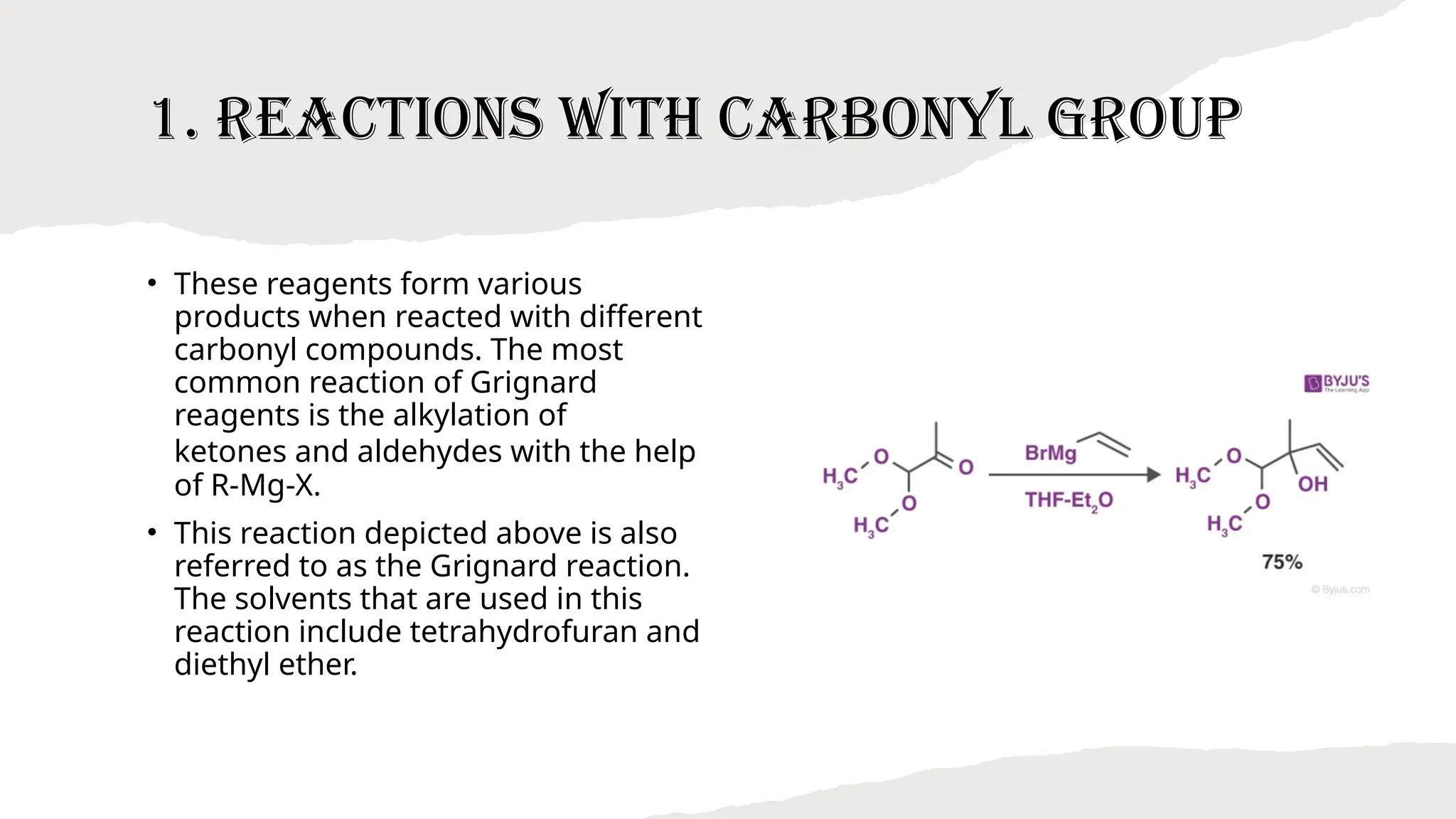
• These reagents form various
products when reacted with different
carbonyl compounds. The most
common reaction of Grignard
reagents is the alkylation of
ketones and aldehydes with the help
of R-Mg-X.
• This reaction depicted above is also
referred to as the Grignard reaction.
The solvents that are used in this
reaction include tetrahydrofuran and
diethyl ether.
2. Reactions with Non-
Carbon Electrophiles
• For the formation of new carbon-
heteroatom bonds, Grignard reagents
and some organolithium compounds
are very useful. These reagents can
also undergo a transmetallation
reaction with cadmium chloride,
yielding dialkyl cadmium. This
reaction can be written as follows.
• 2R-Mg-X + CdCl2 R
→ 2Cd + 2Mg(X)Cl
• Alkyl chains can be attached to many
metals and metalloids with the help of
these reagents.
3. Reactions with Organic
Halides
• Typically, these reagents are quite
unreactive towards organic halides
which highly contrasts their behaviour
towards other halides. However, carbon-
carbon coupling reactions occur with
Grignard reagents acting as a reactant
when a metal catalyst is introduced.
• An example of such a coupling reaction
is the reaction between methyl p-
chlorobenzoate and nonyl magnesium
bromide which yields the compound p-
nonyl benzoic acid in the presence of
the catalyst – Tris(acetylaceto) iron(III).
4. Reaction between Acetone and Methyl Magnesium
Chloride
• The reaction of methyl
magnesium bromide with acetone
followed by hydrolysis gives
tertiary alcohol. Acetone reacts
with methyl magnesium bromide
followed by hydrolysis to give
secondary alcohols.
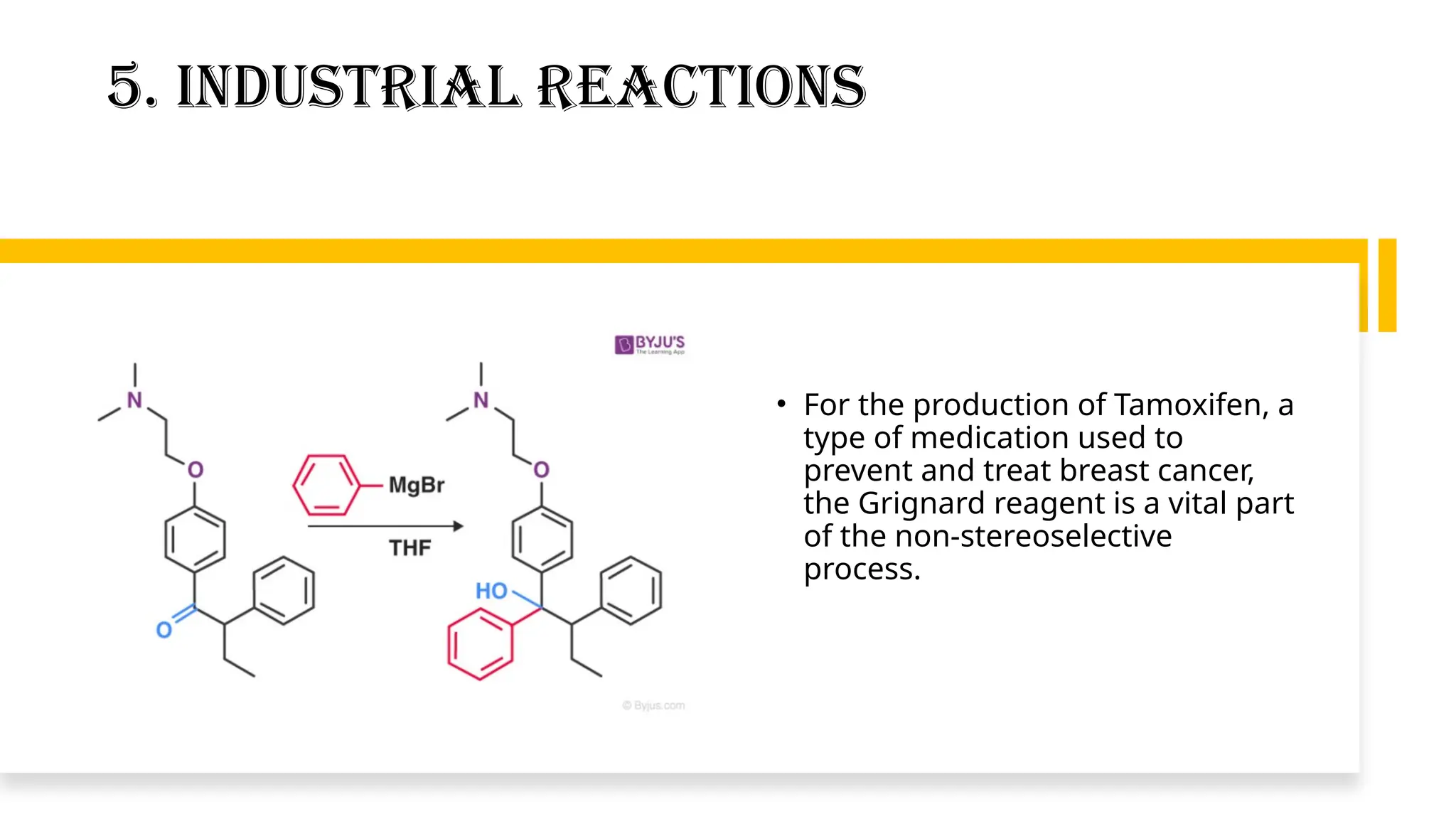
5. Industrial Reactions
• For the production of Tamoxifen, a
type of medication used to
prevent and treat breast cancer,
the Grignard reagent is a vital part
of the non-stereoselective
process.
•THANK YOU

GRIGNARD'S REAGENT PREPARATION AND IT'S USES .pptx

  • 1.
    GRIGNARD’S REAGENT PREPaRATION AND IT’S USES SUBMITTEDTO : Dr. MANMOHAN SIR SUBMITTED BY : NISHTHA SRIVASTAVA
  • 2.
    CONTENTS :- WHAT ISGRIGNARD’S REAGENT ? GRIGNARD REAGENTS PREPARATION OF GRIGNARD R EAGENTS REACTIONS OF GRIGNARD REA GENTS
  • 3.
    WHAT IS GRIGNARD’SREAGENT ? • A Grignard reagent is an organomagnesium compound which can be described by the chemical formula ‘R-Mg- X’ where R refers to an alkyl or aryl group and X refers to a halogen. • They are generally produced by reacting an aryl halide or an alkyl halide with magnesium. • These reagents were discovered by the French chemist Victor Grignard, who won the Nobel Prize in Chemistry in the year 1912 for his work on these compounds.
  • 4.
    GRIGNARD REAGENTS • Grignardreagents (RMgX) are commonly used for organic synthesis. However, these highly reactive compounds are supplied inflammable solvents, which cause extra complexity in their transport. Herein we note that Grignard reagents with linear alkyl chains can be trapped and stabilized by the macrocyclic host pillar arene while retaining their reactivity. • Reactions that form carbon-carbon bonds are among the most beneficial to synthetic organic chemist. In 1912, Victor Grignard was awarded the Nobel Prize in Chemistry for his discovery of a new sequence of reactions resulting in the creation of a carbon-carbon bond. Grignard synthesis involves the preparation of an organomagnesium reagent through the reaction of an alkyl bromide with magnesium metal.
  • 5.
    • The Grignardreaction is an organic reaction used to produce a variety of products through the reaction of an organomagnesium compound, also known as an electrophilic “Grignard reagent,” followed by an acidic reaction. The Grignard reagent is formed by the reaction of an alkyl or aryl halide with magnesium metal via a radical mechanism.
  • 6.
    • The processof preparing Grignard reagents is described in the points provided below. It can be noted that many of these reagents can also be purchased commercially. 1.These reagents are prepared via the treatment of magnesium with organic halides such as alkyl or aryl halides. 2.This is done with the help of solvents comprising ethers (which are described by the formula R-O-R’) because the ligands provided by these solvents help in the stabilization of the organomagnesium compound. PREPARATION OF GRIGNARD REAGENTS
  • 7.
    4. Water andair are very harmful to this synthesis and can quickly destroy the Grignard reagent which is being formed via protonolysis or via oxidation of the reagent. Therefore, the process must be carried out in air-free conditions. 5. Alternatively, the magnesium can be activated to make it consume water when wet solvents are used with the help of ultrasound. 6. After the slow induction period of the reaction, the process can be quite exothermic. This is a very important factor to consider while industrially producing the Grignard reagent. The organic halides used in these reactions include aryl or alkyl chlorides, bromides, and iodides. Aryl fluorides and alkyl fluorides are not very reactive and are hence not commonly used. However, with the help of Rieke metals, the magnesium can be activated to make the fluoride more reactive
  • 8.
    • An illustrationdetailing the preparation of these reagents is provided below. • The quality testing of the synthesized Grignard reagents is done via titrations involving protic reagents that do not contain water (since these reagents are highly sensitive to oxygen and water) and a colour indicator. One suitable compound for these titrations is methanol.
  • 9.
    REACTIONS OF GRIG NARDREAGENTS • During a reaction involving Grignard reagents, it is necessary to ensure that no water is present which would otherwise cause the reagent to decompose rapidly. Therefore, the majority of Grignard reactions occur in solvents such as anhydrous diethyl ether or tetrahydrofuran because the oxygen in these solvents stabilizes the magnesium reagent. • Grignard reagents are very important reagents in organic chemistry since they can be reacted with a wide range of compounds to form different products.
  • 10.
    Reactions of GrignardREAGENT :- I. Reactions with Carbonyl Group II. Reactions with Non-Carbon Electrophiles III. Reactions with Organic Halides IV. Reaction between Acetone and Methyl Magnesium Chloride V. Industrial Reactions
  • 11.
    1. Reactions withCarbonyl Group • These reagents form various products when reacted with different carbonyl compounds. The most common reaction of Grignard reagents is the alkylation of ketones and aldehydes with the help of R-Mg-X. • This reaction depicted above is also referred to as the Grignard reaction. The solvents that are used in this reaction include tetrahydrofuran and diethyl ether.
  • 12.
    2. Reactions withNon- Carbon Electrophiles • For the formation of new carbon- heteroatom bonds, Grignard reagents and some organolithium compounds are very useful. These reagents can also undergo a transmetallation reaction with cadmium chloride, yielding dialkyl cadmium. This reaction can be written as follows. • 2R-Mg-X + CdCl2 R → 2Cd + 2Mg(X)Cl • Alkyl chains can be attached to many metals and metalloids with the help of these reagents.
  • 13.
    3. Reactions withOrganic Halides • Typically, these reagents are quite unreactive towards organic halides which highly contrasts their behaviour towards other halides. However, carbon- carbon coupling reactions occur with Grignard reagents acting as a reactant when a metal catalyst is introduced. • An example of such a coupling reaction is the reaction between methyl p- chlorobenzoate and nonyl magnesium bromide which yields the compound p- nonyl benzoic acid in the presence of the catalyst – Tris(acetylaceto) iron(III).
  • 14.
    4. Reaction betweenAcetone and Methyl Magnesium Chloride • The reaction of methyl magnesium bromide with acetone followed by hydrolysis gives tertiary alcohol. Acetone reacts with methyl magnesium bromide followed by hydrolysis to give secondary alcohols.
  • 15.
    5. Industrial Reactions •For the production of Tamoxifen, a type of medication used to prevent and treat breast cancer, the Grignard reagent is a vital part of the non-stereoselective process.
  • 16.