ORGANISATIONPrepared by
B.Pradyumna(CSE)
Guidance by
T.Kiran
(Assistant Professor)
MALLAREDDY INSTITUTE OF ENGINEETING AND TECHNOLOGY
What is Organisation..?
Organisation is a process of bringing
and uniting people to achieve the
objectives of the organisation. It also
implies the grouping of the staff to
achieve the common objectives.
Organisation differs from organizing…
Organising is a function of management where as Organisation refers to an
establishment where the functions of manangement are performed.
 Organising is a process of:
 -> Determining,grouping,and structuring the activities
 ->Creating roles for effective performance at work
 ->Allocating necessary authority and responsibility for results
 ->Determining detailed procedures and systems for different
problem areas such as coordination,decision
making,motivation…etc.
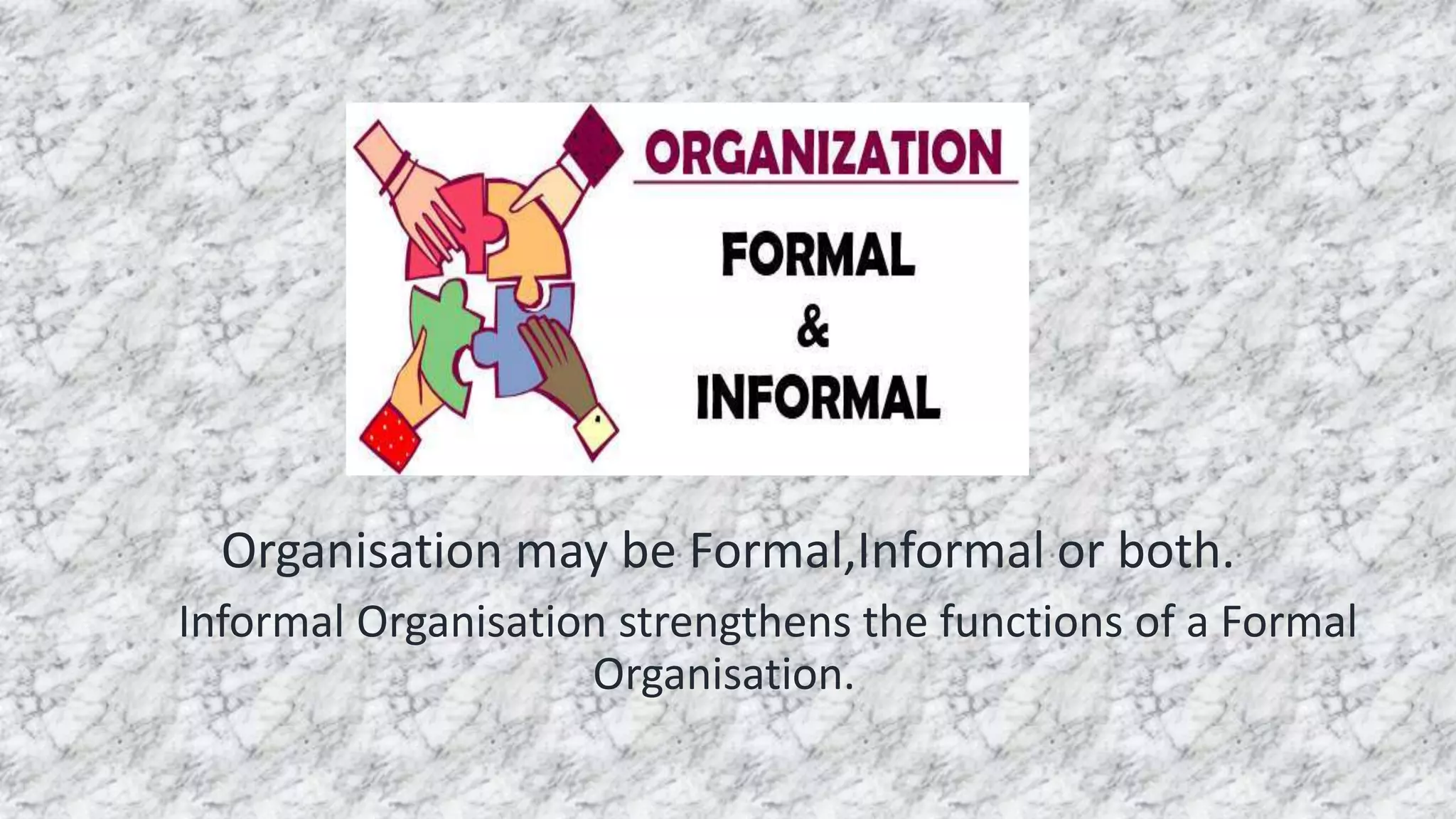
Organisation may be Formal,Informal or both.
Informal Organisation strengthens the functions of a Formal
Organisation.
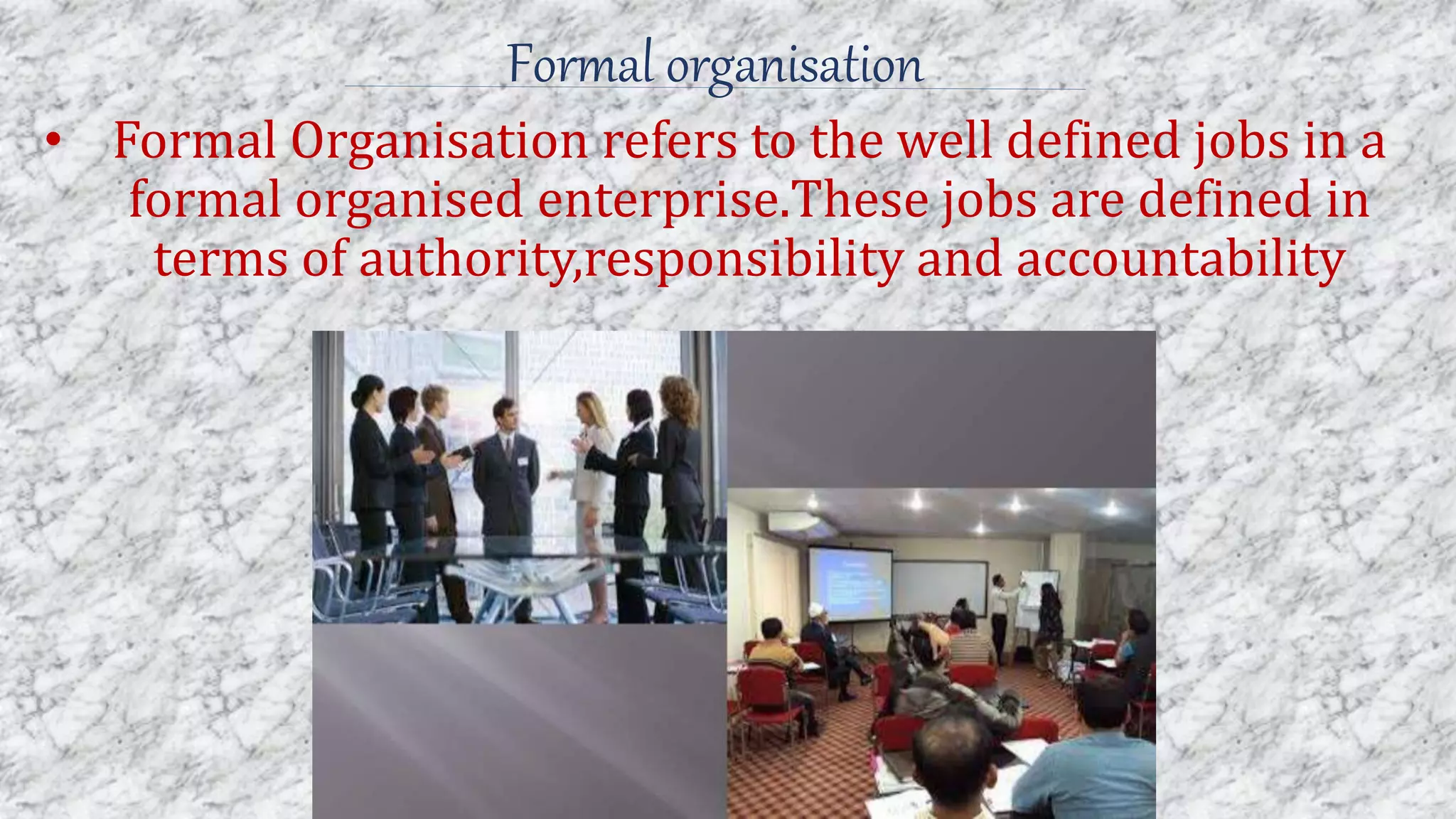
Formal organisation
• Formal Organisation refers to the well defined jobs in a
formal organised enterprise.These jobs are defined in
terms of authority,responsibility and accountability
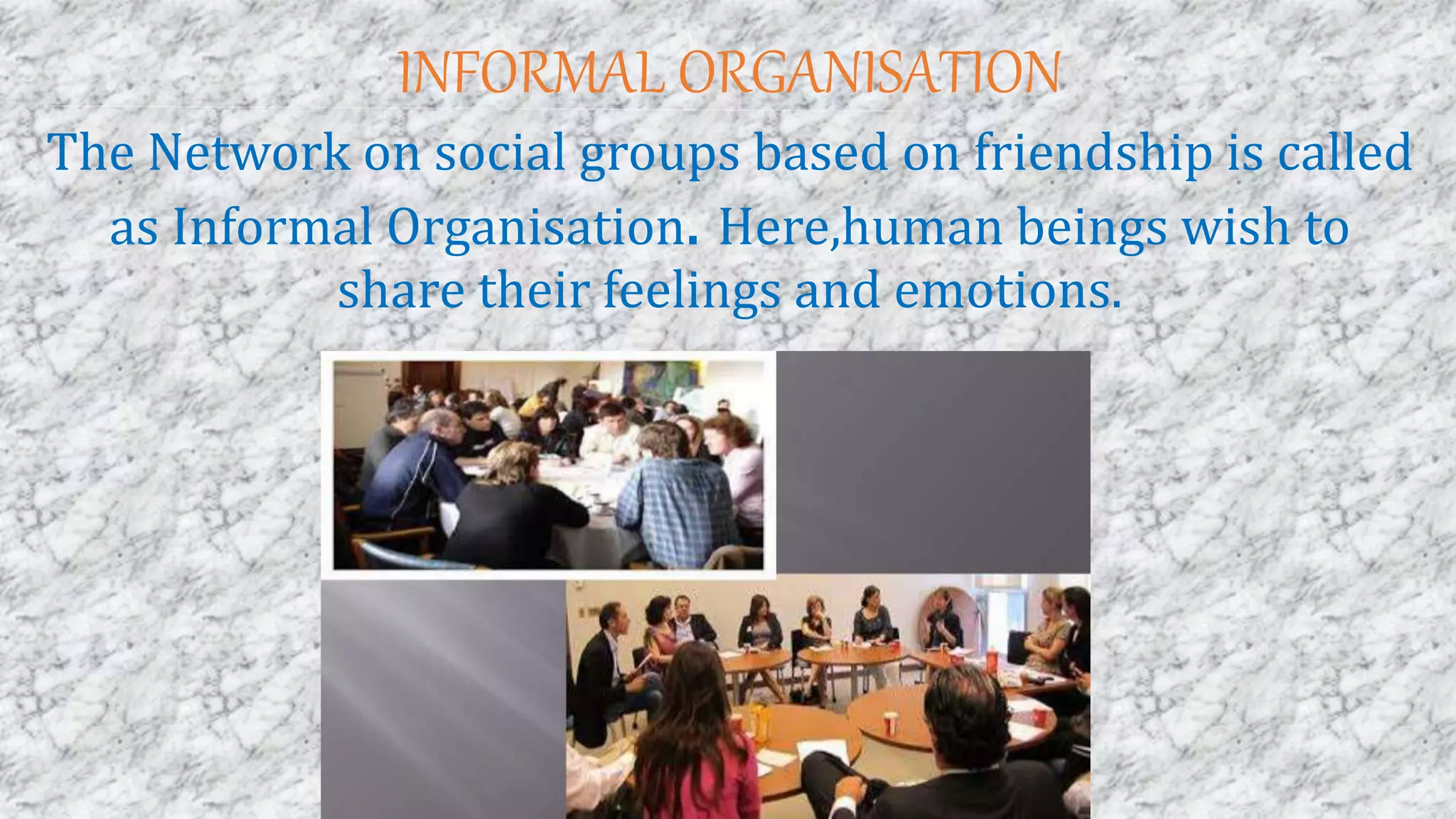
INFORMAL ORGANISATION
The Network on social groups based on friendship is called
as Informal Organisation. Here,human beings wish to
share their feelings and emotions.
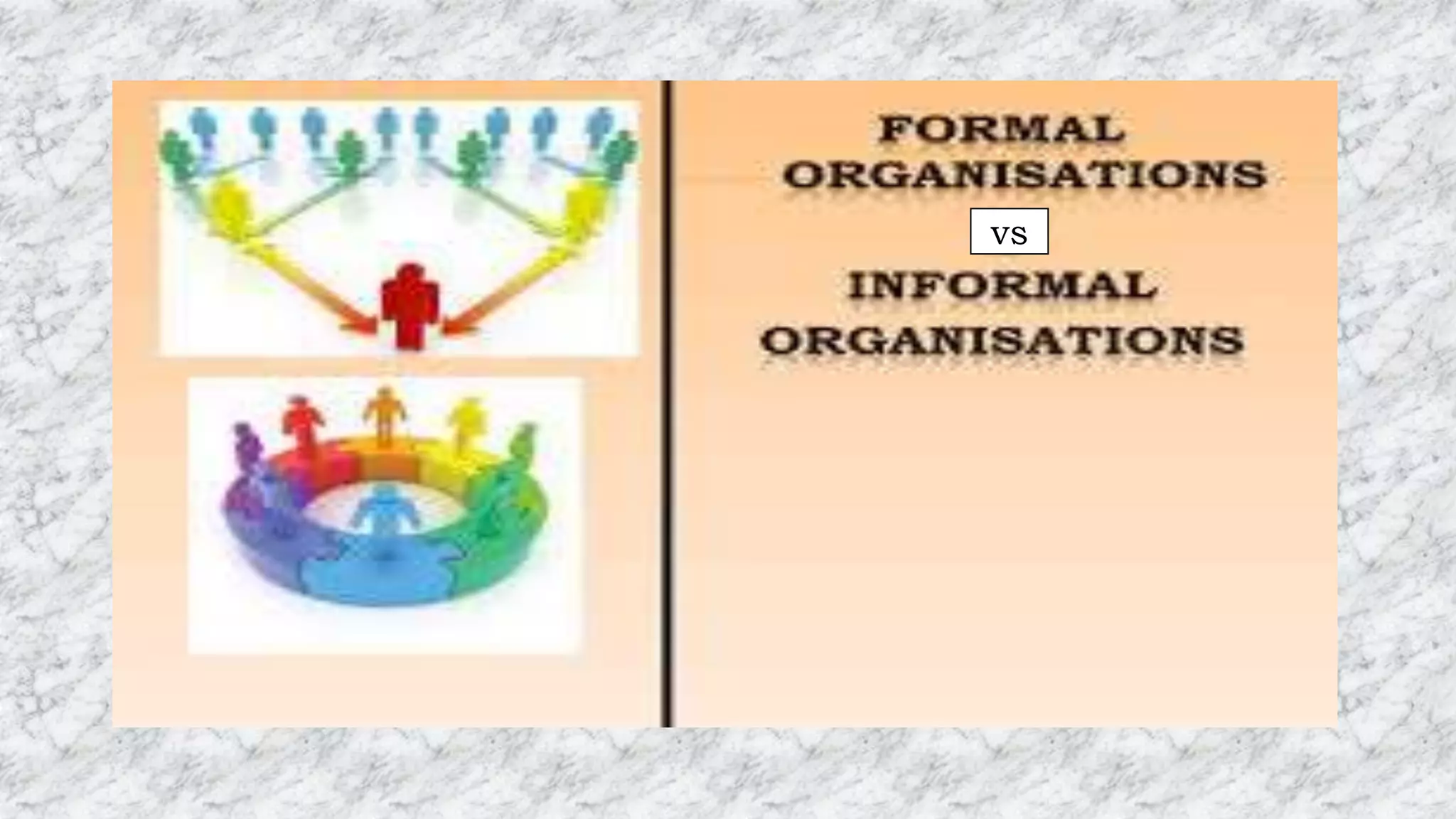
vs
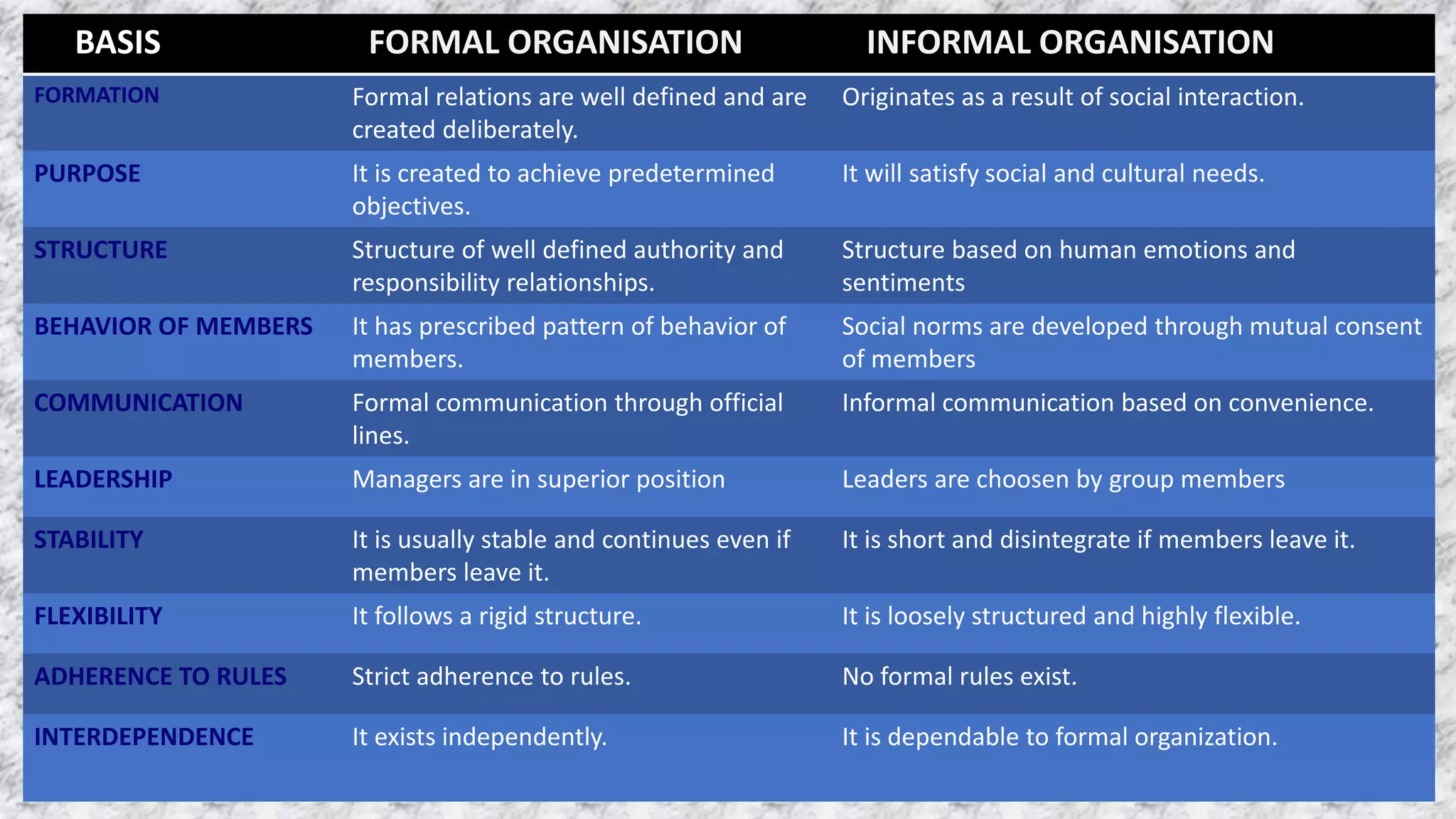
BASIS FORMAL ORGANISATION INFORMAL ORGANISATION
FORMATION Formal relations are well defined and are
created deliberately.
Originates as a result of social interaction.
PURPOSE It is created to achieve predetermined
objectives.
It will satisfy social and cultural needs.
STRUCTURE Structure of well defined authority and
responsibility relationships.
Structure based on human emotions and
sentiments
BEHAVIOR OF MEMBERS It has prescribed pattern of behavior of
members.
Social norms are developed through mutual consent
of members
COMMUNICATION Formal communication through official
lines.
Informal communication based on convenience.
LEADERSHIP Managers are in superior position Leaders are choosen by group members
STABILITY It is usually stable and continues even if
members leave it.
It is short and disintegrate if members leave it.
FLEXIBILITY It follows a rigid structure. It is loosely structured and highly flexible.
ADHERENCE TO RULES Strict adherence to rules. No formal rules exist.
INTERDEPENDENCE It exists independently. It is dependable to formal organization.
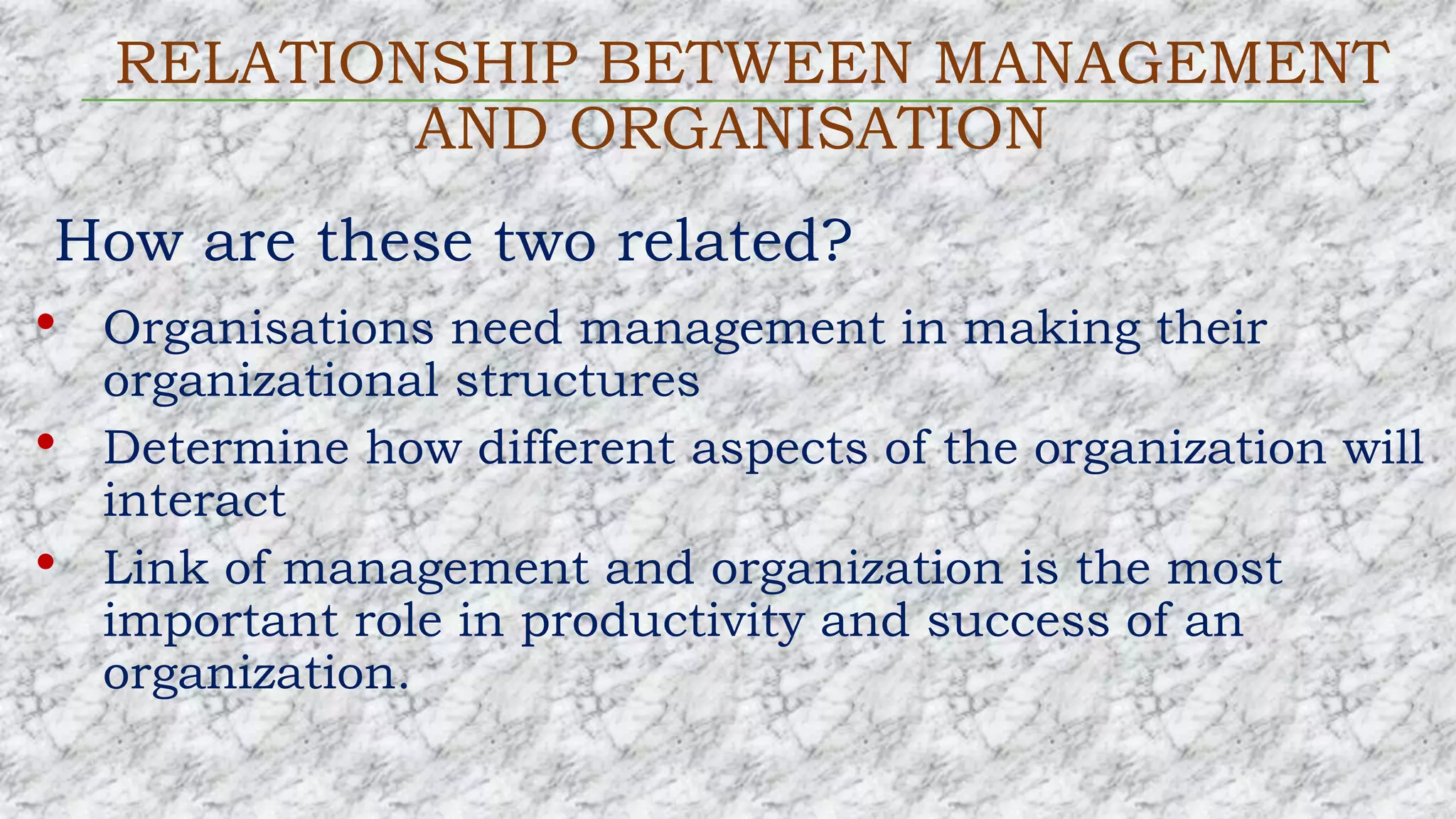
RELATIONSHIP BETWEEN MANAGEMENT
AND ORGANISATION
How are these two related?
• Organisations need management in making their
organizational structures
• Determine how different aspects of the organization will
interact
• Link of management and organization is the most
important role in productivity and success of an
organization.
In building an Organisation:
 Managers design an organization structure and architecture for the system of
production.
 Different levels of management will participate in different componenets of this
design process.
 Upper management creating the initial organizational architecture and structure.
Employees/Workforce:
 Make up most of the organization.
 One of the most important part of an organization
 Good management offers a bridge by connecting each and every corner.
 Following and executing decisions/plans.
 Managers are the drivers,they are the engine.
BOTH ARE INCOMPLETE WITHOUT EACHOTHER.
Basic concepts of organization
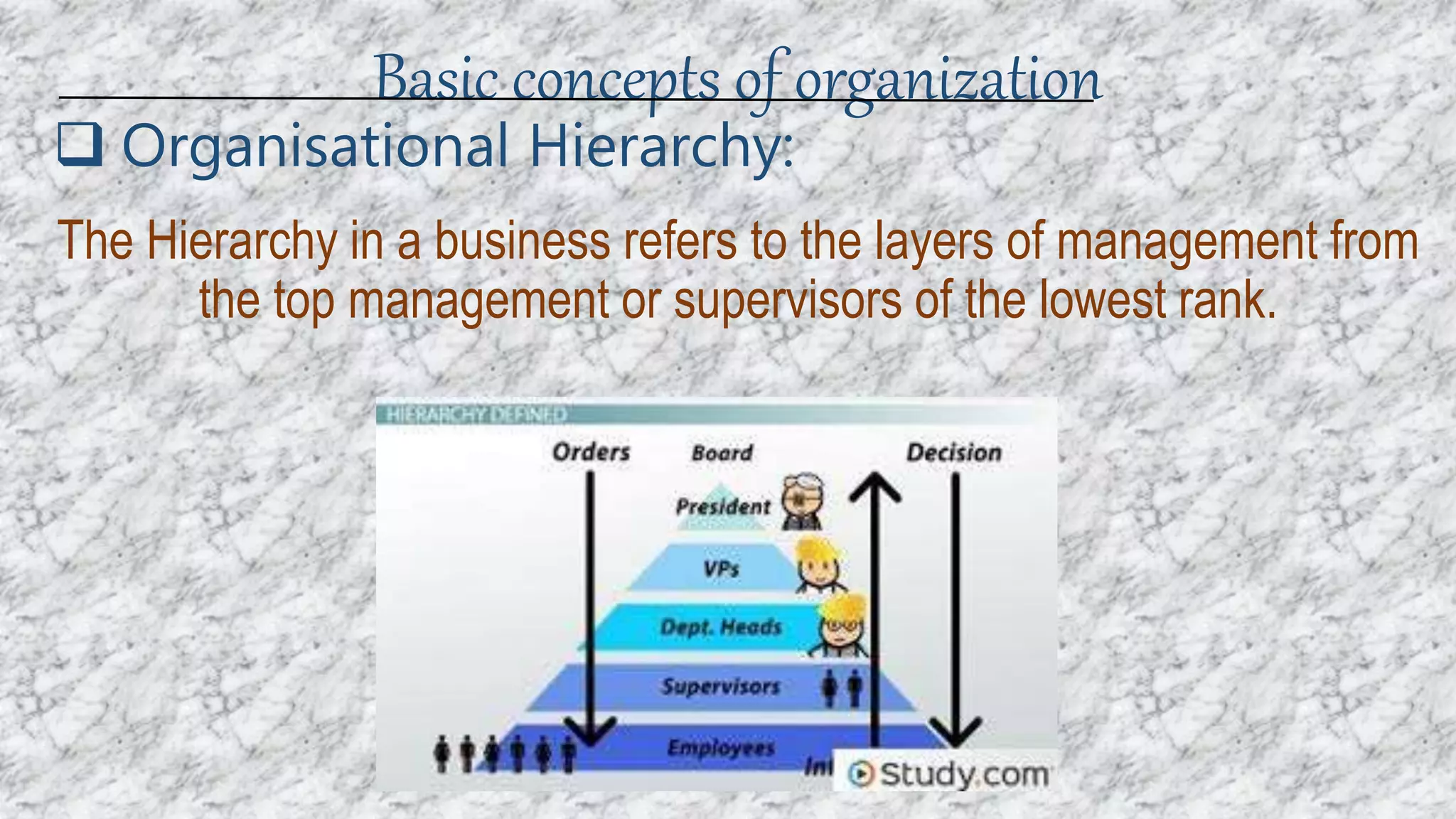
 Organisational Hierarchy:
The Hierarchy in a business refers to the layers of management from
the top management or supervisors of the lowest rank.
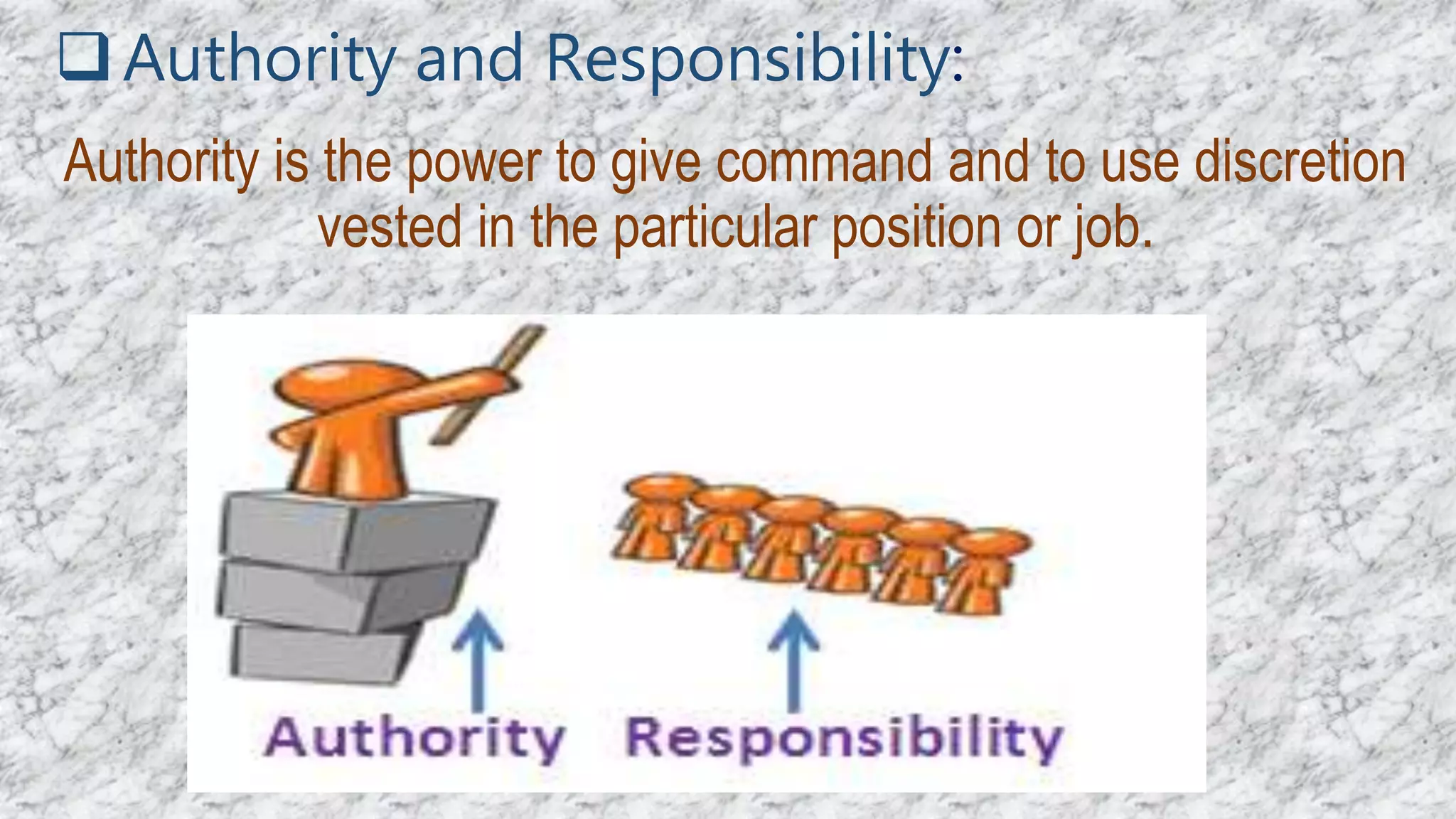
Authority and Responsibility:
Authority is the power to give command and to use discretion
vested in the particular position or job.
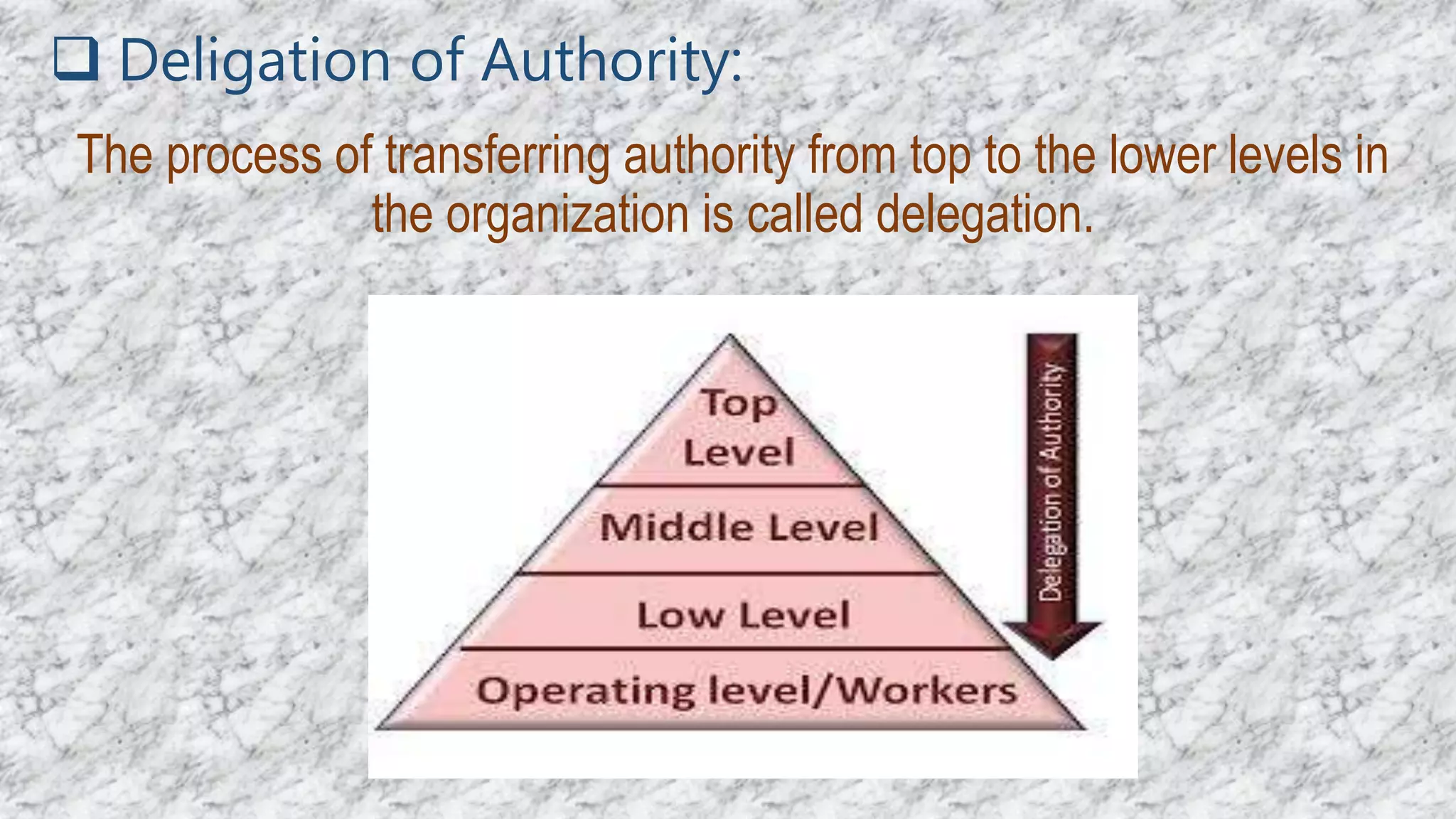
 Deligation of Authority:
The process of transferring authority from top to the lower levels in
the organization is called delegation.
 Span of management:
It is also called as span of control.It refers to the number of subordinates
that can be effectively controlled by the manager at a given point of time.
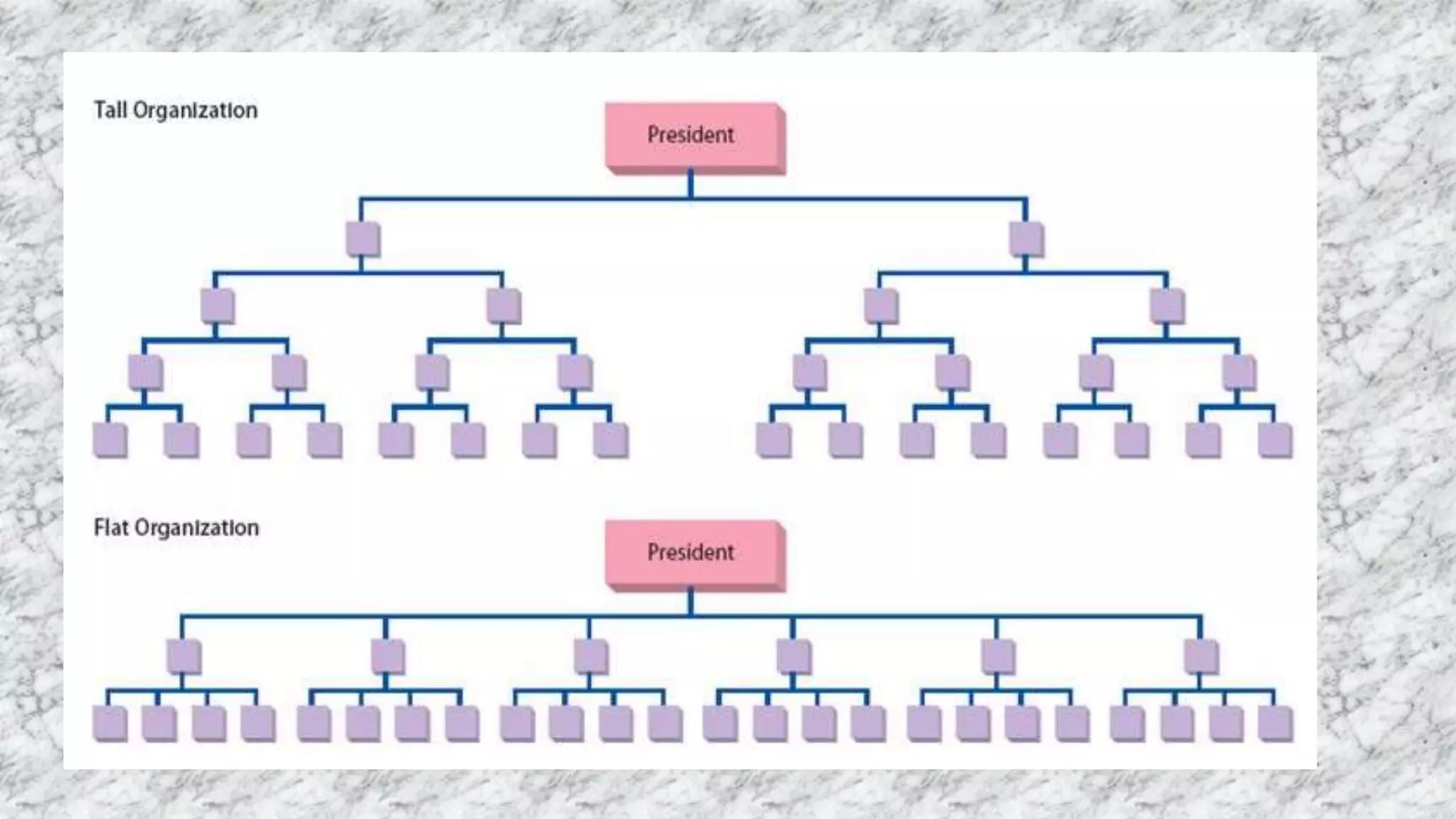
 Flat and Tall Organisations:
Tall and flat organizational structures refer to the structures of an
organization’s levels of management. A tall organization, or vertical
organization, is one in which the CEO/Director sits at the top of the chain of
command, with various levels of management underneath. A flat
organization, or horizontal organization, involves fewer levels of
management and more employee autonomy in the decision-making
process.
PRINCIPLES OF ORGANISATION
 Align departmental objectives to corporate goals
 Cost-effective operations
 Optimum number of subordinates
 Specialisation
 Define Authority
 Flow of authority
 Manage via exceptional cases
 Ensure one employee,one superior
 One head and one plan
 Define responsibility
 Commensurate authority and responsibility
 Attain balance
 Ensure Flexibility
 Provide for continuity
TYPES OF ORGANISATION
There are 5 common forms of organization structures-
LINE,FUNCTIONAL,LINE AND STAFF,COMMITTEE ,MATRIX
ORGANISATION.
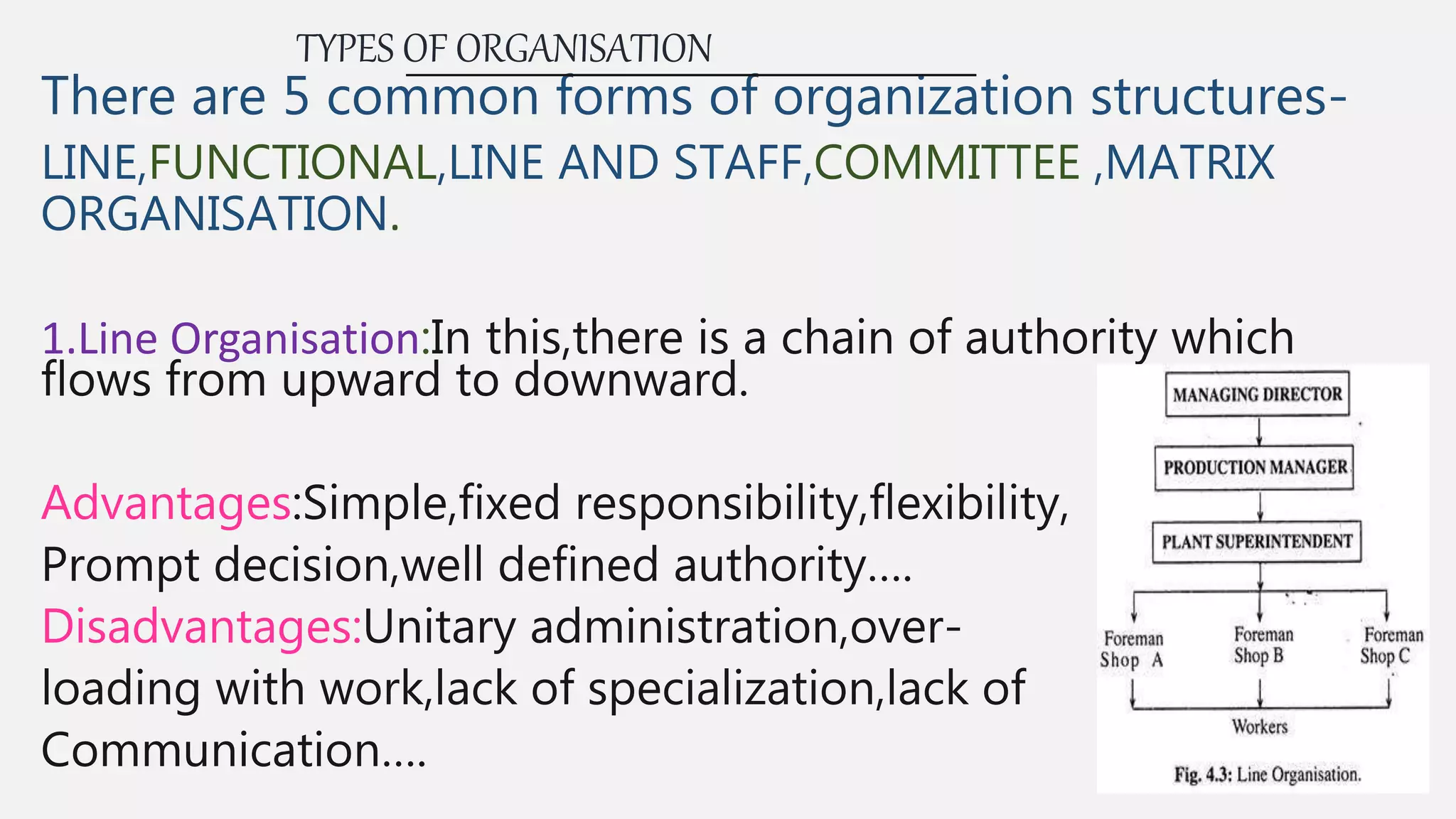
1.Line Organisation:In this,there is a chain of authority which
flows from upward to downward.
Advantages:Simple,fixed responsibility,flexibility,
Prompt decision,well defined authority….
Disadvantages:Unitary administration,over-
loading with work,lack of specialization,lack of
Communication….
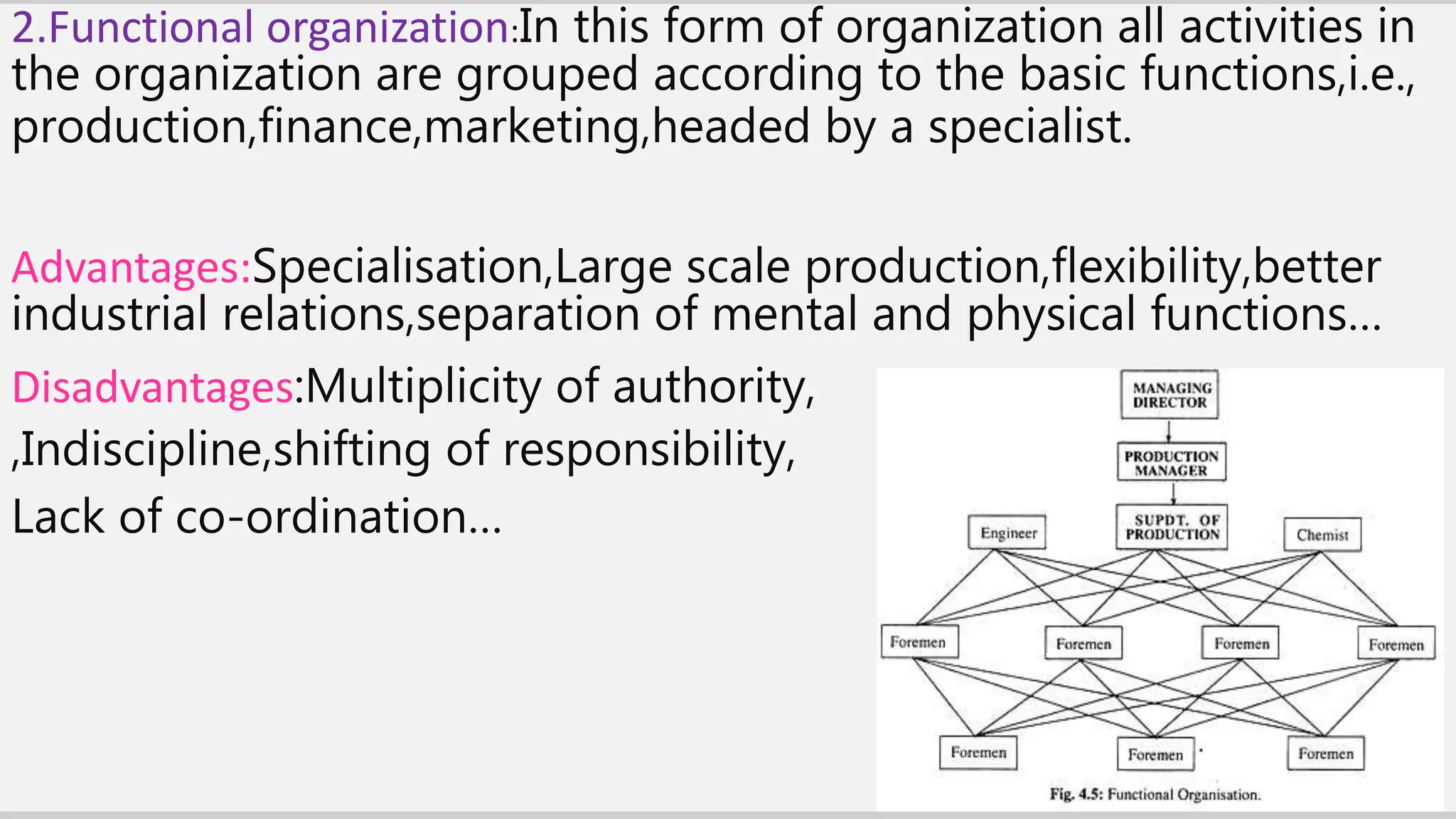
2.Functional organization:In this form of organization all activities in
the organization are grouped according to the basic functions,i.e.,
production,finance,marketing,headed by a specialist.
Advantages:Specialisation,Large scale production,flexibility,better
industrial relations,separation of mental and physical functions…
Disadvantages:Multiplicity of authority,
,Indiscipline,shifting of responsibility,
Lack of co-ordination…
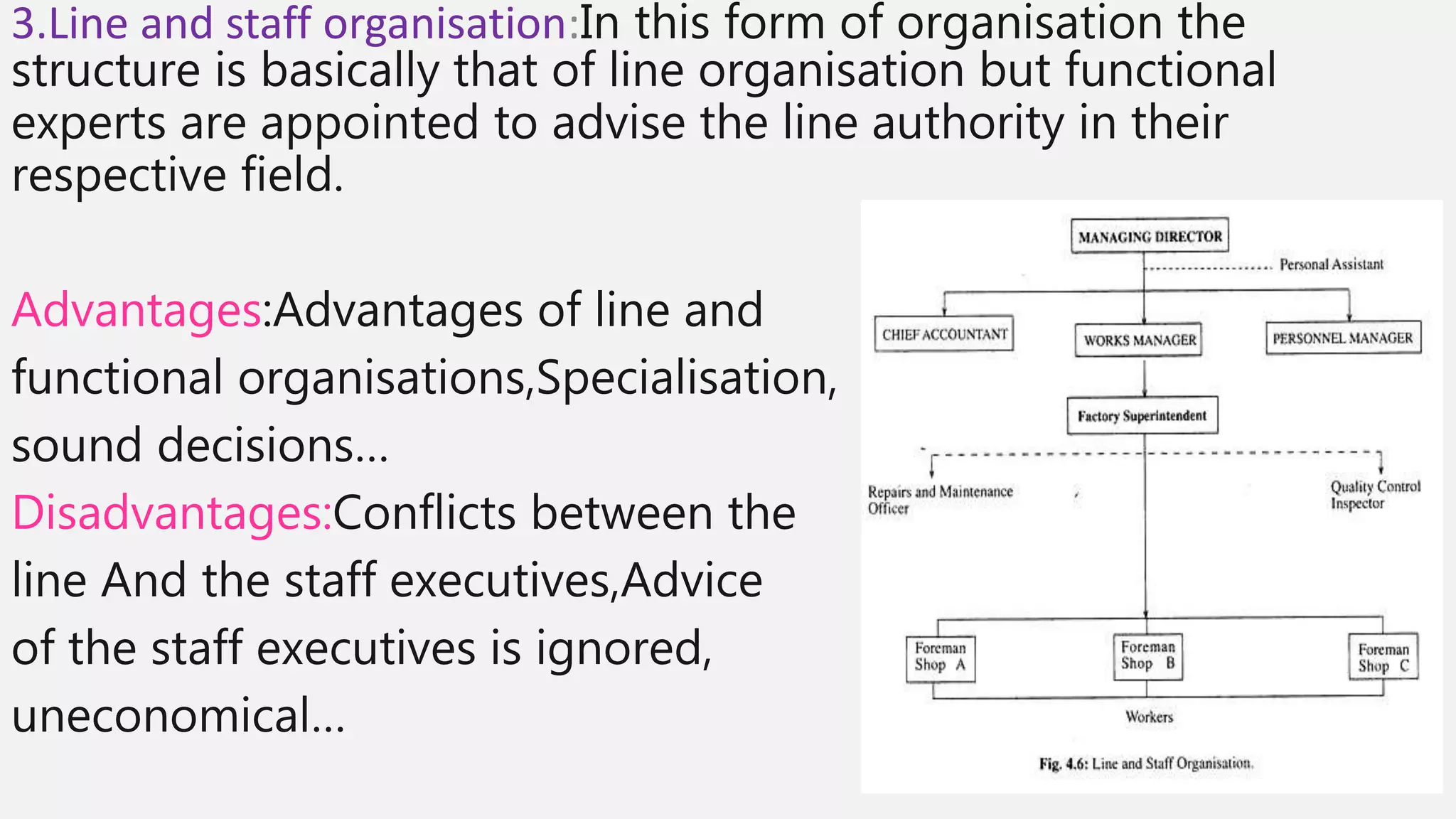
3.Line and staff organisation:In this form of organisation the
structure is basically that of line organisation but functional
experts are appointed to advise the line authority in their
respective field.
Advantages:Advantages of line and
functional organisations,Specialisation,
sound decisions…
Disadvantages:Conflicts between the
line And the staff executives,Advice
of the staff executives is ignored,
uneconomical…
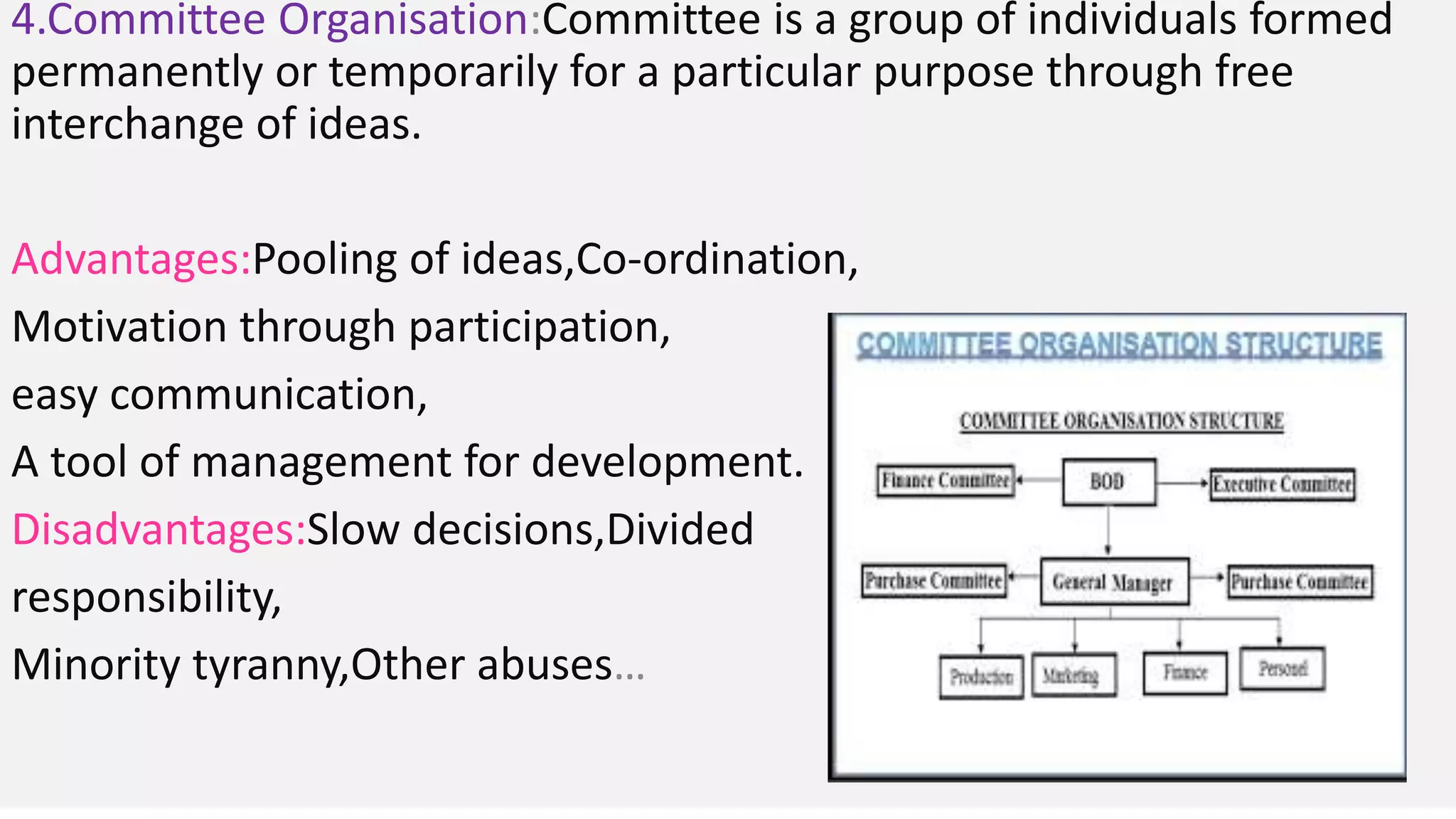
4.Committee Organisation:Committee is a group of individuals formed
permanently or temporarily for a particular purpose through free
interchange of ideas.
Advantages:Pooling of ideas,Co-ordination,
Motivation through participation,
easy communication,
A tool of management for development.
Disadvantages:Slow decisions,Divided
responsibility,
Minority tyranny,Other abuses…
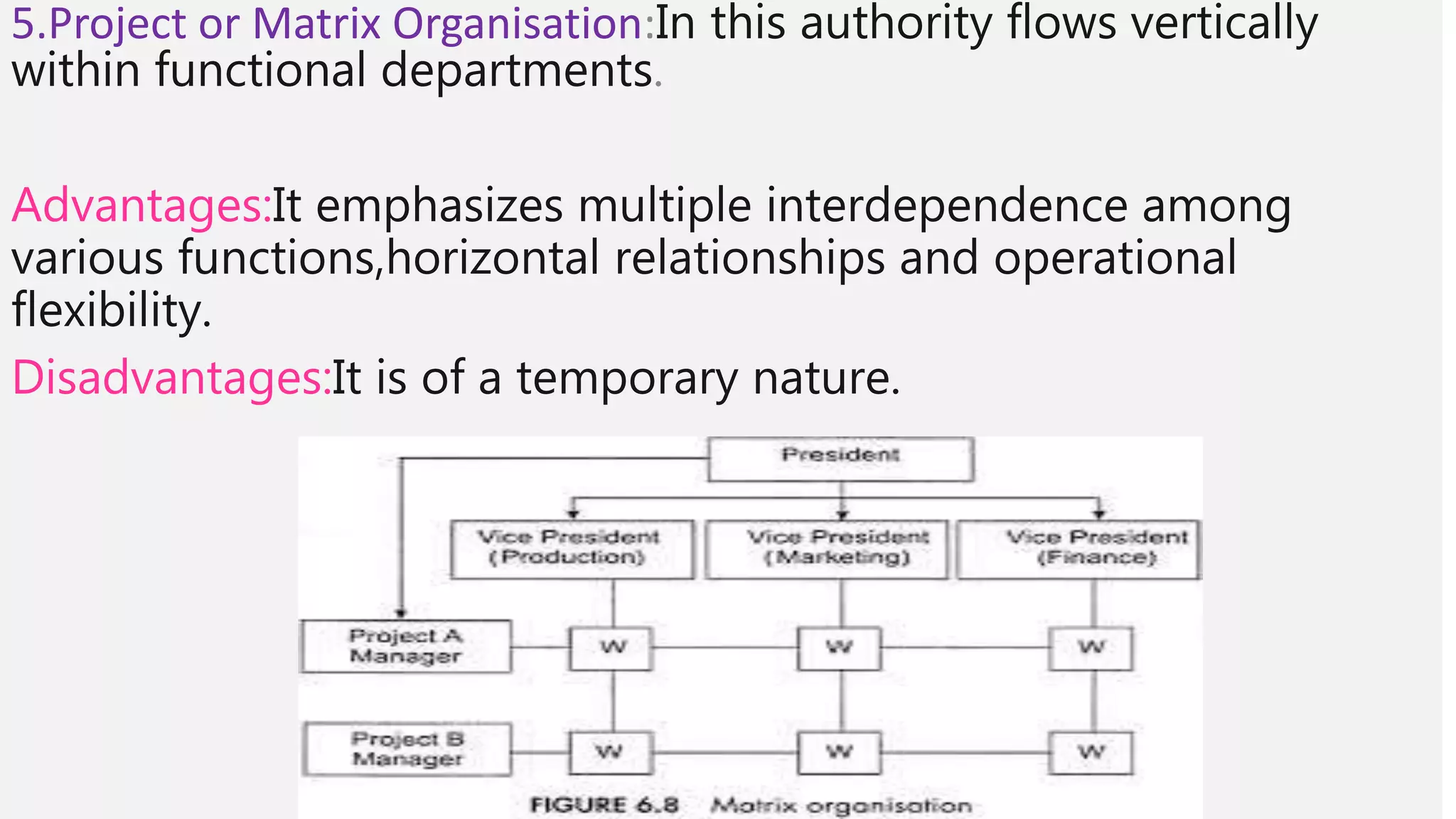
5.Project or Matrix Organisation:In this authority flows vertically
within functional departments.
Advantages:It emphasizes multiple interdependence among
various functions,horizontal relationships and operational
flexibility.
Disadvantages:It is of a temporary nature.
organisation chart
An organizational chart is a diagram that visually conveys a
company's internal structure by detailing the roles,
responsibilities, and relationships between individuals within
an entity. Organizational charts either broadly depict an
enterprise company-wide or drill down to a specific
department or unit.
Advantages:
• Useful for visitors to see the overall size of the business and
where people fit in.
• Useful for new employees to get an overall feel fot the
business.
Disadvantages:
• Information can soon be out of date i.e., people leave.
MODERN TRENDS IN ORGANISATIONAL STRUCTURE DESIGNS
 Virtual Organisation
 Cellular Organisation
 Team Organisation
 Boundaryless Organisation
 Inverted Pyramid
EMPOWERMENT
 Empowerment is the concept in management that if
employees are given information, resources, and opportunity
at the same time as being held responsible for their job
outcomes, then they will be more productive and have higher
job satisfaction.
 It improves the quality working life for ordinary employees and
it centres around “enabling,energizing,engaging,enthusing”.
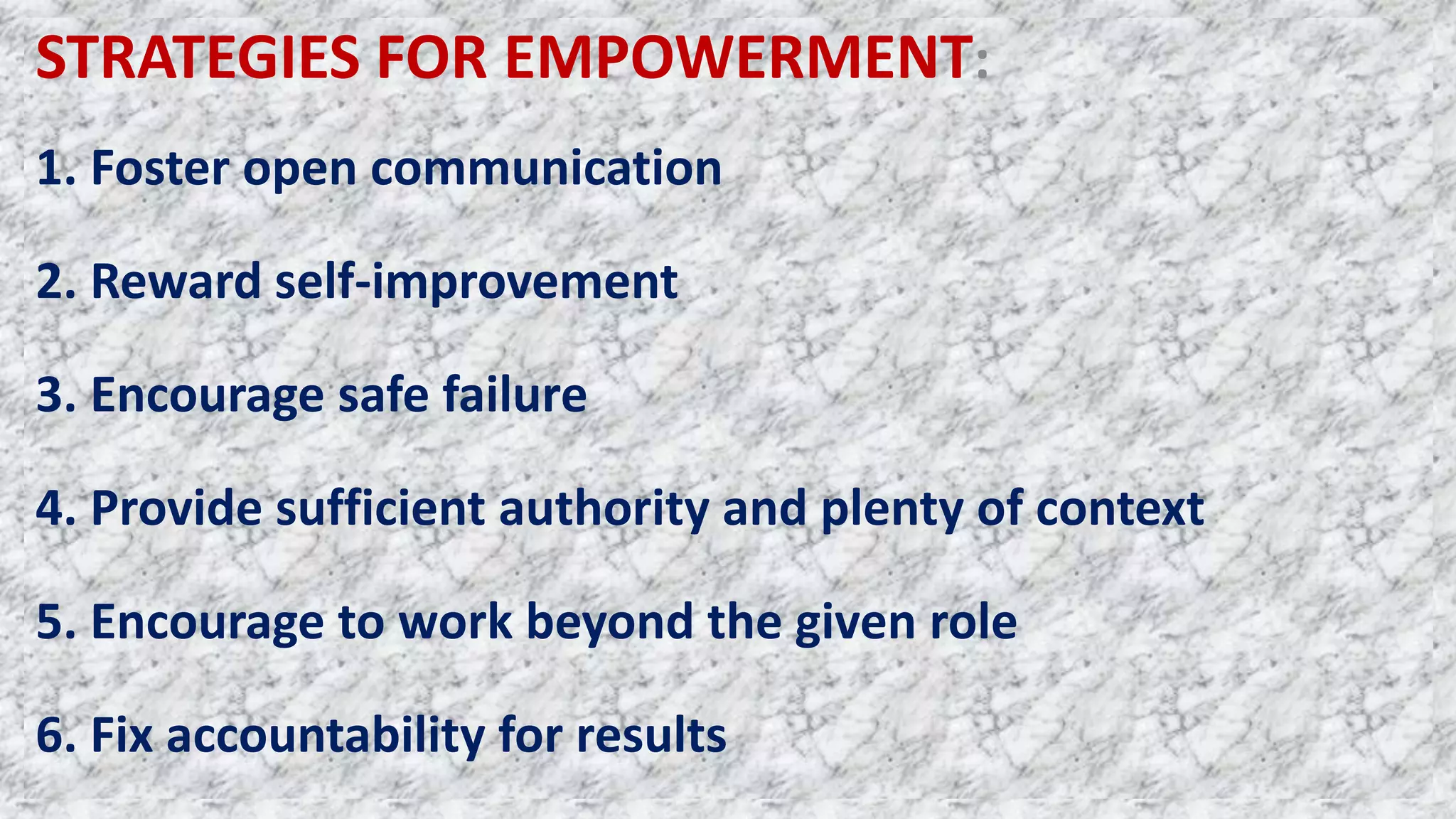
STRATEGIES FOR EMPOWERMENT:
1. Foster open communication
2. Reward self-improvement
3. Encourage safe failure
4. Provide sufficient authority and plenty of context
5. Encourage to work beyond the given role
6. Fix accountability for results
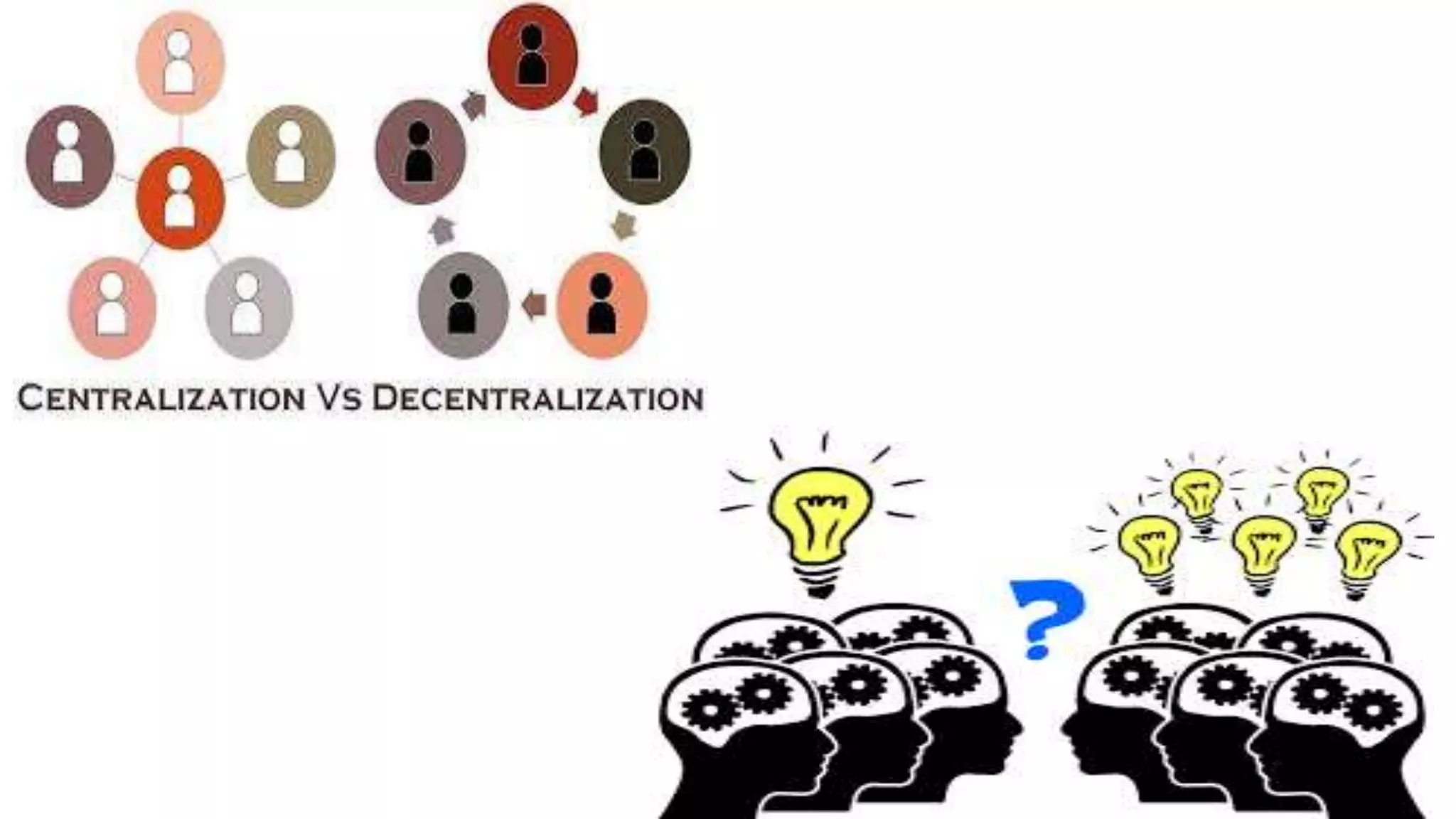
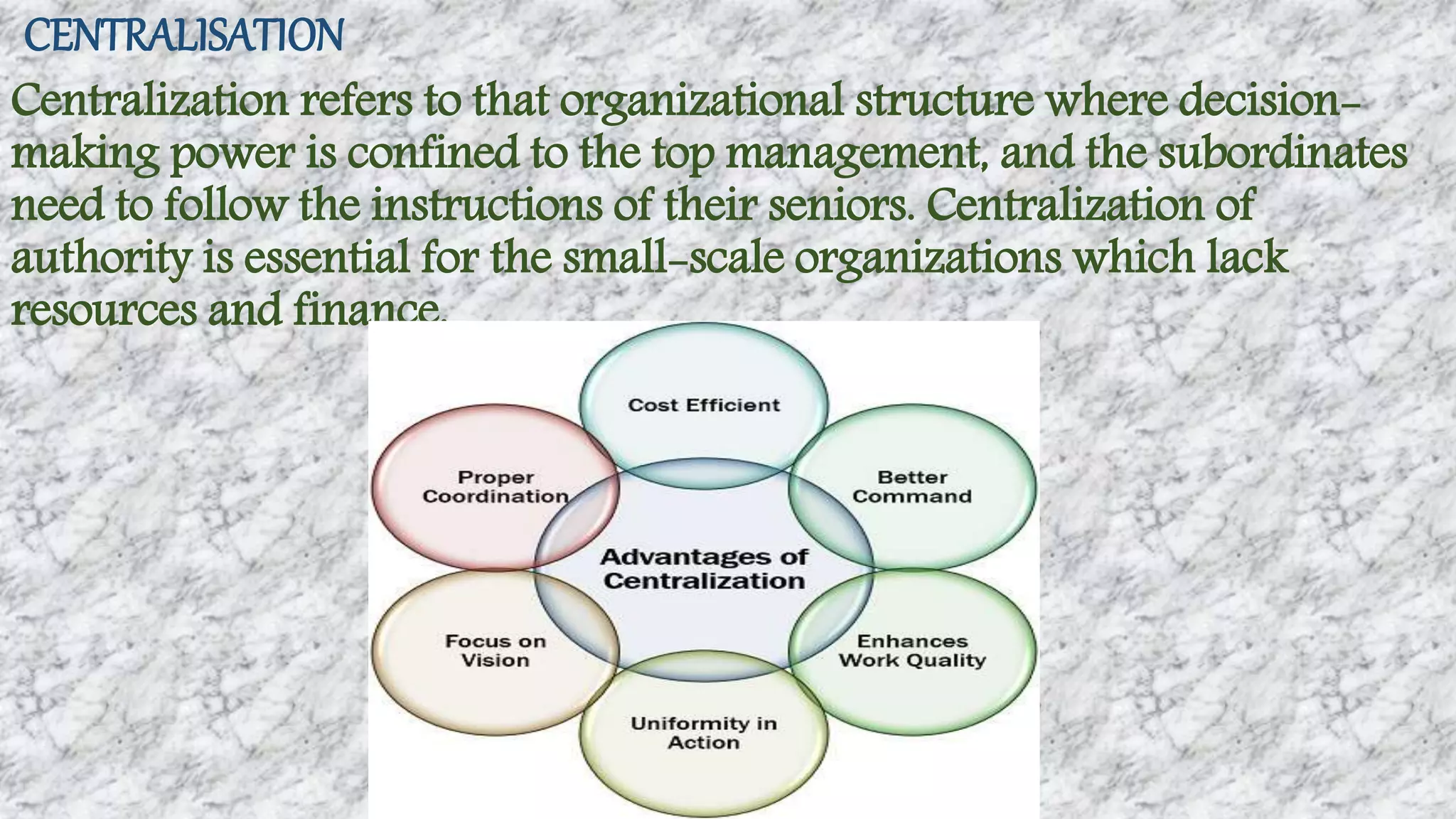
CENTRALISATION
Centralization refers to that organizational structure where decision-
making power is confined to the top management, and the subordinates
need to follow the instructions of their seniors. Centralization of
authority is essential for the small-scale organizations which lack
resources and finance.
DECENTRALISATION
The dissemination of authority, responsibility and accountability to the
various management levels, is known as Decentralization.
OR
The process of transferring and assigning decision-making authority to
lower levels of an organizational hierarchy.
Advantages:
• Reduces the burden on top executives
• Facilitates diversification
• To provide product and market emphasis
• Executive Development
• It promotes motivation
• Better control and supervision
• Quick Decision-Making.
REECENTRALISATION
It is a process of taking back the authority from the divisions or
departments where the purpose of decentralization is not
achieved.
Advantages:
• It offers scope for the managers to correct the situation instantly.
• It improves the confidence level of the stakeholders.
• It is a quick response tool to upload service quality.
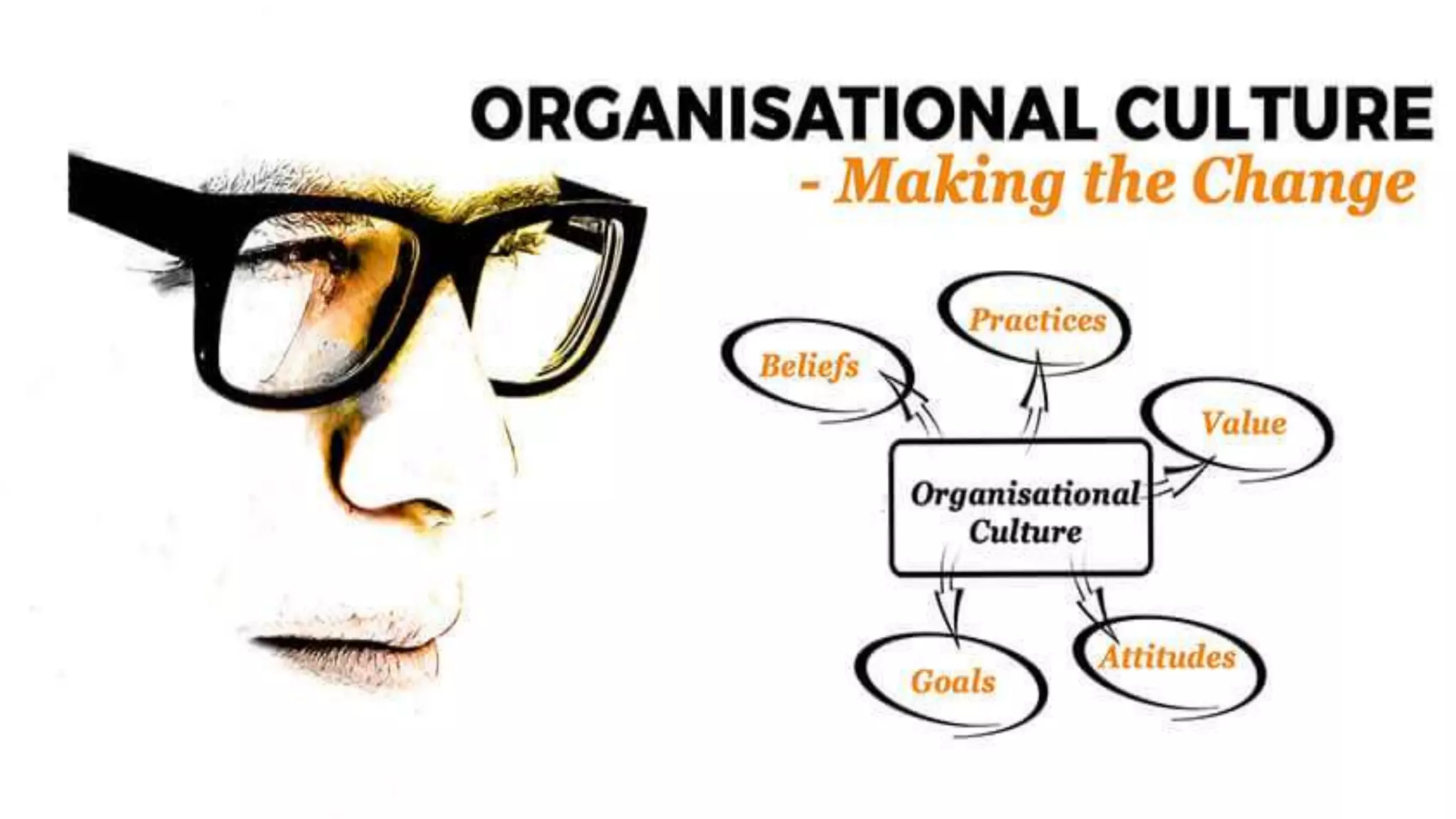
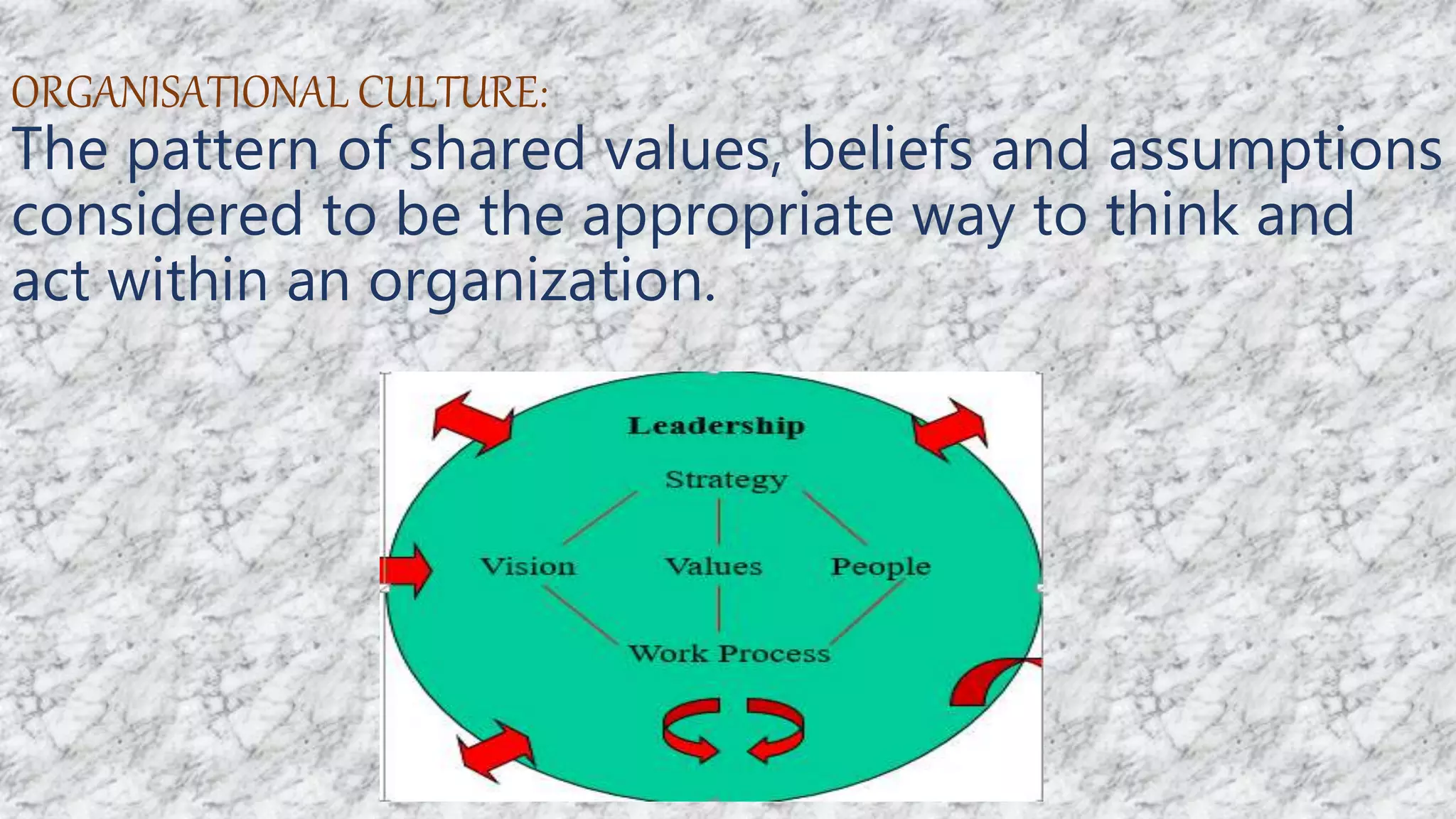
ORGANISATIONAL CULTURE:
The pattern of shared values, beliefs and assumptions
considered to be the appropriate way to think and
act within an organization.
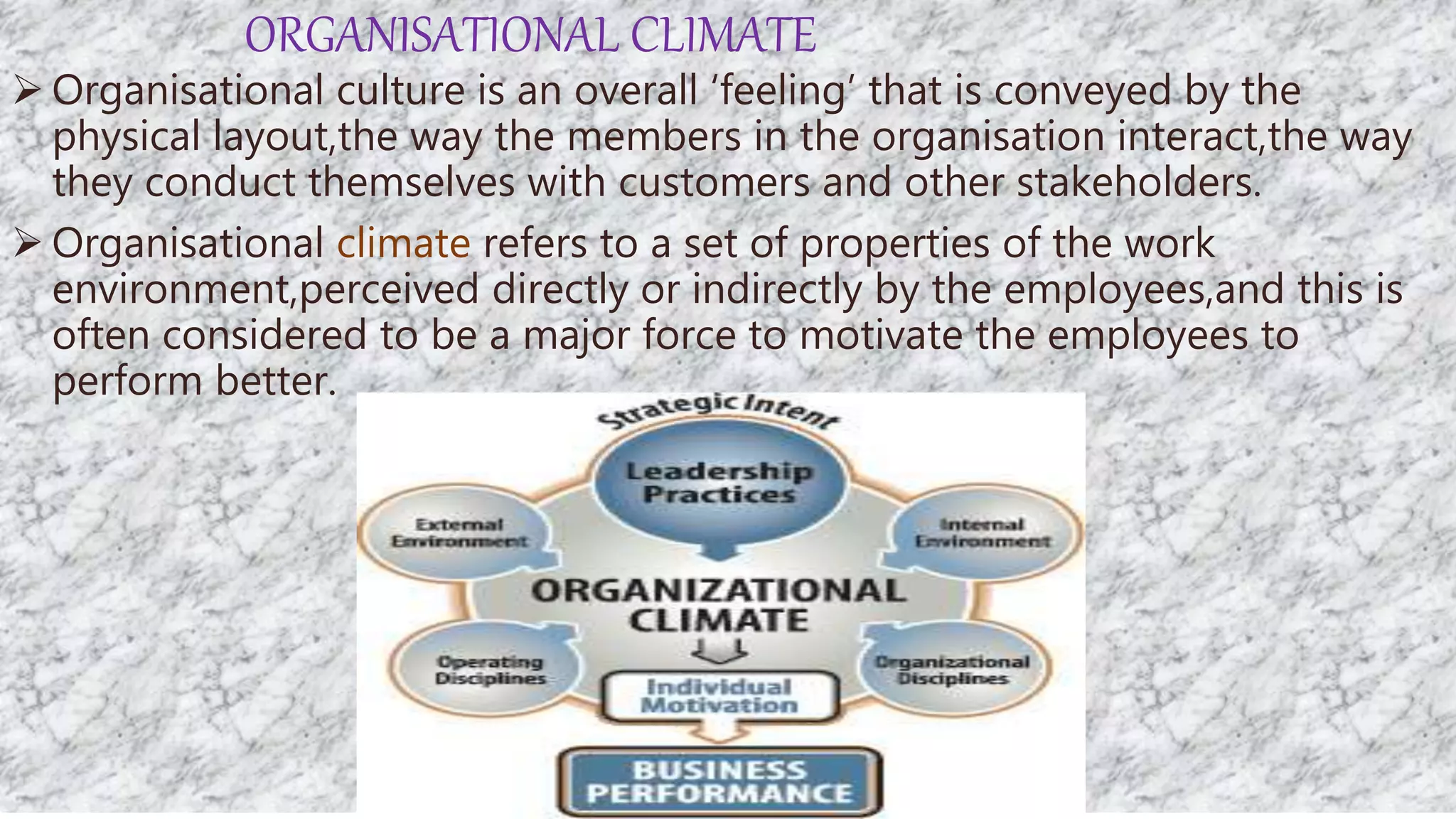
ORGANISATIONAL CLIMATE
 Organisational culture is an overall ‘feeling’ that is conveyed by the
physical layout,the way the members in the organisation interact,the way
they conduct themselves with customers and other stakeholders.
 Organisational climate refers to a set of properties of the work
environment,perceived directly or indirectly by the employees,and this is
often considered to be a major force to motivate the employees to
perform better.
TYPES OF ORGANISATIONAL CULTURE
1. Dominent culture and Sub culture
2. Strong culture and Weak culture
Dominent culture and Sub culture:
• Dominent culture is a set of core values that are shared by majority of
the organizational members.
• It is a macro view of organizational personality.
• Sub-culture refers to the set of values that are shared by the members
of a division or department.
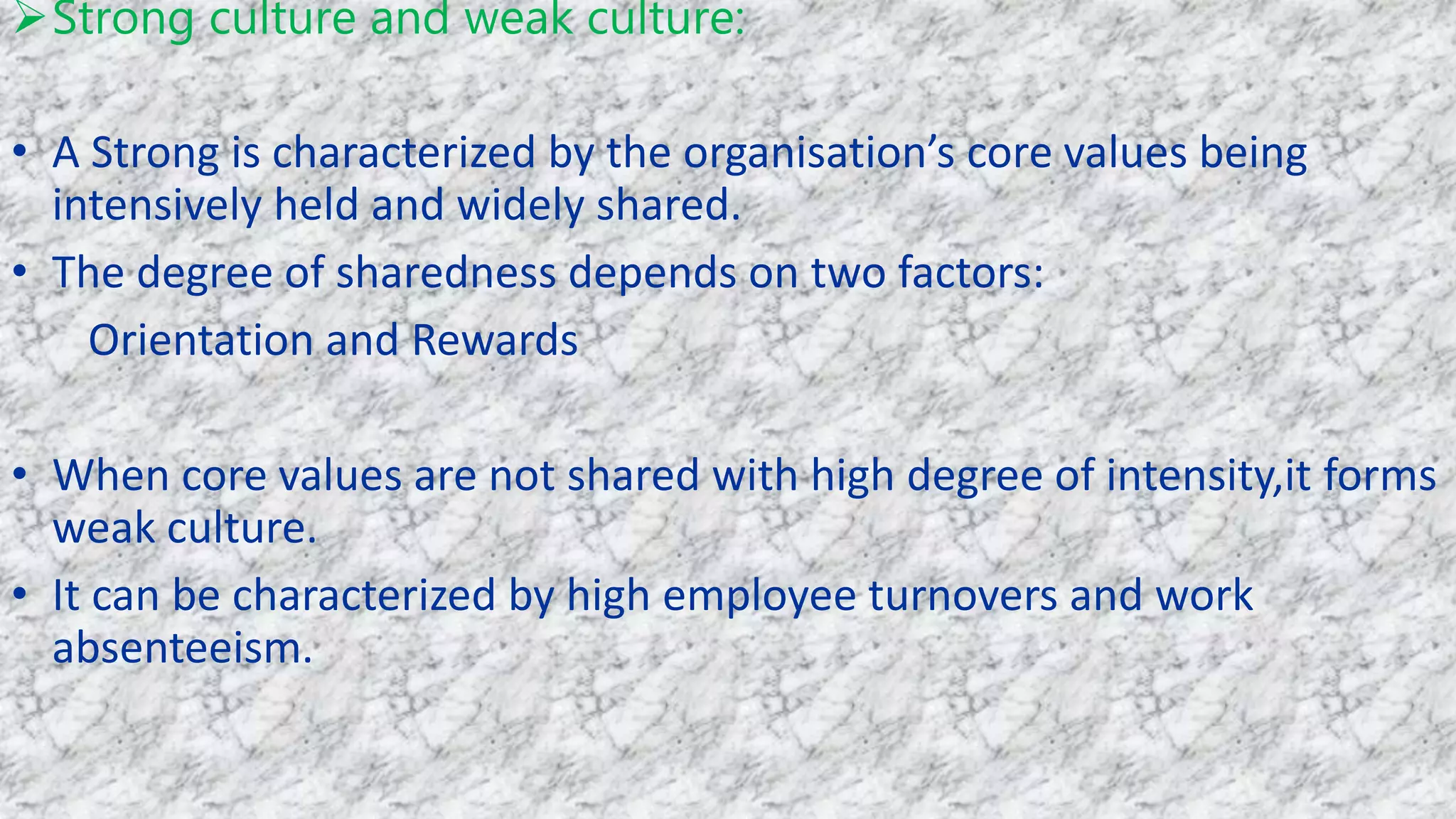
Strong culture and weak culture:
• A Strong is characterized by the organisation’s core values being
intensively held and widely shared.
• The degree of sharedness depends on two factors:
Orientation and Rewards
• When core values are not shared with high degree of intensity,it forms
weak culture.
• It can be characterized by high employee turnovers and work
absenteeism.
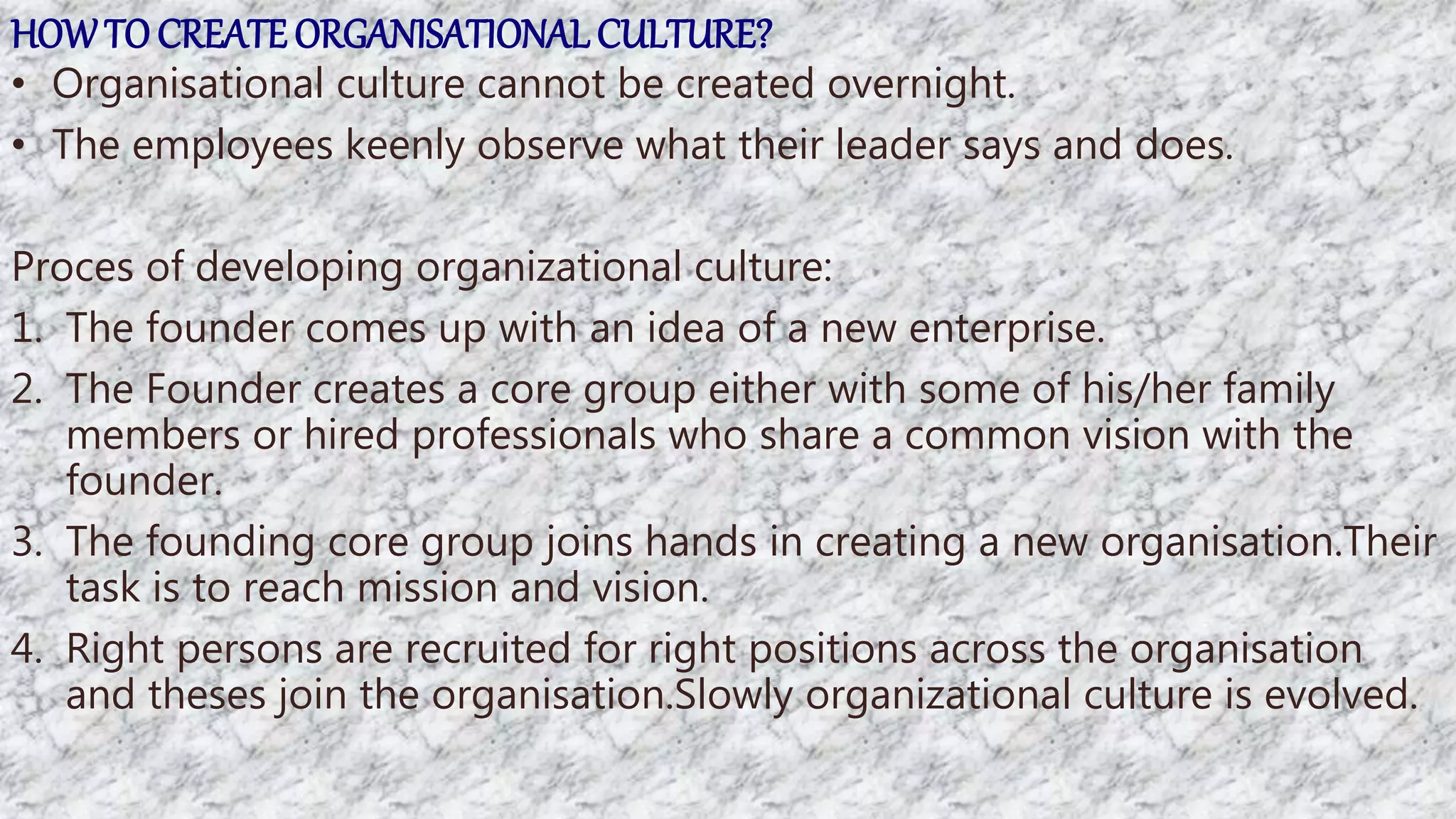
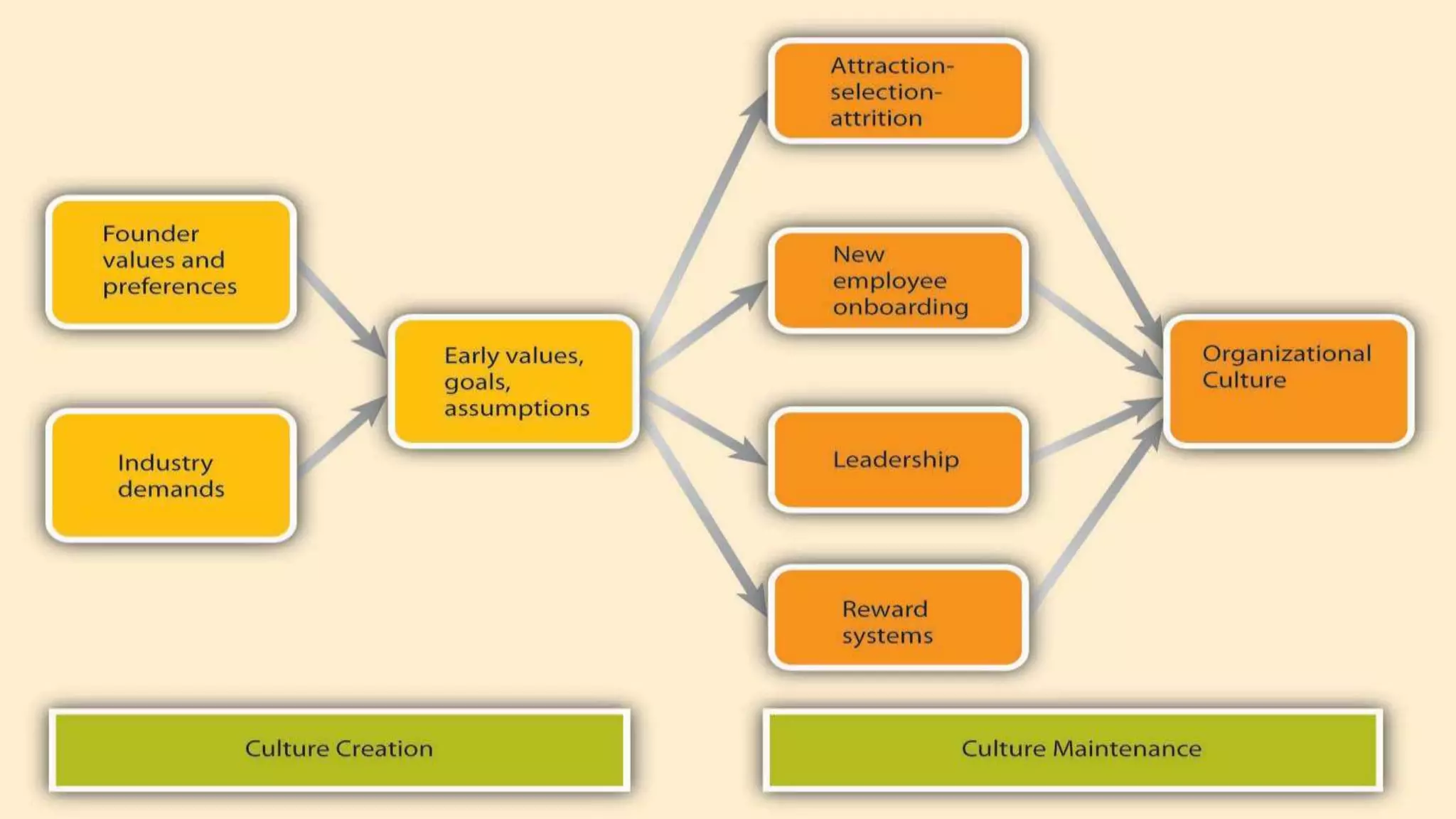
HOWTO CREATE ORGANISATIONALCULTURE?
• Organisational culture cannot be created overnight.
• The employees keenly observe what their leader says and does.
Proces of developing organizational culture:
1. The founder comes up with an idea of a new enterprise.
2. The Founder creates a core group either with some of his/her family
members or hired professionals who share a common vision with the
founder.
3. The founding core group joins hands in creating a new organisation.Their
task is to reach mission and vision.
4. Right persons are recruited for right positions across the organisation
and theses join the organisation.Slowly organizational culture is evolved.
MAINTAININGORGANISATIONALCULTURE
Maintaining organizational culture is an uphill task.Once Organisational
culture is initiated and begins to develop,there are several ways to get the
acceptance of core values to maintain the culture.
• Entry-level personnel need to be carefully identified and trained.
• Newcomers need to be carefully oriented to the organizational norms and
values.
• The performance of the executives is evaluated based on their orientation
to organiasational values and functional achievements.
• The managers share the stories and folklore to their team and groups that
validate organisatinsal culture and the way of doing things .
• Recognise and promote those with energy,aggressiveness and ability to
get things done through others.
CHAINGING ORGANISATIONAL CULTURE
o Organisational culture need not be the same all through the life
of an organisation.
o Organisational is a function of expections of customers,
employees,creditors.
o If technology changes,customers expect faster service and
organisations.Thus,culture need to be change.
o Organisational culture also undergo a huge change particularly
when business get merged,acquired or form into an alliance.
CHANGE OF MANAGEMENT
 Every good manager must be able to anticipate predictable changes.
Apart from that, he should also be able to smoothly incorporate these
changes into the organization. This is basically the entire aim of
change management.
 Change is always inevitable; one can never completely prevent it.
Managers can either wait for changes to occur or they can anticipate
them and act in advance. A good manager will always do the latter.
 This process generally requires a thorough understanding of factors
that affect changes. This is because external and internal factors are
solely responsible for effecting changes.
TYPES OF MANAGEMENT CHANGES
• Structural change
• Strategic change
• Product-oriented change
• Process-oriented change
• Radical change
• Planned change
• Unplanned change
• Emergent change
• Organisation wide vs. sub-system change
• Transformal vs. incremental change
MODELS OF CHANGE MANAGEMENT
 Kotter’s Model of Leading Change
• Establish a sense of urgency
• Create the guiding coalition
• Develop a change vision and strategy
• Communicate the change vision
• Empower employees for broad-based action
• Generate short-term wins
• Consolidate gains and produce more changes
• Anchor new approaches in the culture
 ADKAR Model of Change Management(Awareness,Desire,Knowledge,Ability
and Reinforcement)
 Kurt Lewin’s Model of Unfreeze,Change and Refreeze
RESISTANCE TO CHANGE
 Change is always beneficial and difficult to implement.
 It is important for Change to occur continually,For adjusting dynamic
forces.
 Resistance to change will be on two main reasons:
1.Social change
2.Chnage in human relationship with technical change.
OVER VIEW OF ORGANISATION AND ITS STRUCTURES

OVER VIEW OF ORGANISATION AND ITS STRUCTURES

  • 1.
    ORGANISATIONPrepared by B.Pradyumna(CSE) Guidance by T.Kiran (AssistantProfessor) MALLAREDDY INSTITUTE OF ENGINEETING AND TECHNOLOGY
  • 2.
    What is Organisation..? Organisationis a process of bringing and uniting people to achieve the objectives of the organisation. It also implies the grouping of the staff to achieve the common objectives.
  • 3.
    Organisation differs fromorganizing… Organising is a function of management where as Organisation refers to an establishment where the functions of manangement are performed.  Organising is a process of:  -> Determining,grouping,and structuring the activities  ->Creating roles for effective performance at work  ->Allocating necessary authority and responsibility for results  ->Determining detailed procedures and systems for different problem areas such as coordination,decision making,motivation…etc.
  • 4.
    Organisation may beFormal,Informal or both. Informal Organisation strengthens the functions of a Formal Organisation.
  • 5.
    Formal organisation • FormalOrganisation refers to the well defined jobs in a formal organised enterprise.These jobs are defined in terms of authority,responsibility and accountability
  • 6.
    INFORMAL ORGANISATION The Networkon social groups based on friendship is called as Informal Organisation. Here,human beings wish to share their feelings and emotions.
  • 7.
  • 8.
    BASIS FORMAL ORGANISATIONINFORMAL ORGANISATION FORMATION Formal relations are well defined and are created deliberately. Originates as a result of social interaction. PURPOSE It is created to achieve predetermined objectives. It will satisfy social and cultural needs. STRUCTURE Structure of well defined authority and responsibility relationships. Structure based on human emotions and sentiments BEHAVIOR OF MEMBERS It has prescribed pattern of behavior of members. Social norms are developed through mutual consent of members COMMUNICATION Formal communication through official lines. Informal communication based on convenience. LEADERSHIP Managers are in superior position Leaders are choosen by group members STABILITY It is usually stable and continues even if members leave it. It is short and disintegrate if members leave it. FLEXIBILITY It follows a rigid structure. It is loosely structured and highly flexible. ADHERENCE TO RULES Strict adherence to rules. No formal rules exist. INTERDEPENDENCE It exists independently. It is dependable to formal organization.
  • 9.
    RELATIONSHIP BETWEEN MANAGEMENT ANDORGANISATION How are these two related? • Organisations need management in making their organizational structures • Determine how different aspects of the organization will interact • Link of management and organization is the most important role in productivity and success of an organization.
  • 10.
    In building anOrganisation:  Managers design an organization structure and architecture for the system of production.  Different levels of management will participate in different componenets of this design process.  Upper management creating the initial organizational architecture and structure. Employees/Workforce:  Make up most of the organization.  One of the most important part of an organization  Good management offers a bridge by connecting each and every corner.  Following and executing decisions/plans.  Managers are the drivers,they are the engine. BOTH ARE INCOMPLETE WITHOUT EACHOTHER.
  • 11.
    Basic concepts oforganization  Organisational Hierarchy: The Hierarchy in a business refers to the layers of management from the top management or supervisors of the lowest rank.
  • 12.
    Authority and Responsibility: Authorityis the power to give command and to use discretion vested in the particular position or job.
  • 13.
     Deligation ofAuthority: The process of transferring authority from top to the lower levels in the organization is called delegation.
  • 14.
     Span ofmanagement: It is also called as span of control.It refers to the number of subordinates that can be effectively controlled by the manager at a given point of time.  Flat and Tall Organisations: Tall and flat organizational structures refer to the structures of an organization’s levels of management. A tall organization, or vertical organization, is one in which the CEO/Director sits at the top of the chain of command, with various levels of management underneath. A flat organization, or horizontal organization, involves fewer levels of management and more employee autonomy in the decision-making process.
  • 16.
    PRINCIPLES OF ORGANISATION Align departmental objectives to corporate goals  Cost-effective operations  Optimum number of subordinates  Specialisation  Define Authority  Flow of authority  Manage via exceptional cases
  • 17.
     Ensure oneemployee,one superior  One head and one plan  Define responsibility  Commensurate authority and responsibility  Attain balance  Ensure Flexibility  Provide for continuity
  • 18.
    TYPES OF ORGANISATION Thereare 5 common forms of organization structures- LINE,FUNCTIONAL,LINE AND STAFF,COMMITTEE ,MATRIX ORGANISATION. 1.Line Organisation:In this,there is a chain of authority which flows from upward to downward. Advantages:Simple,fixed responsibility,flexibility, Prompt decision,well defined authority…. Disadvantages:Unitary administration,over- loading with work,lack of specialization,lack of Communication….
  • 19.
    2.Functional organization:In thisform of organization all activities in the organization are grouped according to the basic functions,i.e., production,finance,marketing,headed by a specialist. Advantages:Specialisation,Large scale production,flexibility,better industrial relations,separation of mental and physical functions… Disadvantages:Multiplicity of authority, ,Indiscipline,shifting of responsibility, Lack of co-ordination…
  • 20.
    3.Line and stafforganisation:In this form of organisation the structure is basically that of line organisation but functional experts are appointed to advise the line authority in their respective field. Advantages:Advantages of line and functional organisations,Specialisation, sound decisions… Disadvantages:Conflicts between the line And the staff executives,Advice of the staff executives is ignored, uneconomical…
  • 21.
    4.Committee Organisation:Committee isa group of individuals formed permanently or temporarily for a particular purpose through free interchange of ideas. Advantages:Pooling of ideas,Co-ordination, Motivation through participation, easy communication, A tool of management for development. Disadvantages:Slow decisions,Divided responsibility, Minority tyranny,Other abuses…
  • 22.
    5.Project or MatrixOrganisation:In this authority flows vertically within functional departments. Advantages:It emphasizes multiple interdependence among various functions,horizontal relationships and operational flexibility. Disadvantages:It is of a temporary nature.
  • 23.
    organisation chart An organizationalchart is a diagram that visually conveys a company's internal structure by detailing the roles, responsibilities, and relationships between individuals within an entity. Organizational charts either broadly depict an enterprise company-wide or drill down to a specific department or unit. Advantages: • Useful for visitors to see the overall size of the business and where people fit in. • Useful for new employees to get an overall feel fot the business. Disadvantages: • Information can soon be out of date i.e., people leave.
  • 24.
    MODERN TRENDS INORGANISATIONAL STRUCTURE DESIGNS  Virtual Organisation  Cellular Organisation  Team Organisation  Boundaryless Organisation  Inverted Pyramid
  • 25.
    EMPOWERMENT  Empowerment isthe concept in management that if employees are given information, resources, and opportunity at the same time as being held responsible for their job outcomes, then they will be more productive and have higher job satisfaction.  It improves the quality working life for ordinary employees and it centres around “enabling,energizing,engaging,enthusing”.
  • 26.
    STRATEGIES FOR EMPOWERMENT: 1.Foster open communication 2. Reward self-improvement 3. Encourage safe failure 4. Provide sufficient authority and plenty of context 5. Encourage to work beyond the given role 6. Fix accountability for results
  • 28.
    CENTRALISATION Centralization refers tothat organizational structure where decision- making power is confined to the top management, and the subordinates need to follow the instructions of their seniors. Centralization of authority is essential for the small-scale organizations which lack resources and finance.
  • 29.
    DECENTRALISATION The dissemination ofauthority, responsibility and accountability to the various management levels, is known as Decentralization. OR The process of transferring and assigning decision-making authority to lower levels of an organizational hierarchy. Advantages: • Reduces the burden on top executives • Facilitates diversification • To provide product and market emphasis • Executive Development • It promotes motivation • Better control and supervision • Quick Decision-Making.
  • 30.
    REECENTRALISATION It is aprocess of taking back the authority from the divisions or departments where the purpose of decentralization is not achieved. Advantages: • It offers scope for the managers to correct the situation instantly. • It improves the confidence level of the stakeholders. • It is a quick response tool to upload service quality.
  • 33.
    ORGANISATIONAL CULTURE: The patternof shared values, beliefs and assumptions considered to be the appropriate way to think and act within an organization.
  • 34.
    ORGANISATIONAL CLIMATE  Organisationalculture is an overall ‘feeling’ that is conveyed by the physical layout,the way the members in the organisation interact,the way they conduct themselves with customers and other stakeholders.  Organisational climate refers to a set of properties of the work environment,perceived directly or indirectly by the employees,and this is often considered to be a major force to motivate the employees to perform better.
  • 35.
    TYPES OF ORGANISATIONALCULTURE 1. Dominent culture and Sub culture 2. Strong culture and Weak culture Dominent culture and Sub culture: • Dominent culture is a set of core values that are shared by majority of the organizational members. • It is a macro view of organizational personality. • Sub-culture refers to the set of values that are shared by the members of a division or department.
  • 36.
    Strong culture andweak culture: • A Strong is characterized by the organisation’s core values being intensively held and widely shared. • The degree of sharedness depends on two factors: Orientation and Rewards • When core values are not shared with high degree of intensity,it forms weak culture. • It can be characterized by high employee turnovers and work absenteeism.
  • 37.
    HOWTO CREATE ORGANISATIONALCULTURE? •Organisational culture cannot be created overnight. • The employees keenly observe what their leader says and does. Proces of developing organizational culture: 1. The founder comes up with an idea of a new enterprise. 2. The Founder creates a core group either with some of his/her family members or hired professionals who share a common vision with the founder. 3. The founding core group joins hands in creating a new organisation.Their task is to reach mission and vision. 4. Right persons are recruited for right positions across the organisation and theses join the organisation.Slowly organizational culture is evolved.
  • 38.
    MAINTAININGORGANISATIONALCULTURE Maintaining organizational cultureis an uphill task.Once Organisational culture is initiated and begins to develop,there are several ways to get the acceptance of core values to maintain the culture. • Entry-level personnel need to be carefully identified and trained. • Newcomers need to be carefully oriented to the organizational norms and values. • The performance of the executives is evaluated based on their orientation to organiasational values and functional achievements. • The managers share the stories and folklore to their team and groups that validate organisatinsal culture and the way of doing things . • Recognise and promote those with energy,aggressiveness and ability to get things done through others.
  • 41.
    CHAINGING ORGANISATIONAL CULTURE oOrganisational culture need not be the same all through the life of an organisation. o Organisational is a function of expections of customers, employees,creditors. o If technology changes,customers expect faster service and organisations.Thus,culture need to be change. o Organisational culture also undergo a huge change particularly when business get merged,acquired or form into an alliance.
  • 42.
    CHANGE OF MANAGEMENT Every good manager must be able to anticipate predictable changes. Apart from that, he should also be able to smoothly incorporate these changes into the organization. This is basically the entire aim of change management.  Change is always inevitable; one can never completely prevent it. Managers can either wait for changes to occur or they can anticipate them and act in advance. A good manager will always do the latter.  This process generally requires a thorough understanding of factors that affect changes. This is because external and internal factors are solely responsible for effecting changes.
  • 43.
    TYPES OF MANAGEMENTCHANGES • Structural change • Strategic change • Product-oriented change • Process-oriented change • Radical change • Planned change • Unplanned change • Emergent change • Organisation wide vs. sub-system change • Transformal vs. incremental change
  • 44.
    MODELS OF CHANGEMANAGEMENT  Kotter’s Model of Leading Change • Establish a sense of urgency • Create the guiding coalition • Develop a change vision and strategy • Communicate the change vision • Empower employees for broad-based action • Generate short-term wins • Consolidate gains and produce more changes • Anchor new approaches in the culture  ADKAR Model of Change Management(Awareness,Desire,Knowledge,Ability and Reinforcement)  Kurt Lewin’s Model of Unfreeze,Change and Refreeze
  • 45.
    RESISTANCE TO CHANGE Change is always beneficial and difficult to implement.  It is important for Change to occur continually,For adjusting dynamic forces.  Resistance to change will be on two main reasons: 1.Social change 2.Chnage in human relationship with technical change.