UNIT 2 :ORGANISING
Nature and purpose
Formal and informal organization
organization chart
organization structure & Types
Line and staff authority
Departmentalization
Delegation of authority
Centralization and
Decentralization
Session 2024-25
3.
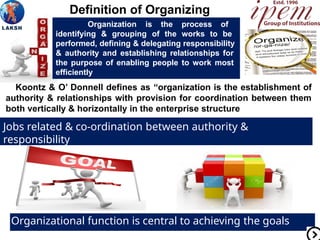
Organizational function iscentral to achieving the goals
Jobs related & co-ordination between authority &
responsibility
Definition of Organizing
Organization is the process of
identifying & grouping of the works to be
performed, defining & delegating responsibility
& authority and establishing relationships for
the purpose of enabling people to work most
efficiently
Koontz & O’ Donnell defines as “organization is the establishment of
authority & relationships with provision for coordination between them
both vertically & horizontally in the enterprise structure
4.
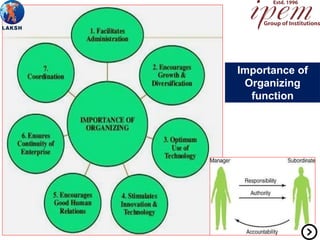
Importance of Organizingfunction
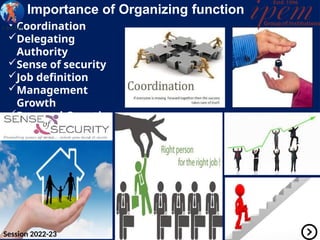
Coordination
Delegating
Authority
Sense of security
Job definition
Management
Growth
Personal Growth
Session 2022-23
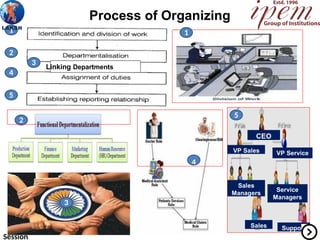
Process of Organizing
LinkingDepartments
1
1
2
3
4
5
2
3
4
5
CEO
VP Sales VP Service
Sales
Managers
Service
Managers
Sales Support
Session
7.
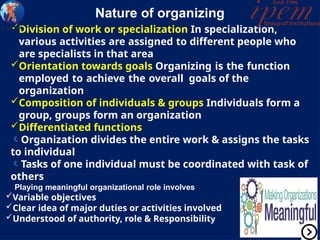
Nature of organizing
Divisionof work or specialization In specialization,
various activities are assigned to different people who
are specialists in that area
Orientation towards goals Organizing is the function
employed to achieve the overall goals of the
organization
Composition of individuals & groups Individuals form a
group, groups form an organization
Differentiated functions
Organization divides the entire work & assigns the tasks
to individual
Tasks of one individual must be coordinated with task of
others
Playing meaningful organizational role involves
Variable objectives
Clear idea of major duties or activities involved
Understood of authority, role & Responsibility
8.
Purpose of organizing
Helpsto achieve organizational goal
Organization focuses attention of individual
objectives towards overall objectives
Optimum use of resources
Make best use of resources such as Men, Material ,
Money . Machine , Method & Market, It is necessary to design
an organization properly. Should be given right person for
right job
To perform managerial function
Planning, staffing, Directing & controlling cannot be
implemented without proper organization
Facilitates growth & diversification
A good organization are essential for expanding
business activity & essential for product diversification such
as establishing a new product line
Human treatment of employees
Organization has adapted the modern concept of
system approach based on human relations
9.
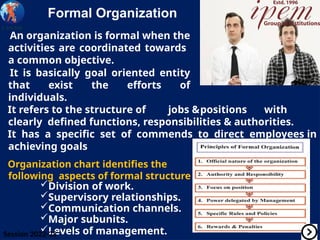
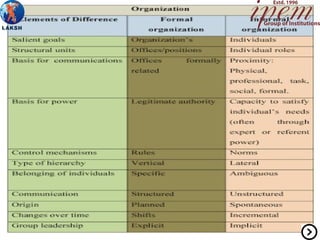
Formal Organization
An organizationis formal when the
activities are coordinated towards
a common objective.
It is basically goal oriented entity
that exist the efforts of
individuals.
It refers to the structure of jobs &positions with
clearly defined functions, responsibilities & authorities.
It has a specific set of commends to direct employees in
achieving goals
Organization chart identifies the
following aspects of formal structure
Division of work.
Supervisory relationships.
Communication channels.
Major subunits.
Levels of management.
Session 2022-23
10.
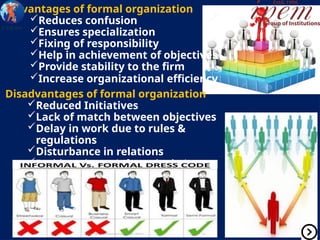
Advantages of formalorganization
Reduces confusion
Ensures specialization
Fixing of responsibility
Help in achievement of objectives
Provide stability to the firm
Increase organizational efficiency
Disadvantages of formal organization
Reduced Initiatives
Lack of match between objectives
Delay in work due to rules &
regulations
Disturbance in relations
Problem due to informal relations
11.
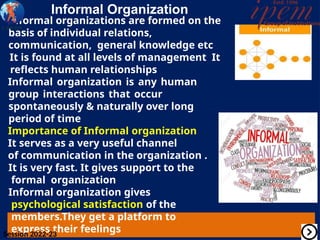
Informal Organization
Informal organizationsare formed on the
basis of individual relations,
communication, general knowledge etc
It is found at all levels of management It
reflects human relationships
Informal organization is any human
group interactions that occur
spontaneously & naturally over long
period of time
Importance of Informal organization
It serves as a very useful channel
of communication in the organization .
It is very fast. It gives support to the
formal organization
Informal organization gives
psychological satisfaction of the
members.They get a platform to
express their feelings
Session 2022-23
12.
Advantages of informalorganization
Cooperation
Sense of Belonging ness (Stress free)
Fast communication
Aid (Help or assist ) on the job
Disadvantages of informal organization
Resistance to change (sometimes management
are not
accepted )
Clash (fight) in interest
It is very much affected by the rumors
Disturbance in relations
Problem due to informal relations
14.
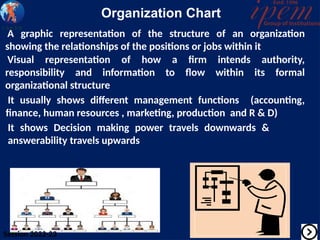
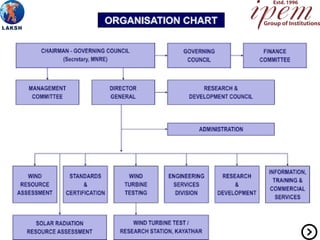
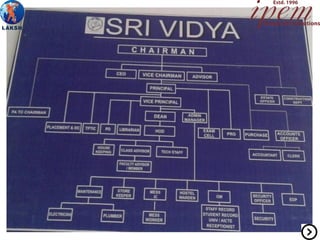
Organization Chart
A graphicrepresentation of the structure of an organization
showing the relationships of the positions or jobs within it
Visual representation of how a firm intends authority,
responsibility and information to flow within its formal
organizational structure
It usually shows different management functions (accounting,
finance, human resources , marketing, production and R & D)
It shows Decision making power travels downwards &
answerability travels upwards
Session 2022-23
17.
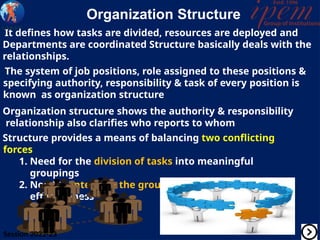
Organization Structure
It defineshow tasks are divided, resources are deployed and
Departments are coordinated Structure basically deals with the
relationships.
The system of job positions, role assigned to these positions &
specifying authority, responsibility & task of every position is
known as organization structure
Organization structure shows the authority & responsibility
relationship also clarifies who reports to whom
Structure provides a means of balancing two conflicting
forces
1. Need for the division of tasks into meaningful
groupings
2. Need to integrate the groupings for efficiency &
effectiveness
Session 2022-23
18.
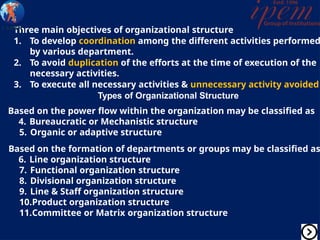
Three main objectivesof organizational structure
1. To develop coordination among the different activities performed
by various department.
2. To avoid duplication of the efforts at the time of execution of the
necessary activities.
3. To execute all necessary activities & unnecessary activity avoided
Types of Organizational Structure
Based on the power flow within the organization may be classified as
4. Bureaucratic or Mechanistic structure
5. Organic or adaptive structure
Based on the formation of departments or groups may be classified as
6. Line organization structure
7. Functional organization structure
8. Divisional organization structure
9. Line & Staff organization structure
10.Product organization structure
11.Committee or Matrix organization structure
19.
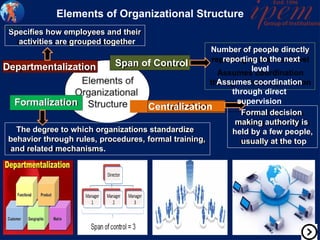
Elements of OrganizationalStructure
Span of Control
Departmentalization
Centralization
Formalization
Formal decision
making authority is
held by a few people,
usually at the top
Number of people directly
reporting to the next
level
Assumes coordination
through direct
supervision
The degree to which organizations standardize
behavior through rules, procedures, formal training,
and related mechanisms.
Specifies how employees and their
activities are grouped together
20.
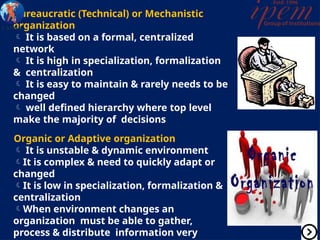
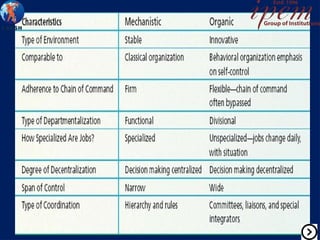
Bureaucratic (Technical) orMechanistic
organization
It is based on a formal, centralized
network
It is high in specialization, formalization
& centralization
It is easy to maintain & rarely needs to be
changed
well defined hierarchy where top level
make the majority of decisions
Organic or Adaptive organization
It is unstable & dynamic environment
It is complex & need to quickly adapt or
changed
It is low in specialization, formalization &
centralization
When environment changes an
organization must be able to gather,
process & distribute information very
22.
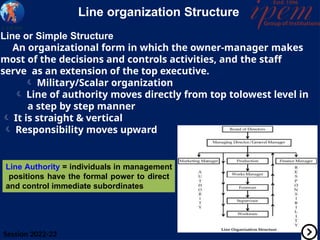
Line organization Structure
Lineor Simple Structure
An organizational form in which the owner-manager makes
most of the decisions and controls activities, and the staff
serve as an extension of the top executive.
Military/Scalar organization
Line of authority moves directly from top tolowest level in
a step by step manner
It is straight & vertical
Responsibility moves upward
Line Authority = individuals in management
positions have the formal power to direct
and control immediate subordinates
Session 2022-23
23.
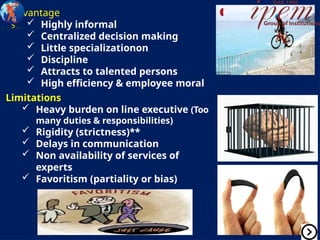
Advantage
s Highlyinformal
Centralized decision making
Little specializationon
Discipline
Attracts to talented persons
High efficiency & employee moral
Limitations
Heavy burden on line executive (Too
many duties & responsibilities)
Rigidity (strictness)**
Delays in communication
Non availability of services of
experts
Favoritism (partiality or bias)
24.
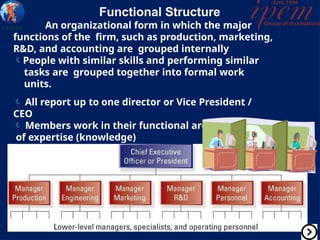
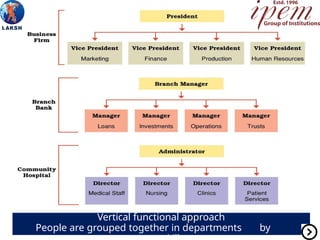
Functional Structure
An organizationalform in which the major
functions of the firm, such as production, marketing,
R&D, and accounting are grouped internally
People with similar skills and performing similar
tasks are grouped together into formal work
units.
All report up to one director or Vice President /
CEO
Members work in their functional areas
of expertise (knowledge)
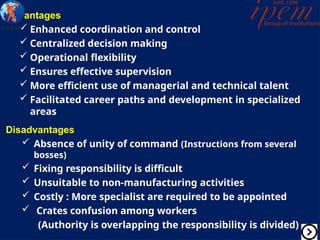
Advantages
Enhanced coordinationand control
Centralized decision making
Operational flexibility
Ensures effective supervision
More efficient use of managerial and technical talent
Facilitated career paths and development in specialized
areas
Disadvantages
Absence of unity of command (Instructions from several
bosses)
Fixing responsibility is difficult
Unsuitable to non-manufacturing activities
Costly : More specialist are required to be appointed
Crates confusion among workers
(Authority is overlapping the responsibility is divided)
27.
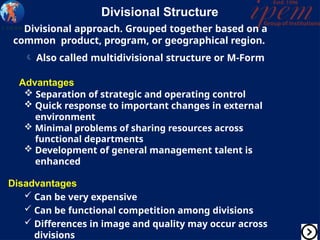
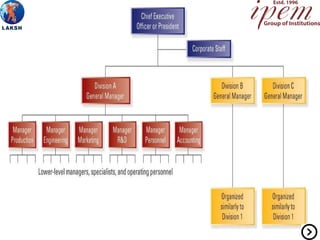
Divisional Structure
Divisional approach.Grouped together based on a
common product, program, or geographical region.
Also called multidivisional structure or M-Form
Advantages
Separation of strategic and operating control
Quick response to important changes in external
environment
Minimal problems of sharing resources across
functional departments
Development of general management talent is
enhanced
Disadvantages
Can be very expensive
Can be functional competition among divisions
Differences in image and quality may occur across
divisions
29.
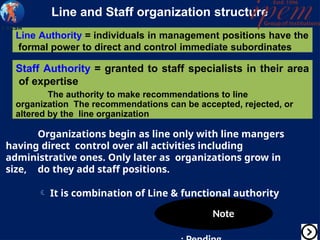
Line and Stafforganization structure
Line Authority = individuals in management positions have the
formal power to direct and control immediate subordinates
Staff Authority = granted to staff specialists in their area
of expertise
The authority to make recommendations to line
organization The recommendations can be accepted, rejected, or
altered by the line organization
Organizations begin as line only with line mangers
having direct control over all activities including
administrative ones. Only later as organizations grow in
size, do they add staff positions.
It is combination of Line & functional authority
Note
30.
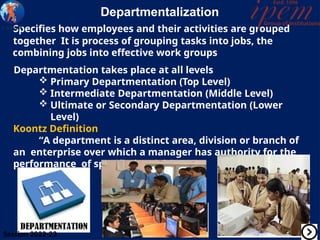
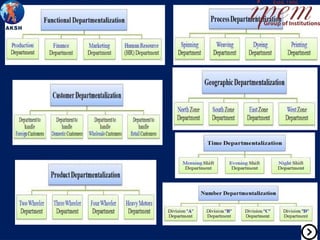
Departmentalization
Specifies how employeesand their activities are grouped
together It is process of grouping tasks into jobs, the
combining jobs into effective work groups
Departmentation takes place at all levels
Primary Departmentation (Top Level)
Intermediate Departmentation (Middle Level)
Ultimate or Secondary Departmentation (Lower
Level)
Koontz Definition
“A department is a distinct area, division or branch of
an enterprise over which a manager has authority for the
performance of specified activities
Session 2022-23
31.
Importance of Departmentation
Specialization One major function & efficiency of operation
increases
Expansion (Growth)
Autonomy (Independent) Freedom provides job satisfaction
& motivation
Fixation of responsibility It provides a basis for building up
locality & commitment
Appraisal of managerial performance becomes easier when
specific tasks are assigned to specific personnel
Managerial development It facilities communication,
coordination & control
Advantages
Employees can develop skills depth
Good Coordination
Easily direct & control
Responsibility easily located
Disadvantages
Lack of communication
Individuality
33.
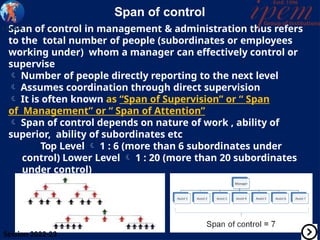
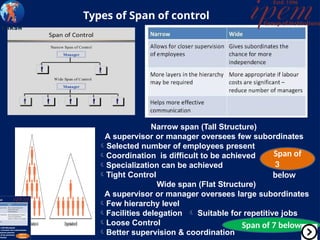
Span of control
Spanof control in management & administration thus refers
to the total number of people (subordinates or employees
working under) whom a manager can effectively control or
supervise
Number of people directly reporting to the next level
Assumes coordination through direct supervision
It is often known as “Span of Supervision” or “ Span
of Management” or “ Span of Attention”
Span of control depends on nature of work , ability of
superior, ability of subordinates etc
Top Level 1 : 6 (more than 6 subordinates under
control) Lower Level 1 : 20 (more than 20 subordinates
under control)
Session 2022-23
34.
Types of Spanof control
Narrow span (Tall Structure)
A supervisor or manager oversees few subordinates
Selected number of employees present
Coordination is difficult to be achieved
Specialization can be achieved
Tight Control
Wide span (Flat Structure)
A supervisor or manager oversees large subordinates
Few hierarchy level
Facilities delegation Suitable for repetitive jobs
Loose Control
Better supervision & coordination
Span of
3
below
Span of 7 below
35.
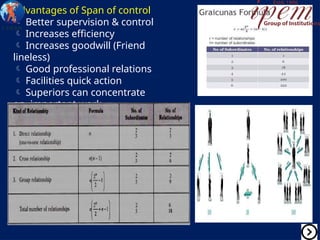
Advantages of Spanof control
Better supervision & control
Increases efficiency
Increases goodwill (Friend
lineless)
Good professional relations
Facilities quick action
Superiors can concentrate
on important work
36.
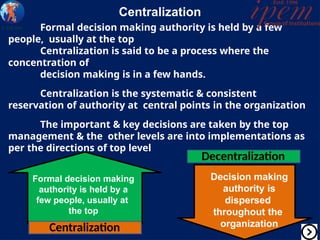
Centralization
Formal decision makingauthority is held by a few
people, usually at the top
Centralization is said to be a process where the
concentration of
decision making is in a few hands.
Centralization is the systematic & consistent
reservation of authority at central points in the organization
The important & key decisions are taken by the top
management & the other levels are into implementations as
per the directions of top level
Formal decision making
authority is held by a
few people, usually at
the top
Decision making
authority is
dispersed
throughout the
organization
Centralization
Decentralization
37.
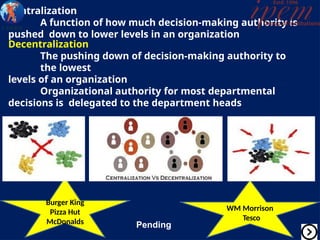
Centralization
A function ofhow much decision-making authority is
pushed down to lower levels in an organization
Decentralization
The pushing down of decision-making authority to
the lowest
levels of an organization
Organizational authority for most departmental
decisions is delegated to the department heads
Burger King
Pizza Hut
McDonalds
WM Morrison
Tesco
Pending
38.
Delegation of Authority
Itis the essence of management
It is very important factor in formal organization
Delegation of Authority means the granting of
authority to subordinates to operate within prescribed
limits
Assigning jobs to others & giving rights to
execute them
Importance of Delegation of Authority
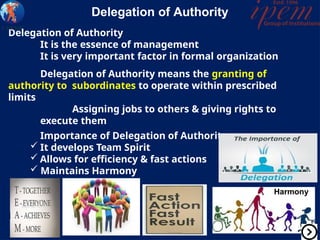
It develops Team Spirit
Allows for efficiency & fast actions
Maintains Harmony
Delegation of Authority
Harmony
39.
Elements of Delegationof Authority
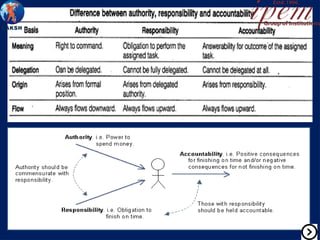
1. Responsibility
It is obligation of the subordinate to complete the work
which is assigned to him
Basis of responsibility is superior subordinate
relationship that exists in the organization
Koontz :
“Responsibility may be defined as the obligation of a
subordinate to whom the duty has been assigned to
perform”
40.
2.Authority
Rightful power orRightful
command Henry Fayol
Authority is the right to give orders to & power to
extract obedience (submission) from the subordinates
It helps to control subordinates
The purpose of granting authority is to
accomplish the organizational objectives
It is not absolute & is limited
It is to influence the behaviour of
subordinates to
in the right direction
If the subordinate does not obey superior
can take disciplinary action & can be
exercised through advice & approve
41.
3.Accontability
It denotes answerabilityfor the accomplishment of
the task assigned by the superior to his subordinates
To be accountable is to be answerable for
one’s conduct In respect to obligation fulfilled or
unfulfilled
It is not only what we do, but also what
we do not do, for which we are accountable
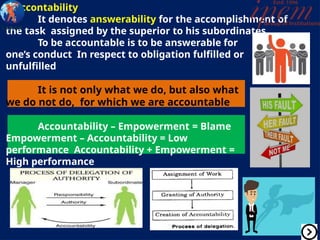
Accountability – Empowerment = Blame
Empowerment – Accountability = Low
performance Accountability + Empowerment =
High performance