SUBMMITTED TO :  SUBMMITED BY : MR.B.S NEGI  SANDEEP SINGH ROHIT KUMAR PAWAN KUKRETI      G.B.PANT ENGINEERING COLLAGE   SESSION(2010-2013)   TOPIC- COMMUNICATION
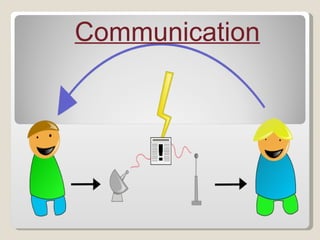
Communication
Introduction  Meaning of communication Definition of communication Communication process  The two-way communication process Communication Model Forms of communication  Non-verbal communication verbal communication Patterns of Communication Downward communication Upward communication Lateral communication
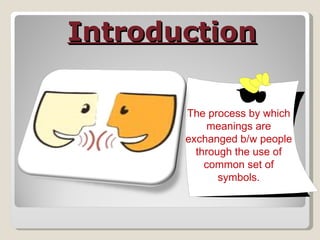
Introduction   The process by which meanings are exchanged b/w people through the use of common set of symbols.
Meaning Of Communication Communication may be defined as the process by which  information is exchanged  between individuals. The process includes the use of  written messages, spoken words and gestures.
Objectives of Communication Advice  Suggestion Order Education  Warning Motivation Counseling
Definition   Acc. to John Adair , “Communication is essentially the ability of one person to make contact with another & to make himself /  herself understood”.  Acc. to Allen , “Communication involves a systematic & continuous process of telling, listening & understanding”.
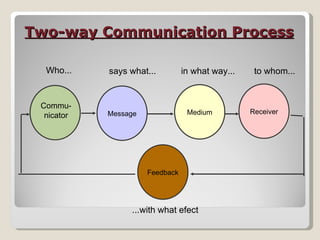
Two-way Communication Process Message Medium Receiver Feedback Who... says what... in what way... to whom... ...with what efect Commu-nicator
 
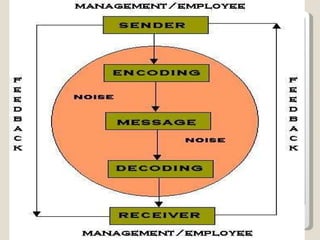
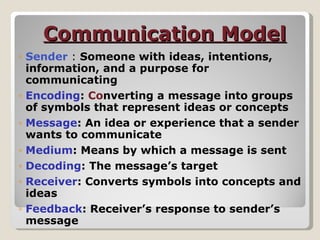
Communication Model Sender  :  Someone with ideas, intentions, information, and a purpose for communicating Encoding :  Co nverting a message into groups  of symbols that represent ideas or concepts Message : An idea or experience that a sender wants to communicate Medium : Means by which a message is sent Decoding :   The message’s target Receiver : Converts symbols into concepts and ideas Feedback : Receiver’s response to sender’s message
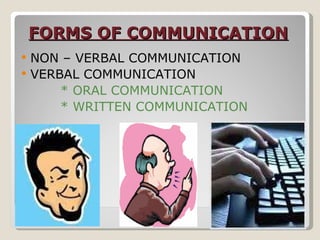
FORMS OF COMMUNICATION NON – VERBAL COMMUNICATION  VERBAL COMMUNICATION  * ORAL COMMUNICATION  * WRITTEN COMMUNICATION
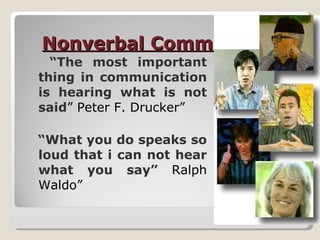
Nonverbal Communication “ The most important thing in communication is hearing what is not said ” Peter F. Drucker” “ What you do speaks so loud that i can not hear what you say”  Ralph Waldo”
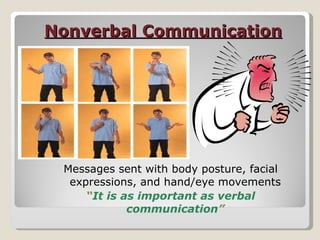
Nonverbal Communication Messages sent with body posture, facial expressions, and hand/eye movements “ It is as important as verbal communication ”
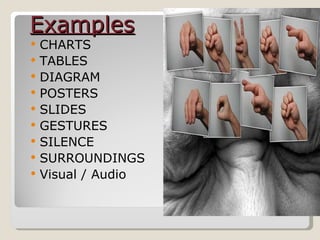
Examples   CHARTS  TABLES DIAGRAM POSTERS SLIDES GESTURES SILENCE SURROUNDINGS Visual / Audio
 
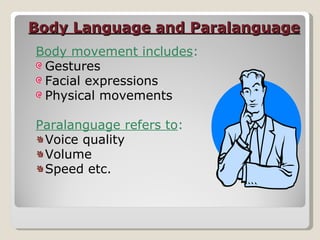
Body Language and Paralanguage Body movement includes : Gestures Facial expressions Physical movements Paralanguage refers to : Voice quality Volume Speed etc.
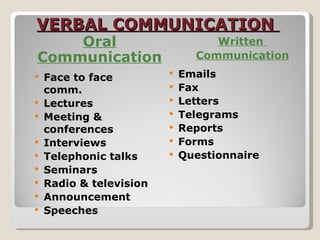
VERBAL COMMUNICATION  Oral Communication Written  Communication Face to face comm. Lectures Meeting & conferences Interviews Telephonic talks Seminars Radio & television Announcement  Speeches Emails Fax Letters Telegrams Reports Forms Questionnaire
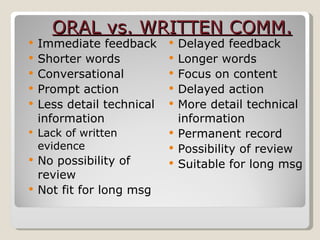
ORAL vs. WRITTEN COMM. Immediate feedback Shorter words Conversational Prompt action Less detail technical information Lack of written evidence No possibility of review Not fit for long msg Delayed feedback Longer words Focus on content Delayed action More detail technical information Permanent record Possibility of review Suitable for long msg
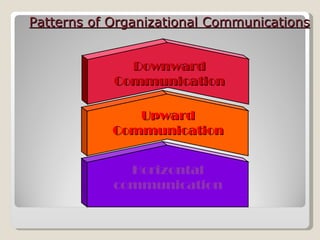
Patterns of Organizational Communications Downward Communication Upward Communication Horizontal communication
Directions of Communication Downward communication Flows from higher to lower levels in an organization Includes management policies, instructions, and official memos Upward communication Flows from lower to higher levels in an organization Includes suggestion boxes, group meetings,  procedures, anonymous emails, unauthorized websites  Horizontal communication
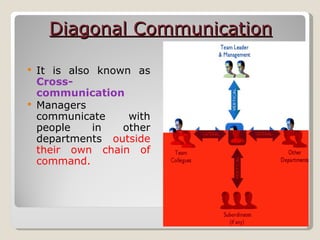
Diagonal Communication It is also known as  Cross-communication Managers communicate with people in other departments  outside their own chain of command.
 

Communication

  • 1.
    SUBMMITTED TO : SUBMMITED BY : MR.B.S NEGI SANDEEP SINGH ROHIT KUMAR PAWAN KUKRETI G.B.PANT ENGINEERING COLLAGE SESSION(2010-2013) TOPIC- COMMUNICATION
  • 2.
  • 3.
    Introduction Meaningof communication Definition of communication Communication process The two-way communication process Communication Model Forms of communication Non-verbal communication verbal communication Patterns of Communication Downward communication Upward communication Lateral communication
  • 4.
    Introduction The process by which meanings are exchanged b/w people through the use of common set of symbols.
  • 5.
    Meaning Of CommunicationCommunication may be defined as the process by which information is exchanged between individuals. The process includes the use of written messages, spoken words and gestures.
  • 6.
    Objectives of CommunicationAdvice Suggestion Order Education Warning Motivation Counseling
  • 7.
    Definition Acc. to John Adair , “Communication is essentially the ability of one person to make contact with another & to make himself / herself understood”. Acc. to Allen , “Communication involves a systematic & continuous process of telling, listening & understanding”.
  • 8.
    Two-way Communication ProcessMessage Medium Receiver Feedback Who... says what... in what way... to whom... ...with what efect Commu-nicator
  • 9.
  • 10.
    Communication Model Sender : Someone with ideas, intentions, information, and a purpose for communicating Encoding : Co nverting a message into groups of symbols that represent ideas or concepts Message : An idea or experience that a sender wants to communicate Medium : Means by which a message is sent Decoding : The message’s target Receiver : Converts symbols into concepts and ideas Feedback : Receiver’s response to sender’s message
  • 11.
    FORMS OF COMMUNICATIONNON – VERBAL COMMUNICATION VERBAL COMMUNICATION * ORAL COMMUNICATION * WRITTEN COMMUNICATION
  • 12.
    Nonverbal Communication “The most important thing in communication is hearing what is not said ” Peter F. Drucker” “ What you do speaks so loud that i can not hear what you say” Ralph Waldo”
  • 13.
    Nonverbal Communication Messagessent with body posture, facial expressions, and hand/eye movements “ It is as important as verbal communication ”
  • 14.
    Examples CHARTS TABLES DIAGRAM POSTERS SLIDES GESTURES SILENCE SURROUNDINGS Visual / Audio
  • 15.
  • 16.
    Body Language andParalanguage Body movement includes : Gestures Facial expressions Physical movements Paralanguage refers to : Voice quality Volume Speed etc.
  • 17.
    VERBAL COMMUNICATION Oral Communication Written Communication Face to face comm. Lectures Meeting & conferences Interviews Telephonic talks Seminars Radio & television Announcement Speeches Emails Fax Letters Telegrams Reports Forms Questionnaire
  • 18.
    ORAL vs. WRITTENCOMM. Immediate feedback Shorter words Conversational Prompt action Less detail technical information Lack of written evidence No possibility of review Not fit for long msg Delayed feedback Longer words Focus on content Delayed action More detail technical information Permanent record Possibility of review Suitable for long msg
  • 19.
    Patterns of OrganizationalCommunications Downward Communication Upward Communication Horizontal communication
  • 20.
    Directions of CommunicationDownward communication Flows from higher to lower levels in an organization Includes management policies, instructions, and official memos Upward communication Flows from lower to higher levels in an organization Includes suggestion boxes, group meetings, procedures, anonymous emails, unauthorized websites Horizontal communication
  • 21.
    Diagonal Communication Itis also known as Cross-communication Managers communicate with people in other departments outside their own chain of command.
  • 22.

Editor's Notes

  • #2 Multimedia Lecture Support Package to Accompany Basic Marketing Lecture Script 6-
  • #3 Multimedia Lecture Support Package to Accompany Basic Marketing Lecture Script 6-
  • #4 Multimedia Lecture Support Package to Accompany Basic Marketing Lecture Script 6-
  • #5 Multimedia Lecture Support Package to Accompany Basic Marketing Lecture Script 6-
  • #6 Multimedia Lecture Support Package to Accompany Basic Marketing Lecture Script 6-
  • #7 Multimedia Lecture Support Package to Accompany Basic Marketing Lecture Script 6-
  • #8 Multimedia Lecture Support Package to Accompany Basic Marketing Lecture Script 6-
  • #9 Multimedia Lecture Support Package to Accompany Basic Marketing Lecture Script 6-
  • #10 Multimedia Lecture Support Package to Accompany Basic Marketing Lecture Script 6-
  • #11 Multimedia Lecture Support Package to Accompany Basic Marketing Lecture Script 6-
  • #12 Multimedia Lecture Support Package to Accompany Basic Marketing Lecture Script 6-
  • #13 Multimedia Lecture Support Package to Accompany Basic Marketing Lecture Script 6-
  • #14 Multimedia Lecture Support Package to Accompany Basic Marketing Lecture Script 6-
  • #15 Multimedia Lecture Support Package to Accompany Basic Marketing Lecture Script 6-
  • #16 Multimedia Lecture Support Package to Accompany Basic Marketing Lecture Script 6-
  • #17 Multimedia Lecture Support Package to Accompany Basic Marketing Lecture Script 6-
  • #18 Multimedia Lecture Support Package to Accompany Basic Marketing Lecture Script 6-
  • #19 Multimedia Lecture Support Package to Accompany Basic Marketing Lecture Script 6-
  • #20 Multimedia Lecture Support Package to Accompany Basic Marketing Lecture Script 6-
  • #21 Multimedia Lecture Support Package to Accompany Basic Marketing Lecture Script 6-
  • #22 Multimedia Lecture Support Package to Accompany Basic Marketing Lecture Script 6-
  • #23 Multimedia Lecture Support Package to Accompany Basic Marketing Lecture Script 6-