THE INTERNAL
ORGANIZATION: RESOURCES,
CAPABILITIES, CORE
COMPETENCIES, AND
COMPETITIVE ADVANTAGE
ANALYZING THE INTERNAL ORGANIZATION
The Context of Internal Analysis
One of the conditions associated with analysing a firm's
internal organization is the reality that in today's global
economy, some of the resources that were traditionally
critical to firms' efforts to produce, sell, and distribute
their goods or services--such as labor costs, access to
financial resources and raw materials, and protected or
regulated markets although still important, are now less
likely to be the source of competitive advantages.
Global mind-set
is the ability to analyse, understand, and manage an
internal organization in ways that are not dependent on
the assumptions of a single country, culture, or context.
ANALYZING THE INTERNAL ORGANIZATION
Creating Value
Value is measured by a product's performance
characteristics and by its attributes for which customers
are willing to pay. Firms create value by innovatively
bundling and leveraging their resources to form
capabilities and core competencies, Firms with a
competitive advantage create more value for customers
than do competitors.
ANALYZING THE INTERNAL ORGANIZATION
The Challenge of Analyzing the Internal
Organization
The strategic decisions managers make about the
internal organization are non-routine," have ethical
implications," and significantly influence the firm's
ability to earn above-average returns. They are three
conditions, uncertainty, complexity, and intra
organizational conflict, affect managers as they analyze
the internal organization and make decisions about
resources.
Uncertainty Uncertainty exists about the
characteristics of the firm’s
general and industry
environments and customers
needs.
CONDITIONS Complexity Complexity results from the
interrelationships among
conditions shaping a firm.
Intra-organizational conflicts Intra-organizational conflicts may
exist among managers making
decisions as well as among those
affected by the decisions.
Conditions affecting managerial decisions about
resources, capabilities, and core competencies
RESOURCES, CAPABILITIES, AND CORE
COMPETENCIES
Resources
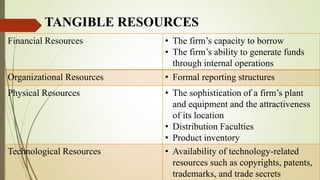
Tangible resources are assets that can be observed and quantified.
Production equipment, manufacturing facilities, distribution centers,
and formal reporting structures are examples of tangible resources.
Intangible resources are assets that are rooted deeply in the firm's
history, accumulate over time, and are relatively difficult for
competitors to analyze and imitate. Because they are embedded in
unique patterns of routines, intangible resources are difficult for
competitors to analyze and imitate. Knowledge, trust between
managers and employees, managerial capabilities, organizational
routines, scientific capabilities, the capacity for innovation, brand
name, the firm's reputation for its goods or services and how it
interacts with people and organizational culture are intangible
resources.
Financial Resources • The firm’s capacity to borrow
• The firm’s ability to generate funds
through internal operations
Organizational Resources • Formal reporting structures
Physical Resources • The sophistication of a firm’s plant
and equipment and the attractiveness
of its location
• Distribution Faculties
• Product inventory
Technological Resources • Availability of technology-related
resources such as copyrights, patents,
trademarks, and trade secrets
TANGIBLE RESOURCES
Human Resources • Knowledge
• Trust
• Skills
• Abilities to collaborate with others
Innovation Resources • Ideas
• Scientific capabilities
• Capacity to innovate
Reputational Resources • Brand name
• Perceptions of product quality,
durability, and reliability
• Positive reputation with stakeholders
such as suppliers and customers
INTANGIBLE RESOURCES
RESOURCES, CAPABILITIES, AND CORE
COMPETENCIES
Capabilities
The firm combines individual tangible and intangible
resources to create capabilities. In turn, capabilities are
used to complete the organizational tasks required to
produce, distribute, and service the goods or services the
firm provides to customers for the purpose of creating
value for them.
RESOURCES, CAPABILITIES, AND CORE
COMPETENCIES
Core Competencies
are capabilities that serve as a source of
competitive advantage for a firm over its rivals. Core
competencies distinguish a company competitively
and reflect its personality. Core competencies emerge
over time through an organizational process of
accumulating and learning how to deploy different
resources and capabilities.
Building Core Competencies
two tools help firms identify their core
competencies. The first consists of four specific
criteria of sustainable competitive advantage that can
be used to determine which capabilities are core
competencies. The second tool is the value chain
analysis. Firms use this tool to select the value-
creating competencies that should be maintained,
upgraded, or developed and those that should be
outsourced.
Valuable Capabilities • Help a firm neutralize threats or
exploit opportunities
Rare Capabilities • are not possessed by many others
Costly to imitate Capabilities • Historical: a unique and a valuable
organizational culture or brand name
• Ambiguous cause: the cause and uses
of a competence are unclear
• Social complexity: interpersonal
relationships, trust, and friendship
among managers, suppliers, and
customers
Non substitutable Capabilities • No strategic equivalent
The Four Criteria of Sustainable Competitive Advantage
Building Core Competencies
Value Chain Analysis
Value chain analysis allows the firm to understand the
parts of its operations that create value and those that do
not. Understanding these issues is important because the
firm earns above-average returns only when the value it
creates is greater than the costs incurred to create that
value." The value chain is a template that firms use to
analyze their cost position and to identify the multiple
means that can be used to facilitate implementation of a
chosen strategy.
FINANCE
HUMAN
RESORCES
SUPPLY CHAIN
MANAGEMENT
MANAGEMENT
INFORMATION SYSTEM
OPERATIONS DISTRIBUTION MARKETING
FOLLOW UP
SERVICE
A Model of Value Chain
Customer
value
Support
Functions
Value Chain Activities
Outsourcing
is the purchase of a value-creating activity or a
support function activity from an external supplier.
Not-for-profit agencies as well as for-profit
organizations actively engage in outsourcing. Firms
engaging in effective outsourcing increase their
flexibility, mitigate risks, and reduce their capital
investments.
Competencies, Strengths, Weaknesses, and
Strategic Decisions
By analyzing the internal organization, firms identify
their strengths and weaknesses as reflected by their
resources, capabilities, and core competencies. If a firm
has weak capabilities or does not have core
competencies in areas required to achieve a competitive
advantage, it must acquire those resources and build the
needed capabilities and competencies.

MODULE-3-THE-INTERNAL-ORGANIZATION.pptx

  • 1.
    THE INTERNAL ORGANIZATION: RESOURCES, CAPABILITIES,CORE COMPETENCIES, AND COMPETITIVE ADVANTAGE
  • 2.
    ANALYZING THE INTERNALORGANIZATION The Context of Internal Analysis One of the conditions associated with analysing a firm's internal organization is the reality that in today's global economy, some of the resources that were traditionally critical to firms' efforts to produce, sell, and distribute their goods or services--such as labor costs, access to financial resources and raw materials, and protected or regulated markets although still important, are now less likely to be the source of competitive advantages.
  • 3.
    Global mind-set is theability to analyse, understand, and manage an internal organization in ways that are not dependent on the assumptions of a single country, culture, or context.
  • 4.
    ANALYZING THE INTERNALORGANIZATION Creating Value Value is measured by a product's performance characteristics and by its attributes for which customers are willing to pay. Firms create value by innovatively bundling and leveraging their resources to form capabilities and core competencies, Firms with a competitive advantage create more value for customers than do competitors.
  • 5.
    ANALYZING THE INTERNALORGANIZATION The Challenge of Analyzing the Internal Organization The strategic decisions managers make about the internal organization are non-routine," have ethical implications," and significantly influence the firm's ability to earn above-average returns. They are three conditions, uncertainty, complexity, and intra organizational conflict, affect managers as they analyze the internal organization and make decisions about resources.
  • 6.
    Uncertainty Uncertainty existsabout the characteristics of the firm’s general and industry environments and customers needs. CONDITIONS Complexity Complexity results from the interrelationships among conditions shaping a firm. Intra-organizational conflicts Intra-organizational conflicts may exist among managers making decisions as well as among those affected by the decisions. Conditions affecting managerial decisions about resources, capabilities, and core competencies
  • 7.
    RESOURCES, CAPABILITIES, ANDCORE COMPETENCIES Resources Tangible resources are assets that can be observed and quantified. Production equipment, manufacturing facilities, distribution centers, and formal reporting structures are examples of tangible resources. Intangible resources are assets that are rooted deeply in the firm's history, accumulate over time, and are relatively difficult for competitors to analyze and imitate. Because they are embedded in unique patterns of routines, intangible resources are difficult for competitors to analyze and imitate. Knowledge, trust between managers and employees, managerial capabilities, organizational routines, scientific capabilities, the capacity for innovation, brand name, the firm's reputation for its goods or services and how it interacts with people and organizational culture are intangible resources.
  • 8.
    Financial Resources •The firm’s capacity to borrow • The firm’s ability to generate funds through internal operations Organizational Resources • Formal reporting structures Physical Resources • The sophistication of a firm’s plant and equipment and the attractiveness of its location • Distribution Faculties • Product inventory Technological Resources • Availability of technology-related resources such as copyrights, patents, trademarks, and trade secrets TANGIBLE RESOURCES
  • 9.
    Human Resources •Knowledge • Trust • Skills • Abilities to collaborate with others Innovation Resources • Ideas • Scientific capabilities • Capacity to innovate Reputational Resources • Brand name • Perceptions of product quality, durability, and reliability • Positive reputation with stakeholders such as suppliers and customers INTANGIBLE RESOURCES
  • 10.
    RESOURCES, CAPABILITIES, ANDCORE COMPETENCIES Capabilities The firm combines individual tangible and intangible resources to create capabilities. In turn, capabilities are used to complete the organizational tasks required to produce, distribute, and service the goods or services the firm provides to customers for the purpose of creating value for them.
  • 11.
    RESOURCES, CAPABILITIES, ANDCORE COMPETENCIES Core Competencies are capabilities that serve as a source of competitive advantage for a firm over its rivals. Core competencies distinguish a company competitively and reflect its personality. Core competencies emerge over time through an organizational process of accumulating and learning how to deploy different resources and capabilities.
  • 12.
    Building Core Competencies twotools help firms identify their core competencies. The first consists of four specific criteria of sustainable competitive advantage that can be used to determine which capabilities are core competencies. The second tool is the value chain analysis. Firms use this tool to select the value- creating competencies that should be maintained, upgraded, or developed and those that should be outsourced.
  • 13.
    Valuable Capabilities •Help a firm neutralize threats or exploit opportunities Rare Capabilities • are not possessed by many others Costly to imitate Capabilities • Historical: a unique and a valuable organizational culture or brand name • Ambiguous cause: the cause and uses of a competence are unclear • Social complexity: interpersonal relationships, trust, and friendship among managers, suppliers, and customers Non substitutable Capabilities • No strategic equivalent The Four Criteria of Sustainable Competitive Advantage
  • 14.
    Building Core Competencies ValueChain Analysis Value chain analysis allows the firm to understand the parts of its operations that create value and those that do not. Understanding these issues is important because the firm earns above-average returns only when the value it creates is greater than the costs incurred to create that value." The value chain is a template that firms use to analyze their cost position and to identify the multiple means that can be used to facilitate implementation of a chosen strategy.
  • 15.
    FINANCE HUMAN RESORCES SUPPLY CHAIN MANAGEMENT MANAGEMENT INFORMATION SYSTEM OPERATIONSDISTRIBUTION MARKETING FOLLOW UP SERVICE A Model of Value Chain Customer value Support Functions Value Chain Activities
  • 16.
    Outsourcing is the purchaseof a value-creating activity or a support function activity from an external supplier. Not-for-profit agencies as well as for-profit organizations actively engage in outsourcing. Firms engaging in effective outsourcing increase their flexibility, mitigate risks, and reduce their capital investments.
  • 17.
    Competencies, Strengths, Weaknesses,and Strategic Decisions By analyzing the internal organization, firms identify their strengths and weaknesses as reflected by their resources, capabilities, and core competencies. If a firm has weak capabilities or does not have core competencies in areas required to achieve a competitive advantage, it must acquire those resources and build the needed capabilities and competencies.