STRUCTURAL DIMENSIONS IN
ORGANIZATIONS
Mr. Sanket Senapati
Some of the Basics…
• Administrative Component
• Autonomy
• Centralization
• Complexity
• Delegation of Authority
• Differentiation
• Integration
• Professionalism
• Span of Control
• Specialization
• Standardization
• Vertical Span
COMPLEXITY
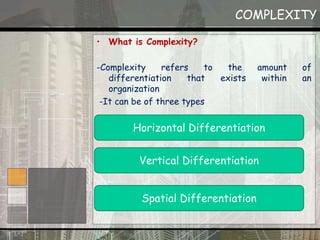
• What is Complexity?
-Complexity refers to the amount of
differentiation that exists within an
organization
-It can be of three types
Horizontal Differentiation
Vertical Differentiation
Spatial Differentiation
HORIZONTAL DIFFERENTIATION
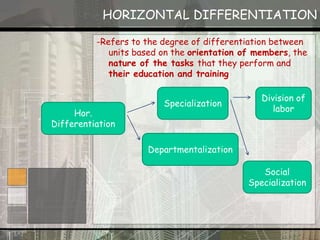
-Refers to the degree of differentiation between
units based on the orientation of members, the
nature of the tasks that they perform and
their education and training
Hor.
Differentiation
Specialization
Departmentalization
Division of
labor
Social
Specialization
HORIZONTAL DIFFERENTIATION
• Specialization refers to the grouping of
activities performed by an individual
1. Division of labor or functional specialization: -
-Jobs are broken down into simple and routine
tasks
-High substitutability of employees
2. Social Specialization: Individuals are
specialized rather than the work
An increase in either form of specialization
increases the complexity in the organization
WHY?
HORIZONTAL DIFFERENTIATION
• Specialization is linked with departmentalization
• Division of labor creates groups of specialists
• Departmentalization is the way in which
organizations typically coordinate activities
which have been horizontally differentiated
• Departments can be created on the basis of
simple numbers, function, product or service,
geography etc.
• Functional specialization can also be geographic
in nature
VERTICAL DIFFERENTIATION
• Refers to the depth of the structure
• Vertical differentiation can be best understood
as a response to the increase in horizontal
differentiation
• Organizations with the same number of
employees need not have the same span of
control (employee number=4096)
• Evidence is clouded on the effectiveness of tall
or flat structures
• Context is of vital importance (type of job held
and characteristics of the job holder)
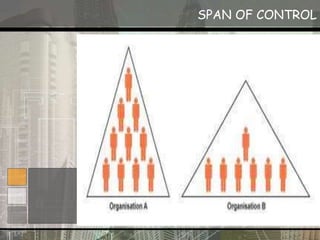
SPAN OF CONTROL
VERTICAL DIFFERENTIATION
What factors influence the span of control?
1. The ability and expertise of the manager in the
controlling position
2. The nature of the task being performed (i.e.
routineness of the task and the inter-
relatedness among the subordinates)
3. The spatial differentiation
4. The amount and type of interaction required by
the supervisor position with higher level
positions
The more competent the manager and
subordinates, the less geographically
dispersed and the less interrelated and more
routine tasks, the wider the span of control
can be
SPATIAL DIFFERENTIATION
• Multiple locations increases complexity
• Spatial differentiation can be thought of as an
extension to vertical and horizontal
differentiation
• What is its linkage to horizontal
differentiation?
• Physical separation itself would increase
complexity
• What is its linkage with vertical differentiation?
FORMALIZATION
• Formalization refers to the degree to which jobs
within the organization are standardized.
• Job Incumbent has minimum discretion over what
needs to be done
• Where formalization is low then employees’
behavior is non-programmed
• Formalization is a measure of standardization
• Standardization removes the need for the
consideration of alternatives
• Does formalization have to be in writing? And what
is the range?
FORMALIZATION
Formalization decreases variability
Formalization promotes coordination
Formalization promotes economy of costs
Formalization promotes order in IPR issues
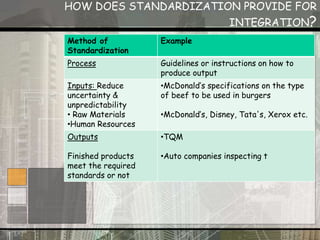
HOW DOES STANDARDIZATION PROVIDE FOR
INTEGRATION?
Method of
Standardization
Example
Process Guidelines or instructions on how to
produce output
Inputs: Reduce
uncertainty &
unpredictability
• Raw Materials
•Human Resources
•McDonald’s specifications on the type
of beef to be used in burgers
•McDonald’s, Disney, Tata's, Xerox etc.
Outputs
Finished products
meet the required
standards or not
•TQM
•Auto companies inspecting t
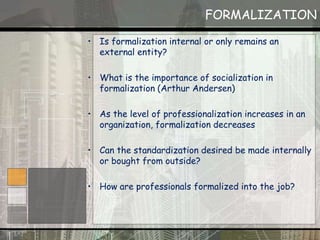
FORMALIZATION
• Is formalization internal or only remains an
external entity?
• What is the importance of socialization in
formalization (Arthur Andersen)
• As the level of professionalization increases in an
organization, formalization decreases
• Can the standardization desired be made internally
or bought from outside?
• How are professionals formalized into the job?
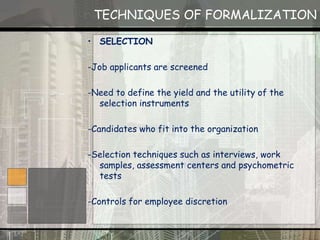
TECHNIQUES OF FORMALIZATION
• SELECTION
-Job applicants are screened
-Need to define the yield and the utility of the
selection instruments
-Candidates who fit into the organization
-Selection techniques such as interviews, work
samples, assessment centers and psychometric
tests
-Controls for employee discretion
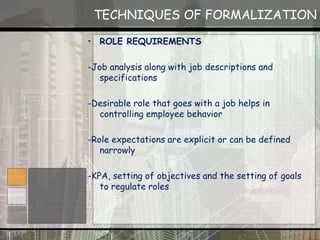
TECHNIQUES OF FORMALIZATION
• ROLE REQUIREMENTS
-Job analysis along with job descriptions and
specifications
-Desirable role that goes with a job helps in
controlling employee behavior
-Role expectations are explicit or can be defined
narrowly
-KPA, setting of objectives and the setting of goals
to regulate roles
TECHNIQUES OF FORMALIZATION
• RULES, POLICIES AND PROCEDURES
• TRAINING
• RITUALS
FORMALIZATION AND COMPLEXITY
• Formalization and complexity are interlinked
together
• Cases of high complexity linked with low levels of
formalization
• Horizontal differentiation achieved through
division of labor facilitates high formalization
and vice versa.
• People conducting non-routine jobs are socialized
on internal standards of control
• Key to understanding this relationship is
understanding how horizontal differentiation is
achieved
CENTRALIZATION
• Centralization is the most problematic
of the three statements
• The degree to which decision making is
concentrated at a single point in the
organization
• Decentralization
• Centralization differs from spatial
differentiation
CHALLENGES OF CENTRALIZATION
1
• Do we look only at formal authority?
• What importance do you give to
informal authority?
2
• Can policies override decentralization?
• Is decentralization artificial?
3
• What does concentration at a single
point mean?
• Where is decision making
concentrated?
CHALLENGES OF CENTRALIZATION
4
• Does an information system that
closely monitors decentralized
decisions maintain centralized
control?
5
• Does control by lower level
managers result in the
decentralization of centralized
decisions?
IMPORTANCE OF CENTRALIZATION
• Managers are limited in their ability to process
information
• Rapid adaptation to the environment
• Participation in the decision making process
• Training to the lower level employees
• Under what conditions is centralization
preferred?
• Relations with complexity and formalization

Structural dimensions in organizations

  • 1.
  • 2.
    Some of theBasics… • Administrative Component • Autonomy • Centralization • Complexity • Delegation of Authority • Differentiation • Integration • Professionalism • Span of Control • Specialization • Standardization • Vertical Span
  • 3.
    COMPLEXITY • What isComplexity? -Complexity refers to the amount of differentiation that exists within an organization -It can be of three types Horizontal Differentiation Vertical Differentiation Spatial Differentiation
  • 4.
    HORIZONTAL DIFFERENTIATION -Refers tothe degree of differentiation between units based on the orientation of members, the nature of the tasks that they perform and their education and training Hor. Differentiation Specialization Departmentalization Division of labor Social Specialization
  • 5.
    HORIZONTAL DIFFERENTIATION • Specializationrefers to the grouping of activities performed by an individual 1. Division of labor or functional specialization: - -Jobs are broken down into simple and routine tasks -High substitutability of employees 2. Social Specialization: Individuals are specialized rather than the work An increase in either form of specialization increases the complexity in the organization WHY?
  • 6.
    HORIZONTAL DIFFERENTIATION • Specializationis linked with departmentalization • Division of labor creates groups of specialists • Departmentalization is the way in which organizations typically coordinate activities which have been horizontally differentiated • Departments can be created on the basis of simple numbers, function, product or service, geography etc. • Functional specialization can also be geographic in nature
  • 7.
    VERTICAL DIFFERENTIATION • Refersto the depth of the structure • Vertical differentiation can be best understood as a response to the increase in horizontal differentiation • Organizations with the same number of employees need not have the same span of control (employee number=4096) • Evidence is clouded on the effectiveness of tall or flat structures • Context is of vital importance (type of job held and characteristics of the job holder)
  • 8.
  • 9.
    VERTICAL DIFFERENTIATION What factorsinfluence the span of control? 1. The ability and expertise of the manager in the controlling position 2. The nature of the task being performed (i.e. routineness of the task and the inter- relatedness among the subordinates) 3. The spatial differentiation 4. The amount and type of interaction required by the supervisor position with higher level positions The more competent the manager and subordinates, the less geographically dispersed and the less interrelated and more routine tasks, the wider the span of control can be
  • 10.
    SPATIAL DIFFERENTIATION • Multiplelocations increases complexity • Spatial differentiation can be thought of as an extension to vertical and horizontal differentiation • What is its linkage to horizontal differentiation? • Physical separation itself would increase complexity • What is its linkage with vertical differentiation?
  • 11.
    FORMALIZATION • Formalization refersto the degree to which jobs within the organization are standardized. • Job Incumbent has minimum discretion over what needs to be done • Where formalization is low then employees’ behavior is non-programmed • Formalization is a measure of standardization • Standardization removes the need for the consideration of alternatives • Does formalization have to be in writing? And what is the range?
  • 12.
    FORMALIZATION Formalization decreases variability Formalizationpromotes coordination Formalization promotes economy of costs Formalization promotes order in IPR issues
  • 13.
    HOW DOES STANDARDIZATIONPROVIDE FOR INTEGRATION? Method of Standardization Example Process Guidelines or instructions on how to produce output Inputs: Reduce uncertainty & unpredictability • Raw Materials •Human Resources •McDonald’s specifications on the type of beef to be used in burgers •McDonald’s, Disney, Tata's, Xerox etc. Outputs Finished products meet the required standards or not •TQM •Auto companies inspecting t
  • 14.
    FORMALIZATION • Is formalizationinternal or only remains an external entity? • What is the importance of socialization in formalization (Arthur Andersen) • As the level of professionalization increases in an organization, formalization decreases • Can the standardization desired be made internally or bought from outside? • How are professionals formalized into the job?
  • 15.
    TECHNIQUES OF FORMALIZATION •SELECTION -Job applicants are screened -Need to define the yield and the utility of the selection instruments -Candidates who fit into the organization -Selection techniques such as interviews, work samples, assessment centers and psychometric tests -Controls for employee discretion
  • 16.
    TECHNIQUES OF FORMALIZATION •ROLE REQUIREMENTS -Job analysis along with job descriptions and specifications -Desirable role that goes with a job helps in controlling employee behavior -Role expectations are explicit or can be defined narrowly -KPA, setting of objectives and the setting of goals to regulate roles
  • 17.
    TECHNIQUES OF FORMALIZATION •RULES, POLICIES AND PROCEDURES • TRAINING • RITUALS
  • 18.
    FORMALIZATION AND COMPLEXITY •Formalization and complexity are interlinked together • Cases of high complexity linked with low levels of formalization • Horizontal differentiation achieved through division of labor facilitates high formalization and vice versa. • People conducting non-routine jobs are socialized on internal standards of control • Key to understanding this relationship is understanding how horizontal differentiation is achieved
  • 19.
    CENTRALIZATION • Centralization isthe most problematic of the three statements • The degree to which decision making is concentrated at a single point in the organization • Decentralization • Centralization differs from spatial differentiation
  • 20.
    CHALLENGES OF CENTRALIZATION 1 •Do we look only at formal authority? • What importance do you give to informal authority? 2 • Can policies override decentralization? • Is decentralization artificial? 3 • What does concentration at a single point mean? • Where is decision making concentrated?
  • 21.
    CHALLENGES OF CENTRALIZATION 4 •Does an information system that closely monitors decentralized decisions maintain centralized control? 5 • Does control by lower level managers result in the decentralization of centralized decisions?
  • 22.
    IMPORTANCE OF CENTRALIZATION •Managers are limited in their ability to process information • Rapid adaptation to the environment • Participation in the decision making process • Training to the lower level employees • Under what conditions is centralization preferred? • Relations with complexity and formalization