Managing International Information Systems  By  The PowerPoint slides were developed by Mus Khairy (PhD), Stanford University at California. Educational ,Social Psychologists at German University at Cairo (GUC) unless otherwise noted on specific slides.
Identify the major factors driving the internationalization of business  Compare strategies for developing global businesses  Demonstrate how information systems can support different global business strategies Management Information Systems Managing International Information Systems  OBJECTIVES
Evaluate the issues and technical alternatives to be considered when developing international information systems  Identify the challenges posed by global information systems and management solutions  OBJECTIVES (Continued) Management Information Systems Managing International Information Systems
Challenge:  Fulfill customer orders made to a network of forty subsidiaries in Europe, Asia, and North America whose systems could not share data with one another  Solutions:  develop a single corporate database and use middleware with standard interfaces to connect all the subsidiary’s systems  Develop a single worldwide data model with standard definitions and codes Illustrates the role of systems in an international environment for reducing inventory and business process costs worldwide.  Management Information Systems Managing International Information Systems
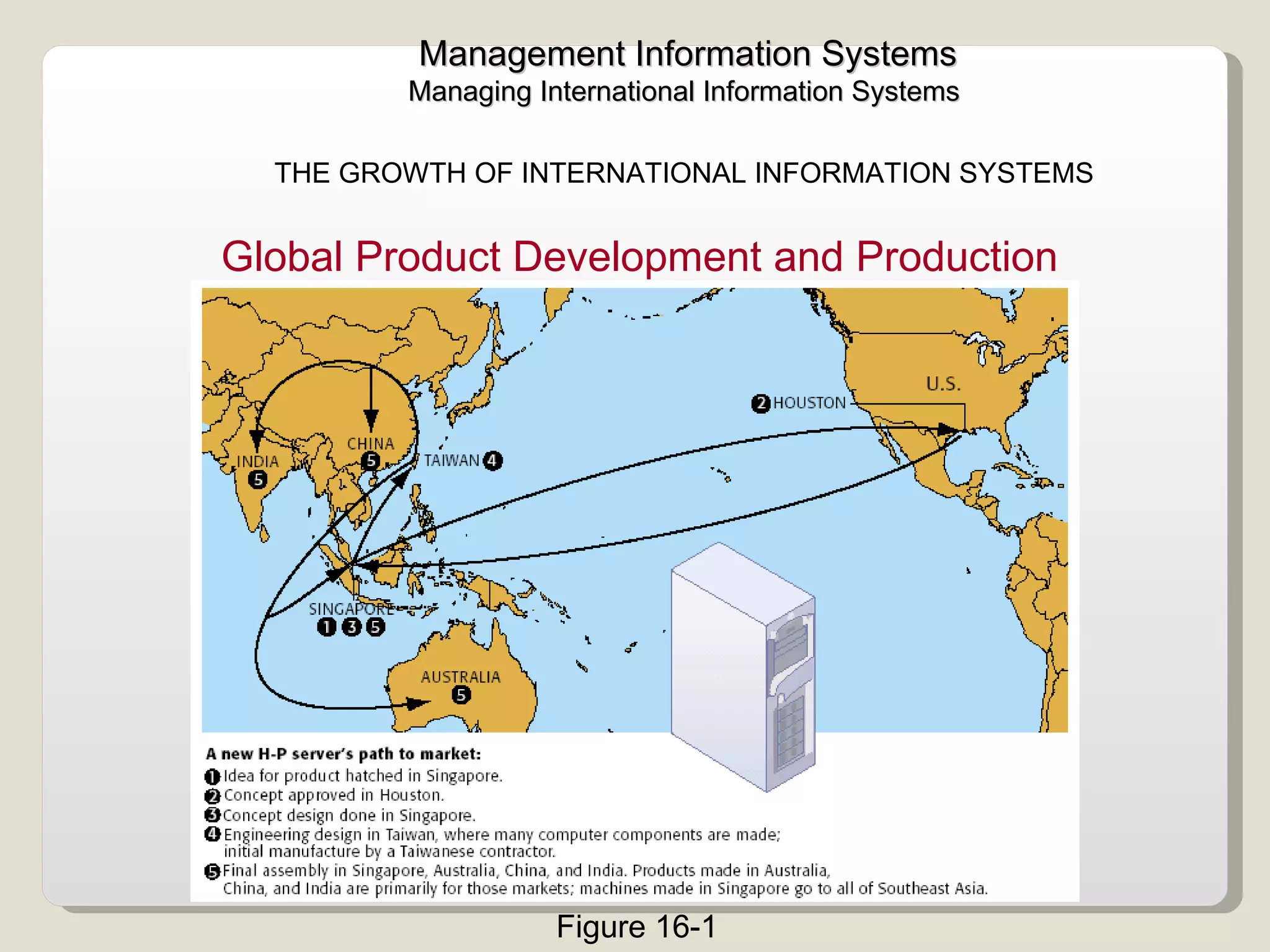
THE GROWTH OF INTERNATIONAL INFORMATION SYSTEMS  Global Product Development and Production  Management Information Systems Managing International Information Systems  Figure 16-1
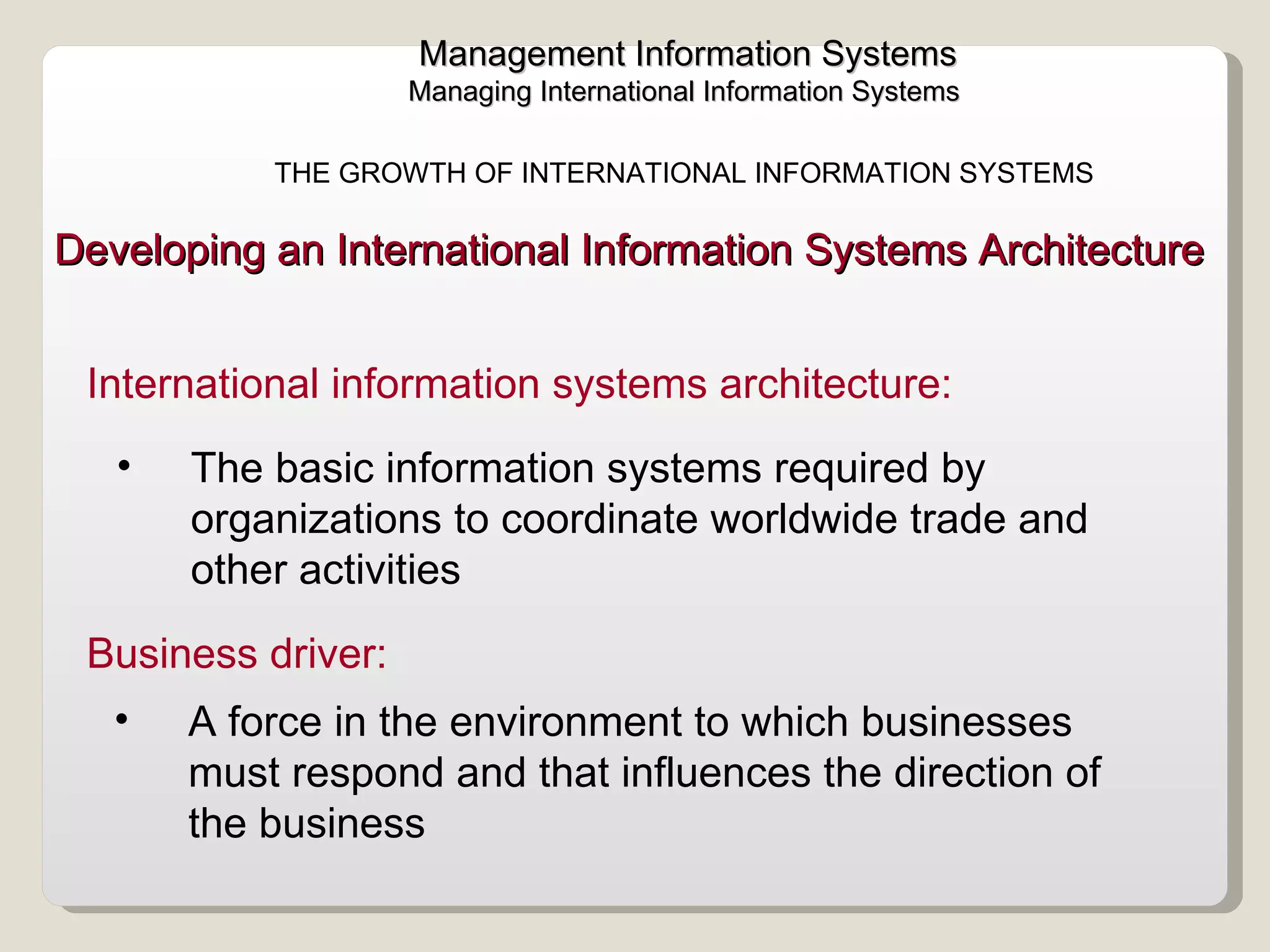
The basic information systems required by organizations to coordinate worldwide trade and other activities Developing an International Information Systems Architecture  International information systems architecture:  Management Information Systems Managing International Information Systems  THE GROWTH OF INTERNATIONAL INFORMATION SYSTEMS  A force in the environment to which businesses must respond and that influences the direction of the business Business driver:
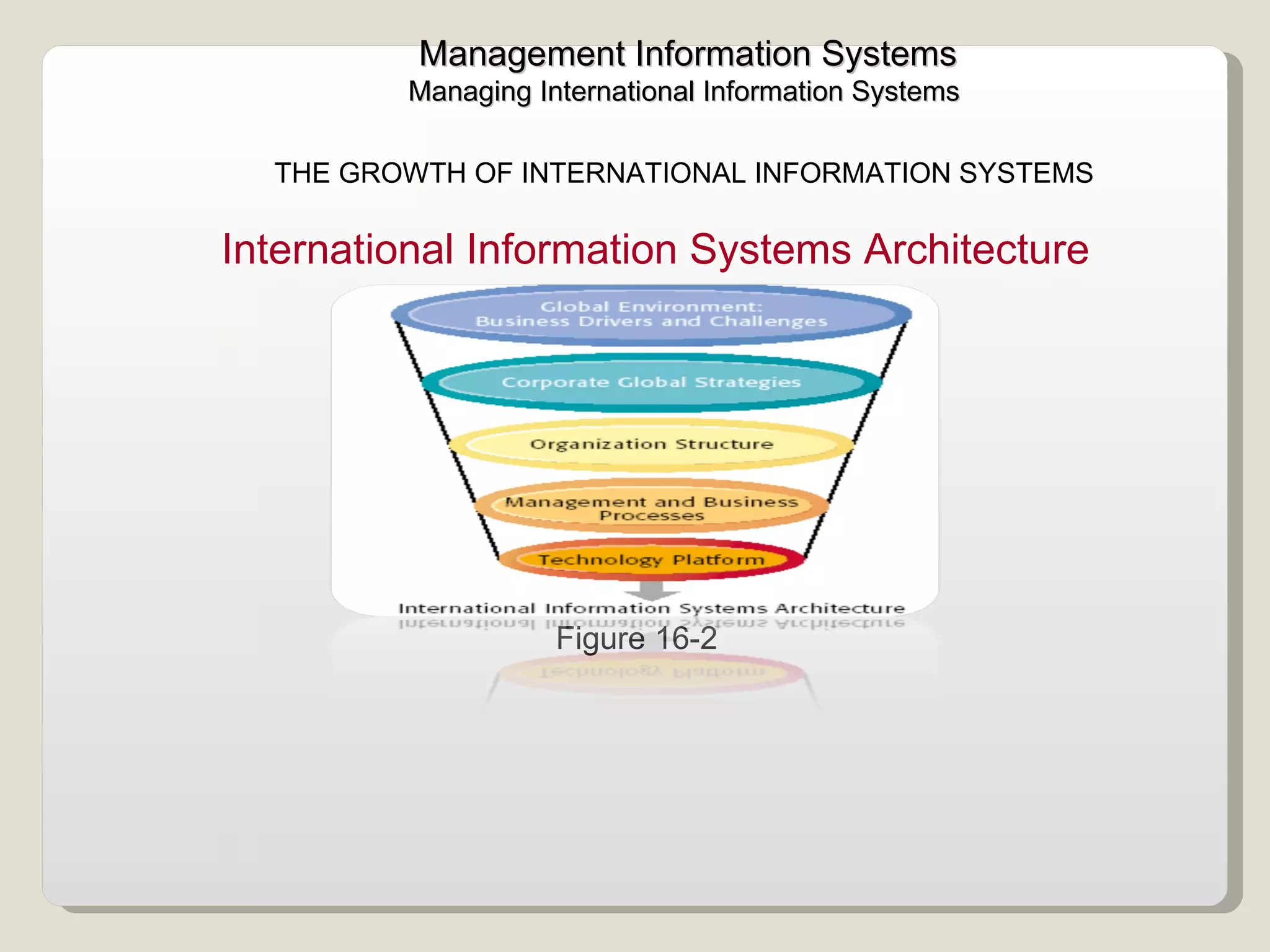
International Information Systems Architecture  Management Information Systems Managing International Information Systems  THE GROWTH OF INTERNATIONAL INFORMATION SYSTEMS  Figure 16-2
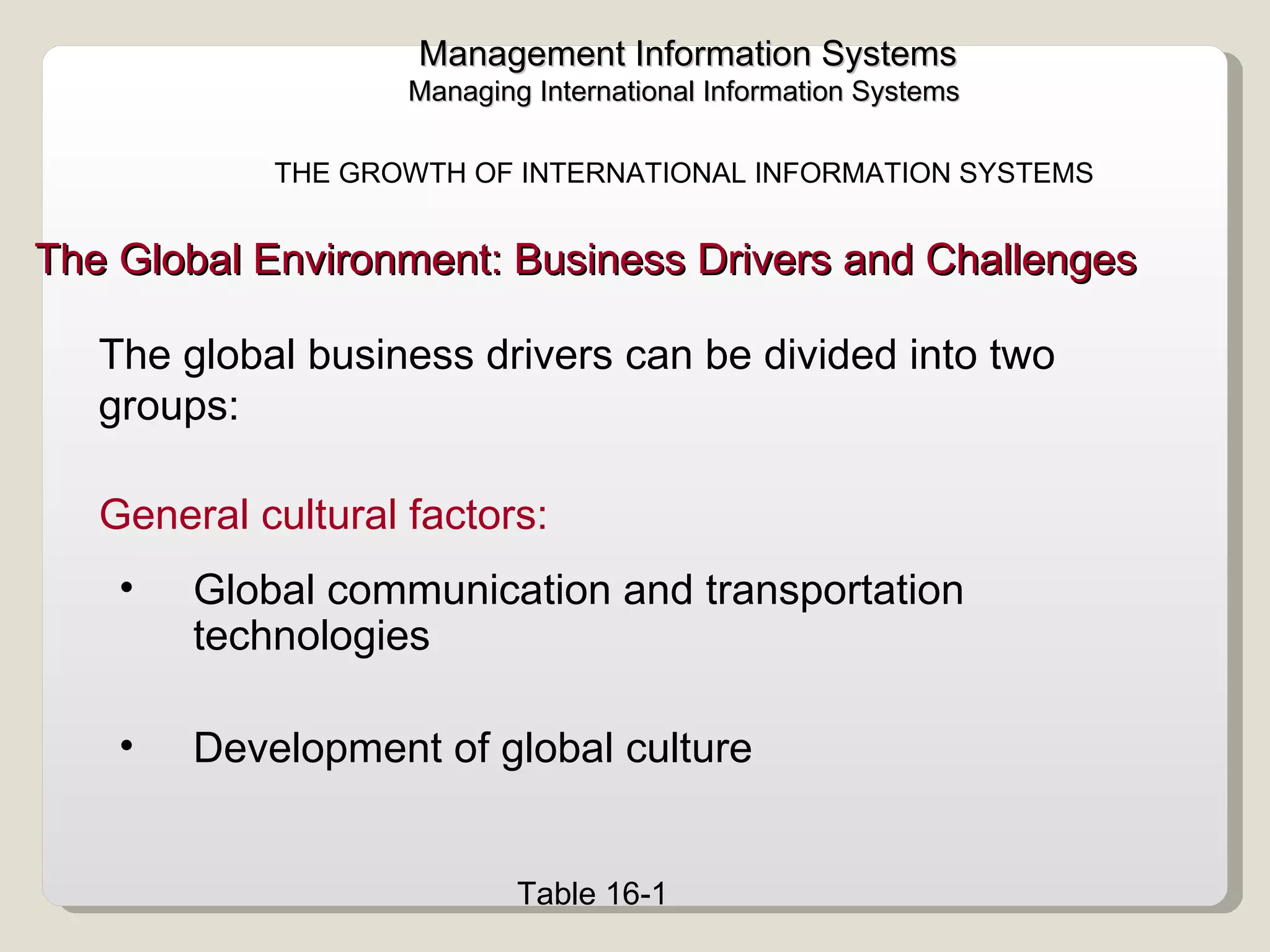
The Global Environment: Business Drivers and Challenges  The global business drivers can be divided into two groups:  Management Information Systems Managing International Information Systems  THE GROWTH OF INTERNATIONAL INFORMATION SYSTEMS  Global communication and transportation technologies  Development of global culture  General cultural factors:  Table 16-1
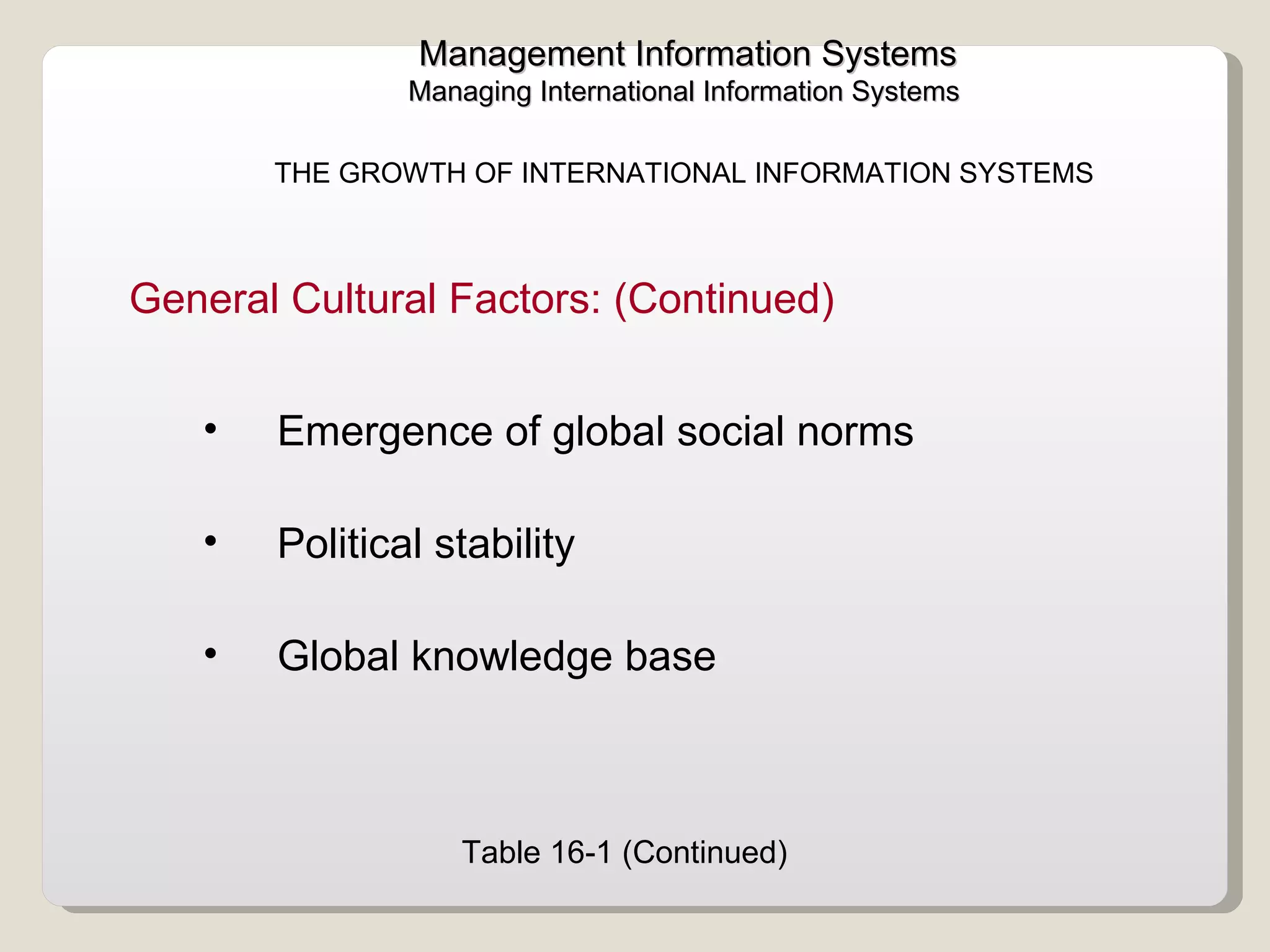
Management Information Systems Managing International Information Systems  THE GROWTH OF INTERNATIONAL INFORMATION SYSTEMS  Emergence of global social norms  Political stability  Global knowledge base  Table 16-1 (Continued) General Cultural Factors: (Continued)
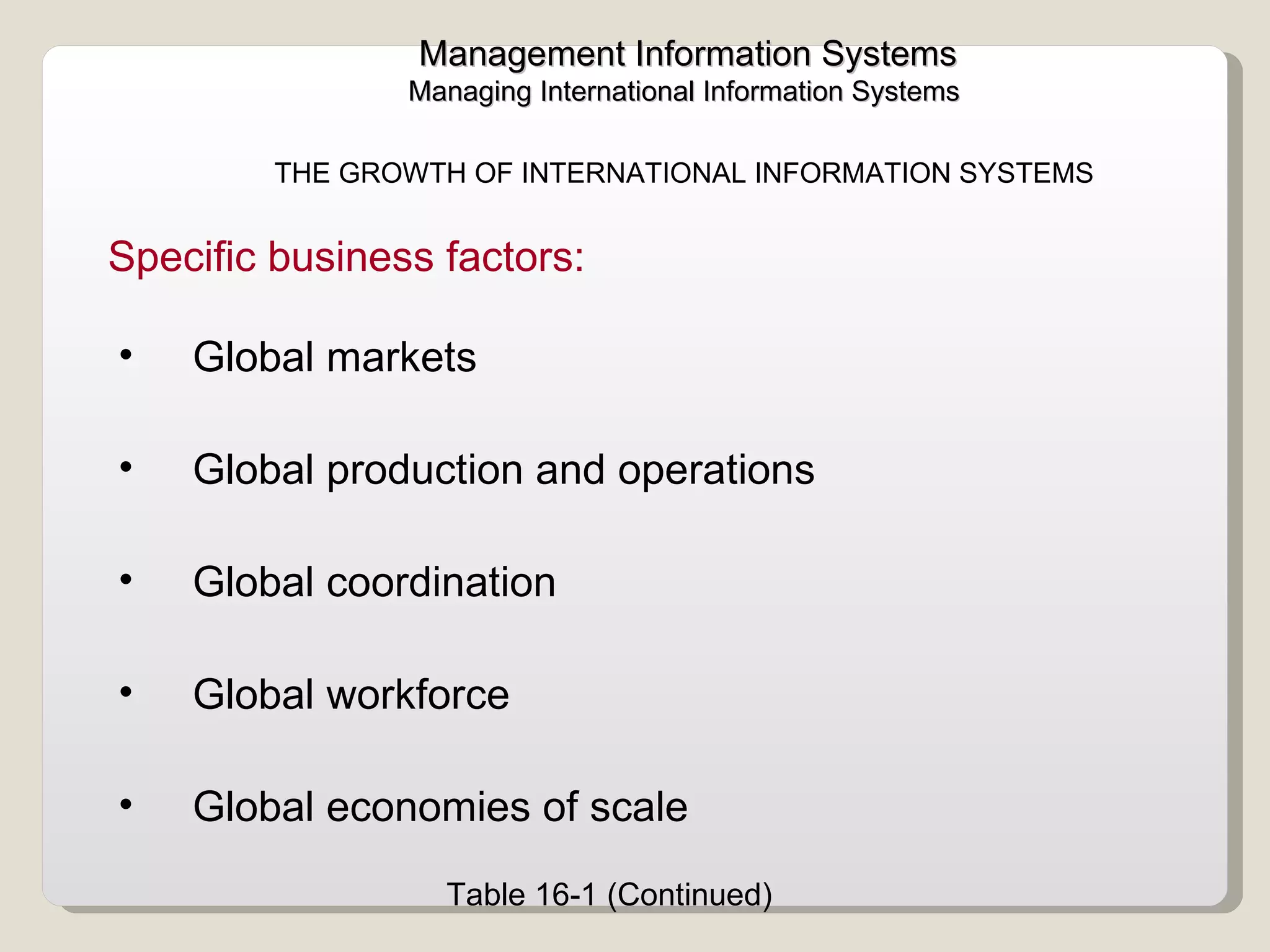
Management Information Systems Managing International Information Systems  THE GROWTH OF INTERNATIONAL INFORMATION SYSTEMS  Global markets  Global production and operations  Global coordination  Global workforce  Global economies of scale  Specific business factors:  Table 16-1 (Continued)
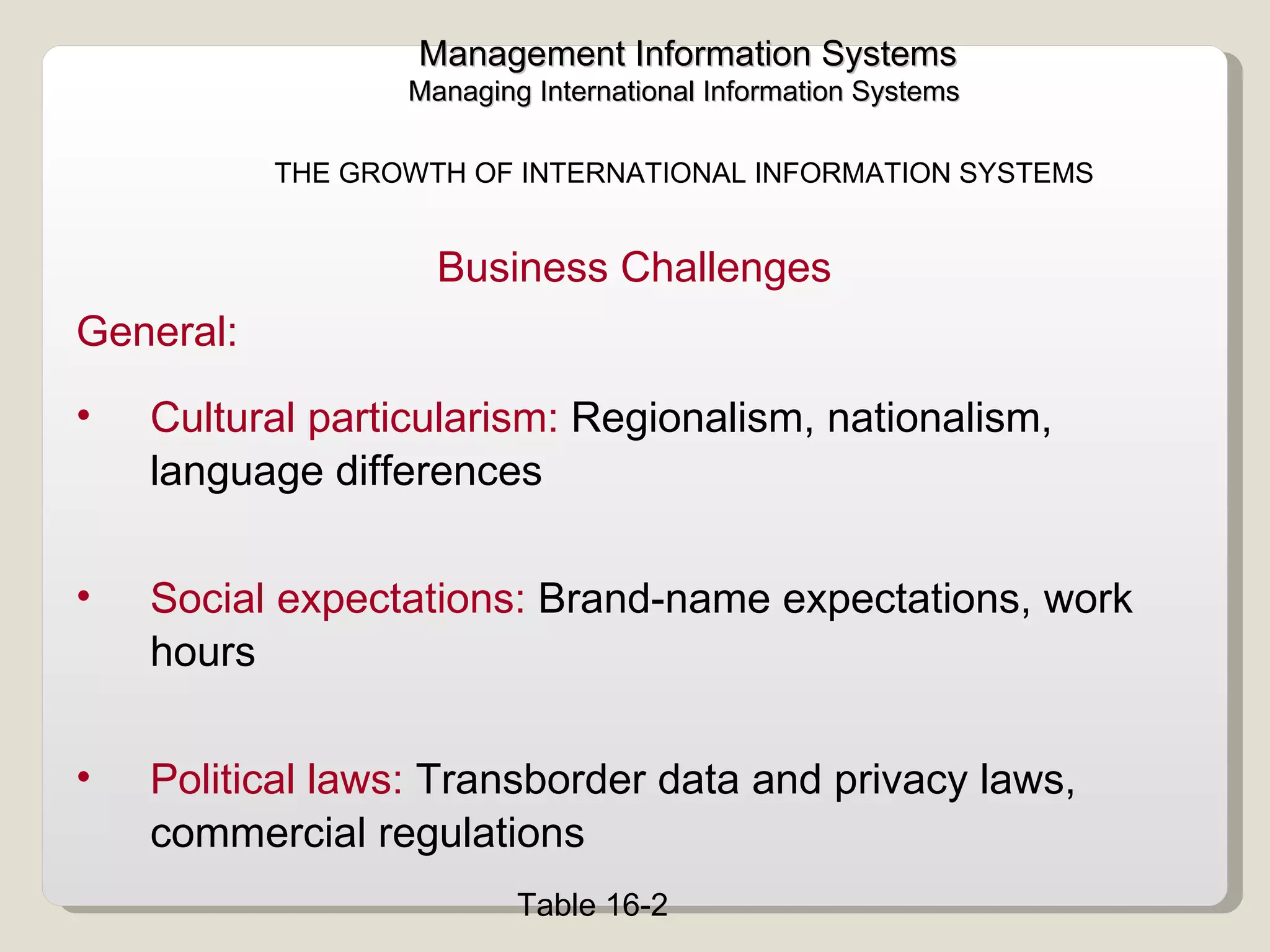
Management Information Systems Managing International Information Systems  THE GROWTH OF INTERNATIONAL INFORMATION SYSTEMS  Business Challenges  Cultural particularism:  Regionalism, nationalism, language differences Social expectations:  Brand-name expectations, work hours  Political laws:  Transborder data and privacy laws, commercial regulations  General:  Table 16-2
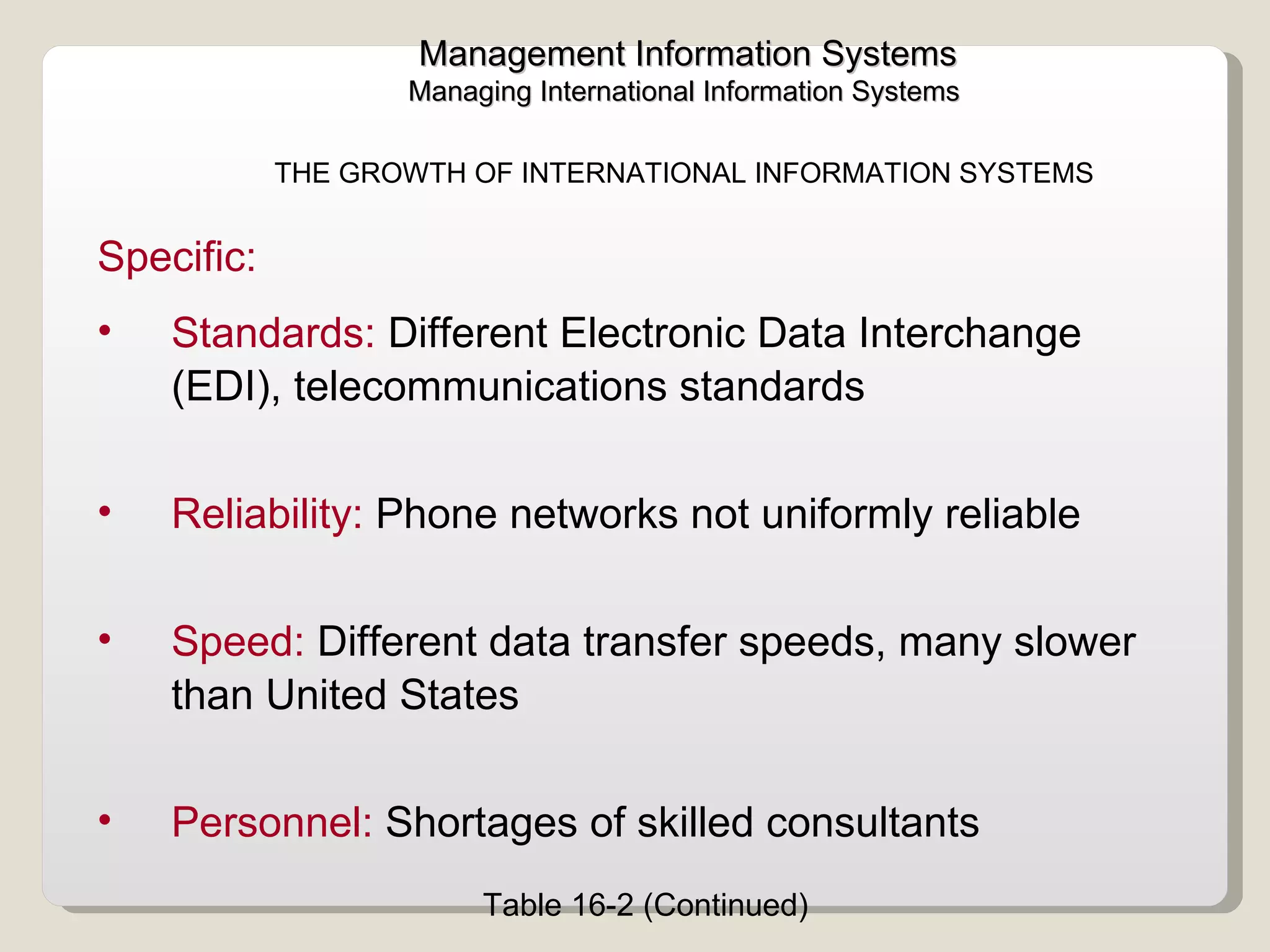
Management Information Systems Managing International Information Systems  THE GROWTH OF INTERNATIONAL INFORMATION SYSTEMS  Standards:   Different   Electronic Data Interchange (EDI), telecommunications standards  Reliability:  Phone networks not uniformly reliable Speed:   Different data transfer speeds, many slower than United States Personnel:   Shortages of skilled consultants Specific:  Table 16-2 (Continued)
Management Information Systems Managing International Information Systems  ORGANIZING INTERNATIONAL INFORMATION SYSTEMS  Three kinds of organizational structure: Centralized (in the home country) Decentralized (to local foreign units) Coordinated (all units participate as equals)  Global Strategies and Business Organization
Management Information Systems Managing International Information Systems  ORGANIZING INTERNATIONAL INFORMATION SYSTEMS  Heavy centralization of corporate activities in the home country of origin Domestic exporter strategy:  Centralized financial management and control while decentralizing production, sales, and marketing operations to units in other countries Multinational strategy:
Management Information Systems Managing International Information Systems  ORGANIZING INTERNATIONAL INFORMATION SYSTEMS  The product is financed and initially produced in the home country, but for product-specific reasons rely on foreign personnel for further production, marketing, and human resources. Franchisers:  The value-adding activities are managed from a global perspective without reference to national borders, optimizing sources of supply and demand wherever they appear, and taking advantage of any local competitive advantages. Transnational strategy:
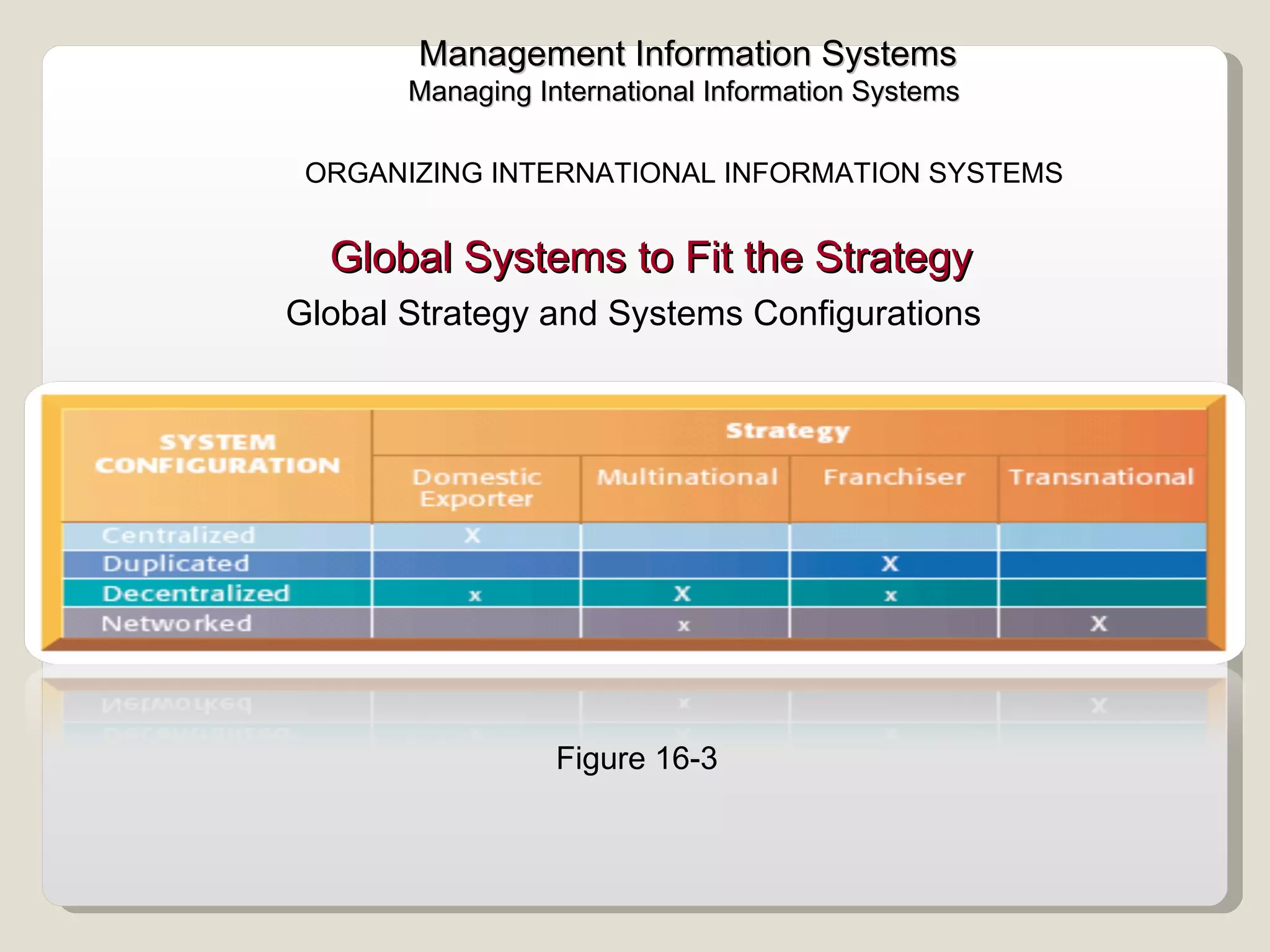
Global Systems to Fit the Strategy Global Strategy and Systems Configurations  Management Information Systems Managing International Information Systems  ORGANIZING INTERNATIONAL INFORMATION SYSTEMS  Figure 16-3
Management Information Systems Managing International Information Systems  Centralized systems:  Systems development and operation occur totally at the domestic home base.  Duplicated systems:  Development occurs at the home base but operations are handed over to autonomous units in foreign locations. Four types of systems configuration:  ORGANIZING INTERNATIONAL INFORMATION SYSTEMS
Management Information Systems Managing International Information Systems  3.   Decentralized systems:  Each foreign unit designs its own unique solutions and systems. 4.  Networked systems:  Systems development and operations occur in an integrated and coordinated fashion across all units. ORGANIZING INTERNATIONAL INFORMATION SYSTEMS  Four types of systems configuration: (Continued)
Management Information Systems Managing International Information Systems  ORGANIZING INTERNATIONAL INFORMATION SYSTEMS  Organize value-adding activities along lines of comparative advantage  Develop and operate systems units at each level of corporate activity —regional, national, and international  Establish at world headquarters  Reorganizing the Business To develop a global company and information systems support structure:
Management Information Systems Managing International Information Systems  MANAGING GLOBAL SYSTEMS  Agreeing on common user requirements Introducing changes in business processes Coordinating applications development Coordinating software releases Encouraging local users to support global systems  Management Challenges in Developing Global Systems  Table 16-4
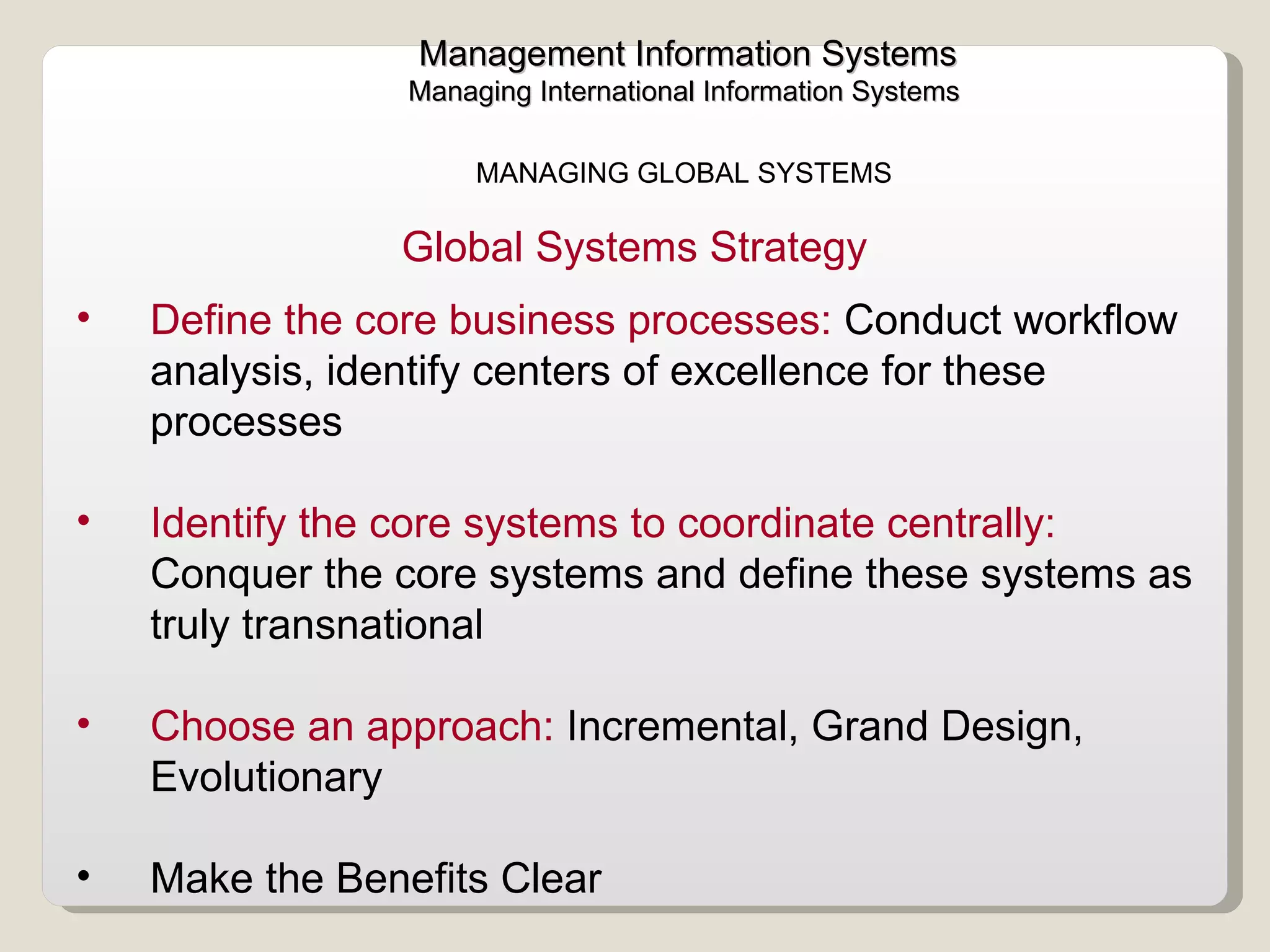
Management Information Systems Managing International Information Systems  MANAGING GLOBAL SYSTEMS  Define the core business processes:  Conduct workflow analysis, identify centers of excellence for these processes  Identify the core systems to coordinate centrally:  Conquer the core systems and define these systems as truly transnational Choose an approach:  Incremental, Grand Design, Evolutionary  Make the Benefits Clear  Global Systems Strategy
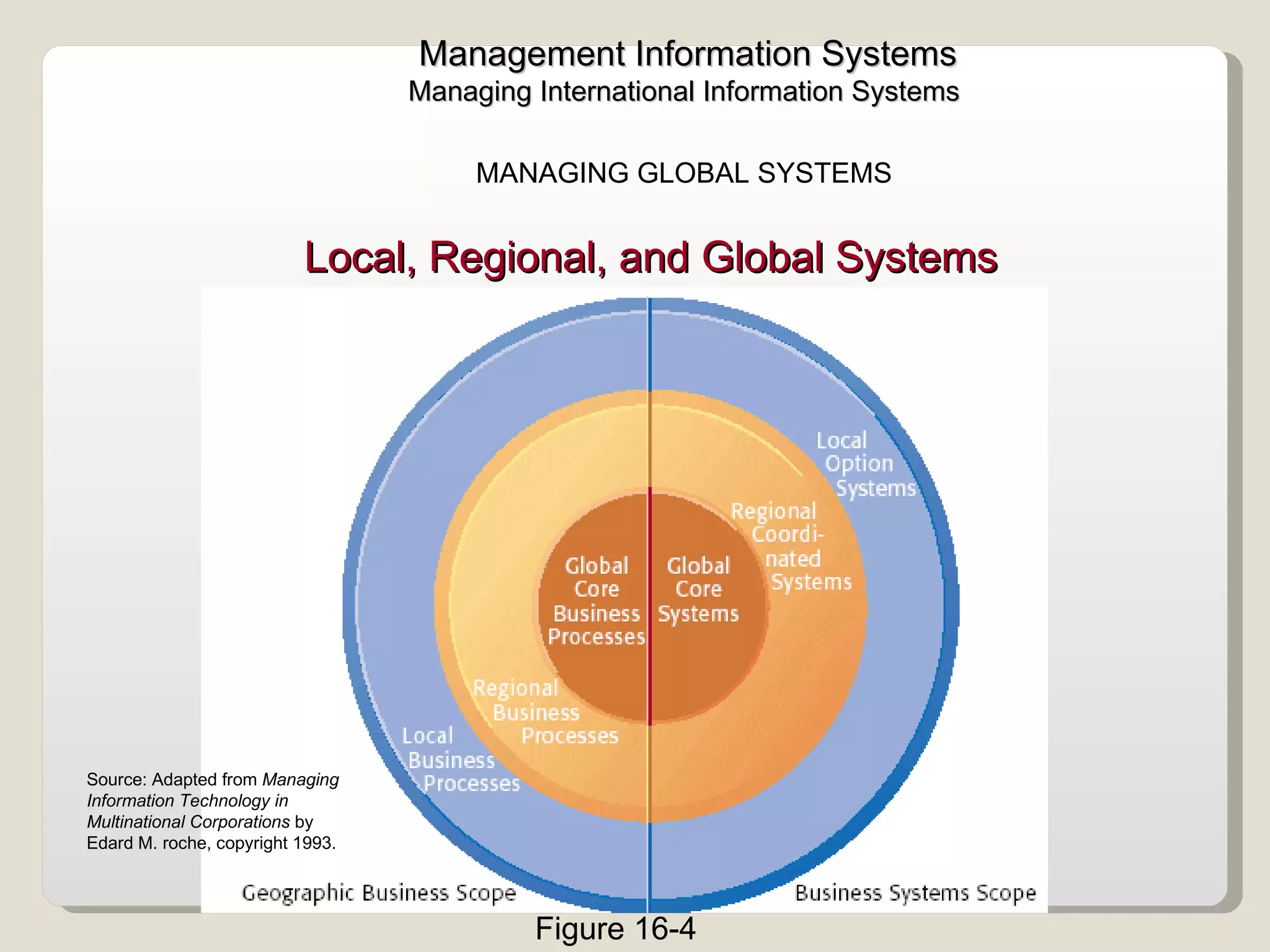
Local, Regional, and Global Systems Management Information Systems Managing International Information Systems  MANAGING GLOBAL SYSTEMS  Source: Adapted from  Managing Information Technology in Multinational Corporations  by Edard M. roche, copyright 1993. Figure 16-4
Management Information Systems Managing International Information Systems  TECHNOLOGY ISSUES AND OPPORTUNITIES FOR GLOBAL VALUE CHAINS  Computing platforms and systems integration:   Develop global, distributed, and integrated systems to support digital business processes spanning national boundaries Use of same hardware and operating system does not guarantee integration. Establish data and technical standards  Technology Challenges of Global Systems
Management Information Systems Managing International Information Systems  TECHNOLOGY ISSUES AND OPPORTUNITIES FOR GLOBAL VALUE CHAINS  Overcoming disparate national technical standards, data exchange restrictions and service levels User of Internet technology to create global intranets, extranets, virtual private networks (VPNs)  Connectivity: Technology Challenges of Global Systems (Continued)
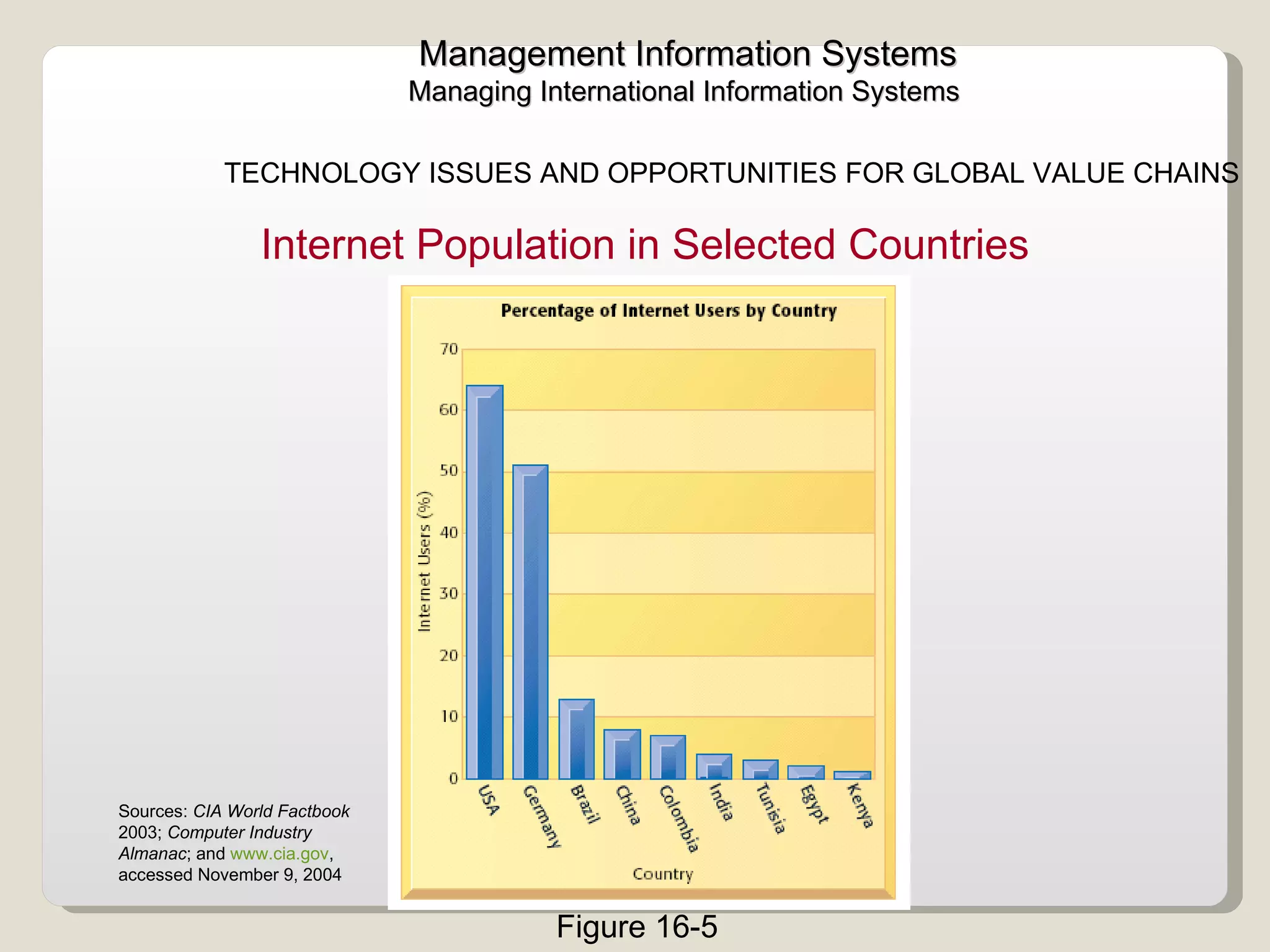
Internet Population in Selected Countries  Management Information Systems Managing International Information Systems  TECHNOLOGY ISSUES AND OPPORTUNITIES FOR GLOBAL VALUE CHAINS  Sources:  CIA World Factbook  2003;  Computer Industry Almanac ; and  www.cia.gov , accessed November 9, 2004 Figure 16-5
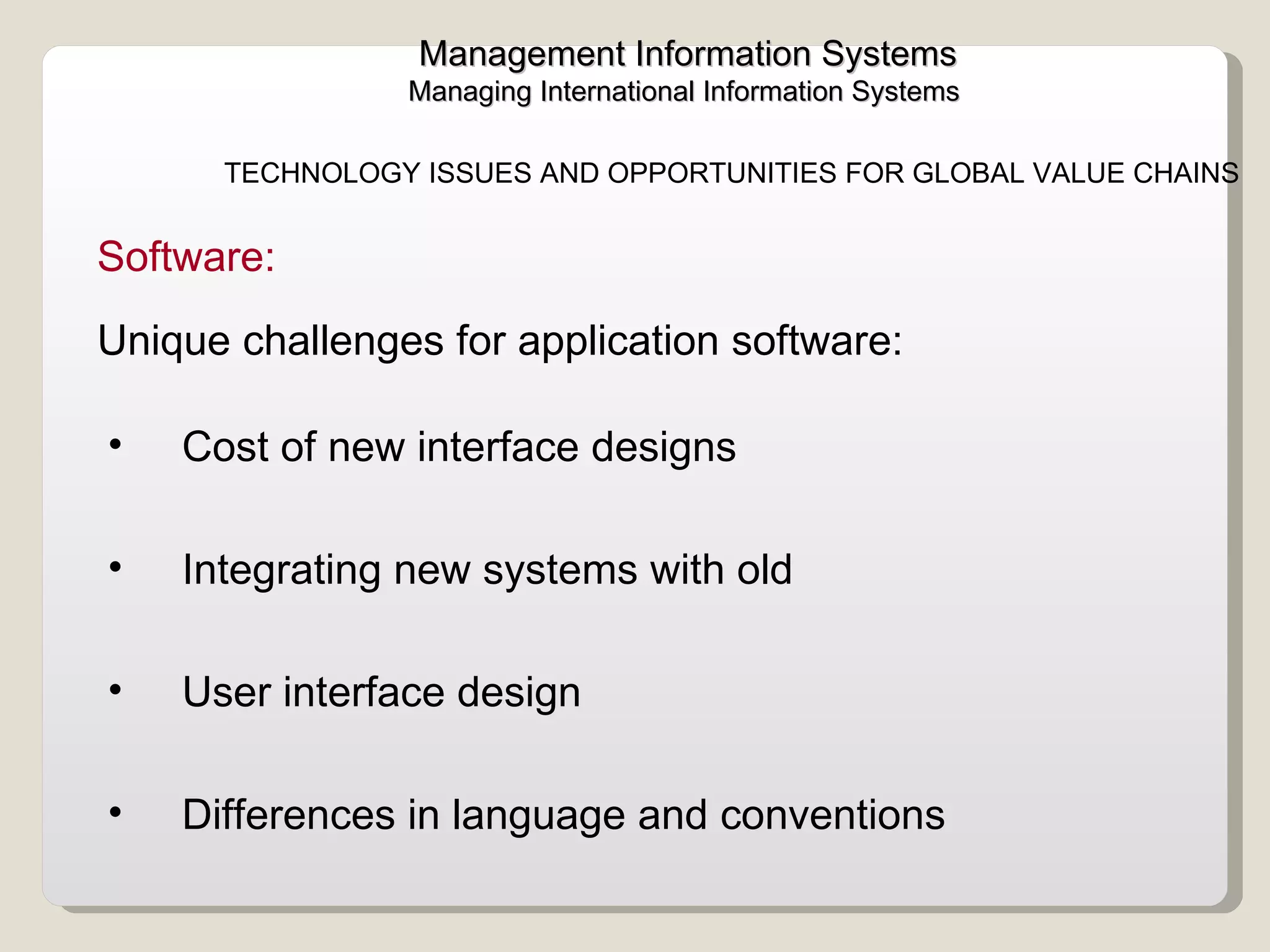
Management Information Systems Managing International Information Systems  TECHNOLOGY ISSUES AND OPPORTUNITIES FOR GLOBAL VALUE CHAINS  Cost of new interface designs Integrating new systems with old User interface design Differences in language and conventions  Software:  Unique challenges for application software:
Management Information Systems Managing International Information Systems  TECHNOLOGY ISSUES AND OPPORTUNITIES FOR GLOBAL VALUE CHAINS  Outsourcing portions of new systems like development work or maintenance of existing systems to external vendors in another country  Offshore software outsourcing:  Managing Global Software Development
Management Information Systems Managing International Information Systems  TECHNOLOGY ISSUES AND OPPORTUNITIES FOR GLOBAL VALUE CHAINS  Contract cost Vendor selection costs Transition management and knowledge transfer costs  Domestic human resources costs  Major cost components of offshore software development:
Management Information Systems Managing International Information Systems  TECHNOLOGY ISSUES AND OPPORTUNITIES FOR GLOBAL VALUE CHAINS  Costs of improving software development processes Costs of adjusting to cultural differences  Cost of managing an offshore contract  Major cost components of offshore software development: (Continued)
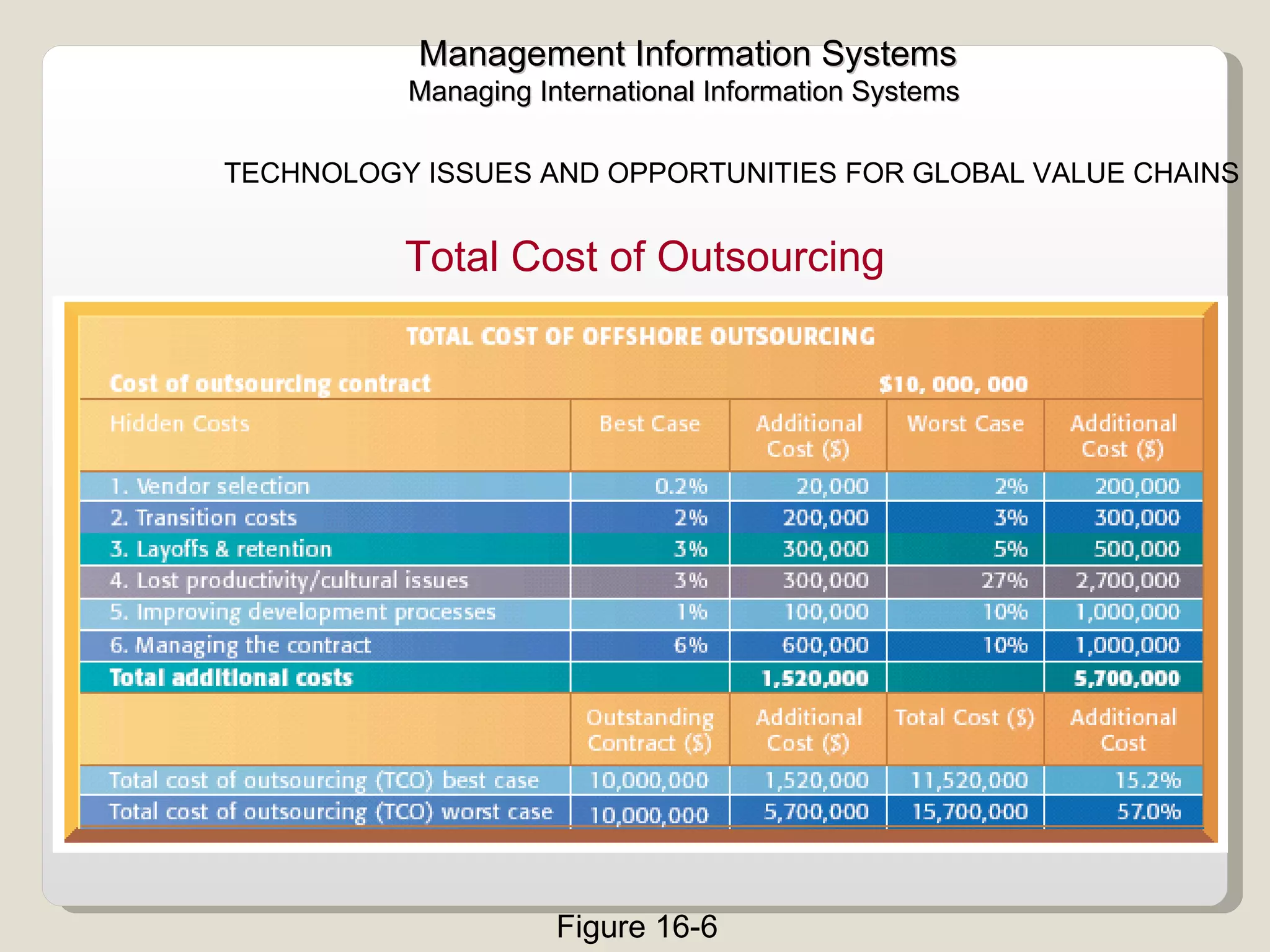
Total Cost of Outsourcing  Management Information Systems Managing International Information Systems  TECHNOLOGY ISSUES AND OPPORTUNITIES FOR GLOBAL VALUE CHAINS  Figure 16-6
Management Information Systems Managing International Information Systems  MANAGEMENT OPPORTUNITIES, CHALLENGES, AND SOLUTIONS Management Opportunities:  Ability to lower costs through global scale economies by building international systems for producing and selling goods and services in different regions of the world
Management Information Systems Managing International Information Systems  Finding the right global business strategy Difficulties of managing change in a multicultural firm Difficulties of achieving global connectivity and integration  Management Challenges:  MANAGEMENT OPPORTUNITIES, CHALLENGES, AND SOLUTIONS
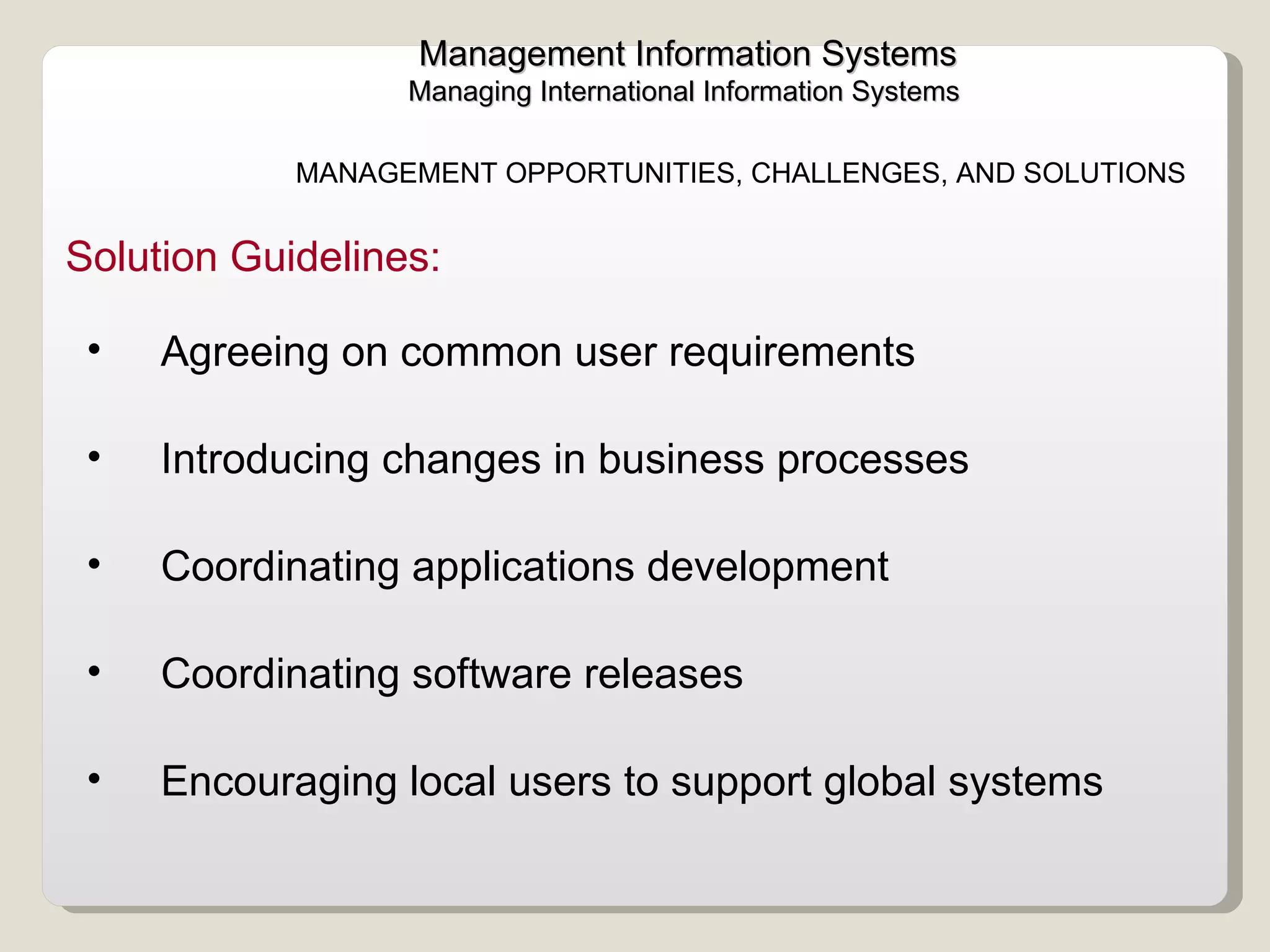
Management Information Systems Managing International Information Systems  Agreeing on common user requirements  Introducing changes in business processes  Coordinating applications development  Coordinating software releases  Encouraging local users to support global systems  Solution Guidelines:  MANAGEMENT OPPORTUNITIES, CHALLENGES, AND SOLUTIONS

Managing International Information Systems

  • 1.
    Managing International InformationSystems By The PowerPoint slides were developed by Mus Khairy (PhD), Stanford University at California. Educational ,Social Psychologists at German University at Cairo (GUC) unless otherwise noted on specific slides.
  • 2.
    Identify the majorfactors driving the internationalization of business Compare strategies for developing global businesses Demonstrate how information systems can support different global business strategies Management Information Systems Managing International Information Systems OBJECTIVES
  • 3.
    Evaluate the issuesand technical alternatives to be considered when developing international information systems Identify the challenges posed by global information systems and management solutions OBJECTIVES (Continued) Management Information Systems Managing International Information Systems
  • 4.
    Challenge: Fulfillcustomer orders made to a network of forty subsidiaries in Europe, Asia, and North America whose systems could not share data with one another Solutions: develop a single corporate database and use middleware with standard interfaces to connect all the subsidiary’s systems Develop a single worldwide data model with standard definitions and codes Illustrates the role of systems in an international environment for reducing inventory and business process costs worldwide. Management Information Systems Managing International Information Systems
  • 5.
    THE GROWTH OFINTERNATIONAL INFORMATION SYSTEMS Global Product Development and Production Management Information Systems Managing International Information Systems Figure 16-1
  • 6.
    The basic informationsystems required by organizations to coordinate worldwide trade and other activities Developing an International Information Systems Architecture International information systems architecture: Management Information Systems Managing International Information Systems THE GROWTH OF INTERNATIONAL INFORMATION SYSTEMS A force in the environment to which businesses must respond and that influences the direction of the business Business driver:
  • 7.
    International Information SystemsArchitecture Management Information Systems Managing International Information Systems THE GROWTH OF INTERNATIONAL INFORMATION SYSTEMS Figure 16-2
  • 8.
    The Global Environment:Business Drivers and Challenges The global business drivers can be divided into two groups: Management Information Systems Managing International Information Systems THE GROWTH OF INTERNATIONAL INFORMATION SYSTEMS Global communication and transportation technologies Development of global culture General cultural factors: Table 16-1
  • 9.
    Management Information SystemsManaging International Information Systems THE GROWTH OF INTERNATIONAL INFORMATION SYSTEMS Emergence of global social norms Political stability Global knowledge base Table 16-1 (Continued) General Cultural Factors: (Continued)
  • 10.
    Management Information SystemsManaging International Information Systems THE GROWTH OF INTERNATIONAL INFORMATION SYSTEMS Global markets Global production and operations Global coordination Global workforce Global economies of scale Specific business factors: Table 16-1 (Continued)
  • 11.
    Management Information SystemsManaging International Information Systems THE GROWTH OF INTERNATIONAL INFORMATION SYSTEMS Business Challenges Cultural particularism: Regionalism, nationalism, language differences Social expectations: Brand-name expectations, work hours Political laws: Transborder data and privacy laws, commercial regulations General: Table 16-2
  • 12.
    Management Information SystemsManaging International Information Systems THE GROWTH OF INTERNATIONAL INFORMATION SYSTEMS Standards: Different Electronic Data Interchange (EDI), telecommunications standards Reliability: Phone networks not uniformly reliable Speed: Different data transfer speeds, many slower than United States Personnel: Shortages of skilled consultants Specific: Table 16-2 (Continued)
  • 13.
    Management Information SystemsManaging International Information Systems ORGANIZING INTERNATIONAL INFORMATION SYSTEMS Three kinds of organizational structure: Centralized (in the home country) Decentralized (to local foreign units) Coordinated (all units participate as equals) Global Strategies and Business Organization
  • 14.
    Management Information SystemsManaging International Information Systems ORGANIZING INTERNATIONAL INFORMATION SYSTEMS Heavy centralization of corporate activities in the home country of origin Domestic exporter strategy: Centralized financial management and control while decentralizing production, sales, and marketing operations to units in other countries Multinational strategy:
  • 15.
    Management Information SystemsManaging International Information Systems ORGANIZING INTERNATIONAL INFORMATION SYSTEMS The product is financed and initially produced in the home country, but for product-specific reasons rely on foreign personnel for further production, marketing, and human resources. Franchisers: The value-adding activities are managed from a global perspective without reference to national borders, optimizing sources of supply and demand wherever they appear, and taking advantage of any local competitive advantages. Transnational strategy:
  • 16.
    Global Systems toFit the Strategy Global Strategy and Systems Configurations Management Information Systems Managing International Information Systems ORGANIZING INTERNATIONAL INFORMATION SYSTEMS Figure 16-3
  • 17.
    Management Information SystemsManaging International Information Systems Centralized systems: Systems development and operation occur totally at the domestic home base. Duplicated systems: Development occurs at the home base but operations are handed over to autonomous units in foreign locations. Four types of systems configuration: ORGANIZING INTERNATIONAL INFORMATION SYSTEMS
  • 18.
    Management Information SystemsManaging International Information Systems 3. Decentralized systems: Each foreign unit designs its own unique solutions and systems. 4. Networked systems: Systems development and operations occur in an integrated and coordinated fashion across all units. ORGANIZING INTERNATIONAL INFORMATION SYSTEMS Four types of systems configuration: (Continued)
  • 19.
    Management Information SystemsManaging International Information Systems ORGANIZING INTERNATIONAL INFORMATION SYSTEMS Organize value-adding activities along lines of comparative advantage Develop and operate systems units at each level of corporate activity —regional, national, and international Establish at world headquarters Reorganizing the Business To develop a global company and information systems support structure:
  • 20.
    Management Information SystemsManaging International Information Systems MANAGING GLOBAL SYSTEMS Agreeing on common user requirements Introducing changes in business processes Coordinating applications development Coordinating software releases Encouraging local users to support global systems Management Challenges in Developing Global Systems Table 16-4
  • 21.
    Management Information SystemsManaging International Information Systems MANAGING GLOBAL SYSTEMS Define the core business processes: Conduct workflow analysis, identify centers of excellence for these processes Identify the core systems to coordinate centrally: Conquer the core systems and define these systems as truly transnational Choose an approach: Incremental, Grand Design, Evolutionary Make the Benefits Clear Global Systems Strategy
  • 22.
    Local, Regional, andGlobal Systems Management Information Systems Managing International Information Systems MANAGING GLOBAL SYSTEMS Source: Adapted from Managing Information Technology in Multinational Corporations by Edard M. roche, copyright 1993. Figure 16-4
  • 23.
    Management Information SystemsManaging International Information Systems TECHNOLOGY ISSUES AND OPPORTUNITIES FOR GLOBAL VALUE CHAINS Computing platforms and systems integration: Develop global, distributed, and integrated systems to support digital business processes spanning national boundaries Use of same hardware and operating system does not guarantee integration. Establish data and technical standards Technology Challenges of Global Systems
  • 24.
    Management Information SystemsManaging International Information Systems TECHNOLOGY ISSUES AND OPPORTUNITIES FOR GLOBAL VALUE CHAINS Overcoming disparate national technical standards, data exchange restrictions and service levels User of Internet technology to create global intranets, extranets, virtual private networks (VPNs) Connectivity: Technology Challenges of Global Systems (Continued)
  • 25.
    Internet Population inSelected Countries Management Information Systems Managing International Information Systems TECHNOLOGY ISSUES AND OPPORTUNITIES FOR GLOBAL VALUE CHAINS Sources: CIA World Factbook 2003; Computer Industry Almanac ; and www.cia.gov , accessed November 9, 2004 Figure 16-5
  • 26.
    Management Information SystemsManaging International Information Systems TECHNOLOGY ISSUES AND OPPORTUNITIES FOR GLOBAL VALUE CHAINS Cost of new interface designs Integrating new systems with old User interface design Differences in language and conventions Software: Unique challenges for application software:
  • 27.
    Management Information SystemsManaging International Information Systems TECHNOLOGY ISSUES AND OPPORTUNITIES FOR GLOBAL VALUE CHAINS Outsourcing portions of new systems like development work or maintenance of existing systems to external vendors in another country Offshore software outsourcing: Managing Global Software Development
  • 28.
    Management Information SystemsManaging International Information Systems TECHNOLOGY ISSUES AND OPPORTUNITIES FOR GLOBAL VALUE CHAINS Contract cost Vendor selection costs Transition management and knowledge transfer costs Domestic human resources costs Major cost components of offshore software development:
  • 29.
    Management Information SystemsManaging International Information Systems TECHNOLOGY ISSUES AND OPPORTUNITIES FOR GLOBAL VALUE CHAINS Costs of improving software development processes Costs of adjusting to cultural differences Cost of managing an offshore contract Major cost components of offshore software development: (Continued)
  • 30.
    Total Cost ofOutsourcing Management Information Systems Managing International Information Systems TECHNOLOGY ISSUES AND OPPORTUNITIES FOR GLOBAL VALUE CHAINS Figure 16-6
  • 31.
    Management Information SystemsManaging International Information Systems MANAGEMENT OPPORTUNITIES, CHALLENGES, AND SOLUTIONS Management Opportunities: Ability to lower costs through global scale economies by building international systems for producing and selling goods and services in different regions of the world
  • 32.
    Management Information SystemsManaging International Information Systems Finding the right global business strategy Difficulties of managing change in a multicultural firm Difficulties of achieving global connectivity and integration Management Challenges: MANAGEMENT OPPORTUNITIES, CHALLENGES, AND SOLUTIONS
  • 33.
    Management Information SystemsManaging International Information Systems Agreeing on common user requirements Introducing changes in business processes Coordinating applications development Coordinating software releases Encouraging local users to support global systems Solution Guidelines: MANAGEMENT OPPORTUNITIES, CHALLENGES, AND SOLUTIONS