Closing the Gaps
in Leadership Development


                                   By: Brigitta Theleman
                             Director, OneMBA Program
                       UNC Kenan-Flagler Business School

                                            All Content ยฉ UNC Executive Development 2011
           Website: www.execdev.unc.edu | Phone: 1.800.862.3932 | Email: unc_exec@unc.edu
Closing the Gaps in Leadership Development


        Our Promise
        This white paper examines the knowledge, skills and abilities business leaders must have to
        ensure the continued success of their organizations in todayโ€™s competitive global
        marketplace. It will introduce HR and talent management professionals to a four-step
        process taught at UNCโ€™s Kenan-Flagler Business School to improve leadership skills and to
        create a leadership culture within organizations.

        Introduction

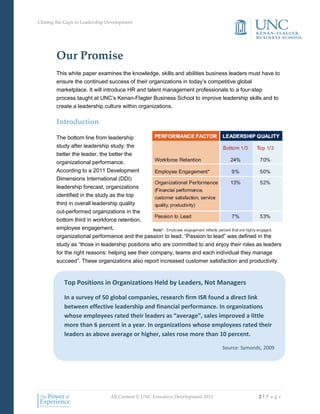
        The bottom line from leadership
        study after leadership study: the
        better the leader, the better the
        organizational performance.
        According to a 2011 Development
        Dimensions International (DDI)
        leadership forecast, organizations
        identified in the study as the top
        third in overall leadership quality
        out-performed organizations in the
        bottom third in workforce retention,
        employee engagement,
        organizational performance and the passion to lead. โ€œPassion to leadโ€ was defined in the
        study as โ€œthose in leadership positions who are committed to and enjoy their roles as leaders
        for the right reasons: helping see their company, teams and each individual they manage
        succeedโ€. These organizations also report increased customer satisfaction and productivity.


           Top Positions in Organizations Held by Leaders, Not Managers

           In a survey of 50 global companies, research firm ISR found a direct link
           between effective leadership and financial performance. In organizations
           whose employees rated their leaders as โ€œaverageโ€, sales improved a little
           more than 6 percent in a year. In organizations whose employees rated their
           leaders as above average or higher, sales rose more than 10 percent.

                                                                               Source: Symonds, 2009


                                All Content ยฉ UNC Executive Development 2011                 2|P a g e
Closing the Gaps in Leadership Development


        HR and talent management professionals know the value of strong leadership but continue
        to struggle to create learning cultures in their organizations:

            โ€ข   According to the DDI report, 66 percent of leaders in organizations that rate their
                overall leadership quality as high are confident of their organizationโ€™s success. Only 4
                percent of leaders in organizations with low leadership quality are confident of their
                organizationโ€™s success.


            โ€ข   An American Management Association study found that organizations with global
                leadership programs in place are more likely to report higher market performance.
                Only about two-fifths of respondents, however, agreed or strongly agreed with the
                statement that their โ€œleadership development program is highly effective.โ€ That same
                study found that among companies with 1,000 or more employees and some degree
                of a multinational presence, approximately half had implemented one or more
                leadership development programs (Vickers, 2010).

            โ€ข   A report by Theresa Minton-Eversole, editor/manager for SHRM Online, found that
                only 40 percent of employers reported having a formal succession or executive
                coaching program in place, and only 54 percent said they had a process in place to
                identify high potential employees (Minton-Eversole, 2009).


        Leadership Knowledge, Skills and
        Abilities Needed Today
        An increasing number of employers understand the connection between leadership and
        organizational success. During the recent recession when organizations slashed training
        budgets, leadership development programs were retained (Mattiolli, 2009). Employers
        learned their lesson from previous lean times and knew that if they were to emerge from the
        recession in good shape, they needed to find, keep and foster good leaders to effectively
        lead in difficult times.

        But what skills do business leaders need for todayโ€™s business environment? The DDI study
        tried to determine whether the skill sets leaders need in todayโ€™s business environment would
        be the same needed in the next few years. They found that some of the key skills required
        today, such as driving and managing change; coaching and developing others; and
        executing organizational strategy, would still be required. Two new skills were identified as
        being increasingly vital in the near future: identifying and developing future talent and


                                All Content ยฉ UNC Executive Development 2011                  3|P a g e
Closing the Gaps in Leadership Development


        fostering creativity and innovation. These latter skills speak directly to the increasing
        influence of HR and talent management professionals in an organization. An IBM study also
        noted that creativity and innovation were critical leadership skills. Neuroscientist and founder
        of the NeuroLeadership Institute David Rock would add adaptability to that list (Fox, 2011).


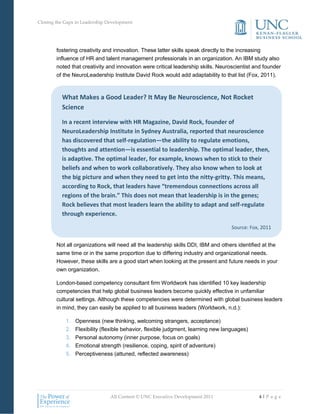
          What Makes a Good Leader? It May Be Neuroscience, Not Rocket
          Science

          In a recent interview with HR Magazine, David Rock, founder of
          NeuroLeadership Institute in Sydney Australia, reported that neuroscience
          has discovered that self-regulationโ€”the ability to regulate emotions,
          thoughts and attentionโ€”is essential to leadership. The optimal leader, then,
          is adaptive. The optimal leader, for example, knows when to stick to their
          beliefs and when to work collaboratively. They also know when to look at
          the big picture and when they need to get into the nitty-gritty. This means,
          according to Rock, that leaders have โ€œtremendous connections across all
          regions of the brain.โ€ This does not mean that leadership is in the genes;
          Rock believes that most leaders learn the ability to adapt and self-regulate
          through experience.

                                                                                   Source: Fox, 2011


        Not all organizations will need all the leadership skills DDI, IBM and others identified at the
        same time or in the same proportion due to differing industry and organizational needs.
        However, these skills are a good start when looking at the present and future needs in your
        own organization.

        London-based competency consultant firm Worldwork has identified 10 key leadership
        competencies that help global business leaders become quickly effective in unfamiliar
        cultural settings. Although these competencies were determined with global business leaders
        in mind, they can easily be applied to all business leaders (Worldwork, n.d.):

            1.   Openness (new thinking, welcoming strangers, acceptance)
            2.   Flexibility (flexible behavior, flexible judgment, learning new languages)
            3.   Personal autonomy (inner purpose, focus on goals)
            4.   Emotional strength (resilience, coping, spirit of adventure)
            5.   Perceptiveness (attuned, reflected awareness)


                                All Content ยฉ UNC Executive Development 2011                   4|P a g e
Closing the Gaps in Leadership Development


            6.   Listening orientation (active listening)
            7.   Transparency (clarity of communication, exposing intentions)
            8.   Cultural knowledge (information gathering, valuing differences)
            9.   Influencing (rapport, range of styles, sensitivity to context)
            10. Synergy (creating new alternatives)

        Talent development and HR professionals should identify the knowledge, skills and abilities
        required for leaders in their organization so that they can build a framework that will support
        the development of these competencies.


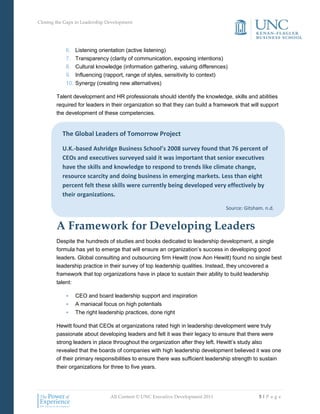
          The Global Leaders of Tomorrow Project

          U.K.-based Ashridge Business Schoolโ€™s 2008 survey found that 76 percent of
          CEOs and executives surveyed said it was important that senior executives
          have the skills and knowledge to respond to trends like climate change,
          resource scarcity and doing business in emerging markets. Less than eight
          percent felt these skills were currently being developed very effectively by
          their organizations.

                                                                                Source: Gitsham, n.d.


        A Framework for Developing Leaders
        Despite the hundreds of studies and books dedicated to leadership development, a single
        formula has yet to emerge that will ensure an organizationโ€™s success in developing good
        leaders. Global consulting and outsourcing firm Hewitt (now Aon Hewitt) found no single best
        leadership practice in their survey of top leadership qualities. Instead, they uncovered a
        framework that top organizations have in place to sustain their ability to build leadership
        talent:

            โ€ข    CEO and board leadership support and inspiration
            โ€ข    A maniacal focus on high potentials
            โ€ข    The right leadership practices, done right

        Hewitt found that CEOs at organizations rated high in leadership development were truly
        passionate about developing leaders and felt it was their legacy to ensure that there were
        strong leaders in place throughout the organization after they left. Hewittโ€™s study also
        revealed that the boards of companies with high leadership development believed it was one
        of their primary responsibilities to ensure there was sufficient leadership strength to sustain
        their organizations for three to five years.


                                All Content ยฉ UNC Executive Development 2011                  5|P a g e
Closing the Gaps in Leadership Development


        Not surprisingly, organizations with strong leadership development cultures (called Top
        Companies in the Hewitt study) identify and keep a sharp eye on their high potential
        employees. The Hewitt study found that 95 percent of the Top Companies in leadership
        development identify high potentials as compared with 77 percent of other companies. Top
        Companies track turnover of high potentials 72 percent of the time, versus 60 percent in
        other companies. In addition, the Top Companies use internal training and developmental
        assignments with high potential employees 90 and 89 percent of the time, respectively. In
        comparison, non-top companies use the same development activities just 51 percent and 43
        percent. Top Companies also compensate high potential employees just for being high
        potential 75 percent of the time, versus 38 percent of the time for non-top companies.

        Hewitt found that Top Companies develop the right leadership practices for their organization
        and industry and ensure accountability for their success 85 percent of the time, versus 35
        percent for non-top companies. In addition, 85 percent of Top Company leaders are held
        accountable for developing high potentials through performance management systems
        versus 46 percent in non-top companies, further demonstrating the leadership development
        culture developed in Top Companies.

        Top-performing companies may focus on different leadership skills to develop based on
        industry and organizational needs, but share the three common themes just described: top
        management and board-level support for leadership development, an organizational
        commitment to high potential employees, and accountability for the success of their
        leadership practices.

        Talent management and HR professionals should assess whether these three factors exist in
        their organizations because they are vital to creating leadership learning cultures that will
        ultimately make their organizations stronger and more successful.


        Closing the Gap with the Continuous
        Learning Cycle
        You can spend a lifetime reading about leadership; a quick Internet search will show that
        there are nearly 70,000 books on the subject available through Amazon.com and more than
        two million research articles. Thought leaders at UNCโ€™s Kenan-Flagler Business School have
        condensed the best of these publications into an effective continuous learning cycle that HR
        and talent management professionals can incorporate into their organizationsโ€™ leadership
        development programs to strengthen each individualโ€™s ability to learn and adapt as a leader.
        The continuous learning cycle is an integrated approach that focuses on the following four
        core components and produces solid results in leadership development.


                                All Content ยฉ UNC Executive Development 2011                6|P a g e
Closing the Gaps in Leadership Development


        The Continuous Learning Cycle

        1. Principles

        Principles are the knowledge, skills and abilities leaders need to
        possess. The first step in an organizationโ€™s leadership
        development plan begins with identifying what knowledge, skills
        and abilities need to be further developed in the organization.
        These can include such areas as:

            โ€ข   Leading and managing (decision-making, problem-solving, using power and
                authority)


            โ€ข   Strategy (developing a business strategy and using strategy to make informed
                business decisions)

            โ€ข   Ethics (facing ethical dilemma and exhibiting integrity, courage, compassion and
                honesty)


            โ€ข   Management communication (clearly expressing authority, persuasion, motivation,
                transparency, influence and inspiration)

        This is by no means an inclusive list as the results of studies by DDI, IBM and others can
        attest. Other areas that could be identified for development may include the ability to deal
        with ambiguity, working well with others (teamwork), negotiating effectively, developing self-
        awareness or developing open-mindedness (a development area that is vital to a global
        leaderโ€™s success).

        Corporate Example: IBMโ€™s Corporate Service Corps Development
        Program

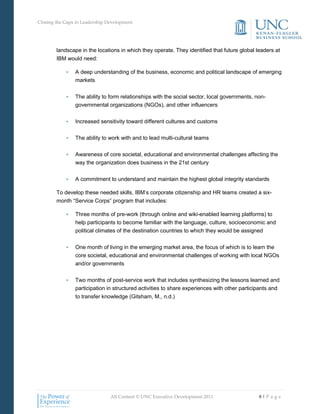
                           In 2007, a team of 30 top leaders at IBM set out to identify the knowledge
                           and skills that IBM would require of its future leaders. The team discovered
                           that in the past, it was sufficient for IBM leaders to know about the
        business. In the future, however, they would need to be aware of the wider political


                                All Content ยฉ UNC Executive Development 2011                 7|P a g e
Closing the Gaps in Leadership Development


        landscape in the locations in which they operate. They identified that future global leaders at
        IBM would need:

            โ€ข   A deep understanding of the business, economic and political landscape of emerging
                markets


            โ€ข   The ability to form relationships with the social sector, local governments, non-
                governmental organizations (NGOs), and other influencers

            โ€ข   Increased sensitivity toward different cultures and customs

            โ€ข   The ability to work with and to lead multi-cultural teams

            โ€ข   Awareness of core societal, educational and environmental challenges affecting the
                way the organization does business in the 21st century


            โ€ข   A commitment to understand and maintain the highest global integrity standards

        To develop these needed skills, IBMโ€™s corporate citizenship and HR teams created a six-
        month โ€œService Corpsโ€ program that includes:

            โ€ข   Three months of pre-work (through online and wiki-enabled learning platforms) to
                help participants to become familiar with the language, culture, socioeconomic and
                political climates of the destination countries to which they would be assigned

            โ€ข   One month of living in the emerging market area, the focus of which is to learn the
                core societal, educational and environmental challenges of working with local NGOs
                and/or governments

            โ€ข   Two months of post-service work that includes synthesizing the lessons learned and
                participation in structured activities to share experiences with other participants and
                to transfer knowledge (Gitsham, M., n.d.)


                                All Content ยฉ UNC Executive Development 2011                  8|P a g e
Closing the Gaps in Leadership Development


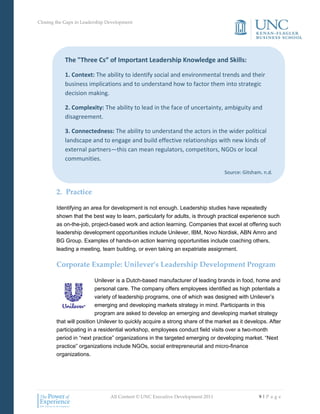
            The "Three Csโ€ of Important Leadership Knowledge and Skills:

            1. Context: The ability to identify social and environmental trends and their
            business implications and to understand how to factor them into strategic
            decision making.

            2. Complexity: The ability to lead in the face of uncertainty, ambiguity and
            disagreement.

            3. Connectedness: The ability to understand the actors in the wider political
            landscape and to engage and build effective relationships with new kinds of
            external partnersโ€”this can mean regulators, competitors, NGOs or local
            communities.

                                                                                Source: Gitsham, n.d.


        2. Practice

        Identifying an area for development is not enough. Leadership studies have repeatedly
        shown that the best way to learn, particularly for adults, is through practical experience such
        as on-the-job, project-based work and action learning. Companies that excel at offering such
        leadership development opportunities include Unilever, IBM, Novo Nordisk, ABN Amro and
        BG Group. Examples of hands-on action learning opportunities include coaching others,
        leading a meeting, team building, or even taking an expatriate assignment.

        Corporate Example: Unileverโ€™s Leadership Development Program

                          Unilever is a Dutch-based manufacturer of leading brands in food, home and
                          personal care. The company offers employees identified as high potentials a
                          variety of leadership programs, one of which was designed with Unileverโ€™s
                          emerging and developing markets strategy in mind. Participants in this
                          program are asked to develop an emerging and developing market strategy
        that will position Unilever to quickly acquire a strong share of the market as it develops. After
        participating in a residential workshop, employees conduct field visits over a two-month
        period in โ€œnext practiceโ€ organizations in the targeted emerging or developing market. โ€œNext
        practiceโ€ organizations include NGOs, social entrepreneurial and micro-finance
        organizations.


                                All Content ยฉ UNC Executive Development 2011                   9|P a g e
Closing the Gaps in Leadership Development


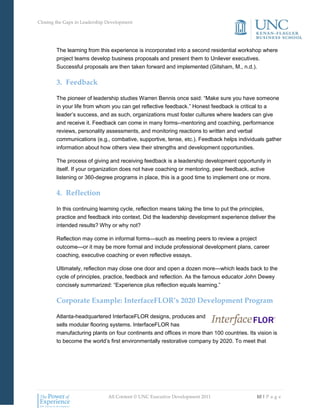
        The learning from this experience is incorporated into a second residential workshop where
        project teams develop business proposals and present them to Unilever executives.
        Successful proposals are then taken forward and implemented (Gitsham, M., n.d.).

        3. Feedback

        The pioneer of leadership studies Warren Bennis once said: โ€œMake sure you have someone
        in your life from whom you can get reflective feedback.โ€ Honest feedback is critical to a
        leaderโ€™s success, and as such, organizations must foster cultures where leaders can give
        and receive it. Feedback can come in many forms--mentoring and coaching, performance
        reviews, personality assessments, and monitoring reactions to written and verbal
        communications (e.g., combative, supportive, tense, etc.). Feedback helps individuals gather
        information about how others view their strengths and development opportunities.

        The process of giving and receiving feedback is a leadership development opportunity in
        itself. If your organization does not have coaching or mentoring, peer feedback, active
        listening or 360-degree programs in place, this is a good time to implement one or more.

        4. Reflection

        In this continuing learning cycle, reflection means taking the time to put the principles,
        practice and feedback into context. Did the leadership development experience deliver the
        intended results? Why or why not?

        Reflection may come in informal formsโ€”such as meeting peers to review a project
        outcomeโ€”or it may be more formal and include professional development plans, career
        coaching, executive coaching or even reflective essays.

        Ultimately, reflection may close one door and open a dozen moreโ€”which leads back to the
        cycle of principles, practice, feedback and reflection. As the famous educator John Dewey
        concisely summarized: โ€œExperience plus reflection equals learning.โ€

        Corporate Example: InterfaceFLORโ€™s 2020 Development Program

        Atlanta-headquartered InterfaceFLOR designs, produces and
        sells modular flooring systems. InterfaceFLOR has
        manufacturing plants on four continents and offices in more than 100 countries. Its vision is
        to become the worldโ€™s first environmentally restorative company by 2020. To meet that


                               All Content ยฉ UNC Executive Development 2011                 10 | P a g e
Closing the Gaps in Leadership Development


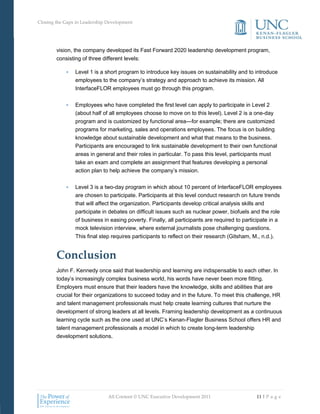
        vision, the company developed its Fast Forward 2020 leadership development program,
        consisting of three different levels:

            โ€ข   Level 1 is a short program to introduce key issues on sustainability and to introduce
                employees to the companyโ€™s strategy and approach to achieve its mission. All
                InterfaceFLOR employees must go through this program.

            โ€ข   Employees who have completed the first level can apply to participate in Level 2
                (about half of all employees choose to move on to this level). Level 2 is a one-day
                program and is customized by functional areaโ€”for example; there are customized
                programs for marketing, sales and operations employees. The focus is on building
                knowledge about sustainable development and what that means to the business.
                Participants are encouraged to link sustainable development to their own functional
                areas in general and their roles in particular. To pass this level, participants must
                take an exam and complete an assignment that features developing a personal
                action plan to help achieve the companyโ€™s mission.


            โ€ข   Level 3 is a two-day program in which about 10 percent of InterfaceFLOR employees
                are chosen to participate. Participants at this level conduct research on future trends
                that will affect the organization. Participants develop critical analysis skills and
                participate in debates on difficult issues such as nuclear power, biofuels and the role
                of business in easing poverty. Finally, all participants are required to participate in a
                mock television interview, where external journalists pose challenging questions.
                This final step requires participants to reflect on their research (Gitsham, M., n.d.).


        Conclusion
        John F. Kennedy once said that leadership and learning are indispensable to each other. In
        todayโ€™s increasingly complex business world, his words have never been more fitting.
        Employers must ensure that their leaders have the knowledge, skills and abilities that are
        crucial for their organizations to succeed today and in the future. To meet this challenge, HR
        and talent management professionals must help create learning cultures that nurture the
        development of strong leaders at all levels. Framing leadership development as a continuous
        learning cycle such as the one used at UNCโ€™s Kenan-Flagler Business School offers HR and
        talent management professionals a model in which to create long-term leadership
        development solutions.


                               All Content ยฉ UNC Executive Development 2011                    11 | P a g e
Closing the Gaps in Leadership Development


        About UNC Executive Development
        Our approach to program design and delivery draws upon the power of real-world, applicable
        experiences from our faculty and staff, integrated with the knowledge our client partners
        share about the challenges they face.

        We call this approach The Power of Experience. We combine traditional with experiential
        and unique learning. Through action learning and business simulation activities, we
        challenge participants to think, reflect and make decisions differently.


        Our Approach: The Partnership

        Our team customizes each leadership program through a highly collaborative process that
        involves our clients, program directors, faculty and program managers. This integrated
        approach consistently drives strong outcomes.


        Our Approach: The Results

        Our executive education programs are designed with results in mind. Below are a few
        examples of the results our client partners have achieved:


            ๏‚ท   Leadership refocused with new             ๏‚ท   Products redefined
                strategy and cohesive vision              ๏‚ท   New markets targeted
            ๏‚ท   Strategic plans created for the           ๏‚ท   Cost-saving measures developed
                global marketplace                        ๏‚ท   Silos leveled
            ๏‚ท   Supply chains streamlined                 ๏‚ท   Teams aligned

        Participants leave empowered to bring in new ideas, present different ways to grow business
        and tackle challenges. The result is stronger individuals leading stronger teams and
        organizations.

        At UNC Kenan-Flagler Business School, leadership development is a
        serious commitment that we make to each individualโ€™s long-term career
        success. To learn more about the Leadership Initiative, visit www.kenan-
        flagler.unc.edu/Leadership.


        Contact Us
        Website: www.execdev.unc.edu | Phone: 1.800.862.3932 | Email: unc_exec@unc.edu


                               All Content ยฉ UNC Executive Development 2011              12 | P a g e
Closing the Gaps in Leadership Development


        Sources
        Bliss, W. (December 14, 2010). Developing Organizational Leaders. SHRM Online.
        Retrieved July 6, 2011 from http://www.shrm.org.

        Boatman, J. & Wellins, R. Global Leadership Forecast 2011. DDI International.

        DDI (June 13, 2011). DDI Global Leadership Forecast Shows Leadership Development
        Processes and Practices Need to Change. Newswire Today. Retrieved July 4, 2011 from
        http://www.newswiretoday.com/news/922229/.

        Effron, M., Greenslade, S. & Salob, M. (July 4, 2007). Growing Great Leaders: Does It Really
        Matter? Human Resource Planning, 28.3.

        Ely, K., Boyce, L., Nelson, J., Zaccaro, S., Hernez-Broome, G. & Whyman, W. (August
        2010). Evaluating leadership coaching: A review and integrated framework. The Leadership
        Quarterly, 21, 4, 585-599.

        Eubanks, D., Antes, A., Friedrich, T., Caughron, J., Blackwell, L., Bedell-Avers, K., &
        Mumford, M. (June 2010). Criticism and outstanding leadership: An evaluation of leader
        reactions and critical outcomes. The Leadership Quarterly, 21, 3, 365-388.

        Fox, A. (June 2011). Leading with the Brain. HR Magazine, 52-53.

        Gitsham, M. (n.d.). Developing the Global Leader of Tomorrow. Ashridge Business School,
        Hertfordshire: U.K.

        Goodman, N. (June 6, 2011). Best Practices: What Not to Do When Developing Global
        Leaders. Training. Retrieved July 3, 2011 from http://trainingmag.com.

        Hollenbeck, G. & McCall, M. (January 28, 2002). Developing Global Executivesโ€”How to
        Train Leaders for a More Global Perspective. Harvard Business School. Retrieved July 4,
        2011 from http://hbswk.hbs.edu/archive/2732.html.

        _____ (n.d.). International Competencies. World Work. Retrieved July 4, 2011 from
        http://www.worldwork.biz/legacy/www/docs3/competencies.html.

        Koprowski, R. (May 27, 2004). The Six Principles for Developing Global Leaders. AME Info.
        Retrieved July 4, 2011 from www.ameinfo.com/40293.html.

        _____ (n.d.). Learning Leadership Principles. UNC Kenan-Flagler. Retrieved July 9, 2011
        from http://www.kenan-flagler.unc.edu/leadership/principles.cfm.

        Mattioli, D. (February 9, 2009). Despite Cutbacks, Firms Invest in Developing Leaders. The
        Wall Street Journal. Retrieved July 5, 2011 from http://online.wsj.com/article/
        SB12339587424605897.html.


                               All Content ยฉ UNC Executive Development 2011              13 | P a g e
Closing the Gaps in Leadership Development


        Minton-Eversole, T. (February 18, 2009). Companies Doing Little to Close Leadership Gaps,
        Study Finds. SHRM Online. Retrieved July 6, 2011 from http://www.shrm.org/
        hrdisciplines/orgempdev/articles/.

        Simmonds, D. & Tsu, O. (November 2010). Effective design of a global leadership
        programme. Human Resource Development International, 13, 5, 519-540).

        Solansky, S. (August 2010). The evaluation of two key leadership development program
        compenents: Leadership skills assessment and leadership mentoring. The Leadership
        Quarterly, 21, 4, 675-681.

        Symonds, M. (June 19, 2009). B-Schoolโ€™s Big Challenge: Developing Leaders, Not Just
        Managers. Forbes.com. Retrieved July 5, 2011 from http://www.forbes.com/2009/06/19/
        business-schools-innovation-leadership-careers-education.html.

        _____ (n.d.). UNC Kenan-Flagler Leadership Overview. Retrieved July 3, 2011 from
        http://www.kenan-flagler.unc.edu/Leadership/leadership-initiative-overview.cfm.

        Vickers, M. (August 5, 2010). Four Key Practices for Developing Global Leaders. American
        Management Association. Retrieved July 4, 2011 from http://www.amanet.
        org/training/articles/Four-Key-Practices-for-Developing-Global-Leaders.aspx.


                               All Content ยฉ UNC Executive Development 2011               14 | P a g e

Closing the Gaps in Leadership Development

  • 1.
    Closing the Gaps inLeadership Development By: Brigitta Theleman Director, OneMBA Program UNC Kenan-Flagler Business School All Content ยฉ UNC Executive Development 2011 Website: www.execdev.unc.edu | Phone: 1.800.862.3932 | Email: unc_exec@unc.edu
  • 2.
    Closing the Gapsin Leadership Development Our Promise This white paper examines the knowledge, skills and abilities business leaders must have to ensure the continued success of their organizations in todayโ€™s competitive global marketplace. It will introduce HR and talent management professionals to a four-step process taught at UNCโ€™s Kenan-Flagler Business School to improve leadership skills and to create a leadership culture within organizations. Introduction The bottom line from leadership study after leadership study: the better the leader, the better the organizational performance. According to a 2011 Development Dimensions International (DDI) leadership forecast, organizations identified in the study as the top third in overall leadership quality out-performed organizations in the bottom third in workforce retention, employee engagement, organizational performance and the passion to lead. โ€œPassion to leadโ€ was defined in the study as โ€œthose in leadership positions who are committed to and enjoy their roles as leaders for the right reasons: helping see their company, teams and each individual they manage succeedโ€. These organizations also report increased customer satisfaction and productivity. Top Positions in Organizations Held by Leaders, Not Managers In a survey of 50 global companies, research firm ISR found a direct link between effective leadership and financial performance. In organizations whose employees rated their leaders as โ€œaverageโ€, sales improved a little more than 6 percent in a year. In organizations whose employees rated their leaders as above average or higher, sales rose more than 10 percent. Source: Symonds, 2009 All Content ยฉ UNC Executive Development 2011 2|P a g e
  • 3.
    Closing the Gapsin Leadership Development HR and talent management professionals know the value of strong leadership but continue to struggle to create learning cultures in their organizations: โ€ข According to the DDI report, 66 percent of leaders in organizations that rate their overall leadership quality as high are confident of their organizationโ€™s success. Only 4 percent of leaders in organizations with low leadership quality are confident of their organizationโ€™s success. โ€ข An American Management Association study found that organizations with global leadership programs in place are more likely to report higher market performance. Only about two-fifths of respondents, however, agreed or strongly agreed with the statement that their โ€œleadership development program is highly effective.โ€ That same study found that among companies with 1,000 or more employees and some degree of a multinational presence, approximately half had implemented one or more leadership development programs (Vickers, 2010). โ€ข A report by Theresa Minton-Eversole, editor/manager for SHRM Online, found that only 40 percent of employers reported having a formal succession or executive coaching program in place, and only 54 percent said they had a process in place to identify high potential employees (Minton-Eversole, 2009). Leadership Knowledge, Skills and Abilities Needed Today An increasing number of employers understand the connection between leadership and organizational success. During the recent recession when organizations slashed training budgets, leadership development programs were retained (Mattiolli, 2009). Employers learned their lesson from previous lean times and knew that if they were to emerge from the recession in good shape, they needed to find, keep and foster good leaders to effectively lead in difficult times. But what skills do business leaders need for todayโ€™s business environment? The DDI study tried to determine whether the skill sets leaders need in todayโ€™s business environment would be the same needed in the next few years. They found that some of the key skills required today, such as driving and managing change; coaching and developing others; and executing organizational strategy, would still be required. Two new skills were identified as being increasingly vital in the near future: identifying and developing future talent and All Content ยฉ UNC Executive Development 2011 3|P a g e
  • 4.
    Closing the Gapsin Leadership Development fostering creativity and innovation. These latter skills speak directly to the increasing influence of HR and talent management professionals in an organization. An IBM study also noted that creativity and innovation were critical leadership skills. Neuroscientist and founder of the NeuroLeadership Institute David Rock would add adaptability to that list (Fox, 2011). What Makes a Good Leader? It May Be Neuroscience, Not Rocket Science In a recent interview with HR Magazine, David Rock, founder of NeuroLeadership Institute in Sydney Australia, reported that neuroscience has discovered that self-regulationโ€”the ability to regulate emotions, thoughts and attentionโ€”is essential to leadership. The optimal leader, then, is adaptive. The optimal leader, for example, knows when to stick to their beliefs and when to work collaboratively. They also know when to look at the big picture and when they need to get into the nitty-gritty. This means, according to Rock, that leaders have โ€œtremendous connections across all regions of the brain.โ€ This does not mean that leadership is in the genes; Rock believes that most leaders learn the ability to adapt and self-regulate through experience. Source: Fox, 2011 Not all organizations will need all the leadership skills DDI, IBM and others identified at the same time or in the same proportion due to differing industry and organizational needs. However, these skills are a good start when looking at the present and future needs in your own organization. London-based competency consultant firm Worldwork has identified 10 key leadership competencies that help global business leaders become quickly effective in unfamiliar cultural settings. Although these competencies were determined with global business leaders in mind, they can easily be applied to all business leaders (Worldwork, n.d.): 1. Openness (new thinking, welcoming strangers, acceptance) 2. Flexibility (flexible behavior, flexible judgment, learning new languages) 3. Personal autonomy (inner purpose, focus on goals) 4. Emotional strength (resilience, coping, spirit of adventure) 5. Perceptiveness (attuned, reflected awareness) All Content ยฉ UNC Executive Development 2011 4|P a g e
  • 5.
    Closing the Gapsin Leadership Development 6. Listening orientation (active listening) 7. Transparency (clarity of communication, exposing intentions) 8. Cultural knowledge (information gathering, valuing differences) 9. Influencing (rapport, range of styles, sensitivity to context) 10. Synergy (creating new alternatives) Talent development and HR professionals should identify the knowledge, skills and abilities required for leaders in their organization so that they can build a framework that will support the development of these competencies. The Global Leaders of Tomorrow Project U.K.-based Ashridge Business Schoolโ€™s 2008 survey found that 76 percent of CEOs and executives surveyed said it was important that senior executives have the skills and knowledge to respond to trends like climate change, resource scarcity and doing business in emerging markets. Less than eight percent felt these skills were currently being developed very effectively by their organizations. Source: Gitsham, n.d. A Framework for Developing Leaders Despite the hundreds of studies and books dedicated to leadership development, a single formula has yet to emerge that will ensure an organizationโ€™s success in developing good leaders. Global consulting and outsourcing firm Hewitt (now Aon Hewitt) found no single best leadership practice in their survey of top leadership qualities. Instead, they uncovered a framework that top organizations have in place to sustain their ability to build leadership talent: โ€ข CEO and board leadership support and inspiration โ€ข A maniacal focus on high potentials โ€ข The right leadership practices, done right Hewitt found that CEOs at organizations rated high in leadership development were truly passionate about developing leaders and felt it was their legacy to ensure that there were strong leaders in place throughout the organization after they left. Hewittโ€™s study also revealed that the boards of companies with high leadership development believed it was one of their primary responsibilities to ensure there was sufficient leadership strength to sustain their organizations for three to five years. All Content ยฉ UNC Executive Development 2011 5|P a g e
  • 6.
    Closing the Gapsin Leadership Development Not surprisingly, organizations with strong leadership development cultures (called Top Companies in the Hewitt study) identify and keep a sharp eye on their high potential employees. The Hewitt study found that 95 percent of the Top Companies in leadership development identify high potentials as compared with 77 percent of other companies. Top Companies track turnover of high potentials 72 percent of the time, versus 60 percent in other companies. In addition, the Top Companies use internal training and developmental assignments with high potential employees 90 and 89 percent of the time, respectively. In comparison, non-top companies use the same development activities just 51 percent and 43 percent. Top Companies also compensate high potential employees just for being high potential 75 percent of the time, versus 38 percent of the time for non-top companies. Hewitt found that Top Companies develop the right leadership practices for their organization and industry and ensure accountability for their success 85 percent of the time, versus 35 percent for non-top companies. In addition, 85 percent of Top Company leaders are held accountable for developing high potentials through performance management systems versus 46 percent in non-top companies, further demonstrating the leadership development culture developed in Top Companies. Top-performing companies may focus on different leadership skills to develop based on industry and organizational needs, but share the three common themes just described: top management and board-level support for leadership development, an organizational commitment to high potential employees, and accountability for the success of their leadership practices. Talent management and HR professionals should assess whether these three factors exist in their organizations because they are vital to creating leadership learning cultures that will ultimately make their organizations stronger and more successful. Closing the Gap with the Continuous Learning Cycle You can spend a lifetime reading about leadership; a quick Internet search will show that there are nearly 70,000 books on the subject available through Amazon.com and more than two million research articles. Thought leaders at UNCโ€™s Kenan-Flagler Business School have condensed the best of these publications into an effective continuous learning cycle that HR and talent management professionals can incorporate into their organizationsโ€™ leadership development programs to strengthen each individualโ€™s ability to learn and adapt as a leader. The continuous learning cycle is an integrated approach that focuses on the following four core components and produces solid results in leadership development. All Content ยฉ UNC Executive Development 2011 6|P a g e
  • 7.
    Closing the Gapsin Leadership Development The Continuous Learning Cycle 1. Principles Principles are the knowledge, skills and abilities leaders need to possess. The first step in an organizationโ€™s leadership development plan begins with identifying what knowledge, skills and abilities need to be further developed in the organization. These can include such areas as: โ€ข Leading and managing (decision-making, problem-solving, using power and authority) โ€ข Strategy (developing a business strategy and using strategy to make informed business decisions) โ€ข Ethics (facing ethical dilemma and exhibiting integrity, courage, compassion and honesty) โ€ข Management communication (clearly expressing authority, persuasion, motivation, transparency, influence and inspiration) This is by no means an inclusive list as the results of studies by DDI, IBM and others can attest. Other areas that could be identified for development may include the ability to deal with ambiguity, working well with others (teamwork), negotiating effectively, developing self- awareness or developing open-mindedness (a development area that is vital to a global leaderโ€™s success). Corporate Example: IBMโ€™s Corporate Service Corps Development Program In 2007, a team of 30 top leaders at IBM set out to identify the knowledge and skills that IBM would require of its future leaders. The team discovered that in the past, it was sufficient for IBM leaders to know about the business. In the future, however, they would need to be aware of the wider political All Content ยฉ UNC Executive Development 2011 7|P a g e
  • 8.
    Closing the Gapsin Leadership Development landscape in the locations in which they operate. They identified that future global leaders at IBM would need: โ€ข A deep understanding of the business, economic and political landscape of emerging markets โ€ข The ability to form relationships with the social sector, local governments, non- governmental organizations (NGOs), and other influencers โ€ข Increased sensitivity toward different cultures and customs โ€ข The ability to work with and to lead multi-cultural teams โ€ข Awareness of core societal, educational and environmental challenges affecting the way the organization does business in the 21st century โ€ข A commitment to understand and maintain the highest global integrity standards To develop these needed skills, IBMโ€™s corporate citizenship and HR teams created a six- month โ€œService Corpsโ€ program that includes: โ€ข Three months of pre-work (through online and wiki-enabled learning platforms) to help participants to become familiar with the language, culture, socioeconomic and political climates of the destination countries to which they would be assigned โ€ข One month of living in the emerging market area, the focus of which is to learn the core societal, educational and environmental challenges of working with local NGOs and/or governments โ€ข Two months of post-service work that includes synthesizing the lessons learned and participation in structured activities to share experiences with other participants and to transfer knowledge (Gitsham, M., n.d.) All Content ยฉ UNC Executive Development 2011 8|P a g e
  • 9.
    Closing the Gapsin Leadership Development The "Three Csโ€ of Important Leadership Knowledge and Skills: 1. Context: The ability to identify social and environmental trends and their business implications and to understand how to factor them into strategic decision making. 2. Complexity: The ability to lead in the face of uncertainty, ambiguity and disagreement. 3. Connectedness: The ability to understand the actors in the wider political landscape and to engage and build effective relationships with new kinds of external partnersโ€”this can mean regulators, competitors, NGOs or local communities. Source: Gitsham, n.d. 2. Practice Identifying an area for development is not enough. Leadership studies have repeatedly shown that the best way to learn, particularly for adults, is through practical experience such as on-the-job, project-based work and action learning. Companies that excel at offering such leadership development opportunities include Unilever, IBM, Novo Nordisk, ABN Amro and BG Group. Examples of hands-on action learning opportunities include coaching others, leading a meeting, team building, or even taking an expatriate assignment. Corporate Example: Unileverโ€™s Leadership Development Program Unilever is a Dutch-based manufacturer of leading brands in food, home and personal care. The company offers employees identified as high potentials a variety of leadership programs, one of which was designed with Unileverโ€™s emerging and developing markets strategy in mind. Participants in this program are asked to develop an emerging and developing market strategy that will position Unilever to quickly acquire a strong share of the market as it develops. After participating in a residential workshop, employees conduct field visits over a two-month period in โ€œnext practiceโ€ organizations in the targeted emerging or developing market. โ€œNext practiceโ€ organizations include NGOs, social entrepreneurial and micro-finance organizations. All Content ยฉ UNC Executive Development 2011 9|P a g e
  • 10.
    Closing the Gapsin Leadership Development The learning from this experience is incorporated into a second residential workshop where project teams develop business proposals and present them to Unilever executives. Successful proposals are then taken forward and implemented (Gitsham, M., n.d.). 3. Feedback The pioneer of leadership studies Warren Bennis once said: โ€œMake sure you have someone in your life from whom you can get reflective feedback.โ€ Honest feedback is critical to a leaderโ€™s success, and as such, organizations must foster cultures where leaders can give and receive it. Feedback can come in many forms--mentoring and coaching, performance reviews, personality assessments, and monitoring reactions to written and verbal communications (e.g., combative, supportive, tense, etc.). Feedback helps individuals gather information about how others view their strengths and development opportunities. The process of giving and receiving feedback is a leadership development opportunity in itself. If your organization does not have coaching or mentoring, peer feedback, active listening or 360-degree programs in place, this is a good time to implement one or more. 4. Reflection In this continuing learning cycle, reflection means taking the time to put the principles, practice and feedback into context. Did the leadership development experience deliver the intended results? Why or why not? Reflection may come in informal formsโ€”such as meeting peers to review a project outcomeโ€”or it may be more formal and include professional development plans, career coaching, executive coaching or even reflective essays. Ultimately, reflection may close one door and open a dozen moreโ€”which leads back to the cycle of principles, practice, feedback and reflection. As the famous educator John Dewey concisely summarized: โ€œExperience plus reflection equals learning.โ€ Corporate Example: InterfaceFLORโ€™s 2020 Development Program Atlanta-headquartered InterfaceFLOR designs, produces and sells modular flooring systems. InterfaceFLOR has manufacturing plants on four continents and offices in more than 100 countries. Its vision is to become the worldโ€™s first environmentally restorative company by 2020. To meet that All Content ยฉ UNC Executive Development 2011 10 | P a g e
  • 11.
    Closing the Gapsin Leadership Development vision, the company developed its Fast Forward 2020 leadership development program, consisting of three different levels: โ€ข Level 1 is a short program to introduce key issues on sustainability and to introduce employees to the companyโ€™s strategy and approach to achieve its mission. All InterfaceFLOR employees must go through this program. โ€ข Employees who have completed the first level can apply to participate in Level 2 (about half of all employees choose to move on to this level). Level 2 is a one-day program and is customized by functional areaโ€”for example; there are customized programs for marketing, sales and operations employees. The focus is on building knowledge about sustainable development and what that means to the business. Participants are encouraged to link sustainable development to their own functional areas in general and their roles in particular. To pass this level, participants must take an exam and complete an assignment that features developing a personal action plan to help achieve the companyโ€™s mission. โ€ข Level 3 is a two-day program in which about 10 percent of InterfaceFLOR employees are chosen to participate. Participants at this level conduct research on future trends that will affect the organization. Participants develop critical analysis skills and participate in debates on difficult issues such as nuclear power, biofuels and the role of business in easing poverty. Finally, all participants are required to participate in a mock television interview, where external journalists pose challenging questions. This final step requires participants to reflect on their research (Gitsham, M., n.d.). Conclusion John F. Kennedy once said that leadership and learning are indispensable to each other. In todayโ€™s increasingly complex business world, his words have never been more fitting. Employers must ensure that their leaders have the knowledge, skills and abilities that are crucial for their organizations to succeed today and in the future. To meet this challenge, HR and talent management professionals must help create learning cultures that nurture the development of strong leaders at all levels. Framing leadership development as a continuous learning cycle such as the one used at UNCโ€™s Kenan-Flagler Business School offers HR and talent management professionals a model in which to create long-term leadership development solutions. All Content ยฉ UNC Executive Development 2011 11 | P a g e
  • 12.
    Closing the Gapsin Leadership Development About UNC Executive Development Our approach to program design and delivery draws upon the power of real-world, applicable experiences from our faculty and staff, integrated with the knowledge our client partners share about the challenges they face. We call this approach The Power of Experience. We combine traditional with experiential and unique learning. Through action learning and business simulation activities, we challenge participants to think, reflect and make decisions differently. Our Approach: The Partnership Our team customizes each leadership program through a highly collaborative process that involves our clients, program directors, faculty and program managers. This integrated approach consistently drives strong outcomes. Our Approach: The Results Our executive education programs are designed with results in mind. Below are a few examples of the results our client partners have achieved: ๏‚ท Leadership refocused with new ๏‚ท Products redefined strategy and cohesive vision ๏‚ท New markets targeted ๏‚ท Strategic plans created for the ๏‚ท Cost-saving measures developed global marketplace ๏‚ท Silos leveled ๏‚ท Supply chains streamlined ๏‚ท Teams aligned Participants leave empowered to bring in new ideas, present different ways to grow business and tackle challenges. The result is stronger individuals leading stronger teams and organizations. At UNC Kenan-Flagler Business School, leadership development is a serious commitment that we make to each individualโ€™s long-term career success. To learn more about the Leadership Initiative, visit www.kenan- flagler.unc.edu/Leadership. Contact Us Website: www.execdev.unc.edu | Phone: 1.800.862.3932 | Email: unc_exec@unc.edu All Content ยฉ UNC Executive Development 2011 12 | P a g e
  • 13.
    Closing the Gapsin Leadership Development Sources Bliss, W. (December 14, 2010). Developing Organizational Leaders. SHRM Online. Retrieved July 6, 2011 from http://www.shrm.org. Boatman, J. & Wellins, R. Global Leadership Forecast 2011. DDI International. DDI (June 13, 2011). DDI Global Leadership Forecast Shows Leadership Development Processes and Practices Need to Change. Newswire Today. Retrieved July 4, 2011 from http://www.newswiretoday.com/news/922229/. Effron, M., Greenslade, S. & Salob, M. (July 4, 2007). Growing Great Leaders: Does It Really Matter? Human Resource Planning, 28.3. Ely, K., Boyce, L., Nelson, J., Zaccaro, S., Hernez-Broome, G. & Whyman, W. (August 2010). Evaluating leadership coaching: A review and integrated framework. The Leadership Quarterly, 21, 4, 585-599. Eubanks, D., Antes, A., Friedrich, T., Caughron, J., Blackwell, L., Bedell-Avers, K., & Mumford, M. (June 2010). Criticism and outstanding leadership: An evaluation of leader reactions and critical outcomes. The Leadership Quarterly, 21, 3, 365-388. Fox, A. (June 2011). Leading with the Brain. HR Magazine, 52-53. Gitsham, M. (n.d.). Developing the Global Leader of Tomorrow. Ashridge Business School, Hertfordshire: U.K. Goodman, N. (June 6, 2011). Best Practices: What Not to Do When Developing Global Leaders. Training. Retrieved July 3, 2011 from http://trainingmag.com. Hollenbeck, G. & McCall, M. (January 28, 2002). Developing Global Executivesโ€”How to Train Leaders for a More Global Perspective. Harvard Business School. Retrieved July 4, 2011 from http://hbswk.hbs.edu/archive/2732.html. _____ (n.d.). International Competencies. World Work. Retrieved July 4, 2011 from http://www.worldwork.biz/legacy/www/docs3/competencies.html. Koprowski, R. (May 27, 2004). The Six Principles for Developing Global Leaders. AME Info. Retrieved July 4, 2011 from www.ameinfo.com/40293.html. _____ (n.d.). Learning Leadership Principles. UNC Kenan-Flagler. Retrieved July 9, 2011 from http://www.kenan-flagler.unc.edu/leadership/principles.cfm. Mattioli, D. (February 9, 2009). Despite Cutbacks, Firms Invest in Developing Leaders. The Wall Street Journal. Retrieved July 5, 2011 from http://online.wsj.com/article/ SB12339587424605897.html. All Content ยฉ UNC Executive Development 2011 13 | P a g e
  • 14.
    Closing the Gapsin Leadership Development Minton-Eversole, T. (February 18, 2009). Companies Doing Little to Close Leadership Gaps, Study Finds. SHRM Online. Retrieved July 6, 2011 from http://www.shrm.org/ hrdisciplines/orgempdev/articles/. Simmonds, D. & Tsu, O. (November 2010). Effective design of a global leadership programme. Human Resource Development International, 13, 5, 519-540). Solansky, S. (August 2010). The evaluation of two key leadership development program compenents: Leadership skills assessment and leadership mentoring. The Leadership Quarterly, 21, 4, 675-681. Symonds, M. (June 19, 2009). B-Schoolโ€™s Big Challenge: Developing Leaders, Not Just Managers. Forbes.com. Retrieved July 5, 2011 from http://www.forbes.com/2009/06/19/ business-schools-innovation-leadership-careers-education.html. _____ (n.d.). UNC Kenan-Flagler Leadership Overview. Retrieved July 3, 2011 from http://www.kenan-flagler.unc.edu/Leadership/leadership-initiative-overview.cfm. Vickers, M. (August 5, 2010). Four Key Practices for Developing Global Leaders. American Management Association. Retrieved July 4, 2011 from http://www.amanet. org/training/articles/Four-Key-Practices-for-Developing-Global-Leaders.aspx. All Content ยฉ UNC Executive Development 2011 14 | P a g e