APKIT, Committee on IT Industry Monitoring
HR - trends & advisory
Who and what will help organizations to succeed
What business can learn from Olympic champions
How mobility works
Natalia Berdyeva
HR-Committee, LANIT
March 12, 2015
Goals
 Present key HR trends
– analysts and personal opinions, not all inclusive list,
but certainly important things to consider
 Special focus – leadership, motivation, mobility.
In motivation will see what business can learn from
Olympic champions
 Show some cases
2
Executive summary
3
 To succeed organizations need to be UNIQUE and think as a
START UP
 This requires Leaders (leaders ≠ managers) and
distributed authority system
 Traditional motivation do not work. Comparing employees btw
themselves and selecting “the best employee of the month/year”
humiliates and demotivates. Personalized assessment and
motivation – based on exact person skills and development
goals - is a need
 “Work Life Flexibility” replaces “Work-Life” balance,
Mobility is a great helper in management
 Modern HR needs technologies
4
Part I
HR trends.
special focus –
Leadership, Distributed Authority System
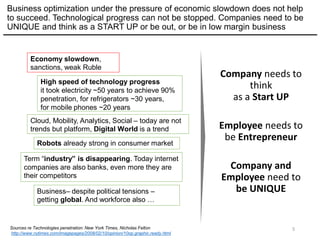
Business optimization under the pressure of economic slowdown does not help
to succeed. Technological progress can not be stopped. Companies need to be
UNIQUE and think as a START UP or be out, or be in low margin business
Company needs to
think
as a Start UP
Employee needs to
be Entrepreneur
Company and
Employee need to
be UNIQUE
Economy slowdown,
sanctions, weak Ruble
High speed of technology progress
it took electricity ~50 years to achieve 90%
penetration, for refrigerators ~30 years,
for mobile phones ~20 years
Cloud, Mobility, Analytics, Social – today are not
trends but platform, Digital World is a trend
Robots already strong in consumer market
Term “industry” is disappearing. Today internet
companies are also banks, even more they are
their competitors
Business– despite political tensions –
getting global. And workforce also …
Sources re Technologies penetration: New York Times, Nicholas Felton
http://www.nytimes.com/imagepages/2008/02/10/opinion/10op.graphic.ready.html
5
6
Run faster
Jump higher
Throw further
+
Be unique
In short, new business motto sounds like this 
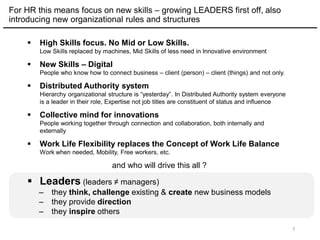
For HR this means focus on new skills – growing LEADERS first off, also
introducing new organizational rules and structures
 High Skills focus. No Mid or Low Skills.
Low Skills replaced by machines, Mid Skills of less need in Innovative environment
 New Skills – Digital
People who know how to connect business – client (person) – client (things) and not only.
 Distributed Authority system
Hierarchy organizational structure is “yesterday”. In Distributed Authority system everyone
is a leader in their role, Expertise not job titles are constituent of status and influence
 Collective mind for innovations
People working together through connection and collaboration, both internally and
externally
 Work Life Flexibility replaces the Concept of Work Life Balance
Work when needed, Mobility, Free workers, etc.
and who will drive this all ?
 Leaders (leaders ≠ managers)
– they think, challenge existing & create new business models
– they provide direction
– they inspire others
7
8
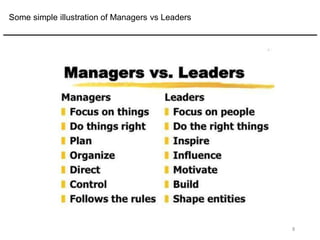
Some simple illustration of Managers vs Leaders
9
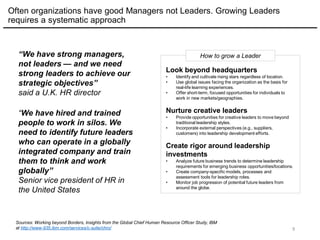
Often organizations have good Managers not Leaders. Growing Leaders
requires a systematic approach
“We have strong managers,
not leaders — and we need
strong leaders to achieve our
strategic objectives”
said a U.K. HR director
“We have hired and trained
people to work in silos. We
need to identify future leaders
who can operate in a globally
integrated company and train
them to think and work
globally”
Senior vice president of HR in
the United States
Sources: Working beyond Borders, Insights from the Global Chief Human Resource Officer Study, IBM
at http://www-935.ibm.com/services/c-suite/chro/
Look beyond headquarters
• Identify and cultivate rising stars regardless of location.
• Use global issues facing the organization as the basis for
real-life learning experiences.
• Offer short-term, focused opportunities for individuals to
work in new markets/geographies.
Nurture creative leaders
• Provide opportunities for creative leaders to move beyond
traditional leadership styles.
• Incorporate external perspectives (e.g., suppliers,
customers) into leadership development efforts.
Create rigor around leadership
investments
• Analyze future business trends to determine leadership
requirements for emerging business opportunities/locations.
• Create company-specific models, processes and
assessment tools for leadership roles.
• Monitor job progression of potential future leaders from
around the globe.
How to grow a Leader
10
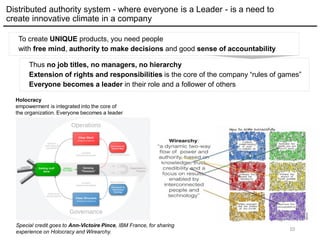
Distributed authority system - where everyone is a Leader - is a need to
create innovative climate in a company
To create UNIQUE products, you need people
with free mind, authority to make decisions and good sense of accountability
Thus no job titles, no managers, no hierarchy
Extension of rights and responsibilities is the core of the company “rules of games”
Everyone becomes a leader in their role and a follower of others
Holocracy
empowerment is integrated into the core of
the organization. Everyone becomes a leader
Special credit goes to Ann-Victoire Pince, IBM France, for sharing
experience on Holocracy and Wirearchy.
11
One last important comment for this part
People are your assets, not liabilities
Alexander Gaertner, CFO, IBM Russia/CIS
12
Part II
special focus –
Motivation & what business
can learn from Olympic champions
13
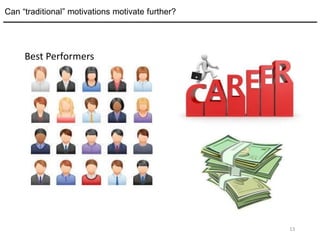
Best Performers
Can “traditional” motivations motivate further?
14
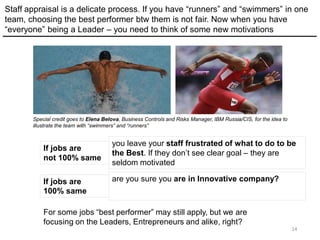
Staff appraisal is a delicate process. If you have “runners” and “swimmers” in one
team, choosing the best performer btw them is not fair. Now when you have
“everyone” being a Leader – you need to think of some new motivations
If jobs are
not 100% same
For some jobs “best performer” may still apply, but we are
focusing on the Leaders, Entrepreneurs and alike, right?
If jobs are
100% same
Special credit goes to Elena Belova, Business Controls and Risks Manager, IBM Russia/CIS, for the idea to
illustrate the team with “swimmers” and “runners”
you leave your staff frustrated of what to do to be
the Best. If they don’t see clear goal – they are
seldom motivated
are you sure you are in Innovative company?
15
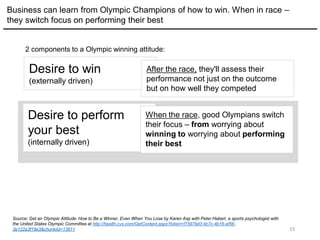
Business can learn from Olympic Champions of how to win. When in race –
they switch focus on performing their best
2 components to a Olympic winning attitude:
Desire to win
(externally driven)
Desire to perform
your best
(internally driven)
When the race, good Olympians switch
their focus – from worrying about
winning to worrying about performing
their best
Source: Get an Olympic Attitude: How to Be a Winner, Even When You Lose by Karen Asp with Peter Haberl, a sports psychologist with
the United States Olympic Committee at http://health.cvs.com/GetContent.aspx?token=f75979d3-9c7c-4b16-af56-
3e122a3f19e3&chunkiid=13811
After the race, they'll assess their
performance not just on the outcome
but on how well they competed
16
Bonnie Blair, gold medalist speed skater,
raced not against her competition but against the clock
Joanna Zeiger, a triathlete from Maryland,
took to the 2000 Summer Olympics in Sydney.
She does not put any pressure on herself to win,
only to do her best and have fun while doing it
Olympic Attitude: What they thought when they achieved
Source: Get an Olympic Attitude: How to Be a Winner, Even When You Lose by Karen Asp with Peter Haberl, a sports psychologist with
the United States Olympic Committee at http://health.cvs.com/GetContent.aspx?token=f75979d3-9c7c-4b16-af56-
3e122a3f19e3&chunkiid=13811
17
Olympic Attitude: What they thought when they achieved
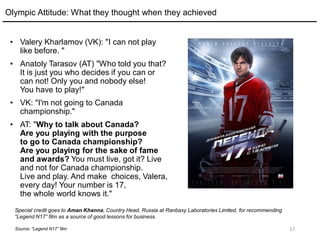
• Valery Kharlamov (VK): "I can not play
like before. "
• Anatoly Tarasov (AT) "Who told you that?
It is just you who decides if you can or
can not! Only you and nobody else!
You have to play!"
• VK: "I'm not going to Canada
championship."
• AT: "Why to talk about Canada?
Are you playing with the purpose
to go to Canada championship?
Are you playing for the sake of fame
and awards? You must live, got it? Live
and not for Canada championship.
Live and play. And make choices, Valera,
every day! Your number is 17,
the whole world knows it."
Special credit goes to Aman Khanna, Country Head, Russia at Ranbaxy Laboratories Limited, for recommending
“Legend N17” film as a source of good lessons for business.
Source: “Legend N17” film
18
Source: Get an Olympic Attitude: How to Be a Winner, Even When You Lose by Karen Asp with Peter Haberl, a sports psychologist with the
United States Olympic Committee at http://health.cvs.com/GetContent.aspx?token=f75979d3-9c7c-4b16-af56-3e122a3f19e3&chunkiid=13811
Obstacles That Stop You From
Being a Winner:
• focusing on the outcome
rather than the activity
• obsession with comparing
yourself to others
Focusing on outcome, comparing employees with each other stops from winning.
Personalized assessment and motivation – based on exact person skills and
development goals - is a need
=> You need to adopt internal
ways to measure your
performance, rather than just
comparing yourself against
other people
Do you help your employee to perform = to win ?
Do your comparisons make sense?
May be you want to consider prizes for everyone who is unique?
Say “Innovator”, not best Innovator, just Innovator?
Olympic Attitude: What stops, what motivates
19
Some more proves of how comparing people is not good &
what is really important for personal motivation and growth
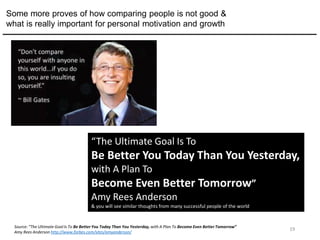
“The Ultimate Goal Is To
Be Better You Today Than You Yesterday,
with A Plan To
Become Even Better Tomorrow”
Amy Rees Anderson
& you will see similar thoughts from many successful people of the world
Source: “The Ultimate GoalIs To Be BetterYou Today Than You Yesterday, with A Plan To Become Even Better Tomorrow”
Amy Rees Anderson http://www.forbes.com/sites/amyanderson/
20
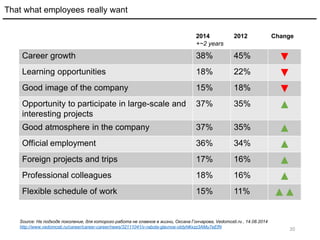
That what employees really want
Source: На подходе поколение, для которого работа не главное в жизни, Оксана Гончарова, Vedomosti.ru , 14.08.2014
http://www.vedomosti.ru/career/career-career/news/32111041/v-rabote-glavnoe-otdyh#ixzz3AMu7eEfN
2014
+~2 years
2012 Change
Career growth 38% 45% ▼
Learning opportunities 18% 22% ▼
Good image of the company 15% 18% ▼
Opportunity to participate in large-scale and
interesting projects
37% 35% ▲
Good atmosphere in the company 37% 35% ▲
Official employment 36% 34% ▲
Foreign projects and trips 17% 16% ▲
Professional colleagues 18% 16% ▲
Flexible schedule of work 15% 11% ▲▲
21
Part III
special focus – Mobility
22
Source: IBM Mobility in numbers, http://www-935.ibm.com/services/us/en/it-
services/pdf/3606_b_ibm_gts_mobility_announcement_mm_infographic_infographicpdf_051012.pdf
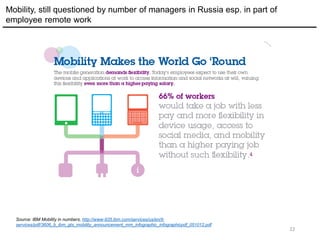
Mobility, still questioned by number of managers in Russia esp. in part of
employee remote work
23
Do you still question Mobility?
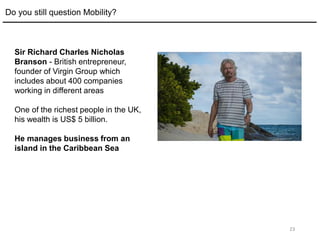
Sir Richard Charles Nicholas
Branson - British entrepreneur,
founder of Virgin Group which
includes about 400 companies
working in different areas
One of the richest people in the UK,
his wealth is US$ 5 billion.
He manages business from an
island in the Caribbean Sea
24
Part IV
Cases
25
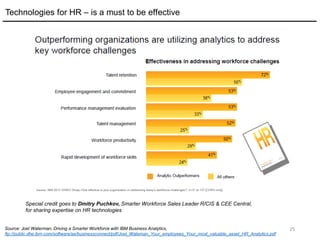
Technologies for HR – is a must to be effective
Source: Joel Waterman, Driving a Smarter Workforce with IBM Business Analytics,
ftp://public.dhe.ibm.com/software/ae/businessconnect/pdf/Joel_Wateman_Your_employees_Your_most_valuable_asset_HR_Analytics.pdf
Special credit goes to Dmitry Puchkov, Smarter Workforce Sales Leader R/CIS & CEE Central,
for sharing expertise on HR technologies
26
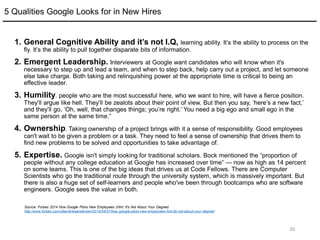
5 Qualities Google Looks for in New Hires
1. General Cognitive Ability and it’s not I.Q, learning ability. It’s the ability to process on the
fly. It’s the ability to pull together disparate bits of information.
2. Emergent Leadership. Interviewers at Google want candidates who will know when it's
necessary to step up and lead a team, and when to step back, help carry out a project, and let someone
else take charge. Both taking and relinquishing power at the appropriate time is critical to being an
effective leader.
3. Humility. people who are the most successful here, who we want to hire, will have a fierce position.
They’ll argue like hell. They’ll be zealots about their point of view. But then you say, ‘here’s a new fact,’
and they’ll go, ‘Oh, well, that changes things; you’re right.’ You need a big ego and small ego in the
same person at the same time.“
4. Ownership. Taking ownership of a project brings with it a sense of responsibility. Good employees
can't wait to be given a problem or a task. They need to feel a sense of ownership that drives them to
find new problems to be solved and opportunities to take advantage of.
5. Expertise. Google isn't simply looking for traditional scholars. Bock mentioned the “proportion of
people without any college education at Google has increased over time” — now as high as 14 percent
on some teams. This is one of the big ideas that drives us at Code Fellows. There are Computer
Scientists who go the traditional route through the university system, which is massively important. But
there is also a huge set of self-learners and people who've been through bootcamps who are software
engineers. Google sees the value in both.
Source: Forbes 2014 How Google Picks New Employees (Hint: It's Not About Your Degree)
http://www.forbes.com/sites/erikaandersen/2014/04/07/how-google-picks-new-employees-hint-its-not-about-your-degree/
27
Thank you!
Natalia Berdyeva,
Market Development & Insights Leader, IBM Russia/CIS
Coordinator, Committee for IT Industry Monitoring, APKIT
Cell: + 7 (985) 761 59 74,
e-mail: Natalia.Berdyeva@ru.ibm.com
LinkedIn http://www.linkedin.com/pub/natalia-berdyeva/6/970/35
Back up
28
29
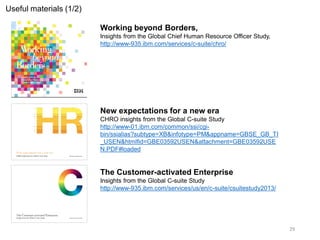
Useful materials (1/2)
Working beyond Borders,
Insights from the Global Chief Human Resource Officer Study,
http://www-935.ibm.com/services/c-suite/chro/
New expectations for a new era
CHRO insights from the Global C-suite Study
http://www-01.ibm.com/common/ssi/cgi-
bin/ssialias?subtype=XB&infotype=PM&appname=GBSE_GB_TI
_USEN&htmlfid=GBE03592USEN&attachment=GBE03592USE
N.PDF#loaded
The Customer-activated Enterprise
Insights from the Global C-suite Study
http://www-935.ibm.com/services/us/en/c-suite/csuitestudy2013/
30
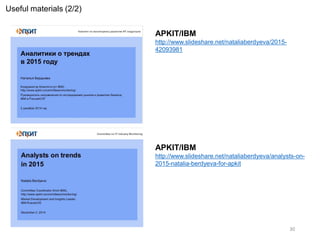
Useful materials (2/2)
APKIT/IBM
http://www.slideshare.net/nataliaberdyeva/2015-
42093981
APKIT/IBM
http://www.slideshare.net/nataliaberdyeva/analysts-on-
2015-natalia-berdyeva-for-apkit

HR - trends and advisory (March update)

  • 1.
    APKIT, Committee onIT Industry Monitoring HR - trends & advisory Who and what will help organizations to succeed What business can learn from Olympic champions How mobility works Natalia Berdyeva HR-Committee, LANIT March 12, 2015
  • 2.
    Goals  Present keyHR trends – analysts and personal opinions, not all inclusive list, but certainly important things to consider  Special focus – leadership, motivation, mobility. In motivation will see what business can learn from Olympic champions  Show some cases 2
  • 3.
    Executive summary 3  Tosucceed organizations need to be UNIQUE and think as a START UP  This requires Leaders (leaders ≠ managers) and distributed authority system  Traditional motivation do not work. Comparing employees btw themselves and selecting “the best employee of the month/year” humiliates and demotivates. Personalized assessment and motivation – based on exact person skills and development goals - is a need  “Work Life Flexibility” replaces “Work-Life” balance, Mobility is a great helper in management  Modern HR needs technologies
  • 4.
    4 Part I HR trends. specialfocus – Leadership, Distributed Authority System
  • 5.
    Business optimization underthe pressure of economic slowdown does not help to succeed. Technological progress can not be stopped. Companies need to be UNIQUE and think as a START UP or be out, or be in low margin business Company needs to think as a Start UP Employee needs to be Entrepreneur Company and Employee need to be UNIQUE Economy slowdown, sanctions, weak Ruble High speed of technology progress it took electricity ~50 years to achieve 90% penetration, for refrigerators ~30 years, for mobile phones ~20 years Cloud, Mobility, Analytics, Social – today are not trends but platform, Digital World is a trend Robots already strong in consumer market Term “industry” is disappearing. Today internet companies are also banks, even more they are their competitors Business– despite political tensions – getting global. And workforce also … Sources re Technologies penetration: New York Times, Nicholas Felton http://www.nytimes.com/imagepages/2008/02/10/opinion/10op.graphic.ready.html 5
  • 6.
    6 Run faster Jump higher Throwfurther + Be unique In short, new business motto sounds like this 
  • 7.
    For HR thismeans focus on new skills – growing LEADERS first off, also introducing new organizational rules and structures  High Skills focus. No Mid or Low Skills. Low Skills replaced by machines, Mid Skills of less need in Innovative environment  New Skills – Digital People who know how to connect business – client (person) – client (things) and not only.  Distributed Authority system Hierarchy organizational structure is “yesterday”. In Distributed Authority system everyone is a leader in their role, Expertise not job titles are constituent of status and influence  Collective mind for innovations People working together through connection and collaboration, both internally and externally  Work Life Flexibility replaces the Concept of Work Life Balance Work when needed, Mobility, Free workers, etc. and who will drive this all ?  Leaders (leaders ≠ managers) – they think, challenge existing & create new business models – they provide direction – they inspire others 7
  • 8.
    8 Some simple illustrationof Managers vs Leaders
  • 9.
    9 Often organizations havegood Managers not Leaders. Growing Leaders requires a systematic approach “We have strong managers, not leaders — and we need strong leaders to achieve our strategic objectives” said a U.K. HR director “We have hired and trained people to work in silos. We need to identify future leaders who can operate in a globally integrated company and train them to think and work globally” Senior vice president of HR in the United States Sources: Working beyond Borders, Insights from the Global Chief Human Resource Officer Study, IBM at http://www-935.ibm.com/services/c-suite/chro/ Look beyond headquarters • Identify and cultivate rising stars regardless of location. • Use global issues facing the organization as the basis for real-life learning experiences. • Offer short-term, focused opportunities for individuals to work in new markets/geographies. Nurture creative leaders • Provide opportunities for creative leaders to move beyond traditional leadership styles. • Incorporate external perspectives (e.g., suppliers, customers) into leadership development efforts. Create rigor around leadership investments • Analyze future business trends to determine leadership requirements for emerging business opportunities/locations. • Create company-specific models, processes and assessment tools for leadership roles. • Monitor job progression of potential future leaders from around the globe. How to grow a Leader
  • 10.
    10 Distributed authority system- where everyone is a Leader - is a need to create innovative climate in a company To create UNIQUE products, you need people with free mind, authority to make decisions and good sense of accountability Thus no job titles, no managers, no hierarchy Extension of rights and responsibilities is the core of the company “rules of games” Everyone becomes a leader in their role and a follower of others Holocracy empowerment is integrated into the core of the organization. Everyone becomes a leader Special credit goes to Ann-Victoire Pince, IBM France, for sharing experience on Holocracy and Wirearchy.
  • 11.
    11 One last importantcomment for this part People are your assets, not liabilities Alexander Gaertner, CFO, IBM Russia/CIS
  • 12.
    12 Part II special focus– Motivation & what business can learn from Olympic champions
  • 13.
    13 Best Performers Can “traditional”motivations motivate further?
  • 14.
    14 Staff appraisal isa delicate process. If you have “runners” and “swimmers” in one team, choosing the best performer btw them is not fair. Now when you have “everyone” being a Leader – you need to think of some new motivations If jobs are not 100% same For some jobs “best performer” may still apply, but we are focusing on the Leaders, Entrepreneurs and alike, right? If jobs are 100% same Special credit goes to Elena Belova, Business Controls and Risks Manager, IBM Russia/CIS, for the idea to illustrate the team with “swimmers” and “runners” you leave your staff frustrated of what to do to be the Best. If they don’t see clear goal – they are seldom motivated are you sure you are in Innovative company?
  • 15.
    15 Business can learnfrom Olympic Champions of how to win. When in race – they switch focus on performing their best 2 components to a Olympic winning attitude: Desire to win (externally driven) Desire to perform your best (internally driven) When the race, good Olympians switch their focus – from worrying about winning to worrying about performing their best Source: Get an Olympic Attitude: How to Be a Winner, Even When You Lose by Karen Asp with Peter Haberl, a sports psychologist with the United States Olympic Committee at http://health.cvs.com/GetContent.aspx?token=f75979d3-9c7c-4b16-af56- 3e122a3f19e3&chunkiid=13811 After the race, they'll assess their performance not just on the outcome but on how well they competed
  • 16.
    16 Bonnie Blair, goldmedalist speed skater, raced not against her competition but against the clock Joanna Zeiger, a triathlete from Maryland, took to the 2000 Summer Olympics in Sydney. She does not put any pressure on herself to win, only to do her best and have fun while doing it Olympic Attitude: What they thought when they achieved Source: Get an Olympic Attitude: How to Be a Winner, Even When You Lose by Karen Asp with Peter Haberl, a sports psychologist with the United States Olympic Committee at http://health.cvs.com/GetContent.aspx?token=f75979d3-9c7c-4b16-af56- 3e122a3f19e3&chunkiid=13811
  • 17.
    17 Olympic Attitude: Whatthey thought when they achieved • Valery Kharlamov (VK): "I can not play like before. " • Anatoly Tarasov (AT) "Who told you that? It is just you who decides if you can or can not! Only you and nobody else! You have to play!" • VK: "I'm not going to Canada championship." • AT: "Why to talk about Canada? Are you playing with the purpose to go to Canada championship? Are you playing for the sake of fame and awards? You must live, got it? Live and not for Canada championship. Live and play. And make choices, Valera, every day! Your number is 17, the whole world knows it." Special credit goes to Aman Khanna, Country Head, Russia at Ranbaxy Laboratories Limited, for recommending “Legend N17” film as a source of good lessons for business. Source: “Legend N17” film
  • 18.
    18 Source: Get anOlympic Attitude: How to Be a Winner, Even When You Lose by Karen Asp with Peter Haberl, a sports psychologist with the United States Olympic Committee at http://health.cvs.com/GetContent.aspx?token=f75979d3-9c7c-4b16-af56-3e122a3f19e3&chunkiid=13811 Obstacles That Stop You From Being a Winner: • focusing on the outcome rather than the activity • obsession with comparing yourself to others Focusing on outcome, comparing employees with each other stops from winning. Personalized assessment and motivation – based on exact person skills and development goals - is a need => You need to adopt internal ways to measure your performance, rather than just comparing yourself against other people Do you help your employee to perform = to win ? Do your comparisons make sense? May be you want to consider prizes for everyone who is unique? Say “Innovator”, not best Innovator, just Innovator? Olympic Attitude: What stops, what motivates
  • 19.
    19 Some more provesof how comparing people is not good & what is really important for personal motivation and growth “The Ultimate Goal Is To Be Better You Today Than You Yesterday, with A Plan To Become Even Better Tomorrow” Amy Rees Anderson & you will see similar thoughts from many successful people of the world Source: “The Ultimate GoalIs To Be BetterYou Today Than You Yesterday, with A Plan To Become Even Better Tomorrow” Amy Rees Anderson http://www.forbes.com/sites/amyanderson/
  • 20.
    20 That what employeesreally want Source: На подходе поколение, для которого работа не главное в жизни, Оксана Гончарова, Vedomosti.ru , 14.08.2014 http://www.vedomosti.ru/career/career-career/news/32111041/v-rabote-glavnoe-otdyh#ixzz3AMu7eEfN 2014 +~2 years 2012 Change Career growth 38% 45% ▼ Learning opportunities 18% 22% ▼ Good image of the company 15% 18% ▼ Opportunity to participate in large-scale and interesting projects 37% 35% ▲ Good atmosphere in the company 37% 35% ▲ Official employment 36% 34% ▲ Foreign projects and trips 17% 16% ▲ Professional colleagues 18% 16% ▲ Flexible schedule of work 15% 11% ▲▲
  • 21.
  • 22.
    22 Source: IBM Mobilityin numbers, http://www-935.ibm.com/services/us/en/it- services/pdf/3606_b_ibm_gts_mobility_announcement_mm_infographic_infographicpdf_051012.pdf Mobility, still questioned by number of managers in Russia esp. in part of employee remote work
  • 23.
    23 Do you stillquestion Mobility? Sir Richard Charles Nicholas Branson - British entrepreneur, founder of Virgin Group which includes about 400 companies working in different areas One of the richest people in the UK, his wealth is US$ 5 billion. He manages business from an island in the Caribbean Sea
  • 24.
  • 25.
    25 Technologies for HR– is a must to be effective Source: Joel Waterman, Driving a Smarter Workforce with IBM Business Analytics, ftp://public.dhe.ibm.com/software/ae/businessconnect/pdf/Joel_Wateman_Your_employees_Your_most_valuable_asset_HR_Analytics.pdf Special credit goes to Dmitry Puchkov, Smarter Workforce Sales Leader R/CIS & CEE Central, for sharing expertise on HR technologies
  • 26.
    26 5 Qualities GoogleLooks for in New Hires 1. General Cognitive Ability and it’s not I.Q, learning ability. It’s the ability to process on the fly. It’s the ability to pull together disparate bits of information. 2. Emergent Leadership. Interviewers at Google want candidates who will know when it's necessary to step up and lead a team, and when to step back, help carry out a project, and let someone else take charge. Both taking and relinquishing power at the appropriate time is critical to being an effective leader. 3. Humility. people who are the most successful here, who we want to hire, will have a fierce position. They’ll argue like hell. They’ll be zealots about their point of view. But then you say, ‘here’s a new fact,’ and they’ll go, ‘Oh, well, that changes things; you’re right.’ You need a big ego and small ego in the same person at the same time.“ 4. Ownership. Taking ownership of a project brings with it a sense of responsibility. Good employees can't wait to be given a problem or a task. They need to feel a sense of ownership that drives them to find new problems to be solved and opportunities to take advantage of. 5. Expertise. Google isn't simply looking for traditional scholars. Bock mentioned the “proportion of people without any college education at Google has increased over time” — now as high as 14 percent on some teams. This is one of the big ideas that drives us at Code Fellows. There are Computer Scientists who go the traditional route through the university system, which is massively important. But there is also a huge set of self-learners and people who've been through bootcamps who are software engineers. Google sees the value in both. Source: Forbes 2014 How Google Picks New Employees (Hint: It's Not About Your Degree) http://www.forbes.com/sites/erikaandersen/2014/04/07/how-google-picks-new-employees-hint-its-not-about-your-degree/
  • 27.
    27 Thank you! Natalia Berdyeva, MarketDevelopment & Insights Leader, IBM Russia/CIS Coordinator, Committee for IT Industry Monitoring, APKIT Cell: + 7 (985) 761 59 74, e-mail: Natalia.Berdyeva@ru.ibm.com LinkedIn http://www.linkedin.com/pub/natalia-berdyeva/6/970/35
  • 28.
  • 29.
    29 Useful materials (1/2) Workingbeyond Borders, Insights from the Global Chief Human Resource Officer Study, http://www-935.ibm.com/services/c-suite/chro/ New expectations for a new era CHRO insights from the Global C-suite Study http://www-01.ibm.com/common/ssi/cgi- bin/ssialias?subtype=XB&infotype=PM&appname=GBSE_GB_TI _USEN&htmlfid=GBE03592USEN&attachment=GBE03592USE N.PDF#loaded The Customer-activated Enterprise Insights from the Global C-suite Study http://www-935.ibm.com/services/us/en/c-suite/csuitestudy2013/
  • 30.