32
www.efmd.org/globalfocus
10
9
8
7
6
5
4
3
2
1
0
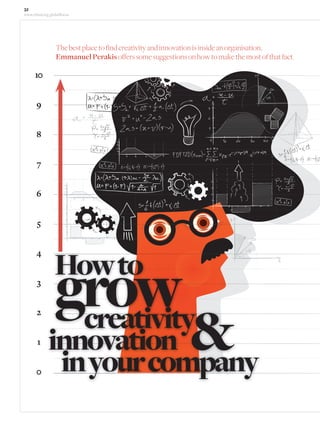
Thebestplacetofindcreativityandinnovationisinsideanorganisation.
EmmanuelPerakisofferssomesuggestionsonhowtomakethemostofthatfact
33
EFMD Global Focus | Volume 05 | Issue 02 2011How to grow creativity and innovation in your company by Emmanuel Perakis
In our turbulent times, creativity and innovation increasingly
constitute not just a way to promote growth, but a potential
precondition for survival for states, companies and
organisations.
It is no coincidence that a 2010 survey of over 1,000
CeOs by IBm services revealed that the most important
“leadership competence” for the coming five years is
expected to be creativity.
however, companies striving to become innovative, usually
focus their efforts exclusively within the area of Product and
Service development (usually via dedicated departments).
although this direct effort is important and adds value, since
it focuses on bottom-line business development processes,
at the same time it neglects powerful indirect leverage
opportunities, such as differentiating business models
and internal organisation.
the field of Business Models offers a number of noteworthy
examples. these include Bhutan, a nation that measures
success not through the well-known indicator of GPD, but
through a sophisticated Gross Domestic happiness statistic
(which it has developed over 30 years and addresses
educational, behavioural and environmental factors). In the
corporate domain another example is nobel Peace Prize
Winner muhammad Yunus’ Grameen Bank (see Global Focus
Volume 5 Issue 1 January 2011), which operates in the same
way as any other “normal” company (it has 20,000 employees
and 2,500 branches). the only difference is that profits are not
given out as dividends, but reinvested for growing the company
in order to support more customers. (this model is known as
a “societal company”).
the field of Internal Organisation also has some significant
examples.
For example, the american fabric, polymer and medical
equipment manufacturer Gore has no hierarchy, organisation
charts or job titles. British retailer tesco segments
employees according to their motivational drivers (a practice
widely used though mainly in marketing). and american
carpet tile producer InterfaceFLOR, best known for its
sustainability practices, utilises word of mouth, rather
than a PR budget to further improve its reputation.
Itisnocoincidencethata
2010surveyofover1,000
CEOsbyIBMServices
revealedthatthemost
important‘leadership
competence’forthecoming
fiveyearsisexpectedto
becreativity
34
www.efmd.org/globalfocus
as well as being in themselves innovative and
creative, these “unusual” practices also act
as catalysts of creativity within companies.
needless to say, such approaches require
thinking outside the box. sometimes simply
adopting practices used in other business
sectors or functions (such as from marketing
to human resources) is adequate. But
sometimes courage and calculated risk
taking is required, which business managers
are usually reluctant to do, especially during
times when their main priority is securing
their own positions.
although no one can ensure innovation, we
can potentially apply some “down to earth”
practices that companies can use at a
reasonably low risk level, to facilitate their
employees’ creativity and innovation.
Below are a number of examples:
Firstthingsfirst–hiring
apple’s steve Jobs once said: “a people hire
a people, B people hire C people and C people
fire a people”.
Innovative people are occasionally “different”,
and are also often intense personalities. this
can potentially be revealed in job interviews.
a candidate who is simply “compliant”, who
follows unwritten but forceful behavioural
rules on “the way we do things here”, probably
will not support the creation of a culture of
innovation. Innovation emerges from diversity
and not from absolute homogeneity in
behaviour and if that makes managers
uncomfortable, well “no pain, no gain”.
Internalcommunication
employees who know what their colleagues
are working on are more likely to generate
new ideas, since the stimuli they receive
are multifaceted. an example comes from
Japanese retail group Ito-Yokado, which
invests 3% of its turnover to finance meetings
of its executives around the world. If this
sounds expensive, simply documenting in
a reader-friendly way corporate procedures
(rather than developing chaotically lengthy
documents) might be a good first step.
15%
Nooneknowswhocanhave
anexceptionalideaorwhen
andwhereitwillarise,so3M
hastheobjectivethat15%
ofallemployees’timewillbe
usedtodevelopnewproducts
25%
DowChemicalandBASF
innovatedanewwayto
producepropyleneoxide,
achemicalbuildingblock
formanyindustrialand
commercialproducts.
Thenewmethodeliminates
hazardouseffluents,creates
upto80%lesswastewater,
uses35%lessenergyand
reducesoperatingcostsby25%
Alignment
British firm Yell, a business search engine
and publisher, has for over ten years followed
a particularly systematic approach, which
clarifies its annual five strategic objectives
(for example, “increase employee satisfaction
by 20%) and then communicates these
intensely and systematically (via brochures,
meeting with managers, corporate intranet
and so on). this ensures that all modifications
in the way of working are aligned towards the
desired direction. Yell’s employee satisfaction
is considered a world-class benchmark and
its culture an admirable accelerating factor
for business growth.
Individualaction
no one knows who can have an exceptional
idea or when and where it will arise. 3m, an
american global company encompassing
brands such as nexcare, Post-it and
scotchgard, has the objective that 15% of all
employees’ time will be used to develop new
products. awards are symbolic-intrinsic
(something that is surprisingly more effective
than extrinsic rewards) and submission of
ideas is non-bureaucratic. all proposals are
evaluated and employees are informed of the
reason if an idea is rejected.
suggestion schemes are a powerful approach
to accelerate creativity, but only if they address
the need of employees to register ideas
simply, receive timely feedback and be
intrinsically recognised for their contribution.
One should not neglect that motivation is
not only linked to the reward of a certain
action, but also to the perceived probability
of receiving this award and the importance
one places on the reward itself.
Informationaccess
american hi-tech company Google not only
accepts but also actively seeks “constructive
argumentation” among employees. It has a
lean hierarchical structure (each manager
has roughly 20 subordinates, rather than the
typical seven in similar companies), maintains
open-space offices and ensures extensive
access to information (it follows the rational
that “you have access to everything you want
except what you cannot have access to” rather
than the more usual “you have only access to
information that we decide you need”).
35
EFMD Global Focus | Volume 05 | Issue 02 2011
Employeesunderpressure
followknownpathsandapplied
practiceswhileanypropensity
towards‘unknown’or‘new’
territoriesissubconsciously
blocked
Workconditions
the result of stress on the human brain is
that it activates the areas of sentiments (the
amygdala) and repetition, while it de-activates
the area of rational thinking. employees
under pressure follow known paths and
applied practices, while any propensity
towards “unknown” or “new” territories is
subconsciously blocked. Gore in america
functions without hierarchy or titles, resulting
in less pressure on employees and increasing
the probability of innovation and self-initiation.
Informalactivity
the informal activity of two engineers within
hP led to the development of its well-known
inkjet printer technology, although this was
not in their official job description. Freedom
to express ideas in areas beyond the official
responsibility of employees, as well as being
given the chance to work on their own ideas,
increases the motivation to be innovative.
Sustainability
Focusing on responsible operations, aiming
at both corporate and environmental
sustainability, cultivates a thinking pattern
“outside the box”, which is usually beneficial
for both the planet and the company.
Jeans maker strauss & Co developed a
way to reduce water consumption for jeans
manufacturing by up to 96%, reducing water
use by 16 million litres and respective
operating costs. Dow Chemical and BasF
innovated a new way to produce propylene
oxide, a chemical building block for many
industrial and commercial products. the
new method eliminates hazardous effluents,
creates up to 80% less wastewater, uses
35% less energy and reduces operating
costs by 25%.
ABOUT THE AUTHOR
EmmanuelPerakisisManaging
PartnerofSTREAM,aEuropean
managementandtrainingconsultancy
info@stream-eu.com
www.stream-eu.com
How to grow creativity and innovation in your company by Emmanuel Perakis
60%
AccordingtotheIBM
Servicessurvey,60%of
CEOsbelievethatthemain
sourcesofinnovationwithin
acompanyarenotscientists,
notconsultantsandnot
universitiesbutratherthe
company’sownemployees.
Serendipity(luckandcuriosity)
the sweetening substance aspartame is a
result of a laboratory accident in 1965 and the
curiosity of a chemist who, quite contrary to
laboratory rules, tasted the substance. even
if it is particularly difficult, companies should
manage not only what they know that they
know (processes, studies and so on) but,
also what they know or do not know that they
don’t know (for example via experimentation).
If all the above make you wonder if
facilitating innovation and creativity is
largely a responsibility of hR departments,
the answer is yes.
according to the IBm services survey, 60%
of CeOs believe that the main sources of
innovation within a company are not scientists,
not consultants and not universities, but
rather the company’s own employees.
the answer to becoming more creative
and innovative lies within a company’s
own people. and although the creation of
a culture with the above characteristics is
a multifaceted project that may last anything
from two to four years, it is probably the most
secure way to become innovative and creative
in the long term.

Innovation_EFMD_052011

  • 1.
  • 2.
    33 EFMD Global Focus| Volume 05 | Issue 02 2011How to grow creativity and innovation in your company by Emmanuel Perakis In our turbulent times, creativity and innovation increasingly constitute not just a way to promote growth, but a potential precondition for survival for states, companies and organisations. It is no coincidence that a 2010 survey of over 1,000 CeOs by IBm services revealed that the most important “leadership competence” for the coming five years is expected to be creativity. however, companies striving to become innovative, usually focus their efforts exclusively within the area of Product and Service development (usually via dedicated departments). although this direct effort is important and adds value, since it focuses on bottom-line business development processes, at the same time it neglects powerful indirect leverage opportunities, such as differentiating business models and internal organisation. the field of Business Models offers a number of noteworthy examples. these include Bhutan, a nation that measures success not through the well-known indicator of GPD, but through a sophisticated Gross Domestic happiness statistic (which it has developed over 30 years and addresses educational, behavioural and environmental factors). In the corporate domain another example is nobel Peace Prize Winner muhammad Yunus’ Grameen Bank (see Global Focus Volume 5 Issue 1 January 2011), which operates in the same way as any other “normal” company (it has 20,000 employees and 2,500 branches). the only difference is that profits are not given out as dividends, but reinvested for growing the company in order to support more customers. (this model is known as a “societal company”). the field of Internal Organisation also has some significant examples. For example, the american fabric, polymer and medical equipment manufacturer Gore has no hierarchy, organisation charts or job titles. British retailer tesco segments employees according to their motivational drivers (a practice widely used though mainly in marketing). and american carpet tile producer InterfaceFLOR, best known for its sustainability practices, utilises word of mouth, rather than a PR budget to further improve its reputation. Itisnocoincidencethata 2010surveyofover1,000 CEOsbyIBMServices revealedthatthemost important‘leadership competence’forthecoming fiveyearsisexpectedto becreativity
  • 3.
    34 www.efmd.org/globalfocus as well asbeing in themselves innovative and creative, these “unusual” practices also act as catalysts of creativity within companies. needless to say, such approaches require thinking outside the box. sometimes simply adopting practices used in other business sectors or functions (such as from marketing to human resources) is adequate. But sometimes courage and calculated risk taking is required, which business managers are usually reluctant to do, especially during times when their main priority is securing their own positions. although no one can ensure innovation, we can potentially apply some “down to earth” practices that companies can use at a reasonably low risk level, to facilitate their employees’ creativity and innovation. Below are a number of examples: Firstthingsfirst–hiring apple’s steve Jobs once said: “a people hire a people, B people hire C people and C people fire a people”. Innovative people are occasionally “different”, and are also often intense personalities. this can potentially be revealed in job interviews. a candidate who is simply “compliant”, who follows unwritten but forceful behavioural rules on “the way we do things here”, probably will not support the creation of a culture of innovation. Innovation emerges from diversity and not from absolute homogeneity in behaviour and if that makes managers uncomfortable, well “no pain, no gain”. Internalcommunication employees who know what their colleagues are working on are more likely to generate new ideas, since the stimuli they receive are multifaceted. an example comes from Japanese retail group Ito-Yokado, which invests 3% of its turnover to finance meetings of its executives around the world. If this sounds expensive, simply documenting in a reader-friendly way corporate procedures (rather than developing chaotically lengthy documents) might be a good first step. 15% Nooneknowswhocanhave anexceptionalideaorwhen andwhereitwillarise,so3M hastheobjectivethat15% ofallemployees’timewillbe usedtodevelopnewproducts 25% DowChemicalandBASF innovatedanewwayto producepropyleneoxide, achemicalbuildingblock formanyindustrialand commercialproducts. Thenewmethodeliminates hazardouseffluents,creates upto80%lesswastewater, uses35%lessenergyand reducesoperatingcostsby25% Alignment British firm Yell, a business search engine and publisher, has for over ten years followed a particularly systematic approach, which clarifies its annual five strategic objectives (for example, “increase employee satisfaction by 20%) and then communicates these intensely and systematically (via brochures, meeting with managers, corporate intranet and so on). this ensures that all modifications in the way of working are aligned towards the desired direction. Yell’s employee satisfaction is considered a world-class benchmark and its culture an admirable accelerating factor for business growth. Individualaction no one knows who can have an exceptional idea or when and where it will arise. 3m, an american global company encompassing brands such as nexcare, Post-it and scotchgard, has the objective that 15% of all employees’ time will be used to develop new products. awards are symbolic-intrinsic (something that is surprisingly more effective than extrinsic rewards) and submission of ideas is non-bureaucratic. all proposals are evaluated and employees are informed of the reason if an idea is rejected. suggestion schemes are a powerful approach to accelerate creativity, but only if they address the need of employees to register ideas simply, receive timely feedback and be intrinsically recognised for their contribution. One should not neglect that motivation is not only linked to the reward of a certain action, but also to the perceived probability of receiving this award and the importance one places on the reward itself. Informationaccess american hi-tech company Google not only accepts but also actively seeks “constructive argumentation” among employees. It has a lean hierarchical structure (each manager has roughly 20 subordinates, rather than the typical seven in similar companies), maintains open-space offices and ensures extensive access to information (it follows the rational that “you have access to everything you want except what you cannot have access to” rather than the more usual “you have only access to information that we decide you need”).
  • 4.
    35 EFMD Global Focus| Volume 05 | Issue 02 2011 Employeesunderpressure followknownpathsandapplied practiceswhileanypropensity towards‘unknown’or‘new’ territoriesissubconsciously blocked Workconditions the result of stress on the human brain is that it activates the areas of sentiments (the amygdala) and repetition, while it de-activates the area of rational thinking. employees under pressure follow known paths and applied practices, while any propensity towards “unknown” or “new” territories is subconsciously blocked. Gore in america functions without hierarchy or titles, resulting in less pressure on employees and increasing the probability of innovation and self-initiation. Informalactivity the informal activity of two engineers within hP led to the development of its well-known inkjet printer technology, although this was not in their official job description. Freedom to express ideas in areas beyond the official responsibility of employees, as well as being given the chance to work on their own ideas, increases the motivation to be innovative. Sustainability Focusing on responsible operations, aiming at both corporate and environmental sustainability, cultivates a thinking pattern “outside the box”, which is usually beneficial for both the planet and the company. Jeans maker strauss & Co developed a way to reduce water consumption for jeans manufacturing by up to 96%, reducing water use by 16 million litres and respective operating costs. Dow Chemical and BasF innovated a new way to produce propylene oxide, a chemical building block for many industrial and commercial products. the new method eliminates hazardous effluents, creates up to 80% less wastewater, uses 35% less energy and reduces operating costs by 25%. ABOUT THE AUTHOR EmmanuelPerakisisManaging PartnerofSTREAM,aEuropean managementandtrainingconsultancy info@stream-eu.com www.stream-eu.com How to grow creativity and innovation in your company by Emmanuel Perakis 60% AccordingtotheIBM Servicessurvey,60%of CEOsbelievethatthemain sourcesofinnovationwithin acompanyarenotscientists, notconsultantsandnot universitiesbutratherthe company’sownemployees. Serendipity(luckandcuriosity) the sweetening substance aspartame is a result of a laboratory accident in 1965 and the curiosity of a chemist who, quite contrary to laboratory rules, tasted the substance. even if it is particularly difficult, companies should manage not only what they know that they know (processes, studies and so on) but, also what they know or do not know that they don’t know (for example via experimentation). If all the above make you wonder if facilitating innovation and creativity is largely a responsibility of hR departments, the answer is yes. according to the IBm services survey, 60% of CeOs believe that the main sources of innovation within a company are not scientists, not consultants and not universities, but rather the company’s own employees. the answer to becoming more creative and innovative lies within a company’s own people. and although the creation of a culture with the above characteristics is a multifaceted project that may last anything from two to four years, it is probably the most secure way to become innovative and creative in the long term.