What is an Incident?
An incident is an occurrence, either caused by
human or natural phenomena, that requires
response actions to prevent or minimize loss of
life, or damage to property and/or the
environment (i.e., fire, floods, earthquakes,
disease outbreaks, Hazmat, terrorist incident,
active shooter, etc.)
What is ICS?
ICS is primarily a command and control system
delineating job responsibilities and organizational
structure for the purpose of managing day-to-day
operations for all types of emergency incidents.
ICS Purposes
Using management best practices, ICS helps to
ensure:
 The safety of responders and others.
 The achievement of tactical objectives.
 The efficient use of resources.
In the past, weaknesses in incident
management were due to:
 Lack of accountability.
 Poor communications.
 Lack of a planning process.
 Overloaded Incident Commanders.
 No method to integrate interagency requirements.
The identification of these areas of management
weakness resulted in the development of ICS.
ICS Benefits
 Meets the needs of incidents of any kind or size.
 Allows personnel from a variety of agencies to
meld rapidly into a common management
structure.
 Provides logistical and administrative support to
operational staff.
 Is cost effective by avoiding duplication of efforts.
ICS is designed to be interdisciplinary
and organizationally flexible.
Basic features of ICS include:
 Common Terminology
 Modular Organization
 Management by objectives
 Chain of Command & Unity of Command
 Unified Command
 Resource Management
 Integrated Communication
 Accountability
 Mobilization
Chain / Unity of Command
Chain of Command
Chain of command is an orderly line of authority within the
ranks of the incident management organization.
Unity of Command
Unity of command means that every individual has a designated
supervisor to whom they report to at the scene of the incident.
Unified Command
 Enables all responsible agencies to manage
incident objectives and strategies.
 Allows Incident Commanders to make joint
decisions by establishing a single command
structure.
 Maintains unity of command. Each employee
only reports to one supervisor.
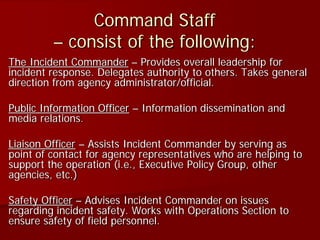
Command Staff
– consist of the following:
The Incident Commander – Provides overall leadership for
incident response. Delegates authority to others. Takes general
direction from agency administrator/official.
Public Information Officer – Information dissemination and
media relations.
Liaison Officer – Assists Incident Commander by serving as
point of contact for agency representatives who are helping to
support the operation (i.e., Executive Policy Group, other
agencies, etc.)
Safety Officer – Advises Incident Commander on issues
regarding incident safety. Works with Operations Section to
ensure safety of field personnel.
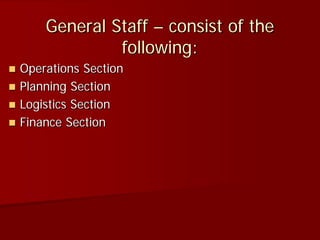
General Staff – consist of the
following:
 Operations Section
 Planning Section
 Logistics Section
 Finance Section
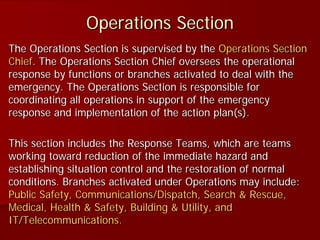
Operations Section
The Operations Section is supervised by the Operations Section
Chief. The Operations Section Chief oversees the operational
response by functions or branches activated to deal with the
emergency. The Operations Section is responsible for
coordinating all operations in support of the emergency
response and implementation of the action plan(s).
This section includes the Response Teams, which are teams
working toward reduction of the immediate hazard and
establishing situation control and the restoration of normal
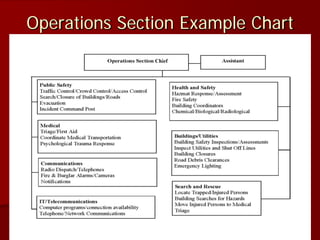
conditions. Branches activated under Operations may include:
Public Safety, Communications/Dispatch, Search & Rescue,
Medical, Health & Safety, Building & Utility, and
IT/Telecommunications.
Operations Section Example Chart
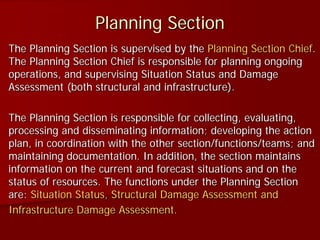
Planning Section
The Planning Section is supervised by the Planning Section Chief.
The Planning Section Chief is responsible for planning ongoing
operations, and supervising Situation Status and Damage
Assessment (both structural and infrastructure).
The Planning Section is responsible for collecting, evaluating,
processing and disseminating information; developing the action
plan, in coordination with the other section/functions/teams; and
maintaining documentation. In addition, the section maintains
information on the current and forecast situations and on the
status of resources. The functions under the Planning Section
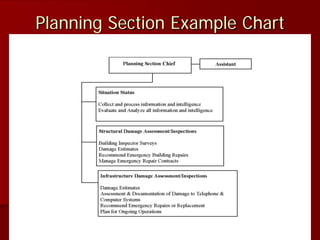
are: Situation Status, Structural Damage Assessment and
Infrastructure Damage Assessment.
Planning Section Example Chart
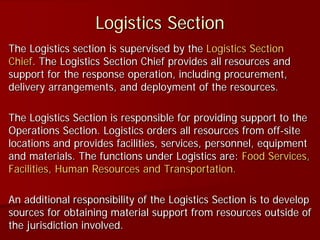
Logistics Section
The Logistics section is supervised by the Logistics Section
Chief. The Logistics Section Chief provides all resources and
support for the response operation, including procurement,
delivery arrangements, and deployment of the resources.
The Logistics Section is responsible for providing support to the
Operations Section. Logistics orders all resources from off-site
locations and provides facilities, services, personnel, equipment
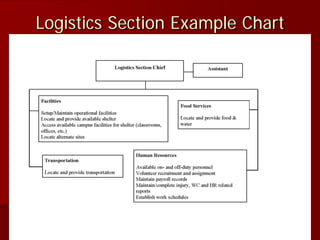
and materials. The functions under Logistics are: Food Services,
Facilities, Human Resources and Transportation.
An additional responsibility of the Logistics Section is to develop
sources for obtaining material support from resources outside of
the jurisdiction involved.
Logistics Section Example Chart
Finance Section
The Finance Section is the responsibility of the Finance Section
Chief. The Finance Section Chief sets up the accounting system
to be used for the emergency and oversees all accounting and
financial aspects of the disaster.
The Finance Section is responsible for all accounting and
financial aspects of the disaster and any other administrative
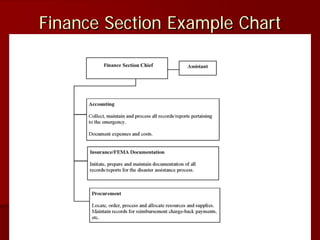
requirements. The functions under the Finance Section are:
Accounting, Insurance / FEMA Documentation, and
Procurement.
Finance Section Example Chart
ICS Resources
 Link to FEMA’s On-Line Training - IS-100.HE
Introduction to the Incident Command System, ICS-100,
for Higher Education
Click here for more information: IS-100.HE
 Link to FEMA’s On-Line Training – IS.200.b
ICS for Single Resources and Initial Action Incidents
Click here for more information: IS-200.b
ICS Resources
 Link to FEMA’s On-Line Training for NIMS
National Incident Management System
Click here for more information: IS-700.a
 Link to FEMA’s On-Line Training for NRF
National Response Framework, An Introduction
Click here for more information: IS-800.b
End of Presentation
Revised 3/12/18 by Jeff Sperley, MHCC Public Safety

Basic Incident Command System for College DRRM Subject

  • 1.
    What is anIncident? An incident is an occurrence, either caused by human or natural phenomena, that requires response actions to prevent or minimize loss of life, or damage to property and/or the environment (i.e., fire, floods, earthquakes, disease outbreaks, Hazmat, terrorist incident, active shooter, etc.)
  • 2.
    What is ICS? ICSis primarily a command and control system delineating job responsibilities and organizational structure for the purpose of managing day-to-day operations for all types of emergency incidents.
  • 3.
    ICS Purposes Using managementbest practices, ICS helps to ensure:  The safety of responders and others.  The achievement of tactical objectives.  The efficient use of resources.
  • 4.
    In the past,weaknesses in incident management were due to:  Lack of accountability.  Poor communications.  Lack of a planning process.  Overloaded Incident Commanders.  No method to integrate interagency requirements. The identification of these areas of management weakness resulted in the development of ICS.
  • 5.
    ICS Benefits  Meetsthe needs of incidents of any kind or size.  Allows personnel from a variety of agencies to meld rapidly into a common management structure.  Provides logistical and administrative support to operational staff.  Is cost effective by avoiding duplication of efforts. ICS is designed to be interdisciplinary and organizationally flexible.
  • 6.
    Basic features ofICS include:  Common Terminology  Modular Organization  Management by objectives  Chain of Command & Unity of Command  Unified Command  Resource Management  Integrated Communication  Accountability  Mobilization
  • 7.
    Chain / Unityof Command Chain of Command Chain of command is an orderly line of authority within the ranks of the incident management organization. Unity of Command Unity of command means that every individual has a designated supervisor to whom they report to at the scene of the incident.
  • 8.
    Unified Command  Enablesall responsible agencies to manage incident objectives and strategies.  Allows Incident Commanders to make joint decisions by establishing a single command structure.  Maintains unity of command. Each employee only reports to one supervisor.
  • 9.
    Command Staff – consistof the following: The Incident Commander – Provides overall leadership for incident response. Delegates authority to others. Takes general direction from agency administrator/official. Public Information Officer – Information dissemination and media relations. Liaison Officer – Assists Incident Commander by serving as point of contact for agency representatives who are helping to support the operation (i.e., Executive Policy Group, other agencies, etc.) Safety Officer – Advises Incident Commander on issues regarding incident safety. Works with Operations Section to ensure safety of field personnel.
  • 10.
    General Staff –consist of the following:  Operations Section  Planning Section  Logistics Section  Finance Section
  • 11.
    Operations Section The OperationsSection is supervised by the Operations Section Chief. The Operations Section Chief oversees the operational response by functions or branches activated to deal with the emergency. The Operations Section is responsible for coordinating all operations in support of the emergency response and implementation of the action plan(s). This section includes the Response Teams, which are teams working toward reduction of the immediate hazard and establishing situation control and the restoration of normal conditions. Branches activated under Operations may include: Public Safety, Communications/Dispatch, Search & Rescue, Medical, Health & Safety, Building & Utility, and IT/Telecommunications.
  • 12.
  • 13.
    Planning Section The PlanningSection is supervised by the Planning Section Chief. The Planning Section Chief is responsible for planning ongoing operations, and supervising Situation Status and Damage Assessment (both structural and infrastructure). The Planning Section is responsible for collecting, evaluating, processing and disseminating information; developing the action plan, in coordination with the other section/functions/teams; and maintaining documentation. In addition, the section maintains information on the current and forecast situations and on the status of resources. The functions under the Planning Section are: Situation Status, Structural Damage Assessment and Infrastructure Damage Assessment.
  • 14.
  • 15.
    Logistics Section The Logisticssection is supervised by the Logistics Section Chief. The Logistics Section Chief provides all resources and support for the response operation, including procurement, delivery arrangements, and deployment of the resources. The Logistics Section is responsible for providing support to the Operations Section. Logistics orders all resources from off-site locations and provides facilities, services, personnel, equipment and materials. The functions under Logistics are: Food Services, Facilities, Human Resources and Transportation. An additional responsibility of the Logistics Section is to develop sources for obtaining material support from resources outside of the jurisdiction involved.
  • 16.
  • 17.
    Finance Section The FinanceSection is the responsibility of the Finance Section Chief. The Finance Section Chief sets up the accounting system to be used for the emergency and oversees all accounting and financial aspects of the disaster. The Finance Section is responsible for all accounting and financial aspects of the disaster and any other administrative requirements. The functions under the Finance Section are: Accounting, Insurance / FEMA Documentation, and Procurement.
  • 18.
  • 19.
    ICS Resources  Linkto FEMA’s On-Line Training - IS-100.HE Introduction to the Incident Command System, ICS-100, for Higher Education Click here for more information: IS-100.HE  Link to FEMA’s On-Line Training – IS.200.b ICS for Single Resources and Initial Action Incidents Click here for more information: IS-200.b
  • 20.
    ICS Resources  Linkto FEMA’s On-Line Training for NIMS National Incident Management System Click here for more information: IS-700.a  Link to FEMA’s On-Line Training for NRF National Response Framework, An Introduction Click here for more information: IS-800.b
  • 21.
    End of Presentation Revised3/12/18 by Jeff Sperley, MHCC Public Safety