Emergency Operations Center (EOC) Operations and Management Course Developed and Prepared by Curt Rasmussen Course Developed for Interview with CRA, Inc. 31 July 2009
Scope This course provides a brief overview of Emergency Operations Center (EOC) Operations and Management with an emphasis basic use of the Observe-Orientate-Decide- Act Loop during emergency operations. This course is not meant as a substitute for FEMA course IS775 or G775, although it is suggested that either or both of the aforementioned course be taken prior to participating in this course.
Enabling Objectives After taking this course, you should be able to: Conduct a basic assessment of your jurisdiction’s ability to manage and operate an Emergency Operations Center. Determine what tests, training, exercises, etc. are required to increase the efficiency and effectiveness of EOC management and/or operation.
Learning Objectives At the end of the course, students should be able to: Describe 3 basic EOC organizational structures systems are available.  Describe the relationship between the EOC and the on-scene Incident Command System (ICS) structure. Describe how the OODA Loop applies to the EOC. Describe the basic Orientate-Observe-Decide-Act Loop (OODA Loop) in the management of an EOC.
Emergency Operations Center What is an Emergency Operations Center ? An Emergency Operations Center acts as a central focal point for government agencies, as well as others in support of disaster operations including response and recovery. As a central focal point, the EOC allows for inter-agency coordination and executive decision making in the support of the incident response. However, it is important to remember that the EOC does not command or control the on-scene response or tactics. Tactical decisions are made by the Incident Commander. The EOC provides strategic support including policy guidance, logistics and information.
Emergency Operations Center The EOC carries out its strategic support through: Information collection and evaluation. Setting of priorities. Resource management. The EOC also allows for a common situational awareness (SA) picture. This helps to alleviate conflicting actions being taken in the support of on-scene response efforts. Taking into consideration all that has been presented thus far what  is the common thread? Information... management, collection and dissemination.
EOC Management: OODA Loop One method which has been used to effectively manage information in a high-stress, high-speed, dynamic environment is the OODA Loop, also known as the Boyd Loop. OODA is an acronym for the components of the loop... Observe – Orientate – Decide – Act  The OODA Loop, which was devised and developed by John Boyd provides a  framework for understanding the governance of  human behavior in unpredictable, dynamically changing environments.
EOC Emergency Operations Management: OODA Loop
EOC Management: OODA Loop But what does the OODA Loop provide in the realm of EOC Operation and Management? Simply stated it provides an understand how various components are tied together. It also provides an understanding on what needs to occur to improve operations or even prevent overall failure in the face of a complex event.
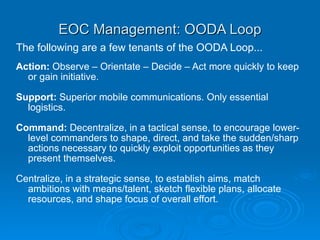
EOC Management: OODA Loop The following are a few tenants of the OODA Loop... Action:  Observe – Orientate – Decide – Act more quickly to keep or gain initiative.  Support:  Superior mobile communications. Only essential logistics.  Command:  Decentralize, in a tactical sense, to encourage lower-level commanders to shape, direct, and take the sudden/sharp actions necessary to quickly exploit opportunities as they present themselves. Centralize, in a strategic sense, to establish aims, match ambitions with means/talent, sketch flexible plans, allocate resources, and shape focus of overall effort.
Emergency Operations Center: Critical Elements When organizing an Emergency Operations Center the following elements need to be taken into consideration:  Facilities Staffing Communications Training Information Organizational Structure
Critical Elements: Facilities Some of the main factors involved in locating an EOC are: Survivability  – The facility must be able to withstand the most likely disasters as determined by a Hazards and Vulnerability Analysis (HVA). Accessibility  – The facility should be accessible by staff and responders alike during disaster/emergency operations, e.g. multiple access roads. Size   - The facility should have enough square footage to comfortably house a fully manned staff. The recommended square footage per staff member is approximately 65 square ft.
Critical Elements: Facilities What does the OODA Loop have to do with EOC facilities? Survivability  – If the facility is not able to withstand the most likely disasters then the OODA Loop will be disrupted as operations have to either move to an alternate or Continuity of Operations (COOP) Site. Accessibility  – If the facility is not easily accessed then the very real likelihood exists that a significant portion of staff members will not be able to respond in a timely manner or even at all. That leads to fewer personnel to deal with the influx of information and requests. This leads to a situation in which the inertia can be lost and the EOC can quickly “fall behind the power curve.”
Critical Elements: Facilities What are the 3 status conditions of an EOC? Cold:  Not equipped, utilities not working... longest start-up period required... this is also the cheapest in day-to-day costs. Warm:  Some systems and/or equipment in place... moderate start-up period required. Hot:  Fully equipped, utilities working... shortest start-up period... this is the most expensive condition for a facility.
Critical Elements: Staffing There are several key factors to consider when staffing the EOC some of which are as follows: All persons assigned to the EOC must have the authority to do what is required by their jobs. Personnel are properly trained for their positions. Personnel are cross-trained to ensure redundancy and survivability. Ensure that there are an appropriate number of personnel who are assigned to the EOC in the event that the operations require multiple operational periods lasting over a significant time period.
Critical Elements: Staffing What portion of the OODA Loop can either be enhanced or hindered by staffing? The Orientation Phase.
Critical Elements: Staffing To ensure that the EOC staff are authorized to perform their essential functions a delegation of authority should be in place so that... The delegation of authority takes effect when a situation occurs requiring EOC activation. The delegation of authority terminates when the emergency ends. Each position within the EOC should have a written Position Description (PD). PDs assist with the following: List of the general responsibilities for each EOC position. Serve as a baseline for determining what training is required.
Critical Elements: Communications Under the subject of communications NIMS has established two basic requirements for communications: Interoperability amongst communications systems is a must. Communications systems must be redundant. It has been found that systems often thought of as being compatible are not. Often this is discovered during actual operations.
Critical Elements: Communications What are some of the reasons why communications systems lack interoperability? Different systems. Different organizational requirements. Different manufactures... claiming interoperability. What are some items that can effect redundancy? Multiple systems supplied by a common power system. Secondary equipment not verified operational.
Critical Elements: Training What is training? Training encompasses testing, both written and other forms and exercises. Training is also referred to as Tests, Training & Exercises (TT&E). TT&E includes all measures taken to ensure that a jurisdiction’s EOC is capable of supporting response and recovery throughout an incident period. What does TT&E have to do with the OODA Loop? TT&E can help to improve the Orientation Phase by allowing the person to more effectively use the information that they have accrued in the Observation Phase.
Critical Elements: Training Effective TT&E programs share several common attributes. TT&E programs provide training in the appropriate functional areas of mission readiness. TT&E programs allow EOC personnel to apply the skills and knowledge they gained in training. TT&E programs build team unity through meaningful opportunities for team members to work together. Homeland Security Exercise and Evaluation Program (HSEEP) is one tool for providing TT&E.
Critical Elements: Training HSEEP: Provides common exercise policy and program guidance. Is a national standard for homeland security exercises. Uses consistent terminology that can be used by all exercise planners. HSEEP utilizes the following categories of exercises: Discussion-based—seminars, workshops, tabletop exercises, and games. Operations-based—drills, functional exercises, and full-scale exercises.
Critical Elements: Information It goes without saying that information is king, without it things would not function as they should, but what is information?  Information is a compilation of data, which in itself is bits of knowledge about single things (Green, p. 179). It is absolutely critical that data is made into usable information from which decisions can be made. A system for assembling data should be in place and exercised and evaluated to ensure that is provides information quickly and accurately. This in-turn speeds up the Act – Act cycle of the OODA Loop.
Critical Elements: Information The following are some information items that is recommended to be incorporated into the EOC: Staff Position Descriptions (PD). Standard Operating Procedures (SOP). Support organization capabilities and status. Hazard and Vulnerability Analysis (HVA). Staff rosters, recall numbers and strip maps. The following are some information items that is recommended to be incorporated into the EOC:
Critical Elements: Organizational Model A  few quick points about National Incident Management System (NIMS)... NIMS requires all jurisdictions to adopt ICS as its incident management system.  NIMS does not require EOCs to adopt ICS as their organizational model.
Critical Elements: Organizational Model An EOC should be organized to facilitate effective operations. An effective organization has these characteristics: Ability to acquire, analyze, and act on information. Flexibility in the face of rapidly changing conditions. Ability to anticipate change. Ability to maintain public confidence. Reliability over time. An EOC should be organized to maximize each of the characteristics of an effective organization.
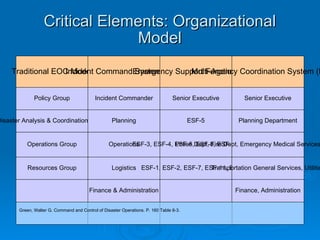
Critical Elements: Organizational Model EOCs are typically organized according to one of the following systems: Incident Command System (ICS) Emergency Support Function (ESF) Multi-Agency Coordination System (MACS) Each of these organization models has advantages and disadvantages.  In some cases, the model selected depends on State law.  In other cases, the model, simply is the one that works best for the jurisdiction.
Critical Elements: Organizational Model Traditional EOC Model Incident Command System (ICS) Emergency Support Function (ESF) Multi-Agency Coordination System (MACS) Policy Group Incident Commander Senior Executive Senior Executive Disaster Analysis & Coordination Group Planning ESF-5 Planning Department Operations Group Operations ESF-3, ESF-4, ESF-6, ESF-8, ESF-9, ESF-10 Police Dept, Fire Dept, Emergency Medical Services, Public Works Resources Group Logistics ESF-1, ESF-2, ESF-7, ESF-11, ESF-12 Transportation General Services, Utilities Finance & Administration Finance, Administration Green, Walter G. Command and Control of Disaster Operations. P. 160 Table 8-3.
Getting All the Pieces Together A successful EOC that not only supports responders in the advent of a disaster, but gives constituents and tax payers a valuable entity at a reasonable cost. Now the million dollar question... how do we put all the elements together to produce a successful EOC? While having all or most of the appropriate tools, facilities and personnel in place is a critical one problem in managing and operating an EOC still often exists... an actual management process, including the appropriate mindset.
Getting All the Pieces Together While the Incident Command System provides the tools by which an EOC can be managed, but does it provide adequate management training? The short answer is “no.” While there are several management systems, e.g. Lean Six Sigma, there is one system which has been successfully used in high-stress, high-tempo operations in dynamic situations. That system is know as the OODA Loop or Boyd Loop.
30 Slide Maximum
Determining When the EOC Should Be Activated Timing of EOC activation depends on the nature of the incident.  Many jurisdictions have phases of EOC activation. Time-phased activation is appropriate: * When an incident occurs that is expected to build over time, such as wildfire. * When there is a warning period before an emergency, such as when a hurricane or riverine flooding has been forecast. * In preparation for planned events.
Deactivating the EOC The on-scene commander is aware of the current incident status and knows: * What remains to be done. * What resources are required to meet the incident objectives. * How long it will take to meet incident objectives. * When the demand for resources slows down. Consider recovery needs.  Often, the EOC must remain activated to facilitate recovery needs after the Incident Command completes its on-scene mission.
Deactivating the EOC (Screen 1 of 2) The decisionmaker for deactivating EOC functions will vary by jurisdiction.  In most cases, the Emergency Management Coordinator will make the decision jointly with agency key personnel and jurisdiction leaders. EOC decisionmakers should make the decision when to release personnel and other resources only after discussion with on-scene commanders.
Deactivating the EOC (Screen 2 of 2) The authority to begin full or partial deactivation should be clearly stated in the jurisdiction’s EOP, and all personnel should know: * Who has the authority. * The process that will be followed for deactivation. Recommendation:  Deactivate in phases.  It is more efficient and cost effective to deactivate personnel as they are no longer needed.
Meeting Information Needs Addressing information needs is part of the emergency planning process.  Documentation for each function in the EOC operation should include: * The information needed. * Who needs the information. * How the information will be used. * How the information will be stored, updated, and maintained. * How the information will be recovered if damaged or lost. Staff working on documents
In Summation What are 3 basic EOC organizational models? Incident Command System (ICS) Emergency Support Function (ESF) Multi-Agency Coordination System (MACS)
In Summation What is the relationship between the EOC and the on-scene Incident Command System (ICS) structure? The EOC provides Incident Commanders with “one stop shopping” for the following (this is not an all inclusive list): Acquiring, allocating and tracking resources. Acquiring, developing, managing and sharing information. Establishing response priorities among incidents. Providing legal and financial support. Liaison with other jurisdictions and other levels of government.
In Summation Describe the basic Orientate – Observe – Decide – Act Loop (OODA Loop) in the management of an EOC during emergency operations.   Describe how the OODA Loop applies to the EOC.
In Summation You should be able to: Conduct a basic assessment of your jurisdiction’s ability to manage and operate an Emergency Operations Center. Determine what tests, training, exercises, etc. are required to increase the efficiency and effectiveness of EOC management and/or operation.
Questions
Resources Von Lubitz, Dag. “All Hazards Approach” to Network-Centric Disaster Management: The Role of Information and Knowledge Management, and Boyd's OODA Loop in Disaster Leadership.  Disasters: The Journal of Disaster Studies, Policy and Management, in press, Blackwell. Accessed on 28 July 2009; <http://www.projectwhitehorse.com/pdfs/5.%20All%20Hazards%20Network%20Centric%20Approach.pdf>

Eoc Operations And Management Training Mod 0

  • 1.
    Emergency Operations Center(EOC) Operations and Management Course Developed and Prepared by Curt Rasmussen Course Developed for Interview with CRA, Inc. 31 July 2009
  • 2.
    Scope This courseprovides a brief overview of Emergency Operations Center (EOC) Operations and Management with an emphasis basic use of the Observe-Orientate-Decide- Act Loop during emergency operations. This course is not meant as a substitute for FEMA course IS775 or G775, although it is suggested that either or both of the aforementioned course be taken prior to participating in this course.
  • 3.
    Enabling Objectives Aftertaking this course, you should be able to: Conduct a basic assessment of your jurisdiction’s ability to manage and operate an Emergency Operations Center. Determine what tests, training, exercises, etc. are required to increase the efficiency and effectiveness of EOC management and/or operation.
  • 4.
    Learning Objectives Atthe end of the course, students should be able to: Describe 3 basic EOC organizational structures systems are available. Describe the relationship between the EOC and the on-scene Incident Command System (ICS) structure. Describe how the OODA Loop applies to the EOC. Describe the basic Orientate-Observe-Decide-Act Loop (OODA Loop) in the management of an EOC.
  • 5.
    Emergency Operations CenterWhat is an Emergency Operations Center ? An Emergency Operations Center acts as a central focal point for government agencies, as well as others in support of disaster operations including response and recovery. As a central focal point, the EOC allows for inter-agency coordination and executive decision making in the support of the incident response. However, it is important to remember that the EOC does not command or control the on-scene response or tactics. Tactical decisions are made by the Incident Commander. The EOC provides strategic support including policy guidance, logistics and information.
  • 6.
    Emergency Operations CenterThe EOC carries out its strategic support through: Information collection and evaluation. Setting of priorities. Resource management. The EOC also allows for a common situational awareness (SA) picture. This helps to alleviate conflicting actions being taken in the support of on-scene response efforts. Taking into consideration all that has been presented thus far what is the common thread? Information... management, collection and dissemination.
  • 7.
    EOC Management: OODALoop One method which has been used to effectively manage information in a high-stress, high-speed, dynamic environment is the OODA Loop, also known as the Boyd Loop. OODA is an acronym for the components of the loop... Observe – Orientate – Decide – Act The OODA Loop, which was devised and developed by John Boyd provides a framework for understanding the governance of human behavior in unpredictable, dynamically changing environments.
  • 8.
    EOC Emergency OperationsManagement: OODA Loop
  • 9.
    EOC Management: OODALoop But what does the OODA Loop provide in the realm of EOC Operation and Management? Simply stated it provides an understand how various components are tied together. It also provides an understanding on what needs to occur to improve operations or even prevent overall failure in the face of a complex event.
  • 10.
    EOC Management: OODALoop The following are a few tenants of the OODA Loop... Action: Observe – Orientate – Decide – Act more quickly to keep or gain initiative. Support: Superior mobile communications. Only essential logistics. Command: Decentralize, in a tactical sense, to encourage lower-level commanders to shape, direct, and take the sudden/sharp actions necessary to quickly exploit opportunities as they present themselves. Centralize, in a strategic sense, to establish aims, match ambitions with means/talent, sketch flexible plans, allocate resources, and shape focus of overall effort.
  • 11.
    Emergency Operations Center:Critical Elements When organizing an Emergency Operations Center the following elements need to be taken into consideration: Facilities Staffing Communications Training Information Organizational Structure
  • 12.
    Critical Elements: FacilitiesSome of the main factors involved in locating an EOC are: Survivability – The facility must be able to withstand the most likely disasters as determined by a Hazards and Vulnerability Analysis (HVA). Accessibility – The facility should be accessible by staff and responders alike during disaster/emergency operations, e.g. multiple access roads. Size - The facility should have enough square footage to comfortably house a fully manned staff. The recommended square footage per staff member is approximately 65 square ft.
  • 13.
    Critical Elements: FacilitiesWhat does the OODA Loop have to do with EOC facilities? Survivability – If the facility is not able to withstand the most likely disasters then the OODA Loop will be disrupted as operations have to either move to an alternate or Continuity of Operations (COOP) Site. Accessibility – If the facility is not easily accessed then the very real likelihood exists that a significant portion of staff members will not be able to respond in a timely manner or even at all. That leads to fewer personnel to deal with the influx of information and requests. This leads to a situation in which the inertia can be lost and the EOC can quickly “fall behind the power curve.”
  • 14.
    Critical Elements: FacilitiesWhat are the 3 status conditions of an EOC? Cold: Not equipped, utilities not working... longest start-up period required... this is also the cheapest in day-to-day costs. Warm: Some systems and/or equipment in place... moderate start-up period required. Hot: Fully equipped, utilities working... shortest start-up period... this is the most expensive condition for a facility.
  • 15.
    Critical Elements: StaffingThere are several key factors to consider when staffing the EOC some of which are as follows: All persons assigned to the EOC must have the authority to do what is required by their jobs. Personnel are properly trained for their positions. Personnel are cross-trained to ensure redundancy and survivability. Ensure that there are an appropriate number of personnel who are assigned to the EOC in the event that the operations require multiple operational periods lasting over a significant time period.
  • 16.
    Critical Elements: StaffingWhat portion of the OODA Loop can either be enhanced or hindered by staffing? The Orientation Phase.
  • 17.
    Critical Elements: StaffingTo ensure that the EOC staff are authorized to perform their essential functions a delegation of authority should be in place so that... The delegation of authority takes effect when a situation occurs requiring EOC activation. The delegation of authority terminates when the emergency ends. Each position within the EOC should have a written Position Description (PD). PDs assist with the following: List of the general responsibilities for each EOC position. Serve as a baseline for determining what training is required.
  • 18.
    Critical Elements: CommunicationsUnder the subject of communications NIMS has established two basic requirements for communications: Interoperability amongst communications systems is a must. Communications systems must be redundant. It has been found that systems often thought of as being compatible are not. Often this is discovered during actual operations.
  • 19.
    Critical Elements: CommunicationsWhat are some of the reasons why communications systems lack interoperability? Different systems. Different organizational requirements. Different manufactures... claiming interoperability. What are some items that can effect redundancy? Multiple systems supplied by a common power system. Secondary equipment not verified operational.
  • 20.
    Critical Elements: TrainingWhat is training? Training encompasses testing, both written and other forms and exercises. Training is also referred to as Tests, Training & Exercises (TT&E). TT&E includes all measures taken to ensure that a jurisdiction’s EOC is capable of supporting response and recovery throughout an incident period. What does TT&E have to do with the OODA Loop? TT&E can help to improve the Orientation Phase by allowing the person to more effectively use the information that they have accrued in the Observation Phase.
  • 21.
    Critical Elements: TrainingEffective TT&E programs share several common attributes. TT&E programs provide training in the appropriate functional areas of mission readiness. TT&E programs allow EOC personnel to apply the skills and knowledge they gained in training. TT&E programs build team unity through meaningful opportunities for team members to work together. Homeland Security Exercise and Evaluation Program (HSEEP) is one tool for providing TT&E.
  • 22.
    Critical Elements: TrainingHSEEP: Provides common exercise policy and program guidance. Is a national standard for homeland security exercises. Uses consistent terminology that can be used by all exercise planners. HSEEP utilizes the following categories of exercises: Discussion-based—seminars, workshops, tabletop exercises, and games. Operations-based—drills, functional exercises, and full-scale exercises.
  • 23.
    Critical Elements: InformationIt goes without saying that information is king, without it things would not function as they should, but what is information? Information is a compilation of data, which in itself is bits of knowledge about single things (Green, p. 179). It is absolutely critical that data is made into usable information from which decisions can be made. A system for assembling data should be in place and exercised and evaluated to ensure that is provides information quickly and accurately. This in-turn speeds up the Act – Act cycle of the OODA Loop.
  • 24.
    Critical Elements: InformationThe following are some information items that is recommended to be incorporated into the EOC: Staff Position Descriptions (PD). Standard Operating Procedures (SOP). Support organization capabilities and status. Hazard and Vulnerability Analysis (HVA). Staff rosters, recall numbers and strip maps. The following are some information items that is recommended to be incorporated into the EOC:
  • 25.
    Critical Elements: OrganizationalModel A few quick points about National Incident Management System (NIMS)... NIMS requires all jurisdictions to adopt ICS as its incident management system. NIMS does not require EOCs to adopt ICS as their organizational model.
  • 26.
    Critical Elements: OrganizationalModel An EOC should be organized to facilitate effective operations. An effective organization has these characteristics: Ability to acquire, analyze, and act on information. Flexibility in the face of rapidly changing conditions. Ability to anticipate change. Ability to maintain public confidence. Reliability over time. An EOC should be organized to maximize each of the characteristics of an effective organization.
  • 27.
    Critical Elements: OrganizationalModel EOCs are typically organized according to one of the following systems: Incident Command System (ICS) Emergency Support Function (ESF) Multi-Agency Coordination System (MACS) Each of these organization models has advantages and disadvantages. In some cases, the model selected depends on State law. In other cases, the model, simply is the one that works best for the jurisdiction.
  • 28.
    Critical Elements: OrganizationalModel Traditional EOC Model Incident Command System (ICS) Emergency Support Function (ESF) Multi-Agency Coordination System (MACS) Policy Group Incident Commander Senior Executive Senior Executive Disaster Analysis & Coordination Group Planning ESF-5 Planning Department Operations Group Operations ESF-3, ESF-4, ESF-6, ESF-8, ESF-9, ESF-10 Police Dept, Fire Dept, Emergency Medical Services, Public Works Resources Group Logistics ESF-1, ESF-2, ESF-7, ESF-11, ESF-12 Transportation General Services, Utilities Finance & Administration Finance, Administration Green, Walter G. Command and Control of Disaster Operations. P. 160 Table 8-3.
  • 29.
    Getting All thePieces Together A successful EOC that not only supports responders in the advent of a disaster, but gives constituents and tax payers a valuable entity at a reasonable cost. Now the million dollar question... how do we put all the elements together to produce a successful EOC? While having all or most of the appropriate tools, facilities and personnel in place is a critical one problem in managing and operating an EOC still often exists... an actual management process, including the appropriate mindset.
  • 30.
    Getting All thePieces Together While the Incident Command System provides the tools by which an EOC can be managed, but does it provide adequate management training? The short answer is “no.” While there are several management systems, e.g. Lean Six Sigma, there is one system which has been successfully used in high-stress, high-tempo operations in dynamic situations. That system is know as the OODA Loop or Boyd Loop.
  • 31.
  • 32.
    Determining When theEOC Should Be Activated Timing of EOC activation depends on the nature of the incident. Many jurisdictions have phases of EOC activation. Time-phased activation is appropriate: * When an incident occurs that is expected to build over time, such as wildfire. * When there is a warning period before an emergency, such as when a hurricane or riverine flooding has been forecast. * In preparation for planned events.
  • 33.
    Deactivating the EOCThe on-scene commander is aware of the current incident status and knows: * What remains to be done. * What resources are required to meet the incident objectives. * How long it will take to meet incident objectives. * When the demand for resources slows down. Consider recovery needs. Often, the EOC must remain activated to facilitate recovery needs after the Incident Command completes its on-scene mission.
  • 34.
    Deactivating the EOC(Screen 1 of 2) The decisionmaker for deactivating EOC functions will vary by jurisdiction. In most cases, the Emergency Management Coordinator will make the decision jointly with agency key personnel and jurisdiction leaders. EOC decisionmakers should make the decision when to release personnel and other resources only after discussion with on-scene commanders.
  • 35.
    Deactivating the EOC(Screen 2 of 2) The authority to begin full or partial deactivation should be clearly stated in the jurisdiction’s EOP, and all personnel should know: * Who has the authority. * The process that will be followed for deactivation. Recommendation: Deactivate in phases. It is more efficient and cost effective to deactivate personnel as they are no longer needed.
  • 36.
    Meeting Information NeedsAddressing information needs is part of the emergency planning process. Documentation for each function in the EOC operation should include: * The information needed. * Who needs the information. * How the information will be used. * How the information will be stored, updated, and maintained. * How the information will be recovered if damaged or lost. Staff working on documents
  • 37.
    In Summation Whatare 3 basic EOC organizational models? Incident Command System (ICS) Emergency Support Function (ESF) Multi-Agency Coordination System (MACS)
  • 38.
    In Summation Whatis the relationship between the EOC and the on-scene Incident Command System (ICS) structure? The EOC provides Incident Commanders with “one stop shopping” for the following (this is not an all inclusive list): Acquiring, allocating and tracking resources. Acquiring, developing, managing and sharing information. Establishing response priorities among incidents. Providing legal and financial support. Liaison with other jurisdictions and other levels of government.
  • 39.
    In Summation Describethe basic Orientate – Observe – Decide – Act Loop (OODA Loop) in the management of an EOC during emergency operations. Describe how the OODA Loop applies to the EOC.
  • 40.
    In Summation Youshould be able to: Conduct a basic assessment of your jurisdiction’s ability to manage and operate an Emergency Operations Center. Determine what tests, training, exercises, etc. are required to increase the efficiency and effectiveness of EOC management and/or operation.
  • 41.
  • 42.
    Resources Von Lubitz,Dag. “All Hazards Approach” to Network-Centric Disaster Management: The Role of Information and Knowledge Management, and Boyd's OODA Loop in Disaster Leadership. Disasters: The Journal of Disaster Studies, Policy and Management, in press, Blackwell. Accessed on 28 July 2009; <http://www.projectwhitehorse.com/pdfs/5.%20All%20Hazards%20Network%20Centric%20Approach.pdf>

Editor's Notes

  • #9 The Observation stage of the Loop is associated with several direct inputs from both outside and inside the operational environment. The Orientation Stage, information and knowledge gathered during the Observation segment of the Loop are subject to final analysis (von Lubitz, p. 12, 13). Orientation is nothing but the act of “getting one’s bearings” in the post-disaster chaos by cognitive grouping of the disorganized structure of the disaster environment into cohesive and easily recognizable blocks, then realigning these blocks into even larger and better organized mental assemblies (cognitive maps of the disaster environment) (von Lubitz, p. 12, 13). The third stage of the Loop defines the nature and characteristics of the action(s) to be taken, and at the Action stage the planned activity is fully implemented (von Lubitz, p. 12, 13). The efficiency in the execution of processes comprising each stage of the Loop reduces the time needed for the completion of the entire “Observation” – “Act” cycle. The quicker the cycle the quicker response to evolving situation thereby effectively keeping or gaining initiative.
  • #29 ESF #5 – Emergency Management Coordination of incident management and response efforts, Issuance of mission assignments, Resource and human capital , Incident action planning, Financial management ESF #6 – Mass Care, Emergency Assistance, Housing, and Human Services Mass care, Emergency assistance, Disaster housing, Human services ESF #7 – Logistics Management and Resource Support Comprehensive, national incident logistics planning, management, and sustainment capability, Resource support (facility space, office equipment and supplies, contracting services, etc.) ESF #8 – Public Health and Medical Services Public health, Medical, Mental health services, Mass fatality management ESF #9 – Search and Rescue Life-saving assistance, Search and rescue operations ESF #10 – Oil and Hazardous Materials Response Oil and hazardous materials (chemical, biological, radiological, etc.) response, Environmental short- and long-term cleanup ESF #11 – Agriculture and Natural Resources Nutrition assistance, Animal and plant disease and pest response, Food safety and security, Natural and cultural resources and historic properties protection and restoration, Safety and well-being of household pets ESF #12 – Energy Energy infrastructure assessment, repair, and restoration, Energy industry utilities coordination, Energy forecast ESF #13 – Public Safety and Security Facility and resource security, Security planning and technical resource assistance, Public safety and security support, Support to access, traffic, and crowd control ESF #14 – Long-Term Community Recovery Social and economic community impact assessment, Long-term community recovery assistance to States, local governments, and the private sector, Analysis and review of mitigation program implementation ESF #15 – External Affairs Emergency public information and protective action guidance, Media and community relations, Congressional and international affairs, Tribal and insular affairs