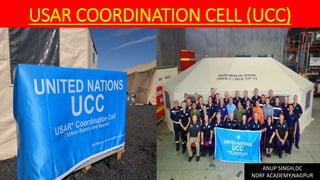
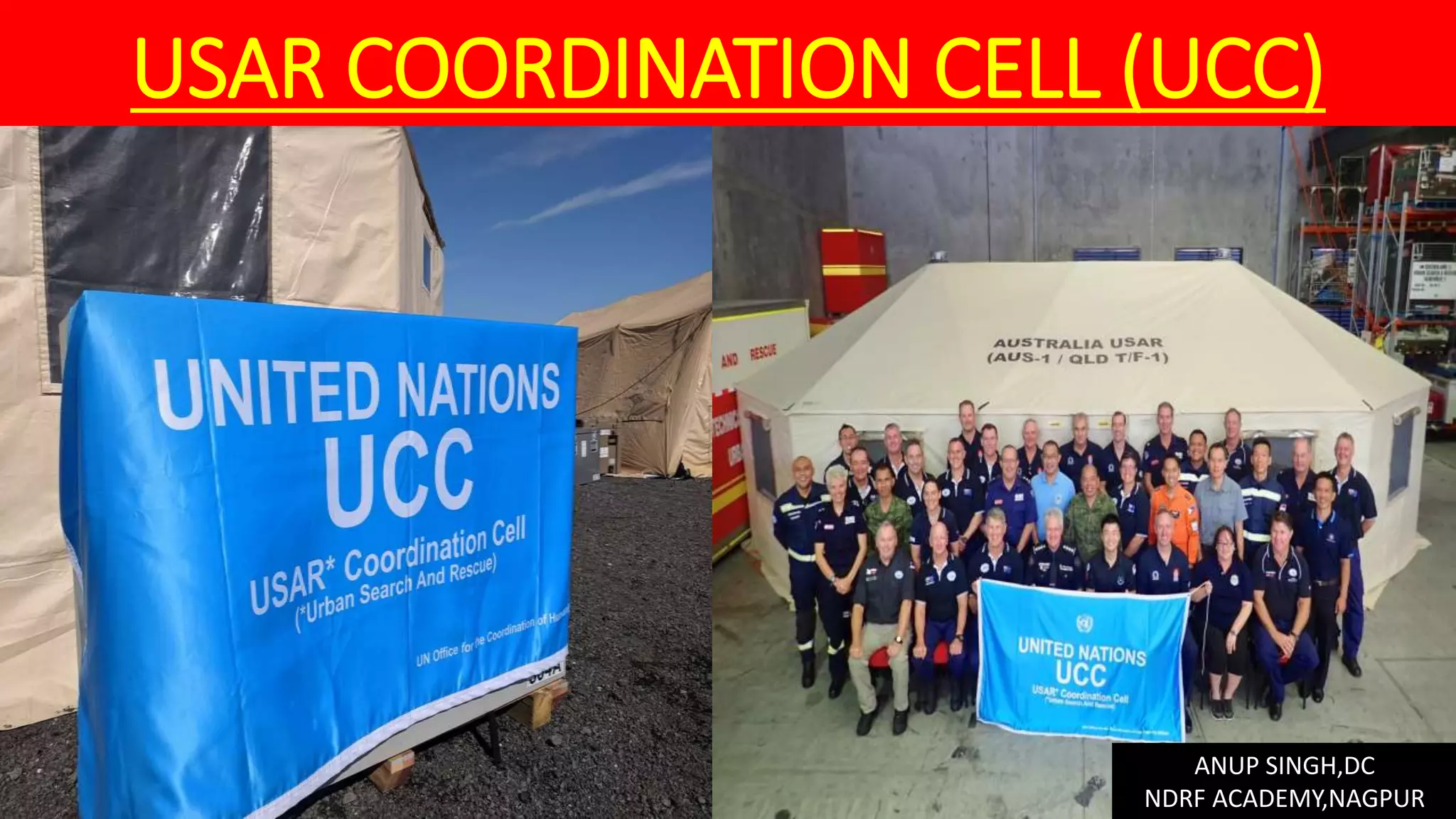

USAR COORDINATION CELL (UCC)
ANUP SINGH,DC
NDRF ACADEMY,NAGPUR
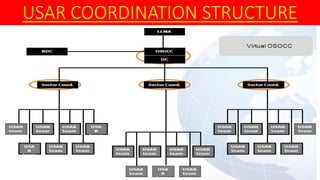
USAR COORDINATION STRUCTURE
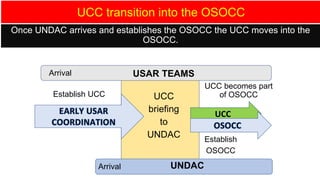
Once UNDAC arrives and establishes the OSOCC the UCC moves into the
OSOCC.
UCC transition into the OSOCC
Establish UCC
Arrival
Establish
OSOCC
UCC
briefing
to
UNDAC
UCC becomes part
of OSOCC
UCC
USAR TEAMS
UNDAC
Arrival
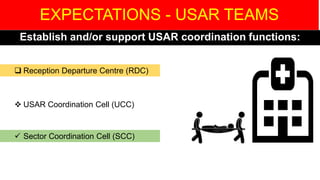
EXPECTATIONS - USAR TEAMS
Establish and/or support USAR coordination functions:
 Sector Coordination Cell (SCC)
 Reception Departure Centre (RDC)
 USAR Coordination Cell (UCC)
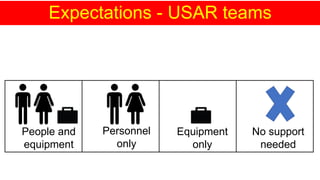
Expectations - USAR teams
People and
equipment
Personnel
only
Equipment
only
No support
needed
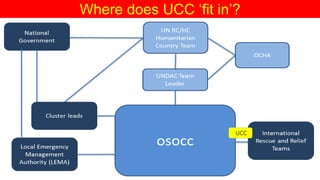
Where does UCC ‘fit in’?
UCC
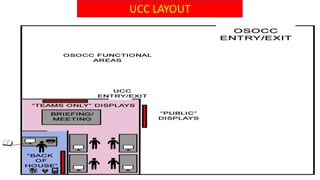
UCC LAYOUT
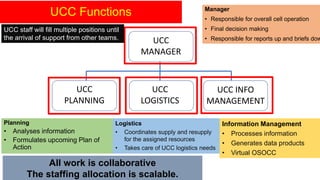
UCC Functions
UCC
MANAGER
UCC
PLANNING
UCC
LOGISTICS
UCC INFO
MANAGEMENT
All work is collaborative
The staffing allocation is scalable.
Manager
• Responsible for overall cell operation
• Final decision making
• Responsible for reports up and briefs dow
Planning
• Analyses information
• Formulates upcoming Plan of
Action
Information Management
• Processes information
• Generates data products
• Virtual OSOCC
Logistics
• Coordinates supply and resupply
for the assigned resources
• Takes care of UCC logistics needs
UCC staff will fill multiple positions until
the arrival of support from other teams.
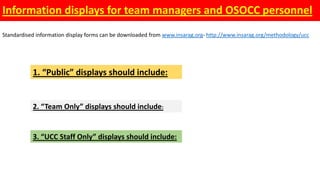
Information displays for team managers and OSOCC personnel
Standardised information display forms can be downloaded from www.insarag.org- http://www.insarag.org/methodology/ucc
1. “Public” displays should include:
2. “Team Only” displays should include:
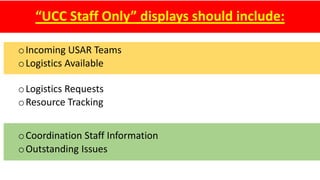
3. “UCC Staff Only” displays should include:
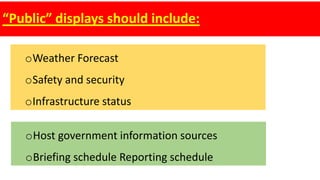
“Public” displays should include:
oWeather Forecast
oSafety and security
oInfrastructure status
oHost government information sources
oBriefing schedule Reporting schedule
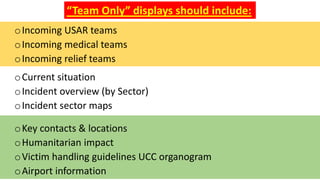
oKey contacts & locations
oHumanitarian impact
oVictim handling guidelines UCC organogram
oAirport information
“Team Only” displays should include:
oIncoming USAR teams
oIncoming medical teams
oIncoming relief teams
oCurrent situation
oIncident overview (by Sector)
oIncident sector maps
“UCC Staff Only” displays should include:
oCoordination Staff Information
oOutstanding Issues
oIncoming USAR Teams
oLogistics Available
oLogistics Requests
oResource Tracking
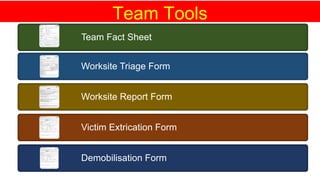
Team Fact Sheet
Worksite Triage Form
Worksite Report Form
Victim Extrication Form
Demobilisation Form
Team Tools
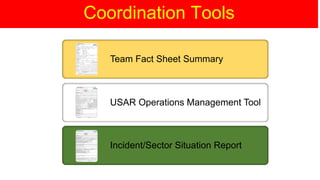
Team Fact Sheet Summary
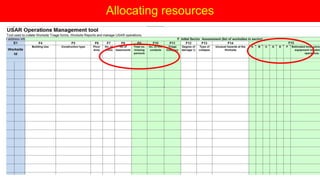
USAR Operations Management Tool
Incident/Sector Situation Report
Coordination Tools
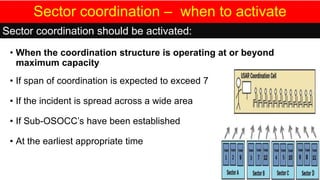
Sector coordination – when to activate
• When the coordination structure is operating at or beyond
maximum capacity
• If span of coordination is expected to exceed 7
• If the incident is spread across a wide area
• If Sub-OSOCC’s have been established
• At the earliest appropriate time
Sector coordination should be activated:
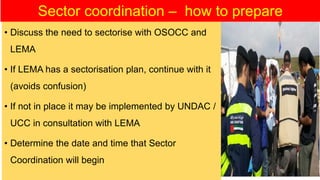
• Discuss the need to sectorise with OSOCC and
LEMA
• If LEMA has a sectorisation plan, continue with it
(avoids confusion)
• If not in place it may be implemented by UNDAC /
UCC in consultation with LEMA
• Determine the date and time that Sector
Coordination will begin
Sector coordination – how to prepare
UCC
A
B
C
OSOCC
RDC
SC
SC
SC
USAR
TEAM
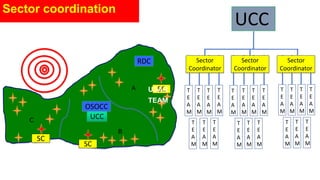
Sector coordination
UCC
T
E
A
M
T
E
A
M
T
E
A
M
T
E
A
M
T
E
A
M
T
E
A
M
T
E
A
M
T
E
A
M
T
E
A
M
T
E
A
M
T
E
A
M
T
E
A
M
T
E
A
M
T
E
A
M
T
E
A
M
T
E
A
M
T
E
A
M
T
E
A
M
T
E
A
M
T
E
A
M
T
E
A
M
Sector
Coordinator
Sector
Coordinator
Sector
Coordinator
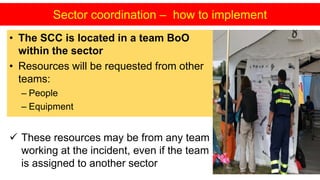
• The SCC is located in a team BoO
within the sector
• Resources will be requested from other
teams:
– People
– Equipment
Sector coordination – how to implement
 These resources may be from any team
working at the incident, even if the team
is assigned to another sector
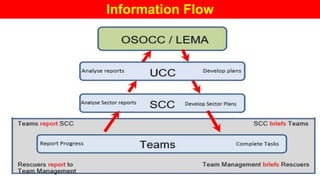
Information Flow
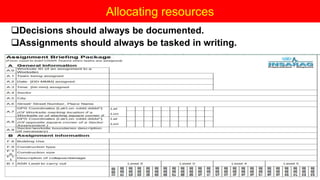
Allocating resources
Decisions should always be documented.
Assignments should always be tasked in writing.
Allocating resources
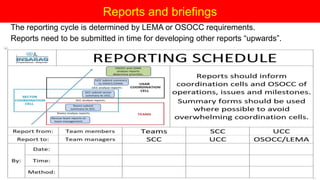
The reporting cycle is determined by LEMA or OSOCC requirements.
Reports need to be submitted in time for developing other reports “upwards”.
Reports and briefings
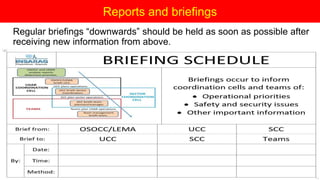
Regular briefings “downwards” should be held as soon as possible after
receiving new information from above.
Reports and briefings
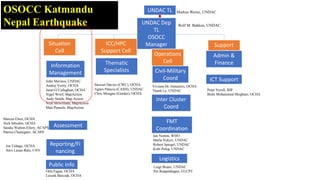
UNDAC TL
UNDAC Dep
TL
OSOCC
ManagerSituation
Cell
Assessment
Information
Management
Support
CellOperations
Cell
ICC/HPC
Support Cell
Reporting/Fi
nancing
Public Info
Markus Werne, UNDACOSOCC Katmandu
Nepal Earthquake
John Marinos, UNDAC
Andrej Verity, OCHA
Janet O’Callaghan, OCHA
Nigel Woof, MapAction
Andy Smith, Map Action
Nick Mcwilliam, MapAction
Matt Pennels, MapAction
Admin &
Finance
ICT Support
Peter Nyrell, IHP
Bishr Mohammed Mirghani, OCHA
Marcus Elten, OCHA
Nick Inboden, OCHA
Sandie Walton-Ellery, ACAPS
Patrice Chataigner, ACAPS
Joe Tobago, OCHA
Alex Lazau-Ratz, UNV
Orla Fagan, OCHA
Leszek Barczak, OCHA
Inter Cluster
Coord
FMT
Coordination
Civil-Military
Coord
Logistics
Thematic
Specialists
Stewart Davies (CWC), OCHA
Agnes Palacio (CASH), UNDAC
Chris Mougne (Gender), OCHA
Viviana De Annuntiis, OCHA
Thanh Le, UNDAC
Ian Norton, WHO
Marla Nykyri, UNDAC
Robert Spiegel, UNDAC
Kobi Peleg, UNDAC
Luigi Bruno, UNDAC
Per Reppenhagen, EUCPT
Rolf M. Bakken, UNDAC
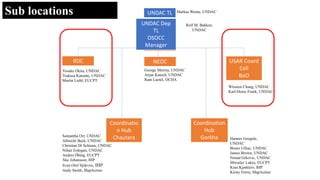
RDC NEOC
Coordination
Hub
Gorkha
Coordinatio
n Hub
Chautara
Operations
Cell
UNDAC TL
UNDAC Dep
TL
OSOCC
Manager
Markus Werne, UNDAC
Rolf M. Bakken,
UNDAC
George Murray, UNDAC
Arjun Katoch, UNDAC
Ram Luetel, OCHA
Yosuke Okita, UNDAC
Tsukasa Katsube, UNDAC
Martin Liebl, EUCPT
USAR Coord
Cell
BoO
Samantha Orr, UNDAC
Albrecht Beck, UNDAC
Christian Di Schiena, UNDAC
Nihan Erdogan, UNDAC
Anders Öberg, EUCPT
Åke Johansson, IHP
Sven Olof Sjökvist, IHP
Andy Smith, MapAction
Hannes Goegele,
UNDAC
Bruno Ulliac, UNDAC
James Brown, UNDAC
Nenad Grkovic, UNDAC
Miroslav Lukes, EUCPT
Knut Kjørkleiv, IHP
Kirsty Ferris, MapAction
Winston Chang, UNDAC
Karl-Heinz Frank, UNDAC
Sub locations
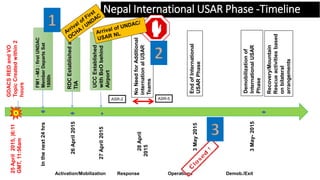
GDACSREDandVO
TopicCreatedwithin2
hours
25April2015,)6:11
GMT,11:56am
RDCEstablishedat
TIA
26April2015
Activation/Mobilization Response Operations Demob./Exit
NoNeedforAdditional
internationalUSAR
Teams
28April
2015
EndofInternational
USARPhase
3May2015
UCCEstablished
withBoObehind
Airport
27April2015
Nepal International USAR Phase -Timeline
FM1–M3:firstUNDAC
MemberDepartsSat
1800h
Inthenext24hrs
Demobilizationof
InternationalUSAR
Phase
3May-2015
Recovery/Mountain
Rescueactivitiesbased
onbilateral
arrangements
ASR-5ASR-2
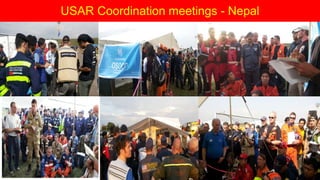
USAR Coordination meetings - Nepal
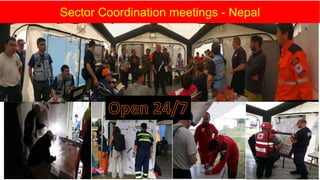
Sector Coordination meetings - Nepal
Demobilisation
As the rescue phase winds down the UCC:
• Plans for closure
• Supports teams returning home (in coordination with the RDC)
When the OSOCC advises that the UCC is to be shut down,
coordination is handed over to the OSOCC.
Facilitates transition of USAR resources to other activities such as
“Beyond the rubble”
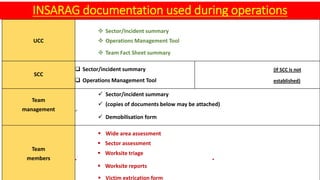
INSARAG documentation used during operations
 Sector/Incident summary
UCC  Operations Management Tool
 Team Fact Sheet summary
SCC
 Sector/incident summary (If SCC is not
 Operations Management Tool established)
Team
 Sector/incident summary
 (copies of documents below may be attached)
management 
 Demobilisation form
 Wide area assessment
Team
 Sector assessment
 Worksite triage
members  
 Worksite reports
 Victim extrication form
THANKS
Ref. INSARAG,OSOCC,UCC HANDBOOKS & WEBSITES

USAR COORDINATION CELL

  • 1.
    USAR COORDINATION CELL(UCC) ANUP SINGH,DC NDRF ACADEMY,NAGPUR
  • 2.
  • 3.
    Once UNDAC arrivesand establishes the OSOCC the UCC moves into the OSOCC. UCC transition into the OSOCC Establish UCC Arrival Establish OSOCC UCC briefing to UNDAC UCC becomes part of OSOCC UCC USAR TEAMS UNDAC Arrival
  • 4.
    EXPECTATIONS - USARTEAMS Establish and/or support USAR coordination functions:  Sector Coordination Cell (SCC)  Reception Departure Centre (RDC)  USAR Coordination Cell (UCC)
  • 5.
    Expectations - USARteams People and equipment Personnel only Equipment only No support needed
  • 6.
    Where does UCC‘fit in’? UCC
  • 7.
  • 8.
    UCC Functions UCC MANAGER UCC PLANNING UCC LOGISTICS UCC INFO MANAGEMENT Allwork is collaborative The staffing allocation is scalable. Manager • Responsible for overall cell operation • Final decision making • Responsible for reports up and briefs dow Planning • Analyses information • Formulates upcoming Plan of Action Information Management • Processes information • Generates data products • Virtual OSOCC Logistics • Coordinates supply and resupply for the assigned resources • Takes care of UCC logistics needs UCC staff will fill multiple positions until the arrival of support from other teams.
  • 9.
    Information displays forteam managers and OSOCC personnel Standardised information display forms can be downloaded from www.insarag.org- http://www.insarag.org/methodology/ucc 1. “Public” displays should include: 2. “Team Only” displays should include: 3. “UCC Staff Only” displays should include:
  • 10.
    “Public” displays shouldinclude: oWeather Forecast oSafety and security oInfrastructure status oHost government information sources oBriefing schedule Reporting schedule
  • 11.
    oKey contacts &locations oHumanitarian impact oVictim handling guidelines UCC organogram oAirport information “Team Only” displays should include: oIncoming USAR teams oIncoming medical teams oIncoming relief teams oCurrent situation oIncident overview (by Sector) oIncident sector maps
  • 12.
    “UCC Staff Only”displays should include: oCoordination Staff Information oOutstanding Issues oIncoming USAR Teams oLogistics Available oLogistics Requests oResource Tracking
  • 13.
    Team Fact Sheet WorksiteTriage Form Worksite Report Form Victim Extrication Form Demobilisation Form Team Tools
  • 14.
    Team Fact SheetSummary USAR Operations Management Tool Incident/Sector Situation Report Coordination Tools
  • 15.
    Sector coordination –when to activate • When the coordination structure is operating at or beyond maximum capacity • If span of coordination is expected to exceed 7 • If the incident is spread across a wide area • If Sub-OSOCC’s have been established • At the earliest appropriate time Sector coordination should be activated:
  • 16.
    • Discuss theneed to sectorise with OSOCC and LEMA • If LEMA has a sectorisation plan, continue with it (avoids confusion) • If not in place it may be implemented by UNDAC / UCC in consultation with LEMA • Determine the date and time that Sector Coordination will begin Sector coordination – how to prepare
  • 17.
  • 18.
    • The SCCis located in a team BoO within the sector • Resources will be requested from other teams: – People – Equipment Sector coordination – how to implement  These resources may be from any team working at the incident, even if the team is assigned to another sector
  • 19.
  • 20.
  • 21.
    Decisions should alwaysbe documented. Assignments should always be tasked in writing. Allocating resources
  • 22.
    The reporting cycleis determined by LEMA or OSOCC requirements. Reports need to be submitted in time for developing other reports “upwards”. Reports and briefings
  • 23.
    Regular briefings “downwards”should be held as soon as possible after receiving new information from above. Reports and briefings
  • 24.
    UNDAC TL UNDAC Dep TL OSOCC ManagerSituation Cell Assessment Information Management Support CellOperations Cell ICC/HPC SupportCell Reporting/Fi nancing Public Info Markus Werne, UNDACOSOCC Katmandu Nepal Earthquake John Marinos, UNDAC Andrej Verity, OCHA Janet O’Callaghan, OCHA Nigel Woof, MapAction Andy Smith, Map Action Nick Mcwilliam, MapAction Matt Pennels, MapAction Admin & Finance ICT Support Peter Nyrell, IHP Bishr Mohammed Mirghani, OCHA Marcus Elten, OCHA Nick Inboden, OCHA Sandie Walton-Ellery, ACAPS Patrice Chataigner, ACAPS Joe Tobago, OCHA Alex Lazau-Ratz, UNV Orla Fagan, OCHA Leszek Barczak, OCHA Inter Cluster Coord FMT Coordination Civil-Military Coord Logistics Thematic Specialists Stewart Davies (CWC), OCHA Agnes Palacio (CASH), UNDAC Chris Mougne (Gender), OCHA Viviana De Annuntiis, OCHA Thanh Le, UNDAC Ian Norton, WHO Marla Nykyri, UNDAC Robert Spiegel, UNDAC Kobi Peleg, UNDAC Luigi Bruno, UNDAC Per Reppenhagen, EUCPT Rolf M. Bakken, UNDAC
  • 25.
    RDC NEOC Coordination Hub Gorkha Coordinatio n Hub Chautara Operations Cell UNDACTL UNDAC Dep TL OSOCC Manager Markus Werne, UNDAC Rolf M. Bakken, UNDAC George Murray, UNDAC Arjun Katoch, UNDAC Ram Luetel, OCHA Yosuke Okita, UNDAC Tsukasa Katsube, UNDAC Martin Liebl, EUCPT USAR Coord Cell BoO Samantha Orr, UNDAC Albrecht Beck, UNDAC Christian Di Schiena, UNDAC Nihan Erdogan, UNDAC Anders Öberg, EUCPT Åke Johansson, IHP Sven Olof Sjökvist, IHP Andy Smith, MapAction Hannes Goegele, UNDAC Bruno Ulliac, UNDAC James Brown, UNDAC Nenad Grkovic, UNDAC Miroslav Lukes, EUCPT Knut Kjørkleiv, IHP Kirsty Ferris, MapAction Winston Chang, UNDAC Karl-Heinz Frank, UNDAC Sub locations
  • 26.
    GDACSREDandVO TopicCreatedwithin2 hours 25April2015,)6:11 GMT,11:56am RDCEstablishedat TIA 26April2015 Activation/Mobilization Response OperationsDemob./Exit NoNeedforAdditional internationalUSAR Teams 28April 2015 EndofInternational USARPhase 3May2015 UCCEstablished withBoObehind Airport 27April2015 Nepal International USAR Phase -Timeline FM1–M3:firstUNDAC MemberDepartsSat 1800h Inthenext24hrs Demobilizationof InternationalUSAR Phase 3May-2015 Recovery/Mountain Rescueactivitiesbased onbilateral arrangements ASR-5ASR-2
  • 27.
  • 28.
  • 29.
    Demobilisation As the rescuephase winds down the UCC: • Plans for closure • Supports teams returning home (in coordination with the RDC) When the OSOCC advises that the UCC is to be shut down, coordination is handed over to the OSOCC. Facilitates transition of USAR resources to other activities such as “Beyond the rubble”
  • 30.
    INSARAG documentation usedduring operations  Sector/Incident summary UCC  Operations Management Tool  Team Fact Sheet summary SCC  Sector/incident summary (If SCC is not  Operations Management Tool established) Team  Sector/incident summary  (copies of documents below may be attached) management   Demobilisation form  Wide area assessment Team  Sector assessment  Worksite triage members    Worksite reports  Victim extrication form
  • 32.

Editor's Notes

  • #5 As previously described, USAR teams are expected to support coordination functions.
  • #6 Teams may need to supply all resources as planned, or nothing.
  • #7 Preview what content we are going to cover. Do not go into details now, these points will be expanded upon in future sessions.
  • #9 Any unfilled positions are the responsibility of the UCC Manager. Logistics looks after the overall incident logistics
  • #10 The UCC receives information from many sources and builds a structured system to display relevant event information and coordination details. This information is used to deliver briefings, produce team handouts and adequately prepare personnel for the disaster location. These forms should be pre-printed and packed in the UCC kit. USAR teams should be trained and become proficient in the use of the forms to ensure effective coordination.   USAR team members are expected to receive and record information communicated during briefings by retaining handouts, taking notes, and/or using a camera.   The items listed below are for display within and around the RDC, however additional items specific to the country or event may be added:
  • #14 Suggest that if anyone is not familiar with all of these forms, they should perhaps spend some time tonight reviewing the content.
  • #15 Suggest that if anyone is not familiar with all of these forms, they should perhaps spend some time tonight reviewing the content.
  • #16 Sector coordination should be implemented as soon as required, or even before it is required – if the forecast identify future issues. The number of 7 is a guide only. It relates to the number of teams, not the number of work sites.
  • #17 Discuss the challenges that you may have when selecting Sector Coordinators: Will there be cultural issues? Will teams see non-selection as an insult? Could teams be seen as receiving preferred treatment? Do teams have the capability to establish and work in a SCC?
  • #18 A USAR team working within a sector can be asked to support Sector Coordination: Staff Resources This may be scalable according to the incident This slide shows geographically and organisationally how Sector Coordination is implemented. [CLICK] First team arrives and establishes RDC and UCC. The LEMA asks for a UCC to be established because of the magnitude of the incident. The UCC initially only coordinates their own team. [CLICK] They quickly know that there is a large number of teams coming to assist so they immediately consider assigning sectors. [CLICK] Next arriving teams are sent to work in the different sectors depending on needs. The span of control is still within acceptable limits, but the UCC should already consider assigning SCC roles to the first arriving teams so that they can welcome and brief the teams arriving in the sector. [CLICK] Once too many teams arrive to maintain effective communication, the UCC must assign Sector Coordinators to assist in information flow UPWARDS and DOWNWARDS. [CLICK] These SCC’s are usually located in or near a USAR team BoO. Staff should be trained in USAR Coordination Coordinators are drawn from classified teams operating in the sector Teams who have already supplied 2 or 4 personnel to other functions are not required to supply Sector Coordination staff
  • #19 Delegating Work Site ID numbers will be covered in upcoming slides. Implementing Sectorisation should be done collaboratively with teams. 3 areas – public/open access, teams area and staff only area. Information displays to be used.
  • #22 ASR Levels
  • #23 ASR Levels
  • #24 ASR Levels
  • #27 2nd formal meeting of GRG in March to review a last time Vol I but mainly to outline and to coordinate VOL II&III Second half 2014 VOL II&III ready for external consultation February 2015 Endorsement VOL II&III by the ISG October 2015 Global Meeting the transition of the revised INSARAG Guidelines During the entire process the GRG welcomes any kind of comments and remarks