

Presented by
Anup Singh, DC
NDRF Academy
Upon completion of this lesson you will be able to
know…
Preparedness system of an exercise.
Key concept of an exercise.
Process for planning an exercise.
Design a drill & its steps.
Design a Table Top Exercise.
2
OBJECTIVES
To integrate the plans, training programs, exercises, and
evaluations.
Turning the Planning Gear – writing or revising a plan
Set in motion the Training Gear – making sure all staff
understands the plan
Exercise & Evaluation Gear – to identify weakness in the
plan as well as areas where additional training is needed
3
To make “Disaster Preparedness” ensure that all
employees receive the training.
Refresher training on disaster preparedness on routine
basis.
Exercise all portions of emergency management plan, in
accordance with the training.
Use a variety of training and exercise for both
discussion-based table top exercises and operations-
based drills.
4
KEY CONCEPTS
Conduct exercises with stakeholder’s representatives
Exercise with all stakeholders, vendors as per mutual aid
agreements.(Evacuation ,Transportation, Relief Requirements, Manpower And
Equipment Requirements etc.)
Evaluate all training and exercise for the improvements
of your emergency management plan, training and
exercise schedule.
Develop relationships with your local emergency
management office (DM Cell).
5
KEY CONCEPTS
6
 Synchronize with your emergency management plan or capability or
training competency that you are planning.
 Must distribute the plan and ensure it is understood .
 Ensure that you conduct training to an established standard of
proficiency. (first timers or refresher training)
 Drills are very useful as intermediate exercises to validate specific
training proficiency.
 If there is no existing plan? You can effectively use seminars and
workshops to review it.
7
Topic – A simple single task activity/process involving a few people to
a complex, multi tasked activity involving multiple
departments/organizations.
Examples;
Roles and responsibilities of key staff members during an emergency.
The IRS and how it relate to the NDRF & state administration staff.
The physical layout of Facility & Location of the nearest stair exit,
Alternate stair exits, Direct route to each exit in case of building.
8
 Emergency telephone numbers and call-down procedures.
 How to assume control minimize rumors and prevent panic.
 Evacuation priorities i.e. ambulatory, wheelchair, differently abled.
 Procedures for protection of residents during an evacuation
 Response procedure to a missing resident.
 If power outage when the generator is inoperable.
 Responding to staff injuries during an emergency event.
 Localized fire response.
9
Contd…
Procedures for utility and water shut-offs.
Sudden power outage.
Sudden water loss or water contamination.
Sudden flooding.
Significant structural damage.
What will be your plan to tackle from them? If
violent resident, family member, staff member etc.
10
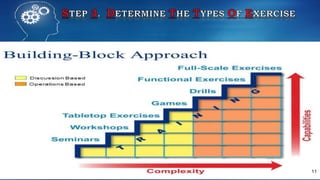
11
 Seminars, Workshops and Drill can usually be executed at low
cost.
 Tabletop exercises with multiple objectives and scenarios
 Functional exercises may require professional support.
 To avoid major expense by using existing tools to develop the
exercise.
 The more work that can be done in-house, the less professional
support.
 Identify and organize the planning team.
 Reserve a meeting space for the planning team.
12
Contd…
Schedule planning meetings.
Identify the type, scope, objectives, and purpose of the
exercise.
Assign responsibility to planning team members.
Create supporting handouts as needed.
Take care of administrative tasks, such as creating
attendee sign-in sheets, ordering refreshments, etc.
Notify players (exercise participants).
Invite observers or external partners. 13
A planning team leader directs and coordinates
All exercise planning activities.
Responsibilities.
Provides guidance.
Establishes timelines.
Monitors the development process.
14
Contd…..
A SME (Subject Matter Expert) provides ….
Technical or functional expertise to develop the scenario.
Serve as evaluators during the conduct of the exercise.
Be responsible for compiling and developing all
exercise documentation.
15
Contd…
Planning team member collects and reviews
policies, plans, and procedures.
 Planning team member will serve
A logistical function,
Providing or arranging for the supplies, materials, facilities, and
services.
The exercise will require administrative support
through out development.
16
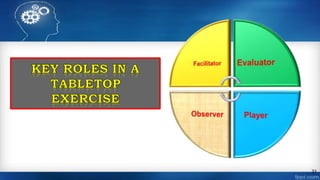
Safety officer
Facilitators
Evaluators
Actors
Players
Observers
17
 Law Enforcement Representatives
 Emergency Medical Services
 Fire and Rescue
 Hospital
 Schools
 Volunteers
 Utility Managers i.e. electricity, water etc.
 Facility Supplier
 Transportation Provider
 Sister Facilities
18
Hot wash: Hot washes may also be held with
discussion-based exercises at the discretion of the
exercise planning team leader.
19
 Debrief: debriefs may be held following the hot
wash or within a few days, following the exercise.
Did this exercise increase your awareness of event
preparedness needs? How?
What can be done to improve police/security at events?
What groups are required to work together at events in
order to address similar situations (Internal/External)?
Who responds to the media and why?
Did this meet the criteria an emergency, disaster of
crises?
20
• What have you learned during this tabletop exercise?
• What are the emergency management preparedness
strengths?
• What are the weakness/gaps in the emergency
management plans?
• List and prioritize five short and long-term actions for
follow-up.
21
(When summaries the Exercise)
 Were the objectives of the exercise met?
 What were the key decisions associated with each activity?
 Were players knowledgeable of current plans, policies, and
procedures?
 Did plans, policies, and procedures support performance tasks?
 Did the observations suggest that all personnel were adequately
trained?
22
Evaluators should consider the
following questions
Contd…
Did the observations identify any resource
shortcomings that could inhibit the ability to execute
an activity?
Did personnel from multiple agencies or jurisdictions
work together to perform tasks, activities or
capabilities?
If so, are there agreements or relationships in place to
support the coordination required?
23
Contd….
Is any cross-training needed to enhance task
performances?
What should be learned from this exercise?
What strengths were identified for each activity?
What areas for improvement are recommended for
each activity?
24
After-Action Reports (AAR) are used to provide
feedback.
An AAR summarizes exercise events and analyzes
performance of the topic’s objective tasks.
The After-Action Report includes an improvement plan
outlining corrective actions needed, along with
timelines for their implementation and assignment to
responsible parties.
25
Once the recommendations, corrective actions,
responsibilities, due dates are clearly identified & agreed
upon in the improvement plan.
Maintaining the discipline to keep the improvement plan
activities on track is the most difficult part of the
process.
Failure to follow improvement plan corrective actions to
completion often results in repeated lessons learned,
and lack of preparedness improvement.
26
It will provide more detailed guidance for NDRF
on two specific types of exercise:-
27
1) Operation-based drills
2) Discussion-based Tabletops
28
1. Plan the drill
2. Call the drill
3. State the drill scenario and purpose
4. Conduct the drill
5. Conclude the drill and document participants and
activities.
6. Evaluate the drill and identify action needed
7. After the drill- next steps
29
Determine if participants can realistically “Talk
through” their critical functions during an emergency.
Help participants become more aware of possible
weaknesses and gaps in the plan.
Thoroughly acquaint participants with the contents of
their facility’s plan.
30
31
Step 1: Assess your facility’s needs.
Step 2: Prioritize the needs and determine the
scope of the exercise.
Step 3: Write a goal (purpose statement) for the
exercise.
Step 4: Write specific objectives for the goal
Step 5: Select or create an emergency scenario
32
Contd…
Step 6: Identify exercise participants.
Step 7: Determine date/time/place.
Step 8: Invite players (participants) and any
external partners if appropriate.
Step 9: Prepare materials.
Step 10: Conduct the exercise.
33
Step 11: Evaluate the exercise.
What went well?
What didn’t go so well, and what might be the
root causes of any concerns?
What were the surprises, if any?
Were the exercise goals and objectives met? If
not, why not?
Are there action items for follow-up in an
improvement plan?
34
There are no right or wrong answers. All ideas are
welcome.
Let there be artificiality in the exercise.
Lets maintain a stress free environment. No fault finding
exercise.
Your response should be based on the information
provided in the scenario
We are looking for creative yet realistic ideas for our
improvement.
Respond as per your present capacity
Do not limit your thinking… 35
36
37
38
THANKS
39

Exercise panning process & discussion

  • 1.
    Presented by Anup Singh,DC NDRF Academy
  • 2.
    Upon completion ofthis lesson you will be able to know… Preparedness system of an exercise. Key concept of an exercise. Process for planning an exercise. Design a drill & its steps. Design a Table Top Exercise. 2 OBJECTIVES
  • 3.
    To integrate theplans, training programs, exercises, and evaluations. Turning the Planning Gear – writing or revising a plan Set in motion the Training Gear – making sure all staff understands the plan Exercise & Evaluation Gear – to identify weakness in the plan as well as areas where additional training is needed 3
  • 4.
    To make “DisasterPreparedness” ensure that all employees receive the training. Refresher training on disaster preparedness on routine basis. Exercise all portions of emergency management plan, in accordance with the training. Use a variety of training and exercise for both discussion-based table top exercises and operations- based drills. 4 KEY CONCEPTS
  • 5.
    Conduct exercises withstakeholder’s representatives Exercise with all stakeholders, vendors as per mutual aid agreements.(Evacuation ,Transportation, Relief Requirements, Manpower And Equipment Requirements etc.) Evaluate all training and exercise for the improvements of your emergency management plan, training and exercise schedule. Develop relationships with your local emergency management office (DM Cell). 5 KEY CONCEPTS
  • 6.
  • 7.
     Synchronize withyour emergency management plan or capability or training competency that you are planning.  Must distribute the plan and ensure it is understood .  Ensure that you conduct training to an established standard of proficiency. (first timers or refresher training)  Drills are very useful as intermediate exercises to validate specific training proficiency.  If there is no existing plan? You can effectively use seminars and workshops to review it. 7
  • 8.
    Topic – Asimple single task activity/process involving a few people to a complex, multi tasked activity involving multiple departments/organizations. Examples; Roles and responsibilities of key staff members during an emergency. The IRS and how it relate to the NDRF & state administration staff. The physical layout of Facility & Location of the nearest stair exit, Alternate stair exits, Direct route to each exit in case of building. 8
  • 9.
     Emergency telephonenumbers and call-down procedures.  How to assume control minimize rumors and prevent panic.  Evacuation priorities i.e. ambulatory, wheelchair, differently abled.  Procedures for protection of residents during an evacuation  Response procedure to a missing resident.  If power outage when the generator is inoperable.  Responding to staff injuries during an emergency event.  Localized fire response. 9
  • 10.
    Contd… Procedures for utilityand water shut-offs. Sudden power outage. Sudden water loss or water contamination. Sudden flooding. Significant structural damage. What will be your plan to tackle from them? If violent resident, family member, staff member etc. 10
  • 11.
  • 12.
     Seminars, Workshopsand Drill can usually be executed at low cost.  Tabletop exercises with multiple objectives and scenarios  Functional exercises may require professional support.  To avoid major expense by using existing tools to develop the exercise.  The more work that can be done in-house, the less professional support.  Identify and organize the planning team.  Reserve a meeting space for the planning team. 12
  • 13.
    Contd… Schedule planning meetings. Identifythe type, scope, objectives, and purpose of the exercise. Assign responsibility to planning team members. Create supporting handouts as needed. Take care of administrative tasks, such as creating attendee sign-in sheets, ordering refreshments, etc. Notify players (exercise participants). Invite observers or external partners. 13
  • 14.
    A planning teamleader directs and coordinates All exercise planning activities. Responsibilities. Provides guidance. Establishes timelines. Monitors the development process. 14
  • 15.
    Contd….. A SME (SubjectMatter Expert) provides …. Technical or functional expertise to develop the scenario. Serve as evaluators during the conduct of the exercise. Be responsible for compiling and developing all exercise documentation. 15
  • 16.
    Contd… Planning team membercollects and reviews policies, plans, and procedures.  Planning team member will serve A logistical function, Providing or arranging for the supplies, materials, facilities, and services. The exercise will require administrative support through out development. 16
  • 17.
  • 18.
     Law EnforcementRepresentatives  Emergency Medical Services  Fire and Rescue  Hospital  Schools  Volunteers  Utility Managers i.e. electricity, water etc.  Facility Supplier  Transportation Provider  Sister Facilities 18
  • 19.
    Hot wash: Hotwashes may also be held with discussion-based exercises at the discretion of the exercise planning team leader. 19  Debrief: debriefs may be held following the hot wash or within a few days, following the exercise.
  • 20.
    Did this exerciseincrease your awareness of event preparedness needs? How? What can be done to improve police/security at events? What groups are required to work together at events in order to address similar situations (Internal/External)? Who responds to the media and why? Did this meet the criteria an emergency, disaster of crises? 20
  • 21.
    • What haveyou learned during this tabletop exercise? • What are the emergency management preparedness strengths? • What are the weakness/gaps in the emergency management plans? • List and prioritize five short and long-term actions for follow-up. 21
  • 22.
    (When summaries theExercise)  Were the objectives of the exercise met?  What were the key decisions associated with each activity?  Were players knowledgeable of current plans, policies, and procedures?  Did plans, policies, and procedures support performance tasks?  Did the observations suggest that all personnel were adequately trained? 22 Evaluators should consider the following questions
  • 23.
    Contd… Did the observationsidentify any resource shortcomings that could inhibit the ability to execute an activity? Did personnel from multiple agencies or jurisdictions work together to perform tasks, activities or capabilities? If so, are there agreements or relationships in place to support the coordination required? 23
  • 24.
    Contd…. Is any cross-trainingneeded to enhance task performances? What should be learned from this exercise? What strengths were identified for each activity? What areas for improvement are recommended for each activity? 24
  • 25.
    After-Action Reports (AAR)are used to provide feedback. An AAR summarizes exercise events and analyzes performance of the topic’s objective tasks. The After-Action Report includes an improvement plan outlining corrective actions needed, along with timelines for their implementation and assignment to responsible parties. 25
  • 26.
    Once the recommendations,corrective actions, responsibilities, due dates are clearly identified & agreed upon in the improvement plan. Maintaining the discipline to keep the improvement plan activities on track is the most difficult part of the process. Failure to follow improvement plan corrective actions to completion often results in repeated lessons learned, and lack of preparedness improvement. 26
  • 27.
    It will providemore detailed guidance for NDRF on two specific types of exercise:- 27 1) Operation-based drills 2) Discussion-based Tabletops
  • 28.
  • 29.
    1. Plan thedrill 2. Call the drill 3. State the drill scenario and purpose 4. Conduct the drill 5. Conclude the drill and document participants and activities. 6. Evaluate the drill and identify action needed 7. After the drill- next steps 29
  • 30.
    Determine if participantscan realistically “Talk through” their critical functions during an emergency. Help participants become more aware of possible weaknesses and gaps in the plan. Thoroughly acquaint participants with the contents of their facility’s plan. 30
  • 31.
  • 32.
    Step 1: Assessyour facility’s needs. Step 2: Prioritize the needs and determine the scope of the exercise. Step 3: Write a goal (purpose statement) for the exercise. Step 4: Write specific objectives for the goal Step 5: Select or create an emergency scenario 32
  • 33.
    Contd… Step 6: Identifyexercise participants. Step 7: Determine date/time/place. Step 8: Invite players (participants) and any external partners if appropriate. Step 9: Prepare materials. Step 10: Conduct the exercise. 33
  • 34.
    Step 11: Evaluatethe exercise. What went well? What didn’t go so well, and what might be the root causes of any concerns? What were the surprises, if any? Were the exercise goals and objectives met? If not, why not? Are there action items for follow-up in an improvement plan? 34
  • 35.
    There are noright or wrong answers. All ideas are welcome. Let there be artificiality in the exercise. Lets maintain a stress free environment. No fault finding exercise. Your response should be based on the information provided in the scenario We are looking for creative yet realistic ideas for our improvement. Respond as per your present capacity Do not limit your thinking… 35
  • 36.
  • 37.
  • 38.
  • 39.