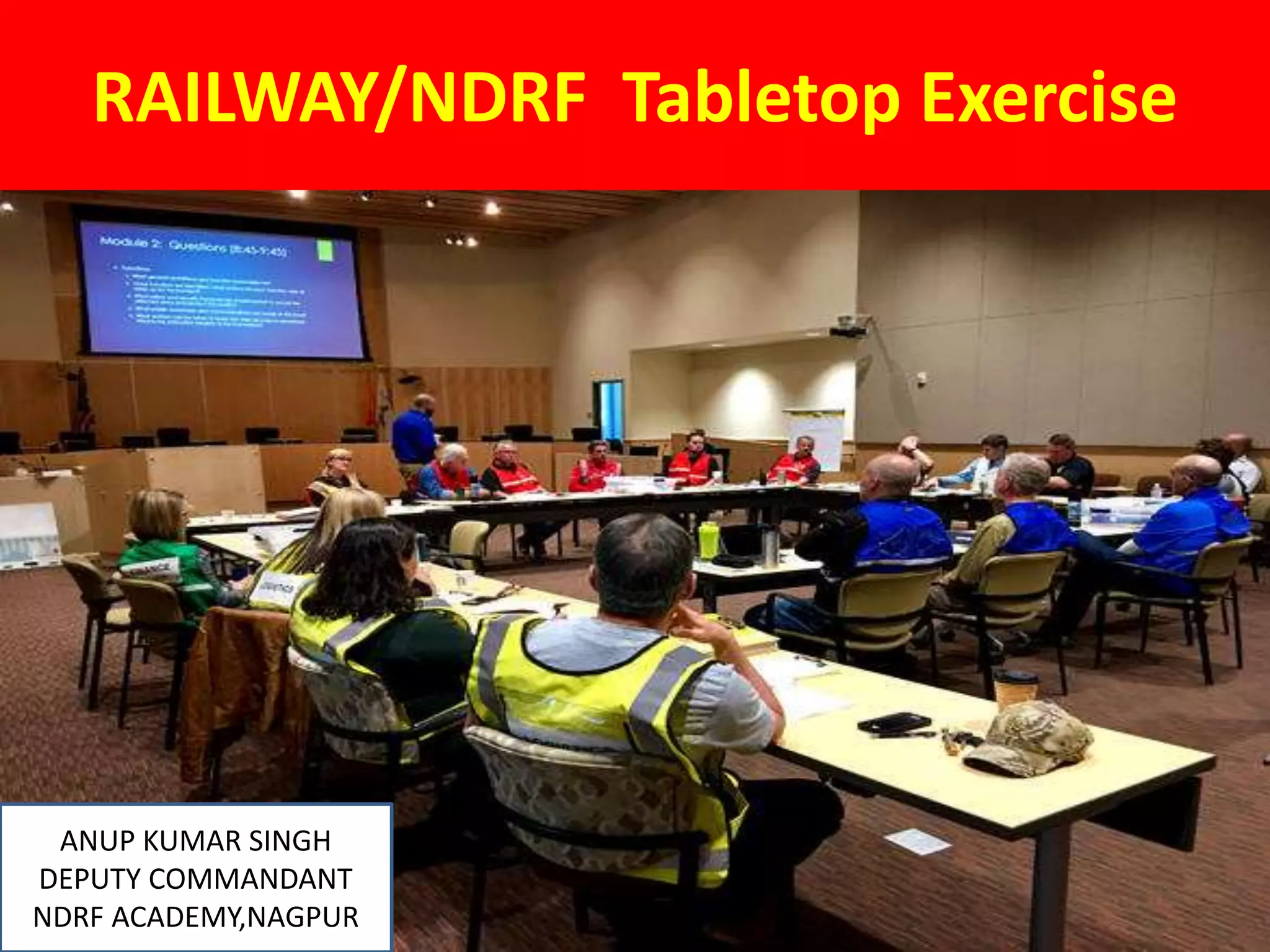
RAILWAY/NDRF Tabletop Exercise
ANUP KUMAR SINGH
DEPUTY COMMANDANT
NDRF ACADEMY,NAGPUR
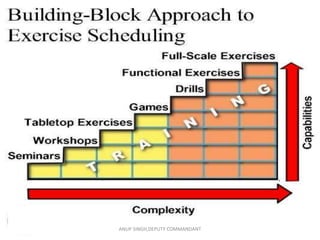
ANUP SINGH,DEPUTY COMMANDANT
What is a Tabletop Exercise?
Informal discussion using a scripted disaster scenario as
a catalyst
No time pressure, designed to promote free and open
exchange of ideas
Familiarizes players with roles, responsibilities,
functions, plans, and procedures
Identify issues requiring further work
Interactive
No fault environment – exchange ideas
Learn what other departments, agencies, &
jurisdictions need from you
Prompts to get you talking/thinking with each other
ANUP SINGH,DEPUTY COMMANDANT
How a Tabletop Works
•A scenario-based discussion is guided by a facilitator
•Simulate an emergency situation in an informal,
stress-free environment.
•Observe offer feedback on the proceedings
•Policies, procedures, plans, and guidelines are
discussed and updated.
•Focus on training and familiarization with roles,
guidelines, and responsibilities.
ANUP SINGH,DEPUTY COMMANDANT
TABLETOP SUCCESS
Participants leave with:
A positive learning experience
Organizational learning
Improvement action planning
More effective policies, plans, and guidelines
Improved preparedness
Reality Check –make the exercise real for you.
ANUP SINGH,DEPUTY COMMANDANT
GROUND RULES
Active Thinking
Active Listening
Active Participation
Respect –challenge ideas, not people
ANUP SINGH,DEPUTY COMMANDANT
Exercise Guidelines
This exercise is designed to test the preparedness of
the Railway/NDRF to respond to a Rail accident event.
The facilitator will present the situation.
 The facilitator will serve as the exercise referee and
provide any official interpretation of the exercise rules.
From time to time, there will be injections into the
scenario. These are intended to further assess response
to the exercise scenario.
Each participant will be given the opportunity to share
his/her views on what worked well and what needs to
be addressed in additional planning, inter agency
coordination.
ANUP SINGH,DEPUTY COMMANDANT
GUIDELINES (CONTINUED)
Players respond to the situation presented, based on knowledge
of response procedures, current plans, and insights from training.
Players will engage in a discussion of appropriate response
actions and issues that arise from the scenario at hand.
 Put yourself in the position described in the scenario
 When asked, describe your actions as if this were “real,”
following organizational plans and procedures
 There are no “right” or “wrong” answers
 Identification of issues, but not necessarily trying to solve them
ANUP SINGH,DEPUTY COMMANDANT
Guidelines (Continued)
Decisions are not precedent setting and may not
reflect your organization’s final position on a given
issue.
Following the exercise, there will be a debriefing
time, aka a “Hot Wash”.
ANUP SINGH,DEPUTY COMMANDANT
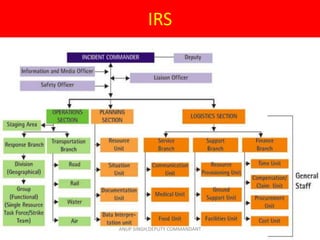
IRS
ANUP SINGH,DEPUTY COMMANDANT
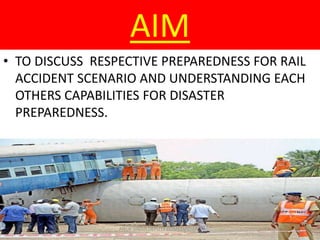
AIM
• TO DISCUSS RESPECTIVE PREPAREDNESS FOR RAIL
ACCIDENT SCENARIO AND UNDERSTANDING EACH
OTHERS CAPABILITIES FOR DISASTER
PREPAREDNESS.
ANUP SINGH,DEPUTY COMMANDANT
SCOPE
1.Functions or capabilities of different stakeholders
2.Understanding response mechanism of various
agencies involved (as per policies and guidelines)
3.Synergy as per Incident Response System
4.A common solution/agreement of the incident
after table top this exercise
ANUP SINGH,DEPUTY COMMANDANT
Purpose
 To examine current policies, procedures, resources and
actions in the context to a response in a rail accident scenario
 To promote greater understanding and ability to apply IRS
principles in this type of scenario setting
 To make improvements as identified as an outcome of the
exercise
 Discuss new concepts and ideas, how can we perform the
most efficiently and effectively?
 Identify gaps and shortfalls in communications and resources
ANUP SINGH,DEPUTY COMMANDANT
Objectives
To evaluate policies and procedures… your plan
To evaluate command and control including
communications procedures
 To identify Trigger Mechanism process
 To identify procedure to set Emergency Operation
Centre ( EOC)
To identify resources needed vs. available
To identify training needs
To identify required improvements and create an
action plan to address those needsANUP SINGH,DEPUTY COMMANDANT
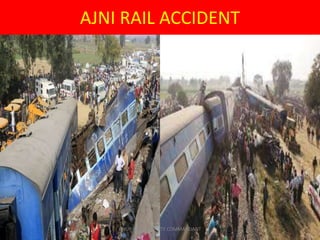
AJNI RAIL ACCIDENT
ANUP SINGH,DEPUTY COMMANDANT
SCENARIO – SATURDAY, MARCH 24
 On 24 march 2018, at approximately 08:20 local time, the
Vidarbha Express (12105) a daily scheduled train from
Mumbai CST to Gondia Junction , derailed near AJNI, Nagpur.
 Speed of the train at the time of derailment is believed to be
90 km per hour.
 An early report indicates at least 15 people killed and over 50
injured.
 S1, S2, S3, S4, S5, S6, B1, B2 & B3 Bogies are badly damaged
and wreckages spread all along the tracks.
 S1, S2, S3 & B3 got mingled to each other.
 Most of the casualties are from two severely damaged
coaches, namely S1 and S2 of sleeper class.
ANUP SINGH,DEPUTY COMMANDANT
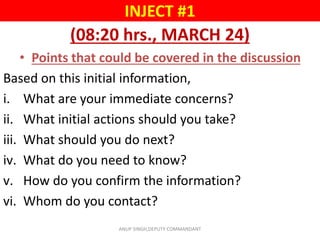
INJECT #1
(08:20 hrs., MARCH 24)
• Points that could be covered in the discussion
Based on this initial information,
i. What are your immediate concerns?
ii. What initial actions should you take?
iii. What should you do next?
iv. What do you need to know?
v. How do you confirm the information?
vi. Whom do you contact?
ANUP SINGH,DEPUTY COMMANDANT
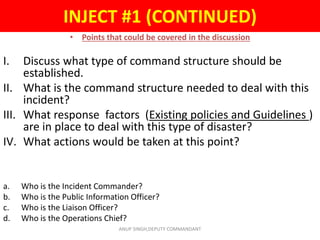
INJECT #1 (CONTINUED)
• Points that could be covered in the discussion
I. Discuss what type of command structure should be
established.
II. What is the command structure needed to deal with this
incident?
III. What response factors (Existing policies and Guidelines )
are in place to deal with this type of disaster?
IV. What actions would be taken at this point?
a. Who is the Incident Commander?
b. Who is the Public Information Officer?
c. Who is the Liaison Officer?
d. Who is the Operations Chief?
ANUP SINGH,DEPUTY COMMANDANT
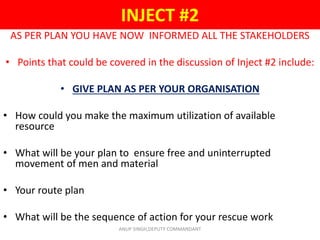
INJECT #2
AS PER PLAN YOU HAVE NOW INFORMED ALL THE STAKEHOLDERS
• Points that could be covered in the discussion of Inject #2 include:
• GIVE PLAN AS PER YOUR ORGANISATION
• How could you make the maximum utilization of available
resource
• What will be your plan to ensure free and uninterrupted
movement of men and material
• Your route plan
• What will be the sequence of action for your rescue work
ANUP SINGH,DEPUTY COMMANDANT
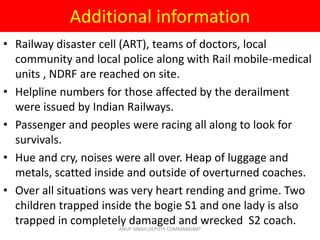
Additional information
• Railway disaster cell (ART), teams of doctors, local
community and local police along with Rail mobile-medical
units , NDRF are reached on site.
• Helpline numbers for those affected by the derailment
were issued by Indian Railways.
• Passenger and peoples were racing all along to look for
survivals.
• Hue and cry, noises were all over. Heap of luggage and
metals, scatted inside and outside of overturned coaches.
• Over all situations was very heart rending and grime. Two
children trapped inside the bogie S1 and one lady is also
trapped in completely damaged and wrecked S2 coach.
ANUP SINGH,DEPUTY COMMANDANT
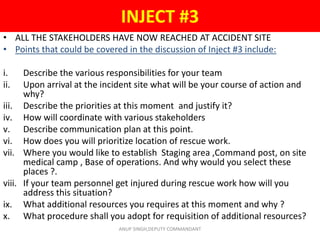
• ALL THE STAKEHOLDERS HAVE NOW REACHED AT ACCIDENT SITE
• Points that could be covered in the discussion of Inject #3 include:
i. Describe the various responsibilities for your team
ii. Upon arrival at the incident site what will be your course of action and
why?
iii. Describe the priorities at this moment and justify it?
iv. How will coordinate with various stakeholders
v. Describe communication plan at this point.
vi. How does you will prioritize location of rescue work.
vii. Where you would like to establish Staging area ,Command post, on site
medical camp , Base of operations. And why would you select these
places ?.
viii. If your team personnel get injured during rescue work how will you
address this situation?
ix. What additional resources you requires at this moment and why ?
x. What procedure shall you adopt for requisition of additional resources?
INJECT #3
ANUP SINGH,DEPUTY COMMANDANT
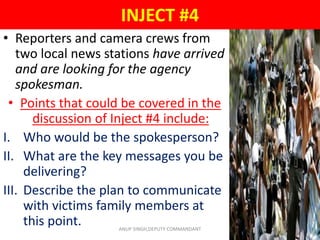
INJECT #4
• Reporters and camera crews from
two local news stations have arrived
and are looking for the agency
spokesman.
• Points that could be covered in the
discussion of Inject #4 include:
I. Who would be the spokesperson?
II. What are the key messages you be
delivering?
III. Describe the plan to communicate
with victims family members at
this point. ANUP SINGH,DEPUTY COMMANDANT
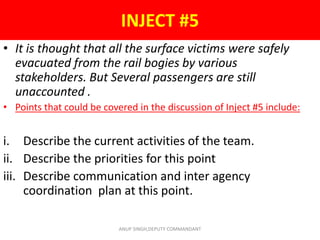
• It is thought that all the surface victims were safely
evacuated from the rail bogies by various
stakeholders. But Several passengers are still
unaccounted .
• Points that could be covered in the discussion of Inject #5 include:
i. Describe the current activities of the team.
ii. Describe the priorities for this point
iii. Describe communication and inter agency
coordination plan at this point.
INJECT #5
ANUP SINGH,DEPUTY COMMANDANT
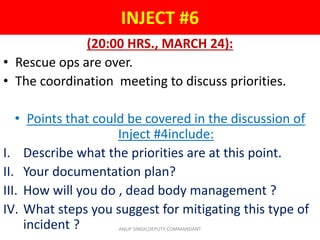
INJECT #6
(20:00 HRS., MARCH 24):
• Rescue ops are over.
• The coordination meeting to discuss priorities.
• Points that could be covered in the discussion of
Inject #4include:
I. Describe what the priorities are at this point.
II. Your documentation plan?
III. How will you do , dead body management ?
IV. What steps you suggest for mitigating this type of
incident ? ANUP SINGH,DEPUTY COMMANDANT
HOT WASH
How well did your Emergency Response Plan and
inter agency coordination operate and what actions
will you take toward improvement?
How well did your IRS concept operate and what
actions will you take toward improvement?
How well did your Communications Plan operate
and what actions will you take toward
improvement? ANUP SINGH,DEPUTY COMMANDANT
AFTER ACTION PLAN
• Lessons Learned:
• For an improved action plan, consider what
• you will:
• Keep Doing ______
• Stop Doing ______
• Do Differently ________________
• Start Doing ______
ANUP SINGH,DEPUTY COMMANDANT
Conclusion
ANUP SINGH,DEPUTY COMMANDANT
LIKE WE RESPOND”
“WE SHOULD TRAIN
PHOTO
CAPTION
ANUP SINGH,DEPUTY COMMANDANT

TABLE TOP EXERCISE,NDRF

  • 1.
    RAILWAY/NDRF Tabletop Exercise ANUPKUMAR SINGH DEPUTY COMMANDANT NDRF ACADEMY,NAGPUR
  • 2.
  • 3.
    What is aTabletop Exercise? Informal discussion using a scripted disaster scenario as a catalyst No time pressure, designed to promote free and open exchange of ideas Familiarizes players with roles, responsibilities, functions, plans, and procedures Identify issues requiring further work Interactive No fault environment – exchange ideas Learn what other departments, agencies, & jurisdictions need from you Prompts to get you talking/thinking with each other ANUP SINGH,DEPUTY COMMANDANT
  • 4.
    How a TabletopWorks •A scenario-based discussion is guided by a facilitator •Simulate an emergency situation in an informal, stress-free environment. •Observe offer feedback on the proceedings •Policies, procedures, plans, and guidelines are discussed and updated. •Focus on training and familiarization with roles, guidelines, and responsibilities. ANUP SINGH,DEPUTY COMMANDANT
  • 5.
    TABLETOP SUCCESS Participants leavewith: A positive learning experience Organizational learning Improvement action planning More effective policies, plans, and guidelines Improved preparedness Reality Check –make the exercise real for you. ANUP SINGH,DEPUTY COMMANDANT
  • 6.
    GROUND RULES Active Thinking ActiveListening Active Participation Respect –challenge ideas, not people ANUP SINGH,DEPUTY COMMANDANT
  • 7.
    Exercise Guidelines This exerciseis designed to test the preparedness of the Railway/NDRF to respond to a Rail accident event. The facilitator will present the situation.  The facilitator will serve as the exercise referee and provide any official interpretation of the exercise rules. From time to time, there will be injections into the scenario. These are intended to further assess response to the exercise scenario. Each participant will be given the opportunity to share his/her views on what worked well and what needs to be addressed in additional planning, inter agency coordination. ANUP SINGH,DEPUTY COMMANDANT
  • 8.
    GUIDELINES (CONTINUED) Players respondto the situation presented, based on knowledge of response procedures, current plans, and insights from training. Players will engage in a discussion of appropriate response actions and issues that arise from the scenario at hand.  Put yourself in the position described in the scenario  When asked, describe your actions as if this were “real,” following organizational plans and procedures  There are no “right” or “wrong” answers  Identification of issues, but not necessarily trying to solve them ANUP SINGH,DEPUTY COMMANDANT
  • 9.
    Guidelines (Continued) Decisions arenot precedent setting and may not reflect your organization’s final position on a given issue. Following the exercise, there will be a debriefing time, aka a “Hot Wash”. ANUP SINGH,DEPUTY COMMANDANT
  • 10.
  • 11.
    AIM • TO DISCUSSRESPECTIVE PREPAREDNESS FOR RAIL ACCIDENT SCENARIO AND UNDERSTANDING EACH OTHERS CAPABILITIES FOR DISASTER PREPAREDNESS. ANUP SINGH,DEPUTY COMMANDANT
  • 12.
    SCOPE 1.Functions or capabilitiesof different stakeholders 2.Understanding response mechanism of various agencies involved (as per policies and guidelines) 3.Synergy as per Incident Response System 4.A common solution/agreement of the incident after table top this exercise ANUP SINGH,DEPUTY COMMANDANT
  • 13.
    Purpose  To examinecurrent policies, procedures, resources and actions in the context to a response in a rail accident scenario  To promote greater understanding and ability to apply IRS principles in this type of scenario setting  To make improvements as identified as an outcome of the exercise  Discuss new concepts and ideas, how can we perform the most efficiently and effectively?  Identify gaps and shortfalls in communications and resources ANUP SINGH,DEPUTY COMMANDANT
  • 14.
    Objectives To evaluate policiesand procedures… your plan To evaluate command and control including communications procedures  To identify Trigger Mechanism process  To identify procedure to set Emergency Operation Centre ( EOC) To identify resources needed vs. available To identify training needs To identify required improvements and create an action plan to address those needsANUP SINGH,DEPUTY COMMANDANT
  • 15.
    AJNI RAIL ACCIDENT ANUPSINGH,DEPUTY COMMANDANT
  • 16.
    SCENARIO – SATURDAY,MARCH 24  On 24 march 2018, at approximately 08:20 local time, the Vidarbha Express (12105) a daily scheduled train from Mumbai CST to Gondia Junction , derailed near AJNI, Nagpur.  Speed of the train at the time of derailment is believed to be 90 km per hour.  An early report indicates at least 15 people killed and over 50 injured.  S1, S2, S3, S4, S5, S6, B1, B2 & B3 Bogies are badly damaged and wreckages spread all along the tracks.  S1, S2, S3 & B3 got mingled to each other.  Most of the casualties are from two severely damaged coaches, namely S1 and S2 of sleeper class. ANUP SINGH,DEPUTY COMMANDANT
  • 17.
    INJECT #1 (08:20 hrs.,MARCH 24) • Points that could be covered in the discussion Based on this initial information, i. What are your immediate concerns? ii. What initial actions should you take? iii. What should you do next? iv. What do you need to know? v. How do you confirm the information? vi. Whom do you contact? ANUP SINGH,DEPUTY COMMANDANT
  • 18.
    INJECT #1 (CONTINUED) •Points that could be covered in the discussion I. Discuss what type of command structure should be established. II. What is the command structure needed to deal with this incident? III. What response factors (Existing policies and Guidelines ) are in place to deal with this type of disaster? IV. What actions would be taken at this point? a. Who is the Incident Commander? b. Who is the Public Information Officer? c. Who is the Liaison Officer? d. Who is the Operations Chief? ANUP SINGH,DEPUTY COMMANDANT
  • 19.
    INJECT #2 AS PERPLAN YOU HAVE NOW INFORMED ALL THE STAKEHOLDERS • Points that could be covered in the discussion of Inject #2 include: • GIVE PLAN AS PER YOUR ORGANISATION • How could you make the maximum utilization of available resource • What will be your plan to ensure free and uninterrupted movement of men and material • Your route plan • What will be the sequence of action for your rescue work ANUP SINGH,DEPUTY COMMANDANT
  • 20.
    Additional information • Railwaydisaster cell (ART), teams of doctors, local community and local police along with Rail mobile-medical units , NDRF are reached on site. • Helpline numbers for those affected by the derailment were issued by Indian Railways. • Passenger and peoples were racing all along to look for survivals. • Hue and cry, noises were all over. Heap of luggage and metals, scatted inside and outside of overturned coaches. • Over all situations was very heart rending and grime. Two children trapped inside the bogie S1 and one lady is also trapped in completely damaged and wrecked S2 coach. ANUP SINGH,DEPUTY COMMANDANT
  • 21.
    • ALL THESTAKEHOLDERS HAVE NOW REACHED AT ACCIDENT SITE • Points that could be covered in the discussion of Inject #3 include: i. Describe the various responsibilities for your team ii. Upon arrival at the incident site what will be your course of action and why? iii. Describe the priorities at this moment and justify it? iv. How will coordinate with various stakeholders v. Describe communication plan at this point. vi. How does you will prioritize location of rescue work. vii. Where you would like to establish Staging area ,Command post, on site medical camp , Base of operations. And why would you select these places ?. viii. If your team personnel get injured during rescue work how will you address this situation? ix. What additional resources you requires at this moment and why ? x. What procedure shall you adopt for requisition of additional resources? INJECT #3 ANUP SINGH,DEPUTY COMMANDANT
  • 22.
    INJECT #4 • Reportersand camera crews from two local news stations have arrived and are looking for the agency spokesman. • Points that could be covered in the discussion of Inject #4 include: I. Who would be the spokesperson? II. What are the key messages you be delivering? III. Describe the plan to communicate with victims family members at this point. ANUP SINGH,DEPUTY COMMANDANT
  • 23.
    • It isthought that all the surface victims were safely evacuated from the rail bogies by various stakeholders. But Several passengers are still unaccounted . • Points that could be covered in the discussion of Inject #5 include: i. Describe the current activities of the team. ii. Describe the priorities for this point iii. Describe communication and inter agency coordination plan at this point. INJECT #5 ANUP SINGH,DEPUTY COMMANDANT
  • 24.
    INJECT #6 (20:00 HRS.,MARCH 24): • Rescue ops are over. • The coordination meeting to discuss priorities. • Points that could be covered in the discussion of Inject #4include: I. Describe what the priorities are at this point. II. Your documentation plan? III. How will you do , dead body management ? IV. What steps you suggest for mitigating this type of incident ? ANUP SINGH,DEPUTY COMMANDANT
  • 25.
    HOT WASH How welldid your Emergency Response Plan and inter agency coordination operate and what actions will you take toward improvement? How well did your IRS concept operate and what actions will you take toward improvement? How well did your Communications Plan operate and what actions will you take toward improvement? ANUP SINGH,DEPUTY COMMANDANT
  • 26.
    AFTER ACTION PLAN •Lessons Learned: • For an improved action plan, consider what • you will: • Keep Doing ______ • Stop Doing ______ • Do Differently ________________ • Start Doing ______ ANUP SINGH,DEPUTY COMMANDANT
  • 27.
  • 28.
    LIKE WE RESPOND” “WESHOULD TRAIN PHOTO CAPTION ANUP SINGH,DEPUTY COMMANDANT