CONSTRUCTION MATERIALS,
STRUCTURES & DAMAGE TYPES
BY
ANUP SINGH
DEPUTY COMMANDANT
NDRF ACADEMY
NAGPUR
OBJECTIVE
UPON COMPLETING THIS LESSON YOU WILL ABLE TO:
1.DEFINE CONSTRUCTION MATERIAL AND CLASSIFY
THEM BY THEIR COMPOSITION TYPES AND USES,
2.LIST AND DESCRIBE THREE FORCES THAT CAN AFFECT
CONSTRUCTION MATERIALS.
3.LIST THREE PROPERTIES OF EACH MATERIAL:
CONCRETE, STEEL, WOOD, AND BRICK.
4.DESCRIBE TWO METHODS OF CONSTRUCTION.
5.LIST FOUR TYPES OF STRUCTURES.
6.NAME AND DESCRIBE THE FOUR BASIC COLLAPSE
PATTERNS.
ANUP SINGH, DEPUTY COMMANDANT
CONSTRUCTION MATERIALS
Natural materials
processed by man and
used in the construction of
buildings, which consist of
structural and non
structural elements.
ANUP SINGH, DEPUTY
COMMANDANT
ANUP SINGH, DEPUTY
COMMANDANT
CLASSIFIED BY COMPOSITION
I. ORGANIC MATERIALS: WOOD, PLYWOOD, PAPER
II. METAL: IRON, STEEL, ALUMINIUM
III.CONGLOMERATES: CONCRETE, PLASTER, CLAY
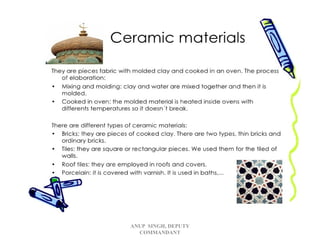
IV.CERAMICS: TILES
V. GLASS: WINDOWS, GLASS BLOCK
VI.PLASTICS: POLYETHYLENE
VII.STONE: MARBLE, GRANITE
ANUP SINGH, DEPUTY
COMMANDANT
ANUP SINGH, DEPUTY
COMMANDANT
ANUP SINGH, DEPUTY
COMMANDANT
ANUP SINGH, DEPUTY
COMMANDANT
ANUP SINGH, DEPUTY
COMMANDANT
ANUP SINGH, DEPUTY
COMMANDANT
ANUP SINGH, DEPUTY
COMMANDANT
ANUP SINGH, DEPUTY
COMMANDANT
A CONSTRUCTION MATERIAL
CONSISTING OF A MIX OF
CEMENT,ROCK,SAND
AND/OR OTHER INERT
MATERIALS, WATER AND A
SMALL AMOUNT OF AIR.
ANUP SINGH, DEPUTY
COMMANDANT
• RESISTANT TO FIRE AND COMPRESSION
• WEAK UNDER TENSION AND SHEAR
• CONTINUES TO HARDEN WITH TIME
ANUP SINGH, DEPUTY
COMMANDANT
• VERY HEAVY: ONE CUBIC METER (M ) WEIGHS
ALMOST 3,000 KG
• CONCRETE CURES BY HYDRATION, MEANING
THAT IT NEEDS WATER TO HARDEN.
• ONCE DRY, CONCRETE ALWAYS DEVELOPS
CRACKS, WHICH DO NOT NECESSARILY
REPRESENT A FAILURE.
• CONCRETE IS STRONG IN COMPRESSION BUT
WEAK IN TENSION, WHICH IS WHY STEEL REBAR
IS A NECESSARY COMPONENT OF CONCRETE
BEAMS, COLUMNS AND FLOORS.
ANUP SINGH, DEPUTY
COMMANDANT
STEELSTEEL
• Can be bent
without breaking
• Resistant to fire
and compression
• Easily conducts
heat, sound and
electricity
CHARACTERISTICS
ANUP SINGH, DEPUTY
COMMANDANT
WOODWOODCHARACTERISTICS
• EASY TO CUT LIGHT
• NOT FIRE-RESISTANT
• GOOD INSULATOR
• (WILL NOT
TRANSMIT
ELECTRICITY)
• PROVIDES WARNING
— CREAKS BEFORE
BREAKING ANUP SINGH, DEPUTY
COMMANDANT
BRICKBRICKCHARACTERISTICS
• DECOMPOSITION DUE TO
HEAT/FIRE
• GOOD INSULATOR OF HEAT
• FIRE RESISTANCE IS HIGH AS
COMPARED TO STONE
ANUP SINGH, DEPUTY
COMMANDANT
FORCES ACTING ON CONSTRUCTION
MATERIALS
1.TENSION
2.COMPRESSION
3.SHEAR
ANUP SINGH, DEPUTY
COMMANDANT
Forces that act to elongate or stretch a
material.
Tension occurs when opposing forces are pulling to
stretch or elongate an object.
– Tensile forces produce internally in structural materials.
ANUP SINGH, DEPUTY
COMMANDANT
Forces that act to crush or compress a
material.
Compression forces occur when pushing on an object
to shorten or compress it.
– Compression and tension are normal stresses.
– The stressed surface is perpendicular to the applied force.
ANUP SINGH, DEPUTY
COMMANDANT
Forces acting in opposite, parallel directions and on
different planes so that they cut or break a material
Shearing forces act opposite to one another.
– Think of how a pair of scissors works.
– The direction of shearing stress is different than
compression and tension because the surface that
is being applied stress is parallel to the direction of
force
ANUP SINGH, DEPUTY
COMMANDANT
ANUP SINGH, DEPUTY
COMMANDANT
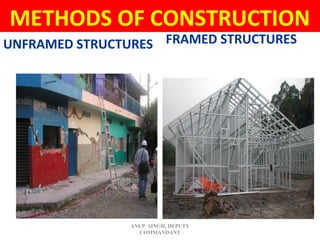
METHODS OF CONSTRUCTION
UNFRAMED STRUCTURES FRAMED STRUCTURES
ANUP SINGH, DEPUTY
COMMANDANT
FRAMED STRUCTURES
ANUP SINGH, DEPUTY
COMMANDANT
UNFRAMED
• UNFRAMED
ANUP SINGH, DEPUTY
COMMANDANT
STRUCTURAL TYPES
1.Light frame
2.Heavy wall
3.Heavy floor
4.Pre-cast concrete
ANUP SINGH, DEPUTY
COMMANDANT
LIGHT FRAME STRUCTURE
ANUP SINGH, DEPUTY
COMMANDANT
Characteristics:
• Residential homes and apartments
• Up to 04 stories
• Constructed mainly of wood.
• Weakness is its lateral strength of walls and connections.
• Highly susceptible to fire due to disrupted utilities and high
surface-to-mass ratio of splintered wood and other light frame
materials.
• Rescuers should check for stability problem while operating in
such environment.
LIGHT FRAME STRUCTURE
ANUP SINGH, DEPUTY
COMMANDANT
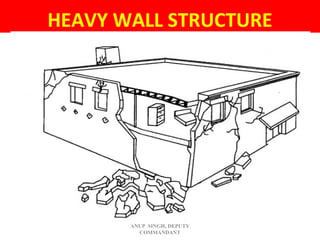
HEAVY WALL STRUCTURE
ANUP SINGH, DEPUTY
COMMANDANT
Characteristics:
• Residential, commercial, industrial, or institutional.
• Up to 06 stories in height.
• Principle weakness is in the lateral strength of the walls and the
connections between the walls and floor or roof assemblies.
• Rescuers may face falling hazards due to small, loose masonry
components resulting from the collapse.
ANUP SINGH, DEPUTY
COMMANDANT
HEAVY WALL STRUCTURE
HEAVY FLOOR STRUCTURE
ANUP SINGH, DEPUTY
COMMANDANT
Characteristics:
• Residential, commercial and industrial including highway
bridges.
• Up to 12 stories in height.
• Weakness is the poor column reinforcement and inadequate
connections between floor slabs and columns.
• Rescuers are vulnerable to the weak stability of the structures.
ANUP SINGH, DEPUTY
COMMANDANT
HEAVY FLOOR STRUCTURE
PRE-CAST CONCRETE STRUCTURE
ANUP SINGH, DEPUTY
COMMANDANT
Characteristics:
• Commercials, residential and pre-cast parking facilities.
• Generally up to 12 stories in height.
• Principle failure is due to the weakness of the connectors used
to connect building parts such as floor, walls and roof.
• Rescuers should check beam-to-column connections for broken
welds and cracked corbels.
ANUP SINGH, DEPUTY
COMMANDANT
PRE-CAST CONCRETE STRUCTURE
CONSTRUCTION MATERIALS
CLASSIFIED BY USE
STRUCTURAL/LOAD-BEARING
ELEMENTS
DECORATIVE ELEMENTS
NON-STRUCTURAL WALLS AND
PARTITIONS
COVERING ELEMENTS (ROOFING)
ANUP SINGH, DEPUTY
COMMANDANT
CHARACTERISTICS OF A
STRUCTURE
1. GENERAL
 Occupancy Type
 Modifications to the original structure /
plans (if applicable)
 Location of utilities
 Contents
 Number of occupants
ANUP SINGH, DEPUTY
COMMANDANT
2. ARCHITECTURAL
ANUP SINGH, DEPUTY
Architectural characteristics of a structure include the
following elements-
 Shape of building and foundation.
 Height and number of floors.
 Number of basement levels.
 Major cantilevers.
 Location of chases (stairwells, elevator shafts and
service chutes)
 Primary materials used.
3. STRUCTURAL ELEMENTS
I. COLUMNS
II. BEAMS, GIRDERS, TRUSSES, JOISTS, RAFTERS,
III.PURLINS, STUDS
IV.FLOOR SLABS, ROOF
V. LOAD BEARING WALLS
VI.FOUNDATIONS
ANUP SINGH, DEPUTY
COMMANDANT
ANUP SINGH, DEPUTY
COMMANDANT
Elements
• EX-
. RAFTERS
. PURLINS
. STUDS
ANUP SINGH, DEPUTY
COMMANDANT
ANUP SINGH, DEPUTY
COMMANDANT
ANUP SINGH, DEPUTY
COMMANDANT
4. NON-STRUCTURAL ELEMENTS
 NON-LOADING WALLS
 PARTITIONS
IN-FILL
FACADES, VENEERS, PARAPETS, AND OTHER
ANUP SINGH, DEPUTY
COMMANDANT
DAMAGE TYPES AND POTENTIAL
HAZARDS
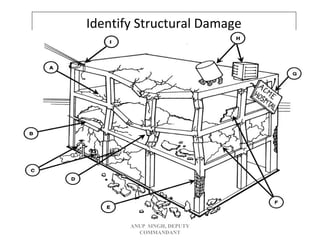
 STRUCTURAL DAMAGE
I. TOTAL STRUCTURAL COLLAPSE
II. LEANING FLOORS, ROOFS AND WALLS
III.COLLAPSED FLOORS AND ROOFS
IV.COLLAPSED COLUMNS IN ONE OR MORE
FLOORS
ANUP SINGH, DEPUTY
COMMANDANT
 SUBSTANTIAL, PERMANENT LATERAL
SHIFT IN THE STRUCTURE
CRACKS IN COLUMNS, FLOOR SLABS
AND/OR LOAD BEARING WALLS
CRACKED FOUNDATION
CRACKED ELEVATOR SHAFT
ANUP SINGH, DEPUTY
COMMANDANT
ANUP SINGH, DEPUTY
COMMANDANT
 NON-STRUCTURAL DAMAGE
 GENERALIZED CRACKING
 CRACKED OR FALLEN EXTERIOR
FACADES AND VENEERS
 FALLEN STAIRCASES
 SHIFT IN ELEVATOR SHAFT
 DAMAGED UTILITIES
 BUILDING SIGNS AND BALCONIES
ANUP SINGH, DEPUTY
COMMANDANT
NON STRUCTURE DAMAGE
ANUP SINGH, DEPUTY
COMMANDANT
TYPES OF HAZARDS
FALLING:- PART OF STRUCTURE OR IT’S
CONTENTS ARE IN DANGER OF
FALLING
 COLLAPSE:- THE VOLUME OF ENCLOSED SPACE
MADE BY THE STRUCTURE WILL BE
REDUCED AS STABILITY IS LOST
OTHER:- ELECTRICITY, WATER, FUELS, TOXIC
GASES (CARBON MONOXIDE),
HAZARDOUS MATERIALS ,
BIOHAZARDS (BLOOD), ETC
ANUP SINGH, DEPUTY
COMMANDANT
TYPES OF COLLAPSE
• Internal collapse
• External collapse
• Total collapse
ANUP SINGH, DEPUTY
COMMANDANT
INTERNAL COLLAPSE
• Pancake
• Lean to collapse
• V shape collapse
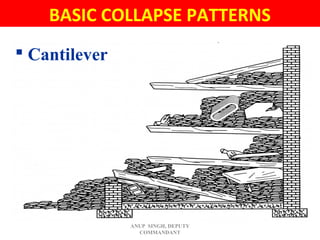
• Cantilever collapse
ANUP SINGH, DEPUTY
COMMANDANT
BASIC COLLAPSE PATTERNS
 Cantilever
ANUP SINGH, DEPUTY
COMMANDANT
ANUP SINGH, DEPUTY
COMMANDANT
 Lean-to
ANUP SINGH, DEPUTY
COMMANDANT
ANUP SINGH, DEPUTY
COMMANDANT
ANUP SINGH, DEPUTY
PANCAKE
ANUP SINGH, DEPUTY
COMMANDANT
ANUP SINGH, DEPUTY
COMMANDANT
PANCAKE
ANUP SINGH, DEPUTY
V-Shape
ANUP SINGH, DEPUTY
COMMANDANT
ANUP SINGH, DEPUTY
COMMANDANT
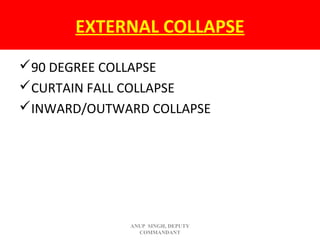
EXTERNAL COLLAPSE
90 DEGREE COLLAPSE
CURTAIN FALL COLLAPSE
INWARD/OUTWARD COLLAPSE
ANUP SINGH, DEPUTY
COMMANDANT
90º ANGLE COLLAPSE
A wall falls outwards to a distance that is at least equal to its
height. Debris will spread as
the wall hits the ground.
ANUP SINGH, DEPUTY
COMMANDANT
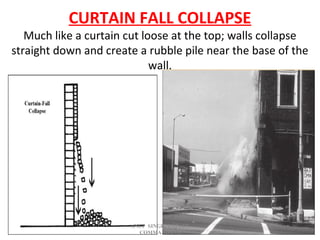
CURTAIN FALL COLLAPSE
Much like a curtain cut loose at the top; walls collapse
straight down and create a rubble pile near the base of the
wall.
ANUP SINGH, DEPUTY
COMMANDANT
INWARD/OUTWARD COLLAPSE
Walls crack horizontally in the middle. The top half
usually falls inwards and the lower half
outwards. (Masonry Wall Collapse )
ANUP SINGH, DEPUTY
COMMANDANT
Identify Structural Damage
ANUP SINGH, DEPUTY
COMMANDANT
THANKS
ANUP SINGH, DEPUTY

Construction materials and damage types