GALVANIC OR VOLTAIC CELL
• GALVANIC CELL: An electrochemical cell that converts the chemical
energy of spontaneous redox reactions into electrical energy is known as
a galvanic cell or a voltaic cell.
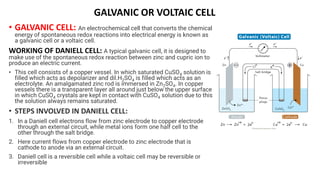
WORKING OF DANIELL CELL: A typical galvanic cell, it is designed to
make use of the spontaneous redox reaction between zinc and cupric ion to
produce an electric current.
• This cell consists of a copper vessel. In which saturated CuSO4 solution is
filled which acts as depolarizer and dil.H2SO4 is filled which acts as an
electrolyte. An amalgamated zinc rod is immersed in Zn2SO4. In copper
vessels there is a transparent layer all around just below the upper surface
in which CuSO4 crystals are kept in contact with CuSO4 solution due to this
the solution always remains saturated.
• STEPS INVOLVED IN DANIELL CELL:
1. In a Daniell cell electrons flow from zinc electrode to copper electrode
through an external circuit, while metal ions form one half cell to the
other through the salt bridge.
2. Here current flows from copper electrode to zinc electrode that is
cathode to anode via an external circuit.
3. Daniell cell is a reversible cell while a voltaic cell may be reversible or
irreversible
CELL REACTIONS
• Ion Zn/ZnSO4 half cell, oxidation reaction occurs. (ANODE)
• Zn → Zn2+ + 2e–
• Ion Cu/CuSO4 half cell, reduction reaction occurs. (CATHODE)
• Cu2+ + 2e– → Cu
• The net cell reaction is
• Zn + Cu2+ ⇌ Zn2+ + Cu
• Cell is represented as
• Zn/Zn2+ || Cu2+/Cu
Salt bridge
• It maintains electrical neutrality in two compartments by allowing movement of anions towards
anodic compartment and cations towards cathodic compartment.
• It is a glass tube having potassium chloride or ammonium nitrate in a gelatin form.
• The gelatin allows ionic movement but prevents any kind of mixing.
• In the case of potassium chloride or ammonium nitrate the ionic mobilities of cations and anions
are the same.
ELECTROLYTIC CELL
ELECTROLYTIC CELL: An electrolytic cell can be defined as an
electrochemical device that uses electrical energy to facilitate a non-
spontaneous redox reaction.
• The three primary components of electrolytic cells are:
• Cathode (which is negatively charged for electrolytic cells)
• Anode (which is positively charged for electrolytic cells)
• Electrolyte
• The electrolyte provides the medium for the exchange of electrons
between the cathode and the anode. Commonly used electrolytes in
electrolytic cells include water (containing dissolved ions) and molten
sodium chloride.
WORKING OF ELECTROLYTIC CELL
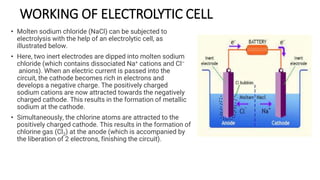
• Molten sodium chloride (NaCl) can be subjected to
electrolysis with the help of an electrolytic cell, as
illustrated below.
• Here, two inert electrodes are dipped into molten sodium
chloride (which contains dissociated Na+ cations and Cl–
anions). When an electric current is passed into the
circuit, the cathode becomes rich in electrons and
develops a negative charge. The positively charged
sodium cations are now attracted towards the negatively
charged cathode. This results in the formation of metallic
sodium at the cathode.
• Simultaneously, the chlorine atoms are attracted to the
positively charged cathode. This results in the formation of
chlorine gas (Cl2) at the anode (which is accompanied by
the liberation of 2 electrons, finishing the circuit).
The associated chemical equations and the overall cell reaction are provided
below
• Reaction at Cathode: [Na+ + e– → Na] x 2
• Reaction at Anode: 2Cl– → Cl2 + 2e–
• Cell Reaction: 2NaCl → 2Na + Cl2
• Thus, molten sodium chloride can be subjected to electrolysis in an electrolytic cell to
generate metallic sodium and chlorine gas as the products.
• Applications of Electrolytic Cells
• The primary application of electrolytic cells is for the production of oxygen gas and
hydrogen gas from water.
• They are also used for the extraction of aluminium from bauxite.
• Another notable application of electrolytic cells is in electroplating, which is the process of
forming a thin protective layer of a specific metal on the surface of another metal.
• The electrorefining of many non-ferrous metals is done with the help of electrolytic cells.
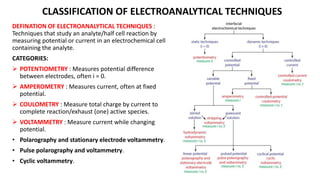
CLASSIFICATION OF ELECTROANALYTICAL TECHNIQUES
DEFINATION OF ELECTROANALYTICAL TECHNIQUES :
Techniques that study an analyte/half cell reaction by
measuring potential or current in an electrochemical cell
containing the analyte.
CATEGORIES:
➢ POTENTIOMETRY : Measures potential difference
between electrodes, often i = 0.
➢ AMPEROMETRY : Measures current, often at fixed
potential.
➢ COULOMETRY : Measure total charge by current to
complete reaction/exhaust (one) active species.
➢ VOLTAMMETRY : Measure current while changing
potential.
• Polarography and stationary electrode voltammetry.
• Pulse polarography and voltammetry.
• Cyclic voltammetry.

GALVANIC AND ELECTROLYTIC CELL

  • 1.
    GALVANIC OR VOLTAICCELL • GALVANIC CELL: An electrochemical cell that converts the chemical energy of spontaneous redox reactions into electrical energy is known as a galvanic cell or a voltaic cell. WORKING OF DANIELL CELL: A typical galvanic cell, it is designed to make use of the spontaneous redox reaction between zinc and cupric ion to produce an electric current. • This cell consists of a copper vessel. In which saturated CuSO4 solution is filled which acts as depolarizer and dil.H2SO4 is filled which acts as an electrolyte. An amalgamated zinc rod is immersed in Zn2SO4. In copper vessels there is a transparent layer all around just below the upper surface in which CuSO4 crystals are kept in contact with CuSO4 solution due to this the solution always remains saturated. • STEPS INVOLVED IN DANIELL CELL: 1. In a Daniell cell electrons flow from zinc electrode to copper electrode through an external circuit, while metal ions form one half cell to the other through the salt bridge. 2. Here current flows from copper electrode to zinc electrode that is cathode to anode via an external circuit. 3. Daniell cell is a reversible cell while a voltaic cell may be reversible or irreversible
  • 2.
    CELL REACTIONS • IonZn/ZnSO4 half cell, oxidation reaction occurs. (ANODE) • Zn → Zn2+ + 2e– • Ion Cu/CuSO4 half cell, reduction reaction occurs. (CATHODE) • Cu2+ + 2e– → Cu • The net cell reaction is • Zn + Cu2+ ⇌ Zn2+ + Cu • Cell is represented as • Zn/Zn2+ || Cu2+/Cu Salt bridge • It maintains electrical neutrality in two compartments by allowing movement of anions towards anodic compartment and cations towards cathodic compartment. • It is a glass tube having potassium chloride or ammonium nitrate in a gelatin form. • The gelatin allows ionic movement but prevents any kind of mixing. • In the case of potassium chloride or ammonium nitrate the ionic mobilities of cations and anions are the same.
  • 3.
    ELECTROLYTIC CELL ELECTROLYTIC CELL:An electrolytic cell can be defined as an electrochemical device that uses electrical energy to facilitate a non- spontaneous redox reaction. • The three primary components of electrolytic cells are: • Cathode (which is negatively charged for electrolytic cells) • Anode (which is positively charged for electrolytic cells) • Electrolyte • The electrolyte provides the medium for the exchange of electrons between the cathode and the anode. Commonly used electrolytes in electrolytic cells include water (containing dissolved ions) and molten sodium chloride.
  • 4.
    WORKING OF ELECTROLYTICCELL • Molten sodium chloride (NaCl) can be subjected to electrolysis with the help of an electrolytic cell, as illustrated below. • Here, two inert electrodes are dipped into molten sodium chloride (which contains dissociated Na+ cations and Cl– anions). When an electric current is passed into the circuit, the cathode becomes rich in electrons and develops a negative charge. The positively charged sodium cations are now attracted towards the negatively charged cathode. This results in the formation of metallic sodium at the cathode. • Simultaneously, the chlorine atoms are attracted to the positively charged cathode. This results in the formation of chlorine gas (Cl2) at the anode (which is accompanied by the liberation of 2 electrons, finishing the circuit).
  • 5.
    The associated chemicalequations and the overall cell reaction are provided below • Reaction at Cathode: [Na+ + e– → Na] x 2 • Reaction at Anode: 2Cl– → Cl2 + 2e– • Cell Reaction: 2NaCl → 2Na + Cl2 • Thus, molten sodium chloride can be subjected to electrolysis in an electrolytic cell to generate metallic sodium and chlorine gas as the products. • Applications of Electrolytic Cells • The primary application of electrolytic cells is for the production of oxygen gas and hydrogen gas from water. • They are also used for the extraction of aluminium from bauxite. • Another notable application of electrolytic cells is in electroplating, which is the process of forming a thin protective layer of a specific metal on the surface of another metal. • The electrorefining of many non-ferrous metals is done with the help of electrolytic cells.
  • 6.
    CLASSIFICATION OF ELECTROANALYTICALTECHNIQUES DEFINATION OF ELECTROANALYTICAL TECHNIQUES : Techniques that study an analyte/half cell reaction by measuring potential or current in an electrochemical cell containing the analyte. CATEGORIES: ➢ POTENTIOMETRY : Measures potential difference between electrodes, often i = 0. ➢ AMPEROMETRY : Measures current, often at fixed potential. ➢ COULOMETRY : Measure total charge by current to complete reaction/exhaust (one) active species. ➢ VOLTAMMETRY : Measure current while changing potential. • Polarography and stationary electrode voltammetry. • Pulse polarography and voltammetry. • Cyclic voltammetry.