Data Mining Lecture 3
Define multi-dimensional data
model
From Tables and Spreadsheets to Data Cubes
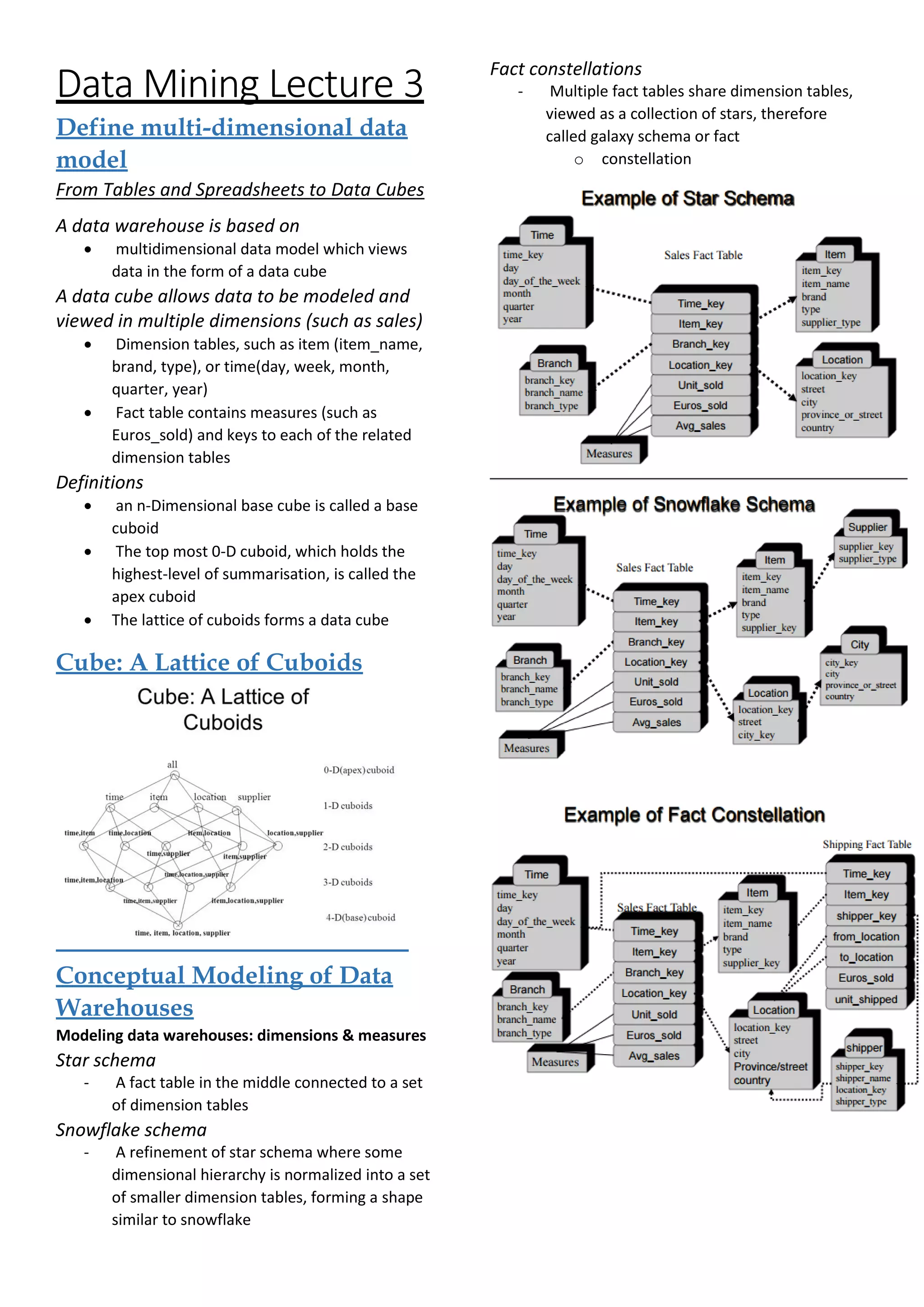
A data warehouse is based on
 multidimensional data model which views
data in the form of a data cube
A data cube allows data to be modeled and
viewed in multiple dimensions (such as sales)
 Dimension tables, such as item (item_name,
brand, type), or time(day, week, month,
quarter, year)
 Fact table contains measures (such as
Euros_sold) and keys to each of the related
dimension tables
Definitions
 an n-Dimensional base cube is called a base
cuboid
 The top most 0-D cuboid, which holds the
highest-level of summarisation, is called the
apex cuboid
 The lattice of cuboids forms a data cube
Cube: A Lattice of Cuboids
Conceptual Modeling of Data
Warehouses
Modeling data warehouses: dimensions & measures
Star schema
- A fact table in the middle connected to a set
of dimension tables
Snowflake schema
- A refinement of star schema where some
dimensional hierarchy is normalized into a set
of smaller dimension tables, forming a shape
similar to snowflake
Fact constellations
- Multiple fact tables share dimension tables,
viewed as a collection of stars, therefore
called galaxy schema or fact
o constellation
DMQL: Language Primitives
Cube Definition (Fact Table)
 define cube <cube_name> [<dimension_list>]:
<measure_list>
Dimension Definition (Dimension Table)
 define dimension <dimension_name> as
(<attribute_or_subdimension_list>)
Special Case (Shared Dimension Tables)
 First time as “cube definition”
 define dimension <dimension_name> as
<dimension_name_first_time> in cube
<cube_name_first_time>
Defining a Star Schema in
DMQL
define cube sales_star [time, item, branch, location]:
Euros_sold = sum(sales_in_Euros),
avg_sales = avg(sales_in_Euros),
units_sold = count(*)
define dimension time as
(time_key, day, day_of_week, month,
quarter, year)
define dimension item as
(item_key, item_name, brand, type,
supplier_type)
define dimension branch as
(branch_key, branch_name, branch_type)
define dimension location as
(location_key, street, city, county, province,
country)
Defining a Snowflake Schema in
DMQL
define cube sales_snowflake [time, item, branch,
location]:
Euros_sold = sum(sales_in_Euros),
avg_sales = avg(sales_in_Euros),
units_sold = count(*)
define dimension time as
(time_key, day, day_of_week, month,
quarter, year)
define dimension item as
(item_key, item_name, brand, type,
supplier(supplier_key, supplier_type))
define dimension branch as
(branch_key, branch_name, branch_type)
define dimension location as
(location_key, street, city(city_key, county,
province, country))
Defining a Fact Constellation in
DMQL
define cube sales [time, item, branch, location]:
Euros_sold = sum(sales_in_Euros), avg_sales =
avg(sales_in_Euros),
units_sold = count(*)
define dimension time as (time_key, day,
day_of_week, month, quarter, year)
define dimension item as (item_key, item_name,
brand, type, supplier_type)
define dimension branch as (branch_key,
branch_name, branch_type)
define dimension location as (location_key, street,
city, province_or_state,
country)
define cube shipping [time, item, shipper,
from_location, to_location]:
Euro_cost = sum(cost_in_Euros), unit_shipped =
count(*)
define dimension time as time in cube sales
define dimension item as item in cube sales
define dimension shipper as (shipper_key,
shipper_name, location as location
in cube sales, shipper_type)
define dimension from_location as location in cube
sales
define dimension to_location as location in cube sales
Measures: Three Categories
Distributive
 if the result derived by applying the function
to n aggregate values is the same as that
derived by applying the function on all the
data without partitioning.
o E.g., count(), sum(), min(), max()
Algebraic
 if it can be computed by an algebraic function
with M arguments (where M is a bounded
integer), each of which is obtained by
applying a distributive aggregate function.
o E.g., avg(), min_N(),
standard_deviation()
Holistic
 if there is no constant bound on the storage
size needed to describe a sub-aggregate.
o E.g., median(), mode(), rank()
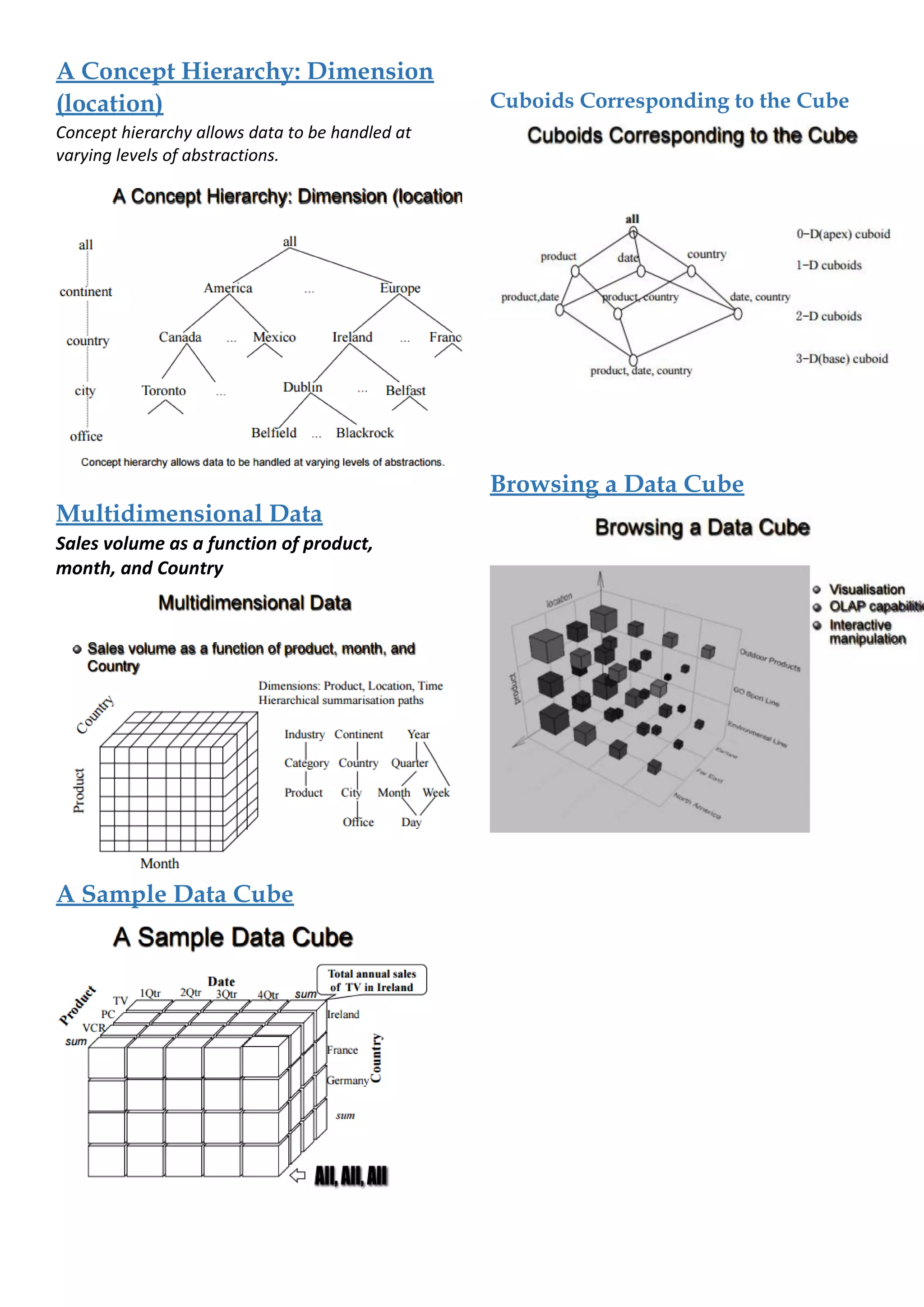
A Concept Hierarchy: Dimension
(location)
Concept hierarchy allows data to be handled at
varying levels of abstractions.
Multidimensional Data
Sales volume as a function of product,
month, and Country
A Sample Data Cube
Cuboids Corresponding to the Cube
Browsing a Data Cube
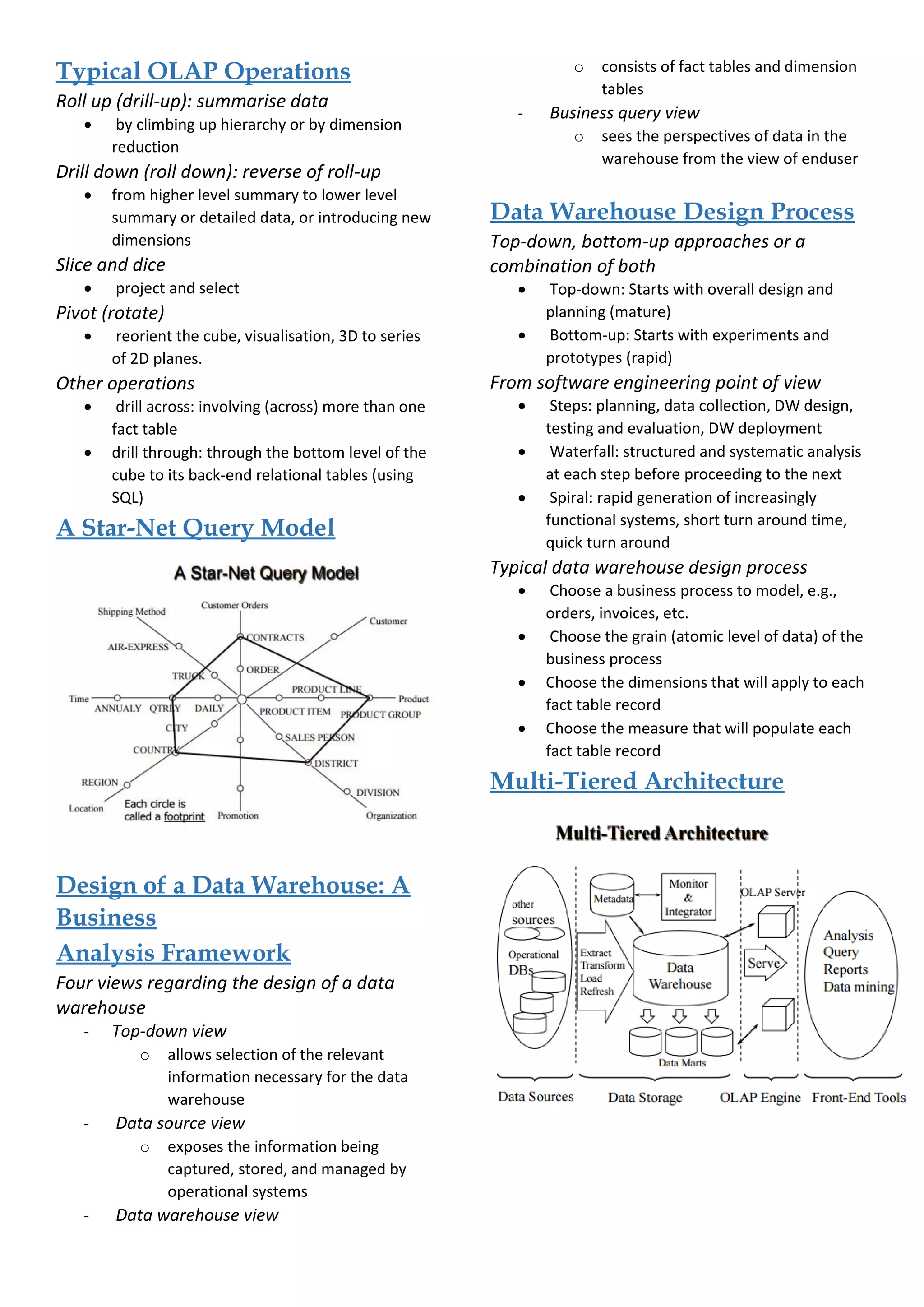
Typical OLAP Operations
Roll up (drill-up): summarise data
 by climbing up hierarchy or by dimension
reduction
Drill down (roll down): reverse of roll-up
 from higher level summary to lower level
summary or detailed data, or introducing new
dimensions
Slice and dice
 project and select
Pivot (rotate)
 reorient the cube, visualisation, 3D to series
of 2D planes.
Other operations
 drill across: involving (across) more than one
fact table
 drill through: through the bottom level of the
cube to its back-end relational tables (using
SQL)
A Star-Net Query Model
Design of a Data Warehouse: A
Business
Analysis Framework
Four views regarding the design of a data
warehouse
- Top-down view
o allows selection of the relevant
information necessary for the data
warehouse
- Data source view
o exposes the information being
captured, stored, and managed by
operational systems
- Data warehouse view
o consists of fact tables and dimension
tables
- Business query view
o sees the perspectives of data in the
warehouse from the view of enduser
Data Warehouse Design Process
Top-down, bottom-up approaches or a
combination of both
 Top-down: Starts with overall design and
planning (mature)
 Bottom-up: Starts with experiments and
prototypes (rapid)
From software engineering point of view
 Steps: planning, data collection, DW design,
testing and evaluation, DW deployment
 Waterfall: structured and systematic analysis
at each step before proceeding to the next
 Spiral: rapid generation of increasingly
functional systems, short turn around time,
quick turn around
Typical data warehouse design process
 Choose a business process to model, e.g.,
orders, invoices, etc.
 Choose the grain (atomic level of data) of the
business process
 Choose the dimensions that will apply to each
fact table record
 Choose the measure that will populate each
fact table record
Multi-Tiered Architecture
Three Data Warehouse Models
Enterprise warehouse
 collects all of the information about subjects
spanning the entire organisation
Data Mart
 a subset of corporate-wide data that is of
value to a specific group of users. Its scope is
confined to specific, selected groups, such as
marketing data mart
- Independent vs. dependent (directly from
warehouse) data mart
Virtual warehouse
 A set of views over operational databases
 Only some of the possible summary views
may be materialised
Data Warehouse Development:
A Recommended Approach
OLAP Server Architectures
Relational OLAP (ROLAP)
 Use relational or extended-relational DBMS
to store and manage warehouse data and
OLAP middleware to support missing pieces
 Include optimisation of DBMS backend,
implementation of aggregation navigation
logic, and additional tools and services
 greater scalability
Multidimensional OLAP (MOLAP)
 Array-based multidimensional storage engine
(sparse matrix techniques)
 fast indexing to pre-computed summarised
data
Hybrid OLAP (HOLAP)
 User flexibility, e.g., low level: relational,
high-level: array
Specialised SQL servers
 specialised support for SQL queries over
star/snowflake schemas
Home Work 1a
Suppose that a data warehouse for a Big University
consists of the following 4
dimensions: students, module, semester, and lecturer
and 2 measures count
and avg_grade. When at the lowest conceptual level
(e.g., for a given student,
module, semester, and lecturer combination), the
avg_grade measure stores
the actual module grade of the student. At higher
conceptual levels,
avg_grade stores the average grade for the given
combination.
1. Draw a snowflake schema diagram for the data
warehouse.
2. Starting with the base cuboid [student, module,
semester, lecturer], what
specific OLAP operations (e.g., roll-up from semester
to year) should one
perform in order to list the average grade of CS
modules for each Big
University student.
3. If each dimension has 5 levels (including all), such
as “student < major <
status < university < all”, how many cuboids will this
cube contain (including
the base and apex cuboids

Data mining 3 - Data Models and Data Warehouse Design (cheat sheet - printable)

  • 1.
    Data Mining Lecture3 Define multi-dimensional data model From Tables and Spreadsheets to Data Cubes A data warehouse is based on  multidimensional data model which views data in the form of a data cube A data cube allows data to be modeled and viewed in multiple dimensions (such as sales)  Dimension tables, such as item (item_name, brand, type), or time(day, week, month, quarter, year)  Fact table contains measures (such as Euros_sold) and keys to each of the related dimension tables Definitions  an n-Dimensional base cube is called a base cuboid  The top most 0-D cuboid, which holds the highest-level of summarisation, is called the apex cuboid  The lattice of cuboids forms a data cube Cube: A Lattice of Cuboids Conceptual Modeling of Data Warehouses Modeling data warehouses: dimensions & measures Star schema - A fact table in the middle connected to a set of dimension tables Snowflake schema - A refinement of star schema where some dimensional hierarchy is normalized into a set of smaller dimension tables, forming a shape similar to snowflake Fact constellations - Multiple fact tables share dimension tables, viewed as a collection of stars, therefore called galaxy schema or fact o constellation
  • 2.
    DMQL: Language Primitives CubeDefinition (Fact Table)  define cube <cube_name> [<dimension_list>]: <measure_list> Dimension Definition (Dimension Table)  define dimension <dimension_name> as (<attribute_or_subdimension_list>) Special Case (Shared Dimension Tables)  First time as “cube definition”  define dimension <dimension_name> as <dimension_name_first_time> in cube <cube_name_first_time> Defining a Star Schema in DMQL define cube sales_star [time, item, branch, location]: Euros_sold = sum(sales_in_Euros), avg_sales = avg(sales_in_Euros), units_sold = count(*) define dimension time as (time_key, day, day_of_week, month, quarter, year) define dimension item as (item_key, item_name, brand, type, supplier_type) define dimension branch as (branch_key, branch_name, branch_type) define dimension location as (location_key, street, city, county, province, country) Defining a Snowflake Schema in DMQL define cube sales_snowflake [time, item, branch, location]: Euros_sold = sum(sales_in_Euros), avg_sales = avg(sales_in_Euros), units_sold = count(*) define dimension time as (time_key, day, day_of_week, month, quarter, year) define dimension item as (item_key, item_name, brand, type, supplier(supplier_key, supplier_type)) define dimension branch as (branch_key, branch_name, branch_type) define dimension location as (location_key, street, city(city_key, county, province, country)) Defining a Fact Constellation in DMQL define cube sales [time, item, branch, location]: Euros_sold = sum(sales_in_Euros), avg_sales = avg(sales_in_Euros), units_sold = count(*) define dimension time as (time_key, day, day_of_week, month, quarter, year) define dimension item as (item_key, item_name, brand, type, supplier_type) define dimension branch as (branch_key, branch_name, branch_type) define dimension location as (location_key, street, city, province_or_state, country) define cube shipping [time, item, shipper, from_location, to_location]: Euro_cost = sum(cost_in_Euros), unit_shipped = count(*) define dimension time as time in cube sales define dimension item as item in cube sales define dimension shipper as (shipper_key, shipper_name, location as location in cube sales, shipper_type) define dimension from_location as location in cube sales define dimension to_location as location in cube sales Measures: Three Categories Distributive  if the result derived by applying the function to n aggregate values is the same as that derived by applying the function on all the data without partitioning. o E.g., count(), sum(), min(), max() Algebraic  if it can be computed by an algebraic function with M arguments (where M is a bounded integer), each of which is obtained by applying a distributive aggregate function. o E.g., avg(), min_N(), standard_deviation() Holistic  if there is no constant bound on the storage size needed to describe a sub-aggregate. o E.g., median(), mode(), rank()
  • 3.
    A Concept Hierarchy:Dimension (location) Concept hierarchy allows data to be handled at varying levels of abstractions. Multidimensional Data Sales volume as a function of product, month, and Country A Sample Data Cube Cuboids Corresponding to the Cube Browsing a Data Cube
  • 4.
    Typical OLAP Operations Rollup (drill-up): summarise data  by climbing up hierarchy or by dimension reduction Drill down (roll down): reverse of roll-up  from higher level summary to lower level summary or detailed data, or introducing new dimensions Slice and dice  project and select Pivot (rotate)  reorient the cube, visualisation, 3D to series of 2D planes. Other operations  drill across: involving (across) more than one fact table  drill through: through the bottom level of the cube to its back-end relational tables (using SQL) A Star-Net Query Model Design of a Data Warehouse: A Business Analysis Framework Four views regarding the design of a data warehouse - Top-down view o allows selection of the relevant information necessary for the data warehouse - Data source view o exposes the information being captured, stored, and managed by operational systems - Data warehouse view o consists of fact tables and dimension tables - Business query view o sees the perspectives of data in the warehouse from the view of enduser Data Warehouse Design Process Top-down, bottom-up approaches or a combination of both  Top-down: Starts with overall design and planning (mature)  Bottom-up: Starts with experiments and prototypes (rapid) From software engineering point of view  Steps: planning, data collection, DW design, testing and evaluation, DW deployment  Waterfall: structured and systematic analysis at each step before proceeding to the next  Spiral: rapid generation of increasingly functional systems, short turn around time, quick turn around Typical data warehouse design process  Choose a business process to model, e.g., orders, invoices, etc.  Choose the grain (atomic level of data) of the business process  Choose the dimensions that will apply to each fact table record  Choose the measure that will populate each fact table record Multi-Tiered Architecture
  • 5.
    Three Data WarehouseModels Enterprise warehouse  collects all of the information about subjects spanning the entire organisation Data Mart  a subset of corporate-wide data that is of value to a specific group of users. Its scope is confined to specific, selected groups, such as marketing data mart - Independent vs. dependent (directly from warehouse) data mart Virtual warehouse  A set of views over operational databases  Only some of the possible summary views may be materialised Data Warehouse Development: A Recommended Approach OLAP Server Architectures Relational OLAP (ROLAP)  Use relational or extended-relational DBMS to store and manage warehouse data and OLAP middleware to support missing pieces  Include optimisation of DBMS backend, implementation of aggregation navigation logic, and additional tools and services  greater scalability Multidimensional OLAP (MOLAP)  Array-based multidimensional storage engine (sparse matrix techniques)  fast indexing to pre-computed summarised data Hybrid OLAP (HOLAP)  User flexibility, e.g., low level: relational, high-level: array Specialised SQL servers  specialised support for SQL queries over star/snowflake schemas Home Work 1a Suppose that a data warehouse for a Big University consists of the following 4 dimensions: students, module, semester, and lecturer and 2 measures count and avg_grade. When at the lowest conceptual level (e.g., for a given student, module, semester, and lecturer combination), the avg_grade measure stores the actual module grade of the student. At higher conceptual levels, avg_grade stores the average grade for the given combination. 1. Draw a snowflake schema diagram for the data warehouse. 2. Starting with the base cuboid [student, module, semester, lecturer], what specific OLAP operations (e.g., roll-up from semester to year) should one perform in order to list the average grade of CS modules for each Big University student. 3. If each dimension has 5 levels (including all), such as “student < major < status < university < all”, how many cuboids will this cube contain (including the base and apex cuboids