



5 Data-Applied.com: Forecast
PerceptronPerceptron can be used for linear classificationLinear classification using  the perceptronIf instances belonging to different classes can be divided in the instance space by using hyper planes, then they are called linearly separableIf instances are linearly separable then we can use perceptron learning rule for classification
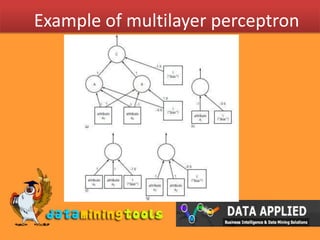
Multilayer PerceptronMultilayer perceptron:We can create a network of perceptron to approximate arbitrary target concepts Multilayer perceptron is an example of an artificial neural networkConsists of: input layer, hidden layer(s), and output layer  Structure of MLP is usually found by experimentationParameters can be found using back propagation or montecarlo simulations
Example of multilayer perceptron
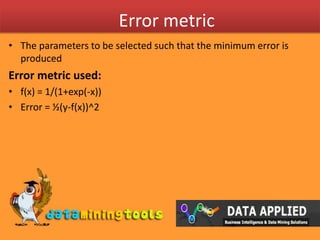
Error metricThe parameters to be selected such that the minimum error is producedError metric used:f(x) = 1/(1+exp(-x))Error = ½(y-f(x))^2
Using montecarlo to get the parametersDistribute some random samples in the weight vector spaceChoose the ones which minimizes errorsRepeat the process till convergenceFinally points at the convergence gives us the value of the parameters
Forecasts using Data Applied’s web interface
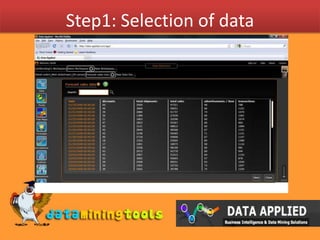
Step1: Selection of data
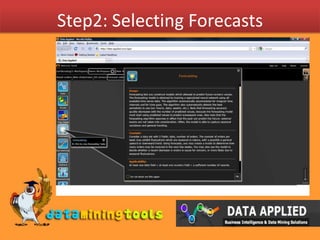
Step2: Selecting Forecasts
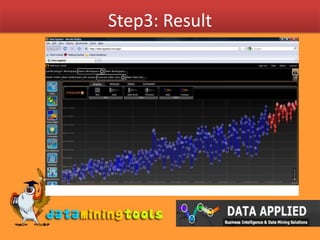
Step3: Result
Visit more self help tutorialsPick a tutorial of your choice and browse through it at your own pace.

Data Applied:Forecast

  • 1.
  • 2.
    PerceptronPerceptron can beused for linear classificationLinear classification using the perceptronIf instances belonging to different classes can be divided in the instance space by using hyper planes, then they are called linearly separableIf instances are linearly separable then we can use perceptron learning rule for classification
  • 3.
    Multilayer PerceptronMultilayer perceptron:Wecan create a network of perceptron to approximate arbitrary target concepts Multilayer perceptron is an example of an artificial neural networkConsists of: input layer, hidden layer(s), and output layer  Structure of MLP is usually found by experimentationParameters can be found using back propagation or montecarlo simulations
  • 4.
  • 5.
    Error metricThe parametersto be selected such that the minimum error is producedError metric used:f(x) = 1/(1+exp(-x))Error = ½(y-f(x))^2
  • 6.
    Using montecarlo toget the parametersDistribute some random samples in the weight vector spaceChoose the ones which minimizes errorsRepeat the process till convergenceFinally points at the convergence gives us the value of the parameters
  • 7.
    Forecasts using DataApplied’s web interface
  • 8.
  • 9.
  • 10.
  • 11.
    Visit more selfhelp tutorialsPick a tutorial of your choice and browse through it at your own pace.