Chapter 3: Data Warehousing and
             OLAP Technology: An Overview

       What is a data warehouse?

       Data warehouse architecture

       From data warehousing to data mining


January 17, 2013      Data Mining: Concepts and Techniques   1
What is Data Warehouse?
      Defined in many different ways, but not rigorously.
            A decision support database that is maintained separately from
             the organization’s operational database
            Support information processing by providing a solid platform of
             consolidated, historical data for analysis.
      “A data warehouse is a subject-oriented, integrated, time-variant,
       and nonvolatile collection of data in support of management’s
       decision-making process.”—W. H. Inmon
      Data warehousing:
            The process of constructing and using data warehouses


January 17, 2013                Data Mining: Concepts and Techniques           2
Data Warehouse—Subject-Oriented

      Organized around major subjects, such as customer,
       product, sales
      Focusing on the modeling and analysis of data for
       decision makers, not on daily operations or transaction
       processing
      Provide a simple and concise view around particular
       subject issues by excluding data that are not useful in the
       decision support process


January 17, 2013          Data Mining: Concepts and Techniques       3
Data Warehouse—Integrated
       Constructed by integrating multiple, heterogeneous data
        sources
          relational databases, flat files, on-line transaction

           records
       Data cleaning and data integration techniques are
        applied.
          Ensure consistency in naming conventions, encoding

           structures, attribute measures, etc. among different
           data sources
                   
                       E.g., Hotel price: currency, tax, breakfast covered, etc.
             When data is moved to the warehouse, it is
              converted.

January 17, 2013                      Data Mining: Concepts and Techniques         4
Data Warehouse—Time Variant
      The time horizon for the data warehouse is significantly
       longer than that of operational systems
            Operational database: current value data
            Data warehouse data: provide information from a
             historical perspective (e.g., past 5-10 years)
      Every key structure in the data warehouse
            Contains an element of time, explicitly or implicitly
            But the key of operational data may or may not
             contain “time element”


January 17, 2013             Data Mining: Concepts and Techniques    5
Data Warehouse—Nonvolatile
      A physically separate store of data transformed from the
       operational environment
      Operational update of data does not occur in the data
       warehouse environment
            Does not require transaction processing, recovery,
             and concurrency control mechanisms
            Requires only two operations in data accessing:
               
                   initial loading of data and access of data


January 17, 2013                Data Mining: Concepts and Techniques   6
Data Warehouse vs. Heterogeneous DBMS

      Traditional heterogeneous DB integration: A query driven approach
            Build wrappers/mediators on top of heterogeneous databases
            When a query is posed to a client site, a meta-dictionary is used
             to translate the query into queries appropriate for individual
             heterogeneous sites involved, and the results are integrated into
             a global answer set
            Complex information filtering, compete for resources
      Data warehouse: update-driven, high performance
            Information from heterogeneous sources is integrated in advance
             and stored in warehouses for direct query and analysis
January 17, 2013                Data Mining: Concepts and Techniques             7
Data Warehouse vs. Operational DBMS
      OLTP (on-line transaction processing)
            Major task of traditional relational DBMS
            Day-to-day operations: purchasing, inventory, banking,
             manufacturing, payroll, registration, accounting, etc.
      OLAP (on-line analytical processing)
            Major task of data warehouse system
            Data analysis and decision making
      Distinct features (OLTP vs. OLAP):
            User and system orientation: customer vs. market
            Data contents: current, detailed vs. historical, consolidated
            Database design: ER + application vs. star + subject
            View: current, local vs. evolutionary, integrated
            Access patterns: update vs. read-only but complex queries
January 17, 2013                Data Mining: Concepts and Techniques         8
OLTP vs. OLAP
                         OLTP                             OLAP
    users                clerk, IT professional           knowledge worker
    function             day to day operations            decision support
    DB design            application-oriented             subject-oriented
    data                 current, up-to-date              historical,
                         detailed, flat relational        summarized, multidimensional
                         isolated                         integrated, consolidated
    usage                repetitive                       ad-hoc
    access               read/write                       lots of scans
                         index/hash on prim. key
    unit of work         short, simple transaction        complex query
    # records accessed   tens                             millions
    #users               thousands                        hundreds
    DB size              100MB-GB                         100GB-TB
    metric               transaction throughput           query throughput, response


January 17, 2013                 Data Mining: Concepts and Techniques                    9
Why Separate Data Warehouse?
      High performance for both systems
            DBMS— tuned for OLTP: access methods, indexing, concurrency
             control, recovery
            Warehouse—tuned for OLAP: complex OLAP queries,
             multidimensional view, consolidation
      Different functions and different data:
            missing data: Decision support requires historical data which
             operational DBs do not typically maintain
            data consolidation: DS requires consolidation (aggregation,
             summarization) of data from heterogeneous sources
            data quality: different sources typically use inconsistent data
             representations, codes and formats which have to be reconciled
      Note: There are more and more systems which perform OLAP
       analysis directly on relational databases
January 17, 2013               Data Mining: Concepts and Techniques            10
Chapter 3: Data Warehousing and
             OLAP Technology: An Overview

       What is a data warehouse?

       Data warehouse architecture

       From data warehousing to data mining


January 17, 2013      Data Mining: Concepts and Techniques   11
Design of Data Warehouse: A Business
                   Analysis Framework
      Four views regarding the design of a data warehouse
            Top-down view
               
                   allows selection of the relevant information necessary for the
                   data warehouse
            Data source view
               
                   exposes the information being captured, stored, and
                   managed by operational systems
            Data warehouse view
                  consists of fact tables and dimension tables
            Business query view
               
                   sees the perspectives of data in the warehouse from the view
                   of end-user
January 17, 2013                  Data Mining: Concepts and Techniques              12
Data Warehouse Design Process
     Top-down, bottom-up approaches or a combination of both
           Top-down: Starts with overall design and planning (mature)
           Bottom-up: Starts with experiments and prototypes (rapid)
     From software engineering point of view
           Waterfall: structured and systematic analysis at each step before
            proceeding to the next
           Spiral: rapid generation of increasingly functional systems, short
            turn around time, quick turn around
     Typical data warehouse design process
           Choose a business process to model, e.g., orders, invoices, etc.
           Choose the grain (atomic level of data) of the business process
           Choose the dimensions that will apply to each fact table record
           Choose the measure that will populate each fact table record
January 17, 2013               Data Mining: Concepts and Techniques              13
Data Warehouse: A Multi-Tiered Architecture

                                       Monitor
                                          &                 OLAP Server
    Other            Metadata
    sources                           Integrator

                                                                          Analysis
  Operational      Extract                                                Query
  DBs              Transform       Data                       Serve       Reports
                   Load
                   Refresh
                                 Warehouse                                Data mining


                                    Data Marts

Data Sources              Data Storage                 OLAP Engine Front-End Tools
January 17, 2013                Data Mining: Concepts and Techniques                    14
Three Data Warehouse Models
      Enterprise warehouse
         collects all of the information about subjects spanning

          the entire organization
      Data Mart
         a subset of corporate-wide data that is of value to a

          specific groups of users. Its scope is confined to
          specific, selected groups, such as marketing data mart
               
                   Independent vs. dependent (directly from warehouse) data mart
      Virtual warehouse
         A set of views over operational databases

         Only some of the possible summary views may be

          materialized
January 17, 2013                 Data Mining: Concepts and Techniques              15
Data Warehouse Development:
                    A Recommended Approach
                                                              Multi-Tier Data
                                                              Warehouse
                      Distributed
                      Data Marts


                                                                  Enterprise
              Data               Data
                                                                  Data
              Mart               Mart
                                                                  Warehouse

                    Model refinement    Model refinement


                   Define a high-level corporate data model
January 17, 2013                  Data Mining: Concepts and Techniques          16
Data Warehouse Back-End Tools and Utilities
     Data extraction
        get data from multiple, heterogeneous, and external

         sources
     Data cleaning
        detect errors in the data and rectify them when possible

     Data transformation
        convert data from legacy or host format to warehouse

         format
     Load
        sort, summarize, consolidate, compute views, check

         integrity, and build indicies and partitions
     Refresh
        propagate the updates from the data sources to the

         warehouse
January 17, 2013         Data Mining: Concepts and Techniques       17
Metadata Repository
     Meta data is the data defining warehouse objects. It stores:
     Description of the structure of the data warehouse
           schema, view, dimensions, hierarchies, derived data defn, data
            mart locations and contents
     Operational meta-data
           data lineage (history of migrated data and transformation path),
            currency of data (active, archived, or purged), monitoring
            information (warehouse usage statistics, error reports, audit trails)
     The algorithms used for summarization
     The mapping from operational environment to the data warehouse
     Data related to system performance
        warehouse schema, view and derived data definitions

     Business data
           business terms and definitions, ownership of data, charging
January 17, 2013                Data Mining: Concepts and Techniques                18
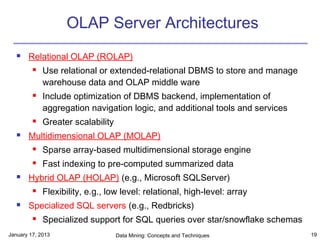
OLAP Server Architectures
      Relational OLAP (ROLAP)
            Use relational or extended-relational DBMS to store and manage
             warehouse data and OLAP middle ware
            Include optimization of DBMS backend, implementation of
             aggregation navigation logic, and additional tools and services
            Greater scalability
      Multidimensional OLAP (MOLAP)
            Sparse array-based multidimensional storage engine
            Fast indexing to pre-computed summarized data
      Hybrid OLAP (HOLAP) (e.g., Microsoft SQLServer)
            Flexibility, e.g., low level: relational, high-level: array
      Specialized SQL servers (e.g., Redbricks)
            Specialized support for SQL queries over star/snowflake schemas
January 17, 2013                   Data Mining: Concepts and Techniques        19
Chapter 3: Data Warehousing and
             OLAP Technology: An Overview

       What is a data warehouse?

       Data warehouse architecture

       From data warehousing to data mining


January 17, 2013      Data Mining: Concepts and Techniques   20
Data Warehouse Usage
      Three kinds of data warehouse applications
            Information processing
               
                   supports querying, basic statistical analysis, and reporting
                   using crosstabs, tables, charts and graphs
            Analytical processing
               
                   multidimensional analysis of data warehouse data
               
                   supports basic OLAP operations, slice-dice, drilling, pivoting
            Data mining
               
                   knowledge discovery from hidden patterns
                  supports associations, constructing analytical models,
                   performing classification and prediction, and presenting the
                   mining results using visualization tools
January 17, 2013                  Data Mining: Concepts and Techniques              21
From On-Line Analytical Processing (OLAP)
      to On Line Analytical Mining (OLAM)
      Why online analytical mining?
        High quality of data in data warehouses

          
            DW contains integrated, consistent, cleaned data
        Available information processing structure surrounding

         data warehouses
           ODBC, OLEDB, Web accessing, service facilities,

            reporting and OLAP tools
        OLAP-based exploratory data analysis

           Mining with drilling, dicing, pivoting, etc.

        On-line selection of data mining functions

          
            Integration and swapping of multiple mining
            functions, algorithms, and tasks
January 17, 2013         Data Mining: Concepts and Techniques     22
An OLAM System Architecture
     Mining query                                               Mining result      Layer4
                                                                                User Interface
                               User GUI API
                                                                                   Layer3
              OLAM                                              OLAP
              Engine                                            Engine          OLAP/OLAM

                                Data Cube API


                                                                                   Layer2
                                  MDDB
                                                                                   MDDB
                                                                Meta
                                                                Data
     Filtering&Integration      Database API                    Filtering
                                                                                   Layer1
                                 Data cleaning     Data
                   Databases                                                       Data
                                Data integration Warehouse                       Repository
January 17, 2013                 Data Mining: Concepts and Techniques                         23
Chapter 3: Data Warehousing and
             OLAP Technology: An Overview

       What is a data warehouse?

       A multi-dimensional data model

       Data warehouse architecture

       Data warehouse implementation

       From data warehousing to data mining

       Summary
January 17, 2013      Data Mining: Concepts and Techniques   24
Summary: Data Warehouse and OLAP Technology

      Why data warehousing?
      Data warehouse architecture
      From OLAP to OLAM (on-line analytical mining)


January 17, 2013           Data Mining: Concepts and Techniques   25
References (I)
      S. Agarwal, R. Agrawal, P. M. Deshpande, A. Gupta, J. F. Naughton, R.
       Ramakrishnan, and S. Sarawagi. On the computation of multidimensional aggregates.
       VLDB’96
      D. Agrawal, A. E. Abbadi, A. Singh, and T. Yurek. Efficient view maintenance in data
       warehouses. SIGMOD’97
      R. Agrawal, A. Gupta, and S. Sarawagi. Modeling multidimensional databases.
       ICDE’97
      S. Chaudhuri and U. Dayal. An overview of data warehousing and OLAP technology.
       ACM SIGMOD Record, 26:65-74, 1997
      E. F. Codd, S. B. Codd, and C. T. Salley. Beyond decision support. Computer World,
       27, July 1993.
      J. Gray, et al. Data cube: A relational aggregation operator generalizing group-by,
       cross-tab and sub-totals. Data Mining and Knowledge Discovery, 1:29-54, 1997.
      A. Gupta and I. S. Mumick. Materialized Views: Techniques, Implementations, and
       Applications. MIT Press, 1999.
      J. Han. Towards on-line analytical mining in large databases. ACM SIGMOD Record,
       27:97-107, 1998.
      V. Harinarayan, A. Rajaraman, and J. D. Ullman. Implementing data cubes efficiently.
January 17, 2013                  Data Mining: Concepts and Techniques                        26
References (II)
     C. Imhoff, N. Galemmo, and J. G. Geiger. Mastering Data Warehouse Design: Relational
      and Dimensional Techniques. John Wiley, 2003
     W. H. Inmon. Building the Data Warehouse. John Wiley, 1996
     R. Kimball and M. Ross. The Data Warehouse Toolkit: The Complete Guide to
      Dimensional Modeling. 2ed. John Wiley, 2002
     P. O'Neil and D. Quass. Improved query performance with variant indexes. SIGMOD'97
     Microsoft. OLEDB for OLAP programmer's reference version 1.0. In
      http://www.microsoft.com/data/oledb/olap, 1998
     A. Shoshani. OLAP and statistical databases: Similarities and differences. PODS’00.
     S. Sarawagi and M. Stonebraker. Efficient organization of large multidimensional arrays.
      ICDE'94
     OLAP council. MDAPI specification version 2.0. In
      http://www.olapcouncil.org/research/apily.htm, 1998
     E. Thomsen. OLAP Solutions: Building Multidimensional Information Systems. John
      Wiley, 1997
     P. Valduriez. Join indices. ACM Trans. Database Systems, 12:218-246, 1987.
     J. Widom. Research problems in data warehousing. CIKM’95.
January 17, 2013                  Data Mining: Concepts and Techniques                           27

Ch03

  • 1.
    Chapter 3: DataWarehousing and OLAP Technology: An Overview  What is a data warehouse?  Data warehouse architecture  From data warehousing to data mining January 17, 2013 Data Mining: Concepts and Techniques 1
  • 2.
    What is DataWarehouse?  Defined in many different ways, but not rigorously.  A decision support database that is maintained separately from the organization’s operational database  Support information processing by providing a solid platform of consolidated, historical data for analysis.  “A data warehouse is a subject-oriented, integrated, time-variant, and nonvolatile collection of data in support of management’s decision-making process.”—W. H. Inmon  Data warehousing:  The process of constructing and using data warehouses January 17, 2013 Data Mining: Concepts and Techniques 2
  • 3.
    Data Warehouse—Subject-Oriented  Organized around major subjects, such as customer, product, sales  Focusing on the modeling and analysis of data for decision makers, not on daily operations or transaction processing  Provide a simple and concise view around particular subject issues by excluding data that are not useful in the decision support process January 17, 2013 Data Mining: Concepts and Techniques 3
  • 4.
    Data Warehouse—Integrated  Constructed by integrating multiple, heterogeneous data sources  relational databases, flat files, on-line transaction records  Data cleaning and data integration techniques are applied.  Ensure consistency in naming conventions, encoding structures, attribute measures, etc. among different data sources  E.g., Hotel price: currency, tax, breakfast covered, etc.  When data is moved to the warehouse, it is converted. January 17, 2013 Data Mining: Concepts and Techniques 4
  • 5.
    Data Warehouse—Time Variant  The time horizon for the data warehouse is significantly longer than that of operational systems  Operational database: current value data  Data warehouse data: provide information from a historical perspective (e.g., past 5-10 years)  Every key structure in the data warehouse  Contains an element of time, explicitly or implicitly  But the key of operational data may or may not contain “time element” January 17, 2013 Data Mining: Concepts and Techniques 5
  • 6.
    Data Warehouse—Nonvolatile  A physically separate store of data transformed from the operational environment  Operational update of data does not occur in the data warehouse environment  Does not require transaction processing, recovery, and concurrency control mechanisms  Requires only two operations in data accessing:  initial loading of data and access of data January 17, 2013 Data Mining: Concepts and Techniques 6
  • 7.
    Data Warehouse vs.Heterogeneous DBMS  Traditional heterogeneous DB integration: A query driven approach  Build wrappers/mediators on top of heterogeneous databases  When a query is posed to a client site, a meta-dictionary is used to translate the query into queries appropriate for individual heterogeneous sites involved, and the results are integrated into a global answer set  Complex information filtering, compete for resources  Data warehouse: update-driven, high performance  Information from heterogeneous sources is integrated in advance and stored in warehouses for direct query and analysis January 17, 2013 Data Mining: Concepts and Techniques 7
  • 8.
    Data Warehouse vs.Operational DBMS  OLTP (on-line transaction processing)  Major task of traditional relational DBMS  Day-to-day operations: purchasing, inventory, banking, manufacturing, payroll, registration, accounting, etc.  OLAP (on-line analytical processing)  Major task of data warehouse system  Data analysis and decision making  Distinct features (OLTP vs. OLAP):  User and system orientation: customer vs. market  Data contents: current, detailed vs. historical, consolidated  Database design: ER + application vs. star + subject  View: current, local vs. evolutionary, integrated  Access patterns: update vs. read-only but complex queries January 17, 2013 Data Mining: Concepts and Techniques 8
  • 9.
    OLTP vs. OLAP OLTP OLAP users clerk, IT professional knowledge worker function day to day operations decision support DB design application-oriented subject-oriented data current, up-to-date historical, detailed, flat relational summarized, multidimensional isolated integrated, consolidated usage repetitive ad-hoc access read/write lots of scans index/hash on prim. key unit of work short, simple transaction complex query # records accessed tens millions #users thousands hundreds DB size 100MB-GB 100GB-TB metric transaction throughput query throughput, response January 17, 2013 Data Mining: Concepts and Techniques 9
  • 10.
    Why Separate DataWarehouse?  High performance for both systems  DBMS— tuned for OLTP: access methods, indexing, concurrency control, recovery  Warehouse—tuned for OLAP: complex OLAP queries, multidimensional view, consolidation  Different functions and different data:  missing data: Decision support requires historical data which operational DBs do not typically maintain  data consolidation: DS requires consolidation (aggregation, summarization) of data from heterogeneous sources  data quality: different sources typically use inconsistent data representations, codes and formats which have to be reconciled  Note: There are more and more systems which perform OLAP analysis directly on relational databases January 17, 2013 Data Mining: Concepts and Techniques 10
  • 11.
    Chapter 3: DataWarehousing and OLAP Technology: An Overview  What is a data warehouse?  Data warehouse architecture  From data warehousing to data mining January 17, 2013 Data Mining: Concepts and Techniques 11
  • 12.
    Design of DataWarehouse: A Business Analysis Framework  Four views regarding the design of a data warehouse  Top-down view  allows selection of the relevant information necessary for the data warehouse  Data source view  exposes the information being captured, stored, and managed by operational systems  Data warehouse view  consists of fact tables and dimension tables  Business query view  sees the perspectives of data in the warehouse from the view of end-user January 17, 2013 Data Mining: Concepts and Techniques 12
  • 13.
    Data Warehouse DesignProcess  Top-down, bottom-up approaches or a combination of both  Top-down: Starts with overall design and planning (mature)  Bottom-up: Starts with experiments and prototypes (rapid)  From software engineering point of view  Waterfall: structured and systematic analysis at each step before proceeding to the next  Spiral: rapid generation of increasingly functional systems, short turn around time, quick turn around  Typical data warehouse design process  Choose a business process to model, e.g., orders, invoices, etc.  Choose the grain (atomic level of data) of the business process  Choose the dimensions that will apply to each fact table record  Choose the measure that will populate each fact table record January 17, 2013 Data Mining: Concepts and Techniques 13
  • 14.
    Data Warehouse: AMulti-Tiered Architecture Monitor & OLAP Server Other Metadata sources Integrator Analysis Operational Extract Query DBs Transform Data Serve Reports Load Refresh Warehouse Data mining Data Marts Data Sources Data Storage OLAP Engine Front-End Tools January 17, 2013 Data Mining: Concepts and Techniques 14
  • 15.
    Three Data WarehouseModels  Enterprise warehouse  collects all of the information about subjects spanning the entire organization  Data Mart  a subset of corporate-wide data that is of value to a specific groups of users. Its scope is confined to specific, selected groups, such as marketing data mart  Independent vs. dependent (directly from warehouse) data mart  Virtual warehouse  A set of views over operational databases  Only some of the possible summary views may be materialized January 17, 2013 Data Mining: Concepts and Techniques 15
  • 16.
    Data Warehouse Development: A Recommended Approach Multi-Tier Data Warehouse Distributed Data Marts Enterprise Data Data Data Mart Mart Warehouse Model refinement Model refinement Define a high-level corporate data model January 17, 2013 Data Mining: Concepts and Techniques 16
  • 17.
    Data Warehouse Back-EndTools and Utilities  Data extraction  get data from multiple, heterogeneous, and external sources  Data cleaning  detect errors in the data and rectify them when possible  Data transformation  convert data from legacy or host format to warehouse format  Load  sort, summarize, consolidate, compute views, check integrity, and build indicies and partitions  Refresh  propagate the updates from the data sources to the warehouse January 17, 2013 Data Mining: Concepts and Techniques 17
  • 18.
    Metadata Repository  Meta data is the data defining warehouse objects. It stores:  Description of the structure of the data warehouse  schema, view, dimensions, hierarchies, derived data defn, data mart locations and contents  Operational meta-data  data lineage (history of migrated data and transformation path), currency of data (active, archived, or purged), monitoring information (warehouse usage statistics, error reports, audit trails)  The algorithms used for summarization  The mapping from operational environment to the data warehouse  Data related to system performance  warehouse schema, view and derived data definitions  Business data  business terms and definitions, ownership of data, charging January 17, 2013 Data Mining: Concepts and Techniques 18
  • 19.
    OLAP Server Architectures  Relational OLAP (ROLAP)  Use relational or extended-relational DBMS to store and manage warehouse data and OLAP middle ware  Include optimization of DBMS backend, implementation of aggregation navigation logic, and additional tools and services  Greater scalability  Multidimensional OLAP (MOLAP)  Sparse array-based multidimensional storage engine  Fast indexing to pre-computed summarized data  Hybrid OLAP (HOLAP) (e.g., Microsoft SQLServer)  Flexibility, e.g., low level: relational, high-level: array  Specialized SQL servers (e.g., Redbricks)  Specialized support for SQL queries over star/snowflake schemas January 17, 2013 Data Mining: Concepts and Techniques 19
  • 20.
    Chapter 3: DataWarehousing and OLAP Technology: An Overview  What is a data warehouse?  Data warehouse architecture  From data warehousing to data mining January 17, 2013 Data Mining: Concepts and Techniques 20
  • 21.
    Data Warehouse Usage  Three kinds of data warehouse applications  Information processing  supports querying, basic statistical analysis, and reporting using crosstabs, tables, charts and graphs  Analytical processing  multidimensional analysis of data warehouse data  supports basic OLAP operations, slice-dice, drilling, pivoting  Data mining  knowledge discovery from hidden patterns  supports associations, constructing analytical models, performing classification and prediction, and presenting the mining results using visualization tools January 17, 2013 Data Mining: Concepts and Techniques 21
  • 22.
    From On-Line AnalyticalProcessing (OLAP) to On Line Analytical Mining (OLAM)  Why online analytical mining?  High quality of data in data warehouses  DW contains integrated, consistent, cleaned data  Available information processing structure surrounding data warehouses  ODBC, OLEDB, Web accessing, service facilities, reporting and OLAP tools  OLAP-based exploratory data analysis  Mining with drilling, dicing, pivoting, etc.  On-line selection of data mining functions  Integration and swapping of multiple mining functions, algorithms, and tasks January 17, 2013 Data Mining: Concepts and Techniques 22
  • 23.
    An OLAM SystemArchitecture Mining query Mining result Layer4 User Interface User GUI API Layer3 OLAM OLAP Engine Engine OLAP/OLAM Data Cube API Layer2 MDDB MDDB Meta Data Filtering&Integration Database API Filtering Layer1 Data cleaning Data Databases Data Data integration Warehouse Repository January 17, 2013 Data Mining: Concepts and Techniques 23
  • 24.
    Chapter 3: DataWarehousing and OLAP Technology: An Overview  What is a data warehouse?  A multi-dimensional data model  Data warehouse architecture  Data warehouse implementation  From data warehousing to data mining  Summary January 17, 2013 Data Mining: Concepts and Techniques 24
  • 25.
    Summary: Data Warehouseand OLAP Technology  Why data warehousing?  Data warehouse architecture  From OLAP to OLAM (on-line analytical mining) January 17, 2013 Data Mining: Concepts and Techniques 25
  • 26.
    References (I)  S. Agarwal, R. Agrawal, P. M. Deshpande, A. Gupta, J. F. Naughton, R. Ramakrishnan, and S. Sarawagi. On the computation of multidimensional aggregates. VLDB’96  D. Agrawal, A. E. Abbadi, A. Singh, and T. Yurek. Efficient view maintenance in data warehouses. SIGMOD’97  R. Agrawal, A. Gupta, and S. Sarawagi. Modeling multidimensional databases. ICDE’97  S. Chaudhuri and U. Dayal. An overview of data warehousing and OLAP technology. ACM SIGMOD Record, 26:65-74, 1997  E. F. Codd, S. B. Codd, and C. T. Salley. Beyond decision support. Computer World, 27, July 1993.  J. Gray, et al. Data cube: A relational aggregation operator generalizing group-by, cross-tab and sub-totals. Data Mining and Knowledge Discovery, 1:29-54, 1997.  A. Gupta and I. S. Mumick. Materialized Views: Techniques, Implementations, and Applications. MIT Press, 1999.  J. Han. Towards on-line analytical mining in large databases. ACM SIGMOD Record, 27:97-107, 1998.  V. Harinarayan, A. Rajaraman, and J. D. Ullman. Implementing data cubes efficiently. January 17, 2013 Data Mining: Concepts and Techniques 26
  • 27.
    References (II)  C. Imhoff, N. Galemmo, and J. G. Geiger. Mastering Data Warehouse Design: Relational and Dimensional Techniques. John Wiley, 2003  W. H. Inmon. Building the Data Warehouse. John Wiley, 1996  R. Kimball and M. Ross. The Data Warehouse Toolkit: The Complete Guide to Dimensional Modeling. 2ed. John Wiley, 2002  P. O'Neil and D. Quass. Improved query performance with variant indexes. SIGMOD'97  Microsoft. OLEDB for OLAP programmer's reference version 1.0. In http://www.microsoft.com/data/oledb/olap, 1998  A. Shoshani. OLAP and statistical databases: Similarities and differences. PODS’00.  S. Sarawagi and M. Stonebraker. Efficient organization of large multidimensional arrays. ICDE'94  OLAP council. MDAPI specification version 2.0. In http://www.olapcouncil.org/research/apily.htm, 1998  E. Thomsen. OLAP Solutions: Building Multidimensional Information Systems. John Wiley, 1997  P. Valduriez. Join indices. ACM Trans. Database Systems, 12:218-246, 1987.  J. Widom. Research problems in data warehousing. CIKM’95. January 17, 2013 Data Mining: Concepts and Techniques 27